Damage, Reincorporated: A Carbon-Based Author Responds

Paul has produced a couple of highly stimulating posts (here and here) reviewing three books concerned with the contemporary interface between war and technology (Manabrata Guha’s Reimagining War in the 21st Century, James Der Derian’s Virtous War and my own The Scientific Way of Warfare) and that involve both pointed comments on the respective texts and some wider considerations of the challenges posed by the study of present transformations in the exercise of collective violence. With so much to reflect upon, a full post is called for in order to respond to the rich lines of thought suggested by Paul and I will attempt to do so here, however incompletely, by taking on specific comments directed at my own work before offering some brief remarks on its relation to the two other books reviewed.

War is War, PERIOD

Paul points to the limitations inherent to the periodisation I propose and I would accept that, for all the caveats and qualifications I have sought to make, the neatness of the technoscientific typology developed inevitably leaves it open to a range of criticisms. It necessarily occludes or minimises the other influences that have impacted military change, it papers over much of the cultural and historical particularities of national military organisations, and it does not really allow for the ebb and flow of different doctrines that cut across different periods. The empirical evidence supporting such a periodisation is likewise obviously selective and, at their weakest, I think the connections I draw between scientific ideas and military practice are more impressionistic than as thoroughly substantiated as I could have wished. Sweeping as it does through four hundred years of history, the work is unabashedly a much more generalising and grand theorising undertaking than the careful and painstakingly detailed studies into the interplay of technoscience and war that have been produced within the field of science and technology studies on topics such as missile guidance or the origins of cybernetics and therefore may well have fallen prey to some of the pitfalls of such a perilous exercise. At the very least though, I would hope the typology is a useful heuristic device for thinking through various tensions inherent to the organisation and application of military force.

In its more forceful defence however, the typology is not intended to imply that in any given period all contemporaneous ideational and social constructs are ruled by the scientific and technological frameworks of the day (something which my use of the term “technoscientific regime” might unfortunately suggest – I remember agonising a long time over the terminology and never settled it to my entire satisfaction). Rather these frameworks act as pregnant sources of meaning among others but with the particularity that they are endowed with the special prestige granted to scientific rationality in modern societies (science in turn being shaped by its wider cultural and institutional settings). In this sense, the notions of metaphor and resonance I employ point to a much more partial and piecemeal role in the shaping of thought than the episteme presented in Foucault’s The Order of Things and in this more limited regard I think the periodisation continues to stand up quite well.
Continue reading

Looking Beyond Spring for the Season: An African Perspective on the World Order after the Arab Revolt

The first of a series of posts by Siba Grovogui, Professor of International Relations and Political Theory at John Hopkins University (followed by a second, third, fourth and fifth installment). He is the author of Sovereigns, Quasi-Sovereigns and Africans: Race and Self-Determination in International Law and of Beyond Eurocentrism and Anarchy: Memories of International Orders and Institutions, as well as a number of articles on race, sovereignty, postcoloniality and human rights and what the history of slavery tells us about the contemporary discourse of international politics. Reposted from The Contemporary Condition. Images by Pablo.


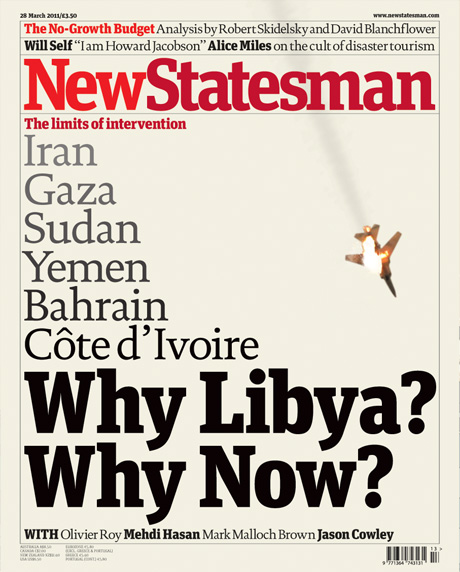
There is much misunderstanding today about the decision of African Union (AU) to not endorse the military intervention in Libya undertaken by France, Great Britain, and the United States in conjunction with a few Arab States. Speculations abound as to whether the uniform decision coming out of Africa indicates that the African Union is out of step with the spirit of freedom sweeping across North Africa and the Arab World; or whether the absence of Africa in the battlefield of Libya merely suggest military ineptitude and political bankruptcy. In fact, it is not accurate that the African Union has been indifferent to the conflict in Libya. The AU opted for mediation and negotiated constitutional compact, with the aim of fostering a different kind of politics. The uniform refusal of the AU to endorse Western intervention has two main explanations. The first is the practice of consensus in decision-making which has long history within Africa. The other is profound unease on the continent about the form and foundation of the intervention itself.

I suggest that there is continent-wide scepticism in Africa about Western leadership in the eras of global governance, the rule of (international) law, the status of international morality, and the future of global democracy. This development is the result of continental experiences with the modes of enactment and execution interventions in Africa. The African position arises therefore from doubt that the coalition of Western powers leading the military effort in Libya today can be trusted to not abuse legitimate anti-Gaddafi sentiments; to not instrumentalize international law and morality; and to not subvert UN procedures and the mechanisms of global governance in order to advance hegemonic agendas and parochial ‘strategic’ interests. In short, underlying the African objection to military intervention is a long-standing tension between international organizations that represent Africa and the self-identified ‘West’ around the representations of the will of the international community, the resulting global democratic deficit in times of intervention, and their effects on international morality, including the principles of humanitarianism.

In relating this conflict, I do not wish to speak for a uniformly-defined ‘Africa’ and/or for all African entities. Continue reading

The Politics of Austerity: Emergency Economics and Debtocracy

austerity |ôˈsteritē| noun – sternness or severity of manner or attitude

It was possible, therefore, to commit a sin without knowing that you committed it, without wanting to commit it, and without being able to avoid it. Sin was not necessarily something that you did: it might be something that happened to you.

– George Orwell, “Such, Such Were the Joys”

Why what have you thought of yourself?

Is it you then that thought yourself less?

Is it you that thought the President greater than you?

Or the rich better off than you? or the educated wiser than you?

 I do not affirm that what you see beyond is futile, I do not advise that you stop,

I do not say leadings you thought great are not great,

But I say that none lead to greater than these lead to.

– Walt Whitman, “A Song for Occupations,” Leaves of Grass

The Politics of Austerity – Part I

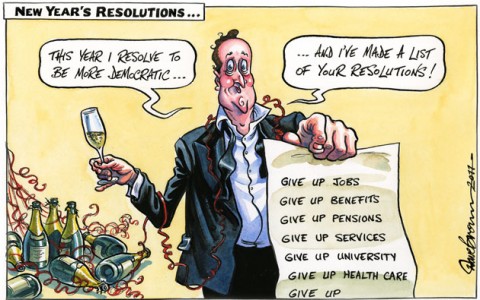
This is the first in a series of posts that look at the political implications of the ongoing global economic crisis. I begin by examining the way that crisis is being used to attack the very idea of democracy through an assertion of the political imperatives of “the market” and the violation, bending and re-writing of the law by capitalist elites. I conclude by laying out how understanding the economic crisis in political terms shapes our ability to respond to it.

In the second post I’ll look at the ethos of austerity, which justifies the pain inflicted on largely innocent people, while suggesting that an affirmative democratic response to the economic crisis must begin with its own ethos, which I suggest should be an ethos of care for the world – which can provide orientation and inspiration for political struggles seeking to address the deeper causes of our current crisis. In the third post, I turn to the structures of the economy and of politics that define the current crisis, looking at the banking crisis, the bailouts, the politics of recovery/austerity and also reflecting of the structural imperatives of capitalism that led us to crisis. This, then, leads to the question of how to respond to the politics of austerity, and of what alternative actions are available to us, which is where the fourth and final post will pick up – with an affirmation of a caring ethos that supports a radically democratic economic vision.

Emergency Economics

In a previous post I briefly highlighted Bonnie Honig’s work, Emergency Politics, to examine the way that the ethical case for austerity is made; most basically, the existence of a supreme emergency, in this case economic, justifies actions that would normally be considered unacceptable. Honig’s work looks at how the appeal to emergency is used to reassert the exceptional political power of the sovereign over and against the law, with a focus on the reassertion of sovereignty witnessed over the past ten years in response to the threat of terrorist attack in the US and Europe.

Rather than accepting the necessarily intractable conflict between the power of the sovereign and the power of the law, Honig attempts to deflate this paradox by turning her attention to the always ongoing contestation that defines democratic politics, a contest over both the content of the law and the institutional embodiment of sovereign power. She suggests, then, that attending to the ambiguities of the “people”, who are both the democratic sovereign and a diffuse multitude, as well as the political element in the law – as new laws come into being through political action – enables us to avoid thinking about emergencies as moments of exception in which the rule of law is lost to the play of political power, while also acknowledging the limits of established law in moments of profound crisis. By undermining the exceptional nature of crises and emergencies Honig alters the challenge we face when circumstances force us to make choices or carry out actions we know are harmful and wrong by asking what we (democratic publics and citizens) can do to survive an emergency with our integrity in tact.

What do we need to do to ensure our continuity as selves and/or our survival as a democracy with integrity? Our survival depends very much on how we handle ourselves in the aftermath of a wrong. We will not recover from some kinds of tragic conflict. But when faced with such situations, we must act and we must inhabit the aftermath of the situation in ways that promote our survival as a democracy.

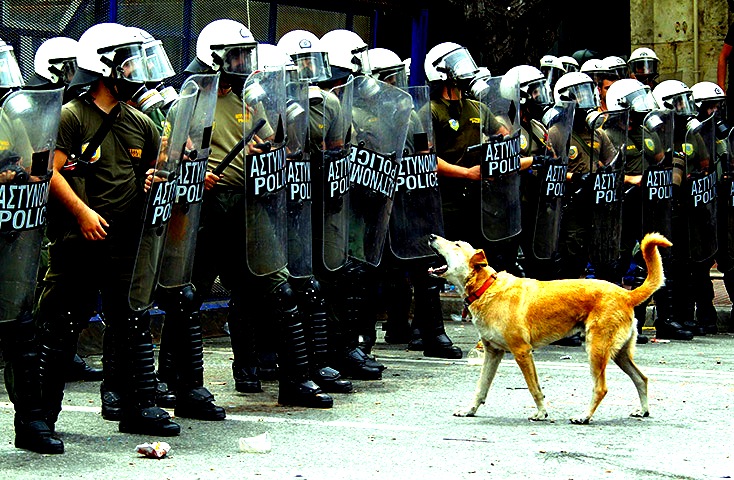
I continue to find this a useful way to understand our current economic crisis. Appeals to austerity depend upon the exceptional state created by crisis in order to justify the pain inflicted upon masses of people and the priority given to private interests (the markets, investors and bankers) over democratic publics. So, as democratically enacted laws must bow before the sovereign power threatened by exceptional attacks, so economic justice and democratic equality must bow before the commands of market forces, of economic inevitability, in this time of crisis.

The economic version of this argument is stronger still. While the space of political contestation that remains open when we accept the framing of emergency politics is limited, it does exist in the clashing of opposing sovereigns. The prospect of a substantive alternative to neoliberal economic ideology is dim, a light flickering weakly on antiquated appeals for a return to Keynesianism or watered down triangulations of the moderate-middle that sell off dreams of a just economy bit by bit – capitalist realism in action.

Honig awakens us to an important aspects of our current crisis: that “the market” is not in fact supremely sovereign, and the move to re-establish and further neoliberal policies and push through austerity measures requires an engagement in democratic politics – albeit one that undermines the notion of the public itself and seeks to use the power of the law to subvert democracy. Recognising the current crisis in these terms not only challenges us to consider how to survive our current troubles without giving up democratic virtues, it also reinvigorates and clarifies the political challenge we face. Emergency economics – with its assertion of debtocracy over democracy – is not an inevitable response to the crisis, it is a political one that we can, and should, fight against.

Continue reading

Damage, Unincorporated*, Part Two: War Studies in the Shadow of the Information Bomb

I’m thinking about something much more important than bombs.
I am thinking about computers.

John von Neumann, 1946 (via The Scientific Way of Warfare)

Modern war has become too complex to be entrusted to the intuition of even our most trusted commander. Only our giant brains can calculate all the possibilities.

John Kemeny, 1961 (ditto)

‘Extreme science’ – the science which runs the incalculable risk of the disappearance of all science. As the tragic phenomenon of a knowledge which has suddenly become cybernetic, this techno-science becomes, then, as mass techno-culture, the agent not, as in the past, of the acceleration of history, but of the dizzying whirl of the acceleration of reality – and that to the detriment of all verisimilitude.

Paul Virilio, The Information Bomb (1998)

Non-Consensual Hallucinations

A recent spate of cyber-attacks, and the civilian-military responses to them, have pushed questions of collective violence, technological complexity and the very relation between war and peace into a more mainstream arena. Alongside diagnoses of the political impact of Web 2.0, the analysis of contemporary technoscience and its militarised uses seems less neophiliac marginalia than urgently-required research program. As previously indicated in Part One of this review, a number of recent works have broached this subject, and in the process have addressed themselves to the very relation between bios and technos, sometimes with the implication that the latter is on the verge of overwhelming the former. Skynet gone live!

Critical engagement with the boundaries and possibilities of Network-Centric Warfare (NCW) thus opens a range of complex problems relating to the co-constitution of war and society, the place of ethics in military analysis (and military practice) and the adequacy of standard categories of social science to world-changing inventions. To expect answers to such broad questions is perhaps to overburden with expectation. Yet it is interesting to find that both Guha and (Antoine) Bousquet, who are most concerned with the radical newness of contemporary war, implicitly operate within a rather traditional understanding of its boundaries. For both, ‘war’ means the restricted arena of battlespace, and in particular that battlespace as viewed by the soldiers and generals of the United States of America.

James Der Derian is intrigued by many of the same questions, but his view is more expansive, and his diagnosis of the connection between NCW and international politics generally more comprehensive. Continue reading

Damage, Unincorporated*, Part One: The Chaoplexity of Collective Violence

The below mirrors closely a review essay I recently completed for the Journal of Intervention and Statebuilding, which should appear at some point in the not-too-distant future. The books under discussion are Reimagining War in the 21st Century: From Clausewitz to Network-Centric Warfare by Manabrata Guha (London and New York: Routledge, 2011); The Scientific Way of Warfare: Order and Chaos on the Battlefields of Modernity by Antoine Bousquet (London: Hurst and Co., 2009); and Virtuous War: Mapping the Military-Industrial-Media-Entertainment Network (2nd Edition) by James Der Derian (London and New York: Routledge, 2009). Part two will follow shortly (lookie here).


I am the last in line that started with who?
With John von Neumann
If it’s the end of time so be it
But hey, it was Truman
Who set me free
I am half man
I’m almost like you
But you’ll be god-damned when I’m through
It’s a new day
So open the bay
And set this free

Black Francis, ‘Half Man’ (2008)

War is different now. On this Manabrata Guha, (our very own) Antoine Bousquet and James Der Derian agree. And their parallel accounts of the impact of technology on war – or more precisely, on the purportedly distinct Western way of war – share some other features. As is to be expected, each engages with traditions of thinking about violence and humanity’s remaking of the natural. Clausewitz looms over all three works, which could be said to share an investment in the tension derived from him between war as a kind of friction and war as a kind of instrument. All three also address a looser set of everyday ideas about (post)modern war, whether in the disconnection of bombers from their targets or the science fiction resonances found in near-instant communication, virtual reality targeting and cyborg warriors.

The question concerning technology – to put it in Martin Heidegger’s formulation, one which concerns all three authors to similar degrees – has gained considerable ground in International Relations and cognate disciplines over the last decades. In large part driven by Der Derian’s early work on post-structuralism and speed, theoretical inquiry into the nature and effects of technological progress has more recently been reinforced by considerable ‘real world’ relevance: in the explosion of social networking and its attendant ‘revolutions’, the increasing deployment of unmanned drones by the US military in Afghanistan and Pakistan and the general discourse of post-Cold War security threats from non-state actors in the form of cyber-attacks, miniaturised weapons systems or black market dirty bombs. As the impact of technology apparently spreads and metastasises, scholarly attention is turning to the sociological and ethical dimensions of digitised networks at war.

So what has the information bomb done to the modalities of collective violence?

Continue reading

Human Rights In Crisis?

UPDATE (8 September 2014): Anthony is now with us permanently, but originally wrote this as a guest post after a stint as a Senior Visiting Fellow at the LSE in 2010, where most of us met him. It was in London that he presented an early version of this argument to the IR theory seminar. A response by our own Joe followed shortly afterwards.


One should not judge a book by its cover, but it is certainly possible to get some sense of the state of a field of study on the basis of the titles of recent books. In the case of the study of human rights, this is quite an interesting exercise: at a time when many claim that human rights proponents have never had it better – the term now has great political respectability and legitimacy; human rights NGOs are thriving; the study of human rights takes place in all the great centres of learning and is taken seriously by previously sceptical disciplines (philosophy, anthropology, international relations). At such a time, one of apparent triumph, there has been a spate of titles which give precisely the opposite impression.

Can human rights survive? What is the future for human rights? Who believes in human rights? Does God believe in human rights? At least two titles claim that human rights are in crisis with one of these playing telos off against demise in questioning the end of human rights. This theme is continued with the important but ironic idea that human rights have been silenced – ironic and paradoxical given their loud presence in all manner of global fora. For many, the success of human rights is a triumph of appearance over substance, and what is often most disturbing to commentators (apart from the obvious hypocrisies of human rights politics) is the absence of a coherent theoretical basis for human rights – a question which in turn can only really be answered by going back to more basic questions regarding the idea of justice.

Continue reading

Riskless in Libya: The Ethical Peril of Zero-Casualty Warfare

…(drum kick)… Yet another new face and mind for The Disorder Of Things. A warm blogospheric welcome to Antoine Bousquet (that’s Dr Bousquet to you), Lecturer in International Politics at Birkbeck. Best known as the author of The Scientific Way Of Warfare: Order and Chaos on the Battlefields of Modernity (due for review here shortly), Antoine has also published on complexity theory and the science/practice of war more generally.


As the military intervention in Libya enters its fourth month of operations, the tensions within the coalition of NATO countries and partners are perceptibly growing with the lack of any tangible progress towards a resolution of the crisis and the recent reporting of civilian casualties. Without prejudging of the final outcome, one cannot help but see in these developments a further echo between the present war – sorry, intervention – and the Kosovo conflict of 1999. Admittedly this time mandated by a UN Security Council resolution, the action in Libya (a.k.a. Operation Unified Protector) is indeed the latest practical exercise of the doctrine of humanitarian intervention, now encapsulated within the wider principle of the responsibility to protect (R2P). Many of the issues and debates raised by that original intervention thus remain as relevant today as they did then.

Although much attention has been focused on the competing claims of universal human rights and inalienable state sovereignty, I want to suggest here that any intervention proposing to act in the name of the former cannot be assessed solely in terms of the inherent merit of such a venture but must just as importantly be examined in view of the means deployed to attain the stated ends. Indeed a marked feature of humanitarian interventions of which Libya is merely the latest instantiation has been the particular form typically taken by military operations, namely that of “riskless” or “zero-casualty” war.

Continue reading

A Kind Of Blank Spot

[M]y wife and I realized you cannot pay attention to everything, so I said to myself “one continent that I am going to leave aside is Africa.” I preferred to concentrate on Europe and China. I did a pretty good deal of work on China because I saw it ripe to become one of the most important parts of the world of which I knew nothing. So, I proceeded to do a lot of work on China in order to know something about it. But Africa is kind of a blank spot for me, apart from casual observation. Even though, I would say that the whole notion of anarchy applies very well to Africa.

In fact, a criticism people used to make to me was that Africa was clearly an anarchic arena, and yet African states did not fight much among themselves. How, then, would a Realist like myself explain that? Well, I did by invoking Turney-High’s book in anthropology, which was published—I believe—in the 1920s. There, he made the very valid point that countries have to obtain a certain level of self-consciousness as being a political entity, and a certain level of competence before they are able to fight one another. Turney-High’s illustration was very clear with his study of the peoples he referred to as the “Californians,” who were such a primitive people that they did not have the ability to form groups or fight as a group. A consciousness and competence at a certain level is needed before a group is able to systematically impose on another group—whether in the form of warfare or in other ways. I think that, for a long time, Africa was in that condition, and that, as it proceeds away from that condition, African countries will be able to fight wars against one another. In a historical sense, though, that is an implication of advancement.

Kenneth N. Waltz, ‘Theory Talks #40: The Physiocrat Of International Politics’, 3 June 2011

We Are The Genuine Hegemonic Masculine!: A Note On Anti-Rape Politics

Friend, former Liberty colleague and Bad Reputation scriber Sarah Jackson drew my attention to a new campaign by End Violence Against Women aimed at men. That was their video. Thus far 188 people (hopefully mainly men) ‘agree’ on Facebook (as the campaign asks them to) that ‘Enough Is Enough’. As Sarah notes, this is the latest in a series of campaigns addressing men directly. They seem a direct response to that most common of feminist points about rape, namely that victims/survivors are not to blame and the focus should not be on them for what they wear, what they drink or how they express themselves but on the men who rape.

Obviously, consciousness-raising for men is necessary in all kinds of ways, and will be for at least as long as supposedly intelligent discussions continue to be dominated by pernicious cop-outs and questionable analysis. Any funding and attention to rape prevention is to be encouraged and supported. Let’s take that as read. But these campaigns are intended to be tools for advancing rape awareness and anti-rape politics, which makes it worth asking what kinds of awareness and politics they promote. How is it that they seek to recast ideas of appropriate manliness?

Continue reading

Race, Gender and Nation in ‘Game Of Thrones’ (2011)

Mostly garlanded by images poached from Winter Is Coming, Bitches. Also, *spoiler alert*. And now subject to discussion in a critical post by Charli Carpenter over at Duck Of Minerva.


At first sight, Game Of Thrones offers something rather different to the standard fantasy fare. Where Lord Of The Rings and its ilk deal in arch dialogue and grand quests, it provides a more gritty and twisted landscape, peopled with dwarves, bastards, spoilt brats, noblewomen who still breast-feed their near-pubescent sons, eunuchs, exiled criminals and incestuous twins. In one conversation, Baelish and Varys even discuss a Lord who enjoys sex with beautiful cadavers (fresh ones only). A fantasy not only of palaces and mystical objects, but also of the gutter.

There is a near-scandalous thrill to this aesthetic realism, especially when measured alongside the allegoral formality of The Chronicles Of Narnia or the cinematic marathons derived from Tolkien’s high Toryism. Where those source materials and corporate cinema required that sexuality be wrapped in chaste folds and circumvented as the higher union of pure love, Game Of Thrones can indulge lust, rutting and the explicit mention of rape. There’s even talk of homosexuality (although not for any of the linchpin characters with whom we are expected to identify). Bared breasts are the order of the day. Childhood tales filtered by HBO.

But this apparent radicality doesn’t go very deep, and in significant ways covers for a narrative saturated with race-thought and misogyny. Continue reading