Looking Beyond Spring for the Season: Echoes of Time Before Tahrir Square

This is the fifth and last part in a series of posts from Siba Grovogui, Professor of International Relations and Political Theory at John Hopkins University. The first part is here; the second here; the third here; the fourth here. The series considers the character and dimensions of the tension between the African Union and ‘the West’ over interventions in Africa. As before, responsibility for visuals adheres solely to Pablo K.
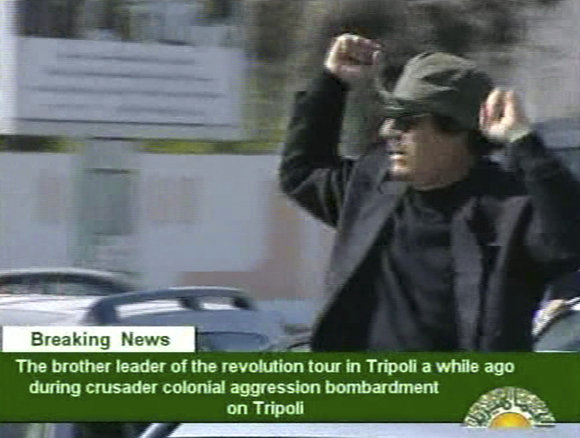

It would be disingenuous to relate events in North Africa and the Middle East (or MENA) today without reference to the media. Here too, there are many possible angles to examine. I will focus on the institutional support that the media provide in shaping consensus in support of foreign policy. In this regard, so-called mainstream Western media and networks (BBC, CNN, Fox, RFI and the like) have played a significant role in generating domestic support for the Libyan campaign. The media find themselves in the contradictory positions of both providing sustenance to foreign policy rationales and reporting on government actions. In this role the media either wittingly or unwittingly assumed the position of justifying contradictory Western foreign policy aims while trying to satisfy the needs of their audiences (especially domestic constituencies and home governments) for information from the front. Consistently, the media often generate sympathy for foreign actors or entities that either support Western interests or have affinities for Western values.

This role is not without a cost, especially when foreign policy actions, including wars, fail to attain their objectives. When the outcome of foreign policy proves disastrous, Western media also have an inexhaustible capacity to either ignore their prior support for the underlying causes or to reposition themselves as mere commentators on events over which they had no control or could not prevent. Increasingly, these tendencies have spread around the world as evidenced in the techniques and styles that have propelled the Qatari-based Al Jazeera into prominence as key contender in the emergent game of production, circulation, and consumption of foreign policy-concordant images for their affective and ideological effects.

So it is not surprising that the backdrop and background scenarios for most reporting on the 2011 revolts in MENA are dimensions of Orientalism, of which they are many. But the most constant is one of autocratic ‘barbarism’. In this regard, the discourses and media techniques for creating and supporting sympathetic figures are just as constant (or invariable) as Western states rationales for intervention. The media-hyped stories of Oriental despotism that preceded Operation Desert Storm, when the US expelled Iraq from Kuwait, have provided the template. During that event, for instance, media feted their viewers with stories of invading Iraqi hordes storming through hospital only to disconnect incubators and let helpless infants die a slow death. These and many stories of heroic bids by US soldiers to prevent such barbarism were later discredited but not the other horrific stories which convinced US citizens of the need to wage war on Saddam Hussein’s occupying army. In the Libyan case today, one of the earlier images of the aura of impunity created by Gaddafi was that of a Libyan female lawyer who was allegedly raped by Gaddafi’s forces. There was also a reported event of military takeover of a hospital.

Continue reading

A Slow Motion Moral Collapse, or, the Principle of Magic?

Belief in magic did not cease when the coarser forms of superstitious practice ceased. The principle of magic is found whenever it is hoped to get results without intelligent control of means; and also when it is supposed that means can exist and yet remain inert and inoperative. In morals and politics such expectation still prevail, and in so far the most important phases of human action are still affected by magic. We think that by feeling strongly enough about something, by wishing hard enough, we can get a desirable result, such as virtuous execution of a good resolve, or peace among nations, or good will in industry. We slur over the necessity of the cooperative action of objective conditions, and the fact that this cooperation is assured only by persistent and close study. Or, on the other hand, we fancy we can get these results by external machinery, by tools or potential means, without a corresponding functioning of human desires and capacities. Often times these two false and contradictory beliefs are combined in the same person. The man who feels that his virtues are his own personal accomplishment is likely to be also the one who thinks that by passing laws he can throw the fear of God into others and make them virtuous by edict and prohibition.

-John Dewey, Human Nature and Conduct

Primitive Accumulation; Or, A Virtual Read-In on the London Riots

The blogosphere has a million corners, countless nooks and several large echo-chambers, complete with their own centres of self-congratulatory gravity. All have been aflame over the last week, saturating events, riots and insurgencies with the weight of historical expectation, the political memory of past iteration and the awesome condescension of easy interpretation. Gaps persist: gender and the dynamics of formally opposed masculinities have escaped all but the most cursory attention. It is one paradox of all this profuse commentary that decrying the statements and manifestos of others is the most satisfying and patronising manifesto of all. At its worst, it engages in the fullest of narcissisms (let’s make this about us and the quality of our analysis) whilst proudly displaying its contempt for thought (now is not the time for theory!). And of course, the problems and challenges are real. Much more real than we can face, too real for the sordid postures of moralising (I denounce Satan and all his works!) and liable to stay as real once we paper over them and return to our default settings.

Oh, and I find myself in unsurprising agreement with Joe and Meera (although I think Ken Livingstone’s attempts to make the link to cuts and social marginalisation is more ham-fisted than shameful). Which is all by way of introduction. There are reams to be written on the way the punditocracy and assorted commentariat are deploying (and misapplying) categories of cause, the unstable and multiple uses made of ‘politics’, the questions of historical precedent and historical return, and on and on. Exhaustion at the war of position prevents any such post. Instead, a mix-tape of diagnosis and critique, with both the smooth joins and the subtle dissonances that implies. More useful than a 1,000 faux-fresh words.

—————–

These looters are doing what they’re supposed to; grabbing the goods they see in the shops and can’t buy in a recession. They loot the bling – the sports shoes, gold watches, mobile phones and plasma TVs; and you can recognize the very poor when you see a woman looting potatoes from a corner shop. These acquisitive looters are certainly copying the gold standard of a social contract eroded by and evaporating with the money. These are riots in the cause of consumer goods. Burning and robbing other people’s things is one thing, but soon enough, and with no social cause or justice worth the name, people too become indistinguishable from things: witness the widely-circulated photo of the woman leaping for her life from a burning building; such potential deaths still threaten to bring the house down on top of us. This whole distressing episode began with the police shooting dead a black man in north London they said was a gunman; no evidence he fired a shot, we’re told, but the man was already indistinguishable from his gun.

Gabriel Gbadamosi, ‘The Blazing Light In August’

Continue reading

Looking Beyond Spring for the Season: Democratic and Non-Democratic Cultures

This is the fourth part in a series of five posts from Siba Grovogui, Professor of International Relations and Political Theory at John Hopkins University. The first part is here; the second here; the third here. The series considers the character and dimensions of the tension between the African Union and ‘the West’ over interventions in Africa. As before, responsibility for visuals adheres solely to Pablo K.


It is not accurate to say that the African Union has been indifferent to the conflict in Libya. If there has been silence in Africa, it has to do with the extent to which the ‘maverick’ Colonel (Gaddafi) has angered some of his peers over the years by interfering in the affairs of such states as Nigeria, Liberia, Burkina Faso, Sierra Leone and others, with disastrous effects. Even when, as in Sudan and Uganda, officeholders have welcomed his entreaties, large segments of the populations have not appreciated them. Yet, regardless of their personal views of Gaddafi and their political differences with him, African elites and populations have yearned for a more positive, conciliatory, and participatory solution to outright regime change or the removal of Gaddafi preferred by the West. This variance, I surmise, comes from a positive understanding of postcoloniality that include forgiveness, solidarity, and democracy and justice, as exhibited in post-apartheid South Africa and post-conflict Liberia, Angola, Mozambique, and the like.

In opting for negotiated mediation and a new constitutional compact, therefore, the African Union (or AU) aimed to foster a different kind of politics in Libya – admittedly one that has escaped many of the states endorsing that position. As articulated by Jean Ping, the Secretary General of the AU, the Libyan crisis offered an opportunity “to enhance a self-nourishing relationship between authority, accountability and responsibility” in order to “reconstitute African politics from being a zero sum to a positive sum game” toward one “characterized by reciprocal behavior and legitimate relations between the governors and the governed.” Mr. Ping added two other dimensions to his vision. The first is an acknowledgement that events in Libya point to the fact that all Africans “yearn for liberty and equality’ and this yearning is “something more consequential than big and strong men.” The second is that Africa’s destiny should be shaped by Africans themselves based on an actualized “sense of common identity based, not on the narrow lenses of state, race or religion, but constructed on Africa’s belief in democracy, good governance and unity as the most viable option to mediate, reconcile and accommodate our individual and collective interests.”

Coming from a politician, these words may read like slogans. But the uniform refusal of the AU to endorse Western intervention tells another story. Continue reading

Looking Beyond Spring for the Season: The West, The African Union, and International Community

This is the third part in a series of five posts from Siba Grovogui, Professor of International Relations and Political Theory at John Hopkins University. The first part is here; the second here. The series considers the character and dimensions of the tension between the African Union and ‘the West’ over interventions in Africa. As before, responsibility for visuals adheres solely to Pablo K.


The oblivion of commentators to these possible African objections has been less than helpful to understanding the actualized Western intervention itself; emergent African ideas on democracy and security; and the actual place of international morality in international affairs. Underlying the African apprehension to military intervention is a long-standing tension between international organizations that represent Africa, on one hand, and self-identified representatives of the West, on the other, over the meaning of international community as well as the source, nature, and proper means of implementation of the collective will. The dispute over the meaning of international community and the collective will has been particularly salient in Africa because, as a political space, Africa has been more subject to military interventions than any other geopolitical space in the modern era. These interventions have reflected contemporaneous relations of power, permissible morality, and objects of desire: from proselytism to fortune-seeking, trade, extraction of raw material, and the strategic pursuit of hegemony. Indeed, it is hard to remember a time since the onset of the slave trade when there was no open conflict between the majority of its states and the West over some dimensions of global governance that implicated the notion of the commons or international community.

The postcolonial era has not brought about any change to this situation. Since the end of World War II and the institution of the United Nations system, the plurality of African political entities have confronted self-appointed representatives of the West over the ethos of UN procedures (involving transparency and open access to the channels of decision-making) and the mechanisms of dispute mediation (including the determination of the principles and applicability of humanitarian interventions in a number of cases). One need only recall the political, legal, and military confrontations between African states and former Western colonial powers over Apartheid South Africa’s mandate over South West (which involved the legality and morality of colonial trusteeship); the French war on Algeria (which involved the legality and legitimacy of settler colonialism); the wars of decolonization in the former Portuguese colonies of Angola, Guinea Bissau, and Mozambique (which involved the principles of majority rule through open elections which communists might win); the unilateral declaration of independence by the white minority in Southern Rhodesia (which involved the principle of white-minority rule in postcolonial Africa); and the legality and morality of apartheid (which involved the principle of self-determination and majority rule). The underlying antagonisms contaminated deliberations throughout the UN system (particularly General Assembly proceedings) and involved all major issues from the Palestine Question to the Law of the Sea to other matters of trade and intellectual property. They reached a climax at the time of exit of the US and Great Britain from UNESCO, which was then directed by Ahmadou Mathar Mbow, a Senegalese diplomat and statesman.

These and other contests have shared a few singular features. One is a Western insistence on representing the essential core and therefore will of something called international community. In any case, the label of international community has often been reserved for Western entities in relations to others, who remain the object of intervention on behalf of the international community. This is to say that the term ‘international community’ has had political functionality in relations of power and domination in which Europe (and later The West) subordinated ‘Africa’. The relevant tradition can be traced back to the opening moments of the modern era, particularly during the ascension of The West to global hegemony. While it has undergone changes over time, the embedded imaginary of international community and its will have been built around artificially fixed identities and politically potent interests. Accordingly, the identity of the West, and therefore the international community, flows from a theology of predestination, formally enunciated as the Monroe doctrine in the US or the Mission Civilizatrice in France.

Continue reading

Reading violence: what’s political about the London riots(?)

To reiterate somewhat, there is a politics to these riots. Panicking, political leaders and many others, have queued up to deny this, labelling it “pure violence,” “criminality, pure and simple“, or “mindless violence“. Over and over again, the distance between the rioters and the ‘community’ or ‘Londoners’ has been set up and reinforced. This is not without some public backing. After all, many Londoners are, rightly, angry, frightened, upset, frustrated, shocked and saddened by the sight of homes and businesses not just smashed but burning voraciously into the night whilst looters showed off their new gear. We were a world away, it seemed, from the specific, dignified, coherent demands for justice being made by Mark Duggan’s family and their supporters. Many asked themselves: what do they want? The answer seemed to be: trainers. What could be political about stealing from Foot Locker?

First things first. This post is not about constructing a narrative of social apologia via moral determinism – i.e. the idea that people couldn’t help themselves, or were bound to do it by their economic status etc. Between this and the ‘mindless violence’ line of argument, there are plenty of fools (sadly many, powerful, wealthy, and in charge of your country) trading in pretty stupid accounts of human behaviour and social causation. Continue reading

Looking Beyond Spring for the Season: Common and Uncommon Grounds

This is the second part in a series of five posts from Siba Grovogui, Professor of International Relations and Political Theory at John Hopkins University. The first part is here. The series will consider the character and dimensions of the tension between the African Union and ‘the West’ over interventions in Africa. Responsibility for visuals adheres solely to Pablo K.


As I indicated in my last post, the decision by the African Union (or AU) to not endorse the current military campaign in Libya has been mistaken by many observers and commentators alternatively as a sign of African leaders’ antipathy to political freedom and civil liberties; a reflexive hostility to former colonial powers, particularly France and Great Britain; a suspicion of the motives of the United States; and more. The related speculations have led to the equally mistaken conclusion that the African Union is out of step with the spirit of freedom sweeping across the Middle East and North Africa (or MENA). The absurdity of the claim is that the only entity that imposed any outline of solution agreeable to Gaddafi has been the African Union and this is that Gaddafi himself would not be part of any future leadership of the country. But the AU has insisted on an inclusive negotiated settlement. The purpose of this series of essays is not therefore to examine the meaning and implications of the absence of ‘Africa’ on the battlefield of Libya, but to point to the larger geopolitical implications of the intervention for international order, global democratic governance, and the promotion of democratic ideals and political pluralism in the region undergoing revolution and beyond.

To begin, it is not just ‘Africa’, ‘African indecision’, and ‘African non-Normativity’ that are at stake in the characterization of African actions or inactions. Much of what is construed as ‘lack’ or ‘absence’ in Africa is also intended to give sustenance to the idea of the indispensability of the West – composed on this occasion by France, Great Britain, the United States, and tangentially Canada – to the realization of the central ends of the MENA Spring. The myth of the centrality of the West to the imaginary of freedom everywhere is inscribed in the name given to the events under description. In the US at least, the Arab Spring evokes many other ‘Springs’ all located in the West (including the 1968 Prague Spring or the 1989 collapse of the Soviet Union and its satellite states). Likewise, ‘Jasmine’, the emblem of the Tunisian revolt has been advanced as evocative of the Ukrainian ‘Orange’ and other colour-coded European events. These allusions have justifications but they are seldom evoked comparatively to elucidate the originality and specificity of the MENA revolutions. In this latter regard, even the suggestion of an Arab Spring assumes that the majorities in the countries involved are Arab. This is not always the case in North Africa but Orientalism obliges!

The fact is that the ongoing revolutions in MENA are at once specific and universal in their own ways. Continue reading

Racist Lies, Oslo Edition: Jihadists, Lone-Wolves, and the Far-Right

Last week (Friday 22 July), a man brought a brutal plan to its grim conclusion in Oslo and Utoeya. After years of festering in resentment and roiling with anger, he worked up the conviction to act on his beliefs. He methodically worked out how to make and plant a home-made bomb. He coldly calculated an ambush of young women and men participating in a political summer camp.

He detonated his car bomb and killed 8 people, as well as damaging the prime minister’s office and several buildings in the area. While the city reacted to the terrifying scene, this man calmly made his way to a summer camp on the island of Utoeya dressed as a policeman, armed with an automatic rifle and enough ammunition to carry out an hour-long attack on the residents of the camp. He killed 68 people before surrendering.

Lie No. 1:

As shocking as the attack in Oslo was, it was apparently less shocking than the identity of this angry and violent man. Right-wing media outlets predictably lead with the unconfirmed story that the attack was carried out by Jihadists. But even mainstream commentators and more responsible media outlets ran with the Islamic terror story without evidence and have pushed the angle even after it was revealed that the perpetrator was a white, Christian, “nationalist” from Norway.

Why did the press so quickly and thoroughly misrepresent the story? We can talk about a knee-jerk response or blame faulty reporting, but there’s a simpler and more troubling dynamic at work here. That answer is that “we” expect angry and violent men committing these type of attacks to be Muslim, non-white, non-European.

Even as the true perpetrator of last Friday’s attacks was found and his own racist views made public, the media and the public struggled to accept and understand Anders Breivik because of their own entrenched racism. The hands that commit such violence are supposed to be brown hands, hands that pray to a false and violent God, hands raised in angry protests in far away countries, hands reaching out to choke white victims. Our image of violence reveals the violence of our images.

The blithe accusation of Muslim extremists and the immediate belief that the attacks in Oslo must have been perpetrated by Al-Qaeda, or some other shadowy network, reveal how deeply racist narratives are embedded in “our” understanding of the world.

Continue reading

Pragmatist Notes, part III

In spite of the fact that diversity of political forms rather than uniformity is the rule, belief in the state as an archetypal entity persists in political philosophy and science. Much dialectical ingenuity has been expended in construction of an essence or intrinsic nature in virtue of which any particular association is entitled to have applied to it the concept of statehood. Equal ingenuity has been expended in explaining away all divergences from this morphological type, and (the favored device) in ranking states in a hierarchical order of value as they approach the defining essence. The idea that there is a model pattern which makes a state a good or true state has affected practice as well as theory. It, more than anything else, is responsible for the effort to form constitutions offhand and impose them ready-made on peoples. Unfortunately, when the falsity of this view was perceived, it was replaced by the idea that states “grow” or develop instead of being made. This “growth” did not mean simply that states alter. Growth signified an evolution through regular stages to a predetermined end because of some intrinsic nisus or principle. This theory discouraged recourse to the only method by which alterations of political forms might be directed: namely, the use of intelligence to judge consequences. Equally with the theory which it displaces, it presumed the existence of a single standard form which defines the state as the essential and true article. After a false analogy with physical science, it was asserted that only the assumption of such a uniformity of process renders a “scientific” treatment of society possible. Incidentally, the theory flattered the conceit of those nations which, being politically “advanced,” assumed that they were so near the apex of evolution as to wear the crown of statehood.

– John Dewey, The Public and Its Problems (1927)

Reality Mining for Population-Centric Computational Counterinsurgency; Or, Feedback Loops Meet Hermeneutic Circles

Drizzled between the gun battles were occasional accounts of villages stabilized and town elders met. But, written as random notes, the accounts were hard to insert into a database. There was nothing consistent, nothing you could plot as a trend over time.

‘These were intelligence reports, not measurable data,’ the source says. ‘The population-centric information wasn’t to be found there.’

So the team widened their search, without much luck. The most reliable data they could find was weekly fruit prices from Jalalabad, a city in northeastern Afghanistan. At least those could be measured over time.

“One assumed there was some secret mound of data to be exploited. But it’s just not true,” the source adds.

Noah Shachtman, ‘Inside Darpa’s Secret Afghan Spy Machine’

Albright has noted that Iran has material to build only 12,000-15,000 centrifuges, and if 1,000 to 2,000 were destroyed, this would hasten the demise of its stockpile. But his and other organizations have also noted that after the centrifuges were replaced, Iran stepped up its enrichment program and its overall production of uranium had actually increased in 2010, despite any effects Stuxnet may have had.

Stuxnet required an enormous amount of resources to produce, but its cost-benefit ratio is still in question. While it may have helped set Iran’s program back to a degree, it also altered the landscape of cyberattacks…In the end, Stuxnet’s creators invested years and perhaps hundreds of thousands of dollars in an attack that was derailed by a single rebooting PC, a trio of naive researchers who knew nothing about centrifuges, and a brash-talking German who didn’t even have an internet connection at home.

Kim Zetter, ‘How Digital Detectives Deciphered Stuxnet, the Most Menacing Malware in History’

These domestic images must be more than simply one more form of distancing, one more way to remove oneself from the grisly reality behind the words; ordinary abstraction is adequate to that task. Something else, something very peculiar, is going on here. Calling the pattern in which bombs fall a ‘footprint’ almost seems a wilful distorting process, a playful, perverse refusal of accountability – because to be accountable is to be unable to do this work.

These words also serve to domesticate, to tame the wild and uncontrollable forces…The metaphors minimize; they are a way to make phenomena that are beyond what the mind can encompass smaller and safer, and thus they are a way of gaining mastery over the unmasterable. The fire-breathing dragon under the bed, the one who threatens to incinerate your family, your town, your planet, becomes a bet you can pat.

Carol Cohn, ‘Sex and Death in the Rational World of Defense Intellectuals’ (1987)

The ways of thinking embodied in institutions govern the way the members of the societies studied by the social scientist behave. The idea of war, for instance, was not simply invented by people who wanted to explain what happens when societies come into armed conflict. It is an idea that provides the criteria of what is appropriate in the behaviour of members of the conflicting societies. Because my country is at war there are certain things which I must do and certain things which I must not do. My behaviour is governed, one could say, by my concept of myself as a member of a belligerent country. The concept of war belongs essentially to my behaviour. But the concept of gravity does not belong essentially to the behaviour of a falling apple in the same way: it belongs rather to the physicist’s explanation of the apple’s behaviour. To recognise this has nothing to do with a belief in ghosts behind the phenomena.

Peter Winch, The Idea Of A Social Science And Its Relation to Philosophy (1958)