The EU Referendum: The EU Mirage

This is the first post in a Disorder forum on the EU referendum. Click here for the forum introduction with the links to the other posts.

Chris BickertonOur first guest author is Christopher J. Bickerton. Chris is University Lecturer in politics at POLIS and an Official Fellow at Queens’ College, Cambridge. He has taught at Oxford, the University of Amsterdam and Sciences Po in Paris. He is author of European Union Foreign Policy: From Effectiveness to Functionality (Palgrave Macmillan, 2011), European Integration: From Nation-States to Member States (Oxford University Press, 2012) and, most recently, The European Union: A Citizen’s Guide (Penguin, 2016). Chris is a regular contributor to Le Monde Diplomatique and The Wall Street Journal, and has written for the Financial Times, New York Times and Foreign Affairs.


 When I am asked to describe the EU, I often say that it is a bit like a mirage. We all know how a mirage works. From far away, the image is clear and strong. As you get closer, it starts to wobble and shimmer until eventually, it disappears.

The EU is like that. Seen from national capitals, from London, Paris, Berlin, Rome, Bratislava or Madrid, it looks clear and distinct. It has its own institutions, its own buildings, even its own legal order. It can punish national governments for over-spending and close national banks. But as you get closer to Brussels, this image begins to wobble. Finally, when you are really up close, it disappears altogether.

What is left are our own national leaders – Merkel, Hollande, Renzi, Cameron – taking decisions between themselves in meetings closed to the general public. We also find our own civil servants and fonctionnaires filling the Thalys trains, the TGVs and the Eurostar, travelling from their own capitals to Brussels to take part in working group meetings that craft and shape EU legislation. Some power is delegated to EU institutions but it is closely policed by member states.

Traditional EU institutions, like the European Commission, have lost much of their power in recent decades, with a leading role played by the European Council which is made up of heads of state and government. Even an institution like the European Central Bank, with its shiny new headquarters in Frankfurt, is far weaker than many think. Its new powers were foisted onto it by national governments keen to distance themselves from the responsibility of solving the Eurozone’s economic and financial crisis.

Looking at the EU as a whole, we cannot say that it stands above its member states, dominating them and issuing orders that national governments must comply with. In fact, the EU is these member states. But why doesn’t it look that way? Continue reading

The EU Referendum: A Disorders Forum

In exactly one month, Britain will hold a referendum on its membership of the European Union, its first since 1975. So far, the debate on ‘Brexit’ has been risible, reflecting both the narrowness and myopia of contemporary politics, and the fact that the debate is being ‘led’ on both sides by conservatives lacking any positive vision of the future. Project Fear reigns supreme. Will your shopping be £4.32 more expensive or £3.16 cheaper if we leave? Will leaving the EU make it more or less likely that your granny will be killed by a criminal immigrant? Will leaving the EU send Britain’s ‘booming’ (!) economy into recession, or plunge Europe back into war and chaos?

This is particularly lamentable because the referendum is the most significant political decision that most British citizens will face in their lifetimes. Given the EU’s enormous influence, the referendum’s consequences will vastly outweigh that of any recent general election.

david-sapsted-10-d3-2015-7729-business-urged-to-get-involved-in-eu-debate-to-prevent-brexit_6043_t12

 This Disorder of Things forum tries to raise the tone, offering a detailed discussion of the pros and cons of Brexit and ‘Bremain’. Importantly, on the ‘Brexit’ side, you will not find the usual patriotic bluster of spitfire nationalism, but rather a progressive case for leaving the EU. Indeed, all of our contributors engage with the truly significant political principles at stake: democracy, sovereignty, accountability, peace, security, and freedom.

Our posts will be published daily over the coming week. Links will be added when the posts go live.

Chris Bickerton kicks off the forum by arguing that today’s EU is not a powerful, supranational body but a network of states that have been transformed from ‘nation states’, deriving their authority domestically, into ‘member states’, deriving their authority from transnational, inter-elite relationships. He argues for Brexit to intensify Britain’s ‘crisis of authority’, forcing a change of political direction.

Building on Chris’s work, my own two cents follow. I suggest analysing the EU through the lens of the politics of scale and state transformation. The EU, I suggest, emerged through the rescaling of governance to inter-elite networks insulated – by design – from popular control. Restoring that control has to involve leaving the EU and revitalising national democracy in an internationalist direction.

Next, Toni Haastrup tackles the Brexiteers from a postcolonial perspective. Taking aim at the spitfire nationalism of the Brexit campaign, she argues their suggestion that UK power and influence would be revivsed by Brexit is based on wilful ignorance and delusions of imperial grandeur.

Next, Ana Juncos and Gilberto Algar-Faria argue that the UK’s security interests are best served by staying inside the EU. Brexit would only weaken the EU’s capacity to deal with the very problems that Britain is trying to escape, like irregular migration and the instability created by the Eurozone crisis.

This view is disputed by Philip Cunliffe. He offers a trenchant critique of the claim that the EU has created peace in Europe and weakening the EU will revive conflict. Nationalism and war have been elite-manufactured problems, he maintains, not the result of popular will. ‘Vote remain or return to war’ is simply blackmail from an elite that, even today, just loves warmongering.

Finally, Catherine Goetze responds to the pro-Brexit posts by warning of the dangers of restoring national democracy through a campaign led by right-wing forces. Drawing on historical parallels, she warns that Brexit might strengthen nationalism across Europe, with very negative consequences.

The Dissonance of Things #6: Logistics – Violence, Empire and Resistance

EXODUS-IV-Hong-Kong-China-2010
Source: Marcus Lyon

This May, The Dissonance of Things switches out British accents for those of the vaguely North American variety, as I serve as host for our sixth podcast on the topic of logistics and its role in the making of military, capitalist, and imperial relations. I’m joined by our very own Laleh Khalili of the School of Oriental and African Studies, and the wonderful Deborah Cowen of the University of Toronto. Together, we take a look at the increasing ubiquity and prominence of logistics as a mode for organizing social and spatial life. We discuss how this seemingly banal concern with the movement of goods is actually foundational to contemporary global capitalism and imperialism, reshaping patterns of inequality, undermining labor power, and transforming strategies of governance. We also ask: what might a counter-logistical project look like? What role does logistics play in anti-colonial and anti-capitalist struggles across the globe?

Listen via iTunes or through the Soundcloud player below.

As always, listen, enjoy, argue, share, and leave us your thoughts below the line. You can also follow our past and future casts on soundcloud.


Further reading:
– Deborah Cowen’s The Deadly Life of Logistics
– Laleh’s blog on maritime logistics, The Gamming

Canada and the Anglo World—the Brexit Edition

Mother, stepmother, perfidious Albion—whatever metaphor one prefers to employ, Britain has always been important to Canada. But what is Canada to Britain? It depends on whom you ask.

This post originally appeared on Open Canada.

Continue reading

Bernie Sanders For Commander-In-Chief

Jesse headshotA timely guest post from Jesse Crane-Seeber. Jesse  grew up in the woods of Ithaca, New York where he graduated from a democratically run public alternative high school. After a BA in “Resisting Hegemony” (a major of his own design) at Ithaca College, he earned a Ph.D. in International Relations at American University.  His dissertation ‘Making War’ analyzed the occupation of Iraq in terms of how U.S. soldiers’  negotiated and made sense of their surroundings, their missions, and the people they tried to help and/or harm. His research involved participant observation, living with military families, analyzing official documents, and sifting through hundreds of hours of soldier-uploaded video content. He teaches at North Carolina State University, and is currently finishing Fifty Shades of Militarism, a study of the fetishization of all things military in the contemporary United States. The views in the post are those of Jesse Crane-Seeber as a private citizen and do not reflect those of North Carolina State University. Obviously.


“coming of age during the plague
of reagan and bush
watching capitalism gun down democracy
it had this funny effect on me
i guess”

– Ani DiFranco, Your Next Bold Move

In recent months, the United States has seen a substantial rebellion against Hillary Clinton’s status as heir-apparent of the Democratic Party. Combined with the contemporary Republican Party’s confusion about whether to embrace regime change, free-trade, or multilateral institutions (even those like NATO that secure US hegemony in the world), the current election cycle offers US voters an unusual set of choices that may not be fully appreciated by those caught in the horse race and name calling of an expensive election.

It is normal to be cynical about what any individual nation can do, never mind a particular leader. Technological change, ecological collapse, international regime complexes, not to mention economic activity, all help explain the limits of what any nation can do. But the President of the United States is not a generic national leader. As the chief architect of the post-World War II political and economic order, the US retains outsized influence, even as we reach peer-peer levels of economic output with the EU and China.

While Secretary Clinton and Senator Sanders voted alike 93% of the time they were both in the Senate, the contrast in how they might impact global politics is much, much larger. One oft-repeated critique of Sanders has been his lack of foreign policy experience, knowledge, or, well, policy. As Ignatius put it, “Foreign policy is the hole in Sanders’s political doughnut.” Several enterprising writers reached out to foreign policy and IR scholars sympathetic to Sanders’ campaign for comment, while a few political scientists have directly addressed the nature of a future Sanders Administration’s foreign policy.

As a critic of the Washington/New York policy expert class and the ways that US Political Science reproduces and authorizes it, what I find troubling is not what ‘experts’ have been saying, but what they haven’t. With the exception of Charli Carpenter’s embrace of Sanders’ willingness to acknowledge what he doesn’t know about foreign policy, all of these commentators seem to reduce US foreign policy to positions on which countries to bomb, (and maybe relations with Israel). More than once, he has been characterized as a ‘realist’ against Clinton’s hawkish liberal interventionist instincts. While that is basically fair and correct, even if the meaning of ‘realist’ in policy debates has little resemblance to the theories I teach under that name, this discussion has been far too narrow. Just this week, an open letter by 20 ‘foreign policy experts’ has explicitly endorsed Sanders’ approach to foreign policy. Going beyond the standard arguments (which I detail below), they draw attention to a wider range of issues that Sanders can lead on. While their arguments and my own line up fairly neatly, it’s important to have a bit more of an extended discussion of the issues involved than their short statement allowed.

Yielding to the dominant view, if only for a moment, I turn first to the Democratic candidates’  approaches to national security and armed force.

Continue reading

On Statues

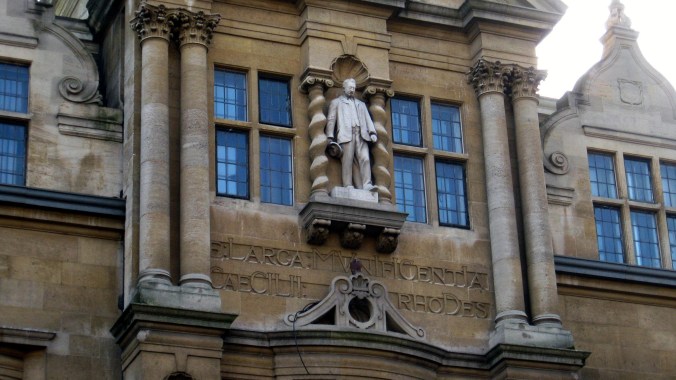
Even commentators sympathetic to the aims of Rhodes Must Fall in Oxford (RMFO) have been at pains to point out that the removal of the statue of Cecil Rhodes on the facade of Oriel College is not the most significant element of the campaign’s platform. Amia Srinivasan observes that ‘Neither the Cape Town nor the Oxford campaign has ever been just about statues.’ Amit Chaudhuri laments that ‘it would be…sad if Rhodes Must Fall in Oxford became identified with the statue in Oriel College alone’ because its ambition beyond the removal of the statue, namely that of decolonising education, is more significant. David Olusoga worries that by building their manifestos around calls for the taking down of statues, the more complex and worthy ideas around decolonisation raised by these campaigns have been ‘distorted into a simple right-wrong, yes-no statue debate’. I don’t disagree (much) with these views and indeed, if you want a right-wrong, yes-no answer, this essay will disappoint. But they beg the question of what statues mean and why we keep putting them up if they are so easily relegated to an epiphenomenal register of political discourse.

It’s worth remembering that RMFO itself has never downplayed the significance of the statue in the way that some of those writing in solidarity with it have done. It describes its mission as that of decolonising ‘the institutional structures and physical space in Oxford and beyond’ (emphasis mine) and lists as its first aim the intention to tackle ‘the plague of colonial iconography (in the form of statues, plaques and paintings) that seeks to whitewash and distort history’. In addition, it aims to reform the Eurocentric curricula to which university students continue to be subject and to address the under-representation and lack of welfare provision for black and minority ethnic staff and students at Oxford. One way to think about the place of the statue in this debate is to see it as a means to an end: as Srinivasan rightly notes, ‘complaints of structural racism and calls for curriculum reform don’t draw public attention like the toppling of a statue, and the RMF leaders know this.’ But while clarifying that its campaign is indeed ‘about more than a statue’, RMFO nonetheless insists that

statues and symbols matter; they are a means through which communities express their values. The normalised glorification of a man who for so many is a symbol of their historical oppression is a tacit admission that – as it stands – Oxford does not consider their history to be important. This is incompatible with a community that posits itself as progressive, enlightened and intellectually honest.

Without wanting to suggest that the success of RMFO should be judged by whether the statue falls or endures (it shouldn’t), I want to think with RMFO about what the expressive function of statues entails. Writing in a very different context, Judith Butler has famously worried that the relegation of injustices to the realm of the ‘merely cultural’ effectively downgrades the urgency with which they demand redress. For ‘merely cultural’ read ‘merely symbolic’, and the risk of disappearance of the demand for iconographic decolonisation (exactly what Oriel College might wish for) becomes obvious: if RMFO is about more than ‘just’ a statue and if we all agree that the statue is ‘merely symbolic’, then we might as well get beyond, behind, and beneath the symbol to address its putative ‘real’ while leaving the symbol itself intact. Meanwhile the possibility that the ‘merely symbolic’ has material consequences remains unexplored.

rhodes oxford

***

Continue reading

The Futures Past of the Women, Peace and Security Agenda

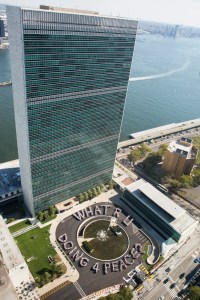
"What are you doing for Peace?" Launch Event

UN Secretariat staff mark the occasion of the 70th anniversary of the United Nations. 17 September 2015. UN Photo/Rick Bajornas.

This essay is a much abridged and lightly edited version of an article of the same name by Paul Kirby and Laura J. Shepherd published on 8 March 2016 in International Affairs.

UNSCR 1325, the foundational resolution of the eight that form the Women, Peace and Security (WPS) policy architecture, has strikingly few critics – or, at least, few who would openly dispute its headline ambition: to achieve global gender equality. It seems particularly appropriate to celebrate the WPS agenda on International Women’s Day, adopted by the United Nations in recognition of the ongoing global struggle for women’s rights. Our modest contribution to IWD celebrations this year is the launch of a special issue of International Affairs, which documents the advances and limits of the WPS agenda. These are traced in the various articles across multiple registers, from the implementation of WPS principles and provisions by regional organizations to the heteronormative dynamics of participation, prevention and protection. And yet, as the contributors show, the much-noted gap between WPS ambitions and current realities is not merely a report on imperfect implementation: rather, it takes us to the heart of what the WPS agenda is, and what it might become.

In our article, we discuss various elements, or ‘pillars’ of the Women, Peace and Security agenda, to evaluate where gains have been made under the auspices of this architecture. The ‘pillars’ are generally identified as ‘protection’, ‘participation’, ‘prevention’ and ‘relief and recovery’, with a fifth – the normative dimension – sometimes included. WPS principles govern activity in each of these domains. Women’s participation in peace agreements, for example, is somewhat more consistent than it was before the WPS agenda was inaugurated, and yet remains disappointing given initial ambitions. From 2005 onwards, there has been a notable increase in the number of peace agreements dealing with multiple aspects of gender security and participation.  The 2015 global study on the implementation of Resolution 1325 found that the proportion of peace agreements since 2000 making reference to women was 27 per cent, more than double the level over the period 1990–2000.  Given the emphasis in the WPS agenda on women as both makers and beneficiaries of peace, this trend towards inclusion is clearly welcome. Yet, as Radhika Coomaraswamy and her colleagues observed: ‘The present programmes put forward by the international community tend to be extremely narrow: just to bring a female body to the table’. Continue reading

Churchill’s “Iron Curtain” Speech (A Black History Month Perspective)

Truman and Churchill in Missouri

Churchill’s Westminster College audience, March 5, 1946 (Life/Getty Images)

This year is the seventieth anniversary of Winston Churchill’s “Iron Curtain” speech, a.k.a. “Sinews of Peace,” a.k.a., the Fulton address, which means that we will soon be hearing all about it once again. The speech is central to the iconography of the Cold War, of anti-communism, and of Anglo-American specialness. Countless historians, biographers and rhetoreticians have examined almost every aspect of it: when and where it was written, whether it was pre-approved by others, including President Truman, and, indeed, how it was received. On the last point, we know that the speech was met with a mixture of cheers and boos. The reactions tended to be politically and ideologically determined. Conservative politicians and the media praised the speech for its realism about the nature of the postwar settlement: at last someone had the courage to publicly say that the victor nations could not forever be friends.  In contrast, most liberals, socialists, and communists condemned the speech as inflammatory. With so many hopes pinned to the newly created United Nations Organization (UNO), the last thing the world needed was geopolitical tension between the Western powers and the Soviet Union, they argued. But that was not all. Some leftists went further still. Churchill’s notion the Anglo-American “special relationship” and “fraternal association” constituted the ultimate sinew of world peace smacked of racial supremacism, they said.

Continue reading

The Dissonance Of Things #5: Decolonising the Academy

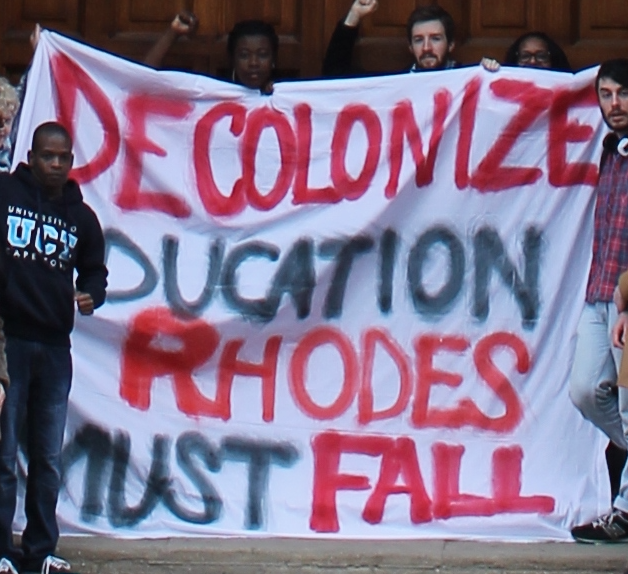
decolonize

In this month’s podcast I’m joined Dalia Gebrial from Rhodes Must Fall Oxford and two stalwarts of TDOT, Meera and Robbie, to discuss ‘Decolonising the Academy’. We take a look at the Rhodes Must Fall campaign and its implications for understanding the relationship between higher education, coloniality and ‘race’. We also ask why is my curriculum white?  What can be done change the way in which knowledge is produced and taught in universities? Finally, we explore how decolonising the academy might relate to anti-colonial and anti-racist struggles taking place outside of the university.

Listen via iTunes or through the Soundcloud player below.

Continue reading

More Groundings

The final piece, and rejoinder, in The Disorder Of Things forum on The Black Pacific.


I have to say, I really didn’t know what to expect from my interlocutors. Perhaps that’s because I have little idea what kind of response to expect from the book and who its readership might be. In any case, these varied and passionate responses are a joy to engage with.

Heloise, you not only provide a lucid introduction to some of the key themes and provocations of my book; you also usefully connect its arguments to broader intellectual and political currents in the world of development, especially regarding indigenous struggles in and over the Americas. Olivia, you provide a striking engagement with the politics of intellectual investment, one that in many ways exceeds the strictures of my book to become a general mediation upon ethics and method. Ajay, you poetically and critically reflect on solidarity building across/besides territory and culture, and in so doing you begin to ask pertinent questions about “groundings” with reference to Turtle Island. Krishna, yours unfolds as a forceful defence of the urgency to focus intellectually upon the materiality of dispossession.

I’m going to engage with your response, Krishna, at some length. But firstly, I want to call attention to and amplify some of the questions that Olivia and Ajay ask.

18379_488175720248_5710406_n

Continue reading