Ten Reasons Not To Write Your Master’s Dissertation on Sexual Violence in War

Marsha Henry

A guest post, following on from some previous reflections on gender and teaching and the politics of pedagogy, from Marsha Henry. Marsha is Lecturer in Gender, Development and Globalisation at the LSE Gender Institute, where she teaches, amongst other things, a course on gender and militarism. Her most recent research is into sexual exploitation in peacekeeping missions and peacekeeper labour hierarchies, and she is also, with Paul Higate, author of Insecure Spaces: Peacekeeping, Power and Performance in Haiti, Kosovo and Liberia (Zed, 2009). With Pablo, she recently co-edited a special issue of International Feminist Journal of Politics on ‘Rethinking Masculinity and Practices of Violence’. This post is based on a presentation given in San Francisco at the International Studies Association in April 2013.


It’s the first day of Lent term and the students are nervously gathered in a small stuffy classroom.  When I walk in and head towards the front of the room, the group falls silent. I introduce myself and we start a round of introductions and I ask students to speak briefly about their interest in the course. The first student tells me, and the class, that she’s in IR (International Relations), and is keen to take the course because she’s interested in studying sexual violence in war.  Another student turns to her, incredulous because she too is interested in that exact subject, and that furthermore she has worked for 3 months in the Democratic Republic of Congo (DRC) and has ‘seen a lot’. A few more students echo similar interests and I’m trying hard not to stereotype these students. But it’s difficult. A mythical figure is beginning to crystallise in my head and I can’t stop it. This figure is young, female and possibly middle-class, sometimes Scandinavian. She’s studying IR, Human Rights or Gender Studies. A few male students also indicate an interest. Some indicate interest in other topics, but there is a numbers problem from the outset. I feel uncomfortable as this is the third year that I’ve taught this course, each time allotting only one lecture week to the subject of sexual violence in war, and subsuming it under the larger heading of ‘gender, sexualised violence and work in militarised contexts’. Each year students have asked for more time to be devoted to the subject, for the lecture week to be moved up, and for their to be less focus on diversity in the armed forces. When students come to me during office hours to discuss the scope of their dissertations on the subject I fidget. After a few conversations with colleagues, I decide I need to start compiling a list – of compelling reasons why students should not write on the subject of sexual violence in war. But what would I do with this list? Can it be shared? And what of my responsibility not to teach on the subject?

10: Writing About ‘It’ Narrows The Political Focus

As a committed feminist, I’m all for drawing significant attention to the ways in which women experience conflict in distinctive ways. But the concentration of interest on sexual violence in wartime often leads to a neglect of the ways in which women experience violence (labelled as sexual or not) in peacetime. This noticeable singular focus on the topic also narrows the possibility of dislodging categories and subject positions. It is often assumed in class conversations, essays and subsequently dissertations that women are the victims and men are the perpetrators of this form of violence. This assumption appears in written work in a way that both masks the possibility of other positionings within the perpetrator-victim continuum, as well as the structurally embedded way in which sexualised violence occurs and is experienced by individuals and communities. This failure to explain the pervasiveness of sexualised violence against women tends to reinforce the binaries and provides a rather fixed aperture for analysing sexual violence in war and its consequences.

9: Researching The Topic Inspires Voyeurism

I’m squirming in my seat as one of the students smiles widely while she explains her interest in working on the topic of sexual violence as a weapon of war. She could be nervous explaining herself in front of her peers and her professor. She could be feeling awkward about the subject matter. She could be conforming to gendered expectations of women in the classroom where female students who express themselves confidently or through feminist rhetoric are categorised as aggressive. If feminist critique is pleasurable, how do we ‘do’ our analysis of sexual violence in wartime, paying attention to experience, trauma, and moral responsibility? There is a tendency, in making visible the ‘horror’ of it all, that students sensationalise the subject by focussing on the minutiae, the details and the thick descriptions. Honing in on the bodily experience of rape, for example, can remove rape in war from the wider social, cultural, economic and political context in which it always takes place. It can be an abstraction of the total experience. The affective impact is that readers of these dissertations distance themselves from subjects in the studies. Those who are victims and/or survivors and end up consciously or unconsciously performing what Donna Haraway referred to as a god-trick.

Continue reading

Call for Participants: Critical War Studies

Advance Wars

Critical War Studies: Emerging Field, Developing Agendas
A one-day workshop to be held at the University of Sussex
11 September 2013

What is left out when critical reflection on armed conflict is conducted under the sign of ‘security’? What are the forms of contemporary militarism? How can the discourses and practices of fighting, transition to ‘peace’, war preparation and military and strategic thought be engaged reflexively? How might militaries be understood as sites of subaltern labour, resistance and critique? How can attentiveness to experiences of war generate critical resources within international relations, sociology, geography, anthropology, history and other disciplines?

Multi-disciplinary proposals are invited for a one-day workshop convened by the University of Sussex Centre for Conflict and Security Research. The organisers welcome contributions engaging the idea of Critical War Studies, the themes outlined above and below, or suggesting other appropriate topics. It is envisaged that this will be the first of several events leading to opportunities for peer-reviewed publication.

Draft workshop structure:

Panel 1: What is ‘Critical War Studies’?

  • What’s in a name? ‘War’, ‘security’ and the analytical status of fighting
  • Critical approaches within strategic theory: who is strategy ‘for’?
  • Theory and the experience of war
  • War in/and society

Panel 2: Political Sociologies of Fighting

  • Technologies, transformations of war, transformations of self
  • Subaltern military labour and military history in Europe and beyond
  • Battle narrative and identity
  • Gendering war
  • ‘Normality’ and ‘extremity’ in fighting and dying

Panel 3: Contemporary Militarisms, Contemporary Militaries

  • Ideology contra experience: reflections on the policy/ practice disconnect in the war on terror
  • Beyond the strategic studies/ peace studies divide: continuity and change in militarism after the Cold War
  • The social construction of weapons
  • Military orientalisms and the representation of violence

Deadline for Proposals: 7 June

Proposals and any queries should be directed to: Joanna Wood (scsr [at] sussex.ac.uk)

What We Talked About At ISA: The God Complex – Biopolitical Ethics

The paper I presented at the ISA is part of a larger project in which I look at the ways in which ethics, in the context of certain political practices, is saturated with biopolitical rationalities. The (re)surfacing and framing of hitherto morally prohibited practices – torture, extraordinary rendition, extrajudicial assassinations – as justifiable, legitimate and even necessary acts of violence, paired with rapidly advancing and increasingly autonomous military technologies that facilitate these practices, has opened new dimensions and demands for considering just what kind of ethics is used to justify these violent modalities. I’m specifically frustrated by the emerging narrative of the use of drones for targeted killing practices in the interminable fight against terror as a ‘wise’ and ‘ethical’ weapon of warfare. The prevalence of utility, instrumentality and necessity in this consideration of ethics strikes me as dubious and worthy of a closer look. This keeps leading me again and again to the perhaps foolhardy, but inevitable question: what, actually, IS ethics? And more specifically: what is ethics in a biopolitically informed socio-political (post)modern context? My quest for an answer begins with the growing divergence in scholarship and philosophical inquiry of the ethicality of ethics, or meta-ethics on one hand, and practical conceptions of ethics, applied ethics, on the other.

It has been noted by philosophers and scholars across geographical and disciplinary divides, that, in recent years, there has been a growing focus in philosophical and political thought on the application of moral and ethical principles rather than the “ethicality” of ethics itself. This trend is particularly widespread in Anglo-American philosophy, and manifests itself in the striking surge of applied ethics as a subfield of ethics, which considers the chief role of ethics to be that of providing a practical guide for moral agents, based on rational analysis, scientific inquiry and technological expertise. In other words, considerations of ethics have become preoccupied with establishing practicalities and ways of application. While the practical side of ethics should, of course, not be dismissed, the domineering focus on ethics’ practicality over considerations of meta-ethics, or the ethicality of ethics, occludes any deeper engagement with what ethics actually is, how moral content is established and how we can understand ethics in modernity as something beyond a mere set of context specific norms and legal regulations, as something other than laws and codes. To make sense of this preoccupation with ethics’ practicalities, it is worthwhile to consider how ethics might, in fact, be determined by the characteristics of a specific form of society. This brings me back to the biopolitical rationalities with which (post)modern societies are infused. Continue reading

Call for Papers: Subjects and Practices of Resistance

french-resistance-1944

For two inter-linked, consecutive workshops under the theme of Subjects and Practices of Resistance to be held 9-11 September 2013 at University of Sussex.

The first workshop (9-10 Sept) is on Discipline(s), Dissent and Dispossession and the second on Counter-Conduct in Global Politics (10-11 Sept).  The workshop convenors encourage attendance at both workshops.  However, paper proposals should specify the intended workshop and which days participants would be able to attend.

The workshops are generously sponsored and supported by the BISA Poststructuralist Politics Working Group (PPWG) and the Centre for Advanced International Theory (CAIT) at the University of Sussex  Continue reading

What We Talked About At ISA: Critical Pedagogies?

Chuy Pedagogy Of The Oppressed

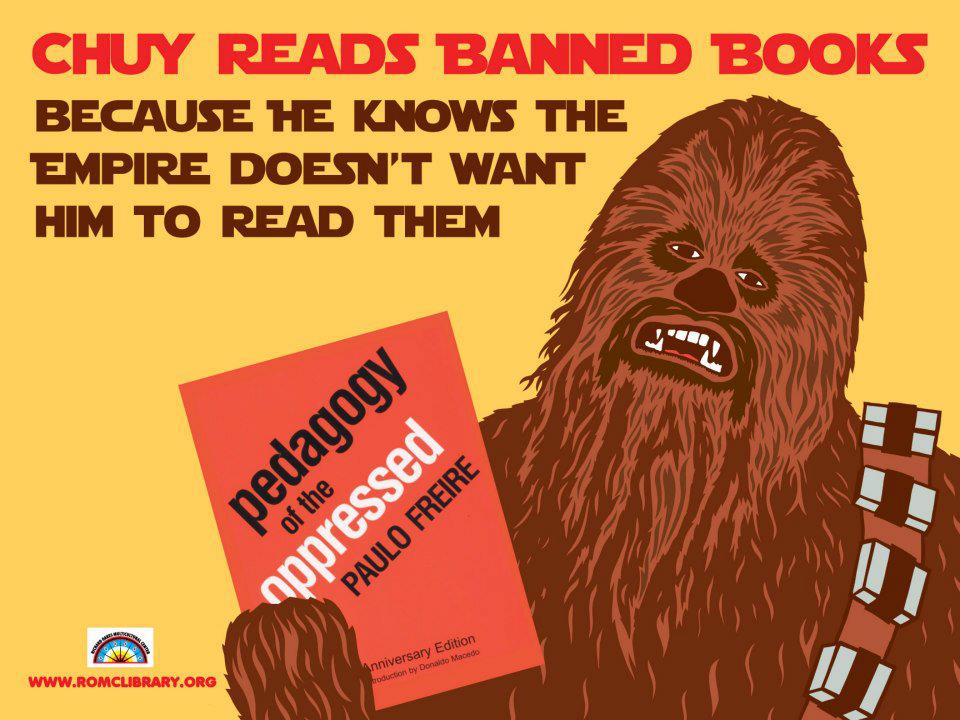
There is something seductive about the idea of critical pedagogies. In an age where the figure of academic is beset on all sides by voracious spectres – the Taxpayer, the Minister, the Entrepreneur, the Curious Public, the Student-Consumer, the Management Consultant – it offers the idea that what happens in the classroom may still matter. More than matter: might in some way emancipate. This promise is perhaps particularly strong in academic International Relations, where those of various ‘marginal’ persuasions might argue that teaching against the grain undoes the destructive commonsense of global politics. That critical pedagogies help us bring back in the human, the ethical, the powerful, those daily experiences shot through with international politics, although our students don’t always see it. Even the titles hint at grand transformation: Pedagogy of the Oppressed!

Don’t get me wrong. I want to be seduced. More than that, I am all too ready to concur with many who also sat on the panel (‘What Do We Teach? How Do We Teach It?: Critical Pedagogies and World Politics’) convened by Meera in San Francisco (they were: Naeem Inayatullah, Laura J. Shepherd, David Blaney, Andrea Paras, Daniel Bendix and Chandra Danielzik). To agree that, since so much mainstream International Relations speaks the discourse of power, it is necessary to reveal its fictions and silences. To agree that narratives and memoirs have their place, alongside such ‘political’ terms as racism, patriarchy and class. To agree that it is better to start with Todorov and The Conquest of  America than it is to begin from a world of ahistorical self-help states. To agree with programmes for interventionist anti-racist education.

But I am also somewhat cautious. Some of that might be read as a spur to critical pedagogy by another name, and some as a delineating of criticality’s limit, at least insofar as that term is often discussed. Call these somewhat speculative micro-interventions the unapologetic curriculum, marginal resistance and real academic politics (always with the rule of three).

Continue reading

What We Talked About At ISA: Teaching Gender and War: Some Reflections on Negotiating the Five Stages of Feminist Consciousness/Grief in Undergraduate Students

Victoria BashamA guest post in our current series on ISA presentations from Victoria Basham, who is Senior Lecturer in Politics at the University of Exeter. Victoria’s research draws on feminist and sociological theory to explore militaries, militarism and militarization. In War, Identity and the Liberal State (Routledge, 2013), she draws on original fieldwork research with members of the British Armed Forces to offer insights into how their everyday experiences are shaped by, and shape, a politics of gender, race and sexuality that not only underpins power relations in the military, but the geopolitics of wars waged by liberal states. Victoria is also a working towards the launch of a new interdisciplinary and global journal called Critical Military Studies which seeks to provide a space for dialogue among scholars questioning the very idea of military organisation and armed force, and seeking to offer new insights into organised and state-sanctioned violence by exploring its wider significance and effects.


Despite the burgeoning literature highlighting the significance of gender to global politics, research into international studies curricula suggests that gender is rarely dealt with extensively or even adequately by ‘top ranking’ UK Politics and International Relations (IR) departments. A cursory glance at popular, introductory undergraduate textbooks in Politics and International Relations also reveals that whilst feminism may be included as an approach, accounts of power as institutionally situated remain dominant. As such, many undergraduates only experience brief introductions to feminism, gender, and issues of sexual identity, if anything at all. So when I was given the chance to design and teach two research-led undergraduate courses in 2009, I saw it as an important opportunity: both to provide students with insights into how gender animates global politics, and to engage in a form of ‘feminist pedagogy’ by encouraging students to look at themselves and the world around them critically and analytically, through the interlocking lenses of gender, race, class and sexuality.

My experience of delivering these courses over the past few years has been largely positive. On more than one occasion students have commented that engaging with feminist theories and praxis had ‘opened their eyes’. However, in other students the experience of studying the global through gendered and postcolonial lenses elicited confusion, anger and pain on their part, at least initially. Indeed, as I have continued to teach these courses, I have often thought of student reactions as akin to Kübler-Ross and Kessler’s five stages of grief or what Patti Lather has aptly called ‘stages of feminist consciousness’.

One possible reason for this is that for feminists, the question of ‘What is Politics?’ necessarily includes accounts of power that are personal, emotional, and everyday. Given that trying to account for how power shapes and is shaped by people’s daily lives is not always readily accessible through a focus on institutions and the like – the usual stuff of politics and IR analysis – many feminist teachers are likely to encourage their students to think through how ‘the personal is political’ in their experiences and to re-personalise an often depersonalised and sanitised set of issues including war. Many of my students (though not all, and rarely, it should be said, in a linear fashion) experience moments of denial, anger, bargaining, depression and acceptance when taking my courses. Moreover, in reacting to their comments and in trying to anticipate their turmoil I often find myself angry, disbelieving, in negotiating mode, saddened and sometimes having to accept, and very grudgingly I’ll admit, that not all of them believe that gender is as significant to war as I do.

Continue reading

What We Talked About At ISA: Cognitive Assemblages

HFT

What follows is the text of my presentation for a roundtable discussion on the use of assemblage thinking for International Relations at ISA in early April.


In this short presentation I want to try and demonstrate some of the qualities assemblage thinking brings with it, and I’ll attempt to do so by showing how it can develop the notion of epistemic communities. First, and most importantly, what I will call ‘cognitive assemblages’ builds on epistemic communities by emphasising the material means to produce, record, and distribute knowledge. I’ll focus on this aspect and try to show what this means for understanding knowledge production in world politics. From there, since this is a roundtable, I’ll try and raise some open questions that I think assemblage thinking highlights about the nature of agency. Third and finally, I want to raise another open question about how to develop assemblage theory and ask whether it remains parasitic on other discourses.

Throughout this, I’ll follow recent work on the concept and take ‘epistemic communities’ to mean more than simply a group of scientists.[1] Instead the term invokes any group that seeks to construct and transmit knowledge, and to influence politics (though not necessarily policy) via their expertise in knowledge. The value of this move is that it recognises the necessity of constructing knowledge in all areas of international politics – this process of producing knowledge isn’t limited solely to highly technical areas, but is instead utterly ubiquitous.

1 / Materiality

Constructivism has, of course, emphasised this more general process as well, highlighting the ways in which identities, norms, interests, and knowledge are a matter of psychological ideas and social forces. In Emanuel Adler’s exemplary words, knowledge for IR “means not only information that people carry in their heads, but also, and primarily, the intersubjective background or context of expectations, dispositions, and language that gives meaning to material reality”.[2] Knowledge here is both mental, inside the head, and social, distributed via communication. The problem with this formulation of what knowledge is, is that decades of research in science and technology studies, and in cognitive science, have shown this to be an impartial view of the nature of knowledge. Instead, knowledge is comprised of a heterogeneous set of materials, only a small portion of which are in fact identifiably ‘social’ or ‘in our heads’. It’s precisely this heterogeneity – and more specifically, the materiality of knowledge – that assemblage thinking focuses our attention on.

Knowledge is inseparable from measuring instruments, from data collection tools, from computer models and physical models, from archives, from databases and from all the material means we use to communicate research findings. In a rather persuasive article, Bruno Latour argues that what separates pre-scientific minds from scientific minds isn’t anything to do with a change inside of our heads.[3] There was no sudden advance in brainpower that made 17th century humans more scientific than 15th century humans, and as philosophy of science has shown, there’s no clear scientific method that we simply started to follow. Instead, Latour argues the shift was in the production and circulation of various new technologies which enabled our rather limited cognitive abilities to become more regimented and to see at a glance a much wider array of facts and theories. The printing press is the most obvious example here, but also the production of rationalised geometrical perspectives and new means of circulating knowledge – all of this contributed to the processes of standardisation, comparison, and categorisation that are essential to the scientific project. Therefore, what changed between the pre-scientific to the scientific was the materiality of knowledge, not our minds. And it’s assemblage thinking which focuses our attention on this aspect, emphasising that any social formation is always a collection of material and immaterial elements.

In this sense, questions about the divide between the material and the ideational can be recognised as false problems. The ideational is always material, and the constructivist is also a materialist.

Continue reading

What We Talked About At ISA: ‘Afghan Masculinities’: The Construction of the Taliban as Sexually Deviant

Taliban 1

The paper I presented earlier this month at the International Studies Annual Conference held in San Francisco looks at how Afghan masculinities have been represented in and by Anglo-American media. The words ‘Afghan man’ conjure up a certain image, a pathologised figure that is now associated with most males in Afghanistan. The paper analyses this figure of the ‘militant’ Afghan man, most strikingly captured by descriptions of the Taliban and juxtaposes it with the less popular, though still familiar trope of the ‘damned’ Afghan man, embodied in the figure of the Afghan President, Hamid Karzai. But here I focus on a particular construction of the Taliban as sexually deviant, (improperly) homosexual men.

Jasbir Puar, in her trenchant appraisal of today’s war machine and the politics of knowledge that sustains it argues that the depictions of masculinity most widely disseminated in the post 9/11 world are terrorist masculinities:

failed and perverse, these emasculated bodies always have femininity as their reference point of malfunction and are metonymically tied to all sorts of pathologies of the mind and the body – homosexuality, incest, pedophilia, madness and disease.

Whilst representations of al-­Qaeda as pathologically perverse have permeated the Western mainstream, the Taliban because of its historically low international profile has escaped that level of media frenzy. The attention it does get, however, is almost always mired in Orientalist fantasies of Eastern men as pathologically disturbed sodomisers. The ‘high jack this fags’ scrawled on a bomb attached to the wing of an attack plane bound for Afghanistan by a USS Enterprise Navy officer, while in no way ubiquitous, is certainly an edifying example of our image of the Taliban as perverse and not quite “normal”.

This perversity of the Taliban has been largely attributed to their madrassa upbringing, an all-­male environment and their concomitant attitude towards women. Continue reading

What We Talked About At ISA 2013: The Practice Turn and Global Ethics

We're talking about practice!

I want to address the use of practice theory in global ethics rather than International Relations or social science broadly. I am neither a social scientist nor a social theorist. My interests are in political and ethical theory, in asking questions about the good in political life. Nonetheless, questions of ethics are an important part of the turn to practice theory because such a reorientation has much to add to how we think about questions of global ethics. I also hope that my reflections on, and uses of, practice theory may be of interest to those who see themselves as social scientists.

In global ethics there is a constant concern with the issue of justification, with determining how we know what is right or good – and especially how we know that what we know is really right or good. What is surprising is how little time is spent considering the details of what is right or good in specific situations. This question it seems is already known, either because we can deduce it through some rational rule or distill it from some social tradition. This is a crude map, but hopefully adequate to place ourselves.

Even among more dissident scholars the focus is on how justifications fail, or how our justifications reproduce undesirable social consequences – the exclusion of the other, the marginalization of women – and these are absolutely vital insights. However, what remains under-examined is what we take to be right or wrong, good or bad, the substantive and at times contradictory content of our ethics. Along with this there is a lack of concern with how we think when we are being ethical, with what social role ethical claims have and with how social institutions and traditions depend upon ethical claims.

Continue reading