Constructing National Security: U.S. Relations With India and China

Jarrod HayesA guest post from Jarrod Hayes on his forthcoming book. Jarrod is an Assistant Professor of International Relations at the Georgia Institute of Technology. In 2003 he received his Bachelor of Arts degree from the University of Colorado at Boulder in astrophysics and political science. He completed his Ph.D. in Politics and International Relations at the University of Southern California in 2009. Prior to joining the Georgia Tech faculty, he was the ConocoPhillips Assistant Professor of International Relations at the University of Oklahoma. His areas of scholarly and teaching interest focus on the role of social orders in shaping international security practice. His scholarship appears in the European Journal of International Relations, German Studies Review, International Organization, and International Studies Quarterly.


Srdjan originally approached me about doing this guest post six months ago. So my thanks to Srdjan and the gang for their patience and for giving me an opportunity to discuss my forthcoming book Constructing National Security: U.S. Relations With India and China, set to come out with Cambridge University Press in September (available on Amazon for a discount). What I would like to do is discuss a bit of the background of the book project before addressing the substance of the book and conclude with some of the implications and questions raised by the work.

The book initially started as a project on the democratic peace. When I was in graduate school, I was captivated in my very first semester (Introduction to IR theory with Robert English) by the law-like regularity of the phenomenon—loads of papers and books demonstrate that democracies do not fight each other (see among others my 2012 article in the European Journal of International Relations, also Harald Müller and Jonas Wolff’s ‘Many Data, Little Explanation’ in Democratic Wars: Looking at the Dark Side of Democratic Peace and Ungerer’s 2012 review in International Studies Review). In part owing to how the subject has been investigated (more on that below), academics have lost perspective on the significance of the phenomenon. Security seems to be everywhere, and applied to almost everything. The initial impetus for the highway system in the United States was national security. President Dwight Eisenhower’s avowed purpose for building the massive transit network was to facilitate the movement of U.S. military forces in the event of a land invasion. Two years later security was used to justify education policy in the form of the 1958 National Defense Education Act. The list goes on. Almost any topic one might think of has probably been included under the rubric of security. The democratic peace, however, points to a notable exception. As reams of evidence indicate, democracies have been consistently unwilling to label their peers as security threats. The puzzle is obvious: how is it that democracies have avoided constructing each other as threats while so many other subjects have been labeled as such.
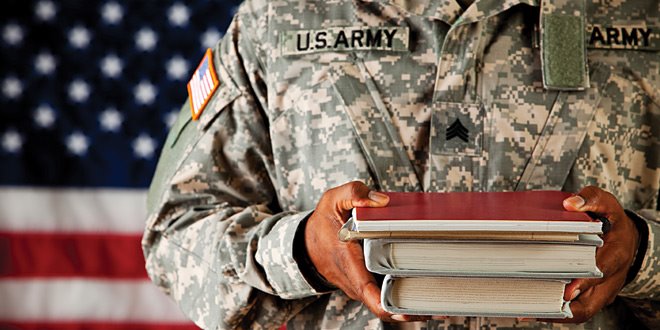
US Army Books

The significance of the democratic peace is self-evident in my opinion. As I read more of the democratic peace (DP) literature, however, I became increasingly dissatisfied with the collective effort to identify the forces that generate the phenomenon. Methodologically, regression-based studies dominate the field. While these studies have been invaluable in establishing the claim that the democratic peace phenomenon exists, by their very nature they are able to demonstrate only correlation, not causation. Not surprisingly, what effort these studies do make towards understanding and explaining the democratic peace focuses on causes — norms and institutions — that could be quantified, sometimes through tenuous proxies. Yet, because the quantitative nature of the studies does not enable access to causal forces, the mechanisms behind the democratic peace remain shrouded in shadow. Perhaps surprisingly given my educational background, I was particularly dissatisfied with the theories and causal assumptions that underlie them in the literature (for the sake of brevity and focus, I will not go into this critique in depth, but interested readers can find it in my 2012 article in the European Journal of International Relations). My dissatisfaction with the literature, specifically with its tendency to brush by the big questions of how the democratic peace is possible, led me to begin pursuing my own theory of the democratic peace.  The book is the result, although it has since grown into an effort to understand how identity shapes security outcomes in democracies.

Continue reading

Notes on Ex-Yu Justice, Part III

Following Part I and Part II


The court is incompetent

The ICTY is constantly criticized for its organizational and procedural shortcomings, but is it fatally “incompetent”? To the extent that it resonates with ex-Yugos this charge must be made in the abstract only – the living ICTY is incompetent compared to the ideal ICTY. Compared to national legal venues, especially as they operated until recently, the court is indispensable, however (more on this below). Further, the ICTY is perceived as the big fish court, and the ability to get those “most responsible” is regarded as one of its strengths. And yet, much of this hard-earned reputation is being squandered in a series of rulings that acquitted some very big and very nasty fish.  Even its supporters feel like the ICTY has lost its mojo.

Consider the Momčilo Perišić case. Here the Yugoslav National Army commander who was first convicted (27 years in prison!) for aiding and abetting war crimes perpetuated by Serb forces across the river Drina, and then completely acquitted by the Appeals Chamber. Logistically and financially supporting génocidaires may not be a crime after all! Putting aside the inability of the prosecutor to ever establish a clear chain of command going from Belgrade to Pale and Knin respectively, this ruling changes the current legal understanding of the principle of command responsibility so decisively that it will almost surely protect many miscreants in the future. Some have even used it read back past ICTY rulings, breaking the chains of causation that lead to Belgrade (“this is a posthumous acquittal of Milošević!”) as well as Zagreb, and blaming  the massacres on the small fish (what’s next? Isolated cases of extremism?).

smallfry

Then there is the acquittal of Ramush Haradinaj, the prime minister of Kosovo, and that particular joint criminal enterprise (the presence of witness intimidation, note, was mentioned in this ruling). Next, the Ante Gotovina and Mladen Markač decision. The 2011 Trial Chamber ruling convicted them to 24 years for their role in, among other things, the joint criminal enterprise to expel the Serb population in Krajina following the 1995 Operation Storm (with Tudjman as the enterprise’s CEO again). Then, earlier this year, the Appeals Chamber ruled, in a split decision, that no such joint criminal enterprise existed (as well as that some Mladić-style military actions might be ok, but let’s put that aside for now). And last, the Jovica Stanišić and Franko Simatović case: the ICTY found no qualms with their arms dealing, bankrolling para-military formations and otherwise supporting of the Serb administrations in Bosnia, Croatia, and Kosovo, and, above all, no evidence of conspiracy to bring about the removal of the non-Serb population from any part of the former Yugoslavia (the rest of their ghastly dossier, so much of which is easily accessible via YouTube, fell outside the court’s scope).

Continue reading

Notes on Ex-Yu Justice, Part II

Following Part I, and in advance of Part III.


The court is political  

The smartass response goes something likes this: “Of course it’s political; what’s not political? Haven’t you read the ICTY’s website? It says clearly that the tribunal was established for explicitly political reasons, too, by the UNSC, which is political by definition.” But the smartass response is a rude interruption. The above assertive prefaces monologue, not dialogue. The monologue is a story about world politics as a dog-eat-dog contest in which the strong always devour the weak with a focus on the origins of the ICTY. “Of course an international judicial institution cannot be created on the basis of an UNSC resolution alone. Of course Chapter VII of the UN Charter does not specify the conditions under which war crimes tribunals can be set up. Of course the ICTY quickly discovered that it could not bother with the question of own legality. But when have great powers ever cared about law and institutions? Might makes right, right? The ICTY is based on the consent of states – big states, not our banana republics.”

This story varies in terms of breadth and depth, but its modal conclusion is that the tribunal cannot represent anything but “victor’s justice” and/or Western and specifically American oppression of those living on the periphery. As for the motive, the supposedly aggressive prosecution of Bosno-Serbo-Croat baddies practiced by the ICTY is a function of the desire for retribution for every case of ex-Yu insolence in recent history, starting with the Trieste crisis of 1945. As discipline and punishment at once, trials are also meant to serve as a warning to the rest of the peripheral and semi-peripheral world. This type of theorizing could be described as a cross between pop-realism and pop-Marxism with a whiff of the crudest forms of pop-anti-Americanism and some other, far less respectable prejudices. While it is not exactly a closed loop, for every new newstory indexing Western and specifically American double standards and double visions in international law, the theory gains strength. Who in the former Yugoslavia doesn’t have an informed opinion on the “Hague Invasion Act”?

imgfrontisThe two accounts of the origins of the ICTY that I have on my shelf make something of an opposite case. Pierre Hazan’s book, subtitled ‘The True Story Behind the ICTY’, suggests that the weak (international justice activists) outfoxed the strong (realist diplomats and state-centric lawyers) and, against all odds, managed to turn the tribunal into such a revolutionary achievement (more on this below). Hazan is no theorist of norms and transnational advocacy networks, but there are more than a few parallels with this literature. The second account is Rachel Kerr’s 2004 book, which begins and ends with the thorny issue of “politicization,” including the issue of “prosecutorial discretion” as its special subset. Kerr has the ICTY walking on a tightrope. Sidle up too closely to justice, and you alienate those who rule the world; let politics in, even to manipulate it for judicial ends, and you lose credibility. While infinitely more nuanced than Hazan’s, Kerr’s framework for analyzing politics (it, too, chimes with 1990s IR theory, namely the “bringing international law back in” literature) follows the same binary – let me personify it a little as a contest between “realists” versus “legalists” – and it reaches the same conclusion. And judging by both the quotidian operation of the court as well as its key decisions up to 2002-3, Kerr finds, “legalists” had the upper hand.

I am not sure what stock-taking exercises based on the realist vs. legalist framework look like today (again, this post is my attempt to reconnect with the literature I stopped following years ago), but what struck me in my conversations is how adamant my interlocutors were in rejecting even the most carefully drawn legalist claims. It’s simple, the typical response goes, the ICTY is subject to constant political pressures and it shouldn’t be surprising to see so much judicial malpractice. Lest one is keen to dismiss this as “typical” ex-communist (and transitionalist) disdain for the notion that law serves to ensure that valuable social goods are distributed in ways that protect equal respect for everyone, note that some of the most critical arguments about the “hopelessly political court” are drawn from the texts left behind by bona fide ICTY insiders like Antonio Cassese (he of  those great international law textbooks), Gabrielle Kirk McDonald, Louise Arbour, Graham Blewitt, Carla Del Ponte, Serge Brammerz, and Florence Hartmann (more below). Anyone can cherry-pick a few memorable lines from a few memoirs and journalistic accounts (Hartmann, if I recall correctly: “the ICTY was formed so that war criminals could negotiate on the level of their innocence”), but what I find interesting is that these types of arguments have gained more and more adherents over the years.

Continue reading

Notes on Ex-Yu Justice, Part I

I don’t recall when I first heard of Radovan Karadžić, but I know it wasn’t any time before the run-up to the first democratic, multi-party elections in Bosnia and Herzegovina. Radovan, with sarcastic endearment called Rašo in my family, emerged as the leader of something called the Serbian Democratic Party, one of the three main “national” political parties that were formed to steer us away from Marxist politics and economics and towards Western, liberal, democratic capitalism.  I do recall voicing scepticism about their promises, and trying to convince my eight grade classmates that ‘national’ really meant ‘nationalist’ and that with “them” at the helm Bosnia would soon look like Lebanon rather than Switzerland. And forget Lebanon, one only had to look over to Croatia to see what parties with the same names were doing, and how well that particular Westernization was going. I remember arguing that there was an alternative, pointing to Ante Marković (a.k.a. Antara, but with slightly less sarcasm) and his “reconstituted” Commies (and to drive the point home I pasted Union of Reform Forces of Yugoslavia campaign posters all over my room).  But there was no alternative, not really. Not with the bad guys in Belgrade, far more powerful than Marković, itching for “armed battles,” and not with the vast majority of citizenry successfully interpellated into political, mutually exclusive Muslims, Serbs & Croats. A Cerberus coalition of said national parties won the elections in November 1990 and took us all to hell.

karadzic_AP

Fast forward to June 2013: it’s a Monday morning and I am looking into Courtroom 1 of the International Criminal Tribunal for the former Yugoslavia (ICTY) in The Hague. Karadžić, sitting behind a huge glass screen, is complaining about some key meaning lost in translation. He appears uncomfortable, at least compared to the other nasty blast from my past: Vojislav Šešelj, a.k.a., Šešo. In the 1990s, he was Serbia’s one-man version of the Radio Télévision Libre des Mille Collines; today, Šešelj is the tribunal’s bête noire. Those who follow the life of the ICTY are familiar with his mixed-methods approach to delegitimizing the court and its proceedings. Hissy fits, impossible demands, hunger strikes, insults, bullying, speechifying, filibustering. Then there is the regular uploading of confidential court documents onto http://www.vseselj.com‎ such that the names of protected witnesses are no longer protected. This certified political scientist (while writing a PhD dissertation on fascism in late 1970s Šešelj apparently spent a year teaching at the University of Michigan) knows how to assess the power of the strong as well as of the weakHe has repeatedly justified his behaviour as “only politics” (“this court is political, I am political, and I am here to destroy you”). And whenever he gets convicted of contempt of court (twice or thrice now), he laughs it off: “I don’t care, I am having the time of my life.”   

He was on fire that morning as well. Invited to Karadžić’s trial as a key witness, Šešelj manages to waste hours of the court’s time on stories that feature, among other things, Swedish prostitutes, Serbian folk heroes, and European medieval history (I paraphrase again, this time from my notes: “Magdeburg, the city that’s now flooded, yes, make sure it goes into the court’s record just like I explained in my book and on my website: it was the Croat armies that massacred its citizens back in 1631”). The little time devoted to answering the questions posed by the prosecutor Alan Tieger – Karadžić, recall, is indicted for genocide; extermination; murder; persecutions; deportation; inhumane acts; terrorizing of, and unlawful attack on, civilians; and taking of hostages – testifies to Šešelj’s focus and impeccable memory. “Absolutely not,” he concludes, Karadžić had nothing to do with any conspiracy to ethnically cleanse parts of Eastern Bosnia. “What happened was a natural population transfer, that’s all.” Continue reading

The Office Of Blood; Or, ‘The Act Of Killing’ (2012)

The images and scenes we discuss below are not those of a conventional film plot. Nevertheless, *spoiler warning*.


Act Of Killing Anwar Screen

It’s hard to know how to write about The Act Of Killing, the unsettling, surreal, humanising, nauseating portrait of an Indonesian death squad that is generating such interest. Joshua Oppenheimer, Christine Cynn and the mainly anonymous Indonesian crew (anonymous for fear of retribution) have conjured something quite extraordinary into the world. Laced with caustic insights into atrocity, empathy, memory, commodification, artifice, power, solidarity, fear, self-deception and play.

One million people were killed in Indonesia in the mid-60s following a military coup. The massacres which aimed at obliterating “communists” (along with ethnic Chinese and intellectuals) have been largely undocumented, with many of the perpetrators occupying prominent positions in the Indonesian government. Without wishing to give too much away or to channel and pre-empt the multiple, contradictory emotions that it is bound to elicit, the main conceit is a film within a film where the murderers re-enact their murders, all the while debating whether to recreate this method, or whether that victim would have cried out in that way, and sometimes whether they might just be showing us too much truth in their performances of the past. At one point there is the satisfied declaration that these scenes of re-articulated horror will be seen as far away as London! Part voyeurs, part students, we are thus implicated in their narratives, viscerally. Aghast, covering our eyes, retching when they retch, laughing guiltily at moments of shared humanity.

The Act Of Killing is a deliberate move from the ‘theatre of the oppressed’ to the ‘theatre of the oppressor’, a move that is challenging not simply because we – those ostensibly passive spectators – are made to face deeply uncomfortable ‘truths’ but also because it is above all a movie that painstakingly documents what Hannah Arendt, in a different context, called the ‘banality of evil’. Whilst there is nothing anodyne or sanitised about these gruesome renactments, they are almost flippantly juxtaposed with the mundane rituals, pedestrian encounters, and even moments of compassion and kindness that make these men all too human. The result is an audience suspended between empathy and disgust, between acceptance and incredulity, and between the absurd and the quotidian.

The Act Of Killing, for us at least, is a gut-twisting manifestation of sometimes nebulous socio-political insights. Insights such as Agamben’s ‘camp’ or Foucauldian ‘state racism’: concepts that suddenly unfold themselves before us on film, embedded as they are in a context otherwise deeply unfamiliar to us. But although seemingly focused, somewhat narrowly, on Medan, Indonesia the ambit of The Act is far greater: it offers a compelling commentary on the connate imbrication of capitalism, commodification, legality, sexual discrimination, racism, and their inescapably violent manifestations. It is less a document-ary about Indonesian history than a meditation on violence, memory and subjectivity themselves, a provocation made universal precisely because of its lingering gaze on these few aged torturers.

Continue reading

Addressing Wartime Sexual Violence at the United Nations Security Council

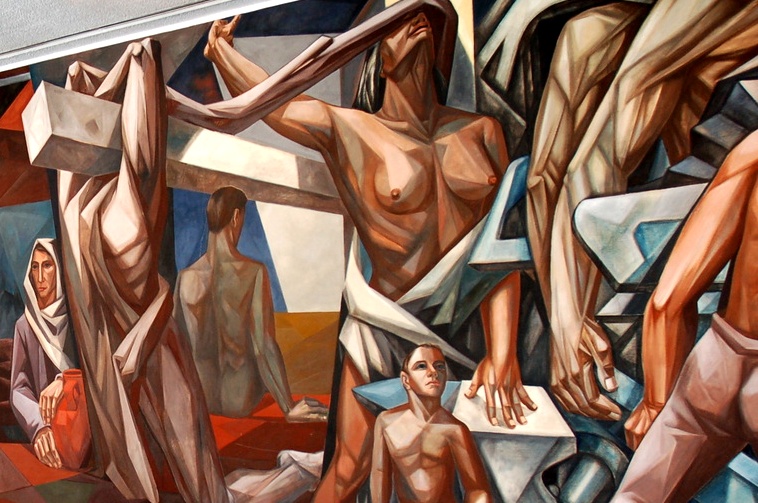
A mural at UN HQ by José Vela Zanetti, via Robin Stevens.

Detail from a José Vela Zanetti mural at the United Nations, New York (original image via Robin Stevens)

Yesterday, the United Nations Security Council met to vote on a new resolution on wartime sexual violence (under the more general rubric of ‘women, peace and security’). Resolution 2106, as it now is, was passed unanimously, and so joins those other numerical signifiers in the chain of gender mainstreaming: 1325, 1820, 1888 and 1960. The session had been convened by William Hague (the UK holds the Security Council chair for June), and the presence of Angelina Jolie (or ‘Angelina Jolly’, as more than one state representative called her) brought obvious publicity advantages, although that in itself is not so surprising both given her close work with Hague on the UK’s Preventing Sexual Violence Initiative and her role as Special Envoy for the UN High Commission for Refugees.

UNSCR 2106 seems designed mainly as a political symbol that the Council “remains actively seized” of the importance of conflict-related sexual violence, and essentially extends a number of themes already in play (there’s a whole bunch of urges, calls for, recognizes, requests in the text). It seeks the expanded use of targeted sanctions against perpetrators and commanders involved in sexual violence and reiterates the connection of that thing called ‘gender’ to DDR, security sector and justice reforms. It repeats the ‘zero tolerance policy’ on sexual violence and abuse by UN forces, requests further reports on progress to the Council, and so on. There were some other points of note, partly in the mention of men and boys as victims, and partly in some puzzling recessive points such as the Resolution’s demand (its word) that women and children abducted into armed forces be released (given that they are especially vulnerable), with no concomitant mention of kidnapped men.

The resolution also called for sexual and gender-based violence training for all pre-deployment and ‘in-mission’ peacekeeper training, and it is here that perhaps the biggest substantive contribution lies. Numerous references were made in the debate to an expanded role for Women Protection Advisers. Like the discussion of targeted sanctions (mentioned first in UNSCR 1820) this is not brand new, since Women Protection Advisers were themselves an innovation of 1888, which upgraded them from existing gender and human rights advisers. The exact nature of the new role is as yet unclear, but it seems to involve an expansion of their mandate to apply to all UN deployments, since they are currently active in just eight peacekeeping missions (which is just over half).

A few other quick observations on the text and the debate.  Continue reading

Russia’s Anti-Gay Laws: The Politics and Consequences of a Moral Panic

A guest post from Cai Wilkinson on recent LGBTQ developments in Russia. Cai is a Lecturer in International Relations in the School of Humanities and Social Sciences at Deakin University, Australia. Her research interests include critical approaches to security, fieldwork-based securitization studies, norm contestation and resistance, and genders and sexualities in International Relations. Her geographic focus is on the former Soviet Union, and she is currently working on projects about LGBT rights and human rights norms in Kyrgyzstan and Russia. She received her PhD from the University of Birmingham, UK, in 2009 for a thesis entitled Interpreting Security: Grounding the Copenhagen School in Kyrgyzstan, which drew upon seven months of fieldwork conducted in Bishkek and Osh in the aftermath of the 2005 overthrow of the Akaev regime. Her work has been published in Security Dialogue, Central Asian Survey and Europe-Asia Studies, and she has contributed chapters to volumes on securitization theory, statehood in Central Asia, and fieldwork-based research methods. Cai is also Chair of the International Studies Association LGBTQA Caucus.


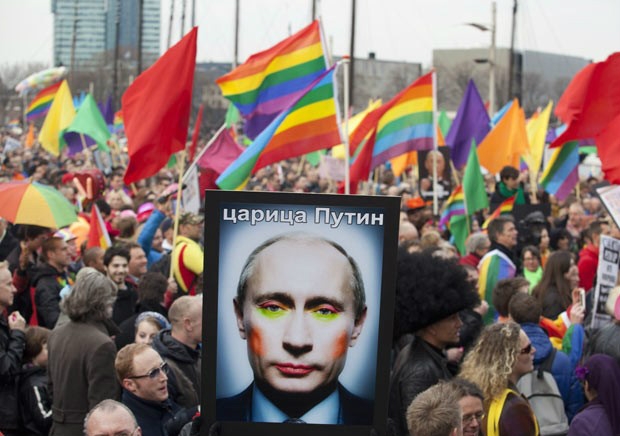
Russia Gay Pride Putin

The issue of LGBT rights in Russia first properly came to mainstream international attention in March 2012, when the St Petersburg Duma passed a law prohibiting “public acts aimed at the propaganda of sodomy, lesbianism, bisexualism and transgenderism amongst minors“. The law provoked an international outcry, including calls for tourists to boycott St Petersburg, sister-cities to consider cut off ties with Russia’s “window on Europe”, and condemnation from the EU, with the European Parliament passing a resolution noting that it was “gravely concerned by developments which restrict freedom of expression and assembly on the basis of misconceptions about homosexuality and transgenderism” and calling on Russia and other countries considering the adoption of similar legislation to “demonstrate, and ensure respect for, the principle of non-discrimination”.

In actual fact, this was not the first “anti-gay” law to be passed in Russia; Ryazan Oblast’s Duma adopted an amendment to local legislation to outlaw the “propaganda of homosexualism” in May 2006, and Arkhangelsk and Kostroma Oblasts followed suit in 2011. Yet the passing of the St Petersburg law proved to be a catalyst for other administrations to introduce similar laws, with a further six subsequently adopting similar legislation and others considering it (so far only the Moscow Regional Duma has rejected legislation). Most significantly, these laws paved the way for consideration of a federal bill outlawing the “propaganda of non-traditional sexual relations to minors”, which the Russian Duma passed on June 11 despite continuing international condemnation and the fierce opposition of local LGBTQ activists and their supporters, who frequently endured physical attacks and arrests while protesting against the law.

Despite being a long-time Russia-watcher, the swiftness at which anti-gay laws have spread and at the ferocity of both popular and state homophobia has been striking. This is not, I should add, simply the result of not paying close enough attention. As a queer undergraduate student studying Russian with a compulsory year abroad to plan for, I was extremely conscious of attitudes towards homosexuality and queerness and the stigma and dangers that local LGBTQ people faced (Laurie Essig’s Queer in Russia was an essential primer), and was extremely careful not to out myself to anyone who wasn’t definitely queer-friendly while living with families first in Krasnoyarsk and then Voronezh in 2001-2002.

At the same time, it appeared until the mid-2000s that slowly but surely Russia was becoming more tolerant. Homosexuality was decriminalised in 1993 without any notable opposition, declassified as a mental illness in 1999, and the percentage of survey respondents advocating for the “liquidation” of homosexuals fell from 31% in 1989 to 22% in 1994 and all of 5% in 2013 (although inevitably survey results are heavily contingent on the phrasing of questions and, as Alexander Kondakov demonstrates, attitudes to homosexuality are no exception). Attempts to recriminalise homosexual relationships between men failed in 2002, 2003 and 2004.

Popular culture in the first half of the 2000s appeared to offer further evidence of the trend: Continue reading

Work and the Politics of Refusal

A World Beyond Work

At the heart of recent discussions on work lies an enduring tension. We can sense that modern work isn’t working anymore, but we don’t know how to let go of it. The disintegration and degradation of wage labor through technological “progress,” increasing commodification and devaluation of reproductive work, steadily rising unemployment and precarious employment, and sustained attacks on the last bastion of permanent employment (the public sector) together with our desperate attempts to resurrect a corporatist corpse that won’t return, all point to the fact that modern employment “exists less and less to provide a living, let alone a life.” Marxist outliers (Andre Gorz, Ivan Illich, Antonio Negri, Zerowork) have been announcing a crisis of work for some time now, remarking how automation both reduces necessary labor time and degrades work without, however, releasing us from the obligation to earn money for a living. Today work persists in a zombie state despite the disintegration of working class culture and organizations and a continuous process of proletarianization. These conversations have returned in full force in recent years with the publication of Kathi Weeks’ groundbreaking The Problem with Work: Marxism, Feminism, Antiwork Politics and Postwork Imaginaries and a sustained interest in these matters in the Jacobin and even mainstream media.

In these debates, however, there remains an unreconciled tension between the obligation (of any self-respecting socialist) to celebrate work as a source of collective power and personal pride and the more futuristic desire to overcome work and even our self-understanding as workers for a more multivalent understanding of life. This is effectively the tension between Marx and his son-in-law Lafargue, between laborists and anarchists, between a politics of equality and one of autonomy. Of course, there can never be a satisfying answer to this problem because the dichotomy itself is a sectarian caricature. Much more interesting would be to stick with this tension as a provocation for a politics whose form and direction has yet to be decided.

How do we, at once, celebrate the types of cooperation, organization, and identities born out of wage labor and recognize that these are inadequate and insufficient modern inventions that have run their course? How can we advance the cause of wage laborers and fight for people to one day stop functioning as workers? An impossible (and scandalous) proposition such as this is the “refusal of work,” the Italian autonomist theory/practice, which claims that workers are able to produce and sustain value independent of capitalist relations of production and centralized power.

Continue reading

The Manning Trial, Truth-Telling, and The Precariousness of Democractic Society

The following is a piece written as part of an interview I did at City University on the political and ethical significance of the Bradley Manning trial currently ongoing (links to potentially embarrassing video to follow).

I think that the most important thing that the Bradley Manning trial shows us is the gap that opens up between our legal institutions and our sense of right and wrong, between the law and morality. Many people around the world are shocked by Manning’s imprisonment. People are shocked partly because he has been held under conditions that the UN said violated his human rights, but also because Manning is being tried for exposing the actions of US soldiers and diplomats, including evidence of many potential and confirmed human rights violations. Manning’s supporters are incredulous and view the proceedings now taking place at Fort Meade as illegitimate.Bradley Manning War Crimes

I understand this incredulity and on a level I share it. What I want to suggest, however, is that what we are seeing in the trial of this young man is even more troubling than the corruption of the law by politics – it reveals that the law is always suffused with politics. The law is a technical code. Yes, it is also a normative system that is supposed to determine right and wrong, guilt and innocence. But it is vital that we do not forget that it is a technical code first and foremost, a code that political authorities use to justify their power. Therefore, those with the capacity to influence and manipulate the legal code will always be at an advantage, will always be able to shape that code not towards the pursuit of justice but towards their own interests. This is what Finnish legal scholar Martti Koskenniemi calls this the gap between apology and utopia. The law has its utopian moments and this is especially true of human rights law – for example, Manning supporters see him as a hero who has exposed the grievous crimes of the US government and its military, particularly in Iraq and Afghanistan. They appeal to human rights standards that are quintessential moral claims, but which sadly lack the force of political authority and so are not reliably protected. This is important, but the law also has its moment of apology, where it serves the interests of established authorities, of powerful actors like the US government.

Continue reading

Gender Trouble, Racial Salvation and the Tragedy of Political Community in ‘Game Of Thrones’ (2012-2013)

A shamefully-delayed commentary on Game Of Thrones, Seasons the Second and Third, since the first one went so well. As before, *great clunking mega spoiler alert*. You have been forewarned.


Recall three justifications for an analysis of pop culture politics. First, for all their superficial escapism, cultural products represent political ideas and ideologies, and do so in ways that may matter more than what we receive through the news. They are full of desires and fantasies that refract and reflect (and to some extent are themselves) real politics. Second, you can criticise the thematics of the show without hating the show. In fact you can do it while loving the show (and finding the fact of that love interesting in itself). In other words, look, I really like Game of Thrones. Moreover, that as great as comparisons with the source text can be, a TV series is a different kind of beast and is entitled to judgement on its own merits. Third, objections that “it’s just a show” don’t wash. If you’re reading this it’s because you have some sense that there are ways of understanding and being embodied in even the lowest of cultural objects (paging Dr Adorno!). That doesn’t mean that the substance of the relationship between media and politics is simple or settled, but it’s there.

Let’s start where we left off last time. It was claimed in some quarters that the plot subverts – even refutes – certain standard typical ideas about the feminine, and critiques feudal social relations along the way. So, rather than being a “racist rape-culture Disneyland with Dragons”, the many strong, complicated, agentic female roles in fact set Game of Thrones as a critique of patriarchy. But only the most one-dimensional of sexisms regards women as utterly abject. The mere presence of intelligent, or emotionally-rounded, or sympathetic female characters is not enough (and that it might be taken as inherently ‘progressive’ probably tells us a lot about contemporary gender politics). No, the issue is how a cultural product deploys some common tropes of masculinity and femininity and, with appropriate caveats about not reading every plot twist as an allegory, how those celebrate or reinforce certain orderings of gender. So a narrative which makes the family the primary unit, and which does so in a conventionally heteronormative register (twincest notwithstanding), is selling a particular idea of gender (and of community and nation and legitimate violence and…).

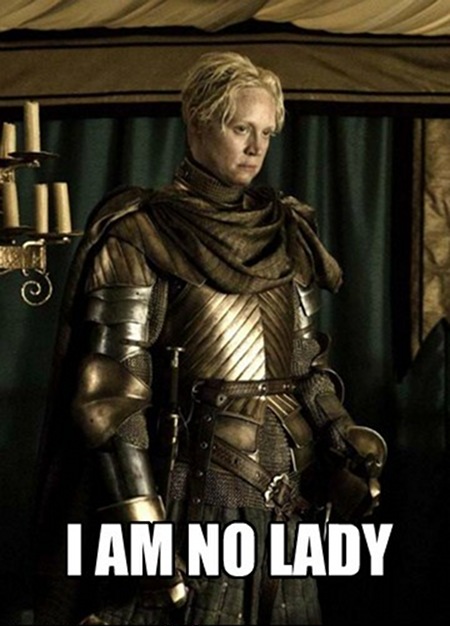
In Seasons 2 and 3, a few female figures threaten to upset the patriarchal framework. As before, there is Arya, astute, principled, fierce, and eager to promise death to her enemies. Brienne of Tarth, giant, loyal, lethal, dismissive. Ygritte, rugged, capable, sexually dominant, a hardened killer with no respect for rank (“If you ripped my silk dress, I’d blacken your eye”).[1] And yet in each case the threat is contained and wrapped in some familiar gender constraints.

Continue reading