Notes on Ex-Yu Justice, Part III

Following Part I and Part II


The court is incompetent

The ICTY is constantly criticized for its organizational and procedural shortcomings, but is it fatally “incompetent”? To the extent that it resonates with ex-Yugos this charge must be made in the abstract only – the living ICTY is incompetent compared to the ideal ICTY. Compared to national legal venues, especially as they operated until recently, the court is indispensable, however (more on this below). Further, the ICTY is perceived as the big fish court, and the ability to get those “most responsible” is regarded as one of its strengths. And yet, much of this hard-earned reputation is being squandered in a series of rulings that acquitted some very big and very nasty fish.  Even its supporters feel like the ICTY has lost its mojo.

Consider the Momčilo Perišić case. Here the Yugoslav National Army commander who was first convicted (27 years in prison!) for aiding and abetting war crimes perpetuated by Serb forces across the river Drina, and then completely acquitted by the Appeals Chamber. Logistically and financially supporting génocidaires may not be a crime after all! Putting aside the inability of the prosecutor to ever establish a clear chain of command going from Belgrade to Pale and Knin respectively, this ruling changes the current legal understanding of the principle of command responsibility so decisively that it will almost surely protect many miscreants in the future. Some have even used it read back past ICTY rulings, breaking the chains of causation that lead to Belgrade (“this is a posthumous acquittal of Milošević!”) as well as Zagreb, and blaming  the massacres on the small fish (what’s next? Isolated cases of extremism?).

smallfry

Then there is the acquittal of Ramush Haradinaj, the prime minister of Kosovo, and that particular joint criminal enterprise (the presence of witness intimidation, note, was mentioned in this ruling). Next, the Ante Gotovina and Mladen Markač decision. The 2011 Trial Chamber ruling convicted them to 24 years for their role in, among other things, the joint criminal enterprise to expel the Serb population in Krajina following the 1995 Operation Storm (with Tudjman as the enterprise’s CEO again). Then, earlier this year, the Appeals Chamber ruled, in a split decision, that no such joint criminal enterprise existed (as well as that some Mladić-style military actions might be ok, but let’s put that aside for now). And last, the Jovica Stanišić and Franko Simatović case: the ICTY found no qualms with their arms dealing, bankrolling para-military formations and otherwise supporting of the Serb administrations in Bosnia, Croatia, and Kosovo, and, above all, no evidence of conspiracy to bring about the removal of the non-Serb population from any part of the former Yugoslavia (the rest of their ghastly dossier, so much of which is easily accessible via YouTube, fell outside the court’s scope).

Continue reading

The Office Of Blood; Or, ‘The Act Of Killing’ (2012)

The images and scenes we discuss below are not those of a conventional film plot. Nevertheless, *spoiler warning*.


Act Of Killing Anwar Screen

It’s hard to know how to write about The Act Of Killing, the unsettling, surreal, humanising, nauseating portrait of an Indonesian death squad that is generating such interest. Joshua Oppenheimer, Christine Cynn and the mainly anonymous Indonesian crew (anonymous for fear of retribution) have conjured something quite extraordinary into the world. Laced with caustic insights into atrocity, empathy, memory, commodification, artifice, power, solidarity, fear, self-deception and play.

One million people were killed in Indonesia in the mid-60s following a military coup. The massacres which aimed at obliterating “communists” (along with ethnic Chinese and intellectuals) have been largely undocumented, with many of the perpetrators occupying prominent positions in the Indonesian government. Without wishing to give too much away or to channel and pre-empt the multiple, contradictory emotions that it is bound to elicit, the main conceit is a film within a film where the murderers re-enact their murders, all the while debating whether to recreate this method, or whether that victim would have cried out in that way, and sometimes whether they might just be showing us too much truth in their performances of the past. At one point there is the satisfied declaration that these scenes of re-articulated horror will be seen as far away as London! Part voyeurs, part students, we are thus implicated in their narratives, viscerally. Aghast, covering our eyes, retching when they retch, laughing guiltily at moments of shared humanity.

The Act Of Killing is a deliberate move from the ‘theatre of the oppressed’ to the ‘theatre of the oppressor’, a move that is challenging not simply because we – those ostensibly passive spectators – are made to face deeply uncomfortable ‘truths’ but also because it is above all a movie that painstakingly documents what Hannah Arendt, in a different context, called the ‘banality of evil’. Whilst there is nothing anodyne or sanitised about these gruesome renactments, they are almost flippantly juxtaposed with the mundane rituals, pedestrian encounters, and even moments of compassion and kindness that make these men all too human. The result is an audience suspended between empathy and disgust, between acceptance and incredulity, and between the absurd and the quotidian.

The Act Of Killing, for us at least, is a gut-twisting manifestation of sometimes nebulous socio-political insights. Insights such as Agamben’s ‘camp’ or Foucauldian ‘state racism’: concepts that suddenly unfold themselves before us on film, embedded as they are in a context otherwise deeply unfamiliar to us. But although seemingly focused, somewhat narrowly, on Medan, Indonesia the ambit of The Act is far greater: it offers a compelling commentary on the connate imbrication of capitalism, commodification, legality, sexual discrimination, racism, and their inescapably violent manifestations. It is less a document-ary about Indonesian history than a meditation on violence, memory and subjectivity themselves, a provocation made universal precisely because of its lingering gaze on these few aged torturers.

Continue reading

The Manning Trial, Truth-Telling, and The Precariousness of Democractic Society

The following is a piece written as part of an interview I did at City University on the political and ethical significance of the Bradley Manning trial currently ongoing (links to potentially embarrassing video to follow).

I think that the most important thing that the Bradley Manning trial shows us is the gap that opens up between our legal institutions and our sense of right and wrong, between the law and morality. Many people around the world are shocked by Manning’s imprisonment. People are shocked partly because he has been held under conditions that the UN said violated his human rights, but also because Manning is being tried for exposing the actions of US soldiers and diplomats, including evidence of many potential and confirmed human rights violations. Manning’s supporters are incredulous and view the proceedings now taking place at Fort Meade as illegitimate.Bradley Manning War Crimes

I understand this incredulity and on a level I share it. What I want to suggest, however, is that what we are seeing in the trial of this young man is even more troubling than the corruption of the law by politics – it reveals that the law is always suffused with politics. The law is a technical code. Yes, it is also a normative system that is supposed to determine right and wrong, guilt and innocence. But it is vital that we do not forget that it is a technical code first and foremost, a code that political authorities use to justify their power. Therefore, those with the capacity to influence and manipulate the legal code will always be at an advantage, will always be able to shape that code not towards the pursuit of justice but towards their own interests. This is what Finnish legal scholar Martti Koskenniemi calls this the gap between apology and utopia. The law has its utopian moments and this is especially true of human rights law – for example, Manning supporters see him as a hero who has exposed the grievous crimes of the US government and its military, particularly in Iraq and Afghanistan. They appeal to human rights standards that are quintessential moral claims, but which sadly lack the force of political authority and so are not reliably protected. This is important, but the law also has its moment of apology, where it serves the interests of established authorities, of powerful actors like the US government.

Continue reading

What We Talked About At ISA: The God Complex – Biopolitical Ethics

The paper I presented at the ISA is part of a larger project in which I look at the ways in which ethics, in the context of certain political practices, is saturated with biopolitical rationalities. The (re)surfacing and framing of hitherto morally prohibited practices – torture, extraordinary rendition, extrajudicial assassinations – as justifiable, legitimate and even necessary acts of violence, paired with rapidly advancing and increasingly autonomous military technologies that facilitate these practices, has opened new dimensions and demands for considering just what kind of ethics is used to justify these violent modalities. I’m specifically frustrated by the emerging narrative of the use of drones for targeted killing practices in the interminable fight against terror as a ‘wise’ and ‘ethical’ weapon of warfare. The prevalence of utility, instrumentality and necessity in this consideration of ethics strikes me as dubious and worthy of a closer look. This keeps leading me again and again to the perhaps foolhardy, but inevitable question: what, actually, IS ethics? And more specifically: what is ethics in a biopolitically informed socio-political (post)modern context? My quest for an answer begins with the growing divergence in scholarship and philosophical inquiry of the ethicality of ethics, or meta-ethics on one hand, and practical conceptions of ethics, applied ethics, on the other.

It has been noted by philosophers and scholars across geographical and disciplinary divides, that, in recent years, there has been a growing focus in philosophical and political thought on the application of moral and ethical principles rather than the “ethicality” of ethics itself. This trend is particularly widespread in Anglo-American philosophy, and manifests itself in the striking surge of applied ethics as a subfield of ethics, which considers the chief role of ethics to be that of providing a practical guide for moral agents, based on rational analysis, scientific inquiry and technological expertise. In other words, considerations of ethics have become preoccupied with establishing practicalities and ways of application. While the practical side of ethics should, of course, not be dismissed, the domineering focus on ethics’ practicality over considerations of meta-ethics, or the ethicality of ethics, occludes any deeper engagement with what ethics actually is, how moral content is established and how we can understand ethics in modernity as something beyond a mere set of context specific norms and legal regulations, as something other than laws and codes. To make sense of this preoccupation with ethics’ practicalities, it is worthwhile to consider how ethics might, in fact, be determined by the characteristics of a specific form of society. This brings me back to the biopolitical rationalities with which (post)modern societies are infused. Continue reading

What We Talked About At ISA: Critical Pedagogies?

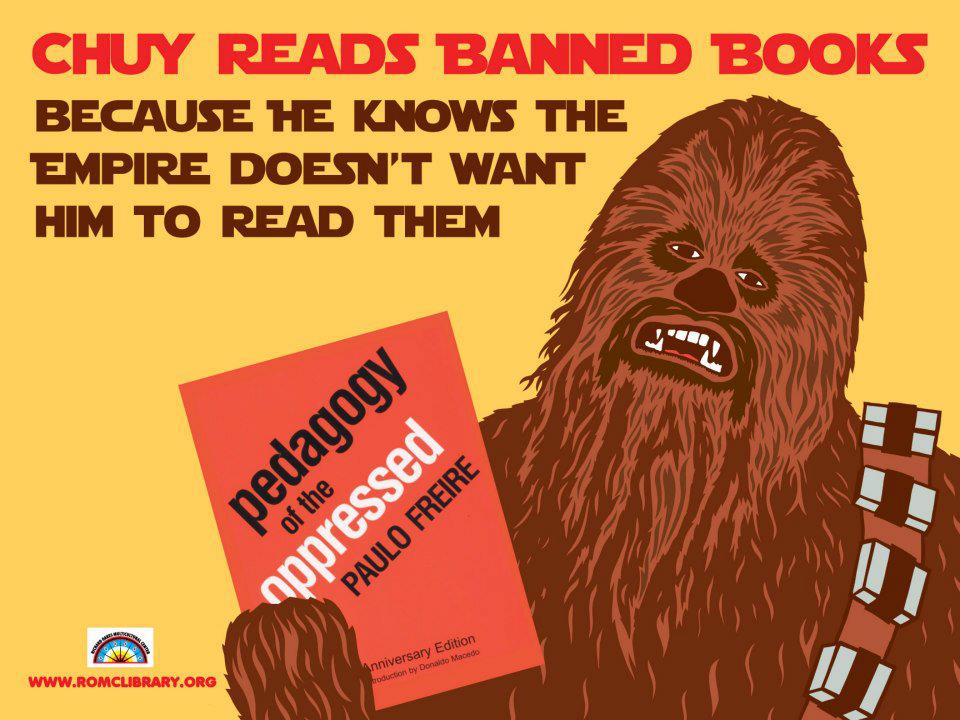
Chuy Pedagogy Of The Oppressed

There is something seductive about the idea of critical pedagogies. In an age where the figure of academic is beset on all sides by voracious spectres – the Taxpayer, the Minister, the Entrepreneur, the Curious Public, the Student-Consumer, the Management Consultant – it offers the idea that what happens in the classroom may still matter. More than matter: might in some way emancipate. This promise is perhaps particularly strong in academic International Relations, where those of various ‘marginal’ persuasions might argue that teaching against the grain undoes the destructive commonsense of global politics. That critical pedagogies help us bring back in the human, the ethical, the powerful, those daily experiences shot through with international politics, although our students don’t always see it. Even the titles hint at grand transformation: Pedagogy of the Oppressed!

Don’t get me wrong. I want to be seduced. More than that, I am all too ready to concur with many who also sat on the panel (‘What Do We Teach? How Do We Teach It?: Critical Pedagogies and World Politics’) convened by Meera in San Francisco (they were: Naeem Inayatullah, Laura J. Shepherd, David Blaney, Andrea Paras, Daniel Bendix and Chandra Danielzik). To agree that, since so much mainstream International Relations speaks the discourse of power, it is necessary to reveal its fictions and silences. To agree that narratives and memoirs have their place, alongside such ‘political’ terms as racism, patriarchy and class. To agree that it is better to start with Todorov and The Conquest of  America than it is to begin from a world of ahistorical self-help states. To agree with programmes for interventionist anti-racist education.

But I am also somewhat cautious. Some of that might be read as a spur to critical pedagogy by another name, and some as a delineating of criticality’s limit, at least insofar as that term is often discussed. Call these somewhat speculative micro-interventions the unapologetic curriculum, marginal resistance and real academic politics (always with the rule of three).

Continue reading

What We Talked About At ISA 2013: The Practice Turn and Global Ethics

We're talking about practice!

I want to address the use of practice theory in global ethics rather than International Relations or social science broadly. I am neither a social scientist nor a social theorist. My interests are in political and ethical theory, in asking questions about the good in political life. Nonetheless, questions of ethics are an important part of the turn to practice theory because such a reorientation has much to add to how we think about questions of global ethics. I also hope that my reflections on, and uses of, practice theory may be of interest to those who see themselves as social scientists.

In global ethics there is a constant concern with the issue of justification, with determining how we know what is right or good – and especially how we know that what we know is really right or good. What is surprising is how little time is spent considering the details of what is right or good in specific situations. This question it seems is already known, either because we can deduce it through some rational rule or distill it from some social tradition. This is a crude map, but hopefully adequate to place ourselves.

Even among more dissident scholars the focus is on how justifications fail, or how our justifications reproduce undesirable social consequences – the exclusion of the other, the marginalization of women – and these are absolutely vital insights. However, what remains under-examined is what we take to be right or wrong, good or bad, the substantive and at times contradictory content of our ethics. Along with this there is a lack of concern with how we think when we are being ethical, with what social role ethical claims have and with how social institutions and traditions depend upon ethical claims.

Continue reading

Reflections on Narrative Voice

The final post in our mini-forum on critical methodologies and narrative in IR. The series is closed by Himadeep Muppidi, who is Betty G.C. Cartwright Professor of International Studies and Political Science at Vassar College, New York. He is the author, most recently, of The Colonial Signs of International Relations (Hurst and Columbia University Press, 2012).


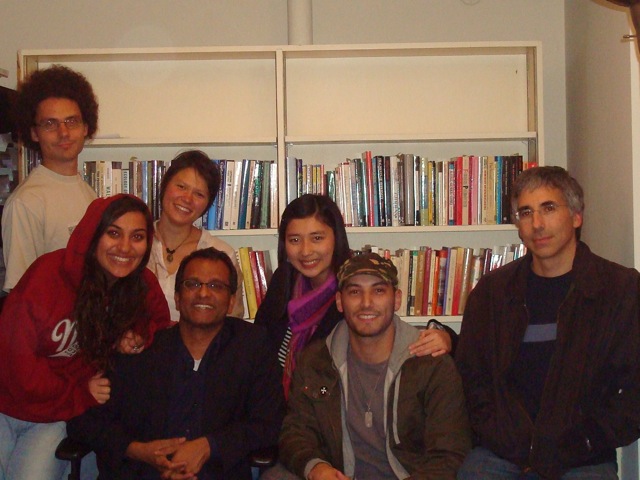
Himadeep Muppidi and Students

Himadeep (seated, fourth from left) with the ‘Vassar village’: students and faculty who were into story-telling.

I went to the York University workshop persuaded of the importance of the narrative turn in the field of international relations. I find literature in various forms useful in my teaching of international relations at Vassar, not least in opening my own provincial imagination to the worlds of others. Entering the international through narratives allows the class to engage political issues from the inside rather than pretending we were somewhere outside looking in or somehow beyond the concerns of those whose worlds we safely theorize. Narratives in different forms – novels, memoirs, short stories, and autobiographical essays – also allow for insightful translations of contemporary contexts. After soaking oneself in the nuance and complexity of narratives, conventional accounts of IR appear lifeless and boringly schematic in their attempts to straddle (our) humanity. They perish, unseen and unmourned, on the classroom floor.

But the discussions in the workshop helped me realize that narratives on their own are not enough. We need critical theories to go along with the current turn towards narratives. Colonialism too sustains itself on effective story-telling and not just brute force. It has a robust history of accumulating, systematizing and circulating its stories, not least to those citizen-subjects it narrates as its benevolent and heroic center. In IR, we often claw our way out of these archival dumps searching for fresher, more humane, worlds.

In the wasteland that is conventional IR, stories of any sort might appear, at first glance, to offer a welcome respite. But there is also, as some of our fellow disciplines can attest to, a politics of story telling: whose stories do we get to hear all the time; whose stories are generally inaudible; how do stories make us over; whose mansions do stories furnish with humanity in every remote room and whose huts do they deprive of life and dignity. Perhaps we need to explore these inequities of the political terrain more even as we take the narrative turn seriously. The question I left with from the all too brief workshop, one that is not a new one by any means, was: How can we, in IR, engage better the diverse worlds of the human international, as they come to us through narratives, without losing sight of the politics of inequity staging their appearances and disappearances?

And there I would have stopped but Naeem Inayatullah encourages me to say more. He wonders if what I am saying is: “No matter the turn, it will be dominated by Europe. So what can we do to give the narrative turn a chance at something else?” I am unsure if it is Europe’s renewed domination of the wasteland that bothers me as much as the prospect of another lost opportunity to plough newer terrain.

Maybe I should defer to the voice of a better storyteller. In a 2009 TED talk, Chimamanda Adichie speaks to what she calls the ‘The Danger of a Single Story’. In this short, approximately 20 minute presentation, Adichie draws our attention to a number of issues relevant to our thinking about stories and storytelling: to how “impressionable and vulnerable” we all are in the face of stories, to how the British and American stories she read as a child opened her imagination and at the same time shaped her childhood writing so much that the stories she wrote, even as she grew up in Nigeria, were of British and American worlds (filled with discussions of the weather and ginger beer). Reading stories by writers such as Chinua Achebe, she tells us, brought her to other worlds in which she could recognize characters like herself. Adichie is appreciative of the ways in which British and American stories opened up her world even as she highlights the dangers of knowing only those stories. This is not just an inter-country issue either.

Even the Nigerian context she imbibes as a child is not shaped by a single story though it takes her a while to realize this. There are subaltern worlds here (the world of the domestic help for instance) that she sees only in a thin and caricatured form at first since the story of “their” poverty dominates her imagination and occludes all their other ways of being human. Adichie insightfully connects stories and storytelling to questions of structural power and narrative homogeneity: our socially learned capacities to hear and tell diverse and plural stories of one’s own world while hearing and re-telling only single stories of the other. Adapting Adichie, I wonder if, given the social structures of teaching and learning IR that we currently inhabit, the narrative turn would only result in a renewed cycle of seemingly new stories about the diversity and humanity of Europe and single and simple stories about its Others.

But Naeem’s question continues to smile at me: “So what can we do to give the narrative turn a chance at something else?” It knows that I haven’t responded fully to it yet. I am tempted to say that I prefer to think with you all on that one. Maybe my partial response would be, in anticipation of a broader and longer conversation, that it is not writing alone but reading and teaching that we need to work further on. Maybe we need to begin by reading and teaching an international in which there are multiple other stories than the one or few we already know about IR’s others. Maybe that is the implicit promise of storytelling conceptualized, critically, as a politics of exile.


Suggestions for further reading: Sven Lindqvist, Eduardo Galeano, Assia Djebar, Amitav Ghosh
Oxygen: Impressions from the Workshop ‘Critical Methodologies: Narrative Voice and the Writing of the Political – The Limits of Language’

Oded LowenheimPost seven in our ongoing mini-forum on methodology and narrative in (critical) IR. This time it’s the turn of Oded Löwenheim, who is Senior Lecturer at the Department of International Relations, The Hebrew University of Jerusalem.  His interests lie in the field of emotions and politics, autoethnography and IR, and investigating the peculiarities of power, so to speak, in various issue areas and fields. He is the author of Predators and Parasites: Persistent Agents of Transnational Harm and Great Power Authority (The University of Michigan Press, 2007), and The Politics of the Trail: Reflexive Mountain Biking along the Frontier of Jerusalem (The University of Michigan Press, forthcoming in 2014). His articles appeared in International Studies Quarterly, Security Dialogue, Security Studies, International Political Sociology and the Review of International Studies. At the Hebrew University he teaches courses on science fiction and on politics and autoethnography and IR.


The two days of the workshop were very intensive for me, in terms of both the many talks and conversations we heard and had, and in terms of the emotional weight I felt during these discussions. Some of the talks we heard were not easy to hear: people told about their personal experiences of places such as the “highway of tears” in British Columbia, Hawaii as a colonized space, or escape from worn-torn Eritrea. Other stories dealt with personal loss and the political meanings of grief; or, of opening up to the inner world of what I, and many other in the West, call “suicide bombers,” while they consider themselves as martyr soldiers; or, of the pain of Inuit people in Canada. But despite the sometimes difficult stories and realities, I felt I am full lungs breathing. I felt that the stories and the responses to them fill me with oxygen, almost literally.

We talked about the way stories and narratives can bridge gaps between people and enable us to reach out to the humanity of others. Yes, stories can be fabricated, manipulated, or exploited to reproduce hegemonic or dominating orders, some of the colleagues in the workshop reminded the participants. Stories can also serve a claim for authenticity, by virtue of the author/teller “being there,” while in many manners, there cannot be such a “there” from the outset. But stories, nonetheless, can create a strong sense of community, I felt. The more I heard the various talks, I realized that we live in a world that values distance and objectivity, but these values also contribute to human loneliness and atomization of societies. Narrativistic research not only challenges the traditional methods of writing in order to highlight various power structures that these methods ignore or do not capture fully. It can also have the potential to restore and to rebuild some sense of community among authors and their readers. By community, I do not mean only a professional community of academicians, which is often a small and closed one, but also a larger human community. Narrativistic writing, I felt during the workshop, can help people resist this institutionally – and structurally – imposed loneliness that is so characteristic of our times, both in academia and in broader society. Lonely people are easier to govern than people with a strong sense of belonging, connection, and community.

One of the most interesting conclusions I took from this workshop was Jenny Edkins’ comment (I hope that was indeed what she meant …) that while the state’s sovereign narrative is about completeness and continuity, a linear story in which there is a clear beginning and a path along which history continues, a path which the state – and I may add in a Foucauldian manner, its admirers/reproducers in academia – purport to know, in many political and historical situations reality is wounded and full of gaps and crevices. Narativistic writing acknowledges these gaps and irregularities, disrupts the linear narrative, but at the same time offers some comfort by engaging in a process of writing about the wound and, no less important: letting the wound write us back.

Indeed, writing about my own wounds and letting them write me back is an essential part of my autoethnographic work. Continue reading

In Praise of Question Marks: Reflections on ‘Critical Methodologies: Narrative Voice and the Writing of the Political – The Limits of Language’

Jennifer RigganThe sixth post on critical methodologies and narrative, by Jennifer Riggan. Jennifer is an Assistant Professor of International Studies in the Department of Historical and Political Studies at Arcadia University, where she began teaching in 2007.  She holds a Ph.D. from the Education, Culture and Society program at the University of Pennsylvania, where she received training in political and educational anthropology and African Studies. Her ethnographic research addresses a variety of issues including nationalism, citizenship, state formation, militarism, development, and education. She has published on the changing relationship between citizenship and nationalism and on the de-coupling of the nation and the state. She is currently working on a project entitled The Teacher State: Militarization and the Reeducation of the Nation in Eritrea which explores the role of teachers in state-making in the east African nation of EritreaThis research has been funded by a Fulbright research fellowship, a Social Science Research Council International Dissertation Field Research Fellowship and a Spencer/National Academy of Education Postdoctoral Fellowship. Dr. Riggan earned a B.A. in English from Trinity College in 1992 and served as a Peace Corps volunteer in Eritrea from 1995 to 1997.


Alienation

I show up at the workshop on October 26th, not quite sure what to expect. I have gone through the ritual preparations for a conference. I have crafted a carefully cultivated appearance—professional, but not formal attire. Light makeup, hair blown dry, hopefully neat but not overly coifed. Glancing around the room, I’d say many of us have made the same preparations. This is a conference. We all know how to perform ourselves for this venue. The ritual is familiar to us. Notebooks at the ready. Cups of coffee in our grips. A firm handshake of greeting when we meet someone. A socially acceptable hug or kiss if we know someone well. Small talk about our institutions, our research, our teaching. Occasionally our children make a brief appearance in the conversation. When we sit down to introduce ourselves, my voice emerges from my mouth, confident and assertive. I hear myself speak and I don’t recognise the sound, even less the tone. How certain this person sounds, I think, I could be convinced by this person.

For me, the ritual is essential to make me believe in the performance. After all, I have no idea why I’m here and I assume, as usual, that some mistake was made when they invited me. Do they really know who I am? The preparatory rituals, the carefully calibrated appearance, the performance of being academic acts as a talisman against someone pointing the finger at you and crying, “imposter!” I say it to myself all the time. But in an odd form of ritual alchemy, I become what I perform. I fake it until I make it and then I actually believe in this ‘I’ that I barely recognized a moment before. I have become the performance. But when I get lost in my performance, where have I actually gone?

Question Marks

We are here to talk about stories. Some of us tell stories. Some of us make arguments about stories. Stories, like academic rituals, are performances. Are they any less alienating than the ritualization of self? The most honest of us raise questions about stories or tell stories that ask questions. Himadeep Muppidi’s poignant and simple assertion, “empire tells amazing stories,” has stayed with me since that day like a song whose words you can’t get out of your head. We are all penetrated by the empire’s stories. They make us cry and fill us with pride or righteous indignation. They have answers. But how do we tell stories that perform less and question more? This is hard to do in a world, and a profession, that prefers periods or exclamation points to question marks. Our language limits us. What is the point of a question without an answer? What do we become in the absence of our performances of certainty?

Continue reading

Narrative, Self, Agency: Reflections on a Workshop

Richard JacksonRichard Jackson offers the fifth post in the Methodology and Narrative mini-forum. Richard is Professor of Peace Studies and Deputy Director of the National Centre for Peace and Conflict Studies, University of Otago, New Zealand. He is the author of Writing the War on Terrorism: Language, Politics and Counterterrorism (Manchester University Press, 2005), Conflict Resolution in the Twenty-first Century: Principles, Methods and Approaches (Ann Arbor MI: Michigan University Press, 2009; co-authored with Jacob Bercovitch), Terrorism: A Critical Introduction (Palgrave-Macmillan, 2011; co-authored with Marie Breen Smyth, Jeroen Gunning and Lee Jarvis), and numerous related articles. He is also the Editor-in-Chief of the journal, Critical Studies on Terrorism. He blogs at Richard Jackson Terrorism Blog, where part of this post originally appeared.


Any scholar who has ever reflected on their academic career can identify a number of key transformative turning points along the way – those moments when some new insight or experience turned you from the path you were on and sent you in an exciting new direction. It may have been a particular lecture, a book, a chance conversation, a teacher. Either way, it altered your thinking and set you on a new course. Reading Joseba Zulaika and William Douglass’s Terror and Taboo in the days after September 11, 2001 was one such turning point for me. I never would have become interested in critical terrorism studies if I hadn’t found a sale copy of that book in the Otago University Bookshop exactly when the world seemed to be going crazy about the ‘new’ threat of terrorism. The books I later wrote, the journal I helped to start, the conferences and panels I helped to organise – all that might not have happened if I hadn’t picked up that particular book when I did. Sometimes our lives turn on a simple moment that seems utterly ordinary at the time.

Attending a workshop on ‘Critical Methodologies: Narrative Voice and the Writing of the Political – The Limits of Language’ organised by Elizabeth Dauphinee, has proved to be another of these important turning points in my academic career. It has transformed me to a degree I never imagined; I feel that I am no longer the scholar or person I was before I went to Toronto for what I thought would be just another interesting but not necessarily out of the ordinary kind of academic workshop. I’m on a different path now. I want to do different things than I did before. It’s not that I have it all mapped or know where I will end up. I just know that I don’t want to continue to be the same kind of scholar I was before or pursue my work and academic career in the same way.

In preparing for the workshop, and during the workshop discussions, I had a genuine moment of revelation about how powerful narrative can be – as a mode of thinking, a way of writing, a method of teaching, a way of seeing and being in the world. I hadn’t really grasped it before, but I learned that narrative can help you connect more deeply with students in teaching situations, and also help them to learn in new ways; it can engender deeper levels of affective understanding and insight of subjects like war and politics; it can help to de-subjugate silenced voices and knowledges; it can challenge dominant political narratives and reveal the operations and effects of discipline and power; it can make your work more interesting and accessible to the reader. During the workshop, we discovered a great many reasons for considering narrative as a powerful tool and approach to IR which ought to be more widely used and legitimised in our discipline.

In relation to critical terrorism studies, the field I am most deeply involved in, I had already started to think that we needed other forms of production apart from scholarly books and articles to make a greater impact on the wider culture – such as films, novels, plays, art, music and so on. However, until I met the other writers and scholars at the workshop and heard their stories and experiences, and how narrative has affected them and impacted on their research, I hadn’t really understood just how powerful and transformative narrative writing could be.

Among other things, perhaps the most important revelation for me was when I came to see that narrative writing – especially auto-ethnographic narrative writing – can be an important step in understanding how your own subjectivity has been constructed, and how in turn, this can be an essential step towards greater individual agency and a kind of personal emancipation. For example, soon after the workshop I began to reflect upon, and write about, how my experiences had shaped my academic and political outlook, leading me down a particular path – and also how those experiences had enriched my understanding of some of the political phenomena I study as an IR scholar. Partly as a result of this auto-ethnographic reflection, I subsequently ‘came out’ in relation to my pacifist beliefs. I wrote the following piece not long after the workshop and published it on my blog.

Continue reading