American Vignettes (II): The Spirit’s Agenda

Most of our day we are unaware of what we are thinking, but it is not our thoughtlessness that is disconcerting, it is our lack of awareness of our thoughtlessness.

It is rare to be in a space uncluttered by social messages, but you suddenly find even your modern sensibilities assaulted as you make your way through contemporary America. There are the expected advertisements, but they cover more of the physical surface of the world than you remember. There are the expected automated announcements, but they pierce the air and reverberate more loudly than you remember. You watch as everyone else moves through this cloud of demands, warnings, enticements, and you wonder: “does their head spin as mine does?”

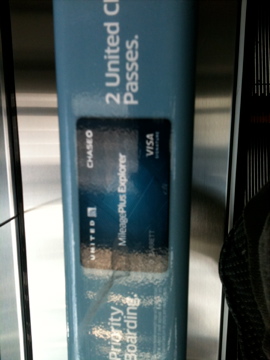
IMG_0135

Advertisement on escalator railing.

The cab you take across Manhattan has a television screen constantly playing commercials – you can silence it but you cannot turn off the scrolling images. The roads you drive down in New York, Chicago and Denver have their negative space filled by an uncountable number of signs, billboards, words – every surface a text. Even tucked away from the public stream of communication, in your home or in your car, the words and pictures crash over you: television is ubiquitous and its light flashes on you wherever you go, the radio blares at you in the coffee shop and the eye doctor’s waiting room, the ads flash on your computer screen as you write emails to friends, and the messages and updates ding and chime on your phone as you sit down to eat a family meal.

The frenetic quality of the day only appears once you are lying in an unfamiliar bed, in a quiet dark room, when you can hear your parents breathing as they sleep down the hall from you, when you can hear the geese who have come south from Canada honking in the distance, when your mind stops receiving, blocking, dodging, collecting words and is able to put its own thoughts together. Being out of place and out of rhythm, you feel the importance of this moment. Slowness. Quiet. Rest. Continue reading

Narrative, Self, Agency: Reflections on a Workshop

Richard JacksonRichard Jackson offers the fifth post in the Methodology and Narrative mini-forum. Richard is Professor of Peace Studies and Deputy Director of the National Centre for Peace and Conflict Studies, University of Otago, New Zealand. He is the author of Writing the War on Terrorism: Language, Politics and Counterterrorism (Manchester University Press, 2005), Conflict Resolution in the Twenty-first Century: Principles, Methods and Approaches (Ann Arbor MI: Michigan University Press, 2009; co-authored with Jacob Bercovitch), Terrorism: A Critical Introduction (Palgrave-Macmillan, 2011; co-authored with Marie Breen Smyth, Jeroen Gunning and Lee Jarvis), and numerous related articles. He is also the Editor-in-Chief of the journal, Critical Studies on Terrorism. He blogs at Richard Jackson Terrorism Blog, where part of this post originally appeared.


Any scholar who has ever reflected on their academic career can identify a number of key transformative turning points along the way – those moments when some new insight or experience turned you from the path you were on and sent you in an exciting new direction. It may have been a particular lecture, a book, a chance conversation, a teacher. Either way, it altered your thinking and set you on a new course. Reading Joseba Zulaika and William Douglass’s Terror and Taboo in the days after September 11, 2001 was one such turning point for me. I never would have become interested in critical terrorism studies if I hadn’t found a sale copy of that book in the Otago University Bookshop exactly when the world seemed to be going crazy about the ‘new’ threat of terrorism. The books I later wrote, the journal I helped to start, the conferences and panels I helped to organise – all that might not have happened if I hadn’t picked up that particular book when I did. Sometimes our lives turn on a simple moment that seems utterly ordinary at the time.

Attending a workshop on ‘Critical Methodologies: Narrative Voice and the Writing of the Political – The Limits of Language’ organised by Elizabeth Dauphinee, has proved to be another of these important turning points in my academic career. It has transformed me to a degree I never imagined; I feel that I am no longer the scholar or person I was before I went to Toronto for what I thought would be just another interesting but not necessarily out of the ordinary kind of academic workshop. I’m on a different path now. I want to do different things than I did before. It’s not that I have it all mapped or know where I will end up. I just know that I don’t want to continue to be the same kind of scholar I was before or pursue my work and academic career in the same way.

In preparing for the workshop, and during the workshop discussions, I had a genuine moment of revelation about how powerful narrative can be – as a mode of thinking, a way of writing, a method of teaching, a way of seeing and being in the world. I hadn’t really grasped it before, but I learned that narrative can help you connect more deeply with students in teaching situations, and also help them to learn in new ways; it can engender deeper levels of affective understanding and insight of subjects like war and politics; it can help to de-subjugate silenced voices and knowledges; it can challenge dominant political narratives and reveal the operations and effects of discipline and power; it can make your work more interesting and accessible to the reader. During the workshop, we discovered a great many reasons for considering narrative as a powerful tool and approach to IR which ought to be more widely used and legitimised in our discipline.

In relation to critical terrorism studies, the field I am most deeply involved in, I had already started to think that we needed other forms of production apart from scholarly books and articles to make a greater impact on the wider culture – such as films, novels, plays, art, music and so on. However, until I met the other writers and scholars at the workshop and heard their stories and experiences, and how narrative has affected them and impacted on their research, I hadn’t really understood just how powerful and transformative narrative writing could be.

Among other things, perhaps the most important revelation for me was when I came to see that narrative writing – especially auto-ethnographic narrative writing – can be an important step in understanding how your own subjectivity has been constructed, and how in turn, this can be an essential step towards greater individual agency and a kind of personal emancipation. For example, soon after the workshop I began to reflect upon, and write about, how my experiences had shaped my academic and political outlook, leading me down a particular path – and also how those experiences had enriched my understanding of some of the political phenomena I study as an IR scholar. Partly as a result of this auto-ethnographic reflection, I subsequently ‘came out’ in relation to my pacifist beliefs. I wrote the following piece not long after the workshop and published it on my blog.

Continue reading

To Yahya

The fourth in our mini-forum on critical methodology and narrative (the full series is here). This entry is authored by A—, a student and activist who shall remain nameless, the political realities and personal dangers of our world being as they are.


To Yahya,

I remember your eyes, your fearful and tired eyes. Your shaking voice is in my ear, repeatedly asking “do you think they want to kill me?” And my desperate answer “no they won’t; we will not allow them”. I am sorry Yahya. When I came to Canada there was no information about you, they had removed you from the…. And took you to an unknown place. We had tried so hard to find you but we could not. I am sorry. I know you thought I forgot you, but I did not. After I heard you were executed I was devastated. Your and other political prisoners’ (who we were trying to help) death embedded in me an incredible pain and weakness. I lost everything that I had believed before, my power, my self-esteem. Everything seemed hollow and reasonless. I lost my faith in humanity, International Law, NGO’s, the UN, Human Rights, the media… and all the places I wrote to and never got any response or any practical help. I see my weakness and I understand that beyond that hollow propagandas nothing actually exists that can do something. After that, I hated all of them, I hated the government and I hated the world for not seeing your pain, for not hearing your voice. Yahya, I hated myself as well. You were such a young and bright man that I could not tell you the truth: that we could do nothing to stop them. That our effort is useless, a waste of time, a waste of life and it does not come from power it only came from the fact that we wanted to make the world see what is happening here. “So what?” you might ask and I do not have any answer for you except to say I am so sorry, I am so terribly sorry.

When I came to Canada, I deliberately tried to keep you and the memory of other prisoners in the distance to avoid the pain. However, your face, your eyes, your fear, your anxiety, are embedded in my mind and will not leave me alone. It creates such a guilt that even If I feel that I am happy for a second, I feel terrible afterward. You come to my mind and I nag myself “shame on you!” and then I think: ‘how afraid were you when they were taking you to hang? Did you scream? Did you cry? How did you feel, Yahya? Because I feel an unimaginable pain in my chest when I think about it. Then everything goes black again and nothing remains to make me happy. Afterward, I feel good about myself, “you had better grieve, A–” I tell myself, “you did not do anything, you deserve to grieve”. Yahya, do you hate me? Do you hate me that I am still alive and you are dead? Do you hate me that you were being tortured but I have not?

When I talk to my fellow students about political prisoners in Iran I try to be so mature and rational to not make them think I am wounded or emotional. However, I wonder if you guys would hear me in that moment and think that I lost my emotions about you. Sometimes I curl up in a corner of the room and start to create creepy voices as if I am dying, pretend to be dead, just to see if I understand you and others’ feelings when you were being hanged and could not breathe. I am not saying these things to you in self- pity. I am just saying them to make you understand that I did not forget you, I won’t. Your voice is here, all over my head, and I do not want it to disappear, I want to yell and cry out your words, but they stick in my throat and only tears come out.

I am writing this letter to let you know that I am so sorry, that I am in pain as well, that I want you to stay and have a voice. I left my loved ones, Yahya. I know it is not comparable with your pain. But I was punished as well. I forced to be alienated from all that is familiar to me and isolated from all the kindness of my loved ones. I remained breathless like you did Yahya, but my breathlessness was only emotional while yours was both physical and emotional. I was punished like you, for seeking my rights, for helping you, and for having a voice. How odd it is for the people here, you know? How odd it is for an eighteen-year-old boy here to do what you have done. To sacrifice his life for a political purpose. When I see a young boy in my school I remember you. Then, I feel terrible for so many beauties in the world that you did not see, for all your ambitions that you could not achieve, and for all your dreams and lost opportunities. How cruel was the cord that took your breath away and how cruel is the world to not care about that action.

I want to shout, Yayha, that you are always remembered, that you are always part of this world and that you are always part of a beautiful chapter of my narrative. I could not save you but I can save your voice. At least I promise you this time…

—–

I sit on my coach, lean back with a pen and paper on my hand, staring at my white piano that I have not touched for few months. “Where should I start?” I think. I am repeatedly asking this question of myself but every time I try to write I find myself overwhelmed with a painful ache in my heart and tears in my eyes. “Let’s try looking through some pictures,” I think, they could inspire me. I take my phone from the table, and I start looking at my pictures. “I did not take very many pictures in Canada,” I wonder why; maybe I do not have enough time. Suddenly, I stop by the picture of Sahand (a mountain in the northwest of Iran, near the city that I used to live). I took the picture from the airplane while I was coming to Canada, it is the picture of its highest peak surrounded by clouds. My eyes get wet again. When you are being forced to leave a place that you were born and raised, everything about that city or region gets a sacred place in your heart. When you understand that you might not see them again you start missing them so much. Sahand is the highest mountain in the province where I lived (East Azerbaycan) and it is called ‘the beautiful mountain’ because it is full of shaghayegh (Anemone Coronaria) in spring. Shaghayegh is the symbol of dead people in Iran. People in my region take a full fist of the soil of the graves of their dead and spread it on the Sahand to turn their loved ones to flowers, so they can be born again all over the Sahand’s body. My tears start to drop again. Yes, I missed Sahand, but it is something more. Something is digging at me from inside. A sense of being useless, or being guilty. My purpose here is to narrate my own past activism to free political prisoners who were sentenced to death, but something is preventing me. Guilt, this is the emotion, I could not let go. Will I be able to finally forgive myself? To stop punishing myself and to truly justify my deeds? Maybe I am starting from the wrong side, maybe I should justify myself to you, may be I should beg forgiveness from you. Then I could rest, then I could forgive myself…
Narrative, Politics and Fictocriticism: Hopes and Dangers

Anthony Burke

The third post in our mini-forum on critical methodologies and narrative in IR, now from Anthony Burke. Anthony is Associate Professor of International Politics at the University of New South Wales, Canberra, Australia. His works include Beyond Security, Ethics and Violence: War Against the Other (Routledge 2007), a recent essay in Angelaki, ‘Humanity After Biopolitics’ (December 2011), and the narrative essay ‘Life in the Hall of Smashed Mirrrors’, in Borderlands and Meanjin.


I

I have long been concerned by the way that language has two potentials with relevance to the study and practice of politics. On one hand, when combined with systems of logic and categorisation, language can construct, imagine, and fix powerful images of the real, and enable their deployment into material formations of industry, political organisation and human action. Language does not translate directly into power or constitute successful actions; it may indeed find contest and frustration. But we should hold this power in awe and watch it carefully, much as we may watch a dangerous animal that comes into our presence — after all, what more dangerous animal is there than the human, given its collective social powers of organisation and rationalisation, powers deployed through and within language?

On the other hand, particular forms and strategies of language have the power to undo and challenge this ontologizing potential: to see meaning defer and slip away, to see truths appear and shimmer into mist, to see its own strategies revealed even as it pursues them, to find itself haunted by thoughts and signs it did not intend. As Michel Foucault describes it in The Thought From Outside, this is language arriving ‘at its own edge…toward an outer bound where it must continually contest itself’. When this takes on the form of fiction, he argues, language is “no longer a power that tirelessly produces images and makes them shine, but rather a power that undoes them, that lessens their overload, that infuses them with an inner transparency that illuminates them little by little until they burst and scatter in the lightness of the unimaginable”.

This points to two strategies: one taking the form of social science, the other, the form of fiction.

I have pursed this project of deconstruction and unmasking in the form of social science, in way that both affirms and challenges its rules: to question ontologies of war and national security, the rationalist pretentions of nuclear strategy, the narrative confidence of American exceptionalism or the ‘good state’. To explore the dangers of all these things, of narrations and categories taken as truth, of choice masquerading as truth.

Yet I was also driven to literature as a possibility…of what, exactly? Continue reading

Fear and Honesty: On Reconciling Theory and Voice, in Two Parts

Kate DaleyThe second post in our guest series on critical methodology and narrative, this time from Kate M. Daley. Kate is a PhD candidate in the Department of Political Science at York University in Toronto, Ontario. Her doctoral research in feminist political theory explores responses to privilege in the context of feminist relationships and her current research interests include narrative research methods, social science education, indigenous methodologies, and anti-oppression knowledges and discourses. She lives in Waterloo, Ontario, where she advocates for projects and policies that support transportation choice, environmental protection, and vibrant public spaces.


Part I: Fear

I am lucky in this room, among my colleagues. I am working in feminist political theory, not international relations, and my discipline has been advocating for and responding to feminist work that is in one’s own voice and that tells one’s own story for decades. Still, I feel a sense of paralysis. I am 27 years old. I have passed my qualifying exams. I have written dozens of graduate papers. My work is starting to get published. I am now starting to stare down my dissertation. And I am not sure that my work has ever been truly honest.

It was my Master’s supervisor who graciously began to break my training. She encouraged me to write in the first person. In her class, I had argued passionately with some of my more conventional colleagues. I had defended the overt positionality of narrative political theory, and valorized those who had the courage to write in their own voice. And yet I most often continued to write as though I was not there at all.

So I started to use first-person pronouns in my academic writing. Sometimes I even included a personal anecdote to make my writing more compelling, more convincing. I believe firmly in the importance of personal narrative for political theory, and for social sciences scholarship. I have thrown in the occasional story to illustrate a point. But I have never really, truly, made myself visible and vulnerable in my theory.

I am afraid. I have come to a place where I can no longer only speak an I that serves as nothing more than a grammatical device between abstract ideas, or a persuasive tactic to convince others of a conclusion I have already drawn. But I cannot wholeheartedly embrace autoethnography and my own narrative, either. I am afraid.

I fear that I will learn that I can write as a faceless academic, but not as a whole person. Continue reading

Critical Methodological and Narrative Developments in IR: A Forum

Elizabeth Dauphinee 2Some months ago, Elizabeth Dauphinee (York) asked if we would be interested in hosting a series of posts resulting from a workshop on recent critical methodological and narrative developments in International Relations. We said yes. Said workshop was funded by the Social Sciences and Humanities Research Council of Canada (SSHRC) and happened in October of last year at the York Centre for International and Security Studies. It considered how narrative writing, including storytelling, autoethnography, and other forms of creative expression are currently altering the provenance of IR knowledge. Over the next week and a bit we will feature posts from many of the contributors. In this introductory post Elizabeth (who previously guest-posted on racism and the self) sets out the trajectory and stakes of the forum.


The ways in which academics and practitioners think about international politics are shaped invariably by the ways in which they produce and access information. In IR, as in all social science disciplines, there exists an established professional language that privileges the initiated, reproduces adherents through highly specialized training practices, and ignores or rebuffs intellectual ‘outsiders’. These languages sanitize academic writing and they strategically deploy their interlocutors in a style of adversarial debate that is often stagnant and exclusionary. In addition, virtually all theories of IR seek replicable truths and are deeply ill-at-ease with results that are unclear or open-ended or with projects that reveal ambiguity and ambivalence. Scholars deploying various critical methodologies have been arguing for decades that knowledge can only be partial and situated. However, this has not led to a change in the way mainstream scholarship is developed and disseminated, and even scholars who consider themselves to be critical typically operate with specialized theoretical languages and narrow intellectual coda that are often impenetrable even for the most diligent and invested student.

In recent years, these dilemmas have led to a new line of academic inquiry that may be fundamentally altering the landscape of IR. These approaches are based in autoethnography and narrative writing, and involve storytelling, explicit use of the ‘I’ as a narrating subject, and deep exploration of the interface between writers and their subject matter. Scholars who work with these approaches are showing that the form writing takes shapes its content, plots its own boundaries, and pre-determines who can comprise its audience. They are showing that researchers are always personally present in their writing, that narratives – both written and oral – are knowledge-producing activities, and that the claim to scientific objectivity is not only impossible but also, critically, undesirable. They are also showing that critical theory written in scholarly language alienates and excludes the very communities that many IR scholars are trying to reach: students, policymakers and practitioners, institutions of governance, international organizations, the reading public, to name just a few.

As this form of writing is growing exponentially in volume and scope, the workshop organizers and participants determined that the time was ripe for a sustained discussion to identify the successes and challenges facing narrative and autoethnographic approaches. Without a careful and systematic exploration of these novel methods by those who are already working with them – and also by those who are unsure of their value – narrative IR may emerge in ways that are misguided and destructive. They may emerge as an exercise in self-indulgence, or as disconnected forays into the personal and confessional without a sustained political motif. Additionally, ethical questions surrounding the disclosure of both self and other are uniquely important for narrative IR scholars, who do not purport to ‘interview’ their subjects in a formal way. And, concerns about epistemic privilege emerge in the context of approaches that do not claim to situate knowledge in any established theory or philosophical tradition.

Continue reading

Journal of Critical Globalisation Studies: A Shout-Out!

Journal of Critical Globalisation Studies Covers

Our friends and colleagues over at the Journal of Critical Globalisation Studies (which, you will recall, is a fully open access, student-and-junior-faculty-run critical IR journal) have just issued two calls: one for new members of the Editorial Team, and another for papers to fill Issue 7 on the theme of ‘Modelling Capitalism’.

Prospective Editorial Team members can find full details here. The positions are suitable for early-career lecturers, postdoctoral researchers, or PhD candidates currently in the first two years of their study and will be considered on a rolling basis. Meanwhile, the blurb for Issue 7 (deadline for submissions: 1 August 2013) is as follows:

Frequently held in suspicion by critical thinkers, modelling and simulation technologies are nonetheless more and more integral to how the world works, utilised by international bodies, governments, financial firms, and large corporations. This special issue wishes to approach in a synoptic fashion some of big themes raised by this development. Questions we are  concerned with include fundamental philosophical issues: Can economic models ever be realistic? Can they model complexity? Pragmatic questions: Is their use responsible for the depression initiated with the 2008 crash? To what extent are they changing the nature of capitalism? Political debate: Do models merely dress up dominant ideologies in technical drapery? Can models be used for critical purposes, or for proposing economic alternatives? With this issue we thus aim to bring into dialogue scholars working in diverse fields including the philosophy of science, economic modelling, the social studies of finance, and political theory.

Issue 6, on ‘Democracy and Law’, is now out and available in full.

Rethinking Masculinity and Practices of Violence

The modified text of an introduction written with Marsha Henry for our special issue of International Feminist Journal of Politics on ‘Rethinking Masculinity and Practices of Violence in Conflict Settings’ (trailed here), which came out in December 2012. The full text of the issue is currently freely available. I don’t know for how long, so get to it!


Join the Navy - The Service for Fighting Men

Why rethink masculinity and conflict? After all, the connection of men and masculinities to organised (and seemingly unorganised) violence has been subject to considerable academic scrutiny over the last decades, not least as part of the feminist critique of disciplinary International Relations. It is now increasingly common to both note the unequal character of gendered violence (it is predominantly men who do the killing and the maiming) and to stress the contingent and sometimes paradoxical status of this situation (women kill and maim too, and the content of ‘man’ and ‘woman’ varies significantly over time, space and context). The analysis of gender within global politics has also moved beyond the level of the state and war to interrogate the full spectrum of social life, from popular culture to political economy. And yet elite institutions still prove stubbornly resistant to teaching gender, feminism and sexuality within ‘the international’, despite introductory texts which increasingly offer such insights to the curious student.

Although you wouldn’t know it from some of the caricatures in circulation, feminist and gender scholars write often of multiplicity in masculinities, of varied and shifting constructions of gendered agency, and of representations of violence as themselves constitutive of gender, rather than merely reflective of a pre-existing distribution of essences. Some, like Melanie McCarry, have become rather sceptical of this situation, warning that the actions and power of men themselves are obscured in the consensus that there are many masculinities. In other words that multiplicity, discourse and construction are not advances in theory, but ways of displacing responsibility away from concrete male perpetrators. At the same time as they direct attention to the material practices of men such criticisms also tend to gloss over rich and situated examples of critical theorising along exactly those lines. A different brand of critic has sometimes suggested that feminism may be incapable of properly analysing the variety of gendered experiences in conflict. But here too, a comprehensive history of the field instead reveals many close and nuanced considerations of men and women at war.

Nevertheless, ambiguities do persist in the way feminist and gender scholars describe and account for masculinity. Against this background, a number of problems come into sharper focus. First, how are masculinities and violences connected in specific locations of power? Second, how do these connections play out internationally, in the interactions between political communities, however understood? Third, just how related are gendered identities to fighting, killing and dying in conflict settings? And fourth, how do the complexities of violence situated in this way reflect back onto theorising about gendered hierarchy and difference?

Some of these questions are more familiar than others, but the collection of articles presented in our special issue of International Feminist Journal of Politics substantially addresses them all (I know, get us, right?). Continue reading

Sour Lips: A Review

Anyone who followed the controversy over the fictitious Gay Girl in Damascus blog, created by Edinburgh-based US graduate student Tom MacMaster writing as Amina Arraf, might have despaired of the prospects of subalterns speaking for themselves. Female, lesbian, Arab, and an anti-Assad protester, MacMaster’s Amina quickly became a posterchild of the Arab Spring for a wide swath of the liberal media and activist blogosphere. For those cognizant of contemporary critiques of homonationalism against the backdrop of pervasive homophobia, Amina’s dispatches from the frontline seemed a perfect embodiment of left liberal fantasies about the possibilities for progressive sexual politics in a time of revolution. Yet if critics such as Joseph Massad have been accused of dismissing subjects who don’t conform to their theoretical predilections, the Amina hoax gestured at an opposite, if no less insidious, temptation: that of desperately seeking subjects who confirmed theoretical utopia.

Continue reading