Why I’ll Miss Jean Bethke Elshtain

A short version of a tribute to Jean Bethke Elshtain, who died last Sunday, from Christine Sylvester, Professor of Political Science at the University of Connecticut.


Jean Bethke Elshtain

She was embraced by feminists for her books on Women and War and Public Man/Private Woman, and then ostracised by the sisterhood for her disapproval of gay marriage and approval of “just” wars in Afghanistan and Iraq. She would become anathema to peace researchers and sandpaper to scholars of critical IR. Those who liked her early writings in a secular vein would be disappointed when she began to argue from a base in religious philosophies. Jean Bethke Elshtain encapsulated the best hopes of feminists to effect change in core topics of “men’s studies” –International Relations and Religious Studies –and ended up instead on the wrong side of several issues. That’s clear. So let’s ignore her recent death, shall we? Possibly celebrate her end?

Not me. I met Jean at a series of feminist IR conferences held between 1989 and 1993 in the USA, and then shared many a panel with her at the International Studies Association for a few years. Without equivocation, had I not met Jean and found favour in her eyes, I wouldn’t have produced publishable work in my own voice. Jean pulled me aside at one conference, sat me down, and told me to maintain and further develop what she called my “maverick tendencies.” The good Coloradan that she was warned against following the herd as it raced along toward…possibly nothing. My graduate school mentors had been excellent and very encouraging, especially Karen Mingst. I learned much from them, but also resisted some of their good advice once I was out on my own, stubbornly insisting on writing about Zimbabwe and feminist IR –two very different specialisations, both approached in slightly off-centre ways. To Jean, that was the way to go. Permission granted. Years later, in 2001, when she was on an ISA panel discussing my work, along with Cynthia Enloe, Steve Smith, and Dipesh Chakrabarty, she gave me a hard time over what she called my “postmodern avoidances;” by then, Jean was a solid believer in truth. She gave an audience member an even harder time, though, for wilfully misrepresenting my arguments.

Jean the scholar I admired very much. Jean the person behind the scholar astounded me. Her story, of course, appears in an early chapter in Women and War (1987), a book that came out decades before IR recent “new” interest in auto-ethnography. Jean depicts herself as a smart-ass tomboy, a shoot-em-up leader of the cavalry of kids, clearly smarter than everyone around her. But she was decidedly in the pack of youngsters who contracted polio before the vaccine, and who had to suffer the neanderthal treatments available at the time (my cousin was similarly afflicted and spent months in a hideous Iron Lung.) Thereafter, Jean walked with a noticeable limp. I remember the two of us racing like maniacs down the streets of the University of Southern California to get to where we were to speak. That pronounced limp on a shortened leg could not be ignored: I suggested we go slower. She wouldn’t have it. “I can do this,” she said, “not happily or easily, but I can do it.”
Continue reading

HEFCE, the REF, Open Access and Journals in Politics, IR and Political Theory

UPDATE (8 September 2014): Lee originally wrote this as a guest post – providing some much needed concrete detail on journal open access policies – but is now with us for good.


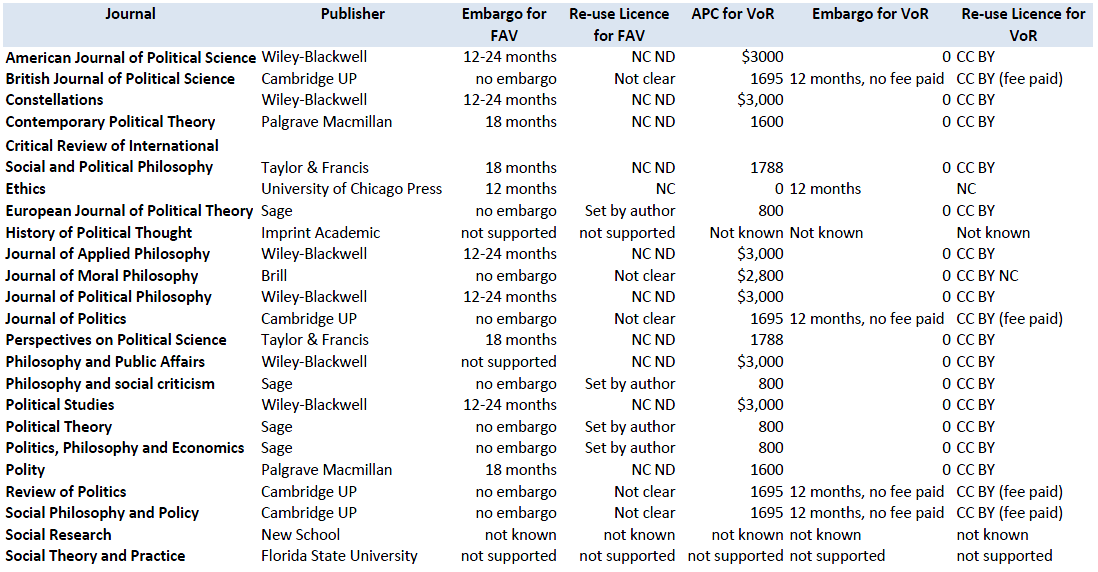
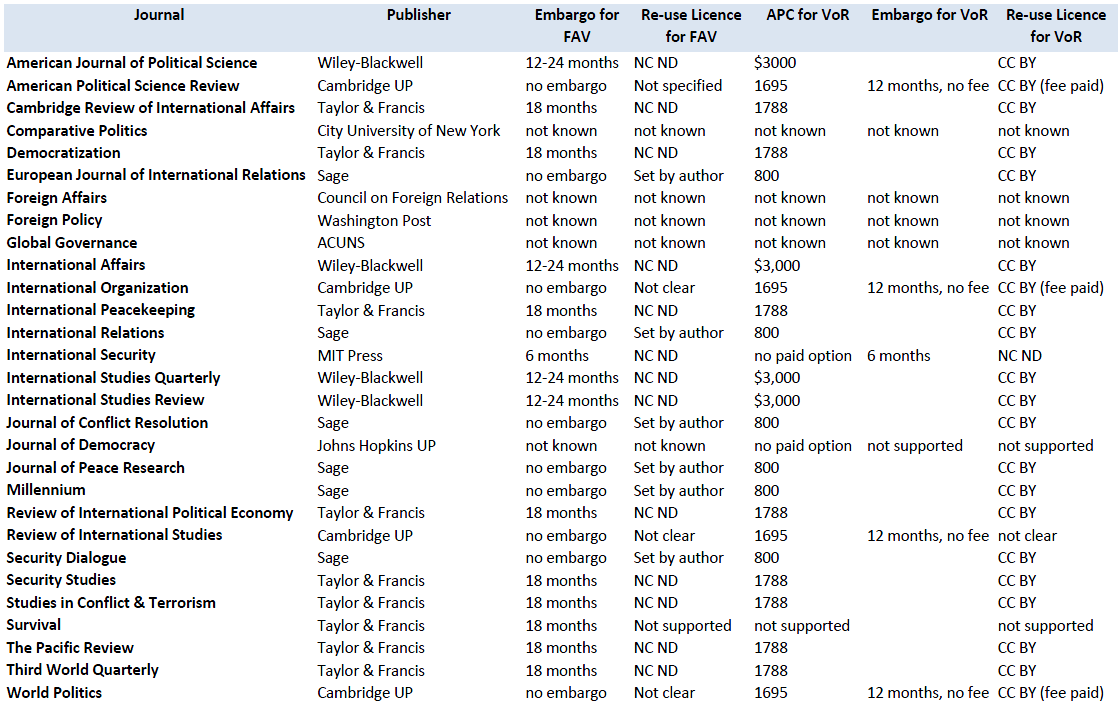
Following the launch of HEFCE’s consultation on Open Access for any post-2014 REF, and the generally positive reaction to it here, I examined the potential implications of HEFCE’s proposals for journal publishing in Politics, IR and Political Theory. I wanted to know whether the serious threat in HEFCE’s earlier proposals – notably the rush for ‘gold’ OA and associated Article Processing Charges (APCs) – had been eliminated by a downgrading of the proposals to permit ‘green’ OA, by depositing a ‘final accepted version’ (FAV, i.e. post-peer review, but pre-type setting) into an institutional repository. I also wanted to see what embargoes journals placed on FAVs (i.e. how long after the ‘Version of Record’ (VoR) is published in the journal the FAV can be made public); what re-use was permitted (what sort of licensing); and also to compare this route with the ‘gold’ access favoured by the Finch Report and the RCUK policy. I also wanted to gather information that could be used as part of a ‘soft boycott’ of OA-resistant outlets.

To do this I selected 57 journals that broadly represent the ‘top’ journals in the three subfields. I used composite rankings from Google Scholar, the ISI Citations Index, and surveys of scholars where available, and got feedback on an initial draft. The list isn’t intended to be definitive, just to give us a better sense of where the ‘big journals’ in which many scholars aspire to publish actually stand on OA.

It is not easy to get this information. Policies can vary by journal, not merely by publisher, and their websites are often opaque on the issue of self-archiving, particularly in terms of licensing. This may change if, as seems likely, HEFCE forges ahead on OA; but publishers also need to be pushed to display clearer information. The exaggerated nature of the Finch Report’s estimate of UK HE’s market power to change publishing models is underscored by the fact that US journals tend not to provide the information I was looking for (my thanks to Sarah Molloy for help with this).

The results are presented below for Politics, IR and Political Theory (click to enlarge each image). There are a lot of complexities with various journals which are shown in the full spreadsheet of results which you can see here; the spreadsheet also lets you reorder the information by different criteria.

OA - IR

Journal Open Access Policies for International Relations.

Journal Open Access Policies for Politics.

Journal Open Access Policies for Politics.

Journal Open Access Policies for Political Theory.

Journal Open Access Policies for Political Theory.

Several conclusions can be drawn.

(1) Most importantly, Pablo and Meera were basically right: the threat of HEFCE rushing to a ‘pay to say’ approach with hugely detrimental financial consequences for universities and the potential for internal rationing of APCs, has been defeated, for now (although RCUK’s policies remain intact). Some journals, particularly in the US, don’t seem to support green FAV self-archiving, or have gold APC routes – this is a problem because they would be non-compliant with HEFCE’s proposals; so we will need to push for exemptions on this score. However, by and large, where they allow FAV self-archiving, none of the journals appear to charge a fee; HEFCE’s current proposals now intend to compel more researchers to do what they are already entitled to do. So long as this does not change, HEFCE’s proposals should not involve ruinous costs or lead to APC rationing.

Continue reading

Rushed thoughts on political theory…

I am not sure I have proper post here, but I am pursuing some thoughts and it seems they might benefit from publicity. In the midst of “fieldwork” – a word I hate… Let’s scratch that – in the midst of a learning experience, in which I have been granted the opportunity to share in the struggle of some very brave people in Washington DC’s Shaw neighbourhood, I have stumbled over what seems a vital point about political theory. So vital in fact that it seems obvious now.

I spent yesterday in the Shaw neighbourhood of DC. Shaw is a historically black area, with a cultural and intellectual history that rivals Harlem or Bronzeville (in Chicago). It is also a neighbourhood in the midst of “gentrification”… wait, that’s the wrong word too. It is a neighbourhood in the midst of a campaign of displacement, moving long terms residents (mostly poor and Black – though also Latino and Asian) out of their homes and community. These people are being displaced to make way for “development” and “urban renewal” – which is a polite way of saying they are being moved for profit, because the investors and the city of Washington DC have found a way to make money off their homes and community.

Walking around the area you can see the transformation in process, as the old and new visions of the area meet like ocean currents. I sat in a park and while a young white woman jogged with her dog, a young and destitute black man watching from a nearby bench complained to himself that her dog needed to run free, not be stuck on a leash, and that the woman should have stayed in the suburbs rather than moving into his neighbourhood. And in Shaw, the writing is literally on the wall, as I walk past a former public housing complex that is now being advertised as a luxury apartment complex by a new owner keen to move out the current residence, renovate the building and move in new more profitable tenants.

I was fortunate to meet a group of local long time residents, mostly black women, who are trying to protect their homes and their place in the Shaw community. I won’t provide details here, but I will say that these people are incredibly brave and they face an absolutely monumental task. To oppose their own displacement requires them to fight against powerful adversaries using a system and a set of rules that is balanced against them. And this is where I started thinking about political theory… Continue reading

What Does It Mean To Edit An Open Access Journal?

Yet another post on open access, but this time featuring a non-Disorder voice. I recently exchanged emails with Dr Eva Erman of Uppsala University on the possibilities and constraints of open access publishing. Eva is the Chief Editor of Ethics & Global Politics, a fully open journal that not only attracts authors of note in normative international political theory (Zygmunt Bauman, Saskia Sassen, Bruno Latour, John Agnew, R.B.J. Walker, Heikki Patomäki, Lea Ypi, Catherine Lu, and our own Rahul Rao!), but has also achieved an Impact Factor above that of many well-known and ‘closed’ journals (0.808, putting it 20th in Ethics and 53rd in Political Science).[1] As we have already discussed, fully open journals of this kind (what might be termed ‘No APC Gold’ journals) can face serious resource constraints, so it is worth understanding what might be possible. My exchange with Eva is book-ended with some thoughts on what it all means.


Ethics and Global Politics

1. Who began the journal, and why?

I got the opportunity to start the journal in 2007. A woman from a newly established publishing company, Anne Bindslev who runs Co-Action Publishing, who knew about my work, asked if I thought there was a subfield/niche within political science that was lacking among prominent journals. And I thought that back then, journals in ethics were not very good at publishing articles in political philosophy and, more specifically, on international political theory and global politics; and journals in international affairs, such as Ethics & International Affairs, were not very theoretically impressive. So, this is why I said yes to launch Ethics & Global Politics. Another reason was that I became interested in open access (OA) as a publishing model, and also for normative reasons thought that a journal that publishes in global ethics, global justice and so on, should do so open access to all people.

2. How is the journal funded? Are Editors or their assistants paid? 

Together with Co-Action publishing (who now run more than 25 OA journals in natural and social sciences), I have managed to get funding for OA publication from two different Swedish funders, the Swedish Research Council and FAS. The last year, FAS has been replaced by funding from Uppsala university, where the journal is editorially based. Of course, this is an insecure situation, economically, since I have to apply for renewed funding every year, which is always a bit uncertain.

The exact budget for 2013 consists of 165,000 Swedish crona (from the Swedish Research Council) and 70,000 Swedish crona from Uppsala university. This is in total an annual cost of around £23,500 or $36,000.

Pretty much everything goes to Co-Action Publishing, who are responsible for production management, webpage, copyediting and type-setting, as well as getting everything out on professional proof reading. Co-Action Publishing do not make any profit from running OA journals. Of course, the voluntary or almost voluntary work on the editorial side, by me mostly, is more difficult to measure.

3. How do you organise, and pay for, your online presence?

Continue reading

Seven Propositions on Open Access

Also Tumblr’d.


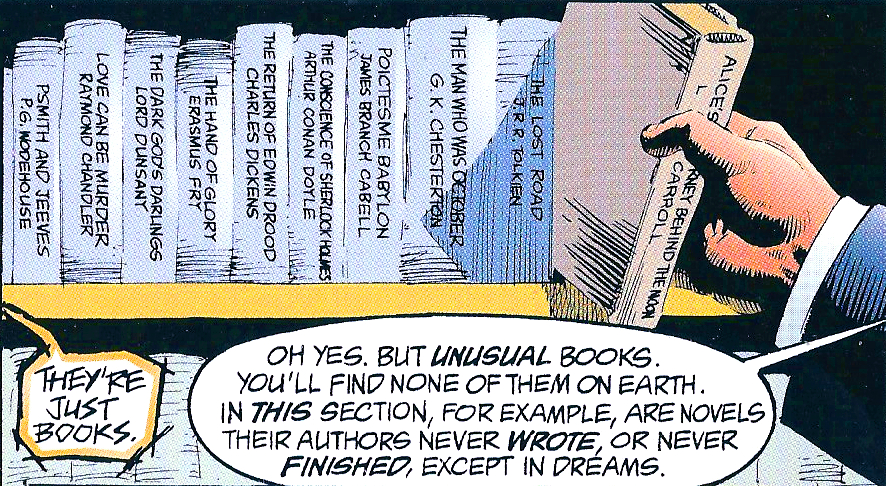
Library of Dream Lucien and Books

1. The embargo distinction between STEM (Science, Technology, Engineering and Mathematics) and AHSS (Arts, Humanities and Social Science) is arbitrary and unjustifiable: if there must be embargoes, let them be 6 months for all;

2. Set learned societies free! They can choose not to be open access if it would drain too much from their coffers. Their prestige (and the prestige of publishing with them even if that means not being returnable to research assessment exercises) should sustain them;

3. Moreover, learned societies are not an unqualified good. Some of them may need to, might even usefully, disappear;

4. Open access is a public good, but it doesn’t require that justification. The inequalities of the global academy, and the division of access to knowledge within it, are plentiful reason enough;

5. Any arbitrary barrier to access, however small, should be resisted. Having to sign up to a repository to access research, or click a special request button, or navigate a series of log-in pages, disrupts access. Articles must be as easy to reach as commentariat opinion pieces. Otherwise you get closed access by nudge theory;

6. Access is a big battle, but not the whole battle. The form of research, the mode of its dissemination, the barriers of disciplinarity, and the legitimacy of ‘academics’ and ‘intellectuals’ in public debate are all also crucial, and currently under-interrogated;

7. ‘Knowledge’, likewise, is up for contestation. Who produces it, what gets excluded by the fetishisation of peer review, what the conditions of academic labour are today (and will become in the next decade), how academics represent the authority or sanctity of their work to civilians: all that needs to remain present as the horizon of possibility.

Bodies in Pain: Yasiin Bey and the Force-Feeding of Hunger Strikers at Guantanamo Bay

Lauren WilcoxA guest post from Lauren Wilcox, currently Charles and Amy Scharf Postdoctoral Fellow in the Department of Political Science at Johns Hopkins University. Lauren is starting a new job as a University Lecturer in Gender Studies at the University of Cambridge this fall. Her  work is located at the intersections of international relations, political theory, and feminist/queer theory in investigating the consequences of thinking about bodies and embodiment in the study of international practices of violence and security. She is the author of articles in Security Studies, Politics & Gender and, most recently, International Feminist Journal of Politics. Lauren’s current book manuscript is entitled Practices of Violence: Theorizing Embodied Subjects in International Relations.


Mos Def Nose Tube

Earlier this month, the UK human rights organization Reprieve released a video in which Yasiin Bey, formerly known as Mos Def, a well-known and critically acclaimed American hip-hop artist and actor, underwent (or attempted) the force-feeding procedure undergone by hunger strikers imprisoned at Guantánamo Bay. In this five minute video, Bey dresses in an orange jumpsuit like those worn by prisoners at Guantánamo Bay, and states simply that this is the ‘standard operating procedure’ for force-feeding hunger striking prisoners. He is then shackled to a chair resembling those used to force-feed prisoners (such as those pictured below). Bey is approached and held down by two people who attempt to insert a nasogastric tube down his nasal passage way. The video shows Bey struggling against the nasogastric tube, crying out, protesting, yelling for it to stop, and ultimately the force feeding is not carried out. The video is extremely emotional and difficult to watch. After the attempted force-feeding ends, Bey struggles to describe what it feels like, describing it as ‘unbearable’. It ends as it begins, with Bey stating ‘peace’ and ‘good morning’.

For some background context, 166 prisoners remain in Guantánamo Bay: of these, 126 have been cleared for release as not posing any threat to US national security, but are still being imprisoned. To protest their treatment and indefinite confinement prisoners have engaged in hunger strikes since the prison camp opened in July of 2002, the first wide scale hunger strike reached a peak in June 2005, when between 130-200 out of approximately 500 prisoners at Guantánamo Bay began refusing food. Hunger strikes again reached a peak in the spring and summer of 2013, and are ongoing with around 100 prisoners refusing food, and of those, between 44 and 46 are being force-fed (pictured above is an image of an inmate being hauled to the medical facilities to be force-fed), a number so high that the military had to send a back-up team of medical personnel to assist with the force-feeding of prisoners. While the force-feeding of hunger strikers when virtually unnoticed in the media in 2005/6, and again in 2009, the latest months have brought renewed attention to the plight of those who have been held at Guantánamo Bay, some for over a decade, with seemingly no progress made on holding tribunals or securing release of the remaining prisoners. Prisoners have spoken out, including an op-ed published in the NY Times by Samir Naji al Hasan Moqbel entitled “Gitmo is Killing Me”. While President Obama has recently renewed his pledge to close Guantánamo Bay, and a federal judge has even more recently stated that while she had no power to stop the force-feedings, Obama could himself order the force-feedings stopped.

What are the effects of Bey’s action? Continue reading

Getting Somewhere: HEFCE Proposals on Open Access for a Post-2014 Research Excellence Framework

zimbabwe-press

This week, the UK’s Higher Education Funding Council for England (HEFCE) published their formal proposals for including an open access requirement in any post-2014 Research Excellence Framework (REF). Responses to this will be accepted until 30th October 2013. These proposals follow a pre-consultation letter and set of responses which were submitted earlier in the year (link to University of Cambridge response).

Following up our concerns about the policy raised over the last few months (here and here, further posts here) the present iteration represents a decent outcome on some of the details, not least because it defers quite a few of them. That these issues have been deferred does not mean that they do not matter; rather it means that the battles on them will be fought elsewhere – with universities, with journal boards, with learned societies, with publishers and their lawyers and so on. Moreover, there is no cause for complacency around the broader political economy of scholarly publishing, which remains wasteful, restrictive and inequitable on many fronts. And of course, the pernicious REF exercise itself, which this government signalled it would review, must be itself vigorously contested (more on this to come).

The Requirements

The proposals are to require that any REF-submitted journal article or conference proceeding published after 2016 must be made available in the final post-peer reviewed version from an institutional repository at the point of acceptance (or publication). This in line with the previous agenda of RCUK and others, and maintains journal exclusivity by accepting substantial embargo times on truly open (read: public) viewing of these deposited versions. So a paper “immediately” placed in an institutional repository may still not be viewable for up to 24 months in the Arts, Humanities and Social Sciences (recall that this length of permissible embargo was extended in the face of publisher lobbying), although it may be possible to request papers directly from the author on an individual basis. This version of mandated open access is applicable only if the address line of the author is a UK HEI at the time of publication, and cases for exceptions can be made. HEFCE’s assessment that this should be broadly achievable under current provisions is reasonable, and represents a good path for opening up access to research under present conditions. From the perspective of maximising green OA, Stevan Harnad’s response is as ever highly incisive. Below are some reflections on the present state of play.

What Has Been Won and Deferred

First, the old green/gold battle is now (nearly) over, and with it the concerns that academics would routinely pay exorbitant author fees to have their research published. Continue reading

On Rejecting Journals

Kertesz - Man and Abandoned Books

Any excuse for an André Kertész image.

Yesterday, in an act of minimal defiance, I declined a request for peer review on the grounds that the journal was owned by Taylor and Francis, and therefore charges authors £1,788 per piece for open access, or imposes an 18 month restriction on repository versions. In the wake of the OA debate, this situation seems increasingly ludicrous: for the short term at least, an increase in journal profit streams, made possible by the sanctity of unpaid academic input. The principle (saying no to closed journal peer review) is not inviolable, but a reluctance to subsidise shareholders with free labour seemed an appropriate response to the current balance of forces.

So far so good, you might think, but there is a lingering issue of ethics. It was suggested, following a previous act of review rejection, that some hypocrisy might be at work. Am I not proposing the withdrawal of a service that others would perform for me without complaint? Since the infrastructure of the academy rests on the provision of reviews, and since academics benefit from having their published work certified, submission to any closed journal, without providing reviews to the same, is tantamount to parasitism. A use of colleagues’ labour without returning the favour, all easily accomplished in an accounting system that positively celebrates the anonymity of authors and reviewers.

The most forceful of open access advocates would point out at this stage that the answer to this dilemma is pretty straightforward: don’t review for closes access journals and don’t publish in them. Simply move your labour – writing, reviewing, editorial board-ing – as quickly as possible to the more open journals. The more of us who do that, the quicker the transition to proper open access will be. This is true, but it won’t quite do. For two reasons.

First, whatever is to be wished for, the Arts, Humanities and Social Sciences currently lack open access journals prestigious enough to make submission to them a low cost option in the economy of reputation. This is a corollary of the market dominance enjoyed by closed journals: scholars are penalised if they step outside of this reputational system. This point that has been raised before, and clearly depends considerably on the exact field, and the national context. On the UK scene, even where academics stress that they themselves would never pre-judge a piece by publication venue, they usually hold that someone else (the Big Other of the REF, policy makers, ranking systems, managers) will, and so they are driven to conform in any case, thus becoming entangled in a chronic game of second-guessing. More clearly still, this disproportionately affects junior and precarious scholars, who have most to lose by moving outside a system still primarily functioning according to logics that precede them.

Second, and more crucially, journals are not just empty vessels, and are not interchangeable in content, editorial policy or audience. Continue reading

Pacific Redemption Songs

Te Hau

“Te Hau” by Abby Wendy

A few years ago I was reasoning with members of Ras Messengers, a reggae-jazz band who had in 1979 toured Aotearoa New Zealand. The Rastafari musicians recollected their experiences with various Māori communities. Occasionally female Māori elders (kuia), in introducing themselves to the band, would connect their genealogies back to Africa. The kuia did this as part of an indigenous practice called whakapapa, which literally means to “make ground”. It is a practice that allows diverse peoples who might never have met to find a genealogical route through which they are already personally related.

Chauncey Huntley from Ras Messengers showing the Rakau (traditional sticks) that he was gifted thirty years previously

Rastafari also have a practice called “grounding”, which is to collectively reason on the meaning and challenges of contemporary life. Over– or inner- standing (instead of under- standing) is cultivated through the guidance of natural laws and – often with the help of drums, fire and holy herb – the intuition provided by spiritual agencies (Irits) that allows ones to pierce the veil of deathly inequality, oppression and dehumanization so as to redeem living energies and relationships that might help with healing in the present. When I think of Irits I also think of a key concept of Māori cosmology called hau. Overstood by Māori Marsdenhau is the breath or wind of spirit which is infused into the process of birth to animate life and associated with the intention to bind peoples together in righteous living.

A key stone of the Rastafari faith is that adherents collectively redeem their African genealogy so as to breathe life back into their suffering condition and leave behind the death of enslavement and its contemporary legacies. So when I heard of this story of the kuia and Ras Messengers, I imagined how this practice might have given strength to the Ras. After all, in those days (and perhaps still today), peoples of various African heritages were often forced (directly or indirectly) to disavow those connections themselves.

Whakapapa is an art practised collectively. Yet it is not free play, nor is it the manufacturing of fiction. It is a creative retrieval. It could even be a redemptive act.

Keskidee 13

Keskidee perform in New Zealand

This was certainly the intention of those who organized the tour of Ras Messengers alongisde the Black British theatre group, Keskidee (the name of a Guianese bird known for its resilience). The organizers were a group of New Zealand activists that came together under the banner Keskidee Aroha (Aroha being the Māori word for love, sympathy, nurturing affection etc). Their intention was to learn from and work with the artistic tropes of Black Power and Rastafari so as to catalyse a cultural revolution and renaissance amongst young Māori and Pasifika peoples thereby strengthening them in their confrontation with a racist post-settler society.

Continue reading