The Slow Boat to China

The following post is the first in a series of oceanic dispatches from Disorder member Charmaine Chua. She is currently on a 46-day journey on board a 100,000 ton Evergreen container ship starting in Los Angeles, going across the Pacific Ocean and ending in Taipei. Follow her ethnographic adventures with the tag ‘Slow Boat to China’.


“In civilizations without boats, dreams dry up, espionage takes the place of adventure, and the police take the place of pirates.”

– Foucault, Of Other Spaces

cc_EPL2_IMG_0666

Source: Author

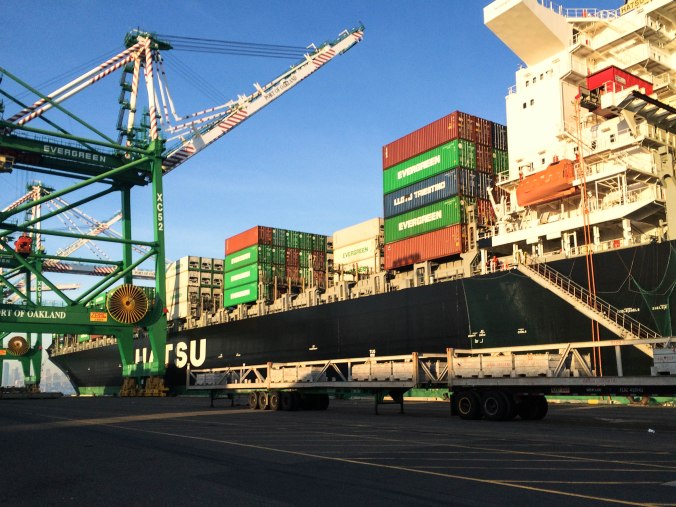
There is uncanny beauty in the monstrous. This, at least, is the feeling that seizes me as I stand under the colossal Ever Cthulhu[1] berthed in the Port of Los Angeles. The ship’s hull alone rises eight stories into the air; even from a distance, I am unable to capture its full length or height within a single camera frame. In describing the ship to my friends and my family, I have sought to make adequate comparisons between its size and more familiar objects: The Ever Cthulhu is 333 meters (1,100 ft) long, 43 meters (141 ft) across, and 70 meters (230 ft) high. It is taller than an eighteen-story building, the Arc De Triomphe, or Niagara Falls. It as long as a line of seventy cars, the Eiffel Tower tipped on its side, two Roman Colosseums, four New York City blocks, or six and half White Houses. I’ve had a lot of practice picturing this ship. Even so, when I am finally at the foot of its immense mass, I can scarcely believe that this monstrosity will be my home for the next 36 days.

I have entered the port’s gateway with very little fuss. As a Singaporean who has lived in the US for the last ten years, I am well acquainted with long lines, laborious checkpoints, and stern homeland security agents who scrutinize my passport with wary questions. This time, I banter with two female security guards at the Evergreen terminal in the port of Los Angeles whose only suspicion is why anyone would want to take the journey I’m on, and board a shuttle bus that drives down a lane flanked by multi-colored containers stacked four high and scores deep, forming long passages along which trucks and cranes stop to pick up their loads. We pass forklifts, spreaders, and trucks with empty chassis, which sweep past in well-oiled synchrony. Less than a 2-minute drive later, I am deposited at the foot of the ship, and I still haven’t shown anyone a passport. Staring up at the vessel, feeling dwarfed by the legs of the gantry cranes that loom far above us, I am directed to a steep and narrow metal gangway ascending seven stories to the deck – the only connection between the ship and land – which shakes and bounces as I drag my suitcase up its 59 steps.

Continue reading

The Politics of Modi’s Vegetarianism

A guest post by Amit Julka and Medha.

AmitJulkaAmit is a PhD student at the Department of Political Science at the National University of Singapore (NUS), and he is working on India’s engagement with Afghanistan from the perspective of Indian identity formation. Previously he worked as a media specialist with the US Embassy in New Delhi and at the Institute for Defence Studies and Analyses (IDSA), New Delhi. He holds an M.A. in South Asian Area studies from SOAS, and is a computer engineer by training.

MedhaMedha is a research fellow/doctoral student at the German Institute for Global and Area Studies (GIGA), Hamburg.  Her research focus is on the role of Islam in India’s identity and foreign policy. She previously worked at the IDSA, and also as a journalist in India, Germany, the Netherlands and Canada. She holds an M.A. in Media Studies, jointly from Aarhus and Swansea Universities.


Among the many anodyne reports from the South Asian Association for Regional Cooperation (SAARC) summit held in Kathmandu recently, there was a curious piece of news: an article about how the Indian Prime Minister was being served ‘simple vegetarian fare with less spices and oil’ while his Pakistani counterpart was enjoying ‘halal meat dishes’ during their respective stays in Nepal. The next day, on social media, India’s Ministry of External Affairs posted a photograph of a menu with the caption ‘All Vegetarian Fare. For those asking here is what the SAARC leaders are having at the Retreat.’

Twitter_Screenshot

While it may be routine for the media to report about the dishes served during meetings and summits, this emphasis on Modi’s vegetarianism—and his apparent success in making sure all the leaders consume vegetarian food, at least at the Retreat—is particularly noteworthy. Especially when the fact that Modi was fasting for Navratri during his visit to the US was also equally publicised. Was this an attempt at burnishing Modi’s image as the Hindu Hriday Samrat within India as well as the increasingly vocal Indian or more precisely, the Hindu community abroad?

Continue reading

Confronting the Global Colour Line

Race and Racism in IR

Our edited volume Race and Racism in International Relations: Confronting the Global Colour Line has now been published. We asked some of the contributors to give us their thoughts on what has been (both deliberately and unwittingly) overlooked by the discipline of International Relations with regard to questions of race and racism; the challenges posed by (re)centring these vital questions; and how IR may atone for its implication in empire. At your service, Sankaran Krishna, Debra Thompson, Srdjan Vucetic and John Hobson.

What has been the least investigated aspect of race and racism in IR?

Sankaran Krishna

The question makes me want to laugh because to me mainstream IR is all about how not to talk about race and racism while constantly appearing to talk about the relations between different kinds of peoples and countries. I came to IR only at the PhD level. My masters in modern history had acquainted me with the history of colonialism, racism, genocide, man-made holocausts like the Great Bengal famine, the slave trade, and other such events, on a world-scale in the post-Columbian (ie; post-1492) era. In my first IR courses in the United States the focus seemed to be on how can we understand the social world through models that pretend humans are unthinking molecules or inanimate entities. Stuff like Bueno de Mesquita’s War Trap (I kept waiting for someone to tell me that was a joke, like they do on Candid Camera.) It was a few years later that I realized that the penchant for abstract theorization, distaste for historical specificity and woolly stuff like ideology, and fetish for numbers – all voiced in deep manly intonations about analytical rigor – were nothing but an assiduous refusal to face the world in all its racial violence and splendor. In other words it’s the absence of considerations of race and racism that coheres the discipline.

When you widen the frame beyond mainstream IR and include those at the margins – thinkers like DuBois immediately come to mind – and especially take into account writings over the last few decades, the picture is a lot better. From my point of view, there has been a tendency in self-proclaimed dissident literatures to be inadequately critical of the racial conditions of their own emergence: invocations of the Global South or postcoloniality or marginality or the colour line can themselves become fetishized and serve as screens preempting a closer inquiry into racial difference and the consequences of othering. Continually calling out the protean forms in which race and racism manifest themselves historically and contemporarily seems, to me at any rate, a worthwhile vocation.

What is the most important theoretical challenge to IR posed by an engagement with race and racism?

Debra Thompson Continue reading

Dr Manchanda, I Presume?

A Doctor of Philosophy was made this day. Our own Nivi, for her thesis on Imagining Afghanistan: The History and Politics of Imperial Knowledge Production, received from the University of Cambridge. An analysis ranging from the imagined border to the constructed tribe, from gender to sexuality and back again, from the post-colonial to the homonationalist, and from the 19th century to present. Duly tested and found more than able by Dr Sharath Srinivasan and Professor Jutta Weldes. Granted without corrections. From this point forth, Dr Manchanda.

LOL Edward Said Eurocentrism

The Politics of the UK HE Marking Boycott, Part III

A brief update. As anticipated in Part II, UCU’s higher education committee voted to suspend the industrial action over pensions until 15 January and enter into negotiations with employers, despite opposition from UCU Left members. Having voted down UCU Left amendments to their negotiating position, the HEC has authorised its representatives to pursue an outcome that implicitly accepts much of the employers’ agenda and envisages sacrificing the 75% of USS members on a final salary pension for a weakly improved career-average scheme for all. It now appears that these proposals were initially discussed at a USS conference with branch delegates in October, but no mandate was given then to pursue the far-reaching changes envisaged, and attendees were actively instructed not to discuss the proposals within their branches. This only confirms my earlier impression that the individuals running UCU have no respect for internal union democracy. They wanted to keep their proposals quiet, hoping that they could simply march UCU members up to the top of the hill and back down again, then unveil their negotiating position and cut a deal privately with UUK. This is backroom dealing at its very worst.

It is also more obvious than ever that these individuals have absolutely no clue about political strategy or power. UCU General Secretary Sally Hunt wrote to members immediately after the action was suspended, asking them to sign a petition “in order to clearly demonstrate to vice-chancellors and principals the strength of feeling among staff about USS”. Recall that 78% of UCU members have voted for strike action and 87% for action short of a strike in the autumn ballot. Does that not already “clearly demonstrate” the “strength of feeling”? What on earth could possibly be added by a petition? Moreover, a strike ballot is an assertion of power: do as we demand, or we will harm your interests. A petition is just that: a plaintive request made to the powerful, containing no inherent assertion of power or leverage, which the powerful are entirely at liberty to disregard at will. The tragedy of UCU is that it is a trade union led by people who do not understand what trade unions are for. Sally Hunt thinks the height of labour activism is signing an online petition asking employers please not to be so mean, and posting photos of them handing in the petition to a blog.

I am also more convinced than ever that this leadership is out of kilter with the membership, despite the latter’s general passivity. The ballot result aside, a recent THE survey recorded the views of 4,000 staff, including on pensions. A full 48% of respondents disagree that USS needs to be reformed at all to make it sustainable, with only 24% of academics agreeing. This suggests that university staff are much more militant than their union leaders: a plurality resist any change at all, let alone the hara kiri being suggested by Hunt and colleagues. Even the minority of staff supporting USS reform might not consent to UCU’s feeble counter-proposals.

Those opposed to all this are still trying to rally branches to call a special HE Sector Conference to thrash out a proper strategy and a decent negotiating position. This internal struggle is now openly displayed in the pages of the THE. As of today, half of the required twenty branches had passed the requisite motions (Open University, Kings, UCL, Goldsmiths, Queen Mary, SOAS, Manchester Met, Liverpool, Salford and St Andrews). Whether this rearguard action can succeed remains to be seen.

Terra-forming Islands in the South China Sea, or the Future of International Law in the Age of Anthropocene

As per our disciplinary formations, IR scholars often indoctrinate instruct their students with the assumption that anarchy is a constant in international relations. The use of the term, however, generally assumes that there are natural/material constants within the international that transcend central concepts of sovereignty, power, and choice/preference. In other words, the assumption is that anarchy has (material) limits. Even those subscribing to the discursive turn would/might agree that there are material constraints that limit ‘meaning construction.’ We base a number of international laws, norms and regulations on this assumption; there are certain constants that cannot be changed through human actions. Our aspirations, capabilities, hopes, preferences, do not change these constants. What if – and this is a big ‘what if’ – for the time being, we are increasingly wrong about this assumption? What if human ability to transform the earth’s eco-systems has reached a level where this basic assumption no longer holds valid, or as valid as it used to be?

its-not-colonialism-its-terraforming

A number of geologists, environmental scientists, and futurists alike have already picked up on this trend. Looking at climate change in particular, they claimed that the earth has entered a new epoch in its life cycle. “We now live in the age of Anthropocene!” these scholars claim. Anthropocene, in this context, refers to the humans’ distinct ability to affect earth’s ecosystems. This claim is disputed, yet many see merit in it. To understand, or reflect, on the implication of the fact that we, as humans, are not the only ‘things’ that matter in this world of ours, you can also look at this amazing post by Audra Mitchell on Posthuman Security.

700x500_slide4-mr_1

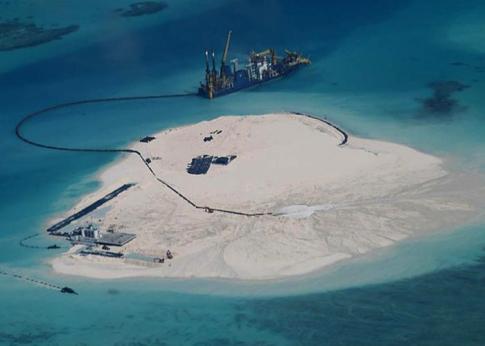
While in the future we might see the effects of other types of terra-forming and/or bio-engineering in international relations and international law, this post will only look at the United Nations Convention on the Law of the Sea and the effects of the Chinese pursuits in the South China Sea on the said law. The BBC ran an excellent exposé back in September on the People’s Republic of China’s (PRC) pursuit of building man-made islands on the South China Sea and its (intended) effects on the territorial water disputes between the countries of the region. Aside from the amazing medium through which the BBC editors and reporters managed to convey the message, the story itself is equally worth reflecting on for all things international.

Continue reading

The Politics of the UK HE Marking Boycott, Part II

Given the level of interest in my previous post (over 2,400 views in the last 10 days), I thought I would provide an analysis of UCU’s counter-proposals on USS and of the ongoing contestation of the leadership’s strategy in the current industrial action. In brief, UCU is offering to sacrifice the final salary scheme and give employers much of what they want, in exchange for a modestly improved career-average scheme. Conservatives within the union are also moving to rescind the industrial action before it has even properly started.

UCU’s Counter-Proposals

UCU’s response to UUK’s proposals, and its counter-proposals, were initially buried in a circular to branches posted on UCU’s website, before being circulated to members on Friday, only after they had been put to employers’ representatives in writing and at the USS Joint Negotiating Committee on Thursday. UCU’s critique of UUK’s proposals is excessively technical, but it does provide this helpful chart of pre-1992 universities’ incomes and costs since 2008/9.

Pre-1992 HEIs Financial Indicators (2008/9 =100). Source: HESA

Pre-1992 HEIs Financial Indicators (2008/9 =100). Source: HESA

The remarkable highlights are that income is up 27.7%; on average, the surplus of income over expenditure is £14.2m per annum, of which £11.2m is retained in reserves, which have consequently increased by 62.5%, leading to a net rise in the universities’ assets of 39.8%. Meanwhile, because of the massive real-terms pay cuts inflicted by employers, staff costs as a proportion of income are 3.7 percentage points lower. Put bluntly: just like major corporations, universities are hoarding cash; they can afford to improve their workers’ pay and conditions, but choose not to do so. There is no crisis in the affordability of pay or pensions in pre-1992 universities.

Continue reading

For the Joy It Brings: Hashtag Activism and Little Wins

I do it for the joy it brings
because I’m a joyful girl
because the world owes me nothing
and we owe each other the world

Ani Difranco, ‘Joyful Girl

So unless you were unplugged last week (and it’s fine if you were, I’m not judging), you would have seen the hashtag #takedownjulienblanc trending on Twitter. Julien Blanc, to whom the hashtag refers, is a self-styled ‘Pick Up Artist’ who charges actual money – between one thousand and three thousand dollars, by all accounts – for the privilege of listening to his advice on how to ‘pick up’ women. For the privilege of listening to his white, male, privilege, actually, given that the (TW) video that caught the attention of the activist community showed Blanc assaulting Japanese women in a highly sexualised way and commenting that ‘when you go to Tokyo, when you’re a white male, you can do what you want’.

Blanc was clearly paying attention in class when they studied Peggy McIntosh’s ‘invisible backpack’; the trouble is, he thought it was a primer rather than a cautionary tale. This is not the only time Blanc has confused genres in this way. Earlier this year, he tweeted a chart mapping out various abusive relationship dynamics, from intimidation to coercion and threats, with the caption ‘May as well be a checklist’ (though the image has since been taken down, along with Blanc’s entire Twitter account). Blanc’s website actively encourages men to use ‘male privilege, isolation and emotional abuse’ to attract women.

The hashtag was started by ‘shitty artist, intersectional feminist’ Jennifer Li.

Li has explained why she started the hashtag, saying that she was moved to start the hashtag because Blanc is actively perpetuating ‘toxic masculinity’, sexism and racism through his website, social media usage, and ‘Real Social Dynamics’ seminars. The hashtag existed, as all hashtags do, to catch the attention of Twitter users, to make explicit Li’s critique of Blanc and to encourage other Twitter users to do their own research into Blanc and his vile misogyny so that they might support efforts to get Blanc’s seminars shut down.

Dear readers, it worked. Continue reading

Pinkwashing Apple

The gays, we love our Mac toys – and now it seems that our conspicuous consumption of such has paid off: Tim Cook, CEO of Apple, has come out gay. And we are never going to hear the end of it. The hyperbole has been extra-ordinary. He is, in short, the new messiah: “Tim Cook’s announcement today will save countless lives.” That, from Human Rights Campaign (HRC) – the same people who also think same sex marriage will dissolve homophobia and cause the LGBTs to be treated equally. Clearly, there is a lot of wishful thinking going on. How should we navigate it? Well, we have an excellent guide over at A Paper Bird. Scott Long, who authors the must read blog on “sex, rights and the world”, has written a “medium length read” on the matter, and you really should read all of it. Here’s a few highlights (but go on, read it in full on your IOS device when time permits!)

Unknown

Continue reading

The Global Colonial 1914-18: A Public Roundtable

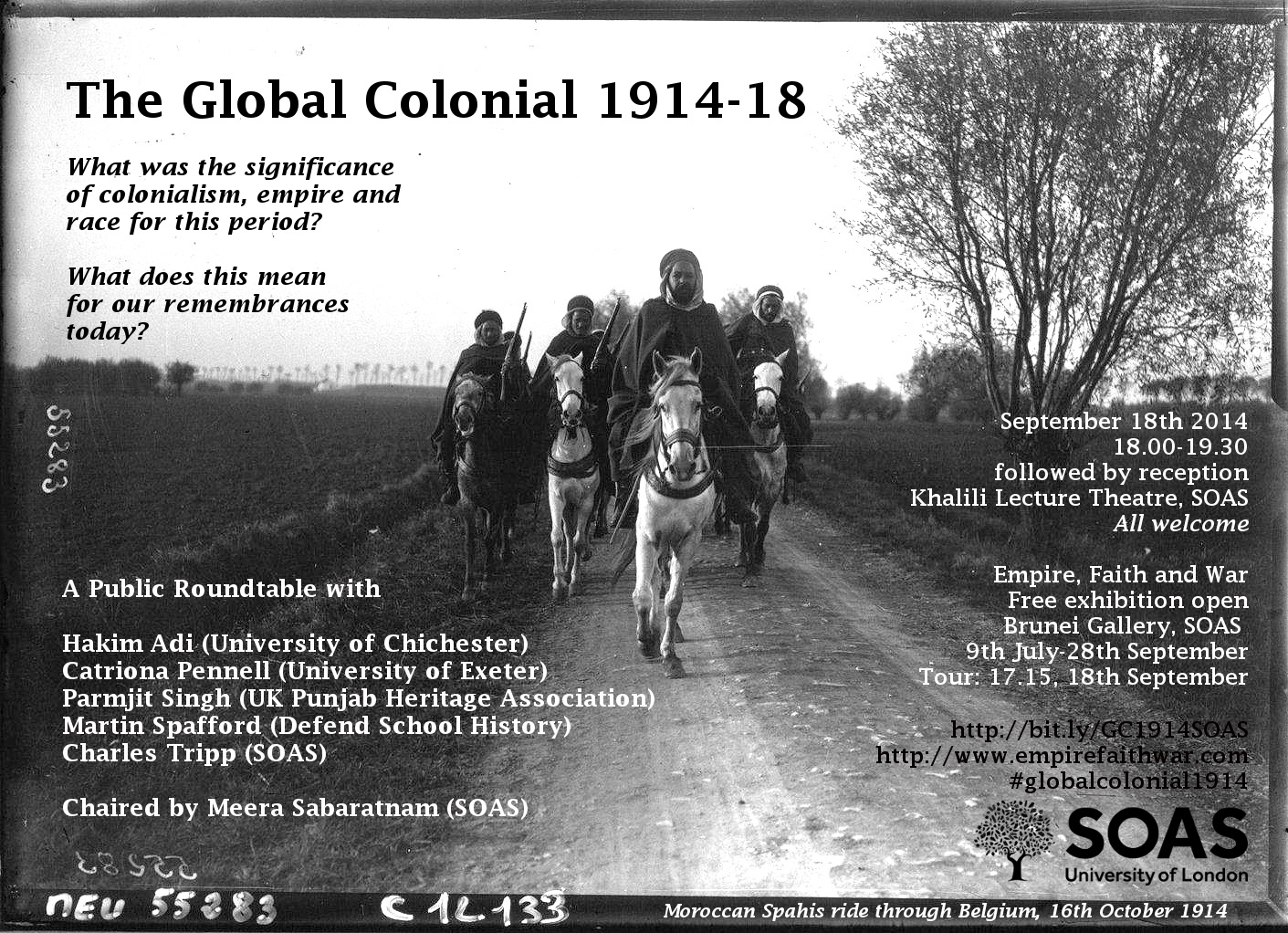
This is the fourth and final post in our series on The Global Colonial 1914-18, which is the video and transcript of the public event which took place at SOAS on September 18th 2014. Links to previous posts and the series as a whole can be found here. Many thanks to our speakers Hakim Adi, Catriona Pennell, Parmjit Singh, Martin Spafford and Charles Tripp for their contributions, as well as the audience for their incisive questions.

Global Colonial 1914 poster


M = Meera Sabaratnam

C = Charles Tripp

H = Dr Hakim Adi

P = Parmjit Singh

CP = Catriona Pennell

MS = Martin Spafford

M:       Okay. Hello, everybody and welcome. Thanks very much for coming. My name is Meera Sabaratnam, I’m a lecturer here at SOAS in international relations. And tonight we’re delighted to host a roundtable on the Global Colonial 1914-18. So obviously this is triggered by a number of contemporary events, not least the centenary of World War One, which you’ll have seen all over the news. But one of the stories I suppose, that gets told less often is the role of the wider world in the way that the war unravelled but also as a theatre of war. And in the place of where the war stood as part of the global context. So what else was going on, multiple revolutions, uprisings. So this is a moment in which the war is an important part of a global order which is undergoing substantial amounts of change. I should say this event is also sponsored…has been organised through the British International Studies Association and their working group on colonial, post-colonial and de-colonial research questions.

And this particular group tries to look at the elements of coloniality and colonialism in how the modern world came to be and what that means for when we understand globalisation and global history. I’m delighted to have a roster of speakers here tonight covering not just all of the sort of main areas, the regions that we’re studying in SOAS, namely Asia, Africa and Middle East. But also researchers and teachers who have been involved in how World War One is remembered in the classroom as a form of public cultural memory. Each of our speakers is going to speak for about 10 minutes. And then after that we’ll open it up for questions. Please do be forthcoming with your questions and we hope to have a good discussion afterwards, okay. I’d first like to welcome Professor Charles Tripp who is professor of Middle East here at SOAS. Thanks.

C:        Thank you very much, Meera. It sounds rather grand, I’m not the professor of Middle East, I’m professor of politics in the Middle East. But why not, grander? I was asked to talk today about the relationship between what was happening in the Middle East and what happened to the Middle East in and around the First World War. And I must admit straight off, I’m not a historian, so I don’t work on the first war particularly but clearly anybody who works in the politics of the Middle East is well aware of the fact that legacies of the First World War and what happened to the region are still very much there and indeed are being revived in the press in one form or another as they talk about Syria and Iraq at the moment. But what I wanted to really try and do is to pick out two themes if I can, in the time allotted. One is the notion that as with many other parts of the world, much was happening before the First World War that the First World War changed the course of, if you like. So in a sense one of the dangers of looking, which of course happens now to some extent in the press and elsewhere, is to see the Middle East purely as the Middle East as a political entity, whatever that is, as a kind of creation of European intervention, the First World War.

But what I’m trying to argue is that actually there were processes long before that that had been going on and that in some ways the European intervention set back in various significant ways that had an effect for the future as well. So the first part is really to think about what had been happening in the 50 years or so before the First World War in the region, we now think of as the Middle East, the Ottoman Empire, Qajar, Iran, North Africa. And I want to look at two themes which are intertwined but really revolve around the same emerging idea and notion which is the idea of the autonomous citizen, which again was quite a novel, a radical idea with hugely radical implications for the dispensations of power. But the two themes that they were intertwined with was, one, the struggle against despotism and the other, struggle against colonialism, both of these seemed to be deeply repressive of the idea of the autonomous citizen. And in some senses therefore what you’re looking at in the long…well, the period before the First World War in the 40 or 50 years, whether it’s in the Ottoman Empire, the Qajar Empire, Iran, in Egypt, you have a struggle against local despotism for constitutionalism. A precarious constitutionalism which is often of course therefore sabotaged by those who would rather not see it. But nevertheless very powerful in the mobilisation of the politics of these regions. Continue reading