What is This Thing Called IR? A View from Howard U

This is the fourth post in our symposium on Vitalis’ White World Order, Black Power Politics. Naeem’s post is here, and Nivi’s is here. Further responses, including from the author are to follow…


IMG_7430

It was a party for DAAD-funded scholars from all over Germany and our hosts at the Martin Luther University of Halle-Wittenberg invited to us a historical costume play.  It was childish, and therefore well-suited for us international Stipendiat/inn/en, many of whom still struggled with basic German: some students and faculty dressed up as famous scholars from various periods in the university’s 500-year history and said a few things about themselves.  I have now forgotten all of the names but one: Anton Wilhelm Amo. A West African slave of a German duke who in 1734 successfully defended a dissertation in Halle’s philosophy department. The (black) guy who played Amo spoke loudly and clearly, but I recall turning to the (black) DAADer sitting next to me, a fellow poli sci student from France: “1734?” “That’s what I heard, too”, she said, “1734.”

Since this was in the era of the (dial-up) Internet, a few days later I was able to learn more about this Amo fellow, including the details eluded in the university play. Vitalis’ latest book, White World Order, Black Power Politics: The Birth of American International Relations (Cornell, 2015) is a powerful reminder of another lesson I learned then: that work by non-white scholars tends to be “denied”–that is, ignored, temporized, ornamentalized and outright purged [1]. How many students of international law or of the German Enlightenment today know anything about Amo’s “On the Right of Moors in Europe” (1729)?  Not many given that the essay has been lost to history, probably because its copies were deemed unworthy of those meticulously maintained rare book collections.  And this is a huge loss given the relevance of historical “rights of Moors” debates for the constitution of “Europe.”

IMG_7431

Continue reading

An African-American Social Science: International Relations

This is the third post in our book symposium on White World Order, Black Power Politics. The opening post by Bob is here, and the earlier response of Naeem is here. Further responses will follow.


White World Order, Black Power Politics (WWOBPP) was on my reading list before it was released; it had come highly recommended by my supervisor who was then reviewing it for Cornell, it was a on a topic that was close to my heart, and it was written by Bob Vitalis, whose work had been an inspiration to me for years.

And yet I was unprepared for the full emotive and intellectual force of the book. WWOBPP is a genealogy of American International Relations, which it turns out is essentially an enterprise in systematic forgetting, in the writing out of and over an already established body of scholarship in the ‘discipline’ pioneered primarily by a cohort of black academics including Alain Locke, Ralph Bunche, Rayford Logan and Merze Tate from the 1920s to the ‘50s that ultimately coalesced around Howard University in the US.

The Howard School were veritable trailblazers in all their scholarship as Bob painstakingly documents, but two of their insights stand out for me in particular: (i) that imperialism was the core problematique of IR, that is, the “central problem for scholars seeking to grasp the nature of and threats to the existing world order” (86) and (ii) that racism and imperialism were mutually implicated, that there was an “elective affinity between the concept of race and empire” (87). Together these two insights revealed that international relations were essentially inter-racial relations, and IR a racial science that served as steadfast handmaiden to empire. Continue reading

White World Order, Black Power Politics: A Symposium

vitalis-e1458738905580This is the first post in the symposium on Robert Vitalis’s, White World Order, Black Power Politics: The Birth of American International Relations (Ithaca: Cornell University Press, 2015). Professor Vitalis (who also answers to ‘Bob’) teaches at the University of Pennsylvania. His first book, When Capitalists Collide: Business Conflict and the End of Empire in Egypt, was published in 1995. His second book, America’s Kingdom: Mythmaking on the Saudi Oil Frontier, published in 2005 was named a book of the year by The Guardian. He has been a fellow at the Woodrow Wilson International Center for Scholars (2009), Rockefeller Foundation (2003), the International Center for Advanced Study, NYU (2002), the American Council of Learned Societies (2002), and the MacArthur-SSRC International Peace and Security Program (1998). He was a MacArthur Award nominee in 1998. Below is his introduction to our symposium.

*Update*

Naeem’s response is here; Nivi’s is here and Srdjan’s is here.


80140100646100L

White World Order, Black Power Politics may well be the only book discussed in this symposium series that isn’t primarily concerned with theory, or at least the only one by an author who does not self identify as a theorist, teaching in a department that does not recognize what I do as “IR.”  It is also less an intellectual history, which might allow it to pass as theory, than it is an institutional history. So I am grateful for the interest in it here.

28522646._UY1280_SS1280_That said, it is indeed a critical history. The records of professors, schools, research organizations, and foundations in the early twentieth century United States reveal a past that bears scant resemblance to the “practitioner histories” or insider accounts of great debates invented about the discipline of international relations in the second half of the century, which are the ones most specialists tell themselves and their students until now. In fact, the more I learned and labored in the archives the more I came to see the problem as similar to the one I wrestled with in my last book, America’s Kingdom: Mythmaking on the Saudi Oil Frontier. The history that U.S. oil companies invented after World War II about their early and unshaken commitment to a “partnership in progress” with the Saudi people, at a moment when criticism of U.S. imperialism was on the rise in the Eastern Province and across the globe, is the one that books repeated uncritically for decades. The firms’ private records though revealed a dramatically different reality. I developed an account of the exploitative order in place in the oil camps, the racial science that justified it in the minds of the American engineers and managers, and the failed efforts of Arab and other workers to bring about its end. I likened what I did in that book to “reverse engineering” particular processes of mythmaking. I’ve done more or less the same thing for a sector of the U.S. academy in White World Order. Continue reading

The EU Referendum: Brexit’s Imperial Delusions

This is a post in our EU referendum forum. Click here for the introduction with links to all the contributions.


haastrupOur next guest contributor is Toni Haastrup. Toni is Lecturer in International Security and a Deputy Director of the Global Europe Centre at the University of Kent. Her current research focuses on: the gendered dynamics of institutional transformation within regional security institutions especially in Europe and Africa; feminist approaches to IR; and the politics of knowledge production about the subaltern. She is author of Charting Transformation through Security: Contemporary EU-Africa Relations (Palgrave Macmillan, 2013) and coeditor, with Yong-Soo Eun, of Regionalizing Global Crises (Palgrave Macmillan, 2014).


One key aspect of the EU referendum debate has been the rise of competing narratives about Britain’s role in the world inside and outside of the EU. On the Brexit side, campaigners argue that escaping the EU would revive Britain’s standing, allowing it to reconfigure relations with Europe, strengthen existing non-European partnerships, and forge new ones. These claims rest on a series of self-delusions about Britain’s capacity to unilaterally set the terms of its international partnerships. Brexiteers willfully ignore those prospective partners who say that a post-Brexit UK would be a less attractive partner. Their narrative seems to rest more on imperial delusions than solid ground – and it is hardly a narrative appropriate for a truly democratic, internationalist country.

A Part of Europe, Apart from the EU: What is Possible?

Pro-Brexit campaigners often suggest that if the UK were to leave the EU, it could fashion a new kind of relationship with Europe similar to the one Norway enjoys. Norway is viewed as a country that has maintained its sovereignty while remaining a close partner of the EU.

But of course, Norway is different. It is a thriving smaller country that is dependent on oil reserves that are much larger than the UK’s. Further, Norway negotiated a very specific entry into the European Economic Association (EEA) and the European Free Trade Association (EFTA). If the UK was to depart, a relationship with the rest of western Europe especially in the context of EFTA is possible, but it is not automatic. Further, a relationship between the UK and other countries that currently exists only in the context of a regional EU relationship will have to be renegotiated, with no guarantee that the UK will indeed be better off outside the EU.

Those in favour of staying within the EU, or Bremain, thus rightly question this narrative as one that is based on uncertainty and the UK’s self-imagining, rather than the realities of the international environment. The idea that Britain would regain its sovereignty way from the EU is a myth whose consequence even the Norwegians warn against.

Continue reading

Canada and the Anglo World—the Brexit Edition

Mother, stepmother, perfidious Albion—whatever metaphor one prefers to employ, Britain has always been important to Canada. But what is Canada to Britain? It depends on whom you ask.

This post originally appeared on Open Canada.

Continue reading

Churchill’s “Iron Curtain” Speech (A Black History Month Perspective)

Truman and Churchill in Missouri

Churchill’s Westminster College audience, March 5, 1946 (Life/Getty Images)

This year is the seventieth anniversary of Winston Churchill’s “Iron Curtain” speech, a.k.a. “Sinews of Peace,” a.k.a., the Fulton address, which means that we will soon be hearing all about it once again. The speech is central to the iconography of the Cold War, of anti-communism, and of Anglo-American specialness. Countless historians, biographers and rhetoreticians have examined almost every aspect of it: when and where it was written, whether it was pre-approved by others, including President Truman, and, indeed, how it was received. On the last point, we know that the speech was met with a mixture of cheers and boos. The reactions tended to be politically and ideologically determined. Conservative politicians and the media praised the speech for its realism about the nature of the postwar settlement: at last someone had the courage to publicly say that the victor nations could not forever be friends.  In contrast, most liberals, socialists, and communists condemned the speech as inflammatory. With so many hopes pinned to the newly created United Nations Organization (UNO), the last thing the world needed was geopolitical tension between the Western powers and the Soviet Union, they argued. But that was not all. Some leftists went further still. Churchill’s notion the Anglo-American “special relationship” and “fraternal association” constituted the ultimate sinew of world peace smacked of racial supremacism, they said.

Continue reading

The Dissonance Of Things #5: Decolonising the Academy

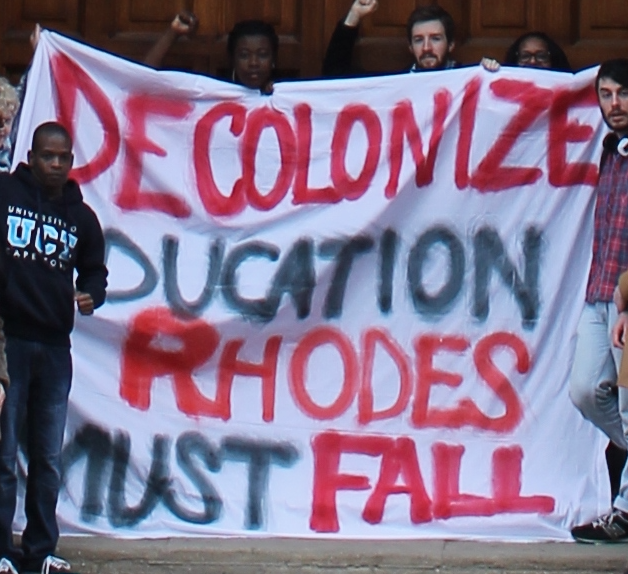
decolonize

In this month’s podcast I’m joined Dalia Gebrial from Rhodes Must Fall Oxford and two stalwarts of TDOT, Meera and Robbie, to discuss ‘Decolonising the Academy’. We take a look at the Rhodes Must Fall campaign and its implications for understanding the relationship between higher education, coloniality and ‘race’. We also ask why is my curriculum white?  What can be done change the way in which knowledge is produced and taught in universities? Finally, we explore how decolonising the academy might relate to anti-colonial and anti-racist struggles taking place outside of the university.

Listen via iTunes or through the Soundcloud player below.

Continue reading

More Groundings

The final piece, and rejoinder, in The Disorder Of Things forum on The Black Pacific.


I have to say, I really didn’t know what to expect from my interlocutors. Perhaps that’s because I have little idea what kind of response to expect from the book and who its readership might be. In any case, these varied and passionate responses are a joy to engage with.

Heloise, you not only provide a lucid introduction to some of the key themes and provocations of my book; you also usefully connect its arguments to broader intellectual and political currents in the world of development, especially regarding indigenous struggles in and over the Americas. Olivia, you provide a striking engagement with the politics of intellectual investment, one that in many ways exceeds the strictures of my book to become a general mediation upon ethics and method. Ajay, you poetically and critically reflect on solidarity building across/besides territory and culture, and in so doing you begin to ask pertinent questions about “groundings” with reference to Turtle Island. Krishna, yours unfolds as a forceful defence of the urgency to focus intellectually upon the materiality of dispossession.

I’m going to engage with your response, Krishna, at some length. But firstly, I want to call attention to and amplify some of the questions that Olivia and Ajay ask.

18379_488175720248_5710406_n

Continue reading

Comforting Discomfort of Rebel Music: Some Diaspora Legba/Pākehā Reflections on Robbie Shilliam’s ‘The Black Pacific’

author pic RutazibwaOur fourth commentary on The Black Pacific. Olivia U. Rutazibwa is Lecturer in European and International Development Studies at the University of Portsmouth, UK. Currently she is a Postdoctoral Fellow at the Käte Hamburg Kolleg/ Centre for Global Cooperation Research, Duisburg in Germany where she looks into ways to decolonise the scholarship on sovereignty and self-determination, drawing from philosophies and practices of autonomous recovery in Somaliland, Agaciro in Rwanda and Black Power in the US. She is the former Africa desk editor and journalist at the Brussels based quarterly MO* Magazine and continues to write monthly op-eds for them.


When I first started reading Robbie Shilliam’s The Black Pacific last April, I was only a couple of pages in when I shot him the following email: “Sitting on a sunny terras [sic] by the waterfront in Antwerp and reading your book. It is not often that I feel deeply comforted, healing, cared for and utterly inspired reading an academic text… At some point I’ll hopefully have more eloquent ways to share my thoughts with you on your book, for now it’s just feelings…J

Today, more than half a year later, the point of ‘more eloquence’ has supposedly arrived, but I doubt that I will ever truly reach it when it comes to this remarkable book.

In what follows I will share some preliminary thoughts on The Black Pacific, rather than venture into a full on book review. The book challenges our traditional (read: colonial) ways of doing research so convincingly and profoundly, that a conventional review would not do it justice. Too many of our research ways continue to be concerned with the generalizable and the linear. Divisive categorisations still play an important role and we end up with consumable knowledge at the service of the (oppressive) control of reality and peoples. Too often then, academic conversations, ideally conceived as open spaces for dialogue, exchange and creation, ossify into zones of judgementality, oxygenised by a misguided belief that there are indeed some absolute truths out there. The Black Pacific speaks a radically different language.

To me, it sang like Rebel Music at the heart of the (IR) academy and as such, it was a source of comforting discomfort. More on that later.

Continue reading

‘We Nah Want No Devil Philosophy’: A Note on the Decolonial Science of ‘The Black Pacific’

The third commentary in our forum on Robbie’s The Black Pacific, this time from Ajay Parasram. Ajay is a lecturer and Doctoral Candidate at Carleton University in Ottawa, unceded Algonquin Territory. His dissertation considers the gradual de-politicization of the colonial norm of “total territorial rule” emerging out of the collision of local and European ontologies of territory in mid-19th century Ceylon (Sri Lanka). One or two more posts to come before Robbie’s rejoinder.


I read The Black Pacific while walking through Coast Salish territories on Turtle Island, known in colonial vernacular as Washington State, USA, and the Lower Mainland of British Columbia, Canada. Attesting to the wide reaching applicability of the ideas advanced within this book, I engage it by drawing examples from Turtle Island, where I live.

The Black Pacific asks readers to reconnect with our shared humanity through cultivating a decolonial science of “deep relation.” This starkly contrasts with the prevailing “colonial science” of categorical separation and developmental hierarchy that is essential to ‘uni-versal’ modernity. To understand the distinction between “deep relation” and “categorical separation,” Shilliam says “We must start by acknowledging that the manifest world is a broadly (post)colonial one, structured through imperial hierarchies that encourage the one-way transmission of political authority, social relations and knowledge from the centres outwards” (20). Colonial science depends on the rigid separation of manifest and spiritual domains, as well as the separation of people into categories such as “enslaved, indentured, native, free, poor and masters. None can relate sideways to each other. They are fixated by the gaze of Britannica, the master” (23).

The Black Pacific is a nuanced, multifaceted call to abandon the science of separation that renders “profane” the myriad knowledges that people cultivate globally. The distinction offered between knowledge production/consumption vs. knowledge cultivation makes a valuable methodological contribution to decolonial research by treating the past (as opposed to History) as something in need of oxygenation:

Unlike knowledge production/consumption (a subaltern under-taking), knowledge cultivation turns matter around and folds it back on itself so as to rebind and encourage growth. This circulatory process of oxygenation necessarily interacts with a wider biotope, enfolding matter from diverse cultivations. (128-129)

Continue reading