Rendition and Exception in the Carceral Archipelago

Given half the chance
They danced around the truth
For most of my youth
Like you’re really going to jump off that roof
You lived your life
In a perfect paradise
The sun always shone
On your beaches with lies

– Leatherface, ‘Diego Garcia’ (2010)

Diego Garcia US Navy SeaBees

In October 2005, then Foreign Office Minister Kim Howells stood before Parliament and reported that the UK government had granted no requests for extraordinary rendition in any part of British territory or airspace, and was aware of no such use. Critics – who suspected that the UK was indeed complicit in rendition for torture – pressed the point. So in December Jack Straw, who was Foreign Secretary, explained that “careful research” within government had turned up no evidence of renditions since 9/11 in UK spaces (land, air, or sea) and, again, no requests. The very next day Straw was giving evidence to the Foreign Affairs Select Committee, and was asked about the possibility of an investigation along similar lines as other EU states. Came the forceful reply:

I do not think that there is any case whatsoever for such an investigation here…I did what it is my duty to do, which is to provide a thorough comprehensive answer. That has been done. It has produced a nil return. Unless we all start to believe in conspiracy theories and that the officials are lying, that I am lying, that behind this there is some kind of secret state which is in league with some dark forces in the United States, and also let me say, we believe that Secretary Rice is lying, there simply is no truth in the claims that the United Kingdom has been involved in rendition full stop, because we have not been, and so what on earth a judicial inquiry would start to do I have no idea.

Conspiracies! Dark forces. Lies and secret states, no less. By January 2006, Howells was again reporting to MPs that all relevant Foreign Office records and recollections had been checked, implying that no proof of rendition had been discovered. Two years later David Miliband, who replaced Straw, was forced to admit that two renditions in fact did pass through the island of Diego Garcia in 2002 (Blair, pathetically: “We have just been informed by the United States of America about what has actually happened”). Suspicions were somewhat confirmed, but it was all a long time ago, and there was a change of Prime Minister, and then of government. While rendition-torture didn’t exactly go away, it faded from view. But it has resurfaced. Last month we discovered that some crucial records are incomplete due to ‘water damage’. Because if you have files pertinent to a major foreign policy controversy, why not store them that badly? Never mind that Ministers had previously argued that they wouldn’t be keeping notes anyway, and had to rely on assurances from the Americans (an “error” in US records was the culprit). Kettle logic, again.

Continue reading

Cavity Searches in Intern(ation)al Relations

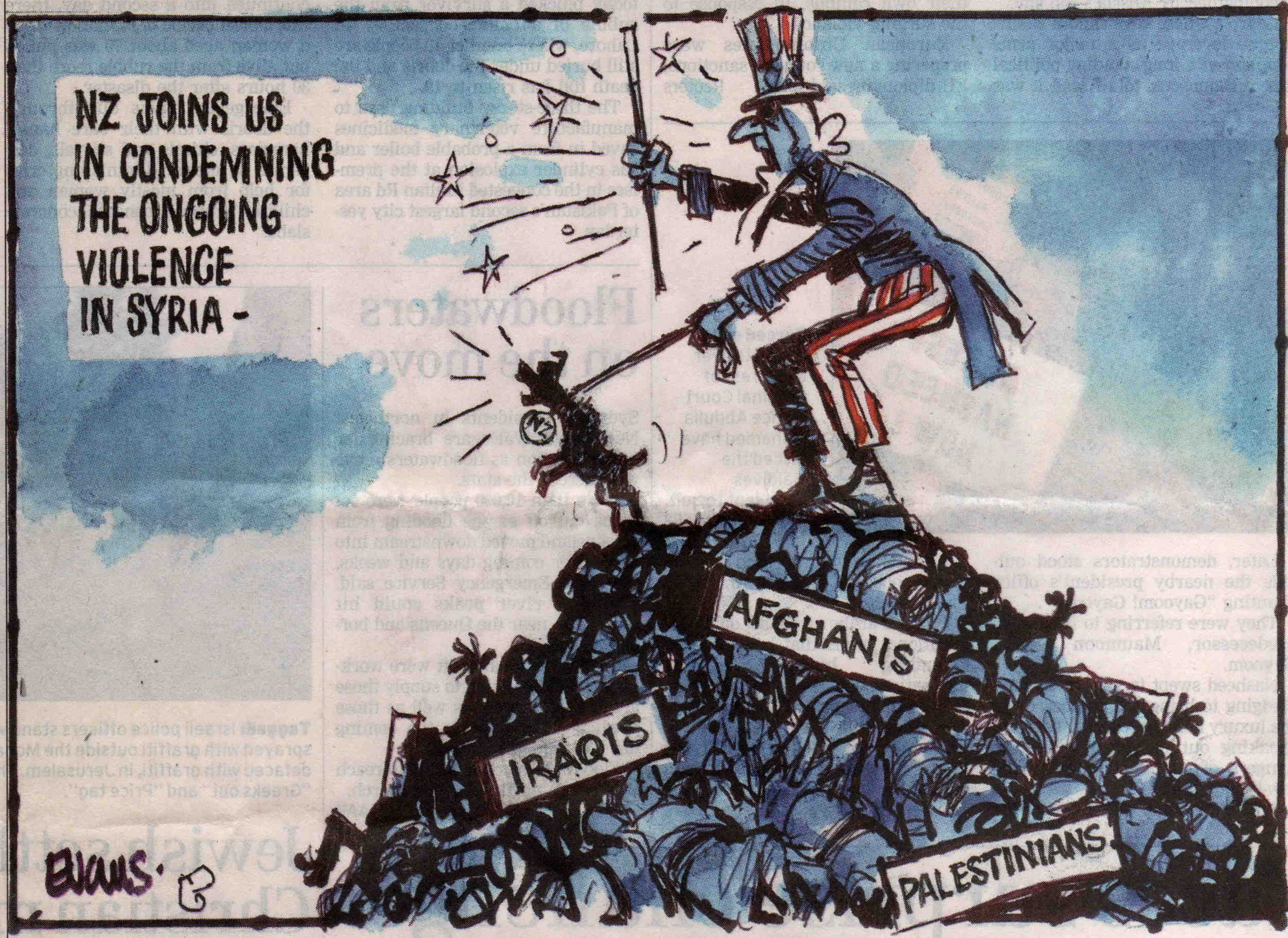
In the most darkly comic scene in Mohammed Hanif’s brilliant A Case of Exploding Mangoes, General Zia—the thinly mustachioed dictator of Pakistan from 1977-88—suffering from a bad case of worms, enlists the services of the physician of his Saudi friend Prince Naif. ‘Birather, bend please’, requests Dr. Sarwari, in a strange mixture of Arabic and American accents. Zia unfastens his belt, slips his trousers down and leans forward, laying his right cheek on his desk. His head is between two flags, Pakistan’s national flag and the flag of the Pakistan Army, as Dr. Sirawar slips a lubricated probing finger into his itchy rectum. The allegory is crystal clear: this is Pakistan being fucked by Saudi and US money and weapons during the anti-Soviet jihad in Afghanistan.

In Mohsin Hamid’s The Reluctant Fundamentalist, the terror attacks of September 11 provide the pivotal moment in the transformation of young Pakistani Princeton graduate Changez Khan from Wall Street analyst to Islamist radical. Watching 9/11 unfold on television while away on a work trip, Khan feels something akin to schadenfreude, as if the attacks were payback for the daily humiliation of being Muslim in America, giving vent to a reservoir of grievance hitherto fiercely suppressed, even denied, in his pursuit of the American dream. Returning to the US, Changez can see that Americans see him differently. In Mira Nair’s film version of the book, he is separated from his white colleagues at immigration and subjected to a cavity search: this is Pakistan being fucked by the US in the aftermath of 9/11.

Continue reading

A Right To The World: On Syria and an Idea of International Public Order

P1 aniang

A guest post from Amy Niang on the contours of ‘international community’, following previous interventions from Siba Grovogui in relation to Libya, Robbie on provinciality in International Relations and John M. Hobson et al. on Eurocentrism in international political theory. Amy teaches international relations at the University of the Witwatersrand and she is affiliated with the Centre of Africa’s International Relations (CAIR). She gained her PhD from the University of Edinburgh in 2011. She has taught International Relations, political theory and African history in South Africa, Scotland and Japan. Her research interests are in the history of state formation, political theory and Africa’s international relations, and she has commented regularly on democracy, civil society and Western intervention in Africa.


The Syria crisis has sparked many debates in scholarly and media circles, not least around the way in which the ‘international community’ should exercise its responsibility to Syrians and to the protection of human rights, particularly in the aftermath of the alleged use of chemical weapons on Syrian civilians. The lack of consensus on the most appropriate response, within the limits of international law, raised a number of questions.

There were times when we were told that a military attack was imminent, others when cautious voices against a military campaign seemed to have the moral upper hand. In the days following the discovery of the use of chemical weapons, the U.S. made public its position on the question, based on the conviction that the Syrian government was responsible. In the general uproar that that ensued, the recent examples of Afghanistan and Iraq guided many deliberations on the wisdom of another humanitarian intervention. Like Barack Obama, many commentators believe in the existence of a red line that delineates the contours of a hypothetical morality, its alleged violation by Syria warranted punishment if the red line was to be pushed back. Many others however warned against acting on an impulse of outrage, Libya is a vivid example of how an ill-conceived intervention can be more damaging than the situation it originally sought to fix.

P3 Hypocrisy-Irony

From the polarized debates, two declarations in particular piqued my interest. The first one was Barack Obama’s Address to the Nation of September 10th, 2013. The second one was the Declaration of the Forum for Former African Heads of State and Government (the Africa Forum) on September 5th, 2013. The first one was as usual widely followed in America and beyond. The second went unnoticed partly because it was of little news worthiness for commentators of world affairs, partly because no one expected Africans to formulate any coherent view on the Syrian question. The first was delivered as an authoritative pronouncement on how a putative ‘we’ (i.e. the international community) should interpret international law and what shape its moral responsibility – here merely one embodiment of the West – should be engaged. Continue reading

Notes on Ex-Yu Justice, Part III

Following Part I and Part II


The court is incompetent

The ICTY is constantly criticized for its organizational and procedural shortcomings, but is it fatally “incompetent”? To the extent that it resonates with ex-Yugos this charge must be made in the abstract only – the living ICTY is incompetent compared to the ideal ICTY. Compared to national legal venues, especially as they operated until recently, the court is indispensable, however (more on this below). Further, the ICTY is perceived as the big fish court, and the ability to get those “most responsible” is regarded as one of its strengths. And yet, much of this hard-earned reputation is being squandered in a series of rulings that acquitted some very big and very nasty fish.  Even its supporters feel like the ICTY has lost its mojo.

Consider the Momčilo Perišić case. Here the Yugoslav National Army commander who was first convicted (27 years in prison!) for aiding and abetting war crimes perpetuated by Serb forces across the river Drina, and then completely acquitted by the Appeals Chamber. Logistically and financially supporting génocidaires may not be a crime after all! Putting aside the inability of the prosecutor to ever establish a clear chain of command going from Belgrade to Pale and Knin respectively, this ruling changes the current legal understanding of the principle of command responsibility so decisively that it will almost surely protect many miscreants in the future. Some have even used it read back past ICTY rulings, breaking the chains of causation that lead to Belgrade (“this is a posthumous acquittal of Milošević!”) as well as Zagreb, and blaming  the massacres on the small fish (what’s next? Isolated cases of extremism?).

smallfry

Then there is the acquittal of Ramush Haradinaj, the prime minister of Kosovo, and that particular joint criminal enterprise (the presence of witness intimidation, note, was mentioned in this ruling). Next, the Ante Gotovina and Mladen Markač decision. The 2011 Trial Chamber ruling convicted them to 24 years for their role in, among other things, the joint criminal enterprise to expel the Serb population in Krajina following the 1995 Operation Storm (with Tudjman as the enterprise’s CEO again). Then, earlier this year, the Appeals Chamber ruled, in a split decision, that no such joint criminal enterprise existed (as well as that some Mladić-style military actions might be ok, but let’s put that aside for now). And last, the Jovica Stanišić and Franko Simatović case: the ICTY found no qualms with their arms dealing, bankrolling para-military formations and otherwise supporting of the Serb administrations in Bosnia, Croatia, and Kosovo, and, above all, no evidence of conspiracy to bring about the removal of the non-Serb population from any part of the former Yugoslavia (the rest of their ghastly dossier, so much of which is easily accessible via YouTube, fell outside the court’s scope).

Continue reading

Notes on Ex-Yu Justice, Part II

Following Part I, and in advance of Part III.


The court is political  

The smartass response goes something likes this: “Of course it’s political; what’s not political? Haven’t you read the ICTY’s website? It says clearly that the tribunal was established for explicitly political reasons, too, by the UNSC, which is political by definition.” But the smartass response is a rude interruption. The above assertive prefaces monologue, not dialogue. The monologue is a story about world politics as a dog-eat-dog contest in which the strong always devour the weak with a focus on the origins of the ICTY. “Of course an international judicial institution cannot be created on the basis of an UNSC resolution alone. Of course Chapter VII of the UN Charter does not specify the conditions under which war crimes tribunals can be set up. Of course the ICTY quickly discovered that it could not bother with the question of own legality. But when have great powers ever cared about law and institutions? Might makes right, right? The ICTY is based on the consent of states – big states, not our banana republics.”

This story varies in terms of breadth and depth, but its modal conclusion is that the tribunal cannot represent anything but “victor’s justice” and/or Western and specifically American oppression of those living on the periphery. As for the motive, the supposedly aggressive prosecution of Bosno-Serbo-Croat baddies practiced by the ICTY is a function of the desire for retribution for every case of ex-Yu insolence in recent history, starting with the Trieste crisis of 1945. As discipline and punishment at once, trials are also meant to serve as a warning to the rest of the peripheral and semi-peripheral world. This type of theorizing could be described as a cross between pop-realism and pop-Marxism with a whiff of the crudest forms of pop-anti-Americanism and some other, far less respectable prejudices. While it is not exactly a closed loop, for every new newstory indexing Western and specifically American double standards and double visions in international law, the theory gains strength. Who in the former Yugoslavia doesn’t have an informed opinion on the “Hague Invasion Act”?

imgfrontisThe two accounts of the origins of the ICTY that I have on my shelf make something of an opposite case. Pierre Hazan’s book, subtitled ‘The True Story Behind the ICTY’, suggests that the weak (international justice activists) outfoxed the strong (realist diplomats and state-centric lawyers) and, against all odds, managed to turn the tribunal into such a revolutionary achievement (more on this below). Hazan is no theorist of norms and transnational advocacy networks, but there are more than a few parallels with this literature. The second account is Rachel Kerr’s 2004 book, which begins and ends with the thorny issue of “politicization,” including the issue of “prosecutorial discretion” as its special subset. Kerr has the ICTY walking on a tightrope. Sidle up too closely to justice, and you alienate those who rule the world; let politics in, even to manipulate it for judicial ends, and you lose credibility. While infinitely more nuanced than Hazan’s, Kerr’s framework for analyzing politics (it, too, chimes with 1990s IR theory, namely the “bringing international law back in” literature) follows the same binary – let me personify it a little as a contest between “realists” versus “legalists” – and it reaches the same conclusion. And judging by both the quotidian operation of the court as well as its key decisions up to 2002-3, Kerr finds, “legalists” had the upper hand.

I am not sure what stock-taking exercises based on the realist vs. legalist framework look like today (again, this post is my attempt to reconnect with the literature I stopped following years ago), but what struck me in my conversations is how adamant my interlocutors were in rejecting even the most carefully drawn legalist claims. It’s simple, the typical response goes, the ICTY is subject to constant political pressures and it shouldn’t be surprising to see so much judicial malpractice. Lest one is keen to dismiss this as “typical” ex-communist (and transitionalist) disdain for the notion that law serves to ensure that valuable social goods are distributed in ways that protect equal respect for everyone, note that some of the most critical arguments about the “hopelessly political court” are drawn from the texts left behind by bona fide ICTY insiders like Antonio Cassese (he of  those great international law textbooks), Gabrielle Kirk McDonald, Louise Arbour, Graham Blewitt, Carla Del Ponte, Serge Brammerz, and Florence Hartmann (more below). Anyone can cherry-pick a few memorable lines from a few memoirs and journalistic accounts (Hartmann, if I recall correctly: “the ICTY was formed so that war criminals could negotiate on the level of their innocence”), but what I find interesting is that these types of arguments have gained more and more adherents over the years.

Continue reading

Notes on Ex-Yu Justice, Part I

I don’t recall when I first heard of Radovan Karadžić, but I know it wasn’t any time before the run-up to the first democratic, multi-party elections in Bosnia and Herzegovina. Radovan, with sarcastic endearment called Rašo in my family, emerged as the leader of something called the Serbian Democratic Party, one of the three main “national” political parties that were formed to steer us away from Marxist politics and economics and towards Western, liberal, democratic capitalism.  I do recall voicing scepticism about their promises, and trying to convince my eight grade classmates that ‘national’ really meant ‘nationalist’ and that with “them” at the helm Bosnia would soon look like Lebanon rather than Switzerland. And forget Lebanon, one only had to look over to Croatia to see what parties with the same names were doing, and how well that particular Westernization was going. I remember arguing that there was an alternative, pointing to Ante Marković (a.k.a. Antara, but with slightly less sarcasm) and his “reconstituted” Commies (and to drive the point home I pasted Union of Reform Forces of Yugoslavia campaign posters all over my room).  But there was no alternative, not really. Not with the bad guys in Belgrade, far more powerful than Marković, itching for “armed battles,” and not with the vast majority of citizenry successfully interpellated into political, mutually exclusive Muslims, Serbs & Croats. A Cerberus coalition of said national parties won the elections in November 1990 and took us all to hell.

karadzic_AP

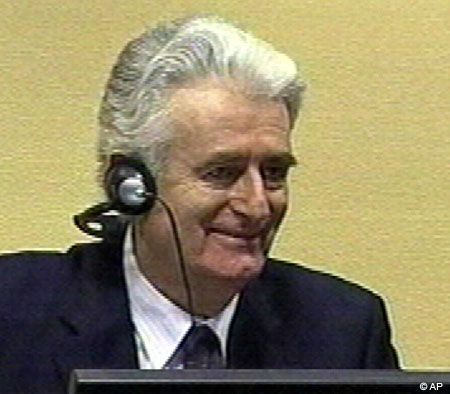
Fast forward to June 2013: it’s a Monday morning and I am looking into Courtroom 1 of the International Criminal Tribunal for the former Yugoslavia (ICTY) in The Hague. Karadžić, sitting behind a huge glass screen, is complaining about some key meaning lost in translation. He appears uncomfortable, at least compared to the other nasty blast from my past: Vojislav Šešelj, a.k.a., Šešo. In the 1990s, he was Serbia’s one-man version of the Radio Télévision Libre des Mille Collines; today, Šešelj is the tribunal’s bête noire. Those who follow the life of the ICTY are familiar with his mixed-methods approach to delegitimizing the court and its proceedings. Hissy fits, impossible demands, hunger strikes, insults, bullying, speechifying, filibustering. Then there is the regular uploading of confidential court documents onto http://www.vseselj.com‎ such that the names of protected witnesses are no longer protected. This certified political scientist (while writing a PhD dissertation on fascism in late 1970s Šešelj apparently spent a year teaching at the University of Michigan) knows how to assess the power of the strong as well as of the weakHe has repeatedly justified his behaviour as “only politics” (“this court is political, I am political, and I am here to destroy you”). And whenever he gets convicted of contempt of court (twice or thrice now), he laughs it off: “I don’t care, I am having the time of my life.”   

He was on fire that morning as well. Invited to Karadžić’s trial as a key witness, Šešelj manages to waste hours of the court’s time on stories that feature, among other things, Swedish prostitutes, Serbian folk heroes, and European medieval history (I paraphrase again, this time from my notes: “Magdeburg, the city that’s now flooded, yes, make sure it goes into the court’s record just like I explained in my book and on my website: it was the Croat armies that massacred its citizens back in 1631”). The little time devoted to answering the questions posed by the prosecutor Alan Tieger – Karadžić, recall, is indicted for genocide; extermination; murder; persecutions; deportation; inhumane acts; terrorizing of, and unlawful attack on, civilians; and taking of hostages – testifies to Šešelj’s focus and impeccable memory. “Absolutely not,” he concludes, Karadžić had nothing to do with any conspiracy to ethnically cleanse parts of Eastern Bosnia. “What happened was a natural population transfer, that’s all.” Continue reading

Addressing Wartime Sexual Violence at the United Nations Security Council

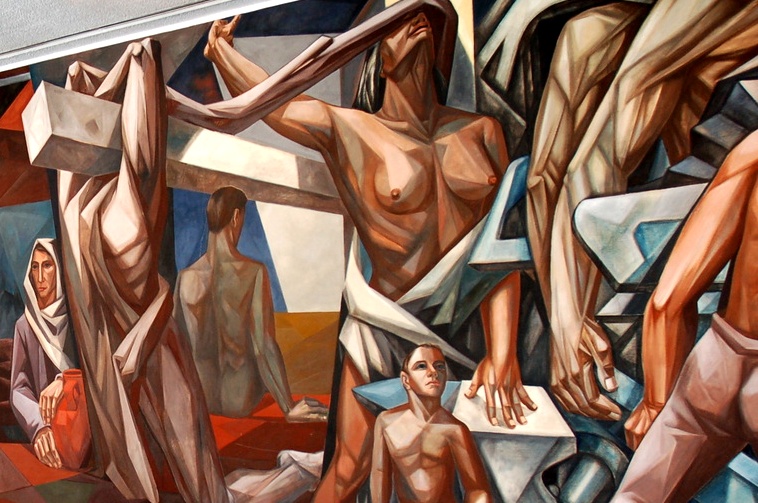
A mural at UN HQ by José Vela Zanetti, via Robin Stevens.

Detail from a José Vela Zanetti mural at the United Nations, New York (original image via Robin Stevens)

Yesterday, the United Nations Security Council met to vote on a new resolution on wartime sexual violence (under the more general rubric of ‘women, peace and security’). Resolution 2106, as it now is, was passed unanimously, and so joins those other numerical signifiers in the chain of gender mainstreaming: 1325, 1820, 1888 and 1960. The session had been convened by William Hague (the UK holds the Security Council chair for June), and the presence of Angelina Jolie (or ‘Angelina Jolly’, as more than one state representative called her) brought obvious publicity advantages, although that in itself is not so surprising both given her close work with Hague on the UK’s Preventing Sexual Violence Initiative and her role as Special Envoy for the UN High Commission for Refugees.

UNSCR 2106 seems designed mainly as a political symbol that the Council “remains actively seized” of the importance of conflict-related sexual violence, and essentially extends a number of themes already in play (there’s a whole bunch of urges, calls for, recognizes, requests in the text). It seeks the expanded use of targeted sanctions against perpetrators and commanders involved in sexual violence and reiterates the connection of that thing called ‘gender’ to DDR, security sector and justice reforms. It repeats the ‘zero tolerance policy’ on sexual violence and abuse by UN forces, requests further reports on progress to the Council, and so on. There were some other points of note, partly in the mention of men and boys as victims, and partly in some puzzling recessive points such as the Resolution’s demand (its word) that women and children abducted into armed forces be released (given that they are especially vulnerable), with no concomitant mention of kidnapped men.

The resolution also called for sexual and gender-based violence training for all pre-deployment and ‘in-mission’ peacekeeper training, and it is here that perhaps the biggest substantive contribution lies. Numerous references were made in the debate to an expanded role for Women Protection Advisers. Like the discussion of targeted sanctions (mentioned first in UNSCR 1820) this is not brand new, since Women Protection Advisers were themselves an innovation of 1888, which upgraded them from existing gender and human rights advisers. The exact nature of the new role is as yet unclear, but it seems to involve an expansion of their mandate to apply to all UN deployments, since they are currently active in just eight peacekeeping missions (which is just over half).

A few other quick observations on the text and the debate.  Continue reading

The Manning Trial, Truth-Telling, and The Precariousness of Democractic Society

The following is a piece written as part of an interview I did at City University on the political and ethical significance of the Bradley Manning trial currently ongoing (links to potentially embarrassing video to follow).

I think that the most important thing that the Bradley Manning trial shows us is the gap that opens up between our legal institutions and our sense of right and wrong, between the law and morality. Many people around the world are shocked by Manning’s imprisonment. People are shocked partly because he has been held under conditions that the UN said violated his human rights, but also because Manning is being tried for exposing the actions of US soldiers and diplomats, including evidence of many potential and confirmed human rights violations. Manning’s supporters are incredulous and view the proceedings now taking place at Fort Meade as illegitimate.Bradley Manning War Crimes

I understand this incredulity and on a level I share it. What I want to suggest, however, is that what we are seeing in the trial of this young man is even more troubling than the corruption of the law by politics – it reveals that the law is always suffused with politics. The law is a technical code. Yes, it is also a normative system that is supposed to determine right and wrong, guilt and innocence. But it is vital that we do not forget that it is a technical code first and foremost, a code that political authorities use to justify their power. Therefore, those with the capacity to influence and manipulate the legal code will always be at an advantage, will always be able to shape that code not towards the pursuit of justice but towards their own interests. This is what Finnish legal scholar Martti Koskenniemi calls this the gap between apology and utopia. The law has its utopian moments and this is especially true of human rights law – for example, Manning supporters see him as a hero who has exposed the grievous crimes of the US government and its military, particularly in Iraq and Afghanistan. They appeal to human rights standards that are quintessential moral claims, but which sadly lack the force of political authority and so are not reliably protected. This is important, but the law also has its moment of apology, where it serves the interests of established authorities, of powerful actors like the US government.

Continue reading

Reviewing the Torture Report

The Nation recently ran a review of The Torture Report: What the Documents Say About America’s Post-9/11 Torture Program, by Larry Siems. The book is drawn from the online report that Siems developed from documents that the American Civil Liberties Union obtained from a series of freedom of information requests – those documents are publicly available on the site as well.

I don’t work on torture nor do I have any specialist knowledge of the US policies after 9/11, but Siems’ work looks fascinating. Not only is he using a massive collection of primary sources, but the way he assembles and analyses the material brings out the systemic use of torture and the dubious ends pursued on the bodies and minds of its victims.

20120811-123525.jpg

Key out takes from the Nation review, written by Peter Baker:

This is oddly apt: failures of understanding are part and parcel of institutionalized torture, which seems to require a systemic aversion to detail, especially the details of other people’s experiences. The most publicly visible manifestation of this aversion was the replacement of “torture”—in both the legal memos and the pages of the nation’s leading newspapers—with terms like “enhanced interrogation.” This same preference for detached vagueness pervades The Torture Report. “Cramped confinement involves the placement of the individual in a confined space,” the administration lawyer John Yoo wrote in a 2002 memo. “The confined space is usually dark.” Depending on the size of the space, “the individual can stand up or sit down.”

Abu Zubaydah’s descriptions of his “cramped confinement,” which Siems quotes, dwell on several aspects that Yoo passes over: how a cloth was draped over his confinement box to restrict his air supply; how the box was so small he could neither sit nor stand but instead had to crouch, which caused a wound in his leg to rupture; how he was given a bucket to use as a toilet, and how it tipped over and spilled while he remained inside for hours; how he lost all sense of time. It is unclear whether Yoo left such details out intentionally, or whether they simply never occurred to him. Similarly, it’s hard to know what to make of a note written by Donald Rumsfeld in ink at the bottom of a 2002 memo on detainee treatment that, among other things, set limits on forced standing. “I stand for 8-10 hours a day,” he wrote. “Why is standing limited to 4 hours?”

America commits torture, funds torture research and encourages torture around the world. It is easy to point the finger at one particularly dark corner or another, be it the CIA or the derelict grunts on the night shift. These documents suggest that a bigger problem might be the sheer number of dark corners: American force abroad is wielded and managed by so many overlapping but distinct organizations that it creates plenty of useful ambiguity as to how, exactly, the overlap is meant to work. There’s a clear sense, especially in memos related to the early days of Guantánamo, of all these various people—Army, Navy, Air Force, CIA, FBI—wandering the cell-block halls, unsure of who is doing what, when and to whom. In the absence of a plan, everyone takes turns dealing with the detainees as he or she sees fit. The guards watch, picking up ideas from the pros for later. One could call the disarray a design flaw, but that would involve assuming that torture wasn’t part of the plan. Given that we know it was, all the confusion seems to have helped; CIA agents reveled in exploiting it, often identifying themselves as FBI agents to avoid having their presence exposed or accurately documented. Defense Department agents pulled a similar move, more than once impersonating State Department officials during torture sessions.

The spectacle of lynching, and the photos documenting that spectacle, served as a boast and a warning: look what we can do—and will. With post-9/11 detainee abuse, the exact same message is being communicated, only so too is its negation: look what we disown, what only the bad apples among us desire, and for which we will duly jail them. Endless memos dissecting torture techniques and parsing existing laws out of existence are a key part of this ritual: they insist that nothing terrible is happening. In a 2002 meeting, a military lawyer was surprisingly honest: “We will need documentation to protect us.” A CIA lawyer chimes in his agreement: “Everything must be approved and documented.”