(Dis)Embodied Methodology in International Political Economy

Nicki Smith

Following some previous discussion on similar themes, a guest post by Nicola Smith. Nicki is Senior Lecturer in Political Science at the University of Birmingham and has published on a diversity of issues surrounding globalisation and social justice. She is currently writing a monograph on Queer Sexual Economies for Palgrave and has published articles in Sexualities, Third World Quarterly and the British Journal of Politics and International Relations. Other related publications include Body/State and Queer Sex Work. The following piece has been developed as part of a book project on methods in critical International Political Economy, edited by Johnna Montgomerie, and a version of it was recently presented at the semi-plenary session on ‘The body in/and international relations’ at the 8th Pan-European Conference on International Relations in Warsaw.


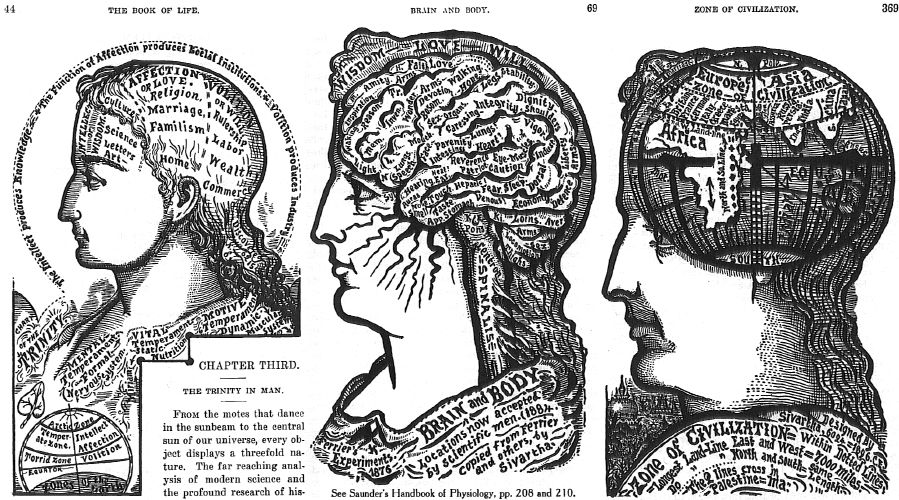
The Book of Life - Brain and Body - Zone of Civilization

There was a time when I understood International Political Economy (IPE) to mean ‘bodies of thought’ (realism, liberalism, Marxism, etc.) and so, not knowing which body to have, I tried each of them on for size. Realism didn’t fit (too tight); liberalism felt wrong (unethically-sourced materials); Marxism looked good (but I lacked the discipline to maintain it). Social constructivism suited my friends and felt pretty comfortable, so this was the body I decided to have. As a social constructivist, I did a lot of work on ideas (‘discourse’) and thought a lot about other bodies of thought. But what I didn’t do was to engage in thought about bodies. Bodies didn’t seem to happen in IPE; they appeared to exist somewhere else entirely, to be accessed only via metaphor (as in the above description) but always somewhere ‘over there’, never as the living, breathing stuff of the discipline. Bodies – or so I assumed – were off the cards.

In other contexts, though, I was thinking a lot about bodies: from the personal (‘will my body be able to produce another body, a child?’) to the professional (‘do I under-perform in job interviews because I gesticulate wildly when nervous?’) and the political, too (‘the government should de-criminalise the sale of sexual services’). Indeed, while I was writing a PhD and then monograph about states and markets – globalisation, economic development and social justice in the Irish Republic – it was bodies that I loved talking, reading, arguing about. I just didn’t see them as ‘IPE’.

In fact, bodies had been there all along; I hadn’t seen them because I hadn’t been looking.

Continue reading

Secrecy and Spectacle in the Overthrow of Mossadegh

Chris Emery LargeA guest post from Christian Emery, Lecturer in International Relations at the University of Plymouth. Chris completed his PhD at the University of Birmingham and has held teaching positions at the University of Warwick and the University of Nottingham. Between 2010 and 2013 he was a Fellow in the Department of International Relations at the London School of Economics. His research covers several areas but is primarily situated at the intersection of International Relations, Diplomatic History, and Foreign Policy Analysis. He is interested in all aspects of post-war US foreign policy, with specific expertise in US policy in Iran. His latest book is US Foreign Policy and the Iranian Revolution (Palgrave Macmillan, coming this October) and he is also the author of pieces in Cold War History, The Iran-Iraq War (Routledge, 2013) and commentary in The Guardian. His next journal article will appear in Diplomacy and Statecraft.


This week an organisation dedicated to expanding public access to US government information, and publishing its former secrets, released documents proving the CIA’s involvement in an illegal covert action. Sound familiar? In this case, however, the authors had no fear of landing themselves in solitary, a foreign embassy, or (worse still) a Russian airport. The organisation lifting the lid was the National Security Archive (I will not indulge in the ironic use of acronyms) which, despite the official sounding name, receives no government funding. The NSA (ok, just once) fights for greater transparency and accountability in US foreign policy within a legal framework. Its primary weapon in fighting for open government is the Freedom of Information Act, and its bluntness may be part of the reason why others have taken more drastic action. I will return to the prescient topic of government secrecy later on, but first a few words on the content of these documents.

The documents are significant for a number of reasons, but the headline news is this: ‘CIA Admits It Was Behind Iran’s Coup.’ The most significant line taken from these documents is from a CIA internal history from the mid-1970s: “the military coup that overthrew Mossadeq and his National Front cabinet was carried out under CIA direction as an act of US foreign policy, conceived and approved of at the highest levels of government.”

A legitimate response is:

Nicholas Cage You Don't Say

Quick historical recap. In August 1953 the CIA (working with MI6) orchestrated the overthrow of Iran’s democratically elected leader Mohammad Mossadegh and installed Muhammad Reza Shah Pahlavi in his place. The specific motivation for the coup (codenamed TPAJAX) was that Mossadegh was attempting to nationalise Iranian oil. The more pressing fear was that his government was unstable and Cold War thinking dictated that this made Iran vulnerable to Soviet influence. This anxiety was heightened by Iran’s huge oil resources, geographic proximity to the Soviet Union, and the existence of a large and well established Iranian communist party (the Tudeh). The plot to topple Mossadegh initially failed, spooking the Shah into premature exile, but a few days later US and UK agents managed through a variety of nefarious tactics to put a decisive number of pro-Shah supporters onto the streets. Mossadegh’s supporters were rounded up and the great man himself was sentenced to death (the sentence was never carried out – he died in Tehran in 1967). After the coup, Iran’s concession to Western oil companies was renegotiated and for the first time American petroleum companies were granted access to draw Iranian oil.

Continue reading

Why I’ll Miss Jean Bethke Elshtain

A short version of a tribute to Jean Bethke Elshtain, who died last Sunday, from Christine Sylvester, Professor of Political Science at the University of Connecticut.


Jean Bethke Elshtain

She was embraced by feminists for her books on Women and War and Public Man/Private Woman, and then ostracised by the sisterhood for her disapproval of gay marriage and approval of “just” wars in Afghanistan and Iraq. She would become anathema to peace researchers and sandpaper to scholars of critical IR. Those who liked her early writings in a secular vein would be disappointed when she began to argue from a base in religious philosophies. Jean Bethke Elshtain encapsulated the best hopes of feminists to effect change in core topics of “men’s studies” –International Relations and Religious Studies –and ended up instead on the wrong side of several issues. That’s clear. So let’s ignore her recent death, shall we? Possibly celebrate her end?

Not me. I met Jean at a series of feminist IR conferences held between 1989 and 1993 in the USA, and then shared many a panel with her at the International Studies Association for a few years. Without equivocation, had I not met Jean and found favour in her eyes, I wouldn’t have produced publishable work in my own voice. Jean pulled me aside at one conference, sat me down, and told me to maintain and further develop what she called my “maverick tendencies.” The good Coloradan that she was warned against following the herd as it raced along toward…possibly nothing. My graduate school mentors had been excellent and very encouraging, especially Karen Mingst. I learned much from them, but also resisted some of their good advice once I was out on my own, stubbornly insisting on writing about Zimbabwe and feminist IR –two very different specialisations, both approached in slightly off-centre ways. To Jean, that was the way to go. Permission granted. Years later, in 2001, when she was on an ISA panel discussing my work, along with Cynthia Enloe, Steve Smith, and Dipesh Chakrabarty, she gave me a hard time over what she called my “postmodern avoidances;” by then, Jean was a solid believer in truth. She gave an audience member an even harder time, though, for wilfully misrepresenting my arguments.

Jean the scholar I admired very much. Jean the person behind the scholar astounded me. Her story, of course, appears in an early chapter in Women and War (1987), a book that came out decades before IR recent “new” interest in auto-ethnography. Jean depicts herself as a smart-ass tomboy, a shoot-em-up leader of the cavalry of kids, clearly smarter than everyone around her. But she was decidedly in the pack of youngsters who contracted polio before the vaccine, and who had to suffer the neanderthal treatments available at the time (my cousin was similarly afflicted and spent months in a hideous Iron Lung.) Thereafter, Jean walked with a noticeable limp. I remember the two of us racing like maniacs down the streets of the University of Southern California to get to where we were to speak. That pronounced limp on a shortened leg could not be ignored: I suggested we go slower. She wouldn’t have it. “I can do this,” she said, “not happily or easily, but I can do it.”

Continue reading

Bodies in Pain: Yasiin Bey and the Force-Feeding of Hunger Strikers at Guantanamo Bay

Lauren WilcoxA guest post from Lauren Wilcox, currently Charles and Amy Scharf Postdoctoral Fellow in the Department of Political Science at Johns Hopkins University. Lauren is starting a new job as a University Lecturer in Gender Studies at the University of Cambridge this fall. Her  work is located at the intersections of international relations, political theory, and feminist/queer theory in investigating the consequences of thinking about bodies and embodiment in the study of international practices of violence and security. She is the author of articles in Security Studies, Politics & Gender and, most recently, International Feminist Journal of Politics. Lauren’s current book manuscript is entitled Practices of Violence: Theorizing Embodied Subjects in International Relations.


Mos Def Nose Tube

Earlier this month, the UK human rights organization Reprieve released a video in which Yasiin Bey, formerly known as Mos Def, a well-known and critically acclaimed American hip-hop artist and actor, underwent (or attempted) the force-feeding procedure undergone by hunger strikers imprisoned at Guantánamo Bay. In this five minute video, Bey dresses in an orange jumpsuit like those worn by prisoners at Guantánamo Bay, and states simply that this is the ‘standard operating procedure’ for force-feeding hunger striking prisoners. He is then shackled to a chair resembling those used to force-feed prisoners (such as those pictured below). Bey is approached and held down by two people who attempt to insert a nasogastric tube down his nasal passage way. The video shows Bey struggling against the nasogastric tube, crying out, protesting, yelling for it to stop, and ultimately the force feeding is not carried out. The video is extremely emotional and difficult to watch. After the attempted force-feeding ends, Bey struggles to describe what it feels like, describing it as ‘unbearable’. It ends as it begins, with Bey stating ‘peace’ and ‘good morning’.

For some background context, 166 prisoners remain in Guantánamo Bay: of these, 126 have been cleared for release as not posing any threat to US national security, but are still being imprisoned. To protest their treatment and indefinite confinement prisoners have engaged in hunger strikes since the prison camp opened in July of 2002, the first wide scale hunger strike reached a peak in June 2005, when between 130-200 out of approximately 500 prisoners at Guantánamo Bay began refusing food. Hunger strikes again reached a peak in the spring and summer of 2013, and are ongoing with around 100 prisoners refusing food, and of those, between 44 and 46 are being force-fed (pictured above is an image of an inmate being hauled to the medical facilities to be force-fed), a number so high that the military had to send a back-up team of medical personnel to assist with the force-feeding of prisoners. While the force-feeding of hunger strikers when virtually unnoticed in the media in 2005/6, and again in 2009, the latest months have brought renewed attention to the plight of those who have been held at Guantánamo Bay, some for over a decade, with seemingly no progress made on holding tribunals or securing release of the remaining prisoners. Prisoners have spoken out, including an op-ed published in the NY Times by Samir Naji al Hasan Moqbel entitled “Gitmo is Killing Me”. While President Obama has recently renewed his pledge to close Guantánamo Bay, and a federal judge has even more recently stated that while she had no power to stop the force-feedings, Obama could himself order the force-feedings stopped.

What are the effects of Bey’s action? Continue reading

Constructing National Security: U.S. Relations With India and China

Jarrod HayesA guest post from Jarrod Hayes on his forthcoming book. Jarrod is an Assistant Professor of International Relations at the Georgia Institute of Technology. In 2003 he received his Bachelor of Arts degree from the University of Colorado at Boulder in astrophysics and political science. He completed his Ph.D. in Politics and International Relations at the University of Southern California in 2009. Prior to joining the Georgia Tech faculty, he was the ConocoPhillips Assistant Professor of International Relations at the University of Oklahoma. His areas of scholarly and teaching interest focus on the role of social orders in shaping international security practice. His scholarship appears in the European Journal of International Relations, German Studies Review, International Organization, and International Studies Quarterly.


Srdjan originally approached me about doing this guest post six months ago. So my thanks to Srdjan and the gang for their patience and for giving me an opportunity to discuss my forthcoming book Constructing National Security: U.S. Relations With India and China, set to come out with Cambridge University Press in September (available on Amazon for a discount). What I would like to do is discuss a bit of the background of the book project before addressing the substance of the book and conclude with some of the implications and questions raised by the work.

The book initially started as a project on the democratic peace. When I was in graduate school, I was captivated in my very first semester (Introduction to IR theory with Robert English) by the law-like regularity of the phenomenon—loads of papers and books demonstrate that democracies do not fight each other (see among others my 2012 article in the European Journal of International Relations, also Harald Müller and Jonas Wolff’s ‘Many Data, Little Explanation’ in Democratic Wars: Looking at the Dark Side of Democratic Peace and Ungerer’s 2012 review in International Studies Review). In part owing to how the subject has been investigated (more on that below), academics have lost perspective on the significance of the phenomenon. Security seems to be everywhere, and applied to almost everything. The initial impetus for the highway system in the United States was national security. President Dwight Eisenhower’s avowed purpose for building the massive transit network was to facilitate the movement of U.S. military forces in the event of a land invasion. Two years later security was used to justify education policy in the form of the 1958 National Defense Education Act. The list goes on. Almost any topic one might think of has probably been included under the rubric of security. The democratic peace, however, points to a notable exception. As reams of evidence indicate, democracies have been consistently unwilling to label their peers as security threats. The puzzle is obvious: how is it that democracies have avoided constructing each other as threats while so many other subjects have been labeled as such.

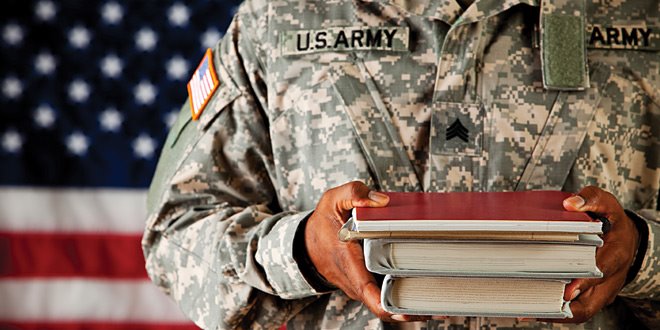
US Army Books

The significance of the democratic peace is self-evident in my opinion. As I read more of the democratic peace (DP) literature, however, I became increasingly dissatisfied with the collective effort to identify the forces that generate the phenomenon. Methodologically, regression-based studies dominate the field. While these studies have been invaluable in establishing the claim that the democratic peace phenomenon exists, by their very nature they are able to demonstrate only correlation, not causation. Not surprisingly, what effort these studies do make towards understanding and explaining the democratic peace focuses on causes — norms and institutions — that could be quantified, sometimes through tenuous proxies. Yet, because the quantitative nature of the studies does not enable access to causal forces, the mechanisms behind the democratic peace remain shrouded in shadow. Perhaps surprisingly given my educational background, I was particularly dissatisfied with the theories and causal assumptions that underlie them in the literature (for the sake of brevity and focus, I will not go into this critique in depth, but interested readers can find it in my 2012 article in the European Journal of International Relations). My dissatisfaction with the literature, specifically with its tendency to brush by the big questions of how the democratic peace is possible, led me to begin pursuing my own theory of the democratic peace.  The book is the result, although it has since grown into an effort to understand how identity shapes security outcomes in democracies.

Continue reading

Russia’s Anti-Gay Laws: The Politics and Consequences of a Moral Panic

A guest post from Cai Wilkinson on recent LGBTQ developments in Russia. Cai is a Lecturer in International Relations in the School of Humanities and Social Sciences at Deakin University, Australia. Her research interests include critical approaches to security, fieldwork-based securitization studies, norm contestation and resistance, and genders and sexualities in International Relations. Her geographic focus is on the former Soviet Union, and she is currently working on projects about LGBT rights and human rights norms in Kyrgyzstan and Russia. She received her PhD from the University of Birmingham, UK, in 2009 for a thesis entitled Interpreting Security: Grounding the Copenhagen School in Kyrgyzstan, which drew upon seven months of fieldwork conducted in Bishkek and Osh in the aftermath of the 2005 overthrow of the Akaev regime. Her work has been published in Security Dialogue, Central Asian Survey and Europe-Asia Studies, and she has contributed chapters to volumes on securitization theory, statehood in Central Asia, and fieldwork-based research methods. Cai is also Chair of the International Studies Association LGBTQA Caucus.


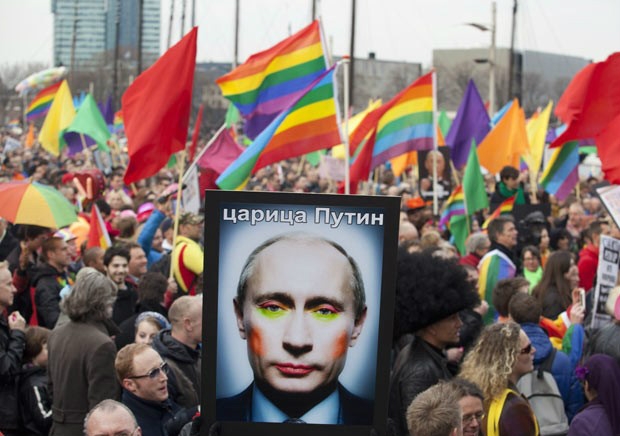
Russia Gay Pride Putin

The issue of LGBT rights in Russia first properly came to mainstream international attention in March 2012, when the St Petersburg Duma passed a law prohibiting “public acts aimed at the propaganda of sodomy, lesbianism, bisexualism and transgenderism amongst minors“. The law provoked an international outcry, including calls for tourists to boycott St Petersburg, sister-cities to consider cut off ties with Russia’s “window on Europe”, and condemnation from the EU, with the European Parliament passing a resolution noting that it was “gravely concerned by developments which restrict freedom of expression and assembly on the basis of misconceptions about homosexuality and transgenderism” and calling on Russia and other countries considering the adoption of similar legislation to “demonstrate, and ensure respect for, the principle of non-discrimination”.

In actual fact, this was not the first “anti-gay” law to be passed in Russia; Ryazan Oblast’s Duma adopted an amendment to local legislation to outlaw the “propaganda of homosexualism” in May 2006, and Arkhangelsk and Kostroma Oblasts followed suit in 2011. Yet the passing of the St Petersburg law proved to be a catalyst for other administrations to introduce similar laws, with a further six subsequently adopting similar legislation and others considering it (so far only the Moscow Regional Duma has rejected legislation). Most significantly, these laws paved the way for consideration of a federal bill outlawing the “propaganda of non-traditional sexual relations to minors”, which the Russian Duma passed on June 11 despite continuing international condemnation and the fierce opposition of local LGBTQ activists and their supporters, who frequently endured physical attacks and arrests while protesting against the law.

Despite being a long-time Russia-watcher, the swiftness at which anti-gay laws have spread and at the ferocity of both popular and state homophobia has been striking. This is not, I should add, simply the result of not paying close enough attention. As a queer undergraduate student studying Russian with a compulsory year abroad to plan for, I was extremely conscious of attitudes towards homosexuality and queerness and the stigma and dangers that local LGBTQ people faced (Laurie Essig’s Queer in Russia was an essential primer), and was extremely careful not to out myself to anyone who wasn’t definitely queer-friendly while living with families first in Krasnoyarsk and then Voronezh in 2001-2002.

At the same time, it appeared until the mid-2000s that slowly but surely Russia was becoming more tolerant. Homosexuality was decriminalised in 1993 without any notable opposition, declassified as a mental illness in 1999, and the percentage of survey respondents advocating for the “liquidation” of homosexuals fell from 31% in 1989 to 22% in 1994 and all of 5% in 2013 (although inevitably survey results are heavily contingent on the phrasing of questions and, as Alexander Kondakov demonstrates, attitudes to homosexuality are no exception). Attempts to recriminalise homosexual relationships between men failed in 2002, 2003 and 2004.

Popular culture in the first half of the 2000s appeared to offer further evidence of the trend: Continue reading

Ten Reasons Not To Write Your Master’s Dissertation on Sexual Violence in War

Marsha Henry

A guest post, following on from some previous reflections on gender and teaching and the politics of pedagogy, from Marsha Henry. Marsha is Lecturer in Gender, Development and Globalisation at the LSE Gender Institute, where she teaches, amongst other things, a course on gender and militarism. Her most recent research is into sexual exploitation in peacekeeping missions and peacekeeper labour hierarchies, and she is also, with Paul Higate, author of Insecure Spaces: Peacekeeping, Power and Performance in Haiti, Kosovo and Liberia (Zed, 2009). With Pablo, she recently co-edited a special issue of International Feminist Journal of Politics on ‘Rethinking Masculinity and Practices of Violence’. This post is based on a presentation given in San Francisco at the International Studies Association in April 2013.


It’s the first day of Lent term and the students are nervously gathered in a small stuffy classroom.  When I walk in and head towards the front of the room, the group falls silent. I introduce myself and we start a round of introductions and I ask students to speak briefly about their interest in the course. The first student tells me, and the class, that she’s in IR (International Relations), and is keen to take the course because she’s interested in studying sexual violence in war.  Another student turns to her, incredulous because she too is interested in that exact subject, and that furthermore she has worked for 3 months in the Democratic Republic of Congo (DRC) and has ‘seen a lot’. A few more students echo similar interests and I’m trying hard not to stereotype these students. But it’s difficult. A mythical figure is beginning to crystallise in my head and I can’t stop it. This figure is young, female and possibly middle-class, sometimes Scandinavian. She’s studying IR, Human Rights or Gender Studies. A few male students also indicate an interest. Some indicate interest in other topics, but there is a numbers problem from the outset. I feel uncomfortable as this is the third year that I’ve taught this course, each time allotting only one lecture week to the subject of sexual violence in war, and subsuming it under the larger heading of ‘gender, sexualised violence and work in militarised contexts’. Each year students have asked for more time to be devoted to the subject, for the lecture week to be moved up, and for their to be less focus on diversity in the armed forces. When students come to me during office hours to discuss the scope of their dissertations on the subject I fidget. After a few conversations with colleagues, I decide I need to start compiling a list – of compelling reasons why students should not write on the subject of sexual violence in war. But what would I do with this list? Can it be shared? And what of my responsibility not to teach on the subject?

10: Writing About ‘It’ Narrows The Political Focus

As a committed feminist, I’m all for drawing significant attention to the ways in which women experience conflict in distinctive ways. But the concentration of interest on sexual violence in wartime often leads to a neglect of the ways in which women experience violence (labelled as sexual or not) in peacetime. This noticeable singular focus on the topic also narrows the possibility of dislodging categories and subject positions. It is often assumed in class conversations, essays and subsequently dissertations that women are the victims and men are the perpetrators of this form of violence. This assumption appears in written work in a way that both masks the possibility of other positionings within the perpetrator-victim continuum, as well as the structurally embedded way in which sexualised violence occurs and is experienced by individuals and communities. This failure to explain the pervasiveness of sexualised violence against women tends to reinforce the binaries and provides a rather fixed aperture for analysing sexual violence in war and its consequences.

9: Researching The Topic Inspires Voyeurism

I’m squirming in my seat as one of the students smiles widely while she explains her interest in working on the topic of sexual violence as a weapon of war. She could be nervous explaining herself in front of her peers and her professor. She could be feeling awkward about the subject matter. She could be conforming to gendered expectations of women in the classroom where female students who express themselves confidently or through feminist rhetoric are categorised as aggressive. If feminist critique is pleasurable, how do we ‘do’ our analysis of sexual violence in wartime, paying attention to experience, trauma, and moral responsibility? There is a tendency, in making visible the ‘horror’ of it all, that students sensationalise the subject by focussing on the minutiae, the details and the thick descriptions. Honing in on the bodily experience of rape, for example, can remove rape in war from the wider social, cultural, economic and political context in which it always takes place. It can be an abstraction of the total experience. The affective impact is that readers of these dissertations distance themselves from subjects in the studies. Those who are victims and/or survivors and end up consciously or unconsciously performing what Donna Haraway referred to as a god-trick.

Continue reading

What We Talked About At ISA: Teaching Gender and War: Some Reflections on Negotiating the Five Stages of Feminist Consciousness/Grief in Undergraduate Students

Victoria BashamA guest post in our current series on ISA presentations from Victoria Basham, who is Senior Lecturer in Politics at the University of Exeter. Victoria’s research draws on feminist and sociological theory to explore militaries, militarism and militarization. In War, Identity and the Liberal State (Routledge, 2013), she draws on original fieldwork research with members of the British Armed Forces to offer insights into how their everyday experiences are shaped by, and shape, a politics of gender, race and sexuality that not only underpins power relations in the military, but the geopolitics of wars waged by liberal states. Victoria is also a working towards the launch of a new interdisciplinary and global journal called Critical Military Studies which seeks to provide a space for dialogue among scholars questioning the very idea of military organisation and armed force, and seeking to offer new insights into organised and state-sanctioned violence by exploring its wider significance and effects.


Despite the burgeoning literature highlighting the significance of gender to global politics, research into international studies curricula suggests that gender is rarely dealt with extensively or even adequately by ‘top ranking’ UK Politics and International Relations (IR) departments. A cursory glance at popular, introductory undergraduate textbooks in Politics and International Relations also reveals that whilst feminism may be included as an approach, accounts of power as institutionally situated remain dominant. As such, many undergraduates only experience brief introductions to feminism, gender, and issues of sexual identity, if anything at all. So when I was given the chance to design and teach two research-led undergraduate courses in 2009, I saw it as an important opportunity: both to provide students with insights into how gender animates global politics, and to engage in a form of ‘feminist pedagogy’ by encouraging students to look at themselves and the world around them critically and analytically, through the interlocking lenses of gender, race, class and sexuality.

My experience of delivering these courses over the past few years has been largely positive. On more than one occasion students have commented that engaging with feminist theories and praxis had ‘opened their eyes’. However, in other students the experience of studying the global through gendered and postcolonial lenses elicited confusion, anger and pain on their part, at least initially. Indeed, as I have continued to teach these courses, I have often thought of student reactions as akin to Kübler-Ross and Kessler’s five stages of grief or what Patti Lather has aptly called ‘stages of feminist consciousness’.

One possible reason for this is that for feminists, the question of ‘What is Politics?’ necessarily includes accounts of power that are personal, emotional, and everyday. Given that trying to account for how power shapes and is shaped by people’s daily lives is not always readily accessible through a focus on institutions and the like – the usual stuff of politics and IR analysis – many feminist teachers are likely to encourage their students to think through how ‘the personal is political’ in their experiences and to re-personalise an often depersonalised and sanitised set of issues including war. Many of my students (though not all, and rarely, it should be said, in a linear fashion) experience moments of denial, anger, bargaining, depression and acceptance when taking my courses. Moreover, in reacting to their comments and in trying to anticipate their turmoil I often find myself angry, disbelieving, in negotiating mode, saddened and sometimes having to accept, and very grudgingly I’ll admit, that not all of them believe that gender is as significant to war as I do.

Continue reading

Reflections on Narrative Voice

The final post in our mini-forum on critical methodologies and narrative in IR. The series is closed by Himadeep Muppidi, who is Betty G.C. Cartwright Professor of International Studies and Political Science at Vassar College, New York. He is the author, most recently, of The Colonial Signs of International Relations (Hurst and Columbia University Press, 2012).


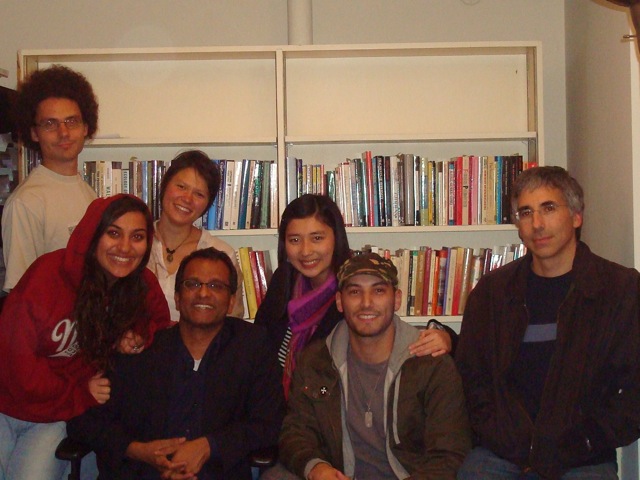
Himadeep Muppidi and Students

Himadeep (seated, fourth from left) with the ‘Vassar village’: students and faculty who were into story-telling.

I went to the York University workshop persuaded of the importance of the narrative turn in the field of international relations. I find literature in various forms useful in my teaching of international relations at Vassar, not least in opening my own provincial imagination to the worlds of others. Entering the international through narratives allows the class to engage political issues from the inside rather than pretending we were somewhere outside looking in or somehow beyond the concerns of those whose worlds we safely theorize. Narratives in different forms – novels, memoirs, short stories, and autobiographical essays – also allow for insightful translations of contemporary contexts. After soaking oneself in the nuance and complexity of narratives, conventional accounts of IR appear lifeless and boringly schematic in their attempts to straddle (our) humanity. They perish, unseen and unmourned, on the classroom floor.

But the discussions in the workshop helped me realize that narratives on their own are not enough. We need critical theories to go along with the current turn towards narratives. Colonialism too sustains itself on effective story-telling and not just brute force. It has a robust history of accumulating, systematizing and circulating its stories, not least to those citizen-subjects it narrates as its benevolent and heroic center. In IR, we often claw our way out of these archival dumps searching for fresher, more humane, worlds.

In the wasteland that is conventional IR, stories of any sort might appear, at first glance, to offer a welcome respite. But there is also, as some of our fellow disciplines can attest to, a politics of story telling: whose stories do we get to hear all the time; whose stories are generally inaudible; how do stories make us over; whose mansions do stories furnish with humanity in every remote room and whose huts do they deprive of life and dignity. Perhaps we need to explore these inequities of the political terrain more even as we take the narrative turn seriously. The question I left with from the all too brief workshop, one that is not a new one by any means, was: How can we, in IR, engage better the diverse worlds of the human international, as they come to us through narratives, without losing sight of the politics of inequity staging their appearances and disappearances?

And there I would have stopped but Naeem Inayatullah encourages me to say more. He wonders if what I am saying is: “No matter the turn, it will be dominated by Europe. So what can we do to give the narrative turn a chance at something else?” I am unsure if it is Europe’s renewed domination of the wasteland that bothers me as much as the prospect of another lost opportunity to plough newer terrain.

Maybe I should defer to the voice of a better storyteller. In a 2009 TED talk, Chimamanda Adichie speaks to what she calls the ‘The Danger of a Single Story’. In this short, approximately 20 minute presentation, Adichie draws our attention to a number of issues relevant to our thinking about stories and storytelling: to how “impressionable and vulnerable” we all are in the face of stories, to how the British and American stories she read as a child opened her imagination and at the same time shaped her childhood writing so much that the stories she wrote, even as she grew up in Nigeria, were of British and American worlds (filled with discussions of the weather and ginger beer). Reading stories by writers such as Chinua Achebe, she tells us, brought her to other worlds in which she could recognize characters like herself. Adichie is appreciative of the ways in which British and American stories opened up her world even as she highlights the dangers of knowing only those stories. This is not just an inter-country issue either.

Even the Nigerian context she imbibes as a child is not shaped by a single story though it takes her a while to realize this. There are subaltern worlds here (the world of the domestic help for instance) that she sees only in a thin and caricatured form at first since the story of “their” poverty dominates her imagination and occludes all their other ways of being human. Adichie insightfully connects stories and storytelling to questions of structural power and narrative homogeneity: our socially learned capacities to hear and tell diverse and plural stories of one’s own world while hearing and re-telling only single stories of the other. Adapting Adichie, I wonder if, given the social structures of teaching and learning IR that we currently inhabit, the narrative turn would only result in a renewed cycle of seemingly new stories about the diversity and humanity of Europe and single and simple stories about its Others.

But Naeem’s question continues to smile at me: “So what can we do to give the narrative turn a chance at something else?” It knows that I haven’t responded fully to it yet. I am tempted to say that I prefer to think with you all on that one. Maybe my partial response would be, in anticipation of a broader and longer conversation, that it is not writing alone but reading and teaching that we need to work further on. Maybe we need to begin by reading and teaching an international in which there are multiple other stories than the one or few we already know about IR’s others. Maybe that is the implicit promise of storytelling conceptualized, critically, as a politics of exile.


Suggestions for further reading: Sven Lindqvist, Eduardo Galeano, Assia Djebar, Amitav Ghosh

The Personal is Political, But Is It IR? On Writing as a Mother and Feminist

Annick WibbenThe penultimate post in our methodology and narrative mini-forum, written by Annick T.R. Wibben. Annick is Associate Professor of Politics and International Studies at the University of San Francisco. She’s been thinking about narrative for a long time, but rarely writes autoethnography. The piece featured here was originally written in 2006, but it’s taken her this long to find a suitable home for it…not to mention the courage to let it go out into the world. When she is not thinking about narrative (or tweeting about feminism, security and violence @ATRWibben), her research at the intersections of feminist theory, security studies, and continental philosophy, aims to radicalize security studies and to challenge the politics of security. In Feminist Security Studies: A Narrative Approach (Routledge, 2011), she examines meanings of security legitimized in existing practices and proposes an opening of the security studies agenda by drawing on narrative approaches. So, really, she’s never not thinking about narrative.


So here I am; it is 9:30am. I am sitting in a room with other women at our weekly Friday writing group. We call ourselves the Writing Warriors, as much to describe what we’re doing as also to encourage ourselves to continue doing it. Most of us are untenured still, which adds an extra dimension to the task of writing – must be productive, must publish! Many of us have small children and when the writing stops, that’s what we talk about: How do we deal with the challenges of combining motherhood and an academic career. We exchange recommendations for childcare and kid-friendly restaurants; we give advice on breastfeeding, potty-training, and where to buy healthy snacks (we certainly don’t have time to make them). Sometimes one or more of us have to miss the writing day (or part of it) when a child is home from school, a babysitter is ill, or we just cannot focus on our own research because we need to catch up on teaching or service commitments (of which we all have plenty, of course).

So here I am; I arrived late today. Only a few minutes late, but late enough to be occupied still with what I left behind in the rush to get here as close as possible to 9am when we meet, greet, talk about our writing plans for the day, and then start writing, promptly at 9:15am. I am wondering should I have left earlier. When? I could have skipped breakfast. I could have ignored my daughter’s requests to read her a story before leaving. Should I not have bothered to throw in the load of laundry? Or, to wipe off the food from the high-chair? I could have gotten here a few minutes earlier…

So here I am; writing IR. I am an international relations scholar, so this is what I do, I write IR. I need to convince myself that this is what I am doing, say it again: I write IR. I write IR. As I repeat these words, something else pops into my mind: Sam I am, I do not like that Sam I am. I do not like green eggs and ham. I do not like them Sam I am… just like the character in Dr. Seuss’ children’s book needs to be convinced to try green eggs and ham just like I need to convince myself, that I am writing IR.

So here I am; staring at the blank page. Continue reading