I was thinking of writing on Dr King’s legacy (again) to mark MLK Day this past Monday, but it turns out that Dr Cornel West has already said what needs to be said.
I was thinking of writing on Dr King’s legacy (again) to mark MLK Day this past Monday, but it turns out that Dr Cornel West has already said what needs to be said.
Newcomers to India, however extensive their previous study about the country, are likely at times to find themselves in baffling or embarrassing situations as a result of their ignorance of local attitudes and customs.
Thus begins Gordon C. Roadarmel’s Cultural Cues and Clues for the American in India, which you can now download here. My friend and mentor Arthur Rubinoff recommended it for various reasons, including the fact that this booklet went to every India-bound Fulbright scholar between 1970s to early 1990s (the first publisher, in 1971, was the Center for South and Southeast Asia Studies at UC Berkley, the last, in 1995, the U.S. Educational Foundation in India). Born in India to missionary parents and a frequent traveler to New Delhi and Allahabad, Roadarmel was regarded as one of the foremost specialists in modern Hindi literature in his time, at least in the United States (in a book review of published in 1970 in the journal Mahfil, Gayatri Spivak is critical of Roadarmel’s translation skills, describing him as a “native American with some Indian schooling”; Vol. 6, No. 2-3, p. 35). In addition to a number of interesting revelations about Indian and American elites in the middle years of the twentieth century, Cultural Cues and Clues invites reflection on standard ethnographic items such how (not) to experience Otherness (“except in parts of South India, people try to keep food above the middle joints of the fingers”), the use and abuse of analogical reasoning (“Chapaties, however, which resemble tortillas, are always eaten by the fingers) or language politics (“Since most Indians have not learned their English from Americans, they may have difficulty in understanding your accent and some of your vocabulary”). Well worth a read – even if you’re not an American academic planning to do fieldwork in India several decades ago.
Posted without comment; thanks James Sadri.
<rant> What I used to dislike about the Iranian elections is what I dislike about all national elections today: they’re all fake. There is a choice but it’s not a meaningful one. With the Iranian elections the argument would be: Ahmadinejad or Karroubi/Mousavi, it doesn’t matter, the real power is with Khamenei the Supreme Leader. So you can elect the Iranian President but you can’t elect the Supreme Leader. Well that’s the situation we’ve all got today, even in the US. There is a Supreme Leader casting a long shadow over every national ‘democratic’ process. You can vote for Obama/Romney, Cameron/Brown/Clegg – whoever – but those are all fake choices, where you’re always choosing between the lesser of two evils, never for the world you really want. You can’t vote to stop 20,000 kids dying today because of lack of access to clean water. You can’t vote to stop all war. You can’t vote for people to have the same freedom of movement regardless of where they’re born. You can’t vote to stop extreme disparities of wealth. You can’t vote to stop climate change. That’s because if you do any of these things at the national level you’re shooting yourself in the foot. Increase labour protection or environmental regulation and the factories and cash will go to our enemies. Increase foreign ‘aid’ and it means less for our struggling people. Try to cap carbon emissions and you’re killing business competitiveness. Our Supreme Leader is national competition. We sacrifice the societies we really want to build – peaceful, harmonious, more equal ones – for violent dysfunctional ones that are hopefully slightly richer than those across the map lines. Nobody seems to question the race to the bottom – we seem only to be focused on being the fastest zombies. The world has globalised yet our politics remains pitifully – pathetically – parochial. So while I’ll be hoping that Romney doesn’t win tomorrow, I’m going to remember that there’s a Supreme Leader out there who’s pissing on all your national elections. And he doesn’t have a beard. </rant>
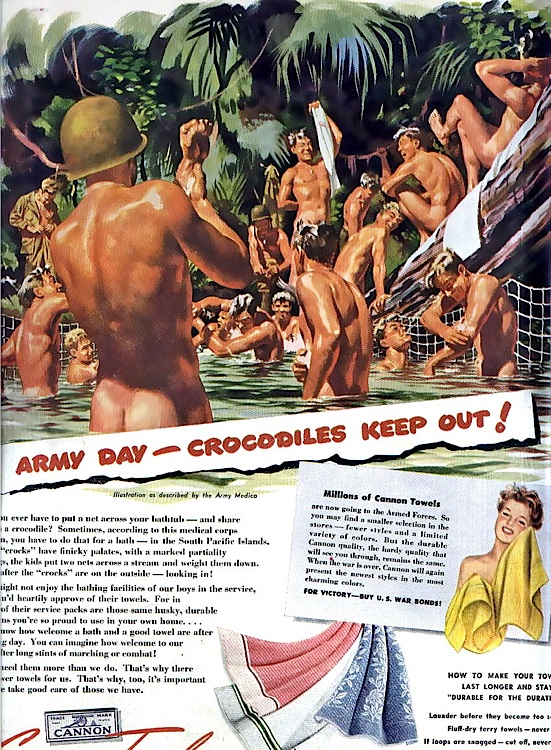
The ever-excellent Sociological Images offers up this 1940s advert, and others like it, as an example of how images previously taken to be innocent consumer bait for stereotypical homemakers now appear to us as dripping with homoeroticism. They may have added too that this half-ironic, half-nostalgic distance is what endears us to such images, which we then enjoy as vintage objects, for all that we know about the true historical context in which they were produced.
One common idea, which relates nicely to military bathing aesthetics (cannon towels? really?) is that many bonding behaviours in nominally heterosexual, male-dominated groups are in fact homosexual, but in a disavowed or repressed way. The scrum, the shared shower, the bunk-beds, the exclusion of women not only from the fields of play and war, but also from the various celebrations and carnivals that follow, all seem to indicate a desire for intimacy that cannot be named as such.
In the excellent Bring Me Men (which deserves its own dedicated review), Aaron Belkin identifies a more complex relation. In becoming military men, there is a need not only to disavow femininity, but also to become intimate with the ‘unmasculine’ and the ‘queer’. Rather than identifying a direct alignment of the masculine with the military, or seeing gender norms as accidental in their intersection with the military, there is instead a constitutive tension between the masculine and the unmasculine (or, we might say, between the strongly heteronormative and the homosexual). Basic training relies on a traumatic ambiguity, continually casting initiates as by turns masculine and unmasculine, so that no soldier can ever be sure that they were sufficiently on the ‘right side’ of the line. As one Marine put it: “The opposite of feminine? No. To me, what is masculine? I don’t know. [pause] And I’ve worked so hard at being it”. The continual ambiguity – what Belkin calls discipline as collapse – interacts with surveillance and punishment to produce the soldier-subject.
More brutally: Continue reading

Todd Akin (R-MO) says that doctors told him that women can’t get pregnant from rape. The doctor in question was presumably Onesipherous W. Bartley, whose 1815 A Treaties on Forensic Medicine or Medical Jurisprudence explained that conception:
must depend on the exciting passion that predominates; to this effect the oestrum/veneris must be excited to such a degree as to produce that mutual orgasm which is essentially necessary to impregnation; if any desponding or depressing passion presides, this will not be accomplished. (via)
At least we know how up to date a certain kind of Republican is on the medical literature. Aaron ‘zunguzungu’ Bady offers a less generous, but surely more astute, diagnosis:
The thing about a chucklehead like Rep. Akins is that he doesn’t actually care whether or not women have a magical anti-rape secretion in their body that makes conception less likely. That’s the whole point: his right not to have to worry about it. If you look at his entire statement, for example, you’ll notice that his foray into weird science was tangential to his main point, which was, simply, punish the criminal not the child. And this is more or less orthodox GOP doctrine, which has the hammer of law enforcement and looks for nails: solve the problem of rape by hammering the criminal, and make abortion into a crime, so you can hammer that too. But this simple-minded approach stumbles when it runs into the problem of the rape-victim: how to have empathy for the victim (because “victim’s rights” is a central pillar of the law and order approach) while also criminalizing her if she gets an abortion? How to insulate her choice to get an abortion from the contingency she did not control, and could not have chosen?
As many have pointed out, then, the first imperative is to make it her choice, and therefore her fault. But there’s still he cognitive dissonance of a rape victim forced to have the child of a rapist, something that doesn’t sit at all easily in the mind of a right wing family-and-police; she’s still a problem, and a thorny one. And so, a simple answer, for a simple mind: she does not exist. He argues that the rape victim who is impregnated is a fantasy of people who want to make the whole thing complicated and difficult, with their “ethics” and “problems,” and so he invents a “doctors told me” story to make it make sense, to explain how what seems complicated is actually simple. But the fact that he’s just making shit up, that women’s body’s aren’t Nature’s Own Anti-Rape Kit, is irrelevant; when you believe in the super-sufficiency of simple laws (and in The Law), problem-cases just become nails to be hammered down or ignored, while “facts” are nothing more that the warrant for doing so.
The chafing constraints of a thesis prevent any original reflection on our hallowed Olympic moment (not least because Rahul has already said so much, and so well). There was little to better Iain Sinclair’s apt diagnosis of “a wonderful national hallucination: a beautiful conjuring between William Borroughs and Charles Satchi…the combination of paranoia and advertising run wild” (a clip worth watching for Jon Snow’s outraged ignorance at the origins of the Olympic Flame [clue: Nazis]). Reports had filtered through that the economic miracle was not as originally billed, with talk of Central London’s ‘ghost town’, stimulating a description elsewhere of the Olympics as an “economic bomb deployed against world cities”. And now there is the most welcome return of K-Punk. At length:
Welcome to the Hunger Games. The function of the Hunger Games is to suppress antagonism, via spectacle and terror. In the same way, London – 2012 preceded and accompanied by the authoritarian lockdown and militarisation of the city – are being held up as the antidote to all discontent. The feelgood Olympics, we are being assured, will do everything from making good the damage done by last year’s riots to seeing off the “threat” of Scottish independence. Any disquiet about London 2012 is being repositioned as “griping” or “cynicism”. Such “whinging”, it is claimed, assumed its proper place of marginality as the vast majority enjoy the Games, and LOCOG is vindicated…
…But once the Olympic floodlights are turned off, most will switch back from an attitude of mild interest to indifference towards even the most dramatic Olympic sports, never mind those many Olympic sports which plainly have limited specator appeal. This isn’t the point though: disquiet about London 2012 was never necessarily based in any hostility towards the sports. Enjoyment of the sport and loathing for LOCOG and the IOC are perfectly compatible.
Cynicism is just about the only rational response to the doublethink of the McDonalds and Coca Cola sponsorship (one of the most prominent things you see as you pass the Olympic site on the train line up from Liverpool Street is the McDonalds logo). As Paolo Virno argues, cynicism is now an attitude that is simply a requirement for late capitalist subjectivity, a way of navigating a world governed by rules that are groundless and arbitrary. But as Virno also argues, “It is no accident … that the most brazen cynicism is accompanied by unrestrained sentimentalism.” Once the Games started, cynicism could be replaced by a managed sentimentality.
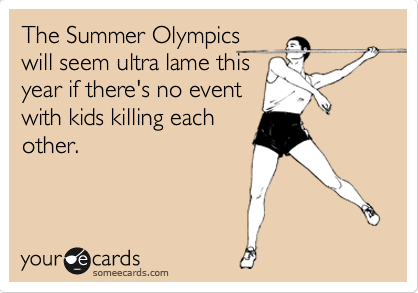
Affective exploitation is crucial to late capitalism. The BBC’s own Caesar Flickerman (the interviewer who extracts maximum sentimental affect from the Hunger Games contestants before they face their deaths in the arena) is the creepily tactile trackside interviewer Phil Jones. Jones’s “interviews” with exhausted athletes, are surely as ritualised as any Chinese state broadcast. Emote. Emote again. Emote differently. Praise the crowd.
And, just in case you somehow missed it, the irrepressible CassetteBoy:
By including what violates women under civil and human rights law, the meaning of “citizen” and “human” begins to have a woman’s face. As women’s actual conditions are recognized as inhuman, those conditions are being changed by requiring that they meet a standard of citizenship and humanity that previously did not apply because they were women. In other words, women both change the standard as we come under it and change the reality it governs by having it applied to us. This democratic process describes not only the common law when it works but also a cardinal tenet of feminist analysis: women are entitled to access to things as they are and also to change them into something worth our having.
Thus women are transforming the definition of equality not by making ourselves the same as men, entitled to violate and silence, or by reifying women’s so-called differences, but by insisting that equal citizenship must encompass what women need to be human, including a right not be sexually violated and silenced. This was done in the Bosnian case by recognizing ethnic particularity, not by denying it. Adapting the words of the philosopher Richard Rorty, we are making the word “woman” a “name of a way of being human.” We are challenging and changing the process of knowing and the practice of power at the same time.
-Catharine MacKinnon, “Postmodernism and Human Rights,” Are Women Human?
Jonathan Meades‘ incisive, irreverent, sweeping, often hilarious and somehow majestic account of the forms of Nazism (architectural, political, libidinal), criminally unavailable on DVD. Presented here in full lo-fi glory. One of the best docu-arguments ever committed to celluloid. You’re very welcome.

The Morning Post, 1913 – on the violence of the suffragette movement:
Early yesterday morning some women succeeded in burning a valuable house near Trowbridge. In the night of Monday to Tuesday ROUGH’S boathouse on the river at Oxford, near the Long Bridges, was seen to be on fire. It was impossible to save the building or the boats which it contained. Nailed to the bridge near was found a card with the words “Votes for women. No peace till we get the vote.” The presumption is that the boathouse was set on fire, the KING’S horse was stopped, and the Trowbridge mansion was destroyed by some of the females who are discontented with the structure of society. Whether that be the case or not – it is quite possible that the truth may not be ascertained – the action is typical of much that has happened lately and deserves thinking about. Indeed, if we are to believe the leaders of the “movement”, the purpose with which these things are done is to make men think. The question is, What are we to think? The planned and deliberate destruction of property is intelligible as an expression of anger against the owner. But as the wellbeing of society depends upon the security of persons and property against wilful attacks, such attacks are regarded as crimes, and one of the principal purpose for which society is organised is to prevent such acts and to punish those who commit them. But in the class or cases which we are considering there is not motive or animosity against the particular person whose property is destroyed. Those who do them have not the personal hatred which usually explains such doings. If this were an isolated case, if it were found that a house had been wilfully set on fire by a young lady well brought up and accustomed in other respects to behave herself well, a jury would probably come to the conclusion that she was not in her right mind, and the Court order that she should be taken care of until she was restored to complete sanity. But the present case is not isolated. There is an epidemic of the state of mind which produced it; it is but one of a large number of similar cases. This frame of mind cannot possibly be considered healthy. The acts which it produces constitute a war, not only upon society as at present constituted but upon any conceivable state of society because it is impossible to imagine any community of human beings not based upon laws for preserving the security of property as well as of life and society, the propounds of the most astounding schemes for the reconstruction of the community, have ever propounded a plan which would not guarantee the work of and man’s hands against wanton and wilful destruction. The women who go about setting fire to houses seem, therefore to have their thoughts out of gear. In most respects apparently their minds work as other people’s do, but the epidemic of arson appears to be a form of monomania. This quality of the minds concerned noes not disappear under an examination of the alleged motive. These ladies say that women ought to have the same political rights as men, and in particular the Parliamentary franchise, and they assert that women are qualified to be members of the body polite. But it is unthinkable that a person who refuses to recognise the fundamental condition upon which every society is founded can be qualified for membership in that society. The person whose mind works in that way is inaccessible to reasonable arguments.
**********

Mahatma Gandhi – on violence:
I do believe that, where there is only a choice between cowardice and violence, I would advise violence… I would rather have India resort to arms in order to defend her honour than that she should, in a cowardly manner, become or remain a helpless witness to her own dishonor.
A trailer for my next post about The Roots
Taken from Phrenology – featuring lyrics by Amiri Baraka, music by The Roots and the unofficial and strangely charming video by a local Philadelphia film maker, Bryan Green. More on this album to come…

 The Disorder Of Things