Un-Manning; Or, Queering Bradley

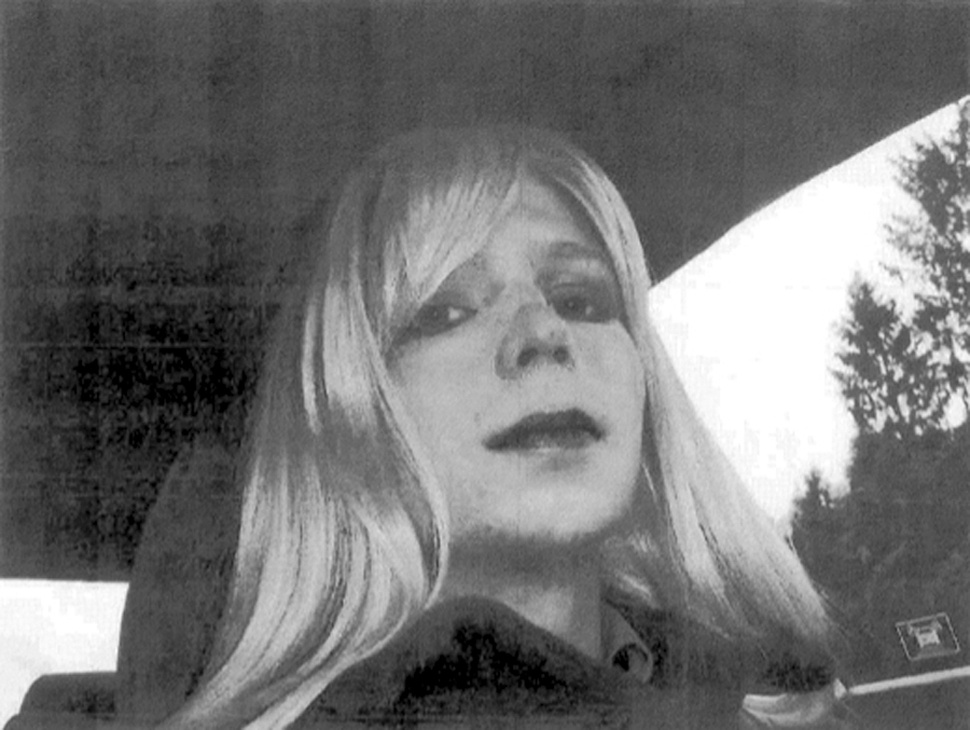
Bradley Manning Trans Wig

Private First Class Chelsea (formerly Bradley) E. Manning has serious gender issues. Or so goes the story of the moment. In the wake of her statement, the question of identity (and language) has somewhat displaced that of the conviction and sentence. Another dimension in the smearing of whistleblowers, perchance. A way to denigrate and emasculate her still further, and so to reinforce the patriarchal entitlement of that shining city on the hill. Except that Manning’s sexual personhood is more contested than that.[1]

Navy Captain and psychiatrist David Moulton, according to CBC, testified that Manning’s ‘gender disorder’, amongst other things, “caused him to conclude he could change the world by leaking classified information”. But Moulton was a defence witness. Captain Steven Lim, Manning’s brigade commander, also pointed towards gender trouble, and revealed the existence of the now much-seen photo of Manning in a wig to the Fort Meade court. Again, a defence witness. Manning’s lawyers were forbidden from seeing much of the (non-)evidence against him, thanks to techniques of classification, and this surely influenced their strategy. Since they could not openly contest claims of the most traitorous harm (claims that were in the end unsubstantiated), why not try and reduce the sentence with whatever biographical resources were available? Where gender identity sometimes served as justification for the leaks, at others it was made irrelevant (to wit: “It was never an excuse because that’s not what drove his actions. What drove his actions was a strong moral compass.”). Interviewed today, David Coombs (Manning’s lawyer) again juggled his client’s personhood somewhat unsuccessfully, maintaining both that “we weren’t offering it as an excuse” but also that Manning’s gender explorations were relevant because they “happened at the same time [as the leaks and therefore] that provides context”.

Paradoxically enough, it is at times Republicans who have had to point out the shamefulness of this strategy:

Now that he prepares to stand trial, he has shown himself to be willing to sacrifice honorable gay and lesbian servicemembers to avoid responsibility. Lawyers for Manning are claiming that his struggle with his sexual orientation contributed to emotional problems that should have precluded him from working in a classified environment. This shameful defense is an offense to the tens of thousands of gay servicemembers who served honorably under “don’t ask, don’t tell.” We all served under the same law, with the same challenges and struggles. We did not commit treason because of it.

Despite the appeal to homonationalism, there is here an actual defence of LGBTQ identity against perpetual fears of a deviance that cannot be trusted with full equality. Fairly obviously, framings of ‘disorder’ put trans* and genderqueer back in the realm of medical pathology from which they have only just begun to escape. And yet this is not a one-sided story of medical bio-politics. Continue reading

Why I’ll Miss Jean Bethke Elshtain

A short version of a tribute to Jean Bethke Elshtain, who died last Sunday, from Christine Sylvester, Professor of Political Science at the University of Connecticut.


Jean Bethke Elshtain

She was embraced by feminists for her books on Women and War and Public Man/Private Woman, and then ostracised by the sisterhood for her disapproval of gay marriage and approval of “just” wars in Afghanistan and Iraq. She would become anathema to peace researchers and sandpaper to scholars of critical IR. Those who liked her early writings in a secular vein would be disappointed when she began to argue from a base in religious philosophies. Jean Bethke Elshtain encapsulated the best hopes of feminists to effect change in core topics of “men’s studies” –International Relations and Religious Studies –and ended up instead on the wrong side of several issues. That’s clear. So let’s ignore her recent death, shall we? Possibly celebrate her end?

Not me. I met Jean at a series of feminist IR conferences held between 1989 and 1993 in the USA, and then shared many a panel with her at the International Studies Association for a few years. Without equivocation, had I not met Jean and found favour in her eyes, I wouldn’t have produced publishable work in my own voice. Jean pulled me aside at one conference, sat me down, and told me to maintain and further develop what she called my “maverick tendencies.” The good Coloradan that she was warned against following the herd as it raced along toward…possibly nothing. My graduate school mentors had been excellent and very encouraging, especially Karen Mingst. I learned much from them, but also resisted some of their good advice once I was out on my own, stubbornly insisting on writing about Zimbabwe and feminist IR –two very different specialisations, both approached in slightly off-centre ways. To Jean, that was the way to go. Permission granted. Years later, in 2001, when she was on an ISA panel discussing my work, along with Cynthia Enloe, Steve Smith, and Dipesh Chakrabarty, she gave me a hard time over what she called my “postmodern avoidances;” by then, Jean was a solid believer in truth. She gave an audience member an even harder time, though, for wilfully misrepresenting my arguments.

Jean the scholar I admired very much. Jean the person behind the scholar astounded me. Her story, of course, appears in an early chapter in Women and War (1987), a book that came out decades before IR recent “new” interest in auto-ethnography. Jean depicts herself as a smart-ass tomboy, a shoot-em-up leader of the cavalry of kids, clearly smarter than everyone around her. But she was decidedly in the pack of youngsters who contracted polio before the vaccine, and who had to suffer the neanderthal treatments available at the time (my cousin was similarly afflicted and spent months in a hideous Iron Lung.) Thereafter, Jean walked with a noticeable limp. I remember the two of us racing like maniacs down the streets of the University of Southern California to get to where we were to speak. That pronounced limp on a shortened leg could not be ignored: I suggested we go slower. She wouldn’t have it. “I can do this,” she said, “not happily or easily, but I can do it.”

Continue reading

Addressing Wartime Sexual Violence at the United Nations Security Council

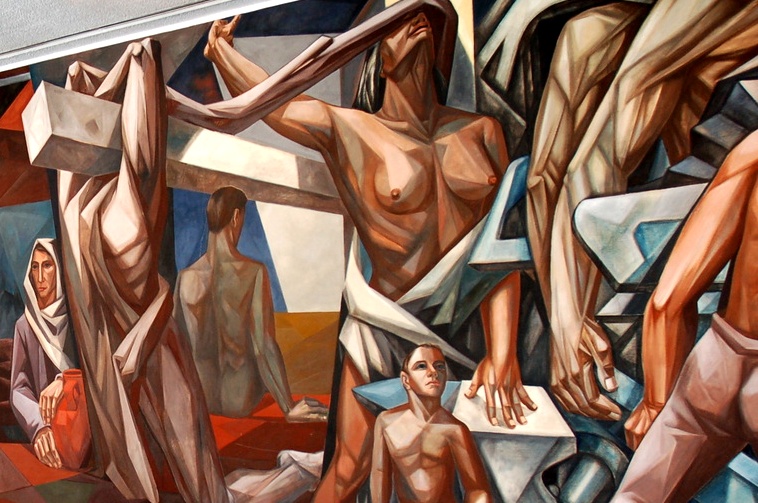
A mural at UN HQ by José Vela Zanetti, via Robin Stevens.

Detail from a José Vela Zanetti mural at the United Nations, New York (original image via Robin Stevens)

Yesterday, the United Nations Security Council met to vote on a new resolution on wartime sexual violence (under the more general rubric of ‘women, peace and security’). Resolution 2106, as it now is, was passed unanimously, and so joins those other numerical signifiers in the chain of gender mainstreaming: 1325, 1820, 1888 and 1960. The session had been convened by William Hague (the UK holds the Security Council chair for June), and the presence of Angelina Jolie (or ‘Angelina Jolly’, as more than one state representative called her) brought obvious publicity advantages, although that in itself is not so surprising both given her close work with Hague on the UK’s Preventing Sexual Violence Initiative and her role as Special Envoy for the UN High Commission for Refugees.

UNSCR 2106 seems designed mainly as a political symbol that the Council “remains actively seized” of the importance of conflict-related sexual violence, and essentially extends a number of themes already in play (there’s a whole bunch of urges, calls for, recognizes, requests in the text). It seeks the expanded use of targeted sanctions against perpetrators and commanders involved in sexual violence and reiterates the connection of that thing called ‘gender’ to DDR, security sector and justice reforms. It repeats the ‘zero tolerance policy’ on sexual violence and abuse by UN forces, requests further reports on progress to the Council, and so on. There were some other points of note, partly in the mention of men and boys as victims, and partly in some puzzling recessive points such as the Resolution’s demand (its word) that women and children abducted into armed forces be released (given that they are especially vulnerable), with no concomitant mention of kidnapped men.

The resolution also called for sexual and gender-based violence training for all pre-deployment and ‘in-mission’ peacekeeper training, and it is here that perhaps the biggest substantive contribution lies. Numerous references were made in the debate to an expanded role for Women Protection Advisers. Like the discussion of targeted sanctions (mentioned first in UNSCR 1820) this is not brand new, since Women Protection Advisers were themselves an innovation of 1888, which upgraded them from existing gender and human rights advisers. The exact nature of the new role is as yet unclear, but it seems to involve an expansion of their mandate to apply to all UN deployments, since they are currently active in just eight peacekeeping missions (which is just over half).

A few other quick observations on the text and the debate.  Continue reading

Work and the Politics of Refusal

A World Beyond Work

At the heart of recent discussions on work lies an enduring tension. We can sense that modern work isn’t working anymore, but we don’t know how to let go of it. The disintegration and degradation of wage labor through technological “progress,” increasing commodification and devaluation of reproductive work, steadily rising unemployment and precarious employment, and sustained attacks on the last bastion of permanent employment (the public sector) together with our desperate attempts to resurrect a corporatist corpse that won’t return, all point to the fact that modern employment “exists less and less to provide a living, let alone a life.” Marxist outliers (Andre Gorz, Ivan Illich, Antonio Negri, Zerowork) have been announcing a crisis of work for some time now, remarking how automation both reduces necessary labor time and degrades work without, however, releasing us from the obligation to earn money for a living. Today work persists in a zombie state despite the disintegration of working class culture and organizations and a continuous process of proletarianization. These conversations have returned in full force in recent years with the publication of Kathi Weeks’ groundbreaking The Problem with Work: Marxism, Feminism, Antiwork Politics and Postwork Imaginaries and a sustained interest in these matters in the Jacobin and even mainstream media.

In these debates, however, there remains an unreconciled tension between the obligation (of any self-respecting socialist) to celebrate work as a source of collective power and personal pride and the more futuristic desire to overcome work and even our self-understanding as workers for a more multivalent understanding of life. This is effectively the tension between Marx and his son-in-law Lafargue, between laborists and anarchists, between a politics of equality and one of autonomy. Of course, there can never be a satisfying answer to this problem because the dichotomy itself is a sectarian caricature. Much more interesting would be to stick with this tension as a provocation for a politics whose form and direction has yet to be decided.

How do we, at once, celebrate the types of cooperation, organization, and identities born out of wage labor and recognize that these are inadequate and insufficient modern inventions that have run their course? How can we advance the cause of wage laborers and fight for people to one day stop functioning as workers? An impossible (and scandalous) proposition such as this is the “refusal of work,” the Italian autonomist theory/practice, which claims that workers are able to produce and sustain value independent of capitalist relations of production and centralized power.

Continue reading

Gender Trouble, Racial Salvation and the Tragedy of Political Community in ‘Game Of Thrones’ (2012-2013)

A shamefully-delayed commentary on Game Of Thrones, Seasons the Second and Third, since the first one went so well. As before, *great clunking mega spoiler alert*. You have been forewarned.


Recall three justifications for an analysis of pop culture politics. First, for all their superficial escapism, cultural products represent political ideas and ideologies, and do so in ways that may matter more than what we receive through the news. They are full of desires and fantasies that refract and reflect (and to some extent are themselves) real politics. Second, you can criticise the thematics of the show without hating the show. In fact you can do it while loving the show (and finding the fact of that love interesting in itself). In other words, look, I really like Game of Thrones. Moreover, that as great as comparisons with the source text can be, a TV series is a different kind of beast and is entitled to judgement on its own merits. Third, objections that “it’s just a show” don’t wash. If you’re reading this it’s because you have some sense that there are ways of understanding and being embodied in even the lowest of cultural objects (paging Dr Adorno!). That doesn’t mean that the substance of the relationship between media and politics is simple or settled, but it’s there.

Let’s start where we left off last time. It was claimed in some quarters that the plot subverts – even refutes – certain standard typical ideas about the feminine, and critiques feudal social relations along the way. So, rather than being a “racist rape-culture Disneyland with Dragons”, the many strong, complicated, agentic female roles in fact set Game of Thrones as a critique of patriarchy. But only the most one-dimensional of sexisms regards women as utterly abject. The mere presence of intelligent, or emotionally-rounded, or sympathetic female characters is not enough (and that it might be taken as inherently ‘progressive’ probably tells us a lot about contemporary gender politics). No, the issue is how a cultural product deploys some common tropes of masculinity and femininity and, with appropriate caveats about not reading every plot twist as an allegory, how those celebrate or reinforce certain orderings of gender. So a narrative which makes the family the primary unit, and which does so in a conventionally heteronormative register (twincest notwithstanding), is selling a particular idea of gender (and of community and nation and legitimate violence and…).

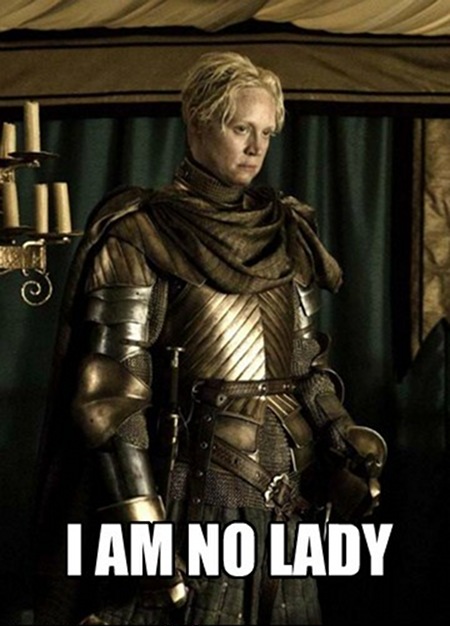
In Seasons 2 and 3, a few female figures threaten to upset the patriarchal framework. As before, there is Arya, astute, principled, fierce, and eager to promise death to her enemies. Brienne of Tarth, giant, loyal, lethal, dismissive. Ygritte, rugged, capable, sexually dominant, a hardened killer with no respect for rank (“If you ripped my silk dress, I’d blacken your eye”).[1] And yet in each case the threat is contained and wrapped in some familiar gender constraints.

Continue reading

Ten Reasons Not To Write Your Master’s Dissertation on Sexual Violence in War

Marsha Henry

A guest post, following on from some previous reflections on gender and teaching and the politics of pedagogy, from Marsha Henry. Marsha is Lecturer in Gender, Development and Globalisation at the LSE Gender Institute, where she teaches, amongst other things, a course on gender and militarism. Her most recent research is into sexual exploitation in peacekeeping missions and peacekeeper labour hierarchies, and she is also, with Paul Higate, author of Insecure Spaces: Peacekeeping, Power and Performance in Haiti, Kosovo and Liberia (Zed, 2009). With Pablo, she recently co-edited a special issue of International Feminist Journal of Politics on ‘Rethinking Masculinity and Practices of Violence’. This post is based on a presentation given in San Francisco at the International Studies Association in April 2013.


It’s the first day of Lent term and the students are nervously gathered in a small stuffy classroom.  When I walk in and head towards the front of the room, the group falls silent. I introduce myself and we start a round of introductions and I ask students to speak briefly about their interest in the course. The first student tells me, and the class, that she’s in IR (International Relations), and is keen to take the course because she’s interested in studying sexual violence in war.  Another student turns to her, incredulous because she too is interested in that exact subject, and that furthermore she has worked for 3 months in the Democratic Republic of Congo (DRC) and has ‘seen a lot’. A few more students echo similar interests and I’m trying hard not to stereotype these students. But it’s difficult. A mythical figure is beginning to crystallise in my head and I can’t stop it. This figure is young, female and possibly middle-class, sometimes Scandinavian. She’s studying IR, Human Rights or Gender Studies. A few male students also indicate an interest. Some indicate interest in other topics, but there is a numbers problem from the outset. I feel uncomfortable as this is the third year that I’ve taught this course, each time allotting only one lecture week to the subject of sexual violence in war, and subsuming it under the larger heading of ‘gender, sexualised violence and work in militarised contexts’. Each year students have asked for more time to be devoted to the subject, for the lecture week to be moved up, and for their to be less focus on diversity in the armed forces. When students come to me during office hours to discuss the scope of their dissertations on the subject I fidget. After a few conversations with colleagues, I decide I need to start compiling a list – of compelling reasons why students should not write on the subject of sexual violence in war. But what would I do with this list? Can it be shared? And what of my responsibility not to teach on the subject?

10: Writing About ‘It’ Narrows The Political Focus

As a committed feminist, I’m all for drawing significant attention to the ways in which women experience conflict in distinctive ways. But the concentration of interest on sexual violence in wartime often leads to a neglect of the ways in which women experience violence (labelled as sexual or not) in peacetime. This noticeable singular focus on the topic also narrows the possibility of dislodging categories and subject positions. It is often assumed in class conversations, essays and subsequently dissertations that women are the victims and men are the perpetrators of this form of violence. This assumption appears in written work in a way that both masks the possibility of other positionings within the perpetrator-victim continuum, as well as the structurally embedded way in which sexualised violence occurs and is experienced by individuals and communities. This failure to explain the pervasiveness of sexualised violence against women tends to reinforce the binaries and provides a rather fixed aperture for analysing sexual violence in war and its consequences.

9: Researching The Topic Inspires Voyeurism

I’m squirming in my seat as one of the students smiles widely while she explains her interest in working on the topic of sexual violence as a weapon of war. She could be nervous explaining herself in front of her peers and her professor. She could be feeling awkward about the subject matter. She could be conforming to gendered expectations of women in the classroom where female students who express themselves confidently or through feminist rhetoric are categorised as aggressive. If feminist critique is pleasurable, how do we ‘do’ our analysis of sexual violence in wartime, paying attention to experience, trauma, and moral responsibility? There is a tendency, in making visible the ‘horror’ of it all, that students sensationalise the subject by focussing on the minutiae, the details and the thick descriptions. Honing in on the bodily experience of rape, for example, can remove rape in war from the wider social, cultural, economic and political context in which it always takes place. It can be an abstraction of the total experience. The affective impact is that readers of these dissertations distance themselves from subjects in the studies. Those who are victims and/or survivors and end up consciously or unconsciously performing what Donna Haraway referred to as a god-trick.

Continue reading

What We Talked About At ISA: Teaching Gender and War: Some Reflections on Negotiating the Five Stages of Feminist Consciousness/Grief in Undergraduate Students

Victoria BashamA guest post in our current series on ISA presentations from Victoria Basham, who is Senior Lecturer in Politics at the University of Exeter. Victoria’s research draws on feminist and sociological theory to explore militaries, militarism and militarization. In War, Identity and the Liberal State (Routledge, 2013), she draws on original fieldwork research with members of the British Armed Forces to offer insights into how their everyday experiences are shaped by, and shape, a politics of gender, race and sexuality that not only underpins power relations in the military, but the geopolitics of wars waged by liberal states. Victoria is also a working towards the launch of a new interdisciplinary and global journal called Critical Military Studies which seeks to provide a space for dialogue among scholars questioning the very idea of military organisation and armed force, and seeking to offer new insights into organised and state-sanctioned violence by exploring its wider significance and effects.


Despite the burgeoning literature highlighting the significance of gender to global politics, research into international studies curricula suggests that gender is rarely dealt with extensively or even adequately by ‘top ranking’ UK Politics and International Relations (IR) departments. A cursory glance at popular, introductory undergraduate textbooks in Politics and International Relations also reveals that whilst feminism may be included as an approach, accounts of power as institutionally situated remain dominant. As such, many undergraduates only experience brief introductions to feminism, gender, and issues of sexual identity, if anything at all. So when I was given the chance to design and teach two research-led undergraduate courses in 2009, I saw it as an important opportunity: both to provide students with insights into how gender animates global politics, and to engage in a form of ‘feminist pedagogy’ by encouraging students to look at themselves and the world around them critically and analytically, through the interlocking lenses of gender, race, class and sexuality.

My experience of delivering these courses over the past few years has been largely positive. On more than one occasion students have commented that engaging with feminist theories and praxis had ‘opened their eyes’. However, in other students the experience of studying the global through gendered and postcolonial lenses elicited confusion, anger and pain on their part, at least initially. Indeed, as I have continued to teach these courses, I have often thought of student reactions as akin to Kübler-Ross and Kessler’s five stages of grief or what Patti Lather has aptly called ‘stages of feminist consciousness’.

One possible reason for this is that for feminists, the question of ‘What is Politics?’ necessarily includes accounts of power that are personal, emotional, and everyday. Given that trying to account for how power shapes and is shaped by people’s daily lives is not always readily accessible through a focus on institutions and the like – the usual stuff of politics and IR analysis – many feminist teachers are likely to encourage their students to think through how ‘the personal is political’ in their experiences and to re-personalise an often depersonalised and sanitised set of issues including war. Many of my students (though not all, and rarely, it should be said, in a linear fashion) experience moments of denial, anger, bargaining, depression and acceptance when taking my courses. Moreover, in reacting to their comments and in trying to anticipate their turmoil I often find myself angry, disbelieving, in negotiating mode, saddened and sometimes having to accept, and very grudgingly I’ll admit, that not all of them believe that gender is as significant to war as I do.

Continue reading

The Personal is Political, But Is It IR? On Writing as a Mother and Feminist

Annick WibbenThe penultimate post in our methodology and narrative mini-forum, written by Annick T.R. Wibben. Annick is Associate Professor of Politics and International Studies at the University of San Francisco. She’s been thinking about narrative for a long time, but rarely writes autoethnography. The piece featured here was originally written in 2006, but it’s taken her this long to find a suitable home for it…not to mention the courage to let it go out into the world. When she is not thinking about narrative (or tweeting about feminism, security and violence @ATRWibben), her research at the intersections of feminist theory, security studies, and continental philosophy, aims to radicalize security studies and to challenge the politics of security. In Feminist Security Studies: A Narrative Approach (Routledge, 2011), she examines meanings of security legitimized in existing practices and proposes an opening of the security studies agenda by drawing on narrative approaches. So, really, she’s never not thinking about narrative.


So here I am; it is 9:30am. I am sitting in a room with other women at our weekly Friday writing group. We call ourselves the Writing Warriors, as much to describe what we’re doing as also to encourage ourselves to continue doing it. Most of us are untenured still, which adds an extra dimension to the task of writing – must be productive, must publish! Many of us have small children and when the writing stops, that’s what we talk about: How do we deal with the challenges of combining motherhood and an academic career. We exchange recommendations for childcare and kid-friendly restaurants; we give advice on breastfeeding, potty-training, and where to buy healthy snacks (we certainly don’t have time to make them). Sometimes one or more of us have to miss the writing day (or part of it) when a child is home from school, a babysitter is ill, or we just cannot focus on our own research because we need to catch up on teaching or service commitments (of which we all have plenty, of course).

So here I am; I arrived late today. Only a few minutes late, but late enough to be occupied still with what I left behind in the rush to get here as close as possible to 9am when we meet, greet, talk about our writing plans for the day, and then start writing, promptly at 9:15am. I am wondering should I have left earlier. When? I could have skipped breakfast. I could have ignored my daughter’s requests to read her a story before leaving. Should I not have bothered to throw in the load of laundry? Or, to wipe off the food from the high-chair? I could have gotten here a few minutes earlier…

So here I am; writing IR. I am an international relations scholar, so this is what I do, I write IR. I need to convince myself that this is what I am doing, say it again: I write IR. I write IR. As I repeat these words, something else pops into my mind: Sam I am, I do not like that Sam I am. I do not like green eggs and ham. I do not like them Sam I am… just like the character in Dr. Seuss’ children’s book needs to be convinced to try green eggs and ham just like I need to convince myself, that I am writing IR.

So here I am; staring at the blank page. Continue reading

Fear and Honesty: On Reconciling Theory and Voice, in Two Parts

Kate DaleyThe second post in our guest series on critical methodology and narrative, this time from Kate M. Daley. Kate is a PhD candidate in the Department of Political Science at York University in Toronto, Ontario. Her doctoral research in feminist political theory explores responses to privilege in the context of feminist relationships and her current research interests include narrative research methods, social science education, indigenous methodologies, and anti-oppression knowledges and discourses. She lives in Waterloo, Ontario, where she advocates for projects and policies that support transportation choice, environmental protection, and vibrant public spaces.


Part I: Fear

I am lucky in this room, among my colleagues. I am working in feminist political theory, not international relations, and my discipline has been advocating for and responding to feminist work that is in one’s own voice and that tells one’s own story for decades. Still, I feel a sense of paralysis. I am 27 years old. I have passed my qualifying exams. I have written dozens of graduate papers. My work is starting to get published. I am now starting to stare down my dissertation. And I am not sure that my work has ever been truly honest.

It was my Master’s supervisor who graciously began to break my training. She encouraged me to write in the first person. In her class, I had argued passionately with some of my more conventional colleagues. I had defended the overt positionality of narrative political theory, and valorized those who had the courage to write in their own voice. And yet I most often continued to write as though I was not there at all.

So I started to use first-person pronouns in my academic writing. Sometimes I even included a personal anecdote to make my writing more compelling, more convincing. I believe firmly in the importance of personal narrative for political theory, and for social sciences scholarship. I have thrown in the occasional story to illustrate a point. But I have never really, truly, made myself visible and vulnerable in my theory.

I am afraid. I have come to a place where I can no longer only speak an I that serves as nothing more than a grammatical device between abstract ideas, or a persuasive tactic to convince others of a conclusion I have already drawn. But I cannot wholeheartedly embrace autoethnography and my own narrative, either. I am afraid.

I fear that I will learn that I can write as a faceless academic, but not as a whole person. Continue reading

Rethinking Masculinity and Practices of Violence

The modified text of an introduction written with Marsha Henry for our special issue of International Feminist Journal of Politics on ‘Rethinking Masculinity and Practices of Violence in Conflict Settings’ (trailed here), which came out in December 2012. The full text of the issue is currently freely available. I don’t know for how long, so get to it!


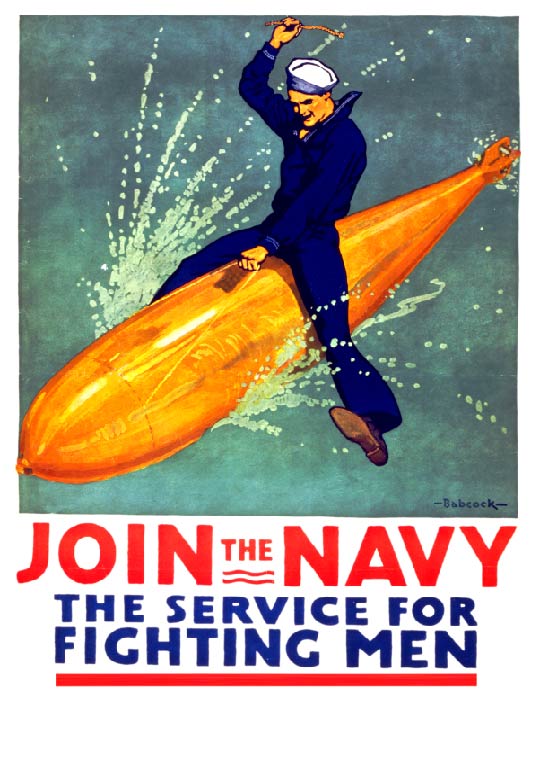
Join the Navy - The Service for Fighting Men

Why rethink masculinity and conflict? After all, the connection of men and masculinities to organised (and seemingly unorganised) violence has been subject to considerable academic scrutiny over the last decades, not least as part of the feminist critique of disciplinary International Relations. It is now increasingly common to both note the unequal character of gendered violence (it is predominantly men who do the killing and the maiming) and to stress the contingent and sometimes paradoxical status of this situation (women kill and maim too, and the content of ‘man’ and ‘woman’ varies significantly over time, space and context). The analysis of gender within global politics has also moved beyond the level of the state and war to interrogate the full spectrum of social life, from popular culture to political economy. And yet elite institutions still prove stubbornly resistant to teaching gender, feminism and sexuality within ‘the international’, despite introductory texts which increasingly offer such insights to the curious student.

Although you wouldn’t know it from some of the caricatures in circulation, feminist and gender scholars write often of multiplicity in masculinities, of varied and shifting constructions of gendered agency, and of representations of violence as themselves constitutive of gender, rather than merely reflective of a pre-existing distribution of essences. Some, like Melanie McCarry, have become rather sceptical of this situation, warning that the actions and power of men themselves are obscured in the consensus that there are many masculinities. In other words that multiplicity, discourse and construction are not advances in theory, but ways of displacing responsibility away from concrete male perpetrators. At the same time as they direct attention to the material practices of men such criticisms also tend to gloss over rich and situated examples of critical theorising along exactly those lines. A different brand of critic has sometimes suggested that feminism may be incapable of properly analysing the variety of gendered experiences in conflict. But here too, a comprehensive history of the field instead reveals many close and nuanced considerations of men and women at war.

Nevertheless, ambiguities do persist in the way feminist and gender scholars describe and account for masculinity. Against this background, a number of problems come into sharper focus. First, how are masculinities and violences connected in specific locations of power? Second, how do these connections play out internationally, in the interactions between political communities, however understood? Third, just how related are gendered identities to fighting, killing and dying in conflict settings? And fourth, how do the complexities of violence situated in this way reflect back onto theorising about gendered hierarchy and difference?

Some of these questions are more familiar than others, but the collection of articles presented in our special issue of International Feminist Journal of Politics substantially addresses them all (I know, get us, right?). Continue reading