#Kony2012 from Advocacy to Militarisation

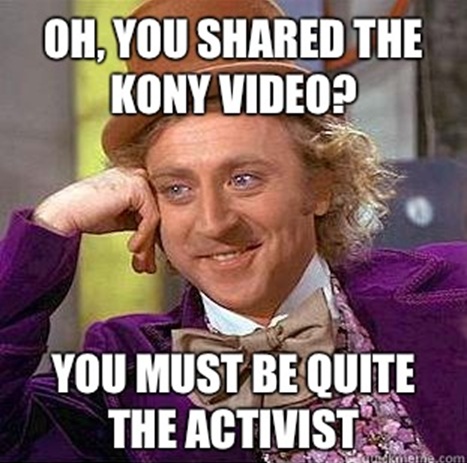
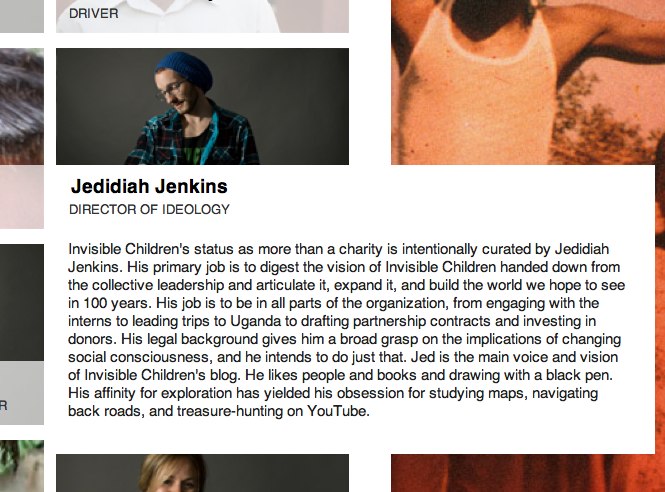
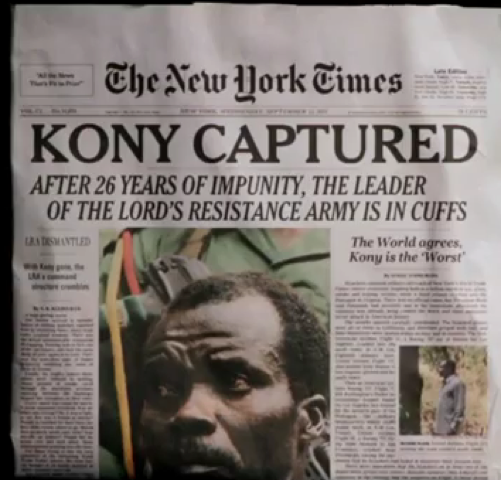
Although the attention spike and mainstream media attention on #Kony2012 has receded, not least thanks to Jason ‘Radical’ Russell’s own brush with infamy, the implications of muscular-liberalism-as-social-media-experiment continue to unfold. My feed at least continues to be peppered with anger towards Invisible Children from informed activists and scholars (although Norbert Mao, for one, takes a much more positive view and Jason Stearns makes a few qualifications of the anti-case worth reading). On Saturday, CEO Ben Keesey and ‘Director of Ideas Development’ Jedidiah Jenkins (formerly ‘Director of Ideology’: yes, really) released a short teaser video promising a sequel to #Kony2012 and declaring that the campaign was “working”. Staying stubbornly loyal to the understanding of foreign policy decision-making expressed in the original narrative, this was said to be because the people at the top were now being forced to respond to an issue they previously hadn’t cared about/known about, all thanks to the public pressure of predominantly young activist-citizens. The major consequence of this pressure being the introduction on March 12 of a Resolution in the US House of Representatives, sponsored by Jim McGovern (a Democrat) and Ed Royce (a Republican), to end Kony’s atrocities and bring justice to Norther Uganda. There’s now a Senate version of the Resolution too, taken by Keesey and Jenkins to dispel those loose accusations of ‘slacktivism’ against Invisible Children and its supporters.

But what does the Resolution actually ask for? Having reaffirmed previous declarations, it:

…calls on the Secretary of State and heads of other government agencies to undertake diplomatic efforts with partner nations focused on—
(A) expanding the number of capable regional military forces deployed to protect civilians and pursue LRA commanders; (B) enhancing cooperation and cross-border coordination among regional governments; and (C) promoting increased contributions from European and other donor nations for regional security efforts.

Now that’s a rather curious formulation of “diplomatic efforts”. Nowhere in the text is there any mention of the human rights records of the Ugandan or DRC armies, nor any suggestion that they are anything but (albeit junior) ‘partners’ in this military endeavour. The preamble makes repeated mention of ‘help’ to regional governments, and one line of text hints at problems (to “address shortcomings in current efforts”), but it is clear that these are deficiencies of coordination and military effectiveness, not of human rights concerns. The claims previously made in defence of the campaign (“we do not defend any of the abuses perpetrated by the Ugandan government or by the Ugandan army”) have rather evaporated in the transition to a formal Resolution, and Keesey and Jenkins make no complaint of that elision. Although recently rather keen to harness #Kony2012’s popularity, Human Rights Watch and others have long catalogued systematic abuses by the UPDF which match the Lord’s Resistance Army closely for brutality. The record of the FARDC (the army of the Democratic Republic of Congo) is worse still. Exact and proportional figures are hard to pinpoint, but there is no question that they are major (and quite possibly the main) perpetrators of rape, terrorism and atrocity in Eastern DRC.

All of this sets a brutal precedent. The vagueness of the call for action and policy detail, lost amongst the emotion ratcheting of being a ‘doer’ rather than a ‘sayer’, opened the door to any number of Liberal Saviour Hawk Military Industrial fantasies (to adapt Teju Cole). This is what groups like the Association of Concerned Africa Scholars warned of, a not-so-creeping militarisation of East and Central Africa. As apparently obvious as stopping Kony’s evil in a hail of righteous bullets cycles seems to Russell and Co., the cycle of insurgency and counter-insurgency tends to be draped at each stage in stark aggressions, with those regional military partners enacting their own ‘invisible’ massacres as they go.

Conspiratorial ideas of Invisible Children as a front for the US government aside, there is clearly a whole set of non-humanitarian interests at play here. I doubt there is any real appetite, and certainly very little capacity, in policy circles for any kind of escalation of direct US military involvement in the area, but then ‘support’ and ‘advice’ for regional allies and proxies has more traditionally been the mark of foreign policy. What those exponential click counts will translate into in policy terms thus remains open, but the signs aren’t great.

Kony 2012 and The Choir of Saviors: You got a song you wanna sing for me?

You got a song you wanna sing for me?
Sing a song, singing man.
Sing another song, singing man.
Sing a song for me.
One for the pressing, two for the cross,
Three for the blessing, four for the loss.
Kid holdin’ a weapon, walk like a corpse
In the face of transgression, military issue Kalash
Nikova or machete or a pitchfork.
He killing ’cause he feel he got nothin’ to live for
In a war taking heads for men like Charles Taylor
And never seen the undisclosed foreign arms dealer.
Thirteen-year-old killer, he look thirty-five,
He changed his name to Little No-Man-Survive.
When he smoke that leaf shorty believe he can fly.
He loot and terrorize and shoot between the eyes.
Who to blame? Its a shame the youth was demonized.
Wishing he could rearrange the truth to see the lies
And he wouldn’t have to raise his barrel to target you,
His heart can’t get through the years of scar tissue.

-“Singing Man“, The Roots

60 million people and counting have now heard about Invisible Children’sKony 2012“. Criticism of the group has been substantial and judicious. The group has defended themselves. Humorous memes are proliferating. Over-exposure has already begun to create awareness fatigue. Yet there is a serious issue largely unaddressed: the most troubling elements of the “Kony 2012” phenomenon are not unique to Invisible Children, but reflect serious moral and political problems with the pursuit of international criminal justice, and in particular the mission and politics of the International Criminal Court and their controversial prosecutor, Luis Moreno-Ocampo.

To put it bluntly: while Jason Russell addresses his audience in the same way he addresses his five-year-old son Gavin, which is clearly inappropriate given the complexity of the issues he’s asking us to consider, Russell’s framing of the evil of Joseph Kony and “our” responsibility to stop him is importantly similar to the narrative of international criminal law, and Ocampo in particular. We should not be too quick to denounce the moral idiocy of Russell as a personal failing – his sentimental and messianic film represents a revealing apotheosis rather than a transgressive break from our sense of international justice. There are unpleasant resonances between Russell and Ocampo – the ICC prosecutor has already praised the group, saying,

“They’re giving a voice to people who before no-one knew about and no-one cared about and I salute them.”

But the commonalities run deeper than a strategic endorsement and should give us pause before we conclude that while Invisible Children may be unscrupulous and ill-informed, some form of outside intervention is needed to save the children of the Great Lakes region of Africa (to say  nothing of the adults being killed) – and yes, an arrest warrant and possible trial by the ICC is as much an intervention as a military invasion. Russell’s call to “stop Kony” is disturbing beyond his narcissism and the organisation’s inept policies and campaigns, his messianic moralising, in which he positions himself (and those like him who just need to be roused to action) as the hero for the powerless victim, is a single melody line in the score that guides the choir singing for international justice. His self-regarding indignation, and our discomfort, should inspire introspection into the desires that lead us to demand that Kony stand trial at the ICC or to insist that “we” must do something to stop the evil that besets that part of Africa.

Continue reading

“Can I Tell You The Bad Guy’s Name?”: A Virtual Read-In and Comment On #Kony2012 and Badvocacy

UPDATE (10 March): Material is coming thick and fast on #Kony2012, so I’m adding three recent interventions. The first is from Ismael Beah, he of child soldier fame, on CNN (apologies for the awful interviewer).

The second is from Adam Branch (who just has a book out on Uganda, war and intervention) on the wrongness, and also the irrelevance to Northern Ugandans, of Invisible Children:

My frustration with the group has largely reflected the concerns expressed so eloquently by those individuals who have been willing to bring the fury of Invisible Children’s true believers down upon themselves in order to point out what is wrong with this group’s approach: the warmongering, the self-indulgence, the commercialization, the reductive and one-sided story it tells, its portrayal of Africans as helpless children in need of rescue by white Americans, and the fact that civilians in Uganda and Central Africa may have to pay a steep price in their own lives so that a lot of young Americans can feel good about themselves, and a few can make good money. This, of course, is sickening, and I think that Kony 2012 is a case of Invisible Children having finally gone too far. They are now facing a backlash from people of conscience who refuse to abandon their capacity to think for themselves.

The third, from Teddy Ruge, beautiful in its rage:

This IC campaign is a perfect example of how fund-sucking NGO’s survive. “Raising awareness” (as vapid an exercise as it is) on the level that IC does, costs money. Loads and loads of money. Someone has to pay for the executive staff, fancy offices, and well, that 30-minute grand-savior, self-crowning exercise in ego stroking—in HD—wasn’t free. In all this kerfuffle, I am afraid everyone is missing the true aim of IC’s brilliant marketing strategy. They are not selling justice, democracy, or restoration of anyone’s dignity. This is a self-aware machine that must continually find a reason to be relevant. They are, in actuality, selling themselves as the issue, as the subject, as the panacea for everything that ails me as the agency-devoid African. All I have to do is show up in my broken English, look pathetic and wanting. You, my dear social media savvy click-activist, will shed a tear, exhaust Facebook’s like button, mobilize your cadre of equally ill-uninformed netizens to throw money at the problem.

Cause, you know, that works so well in the first world.


Glenna Gordon‘s 2008 image of the Invisible Children founders in cod-Rambo pose with the Sudan People’s Liberation Army now defines the #Kony2012 backlash. Jason ‘Radical’ Russell – he who speaks excitedly of ‘war rooms’ – and his compatriots have thus far notched up 12 million-odd Vimeo hits and over 32 million YouTube hits with their 30-minute hymn to awareness, social media, atrocity prevention and youth power. A simulacrum of solidarity now not quite besieged, but at least peppered, by an array of critiques and counter-points, almost always from scholars and activists with their own well-established records of engagement and internationalism.

That backlash is now, predictably enough, giving rise to a counter-backlash from newly enlivened global citizens, and the predominant form taken by this response is itself instructive. Comment threads on posts like Mark’s consistently reveal a nascent activist consciousness which is hugely fragile, but also aggressive. Although many presumably did not know of Joseph Kony until this week (and in this minimal sense, #Kony2012 clearly ‘worked’), they are now so outraged at even the hint of complexity or counter-point that they denounce others as self-promoters, ignorami (ignoramuses?), complacent and/or complicit (by some unspecified metric) in human suffering. The juxtaposition is telling: the fresh anger and one-dimensional vigour of discovering atrocity and of being “empowered” (however vaguely) to end it is simply too appealing to withstand reasoned discussion. And so newly-minted ‘doers’ find themselves in the position of having to attack those old established ‘cynics’, Ugandans and Uganda hands among them, in whose very name they “won’t stop”. Say, at what point exactly did common humanity come to mean lecturing Ugandans that they were “ungrateful” and “negative” for pointing out that Museveni is not so nice either?

But what has been the content of this unbearable counter-critique? Continue reading

Human Rights Contested – Part II

This is a continuation of my previous post

Who Are Human Rights For?

All of the authors take account of the ambiguous history of human rights, in which they can be said to have inspired the Haitian, American and French revolutions, while also justifying the counterrevolutionary post-Cold War order dominated by the United States. Yet recognising this ambiguity without also acknowledging the distinctive reconstruction of contemporary human rights that makes them part of a neo-liberal international order and the unequal power that makes such a quasi-imperial order possible would be irresponsible. A primary contribution made collectively by these texts is that they clearly diagnose the way human rights have been used to consolidate a particular form of political and economic order while undercutting the need for, much less justification of, revolutionary violence. Williams says of Amnesty International’s prisoners of conscience, who serve as archetypal victims of human rights abuse,

the prisoner of conscience, through its restrictive conditions, performs a critical diminution of what constitutes “the political.” The concept not only works to banish from recognition those who resort to or advocate violence, but at the same time it works to efface the very historical conditions that might come to serve as justifications – political and moral – for the taking up of arms.

Human rights, then, are for the civilised victims of the world, those abused by excessive state power, by anomalous states that have not been liberalised – they are not for dangerous radicals seeking to upset the social order.

Continue reading

Human Rights Contested – Part I

This post (presented in two parts) is drawn from a review article that will be forthcoming in The Journal of Intervention and Statebuilding, which looks at a recent set of critical writings on human rights in order to consider the profound limitations and evocative possibilities of the contested idea and politics of human rights.

Human Rights in a Posthuman World: Critical Essays by Upendra Baxi. Oxford: Oxford University Press, 2009.

Surrendering to Utopia: An Anthropology of Human Rights by Mark Goodale. Stanford, CA: Stanford University Press, 2009.

The Divided World: Human Rights and Its Violence by Randall Williams. Minneapolis, MN and London: University of Minnesota Press, 2010.

After Evil: A Politics of Human Rights by Robert Meister. New York, NY: Columbia University Press, 2011.

The central tension of human rights is that they propagate a universal and singular human identity in a fragmented political world. No one writing about human rights ignores this tension, but the most important question we face in judging the value of human rights is how to understand this tension and the divisions it creates. The expected divisions between good and evil, between moral universalists and dangerous relativist, between dignified interventionists and cowardly apologists, have long given shape to human rights, as both an ideal and a political project. Seeing the problems of (and for) human rights in these habituated ways has dulled our capacity for critical judgment, as few want to defend evil or violent particularisms or advocate passivity in the face of suffering. Even among serious and determined critics our inherited divisions are problematic (and increasingly over rehearsed), whether we think of human rights as the imposition of Western cultural values, or in terms of capitalist ideology serving the interests of neo-liberal elites, or as an expression of exceptional sovereign power at the domestic and global levels. The ways that these divisions deal with the tension at the heart of human rights misses the ambiguity of those rights in significant ways.

     Rather than trying to contain the tensions between singularity and pluralism, between commonality and difference, in a clear and definitive accounting, the authors of the texts reviewed here allow them to proliferate. Rather than trying to resolve the problem of human rights, they attempt to understand human rights in their indeterminate dissonance while exploring what they might become. To create and invoke the idea of humanity is not a political activity that is unique (either now or in the past) to the ‘West’. The people most dramatically injured by global capitalism sometimes fight their oppression by innovating and using the language and institutions of human rights. Political exceptions – the exclusion of outsiders, humanitarian wars and imperialist conceits – are certainly enabled by the same sovereign power that grants rights to its subjects, which is a metaphorical drama all too easily supported by human rights, but it is only a partial telling of the tale, a telling that leaves out how human rights can reshape political authority and enable struggles in unexpected ways. The work of these authors pushes us to reject the familiar divisions we use to understand the irresolvable tension at the centre of human rights and see the productive possibilities of that tension. If human rights will always be invoked in a politically divided world, and will also always create further divisions with each declaration and act that realises an ideal universalism, then our focus should be on who assumes (and who can assume) the authority to define humanity, the consequences for those subject to such power, and the ends toward which such authority is directed. Continue reading

Academia in the Age of Digital Reproduction; Or, the Journal System, Redeemed

It took at least 200 years for the novel to emerge as an expressive form after the invention of the printing press.

So said Bob Stein in an interesting roundtable on the digital university from back in April 2010. His point being that the radical transformations in human knowledge and communication practices wrought by the internet remain in their infancy. Our learning curves may be steeper but we haven’t yet begun to grapple with what the collapsing of old forms of social space means. We tweak and vary the models that we’re used to, but are generally cloistered in the paradigms of print.

When it comes to the university, and to the journal system, this has a particular resonance. Academics find themselves in a strange and contradictory position. They are highly valued for their research outputs in the sense that this is what determines their reputation and secures their jobs (although this is increasingly the value of the faux-market and the half-assed quality metric). This academic authority, won by publications, is also, to some extent, what makes students want to work with them and what makes them attractive as experts for government, media and civil society. They are also highly valued in a straight-forward economic sense by private publishing houses, who generate profit from the ability to sell on the product of their labour (books and articles) at virtually no direct remuneration, either for the authors or for those peer reviewers who guarantee a work’s intellectual quality. And yet all (OK, most) also agree that virtually nobody reads this work and that peer review is hugely time-consuming, despite being very complicated in its effects. When conjoined with the mass noise of information overload and the extension and commercialisation of higher education over the last decades, our practices of research, dissemination and quality control begin to take on a ludicrous hue. As Clifford Lynch nicely puts it, “peer review is becoming a bottomless pit for human effort”.

This is an attempt to explore in more detail what the potentialities and limits are for academic journals in the age of digital reproduction. Once we bracket out the sedimented control of current publishers, and think of the liveliness of intellectual exchange encountered through blogs and other social media, a certain hope bubbles up. Why not see opportunity here? Perhaps the time is indeed ripe for the rebirth of the university press, as Martin Weller argues:

the almost wholesale shift to online journals has now seen a realignment with university skills and functions. We do run websites and universities are the places people look to for information (or better, they do it through syndicated repositories). The experience the higher education sector has built up through OER, software development and website maintenance, now aligns nicely with the skills we’ve always had of editing, reviewing, writing and managing journals. Universities are the ideal place now for journals to reside.

Continue reading

Real Men Don’t Rape: A Postscript

Apropos our earlier look at the rhetoric of anti-rape advocacy, Sarah again pointed me in an interesting direction. This time to Vancouver, where a familiar campaign was launched last year. Echoing a similar phraseology (We Are Man; My Strength Is Not For Hurting; Real Men Know The Difference), this one says: Don’t Be That Guy. As is the vogue, the focus is principally on intoxication, nights out and not taking advantage, accompanied by cod-parental instruction: Just because you help her home, doesn’t mean you get to help yourself; and Just because she isn’t saying no doesn’t mean she’s saying yes; and Just because she’s drinking doesn’t mean she wants sex.

What’s interesting is that this exercise in ‘behavioural marketing’ is now seen as a success, and being given significant credit for an apparent 10% drop in rape rates since 2010. To wit:

The reversal in the trend related to sexual assaults reflected the impact of the new education program, better training for police officers and more effective investigation and enforcement, [Deputy Chief LePard] said.

The exact causal balance here is unclear, and there are no firmer details on this gendered accounting for us to work with. There still seem to be some good reasons for scepticism, but if anyone does know of more comprehensive studies on the impact of men-focused campaigns, do share. Particularly interested to hear of any research into the effects of similar behavioural marketing as part of mass anti-rape efforts in the midst of militarised-humanitarian intervention, whether in Congo or elsewhere.

Colouring Lessons: Reflections On The Self-Regulation Of Racism

A guest post, following Srdjan’s and Robbie’s contributions on the meaning and structure of contemporary racism, by Elizabeth Dauphinee. Elizabeth is Associate Professor in the Department of Political Science at York University in Toronto. She is the author of The Ethics of Researching War: Looking for Bosnia and co-editor of The Logics of Biopower and the War on Terror: Living, Dying, Surviving. Her work has appeared in Security Dialogue, Dialectical Anthropology, Review of International Studies and Millennium. Her current research interests involve autoethnographic and narrative approaches to international relations, Levinasian ethics and international relations theory, and the philosophy of religion.


The idea promulgated by Bet 115 that racism can and will meet its demise in a few short decades is based on the assumption that humans are self-regulating creatures, capable of recognizing and assessing their beliefs in an objective way and making appropriate corrections as needed. In order to explore this assumption, we need to inquire into the relationship between the self as an individual entity, capable of navigating and responding to the external world in an objective, disinterested way, and the social sphere, which may so entirely constitute us that we are incapable of thinking beyond the ‘texts’ (or scripts) of our socio-cultural milieus. In simpler terms, the question is: do we create the world, or does the world create us? 

In order to rightly consider this question, it is important to understand the implications of the answers one might be tempted to choose. It is also important to realise that each of us has a personal investment in the answer we might make. If we are individuals capable of willfully altering the world, then it makes sense to say that we can overcome racism (yet one is left with a lingering sense of bewilderment over why we have not done so). If we are fundamentally shaped and inextricably bound by the social sphere in which our ideas are formed, then we might lack the agency to escape the racism that seems to form a cornerstone of the institutions of our historico-political condition. Of course, there are few who would accept that our ability to self-regulate is an either/or proposition.  Rather, it is probably better to understand it as a ‘both/and’ state of affairs. In short, we shape and are shaped by the worlds we occupy. How, exactly, this is so is difficult to pick apart and navigate despite all of social science’s failed attempts to sharpen the distinction between the self and the worlds the self occupies. It inevitably flattens the complexity of social relations, and often ignores the tensions and contradictions that animate people’s views and beliefs. By way of example, let us consider the question with which we began: are we, or are we not, self-regulating creatures? The very structure of the question assumes that one will make answer either one way or the other. It leaves little room to suggest that both propositions are true, but in different ways and with different implications.

Continue reading

TRIP-ing the Geek Fantastic: A Note On Surveying Disciplinary International Relations

The preliminary results of the 2011 Teaching and Research in International Politics (TRIP) Survey for the US are out (this is a way of saying that if you’re not an IR geek, you’ll likely find what follows boring and/or incomprehensible). As well as feeding into the usual list fetishism for “those looking to run the world” (*barf*), there are also a number of questions pumping faculty for predications, threat listings and popularity contests (turns out Professors of International Relations rate George Bush Snr. as a better President than Obama, but have almost nothing but contempt for young W.).

The self-image of the discipline continues to shift within the American heartland, not least with respect to the Big Other of Realism. The 2009 TRIP Survey recorded the percentage of self-identified Realists among US respondents at 21%, with Liberals at 20% and Constructivists at 17%. Things have progressed some way since then, with only just over 16% now willing to call themselves Realist against a steady 20% of Liberals and a narrowly triumphant 20.4% of Constructivists (and given the rankings awarded to Wendt within the ‘top four scholars’ sections, the shorter TRIPS may be rendered more simply as: ALEXANDER WENDT MADE ME A CONSTRUCTIVIST). Agnostics and Refuseniks together continue to outnumber these main categories with 11.5% naming themselves ‘Other’ and a further 25.7% declining to name any paradigmatic preference (a slight increase, but essentially the same levels as in 2008).

Continue reading

Colouring Lessons: Bet 115 and the End of Racism

…(fireworks)… Please welcome, in our now well-established way, another new contributor to The Disorder Of Things. Srdjan Vucetic is currently Assistant Professor at the Graduate School of Public and International Affairs at the University of Ottawa. He is most recently the author of The Anglosphere: A Genealogy of a Racialized Identity in International Relations (on which he may blog soon), as well as of a number of articles on the ‘special relationship’, ‘Anglo’ coalitions of the willing and genealogy as a research tool in IR. Images by Pablo.


The problem of the twentieth century is the problem of the color line; the relation of the darker to the lighter races of men in Asia and Africa, in America and the islands of the sea.

W.E.B. Du Bois’ lucid remark, published in The Atlantic in 1901 (and elsewhere), continues to unify and motivate thinking on race and racism in International Relations. ‘Colouring Lessons: Race, Colour, Nation and Colony in Contemporary IR Theory’, an upcoming BISA-ISA conference panel featuring Meera, Omar, Pablo, Robbie, and myself, will consider how the “problem of the color line” might lead us to think differently about the structure and processes of world politics today. There are many good questions to cover; so many, in fact, that we best start our discussions early. Here’s one: when will racism end?

Let us begin by locating the question in the wonderful world of popular online betting. Thanks to the internet it is now possible to make and take wagers on almost anything, including on the future of phenomena such as racism. Recorded in May 2003 by a certain Bill Moore under the title ‘Bet 115’, one such wager can be found on the Long Bets website (Long Bets is run by a California-based non-profit foundation specializing in public education, including “enjoyably competitive predictions, of interest to society, with philanthropic money at stake”). It goes like this: “By 2100 racism will no longer be a significant phenomenon in most countries of the world”. The author qualified his thinking thus:

This prediction simply puts a date to a trend that is well underway. Racism is a set of learned attitudes and behaviour, and as such it can be eliminated. There has been a great deal of movement toward the elimination of racism in the past century. Racism plays a much less significant role in access to employment, housing, education, in distribution of wealth, etc., than it did 100 years ago. Racist attitudes are no longer acceptable in any mainstream, political, social, religious, corporate, or other public figure.

At the time of this writing, Bet 115 goes unchallenged, but thirty or so comments posted by assorted visitors to the site provide us with an interesting repository of ordinary and extraordinary language definitions of race and racism. (A discussion of the boundary conditions of the prediction follows one on human nature, which in turns follows an exchange regarding the “semantics and scope”). Also interesting is that 68% of the registered users of Long Bets (N=249) have voted “against” the prediction, suggesting that the majority expects the global colour line to outlast the end of the twentieth first century, two hundred years after Du Bois wrote (voting has been “temporarily disabled” this fall).

So what would the recent philosophical and socio-historical research on the subject say about Bet 115?

Continue reading