In a Duck of Minerva blogpost about the 9th Pan-European Conference on International Relations, Cai Wilkinson got most things wrong and three things right. Regarding the latter, the conference and section chairs did indeed manage to produce the probably most diverse programme in the world and they have rightly been highly praised for this accomplishment. I can therefore imagine it took Saara Särmä, the Tumblr artist/activist and admirer of David Hasselhoff a really long search to find something to admonish but then, finally, in a moment of triumph, she spotted 18 of the 32 meeting rooms. Second, greater diversity in organisational structures does not necessarily result in a different politics. This is probably correct but does not demonstrate much insight into policy-making processes within associations or address the issue why one would expect that greater diversity in governance structures would produce a politics that is favoured by Wilkinson. Third, diversity does not just exist along a single axis and the naming of rooms in Sicily illustrates neatly how multiple axes of diversity produce numerous encounters and compete for attention and space.
Wilkinson got most things wrong and therefore claims injury and insult. The rooms in question were not renamed but named. If Wilkinson had asked the organizing committee or for that matter attended the conference she could have learned that 18 converted guest rooms had numbers but got names. Room 5115 became Zimmern and room 5114 became Wolfers, etc. During the conference some panel rooms were unofficially renamed.
The increasing attention to the European refugee crisis in Western media has also galvanized the IR academic community into thinking about possible ways to address the issue. There have been blog posts and Twitter discussions (On Doing ‘Something’ as Academics; Want to Help the Refugees? Teach Migration as part of IR; How to Speak Out As An Academic Community? Help Needed!) about possible actions, especially with respect to the EISA conference that will be held in Sicily in two weeks. On September 11th, EISA section chairs received an email urging them 1) to sign and circulate an open letter to EU policy makers penned in the name of “the academic community”, 2) to bring up the issue in EISA panels and 3) to wear black ribbons/armbands as a sign of mourning and protest.
We applaud the motivations that led to this effort and agree that EU countries could be doing much more to help refugees. We also concur that European scholars could do much more to raise awareness about the complicity of their own governments in various global political crises. Nevertheless, for the reasons detailed below, we have some reservations about both the desire to frame this effort as an EISA effort involving section chairs and the claim to speak in the name of the entire “academic community”. In the blog post Ivory Towers and Sleeping Beauties that discusses these efforts the author urges the “academic community” to do two things; to check their privilege and make themselves feel uncomfortable. These are suggestions that we completely agree with and this post is an effort to continue the dialogue on how we might think of issues in the international system in a way that checks our privileges and makes us feel uncomfortable.
To begin with, the refugee crisis is not new and it is not primarily a European problem that can be solved by some small gesture from the EU. Most refugees from the Syrian War, for instance, are hosted in non-European countries. According to Amnesty International, more than 95% of the refugees (4 million) are in five countries: Turkey (1.9 million), Lebanon (1.2 million), Jordan (650000), Egypt (249,463), Iraq (132,375). Another region hosting huge numbers of refugees is East Africa – based on UNHCR’s latest numbers, Chad hosts about 450000 refugees, Ethiopia hosts 650000 and Kenya has 550000. In fact, almost every world region except Europe is hosting hundreds of thousands to millions of refugees and has been doing so for far longer than Western newspapers have been covering “the refugee crisis”. By most estimates, there are sixty million refugees in the world at the moment.
We understand why European colleagues may want to pressure their own governments to change policy and we wholeheartedly support their individual and/or collective efforts to do so. But to organise a professional effort only now (and without providing any of the larger context) in the name of the entire “academic community” may actually reinforce the Western public misperception that this is a recent or a uniquely European problem or that European countries that have agreed to take comparatively small numbers of refugees are doing something unusually selfless. Continue reading →
If you were to ask a handful of early career scholars for their impressions of the recent British International Studies Association (BISA) conference in London they would probably say: “I wasn’t there”. The reason for the dearth in young attendees is that the conference (like all conferences) was prohibitively priced. Its four days costs a whopping £120 for early birds and £150 otherwise. For undergrads and postgrads the fee is £100 (early bird) and £130 (late). Membership to BISA is compulsory, which costs another £30 a year. It’s a hell of an entry fee into the Ivory Tower.
The way in which the structures of academia are chewing up and spitting out the next generation of scholars-with-no-future is most clearly expressed in the ‘conference trap’, characterised by a double-fuckery – those most in need of attending are precisely those most priced out. While for established academics conferences are little more than an opportunity to blow research budgets on a piss-up with the lads, for aspiring researchers these events are crucial to bolstering the CV and (*shudder*) networking. That is, they are crucial to obtaining a job that will provide them with the means – a proper wage, research budgets, time off teaching etcetera – needed to go to conferences! (And, also, to live).
But it is precisely early career scholars in fractional, contract or zero-hours employment that have limited/ no research budgets and therefore struggle to attend. It is precisely early career scholars that are underpaid and thus unable to pay out of their own pocket. These structural constraints tend to be ratcheted up if you’re a person of colour, not-male, working class, and/or from the global south. On the one hand we can’t afford to go; on the other hand we can’t afford not to go. We need a job to go; we need to go to get a job. Something has to give.
We went to BISA. We didn’t pay. We stole this conference. You can too. Here’s how. Continue reading →
This is the second post in a series reflecting on contemporary global ethics that was originally organised as the Ethical Encounters in a Changing World panel for the 2015 ISA convention in New Orleans. Myriam Fotou’s original post can be accessed here, Elke’s is here, and Jillian’s here. Kim’s discussion post is here.
Encountering Humanity
Humanity is special. This sounds like a very conventional claim. We are used to hearing appeals to our common humanity. The appeal works on the presumption that there is something in human beings that we not only share as humans but which also calls us to respond in particular ways when we encounter each other. We are said to have human rights that exceed any of our particular belongings to states, faiths or ethnicities. We intervene to protect human beings beset by violence and catastrophe, disregarding the norms of sovereignty that prevent outside interference. We appeal to our common humanity to solicit resources for distant strangers, often depicted in their suffering as vulnerable human bodies to shake us from our everyday disregard. Humanity is appealed to as a matter of routine, but what does our humanity consist in?
Reflection on the meaning of humanity is less common than our appeals to it, yet this deeper rumination also comes with practiced ease. Knowing what our humanity is has long been a matter of divining what is distinctive about human beings and then moving to grant our distinctively human capacities an exalted status, claiming it as our essential nature. Humanity, as something to which we appeal, is conventionally a judgment on what is prized in human nature, marking out what is elevated amongst all the contradictions of our all too human nature.
Humanity then works not only as an appeal – “for the love of humanity!” – but also as a standard to which we should be held. Knowing what is properly human provides a guide to our interactions. What do we owe each other? To be treated in accordance with our essential nature. In a typically modern and Western formulation: to be treated as rational beings, to have our individual freedom respected. These sorts of claims have long echoes and many sources. They also have dissonant reverberations because the standard of humanity not only marks off the human from the animal or the divine, but also differences between those human beings recognised as fully and properly human and those denied recognition, and in their denial degraded as sub-human, primitive and savage. This exclusion from full humanity of the non-human negates the appeal and standard of humanity, opening up the non-human to forms of violence, degradation and abuse. Women, savages, barbarians, Jews, Muslims, Asians, Africans, queers, lunatics, cripples; a brutal list of exceptions to the defining standard, such that even its partial enumeration raises questions about humanity as a standard. Nearly as insidious is the way the self-appointed arbiters of humanity use such distinctions to exculpate themselves. Those who fight for humanity against savagery are always noble in their own eyes. Continue reading →
… so I tweeted on the last day of the 56th Annual Convention of the International Studies Association. I was exhausted by that point, numbed and overwhelmed at the sheer volume of thoughts I had asked my poor brain to process over the previous four days. I was ready to crawl into bed and sleep for a week, but I still had to get home, back to Sydney from whence I came, which I duly did, over the course of the next 37 hours.
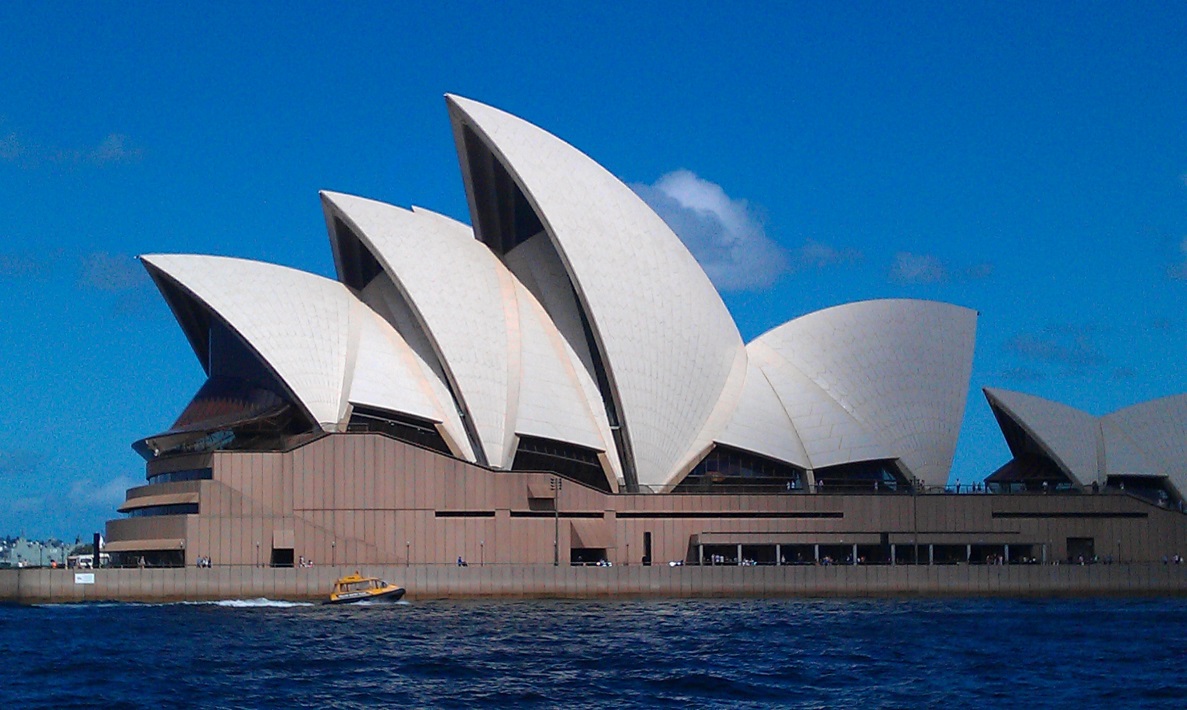
I stared blindly out of the aeroplane window as we circled around Sydney, thinking about nothing much at all, noticing the Opera House and the Sydney Harbour Bridge and how tiny they looked, how much like models, how insignificant. And in the taxi on the way home (and yes, I am acknowledging my privilege as I write this, that is kind of the point of this blog, I think…), I asked the driver to please take the bridge, not the tunnel. There is something about the view from the Eastern Distributor, which brackets Circular Quay with the Harbour Bridge on one side and the Opera House on the other, that feels to me like coming home.
Sydney Opera House. Photo by LJS.
As we drove, and the iconic structures came into view, I thought, somewhat mindlessly, how much bigger they seemed close up. Like I said, I was exhausted, not able to conjure much more than this rather banal observation. Objects in the rear view mirror may be closer than they appear, but objects on the ground, when you’re close up, feel much more significant. Continue reading →
As has been established, encounters between the coloniser and the colonised led to the creation of truths, myths, legends and identities in which the two were mutually implicated. These encounters have also bequeathed a particularly problematic lexicon, one whose provenance is narrowly European and one which has been kept alive especially in the discipline of International Relations, even as it is increasingly renounced by other disciplines and in the world outside the Anglophone academy. In my talk at ISA this year, I sought to problematise the concept of ‘tribe’ and show how a monolithic and unreflective body of work became the norm with reference to Afghan social organisation as exemplified by this kind of statement made by General Jim Gant in 2009:
When one says “Afghan people” what I believe they are really saying is “tribal member”. Every single Afghan is a part of a tribe and understands how the tribe operates and why. This is key for us to understand. Understanding and operating within the tribal world is the only way we can ever know who our friends and enemies are, how the Afghan people think and what is important to them. Because, above all, they are tribesmen first.[1]
By tracing the way in which the term “tribe” has been deployed in the Afghan context, the paper (based on a dissertation chapter) performs two types of intellectual labour. First, by following the evolution of a concept from its use in the early nineteenth century to the literature on Afghanistan in the twenty-first century, wherein the “tribes” seem to have acquired a newfound importance, it undertakes an intellectual history of the term. The Afghan “tribes”, taken as an object of study, follow an interesting trajectory: initially likened to Scottish clans, they were soon seen as brave and loyal men, but fundamentally different from their British interlocutors – albeit interestingly always superior to the Hindus who often provided the necessary contrast – only then to be seen as a “problem” that needed to be managed, and finally, as indispensable to a long-term “Afghan strategy”.[2] And second, the paper endeavours to describe how that intellectual history is intimately connected to the exigencies of imperialism. My argument is that the “tribe” has become a familiar and accessible idiom – another expedient shorthand – used to make sense of Afghanistan’s diverse and complex social structure, but that in the process the term has veered far from the manner in which it was originally conceived and utilised. I aim to demonstrate not only how the term has become more thoroughly racialised, but also how it now amounts to a conceptually vapid word that has paradoxically been credited with ever more importance in “understanding Afghanistan”.
It is one man’s early 19th century writing that continues to be the capstone of much of the academic work done on Afghanistan today. Continue reading →
Below is the text of my intervention at a roundtable organized by Alina Sajed entitled ‘Race and International Relations—A Debate Around John Hobson’s The Eurocentric Conception of World Politics‘. TDoT has hosted a symposium on the book: you can read an initial post by John, commentaries from Meera, Srdjan and Brett, and a reply from John. I’ve tried not to cover the same ground.
While race and racism have recently become topics of increasing interest in the rather parochial world of IR scholarship, few books have ranged so widely across time and thinkers as John Hobson’s The Eurocentric Conception of World Politics. This is a monumental work of scholarship that accumulates a staggering amount of evidence, were further proof necessary, of the white supremacist and/or Eurocentric foundations of IR as a discipline (I use the ‘and/or’ advisedly, because much of the debate that the book has generated and some of my own critique focuses on the complex relationship between the formations that Hobson identifies as ‘scientific racism’ and ‘Eurocentric institutionalism’, about which more in due course). So whatever my problems with the book, I want to endorse it as a deeply necessary intervention in the IR academy. Nonetheless, I find myself in sharp disagreement with some of its central claims in ways that have not been fully addressed in earlier discussions. I will focus here on two areas of disagreement: first, the book’s treatment of Marx, Lenin and Marxism in general; and second, its crucial distinction between ‘scientific racism’ and ‘Eurocentric institutionalism’.
Why focus on a critique of Marxism as Eurocentric and/or imperialist? (Again the ‘and/or’ seems necessary because Hobson’s careful mapping of European thought finds conjunctions of racism and/or Eurocentrism with both imperialist and anti-imperialist sensibilities). Partly this comes out of my own intellectual investment in denying what I believe to be the false choice that is often presented between Marxism and postcolonialism. As such, I find myself troubled as much by Marxist work that repudiates postcolonialism as I am by the opposite tendency (which I think is at work in this book). But partly this also comes out of a sense that if Marxism were in fact as Eurocentric and/or imperialist as Hobson suggests, this would leave inexplicable its enormous appeal in the Third World both in the heyday and aftermath of the great decolonization and liberation movements that it informed. More prosaically, I think Hobson’s readings of Marx and Lenin are temporally truncated and therefore somewhat misleading.
At this year’s ISA, Shahar Hameiri and I talked about our new research project on state transformation and rising powers, with specific reference to China. In a nutshell, we suggest that, like other states, those of so-called ‘rising powers’ are undergoing epochal transformations associated with transformations in the global political economy since the late 1970s, profoundly conditioning how they are ‘rising’.
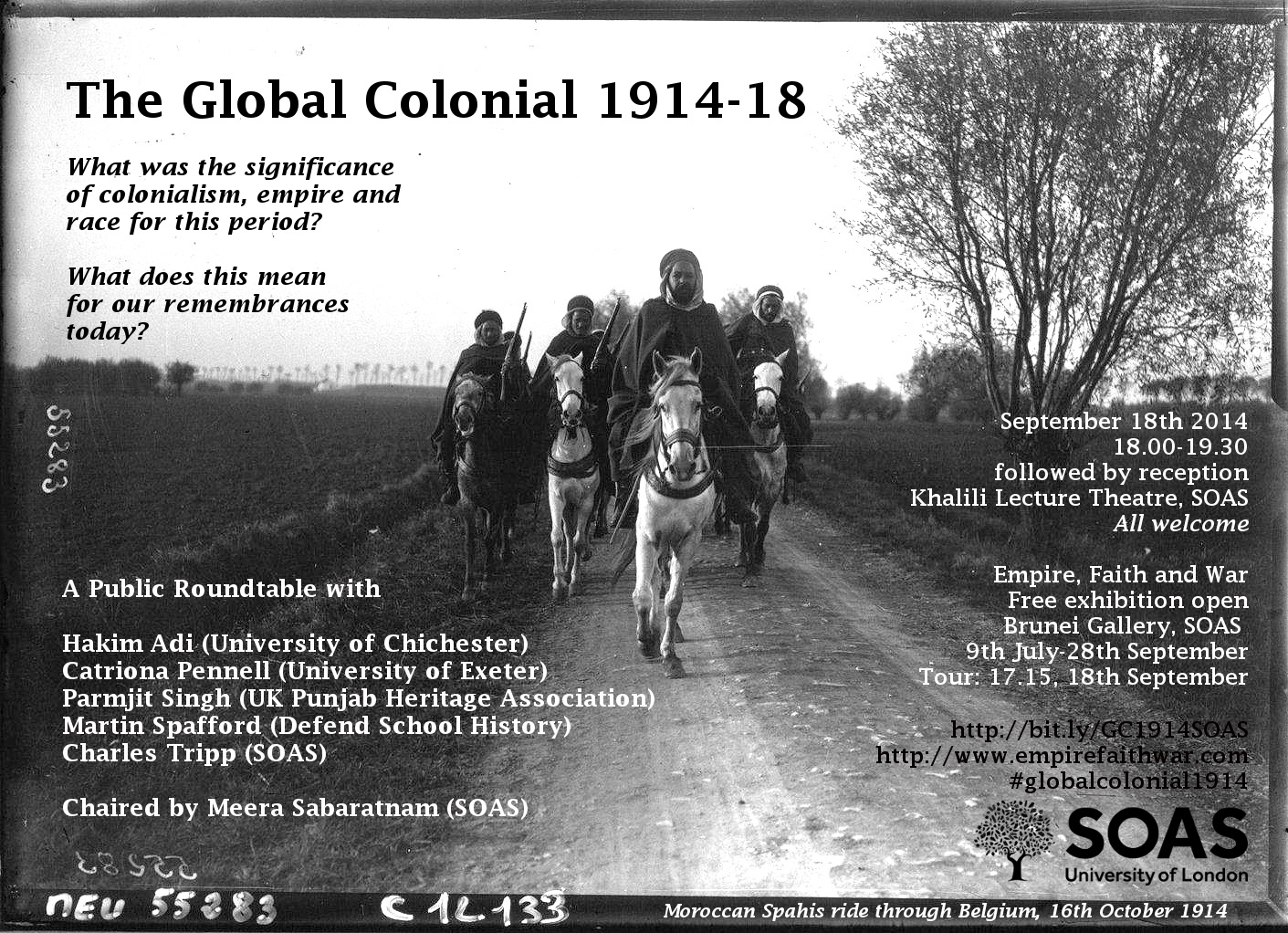
M: Okay. Hello, everybody and welcome. Thanks very much for coming. My name is Meera Sabaratnam, I’m a lecturer here at SOAS in international relations. And tonight we’re delighted to host a roundtable on the Global Colonial 1914-18. So obviously this is triggered by a number of contemporary events, not least the centenary of World War One, which you’ll have seen all over the news. But one of the stories I suppose, that gets told less often is the role of the wider world in the way that the war unravelled but also as a theatre of war. And in the place of where the war stood as part of the global context. So what else was going on, multiple revolutions, uprisings. So this is a moment in which the war is an important part of a global order which is undergoing substantial amounts of change. I should say this event is also sponsored…has been organised through the British International Studies Association and their working group on colonial, post-colonial and de-colonial research questions.
And this particular group tries to look at the elements of coloniality and colonialism in how the modern world came to be and what that means for when we understand globalisation and global history. I’m delighted to have a roster of speakers here tonight covering not just all of the sort of main areas, the regions that we’re studying in SOAS, namely Asia, Africa and Middle East. But also researchers and teachers who have been involved in how World War One is remembered in the classroom as a form of public cultural memory. Each of our speakers is going to speak for about 10 minutes. And then after that we’ll open it up for questions. Please do be forthcoming with your questions and we hope to have a good discussion afterwards, okay. I’d first like to welcome Professor Charles Tripp who is professor of Middle East here at SOAS. Thanks.
C: Thank you very much, Meera. It sounds rather grand, I’m not the professor of Middle East, I’m professor of politics in the Middle East. But why not, grander? I was asked to talk today about the relationship between what was happening in the Middle East and what happened to the Middle East in and around the First World War. And I must admit straight off, I’m not a historian, so I don’t work on the first war particularly but clearly anybody who works in the politics of the Middle East is well aware of the fact that legacies of the First World War and what happened to the region are still very much there and indeed are being revived in the press in one form or another as they talk about Syria and Iraq at the moment. But what I wanted to really try and do is to pick out two themes if I can, in the time allotted. One is the notion that as with many other parts of the world, much was happening before the First World War that the First World War changed the course of, if you like. So in a sense one of the dangers of looking, which of course happens now to some extent in the press and elsewhere, is to see the Middle East purely as the Middle East as a political entity, whatever that is, as a kind of creation of European intervention, the First World War.
But what I’m trying to argue is that actually there were processes long before that that had been going on and that in some ways the European intervention set back in various significant ways that had an effect for the future as well. So the first part is really to think about what had been happening in the 50 years or so before the First World War in the region, we now think of as the Middle East, the Ottoman Empire, Qajar, Iran, North Africa. And I want to look at two themes which are intertwined but really revolve around the same emerging idea and notion which is the idea of the autonomous citizen, which again was quite a novel, a radical idea with hugely radical implications for the dispensations of power. But the two themes that they were intertwined with was, one, the struggle against despotism and the other, struggle against colonialism, both of these seemed to be deeply repressive of the idea of the autonomous citizen. And in some senses therefore what you’re looking at in the long…well, the period before the First World War in the 40 or 50 years, whether it’s in the Ottoman Empire, the Qajar Empire, Iran, in Egypt, you have a struggle against local despotism for constitutionalism. A precarious constitutionalism which is often of course therefore sabotaged by those who would rather not see it. But nevertheless very powerful in the mobilisation of the politics of these regions. Continue reading →



 The Disorder Of Things