[M]y wife and I realized you cannot pay attention to everything, so I said to myself “one continent that I am going to leave aside is Africa.” I preferred to concentrate on Europe and China. I did a pretty good deal of work on China because I saw it ripe to become one of the most important parts of the world of which I knew nothing. So, I proceeded to do a lot of work on China in order to know something about it. But Africa is kind of a blank spot for me, apart from casual observation. Even though, I would say that the whole notion of anarchy applies very well to Africa.
In fact, a criticism people used to make to me was that Africa was clearly an anarchic arena, and yet African states did not fight much among themselves. How, then, would a Realist like myself explain that? Well, I did by invoking Turney-High’s book in anthropology, which was published—I believe—in the 1920s. There, he made the very valid point that countries have to obtain a certain level of self-consciousness as being a political entity, and a certain level of competence before they are able to fight one another. Turney-High’s illustration was very clear with his study of the peoples he referred to as the “Californians,” who were such a primitive people that they did not have the ability to form groups or fight as a group. A consciousness and competence at a certain level is needed before a group is able to systematically impose on another group—whether in the form of warfare or in other ways. I think that, for a long time, Africa was in that condition, and that, as it proceeds away from that condition, African countries will be able to fight wars against one another. In a historical sense, though, that is an implication of advancement.
I do feel somewhat sorry for A.C. Grayling. Following his sudden exit from the Birkbeck scene, former colleagues sent a short but apt letter to The Guardian, expressing appropriate levels of dismay and resistance to the innovation of the New College ofthe Humanities. They raised basically two objections. First, that the New College is for-profit, substituting the business of teaching in place of the vocation of research. And second, that it is in the ‘vanguard’ of efforts to link education to wealth, partly via a leaching of public resources.
Although many prominent names were used to unveil New College, few seem in sight now that it is under sustained attack (Peter Singer, where are you?). And Grayling, somewhat to his credit, keeps replying to the antiquated nay-sayers desperately clinging to the sinking ship of public provision. Perhaps the fullest public defence has come in response to the Birkbeck letter. Although garlanded by academic niceties (“with respect”; “I would be very grateful”), the ultimate conclusion is that his critics lack some basic faculties of reason: “I have seen only an emotional case for scapegoating our project”.
Surely, then, there are firm responses to the proliferating critiques? Grayling’s fuller case for New College turns primarily on the idea that students are being under-charged rather than over-charged. The relevant comparisons? That an MSc in Finance at LSE for an overseas student costs almost £26,000 (with many other programmes charging in the £15-21,000 range) and that a DPhil in cardiovascular medicine at Oxford will set you back nearly £27,000 if you’re not from the EU. The point being that high fees for some already subsidise lower fees for others. Now, you’ll notice what has been done here: £18,000 for an undergraduate degree for all students is being justified on the grounds that you can find a handful of prominent programmes elsewhere that charge more than this for masters programmes for non-EU students.
As an argument for justice it has some merits (Why the disparity here? What are the ‘real’ costs of educating a doctor or financial specialist?). But as a defence of New College as prosaic rather than parasitic it doesn’t stand up to much. And I’m sure there’s a latin term for this kind of fallacy. A direct comparison with liberal arts funding in the US would have offered us more, but that would have required admitting that there is something new about the New College in the UK setting. You’ll recall that, before people starting off letting flares at Grayling’s talks, this was very much the selling point of New College. Its online welcome still announces: “New College of the Humanities is a new concept in university-level education”.
Lots of the new then, which makes it worth thinking through some of the older ideas of the university, as Steve Fuller did so wonderfully back in February. But there is something yet more damning in Grayling’s reply. He says that his project can’t be vanguardist. In a repeat of the AHRC debacle, apparently bright people conclude that you can’t be complicit if the Minister didn’t call you directly and tell you to do something. Grayling clarifies that he is under no compulsion of Government and has no love for the current reconstitution of UK higher education, as if that matters. Moreover, “we cannot be in the vanguard of what has long been happening”. This is the crux of a claim made before: that New College is simultaneously following an economic pathway outside of its control and that it will have no detrimental impact outside of its own halls.
Other engaged in privatised education do happen to think that the New College will accelerate some market openings. But notice that Grayling can’t have it both ways. His argument against allegations of vanguardism is that New College is too small and insignificant for anyone to follow its lead. But his argument for an £18,000 fee compares New College to comparatively small and unrepresentative courses which charge more than he intends to (about 80 people take that MSc in Finance at LSE). An accidentally immanent critique, this mode of argument illustrates exactly how a vanguardist framing works, and has worked over the last years. Find an institution that charges more than you do and has a good reputation. Point out that you could do more, and do it better, if you had their money. Campaign for that outcome while ignoring or dismissing arguments for higher levels of public investment. Repeat. Change the discursive and economic landscape in a series of comparative expansions.
Grayling suggests high fees elsewhere as justification for his high fees, but then expects us to believe that his high fees (which are much more clearly comparable with undergraduate provision than are the courses he cites) won’t be used by anyone anywhere to militate for a further uncapping or greater move to student debt and ‘consumer-led’ education over equal access and public goods. It is hard to see the logic in such a position, not least when it already provides indications of how such an appeal by others would run:
Note one thing: the deafening silence of the vice-chancellors in the controversy over our college project. Why? Because as the individuals most acutely involved in battling with impossible arithmetic, they understand the realities.
Please.
Andrew McGettigan’s excellent and much circulated analysis points out that marketisation requires the softening up of older providers via the introduction of one or more exemplars of new learning: 1) independent, non-profit providers like the University of Buckingham; 2) private, for-profit providers like BPP and now NCH (perhaps owned by people like Apollo); 3) Edexcel in relation with colleges; 4) Cameron’s planned ‘Big Society University’; and 5) globalised multi-nationals. New College has to be viewed in this context and not, as Grayling wants, as some minor footnote. Here’s McGettigan:
The new market conditions must first be created. A significant amount of intervention is required to bring about a ‘level playing field’ in which new, more commercial, operations can compete successfully to drive down costs. The first steps here have already been achieved. First, the complete removal of central funding to arts, humanities and social science degrees exposes the established provision to potential competition in a manner that gives the lie to Willetts’s claim that the cuts have been ‘scrupulously neutral’. (No new provider is currently planning to offer STEM degrees, which are expensive to run and require large overhead and start-up costs.) Second, students at private establishments have already been granted access to the student loans and grants…Third, when viewed in conjunction with the new visa restrictions on overseas students (a political decision affecting an otherwise independent and substantial income stream) and the cuts just announced from HEFCE for the 2011/12 budget, we can conclude that universities are being softened up. Prior to a major reorganization of higher education these cuts are punitive and part of a concerted effort to destabilize the sector for the entry of new agents… What is proposed does not simply benefit small, niche operations but creates the conditions for ‘creative chaos’ similar to that to be unleashed on the National Health Service.
My friend and colleague Mark Kersten has been drawing my attention over the last weeks to a spate of stories about Libya in which it is claimed Gaddafi has been distributing Viagra as an inducement to sexual violence against ‘enemy’ civilian populations. Colum Lynch reported in late April that Ambassador Susan Rice had cited the use of Viagra and evidence of sexual violence during a meeting of the UN Security Council (although this itself is at least third hand – Lynch seems to have picked up the details from Reuters who were passed the information by a UN diplomat who was in the room). The story seems to have originated, or first surfaced, at The Daily Mail, which claimed “numerous reports” of Viagra use.
The testimony of Suleiman Refadi, an Ajdabiya surgeon, in this Al Jazeera piece is the closest thing to a direct claim that Viagra has been distributed to troops. But, as Lynch points out, Human Rights Watch followed up his allegations and say that Refadi had “no direct evidence”, which I assume means either that he himself hadn’t seen the Viagra and condoms, or that some had been found, but not in any pattern that would associate them with a strategy of war rape. Human Rights Watch have a number of reports and commentaries addressing rape in Libya, but do not seem to have found the Viagra claims credible enough to include. Now the International Criminal Court is investigating. Luis Moreno-Ocampo intimates that he has solid evidence for the claims and declares: “It’s like a machete…It’s new. Viagra is a tool of massive rape.”
Following complaints from others at Nottingham, BISA yanked the paper from the online system, so comment on Dr Thornton’s claims is moot. The academic freedom issues at stake are, however, very much alive. Particularly of interest are the grounds on which Nottingham have sought to defend their decisions, both in the initial case and in dealing with Thornton’s internal dissension:
[Academic] freedom is the freedom to question, to criticise, to put forward unpopular ideas and views – it is not the freedom to defame your co-workers and attempt to destroy their reputations as honest, fair and reasonable individuals.
It is important to remember that the original incident, almost three years ago, was triggered by the discovery of an al-Qaida training manual on the computer of an individual who was neither an academic member of staff, nor a student, and in a school where one would not expect to find such material being used for research purposes.
At the recent ISA conference in Montreal, I participated in a lively, weighty and difficult roundtable on postcolonial and poststructural approaches to International Relations. Alina Sajed had supplied the panellists with a provocation by way of refuting Dipesh Chakrabarty’s famous injunction that Europe was the inadequate and indispensible to frame the epistemological constellations of “modernity”. Sajed challenged the panellists to debate whether Europe was in fact dispensable as well as inadequate. There was certainly a spectrum of opinions given and positions taken on the function, possibility and desirability of the relationship between poststructural and postcolonial approaches. As a form of reflection I would like to lay out some thoughts by way of clarifying for myself what the stakes at play are in this discussion and where it might productively lead.
For myself I do not read the Europe that Chakrabarty considers in terms of the historical expansion and exercise of material colonial power. I read it in terms of a fantasy that captures the imagination. At stake is a conception of the whys, hows and shoulds of people suffering, surviving, accommodating, avoiding, resisting and diverting the colonial relation and its many neo- and post- articulations. In this particular respect, I take Frantz Fanon’s position and agree with Sajed: “Europe” must be dispensed with. In any case, as Ashis Nandy has shown, the monopolisation of the meaning of Europe by a fascistic figure (rational, male, hyper-patriarchal, white, civilized, propertied) has required the re-scripting of the pasts of peoples in Europe and a concomitant distillation of the traditions of European thought themselves so as to accord to this fantasy figure. Europe is a fantasy through and through, but one that damages different peoples with different intensities. And those who look in a mirror and experience no significant cognitive dissonance when they proclaim “European” can still count themselves, to different degrees, as being a thoughtful protagonist in a contested human drama. For others, there is only the promise of living this drama vicariously through the thought of others. That is why “Europe” is dispensable, even though for some peoples Europe has never been indispensible; regardless, it must be dispensed with.
Let me explain a little more what I mean by all of this. Europe is first and foremost a sense of being that constructs its empathy and outreach in terms of a self whereby all who cannot intuitively be considered of European heritage are categorized into two entities. First, they might be the “other” – foils to the understanding of the self. Their emptied presence is to be filled as the verso to the internal constitution of the European self. If they are lucky, they are given a kind of non-speaking part in the drama. In fact, they usually are lucky. Much critical European thought – and certainly almost all of canonized European thought – speaks volumes about the ”other” but only so as to fill in the European “self” with greater clarity.
Second, they might be the “abject” – the entity that is impossible for the self to bear a relationship to, although even this impossibility will be instructive to the inquiring European self. Abjects, under the European gaze, are reduced to a primal fear out of which an intensity of feeling is engendered that wills the drama of human (European) civilization. Defined in excess to the other/abject, the internal life of the European self can substitute itself for humanity at large in all times and spaces, and develop itself as a richly contradictory being that overflows its meaning and significance.
I do not know whether other colonialisms predating and contemporaneous to the European project matched this audacity. And in a significant sense, it really does not – and should not – matter. After all, the lure of making comparison is the precise methodology through which the European self overflows to define all others by a lack. I do though want to hazard a particular claim at this point, which might or might not bear up to scrutiny: the prime “others” of European colonialism were the indigenous peoples of the Americas. And while we owe much to Kristeva’s work on the term, the prime “abjects” of European colonialism were the enslaved Africans bought over to the Americas.
You might have thought that the realities of muscular interventionism in Libya had by now trumped the apologetics of constructive engagement. But Benjamin Barber has other ideas. His counter-attack to the nay-sayers deploys several connected themes, all of which appeal, once again, to the purported political realism of befriending Saif Gaddafi and the corresponding idealism and naivety of opposing such benevolent stewardship.
First, the attacks on the fortunate son have been “overwrought”, and have materially endangered the chances of peace by pissing him off. Second, Saif remains “a man divided, torn between years of work on behalf of genuine reform that at times put him at risk”, and thus still open to our charms. Third, he is even now working for civil society and democracy, pressuring his father to release journalists and in effect continuing the work of his foundation as a fifth column within the regime. Yes, Saif has been naughty (I’m not angry, I’m just disappointed), but his intentions are still at least partly good, and failure to achieve a better Libya through a rapprochement with him ultimately condemns we who would rather cling to the saddle of our high-horse than descend into the messy realities of progress.
The riposte is bold, and at least has the merit of maintaining the original analysis, no matter how much short-term developments may seem to degrade it. But the rationalisation, wrapped in what Anthony Barnett so aptly characterises as a ‘cult of sincerity’, falls somewhat short. The central meme, repeated by David Held, represents Saif Gaddafi as an enforcer-cum-reformer of near schizophrenic proportions. While it is (now) readily admitted that he is personally responsible for human wrongs, it also becomes necessary to insist on his internal, and magnificently cloaked, commitment to human rights. This may work for those who knew him personally and remain invested in his personal quirks and charms, but can hardly stand as a recommendation for his role as good faith mediator. As Barber himself argues (with a different intent and a suspect logic) if Saif is both revolution and reaction then he is also neither, and therefore a cipher for the projection of political fantasies.
These justifications repeat binaries of politics/morality and realism/idealism in dismissing critics (we were engaged in a calculated politics while you luxuriate in abstract ethics). Yet they also almost attempt, ham-fisted and inchoate, to escape them. After all, the defence is not that Saif is merely our bastard. Nor is it that he is a true rebel son, prepared to overthrow not only the personal dynamic of filial submission but also the political fatherhood of little green books, torture prisons and outré couture. He is said to be both, flickering and indistinct, as if this commends him. As if he can only change things because he is the natural heir of the old order. He moves between our worlds, you see. A Venn-diagrammed endorsement.
Saif Gaddafi (PhD, LSE, 2008) has lost a lot of friends recently. Even Mariah Carey is embarrassed by him now. The institution to which I have some personal and professional attachment is implicated in a number of intellectual crimes and misdemeanours, as may be a swathe of research on democracy itself. Investigations are under way, by bodies both official and unofficial. All of this now feels faintly old-hat (how much has happened in the last month?), even rather distasteful given the high politics and national destinies currently in the balance. So let the defence be pre-emptive: the academy has political uses, and those with some stake in it need feel no shame in discussing that. If crises are to be opportunities, let us at least attempt to respond to them with clarity and coherence. After all, our efforts are much more likely to matter here than in self-serving postures as the shapers of global destiny.
Saif’s academic predicament is both a substantive issue in its own right and a symptom. As substance, there is now a conversation of sorts around complicity and blame. Over the last weeks, David Held has appealed for calm and attempted a fuller justification of his mentorship (Held was not the thesis supervisor and Saif was not even a research student in his Department at the time, although he, um, “met with him every two or three months, sometimes more frequently, as I would with any PhD student who came to me for advice”). Most fundamentally, it was not naivety but a cautious realism based on material evidence that led a pre-eminent theorist of democracy to enter into what we could not unreasonably call ‘constructive engagement’. [1]
Held characterises the resistance of Fred Halliday to all this as reflecting his view that “in essence, [Saif] was always just a Gaddafi”, which of course makes him sound like someone in thrall to a geneticist theory of dictatorship. The actual objection was somewhat more measured, and, if only ‘in retrospect’, entirely astute:
Iain Pears is on the case. As he notes, it’s simply not convincing that the approved language suddenly appeared in the relevant documents unconnected with the political agenda of the governing party. The pressure may have been implicit, and the relationship might have been more informal and complicit than hierarchical, but the consequences for research are much the same.
But the AHRC not only wants to defend itself from these specific charges but also to maintain the legitimacy of the government setting overall priorities. Once again, the exact mechanics are expected to be taken on trust. Indeed, in 2009 a Commons Select Committee (Innovation, Universities, Science and Skills, since you asked) addressed this exact point. While agreeing ‘in theory’ that the government had a role in setting overarching strategy, the relevant MPs (hardly a selection of Parliamentary rebels) put their collective figure on the aspects of policy that still concern us most:
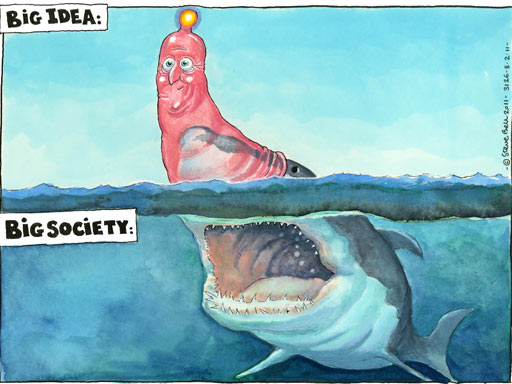
One of the principle battle-cries of the education movement has been that the coalition’s plans amount to a privatisation of the university system. This conclusion is arrived at by a focus on the withdrawal of teaching funding and the increased role given to ‘good relations’ with the private sector. These criticisms stand, but they repeat a common misunderstanding of the neo-liberal project as merely removing the state (call it the laissez-faire fallacy), rather than reorientating the state in a particular way to benefit certain sections and classes of society. The government is obviously complicit in promoting such tropes, which reinforce its narrative of supporting the grassroots and entrepreneurs and civil society and volunteers and champagne and candy for everyone. Hence their frankly playgroup standards of messaging. The Big Society is yellow and smiley-face! The Big Government is red and angry-sad-face!
But we now learn that the government has settled on a rather interventionist approach to all the lovely knowledge we are tasked to produce. ‘Two-minds’ Willetts has decided that the Arts & Humanities Research Council will be allowed to distribute £100 million in research monies each year, but only on condition that it accepts a ‘revision’ of the HaldanePrinciple (“that decisions on individual research proposals are best taken by researchers themselves through peer review”) and so spends a ‘significant’ amount of that money on research into the Big Society. Under the new ‘understanding’, the government continues to ‘value’ and ‘recognise’ the importance of academic independence, but wishes only to propose the merest of commonsensical adjustments:
At the other end of the spectrum there are decisions that ultimately must be for Ministers, albeit informed by external advice; these include the overall size of the funding for science and research and its distribution between the Research Councils, the National Academies and Higher Education research funding. In addition, every Government will have some key national strategic priorities such as addressing the challenges of an ageing population, energy supply or climate change. The research base has an important role to play in addressing such priorities and the Research Councils, with the support of independent advice, have proposed research programmes to tackle them. It is also appropriate for Ministers to ask Research Councils to consider how best they can contribute to these priorities, without crowding out other areas of their missions. But it is for the Research Councils to decide on the specific projects and people to fund within these priorities, free from Ministerial interference. Similarly, Ministers have a legitimate role in decisions that involve long term and large scale commitments of national significance.
The overall mood is civil-service vague, but elements of the language are importantly precise. Continue reading →
Rape is an evolutionary adaptation. More than that, it now appears that anti-rape strategies are evolutionary too, which for women means increased strength at certain stages of the menstrual cycle, increased general distrust of men and hatred of black men in particular. Taking Darwin in vain, this is the argument put together by Jesse Bering at Slate.
We should probably start by getting our definitional house in order. In an admirable example of rigging the answer by misspecifiying the question Bering names rape as “the use of force, or threat of force, to achieve penile-vaginal penetration of a woman without her consent“. So men are biologically incapable of being raped, women incapable of raping, and the sexual-reproductive organs the only legible site for sexualised aggression (no anal here please!).
Hardly surprising, given this terminological firing gun, that rape emerges as a phenomena only comprehensible in procreational terms. This is a narrower agenda even than saying that it is somehow ‘evolutionary’, itself already less than saying it has something to do with ‘biology’ (the possibility of rape being about ‘sex’, socially understood, or ‘power’ stands at yet further removes).
The quality of proof offered doesn’t fare much better. Take the study on racist attitudes and menstrual cycles, results we’re at risk of ignoring with our rampant ‘political correctness’ (*yawn*). Turns out women from this sample (77 white undergraduates) scored higher on fear-of-rape metrics of black men when they were most vulnerable biologically to impregnation. Bering takes this as supporting an evolutionary adaptation against ‘out-groups’, although he concedes that ‘cultural transmission’ may play a role.
The study itself suggests something rather less conclusive. It found that implicit race bias (non-conscious stereotyped associations of the form ‘black-physical’) was much more strongly correlated with rising fertility than explicit bias. Its metrics for race bias were all clearly consistent with a sociological or interpretive account of race (which is to say that race is a social, not a biological category, and that its meaning is historically and politically determined, not the outcome of adaptive ancestral behaviour). The data is also somewhat partial, as its relation to some wider questions. There is no comment on the fact that, for example, race bias remains fairly pronounced even where there is no ‘conception risk’, nor any significant attempt to cite work on general levels of race bias in general populations as a comparator or to examine variation among degree of bias in the women studied and the possible sources for those differences.








 The Disorder Of Things

