How Much Rape Is There In The Congo (DRC)? And How Does It Matter?

Dominique Strauss-Kahn has been accused of a sex crime. After a week of free gossip about sordid secrets concealed by superinjunctions, and in the wake of the Assange controversy, the combination of a high profile financier-cum-left-winger with the whiff of sexualised domination has proved sufficient to displace attention from the Democratic Republic of Congo, which had earned a spike in coverage from a new report on the extent of sexual violence there.

The numbers are appropriately horrifying. Although I can’t access the full American Journal of Public Health paper from my usual entry points (itself frustrating: why lock up your vital statistical research behind a paywall while the media is reporting on it far and wide?), the abstract suggests the following: based on a representative household survey of 3,345 female informants from a 2007 survey added to some population estimates, it is suggested that some 1.7-1.8 million women in Congo have been raped during their lifetimes, and that between 407,000-434,000 (to the nearest thousand) of those have been raped in the last 12 months. A total of 3.1-3.4 million women are estimated to have been victims/survivors of ‘intimate partner sexual violence’, which I assume means not raped by strangers or officially ‘enemy’ soldiers.

Jason Stearns provides some useful context to argue that these numbers are not surprising given previous surveys, if somewhat more solid in methodological terms. The UN has been calling the DRC ‘the rape capital of the world’ for some time now, and there are a significant number of organisations working on these issues in situ. Indeed, the sheer scale of attention to rape in the DRC is spoken of as a logistical problem among those working there. While conducting fieldwork in Goma last year, I spoke to a UNOCHA representative who put their figures (which were not comprehensive) for agencies working on sexual violence in Eastern DRC at 80 international NGOs and over 200 local NGOs, as well as multiple elements of the UN system itself. Properly coordinating work between such a mass of groups (with wildly varying levels of skill and funding) in situations of violence and funding uncertainty is as difficult as you might expect.

This gestures towards one of a number of complexities and problems in the analysis and politics of wartime sexual violence.

Continue reading

What We (Should Have) Talked About at ISA: Poststructural and Postcolonial Thought

…(drumroll)… We are collectively joyous at being able to introduce a new contributor to The Disorder Of Things: Robbie Shilliam, currently at the Victoria University of Wellington and author of a slightly staggering array of critical texts (on the impact of German intellectuals on IR; the Black Atlantic in modernity; the Haitian Revolution; race and sovereignty; and the imperatives of decolonial thinking, among others). Cross-posted at Fanon/Deleuze.


At the recent ISA conference in Montreal, I participated in a lively, weighty and difficult roundtable on postcolonial and poststructural approaches to International Relations. Alina Sajed had supplied the panellists with a provocation by way of refuting Dipesh Chakrabarty’s famous injunction that Europe was the inadequate and indispensible to frame the epistemological constellations of “modernity”. Sajed challenged the panellists to debate whether Europe was in fact dispensable as well as inadequate. There was certainly a spectrum of opinions given and positions taken on the function, possibility and desirability of the relationship between poststructural and postcolonial approaches. As a form of reflection I would like to lay out some thoughts by way of clarifying for myself what the stakes at play are in this discussion and where it might productively lead.

For myself I do not read the Europe that Chakrabarty considers in terms of the historical expansion and exercise of material colonial power. I read it in terms of a fantasy that captures the imagination. At stake is a conception of the whys, hows and shoulds of people suffering, surviving, accommodating, avoiding, resisting and diverting the colonial relation and its many neo- and post- articulations. In this particular respect, I take Frantz Fanon’s position and agree with Sajed: “Europe” must be dispensed with. In any case, as Ashis Nandy has shown, the monopolisation of the meaning of Europe by a fascistic figure (rational, male, hyper-patriarchal, white, civilized, propertied) has required the re-scripting of the pasts of peoples in Europe and a concomitant distillation of the traditions of European thought themselves so as to accord to this fantasy figure. Europe is a fantasy through and through, but one that damages different peoples with different intensities. And those who look in a mirror and experience no significant cognitive dissonance when they proclaim “European” can still count themselves, to different degrees, as being a thoughtful protagonist in a contested human drama. For others, there is only the promise of living this drama vicariously through the thought of others. That is why “Europe” is dispensable, even though for some peoples Europe has never been indispensible; regardless, it must be dispensed with.

Let me explain a little more what I mean by all of this. Europe is first and foremost a sense of being that constructs its empathy and outreach in terms of a self whereby all who cannot intuitively be considered of European heritage are categorized into two entities. First, they might be the “other” – foils to the understanding of the self. Their emptied presence is to be filled as the verso to the internal constitution of the European self. If they are lucky, they are given a kind of non-speaking part in the drama. In fact, they usually are lucky. Much critical European thought – and certainly almost all of canonized European thought – speaks volumes about the ”other” but only so as to fill in the European “self” with greater clarity.

Second, they might be the “abject” – the entity that is impossible for the self to bear a relationship to, although even this impossibility will be instructive to the inquiring European self. Abjects, under the European gaze, are reduced to a primal fear out of which an intensity of feeling is engendered that wills the drama of human (European) civilization. Defined in excess to the other/abject, the internal life of the European self can substitute itself for humanity at large in all times and spaces, and develop itself as a richly contradictory being that overflows its meaning and significance.

I do not know whether other colonialisms predating and contemporaneous to the European project matched this audacity. And in a significant sense, it really does not – and should not – matter. After all, the lure of making comparison is the precise methodology through which the European self overflows to define all others by a lack. I do though want to hazard a particular claim at this point, which might or might not bear up to scrutiny: the prime “others” of European colonialism were the indigenous peoples of the Americas. And while we owe much to Kristeva’s work on the term, the prime “abjects” of European colonialism were the enslaved Africans bought over to the Americas.

Continue reading

What We Talked About At ISA: Critique in Anti-Colonial Thought: Fanon and Cabral as Philosophers of Being, knowledge and ethics

I saw folk die of hunger in Cape Verde and I saw folk die from flogging in Guiné (with beatings, kicks, forced labour), you understand? This is the entire reason for my revolt.”.[1]


I sincerely believe that a subjective experience can be understood by others; and it would give me no pleasure to announce that the black problem is my problem and mine alone and that it is up to me to study it…Physically and affectively. I have not wished to be objective. Besides, that would be dishonest: It is not possible for me to be objective.”.[2]

For some time, I have been preoccupied by the connections between the ways in which we see, analyse and interpret the world, and the forms of political action to which this gives rise. In general, for critical social theory, the challenge is how to think about the world such as to understand and overcome structures of injustice or violence in it.  As a particular instance of this, the anti-colonial movement of the middle part of the twentieth century provides much food for thought, not least when so many point to patterns of colonialism and imperialism in world politics today.

In the paper I presented to the International Studies Association conference a few weeks ago, I offer a particular reading of Frantz Fanon and Amílcar Cabral as philosophers of being, knowledge and ethics.  Commonly, but not exclusively, these two figures are understood as having important things to say about revolt and resistance – Cabral is portrayed as the arch-pragmatist who emphasises the need for political unity and realistic objectives, whereas Fanon is frequently engaged for his affirmative treatment of violence in an anti-colonial context.  In this sense, they are largely approached as political thinkers and activists rather than philosophers per se.

Yet, their systems of thought stem from distinctive, and in important ways shared, philosophical commitments on the nature of being (ontology), ways of constructing knowledge (epistemology) and the ethical foundations of engagement (um, ethics). These foundations are strong, coherent and compelling points of departure and important in terms of understanding what kind of future order they envisaged.  What are these, and how do they support an anti-colonial political programme? What is the relevance of this intellectual legacy today? Continue reading

What We Talked About At ISA: The Monstrous Masculine: War Rape, Race/Gender, and the Figure of the Rapacious African Warrior

If there is something in these utterances more than youthful inexperience, more than a lack of factual knowledge, what is it? Quite simply it is the desire – one might indeed say the need – in Western psychology to set Africa up as a foil to Europe, a place of negations at once remote and vaguely familiar in comparison with which Europe’s own state of spiritual grace will be manifest.

Chinua Achebe, ‘An Image of Africa’ (1978)

Sometimes it seems that we’re merely Constructions made out of yarn, paper & wood with threads rising from our toes and fingertips. We pretend to talk and act as though we were alive but actually we don’t have any choice in the matter. Some secret power directs us.

Evan S. Connell, The Diary Of A Rapist (1966)

1. Rape, Ultra-Violence and Beethoven

When we speak of men in feminism, we might speak generally or specifically, of properties of maleness and masculinity or of things done by particular men (and usually some combination of the two). What is at stake is the distinction between masculinity as a set of internal properties and as a set of relational, and hence contingent, ones. Although this can be taken as denying any substance at all to that category ‘man’, it is perhaps just as well to say that we all build our own subdivided orders of maleness – from men we know, knew, or think we are; from our salient models of true and false and ambiguous masculinity; from the postures and poses we take as appropriate towards them; and from the frames we adopt for dealing with variety, with all the space for the exemplar, the exception, the masquerade and the average that they bring.

The monstrous masculine is one such model, or rather a set of models united by family resemblance. An object of horror, the monstrous masculine is a repository for tropes that identify the hideous excesses and obscene pleasures of maleness. Channelling Barbara Creed (and some Sjoberg and Gentry), it is a set of tropes and themes in our imaginaries of social action, frequently evoking, among others, ideas of a limitless and aggressive sexuality, a cold and calculating self-regard and/or a submerged, if frequently actualised, hatred of women and Woman that borders on the instinctual. In accounts of wartime sexual violence, this figure of the rapacious warrior (usually African) comes to be represented in terms of the calculating soldier-strategist (who chooses rape as a hyper-efficient means to an accumulatory end); the angry soldier-rapist (expressing a deep desire and sexuality); or the habitual soldier-ritualist (enacting the memes and symbolic imperatives of a community, culture or even race).

Think of the figure of the unreason-laced psychopath rapist, whether in the version Joanna Bourke examines as the ‘rapacious degenerate’ or that which Susan Brownmiller addresses as the ‘police-blotter rapist’: “[t]he typical American perpetrator of forcible rape…little more than an aggressive, hostile youth who chooses to do violence to women”. Such protagonists are common in popular representations of rape. In A Clockwork Orange, Alex and his droogs prowl the streets and lanes of town and country, opportunistically submitting the unlucky to attacks driven by a relentless juvenile machismo. And in the scandalous Irréversible, rape is also the product of a subterranean drive. ‘Le Tenia’ does not even search his victim for money as an afterthought – his priorities are only to enact his spontaneous lust and be called ‘daddy’ as he does so.

The monstrous masculine unites conceptions and intimations of masculinity as pathology. This is the Real of a “terrifying dimension, as the primordial abyss which swallows everything, dissolving all identities”. Put otherwise, it embodies in its most psychoanalytic inflection the idea (following Nick Cave) that the desire to possess her is a wound.

Continue reading

Brothers in Arms: ‘Outside The Law’ (2010) & ‘Of Gods And Men’ (2010)

Strange country that gives the man it nourishes both his splendour and his misery!

Albert Camus, Summer in Algiers (1936)

Many presumed his macabre tone would bring back some much-needed edge to the increasingly commercial sensibilities of the Cannes Film Festival this year, but with Ridley Scott’s revamped Robin Hood picked to open the festival hopes were quickly dampened. Tim Burton, the tousle-haired American director, may have a singular visual imagination and be a favourite amongst cinephiles, but as jury president he failed to appreciate the struggle to build a habitable multicultural Europe that was taking place both on and off screen.

A Screaming Man, by French-Chadian Mahamat-Saleh Haroun, is set during the current civil war in Chad, and tells the story of a former central African swimming champion who sends his son to war so as to regain his position as a security guard at the swimming pool of an expensive European hotel. Taking its title from Aimé Césaire’s collection of poems Return to My Native Land, Haroun’s fragile look into post-colonial conflict captures the bewitching impact of a symbol of Europe’s lasting legacy in Africa. Rachid Bouchareb, the celebrated French-Algerian filmmaker, presented Outside The Law; the latest in a new wave of French-North African films aimed at simultaneously curing France’s colonial amnesia and rupturing the borders of contemporary French culture. The film takes place between 1945 and 1961, and focuses on the contrasting fate of three Algerian brothers who have fled for France in the aftermath of the Sétif massacre. It poignantly ends with the credits anticipating the October 1961 Paris Massacre in which over 200 pro-FLN demonstrators were killed by being beaten unconscious and thrown into the River Seine or tortured in the courtyards of Paris police headquarters. Bouchareb has strategically chosen to set his narrative between two of France’s most notorious – but still officially contested – state-sanctioned crimes. Following on from his previous film, Days of Glory, which deals with the discriminatory treatment of indigènes recruited into the Free French Forces formed to liberate France of Nazi occupation in World War II, Outside The Law continues the prescient struggle over representations of France’s colonial history.

'Algerians Drowned Here'

Although Rachid Bouchareb was considered by most to be the favourite to scoop the Moroccan leather encased prize, the man who recently chose to indulge Alice’s imperial ambitions in 3D, decided to award the Palme d’Or to Of Gods And Men. Xavier Beauvois’ drama is set in the Cistercian monastery in Algeria, whose resident monks are confronted by your archetypal Islamic fundamentalists. Saturated with Christian faith, the film squares the noble patience, love and belief of the monks against the intolerance of Islamic fundamentalists and their apparently regressive, intolerant and bloodthirsty worldview. Despite most of the notable tastemakers – from Philip French, Peter Bradshaw, and even the usually astute Mark Kermode – falling for the film’s quaint charms, Of Gods And Men remains a film that enjoys flirting with both audiences’ assumed prejudices and the intolerably stubborn idea of a clash of civilisations. Dare I say Beauvois’ reverential and holier-than-thou tone could have done with some of Roberto Benigni’s light-hearted but equally annoying flamboyancy.

With the likes of Homi Bhabha and Gayatri Spivak now comfortably donning the robes of academic superstardom, cultural studies no longer holds its former position as rebellious younger child of academia. Having breeched the stuffy walls of Ivy League and redbrick institutions, it has becoming increasingly safe in its approaches to contemporary culture, and thus been unable to find an adequate balance between aesthetic concerns and pressing socio-political contexts. Continue reading

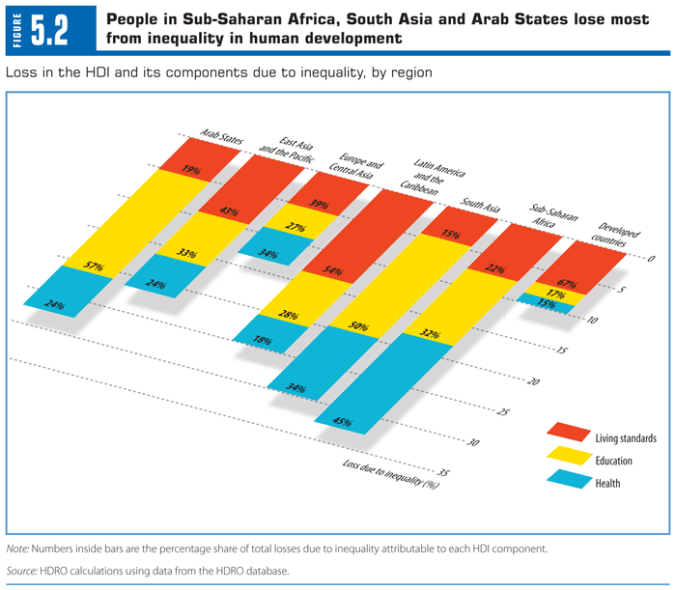
Inequality and the Human(e) Development Index

The UN Development Programme (UNDP) has for the last 20 years pioneered seemingly innovative approaches to development that have substantially redefined the terms on which development aid is conceived, offered and spent. The publishing of the first Human Development Report in 1990 was a bold move which made a case for measuring and judging countries’ developmental status in a way which focused on quality of life indicators as well as macro-economic statistics – an idea now which is completely mainstream and commonplace amongst donor governments and development practitioners.  It also proposed the notion of ‘human security‘ in 1994; a subversive response to the ‘securitisation’ agenda emerging in the wake of the Cold War which sought to broaden both the referent of security and the range of relevant concerns.  It was absolutely instrumental in pushing the Millennium Development Goals agenda – an incredibly ambitious and detailed set of targets for international development practice that served to underpin widespread agreement for the expansion of development funding across donor governments.

Its recent decision to measure inequality as a constituent part of development through its apparent role in determining the quality of life is, in this context, really interesting. On one level, it is indicative of the development community’s constant reflexivity – a term often used by David Williams – which recalibrates the tenor of its activities according to whatever the relevant crisis is supposed to be. Having been roundly critiqued and lambasted for the MDGs’ complicity with impoverishing neoliberal economic structures, we can read this ‘equality turn’ as the UNDP’s attempt to once more place itself on the vanguard of a more humane and responsive development agenda, moving itself away from the territory that the IFIs are starting to encroach upon.

It will be interesting to see whether and how the donors follow down this particular road. To a certain extent, the UNDP’s previous ‘innovations’ on human development, particularly with regard to adjusting for gender inequality, levels of absolute poverty and service provision, have all found various champions amongst western development agencies, all of whom have incorporated these issues seemingly deeply into their approaches to development, albeit perhaps through substantially de-radicalising the most substantive aspects of critique.

Inequality as an issue however poses a much more substantive threat to the international development agenda when pushed too far – not only does it cast doubt on the shining beaconof the self-made rich in the global South, but specifically, it starts to push against the foundational myth that ‘development abroad’ can be achieved with no corresponding change in the fortunes of ‘developed’ countries, a key threat to donor sanguinity and compliance with the UNDP’s more radical agendas. After all, if it is true within countries that vast inequalities impact on quality of life through skewing access to the goods that constitute human well-being, why would this also not be true between countries? The nonsense and yet widespread idea that some countries merely have to ‘catch up’ with others is belied by the inequality point but poses the much harder question for western countries and populaces to deal with: do I support international development enough to sacrifice any aspect of my own well-being?

As argued on an earlier post, the failure of highly-moralising development and anti-poverty agendas to deal at all with the central problem of inequality, both international and domestic, has been egregious and pervasive over the last 20 years, and looks to remain so in the future. The UNDP’s intervention is no doubt a timely one, although given the history of its more radical proposals, one which will probably be so watered down in practice as to be meaningless. Furthermore, by bringing this question within the competence of the ‘development’ policy specialists rather than engaging it as a public political question in ‘developing’ and ‘developed’ countries, the potential for getting to grips with the depth of this challenge seem remote.