On Statues (II)

This is the second in an unplanned series of write-as-stuff-happens posts on the politics of statues. You can read the first and third posts in any order.

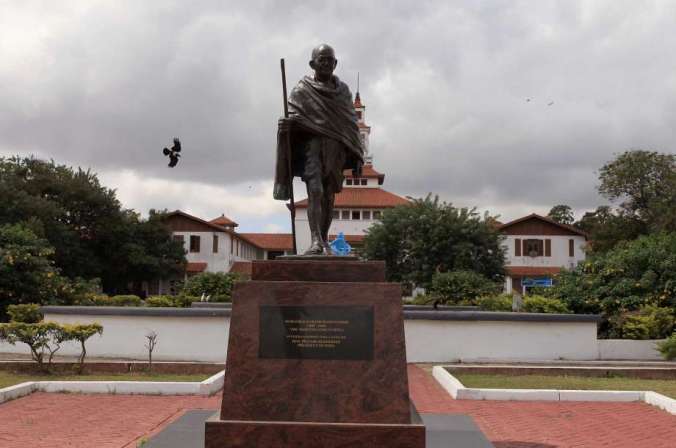
In June 2016, the Indian President Pranab Mukherjee unveiled a statue of Gandhi on the Legon campus of the University of Ghana in Accra. Almost immediately, angry blog posts and articles in the local press denounced the installation of the statue, demanding its removal. On twitter, activists proclaimed #GandhiMustFall and #GandhiForComeDown. An online petition voicing these demands has attracted over 1700 signatures at the time of this writing. The argument of the protesters is simple: Gandhi was a racist. As an activist in South Africa, he worked primarily in the interests of the Indian community, seeking a renegotiation of its position in the existing racial hierarchy of the settler colony without ever attacking the underlying premises of racial ordering. The protesters evidence this claim with Gandhi’s own words drawn from writings across a significant period (1894-1908), in which he refers to black South Africans by what would today be considered the offensive racial slur ‘kaffir’. More than the word, the connotations of which may well have worsened since the time Gandhi employed it, the protesters are angered by the shallowness and rank supremacism of his vision of liberation:

Ours is one continual struggle against a degradation sought to be inflicted upon us by the Europeans, who desire to degrade us to the level of the raw Kaffir whose occupation is hunting, and whose sole ambition is to collect a certain number of cattle to buy a wife with and, then, pass his life in indolence and nakedness (1896).

The protesters link Gandhi’s remarkably accommodationist views on race with his beliefs about caste, the institution of which he would notoriously justify in later arguments with Dalit leader B. R. Ambedkar. Unsurprisingly, the protest against the Gandhi statue draws inspiration from contemporaneous struggles against symbols of colonialism, apartheid and white supremacy all over the world, among which #RhodesMustFall in South Africa is preeminent. The connection is more than incidental: once again, the politics of a settler in turn-of-the-century South Africa has come under scrutiny in a protest against a statue in a distant country.
gandhi-ghana

***

Continue reading

From Global to Transnational: Reading Global Justice through W. E. B. Du Bois

s200_in_s.valdezThis is a guest post by Inés Valdez, assistant professor in political science at The Ohio State University. She works on the political theory of immigration, critical race theory, and cosmopolitanism and her articles have appeared in the American Political Science Review, Political Studies, and Politics, Groups, and Identities, among others outlets.Her book manuscript in progress is on Kant and W. E. B. Du Bois’s cosmopolitanisms. This post is based on a recent workshop paper that will be appearing in a collection on empire, race, and global justice edited by Duncan Bell.


An emerging literature in the field of history has made clear that transnational connections between black Americans and anti-colonial movements in the Caribbean and Asia were prominent in the twentieth century (see, among many others, Slate 2012). These connections resulted in more or less institutionalized forms of communication, exchange, and solidarity that influenced politically how these groups understood their own history of injustice and struggle.

These connections indicate that groups within the West saw their marginalization as connected to groups within what we today call the global South and saw the potential of realms of politics beyond the nation as sites of emancipation and justice.

Despite this literature, and the relatively recent events that they cover, the global justice literature is largely unconcerned with them. There are many disagreements within the global justice literature but one assumption is common: that wealthy countries are homogeneously prosperous and poor countries homogeneously poor. Moreover, whenever scholars do note the inequality within the West, they do so to posit that addressing it should take priority over obligations to the non-West. While scholars tend to disagree on the question of whether the West has a duty of justice toward the non-West, neither those who favor a duty to distribute (cosmopolitans), nor those who disagree with it (social liberals), pause to reflect on the potential affinities between marginalized groups within and outside the West.

Continue reading

White World Order, Black Power Politics: The Author’s Response

Bob’s response to Naeem, NiviSrdjan, and Meera completes our symposium on White World Order, Black Power Politics.


Four critical IR theorists have taken time away from other tasks to read my book carefully, generously, and thoughtfully. What a gift. The brevity of this response will appear stingy by comparison, but I don’t mean it to be. Rather, I am typing with my wrist in a splint, and it hurts, while I am also due to leave in the morning for a two-week vacation. Perhaps there will be another chance to show my gratitude. Many of the questions that Nivi, Naeem, Srdjan, and Meera raise have to do either with the book’s and my relationship to theory or with the limitations of my research strategy, as I anticipated and sought, self-servingly, to head off.

Continue reading

The EU Referendum: Brexit’s Imperial Delusions

This is a post in our EU referendum forum. Click here for the introduction with links to all the contributions.


haastrupOur next guest contributor is Toni Haastrup. Toni is Lecturer in International Security and a Deputy Director of the Global Europe Centre at the University of Kent. Her current research focuses on: the gendered dynamics of institutional transformation within regional security institutions especially in Europe and Africa; feminist approaches to IR; and the politics of knowledge production about the subaltern. She is author of Charting Transformation through Security: Contemporary EU-Africa Relations (Palgrave Macmillan, 2013) and coeditor, with Yong-Soo Eun, of Regionalizing Global Crises (Palgrave Macmillan, 2014).


One key aspect of the EU referendum debate has been the rise of competing narratives about Britain’s role in the world inside and outside of the EU. On the Brexit side, campaigners argue that escaping the EU would revive Britain’s standing, allowing it to reconfigure relations with Europe, strengthen existing non-European partnerships, and forge new ones. These claims rest on a series of self-delusions about Britain’s capacity to unilaterally set the terms of its international partnerships. Brexiteers willfully ignore those prospective partners who say that a post-Brexit UK would be a less attractive partner. Their narrative seems to rest more on imperial delusions than solid ground – and it is hardly a narrative appropriate for a truly democratic, internationalist country.

A Part of Europe, Apart from the EU: What is Possible?

Pro-Brexit campaigners often suggest that if the UK were to leave the EU, it could fashion a new kind of relationship with Europe similar to the one Norway enjoys. Norway is viewed as a country that has maintained its sovereignty while remaining a close partner of the EU.

But of course, Norway is different. It is a thriving smaller country that is dependent on oil reserves that are much larger than the UK’s. Further, Norway negotiated a very specific entry into the European Economic Association (EEA) and the European Free Trade Association (EFTA). If the UK was to depart, a relationship with the rest of western Europe especially in the context of EFTA is possible, but it is not automatic. Further, a relationship between the UK and other countries that currently exists only in the context of a regional EU relationship will have to be renegotiated, with no guarantee that the UK will indeed be better off outside the EU.

Those in favour of staying within the EU, or Bremain, thus rightly question this narrative as one that is based on uncertainty and the UK’s self-imagining, rather than the realities of the international environment. The idea that Britain would regain its sovereignty way from the EU is a myth whose consequence even the Norwegians warn against.

Continue reading

Churchill’s “Iron Curtain” Speech (A Black History Month Perspective)

Truman and Churchill in Missouri

Churchill’s Westminster College audience, March 5, 1946 (Life/Getty Images)

This year is the seventieth anniversary of Winston Churchill’s “Iron Curtain” speech, a.k.a. “Sinews of Peace,” a.k.a., the Fulton address, which means that we will soon be hearing all about it once again. The speech is central to the iconography of the Cold War, of anti-communism, and of Anglo-American specialness. Countless historians, biographers and rhetoreticians have examined almost every aspect of it: when and where it was written, whether it was pre-approved by others, including President Truman, and, indeed, how it was received. On the last point, we know that the speech was met with a mixture of cheers and boos. The reactions tended to be politically and ideologically determined. Conservative politicians and the media praised the speech for its realism about the nature of the postwar settlement: at last someone had the courage to publicly say that the victor nations could not forever be friends.  In contrast, most liberals, socialists, and communists condemned the speech as inflammatory. With so many hopes pinned to the newly created United Nations Organization (UNO), the last thing the world needed was geopolitical tension between the Western powers and the Soviet Union, they argued. But that was not all. Some leftists went further still. Churchill’s notion the Anglo-American “special relationship” and “fraternal association” constituted the ultimate sinew of world peace smacked of racial supremacism, they said.

Continue reading

Notes on Europe and Europeans for the Discerning Traveller

Europe has the only classical tradition that is also considered modern.

Europe claimed Greece as its ancestor. But not anymore.

Europe once turned a Black god white.

Once upon a time Europe decided that it was a family of nations. This decision is commemorated as the beginning of international law.

Because indigenous peoples were not mentioned in a very old book, Europeans wondered if these peoples were human.

Some of the Europeans who cleared lands of their indigenous peoples liked to represent themselves as indigenous princesses.

Europeans once thought that if they left Europe they would degenerate. To this day they view their cousins over the seas with suspicion.

European scientists once found a way to break up human beings into a set of quantum parts.

Europe is proud of freeing itself from metaphorical chains.

Europe got rich out of African slavery. Then it freed the slaves.

Europe was so concerned with slavery that it colonized the African continent.

In Europe you can baptises yourself so as to be born again with a humanitarian soul.

Some of Europe’s top philosophers were bigots and racists, even for their own time.

Europeans were so fascinated with primitives that they created a space in the brain called the unconscious.

Europeans say that Unconscious bias is regrettable but that it doesn’t make a person bad.

Europe prefers to narrate its eras of global war as eras of “long peace”.

Europe once had a big war with itself when some Europeans started to practice in Europe what they had been practicing in their colonies.

Algeria was a part of Europe. But Algeria was not part of the pax-Europa.

Anyone can be European so long as you tell Europeans where you come from.

Europeans can only trust women who show their whole face. Exceptions apply.

Europe never said thank you to muslim scholars.

The Mediterranean is currently the deadliest sea crossing in the world

Europeans are experts on Africa, Asia and Oceania.

Europeans prefer to learn about Africa, Asia and Oceania from other Europeans.

Europe is the only cosmopolitan that is allowed to keep its own adjective.

Europe believes that if it wasn’t written down it didn’t happen.

Europeans like to write about themselves.

Only Europeans can know Europe.

Once Europe was narcissitic, but Europeans fixed that by turning the mirror into a window onto the world.

The Global Colonial 1914-18: A mini-series

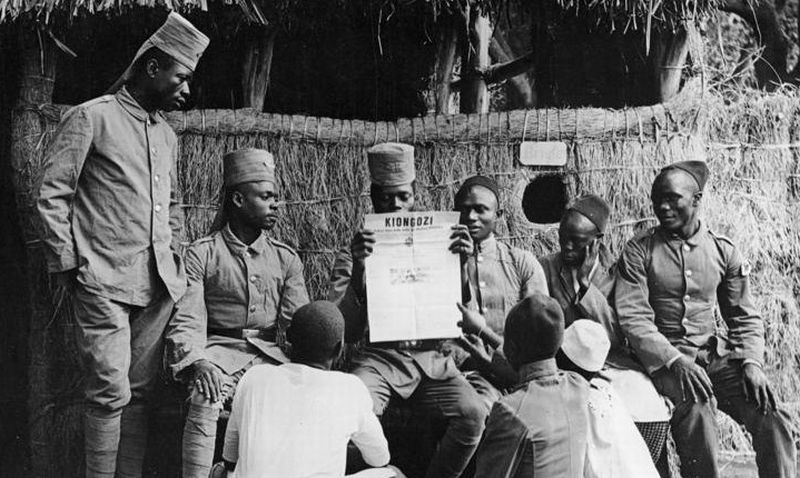
Askaris fighting for Germany listen to the news.

Askaris fighting for Germany listen to the news.

The Disorder of Things hosts a short series of posts connected to the event ‘The Global Colonial 1914-18‘, held at SOAS on 18th September 2014, and co-organised by the Colonial / Postcolonial / De-colonial Working Group of the British International Studies Association.

Our first post is by Lucian M. Ashworth, who discusses the breakdown of the colonial armed peace, as viewed by contemporary observers.

Our second post is by Dušan I. Bjelić, who offers a racial genealogy of the Great War.

Our third post is by Meera Sabaratnam, who suggests a contrapuntal reading of the war based in colonised Mozambique.

Our fourth and final post contains a transcript and video of the public roundtable which took place at the end of the day, featuring Hakim Adi, Catriona Pennell, Parmjit Singh, Martin Spafford and Charles Tripp, in which the colonial dimensions of the war are discussed, as well as their implications for teaching and commemorating the period today.

This post serves as a permanent link for the series.


A Right To The World: On Syria and an Idea of International Public Order

P1 aniang

A guest post from Amy Niang on the contours of ‘international community’, following previous interventions from Siba Grovogui in relation to Libya, Robbie on provinciality in International Relations and John M. Hobson et al. on Eurocentrism in international political theory. Amy teaches international relations at the University of the Witwatersrand and she is affiliated with the Centre of Africa’s International Relations (CAIR). She gained her PhD from the University of Edinburgh in 2011. She has taught International Relations, political theory and African history in South Africa, Scotland and Japan. Her research interests are in the history of state formation, political theory and Africa’s international relations, and she has commented regularly on democracy, civil society and Western intervention in Africa.


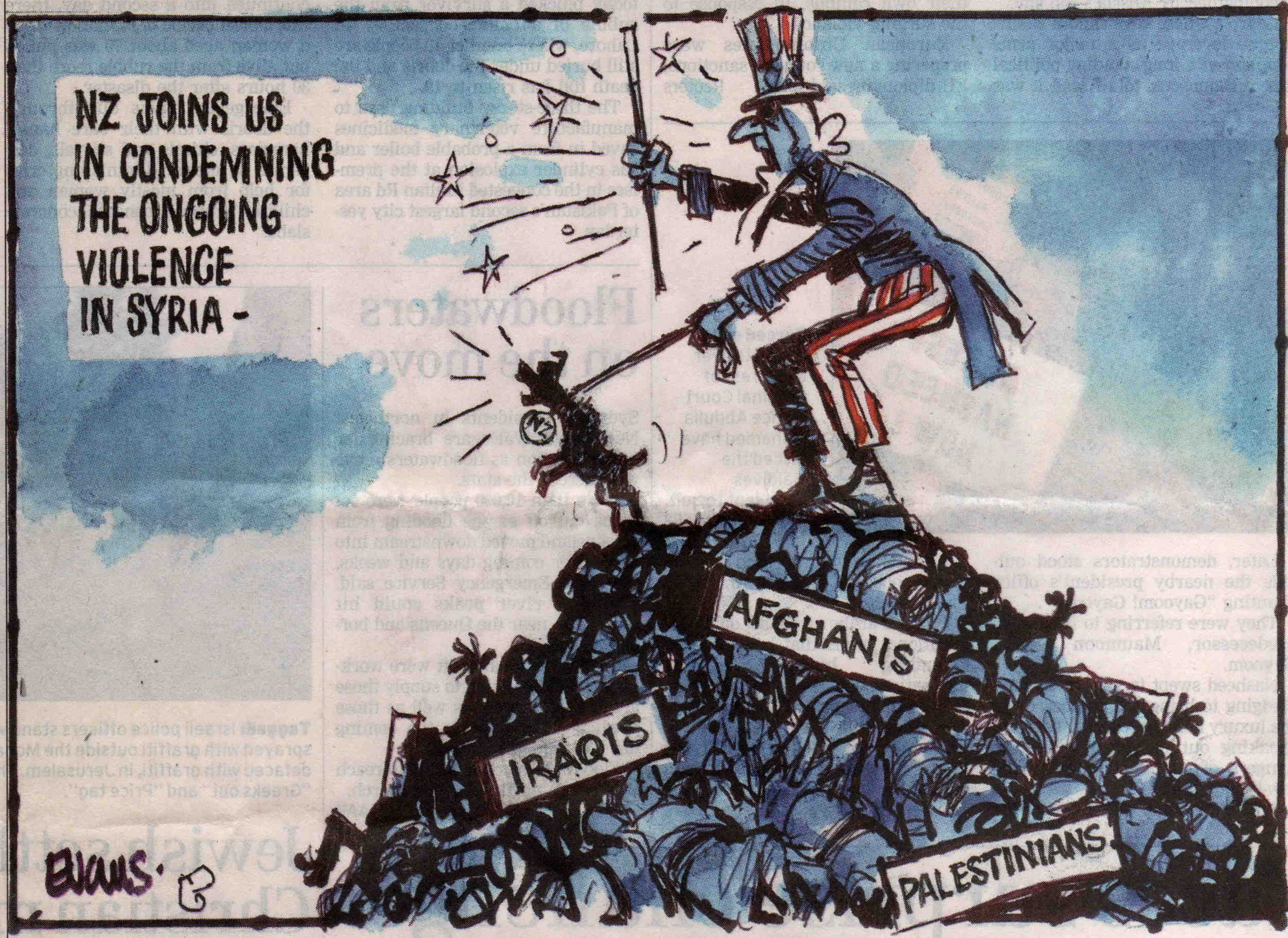
The Syria crisis has sparked many debates in scholarly and media circles, not least around the way in which the ‘international community’ should exercise its responsibility to Syrians and to the protection of human rights, particularly in the aftermath of the alleged use of chemical weapons on Syrian civilians. The lack of consensus on the most appropriate response, within the limits of international law, raised a number of questions.

There were times when we were told that a military attack was imminent, others when cautious voices against a military campaign seemed to have the moral upper hand. In the days following the discovery of the use of chemical weapons, the U.S. made public its position on the question, based on the conviction that the Syrian government was responsible. In the general uproar that that ensued, the recent examples of Afghanistan and Iraq guided many deliberations on the wisdom of another humanitarian intervention. Like Barack Obama, many commentators believe in the existence of a red line that delineates the contours of a hypothetical morality, its alleged violation by Syria warranted punishment if the red line was to be pushed back. Many others however warned against acting on an impulse of outrage, Libya is a vivid example of how an ill-conceived intervention can be more damaging than the situation it originally sought to fix.

P3 Hypocrisy-Irony

From the polarized debates, two declarations in particular piqued my interest. The first one was Barack Obama’s Address to the Nation of September 10th, 2013. The second one was the Declaration of the Forum for Former African Heads of State and Government (the Africa Forum) on September 5th, 2013. The first one was as usual widely followed in America and beyond. The second went unnoticed partly because it was of little news worthiness for commentators of world affairs, partly because no one expected Africans to formulate any coherent view on the Syrian question. The first was delivered as an authoritative pronouncement on how a putative ‘we’ (i.e. the international community) should interpret international law and what shape its moral responsibility – here merely one embodiment of the West – should be engaged. Continue reading

Living Knowledge Traditions and the Priestly Caste of the Western Academy

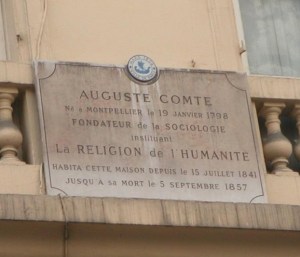
comte

The Western Academy, especially in its social science and humanities wings, incorporates as a priestly caste. Perhaps Kant is the first high priest of this caste when he argues for the Aufklärer to become a corporate entity equivalent to the hierocracy and nobility but exceptional in its duty to provide a truly public service of reasoning. The psalm of this priestly caste is “have the courage to use your own understanding”, its catechism: to singularly possess and hold aloft the flame of revelation, known as science, or, nowadays, the modern episteme. Even Marx holds the flame aloft when he takes Hegel’s Philosopher, who breathes world spirit, and makes him inhabit the skin of the Communist.

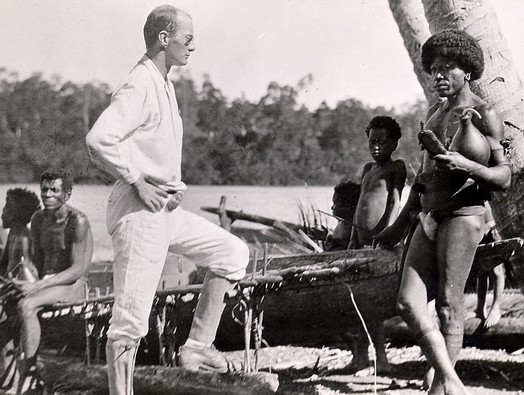
This priestly caste, as it founds the church of modernity, is instantly and integrally involved in founding a broader colonial division of labour.  These new priests conjure up the traditional/modern divide by the use of history –  differentiating old and new European Western societies – and by the use of anthropology (later, sociology too), by differentiating the colonized from the colonized. The living knowledge traditions of the colonized are pronounced dead on arrival in the present. And their cosmologies, philosophies, social practices – are entombed into opaque “cultures” the contents of which can only be clearly illuminated by the keepers of the flame. 

19_malinowski

Ultimately this mapping of difference works through race, gender and class coordinates so that even the “poor” living in the West, as well as un-mastered women and single mothers intersect with (post-)colonized subjects to become part of this opacity. The episteme of the Western Academy thus differentiates between the knowers and the known.

In this respect, the modern episteme is as seminal as gunboats to the maintenance of colonial difference. Key to this difference is not just the attribution of extra-ordinary exploitation, oppression and dispossession to colonized peoples but also their epistemic erasure, i.e., the outlawing of the possibility and desirability of intentional self-determining community amongst the colonized and their post-colonized descendents. It is in the colonial world and not Europe where Europeans develop the art of objectifying peoples into populations such that the basic competency of the colonized to self-define is deemed absent by the instruments and mores of European sanctioned international law. Postcolonial populations have only been able to become peoples under very specific conditionalities; and many who make the transition become the new police of colonial difference. Those who fall between or prefer a third way become the ungoverned, or ungovernable.

Continue reading

Notes on Ex-Yu Justice, Part II

Following Part I, and in advance of Part III.


The court is political  

The smartass response goes something likes this: “Of course it’s political; what’s not political? Haven’t you read the ICTY’s website? It says clearly that the tribunal was established for explicitly political reasons, too, by the UNSC, which is political by definition.” But the smartass response is a rude interruption. The above assertive prefaces monologue, not dialogue. The monologue is a story about world politics as a dog-eat-dog contest in which the strong always devour the weak with a focus on the origins of the ICTY. “Of course an international judicial institution cannot be created on the basis of an UNSC resolution alone. Of course Chapter VII of the UN Charter does not specify the conditions under which war crimes tribunals can be set up. Of course the ICTY quickly discovered that it could not bother with the question of own legality. But when have great powers ever cared about law and institutions? Might makes right, right? The ICTY is based on the consent of states – big states, not our banana republics.”

This story varies in terms of breadth and depth, but its modal conclusion is that the tribunal cannot represent anything but “victor’s justice” and/or Western and specifically American oppression of those living on the periphery. As for the motive, the supposedly aggressive prosecution of Bosno-Serbo-Croat baddies practiced by the ICTY is a function of the desire for retribution for every case of ex-Yu insolence in recent history, starting with the Trieste crisis of 1945. As discipline and punishment at once, trials are also meant to serve as a warning to the rest of the peripheral and semi-peripheral world. This type of theorizing could be described as a cross between pop-realism and pop-Marxism with a whiff of the crudest forms of pop-anti-Americanism and some other, far less respectable prejudices. While it is not exactly a closed loop, for every new newstory indexing Western and specifically American double standards and double visions in international law, the theory gains strength. Who in the former Yugoslavia doesn’t have an informed opinion on the “Hague Invasion Act”?

imgfrontisThe two accounts of the origins of the ICTY that I have on my shelf make something of an opposite case. Pierre Hazan’s book, subtitled ‘The True Story Behind the ICTY’, suggests that the weak (international justice activists) outfoxed the strong (realist diplomats and state-centric lawyers) and, against all odds, managed to turn the tribunal into such a revolutionary achievement (more on this below). Hazan is no theorist of norms and transnational advocacy networks, but there are more than a few parallels with this literature. The second account is Rachel Kerr’s 2004 book, which begins and ends with the thorny issue of “politicization,” including the issue of “prosecutorial discretion” as its special subset. Kerr has the ICTY walking on a tightrope. Sidle up too closely to justice, and you alienate those who rule the world; let politics in, even to manipulate it for judicial ends, and you lose credibility. While infinitely more nuanced than Hazan’s, Kerr’s framework for analyzing politics (it, too, chimes with 1990s IR theory, namely the “bringing international law back in” literature) follows the same binary – let me personify it a little as a contest between “realists” versus “legalists” – and it reaches the same conclusion. And judging by both the quotidian operation of the court as well as its key decisions up to 2002-3, Kerr finds, “legalists” had the upper hand.

I am not sure what stock-taking exercises based on the realist vs. legalist framework look like today (again, this post is my attempt to reconnect with the literature I stopped following years ago), but what struck me in my conversations is how adamant my interlocutors were in rejecting even the most carefully drawn legalist claims. It’s simple, the typical response goes, the ICTY is subject to constant political pressures and it shouldn’t be surprising to see so much judicial malpractice. Lest one is keen to dismiss this as “typical” ex-communist (and transitionalist) disdain for the notion that law serves to ensure that valuable social goods are distributed in ways that protect equal respect for everyone, note that some of the most critical arguments about the “hopelessly political court” are drawn from the texts left behind by bona fide ICTY insiders like Antonio Cassese (he of  those great international law textbooks), Gabrielle Kirk McDonald, Louise Arbour, Graham Blewitt, Carla Del Ponte, Serge Brammerz, and Florence Hartmann (more below). Anyone can cherry-pick a few memorable lines from a few memoirs and journalistic accounts (Hartmann, if I recall correctly: “the ICTY was formed so that war criminals could negotiate on the level of their innocence”), but what I find interesting is that these types of arguments have gained more and more adherents over the years.

Continue reading