What We Talked About At ISA: The U.S. Military-Industrial Complex, Part 2

Part two of a post on my presentation at this year’s ISA. Part one is here.


So what would be the normative-political case for the Military-Industrial Complex (MIC)? As Ledbetter notes, the defence industry never had a shortage of defenders, proponents, beneficiaries, and apologists. Various critiques of the MIC notwithstanding, numerous American commentators are now firmly united in the belief that their country needs a large defence budget in order to protect and project its identities and interests in the world. According to Maddow, this collective belief had a lot to do with the discursive and institutional success of the infamous “Team B” reports on Soviet power, which so profoundly enthused Ronald Reagan and his administration, leading to the gigantic military buildup in the 1980s. Maddow’s assessment is worth citing at length:

The Think Tanks and Very Important Committees of the permanent national security peanut gallery are now so mature and entrenched that almost no one thinks they’re creepy anymore, and national security liberals have simply decided it’s best to add their own voices to them rather than criticize them. But like we lefties learned in trying (and failing) to add a liberal network to the all-right-wing, decades-old medium of political talk radio, the permanent defense gadfly world can’t really grow a liberal wing. It’s an inherently hawkish enterprise. Where’s the inherent urgency in arguing that the threats aren’t as bad as the hype, that military power is being overused, that the defense budget could be safely and wisely scaled back, that maybe this next war doesn’t need us? The only audience for defense wonkery is defense enthusiasts, and they’re not paying the price of admission to hear that defense is overrated.

But knotted into the right-wing discourse on defence spending is a number of corollary arguments that are associated with a variety of lefty positions in the U.S. context.  America’s mainstream media outlets rarely fail to acknowledge how the twinning of the country’s economic and armed forces not only creates high-skilled jobs, but also – and critically – keeps them in the country. The move is mainly rhetorical. Not only have successive U.S. administrations encouraged American defence industry to globalize, but there is also little evidence to suggest that defence spending creates more jobs relative to spending on, say, health care or education (see, for example, Pollin and Garrett-Peltier, 2011). I would suggest, then, that what lies behind contemporary pro-MIC arguments is, in fact, a creative and complex combination of certain economic theories, (realist?) beliefs in war (or the threat of war) as a manifest destiny of the international system, as well as an overarching (liberal?) commitment to a powerful, sovereign state capable of exercising global leadership (aka., a “force for good”, in still favoured New Labour parlance.)

Let us revisit the pro-MIC rhetoric from the era of “Team B.” In a footnote, Ledbetter directs the reader to The Lonely Warriors (1970) by John Stanley Baumgartner, who is described as “one notable true defender of the MIC.” Written by an expert in public management and business administration, Baumgartner’s book makes three arguments for the MIC: 1) defending the free world is a moral thing to do (“Sputnik is only one example of the reasons for MIC”); 2) by definition, defence is a big enterprise and all big enterprises (directly or indirectly, the MIC employs one in ten Americans) occasionally make big mistakes, especially when they respond to the murky and changing specifications set by the government (“the tiger” or “the monster”) and its contracting officers; and last, 3) “unconscionable profit” is not so unconscionable in comparative terms (profit on sales, profit on investment, price/earning ratios etc. tend to be below the industrial average).

Continue reading

What We Talked About At ISA: From #occupyirtheory to #OpenIR?

A write up of my comments at the #occupyirtheory event in San Diego. The event itself was both hope-filled and occasionally frustrating, not least for the small group of walk-outs, apparently ‘political’ ‘scientists’ lacking in any conception of what it actually means to engage in the political (note: this bothered me especially, but was a rather minor irritation in the grander scheme of things). Despite the late hour, there were between 40 and 60 people there throughout, and a number of very positive things have come of it. It looks like there’ll be some gathering at BISA/ISA to discuss further, and we’re pitching something for the Millennium conference on some of the themes addressed below, and there will of course be ISA 2013 too. In the meantime, there’s the Facebook group, the blog, and a mailing list. The term OpenIR is owed to Kathryn Fisher, and seems to several of us to be a better umbrella term for the many things we want to address in the discipline and the academy. I also just want to give a public shout-out to Nick, Wanda, Robbie and Meera for doing so much on this.


The #occupy practice/meme has antecedents. Physical manifestations of a ‘public’, horizontalism, prefigurative politics and more can be traced in all sorts of histories. One such lineage is the foreshadowing of Zucotti Park in recent struggles over education. Take the slogan in March 2010 over privatisation at the University of California, which was ‘STRIKE / OCCUPY / TAKEOVER’. Or Middlesex, where students resisting the dismantling of the Philosophy Department in that same year unfurled a banner during their occupation, one that proclaimed: ‘THE UNIVERSITY IS A FACTORY! STRIKE! OCCUPY!’.

I want briefly, then, to think about the space of the university in our discussions of #occupy. There have been rich and suggestive calls to re-politicise ourselves as academic-activists, to look again at our work and its claims, and to turn our abilities, such as they are, to projects of resistance and transformation. But we risk a displacement. When we talk of ‘the street’, or politics enacted in the reconfigured space of #occupy, or of the ‘real world’ that we must be relevant to, we already miss the university itself as that factory in which we labour. We are tempted by a view of ourselves as leaving ivory towers to do politics, instead of seeing those towers themselves as spaces of politics. As if our institutions and practices were not already part of the world.

Whether you see #occupy as transformational or nor, or whether you simply prefer a different vocabulary, I think a demand remains: a demand to politicise our own positionality. This politicisation can have many dimensions, but I want to suggestively highlight four, each being a sphere in which we should be diagnosing and transforming our own practices.

Continue reading

What We Talked About At ISA: The U.S. Military-Industrial Complex, Part I

Earlier this year, the U.S. government set out to reduce its vast defence budget. On 5 January, Barack Obama became the first U.S. president to hold a press conference at the Pentagon. What prompted it was the release of Sustaining U.S. Global Leadership: Priorities for 21st Century Defence, a “strategic guidance” document outlining the national blueprint for “deterring and defeating aggression,” while reducing record budget deficits “through a lower level of defence spending.” (The document also attracted much media attention because it offered a rare glimpse into the strategic thinking of a president who seems to refuse to be associated with a “doctrine.”) In his State of the Union address three weeks later, Obama reinstated his belief that paring defence sending could help “pay down our debt.” The Pentagon’s FY2013 budget projection followed on 13 February, with a request for $614 billion in funding: $525 billion for the base budget and $88 billion for the so-called overseas contingency operations. FY2012 budget request, the Pentagon noted, was bigger.

Pundits in the US have been debating the meaning of the coming defence cuts, starting with the question of whether there will, in fact, be any cuts in the first place. This debate will probably intensify as the election date approaches, although, indicatively, Obama’s strategic guidance contains no “East of Suez” moments, and his Pentagon speech was a candid expression about the need to stay the course: “Over the next 10 years, the growth in the defence budget will slow, but the fact of the matter is this: It will still grow, because we have global responsibilities that demand our leadership… I firmly believe, and I think the American people understand, that we can keep our military strong and our nation secure with a defence budget that continues to be larger than roughly the next 10 countries combined” (emphasis mine; also, “10” appears to be way too low).

Much remains to be said about the type, magnitude, and sequence of the coming changes to America’s defence, and the electoral 2012 will be too short to say it all. The first round of projected budget cuts (“$487 billion”) takes into consideration the provisions of the self-flagellating Budget Control Act from August 2011. The second round of cuts (“$500 billion”) refers the so-called automatic sequestration cuts, also specified in the Act, which will take effect in January 2013 if Congress does find “alternative” ways to control the budget. U.S. Secretary of Defense Leon Panetta described these automatic cuts as the “doomsday scenario,” a label that Congress’s bipartisan supercommittee will no doubt keep in mind as it looks for those alternatives (such as, for example, legislation to reverse the Act). In the end, what will change is the ordering of America’s military priorities, but not the militarization of America’s “global responsibilities” (to use Obama’s own label) as such. Behind it, after all, are multiple and reinforcing structural factors that make real cuts difficult. One of them is “defence industry,” which some pundits and watchdog organizations like to call, somewhat retrospectively, the “military-industrial complex” (MIC).

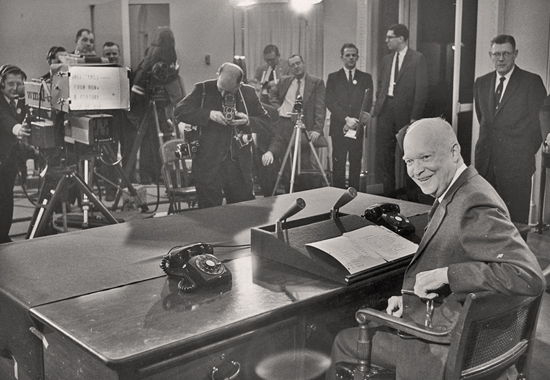
As a conceit, the MIC goes back at least to World War I, but it is popularly dated to Eisenhower’s ‘Farewell Address’ in 1961. As far as US presidential speeches/speechwriting goes, Eisenhower’s was a tour de force in every respect, but the reason why we read it today – or, rather, search for it on YouTube – is for the parts where the president urges the American citizens to pay attention to the “conjunction of an immense military establishment and a large arms industry [that is] new in the American experience,” while advising the American government to “guard against the acquisition of unwarranted influence, whether sought or unsought, by the military-industrial complex.”

Continue reading

Whitewashing History


The Morning Post, 1913 – on the violence of the suffragette movement:

Early yesterday morning some women succeeded in burning a valuable house near Trowbridge. In the night of Monday to Tuesday ROUGH’S boathouse on the river at Oxford, near the Long Bridges, was seen to be on fire. It was impossible to save the building or the boats which it contained. Nailed to the bridge near was found a card with the words “Votes for women. No peace till we get the vote.” The presumption is that the boathouse was set on fire, the KING’S horse was stopped, and the Trowbridge mansion was destroyed by some of the females who are discontented with the structure of society. Whether that be the case or not – it is quite possible that the truth may not be ascertained – the action is typical of much that has happened lately and deserves thinking about. Indeed, if we are to believe the leaders of the “movement”, the purpose with which these things are done is to make men think. The question is, What are we to think? The planned and deliberate destruction of property is intelligible as an expression of anger against the owner. But as the wellbeing of society depends upon the security of persons and property against wilful attacks, such attacks are regarded as crimes, and one of the principal purpose for which society is organised is to prevent such acts and to punish those who commit them. But in the class or cases which we are considering there is not motive or animosity against the particular person whose property is destroyed. Those who do them have not the personal hatred which usually explains such doings. If this were an isolated case, if it were found that a house had been wilfully set on fire by a young lady well brought up and accustomed in other respects to behave herself well, a jury would probably come to the conclusion that she was not in her right mind, and the Court order that she should be taken care of until she was restored to complete sanity. But the present case is not isolated. There is an epidemic of the state of mind which produced it; it is but one of a large number of similar cases. This frame of mind cannot possibly be considered healthy. The acts which it produces constitute a war, not only upon society as at present constituted but upon any conceivable state of society because it is impossible to imagine any community of human beings not based upon laws for preserving the security of property as well as of life and society, the propounds of the most astounding schemes for the reconstruction of the community, have ever propounded a plan which would not guarantee the work of and man’s hands against wanton and wilful destruction. The women who go about setting fire to houses seem, therefore to have their thoughts out of gear. In most respects apparently their minds work as other people’s do, but the epidemic of arson appears to be a form of monomania. This quality of the minds concerned noes not disappear under an examination of the alleged motive. These ladies say that women ought to have the same political rights as men, and in particular the Parliamentary franchise, and they assert that women are qualified to be members of the body polite. But it is unthinkable that a person who refuses to recognise the fundamental condition upon which every society is founded can be qualified for membership in that society. The person whose mind works in that way is inaccessible to reasonable arguments.

**********

Mahatma Gandhi – on violence:

I do believe that, where there is only a choice between cowardice and violence, I would advise violence… I would rather have India resort to arms in order to defend her honour than that she should, in a cowardly manner, become or remain a helpless witness to her own dishonor.

Continue reading

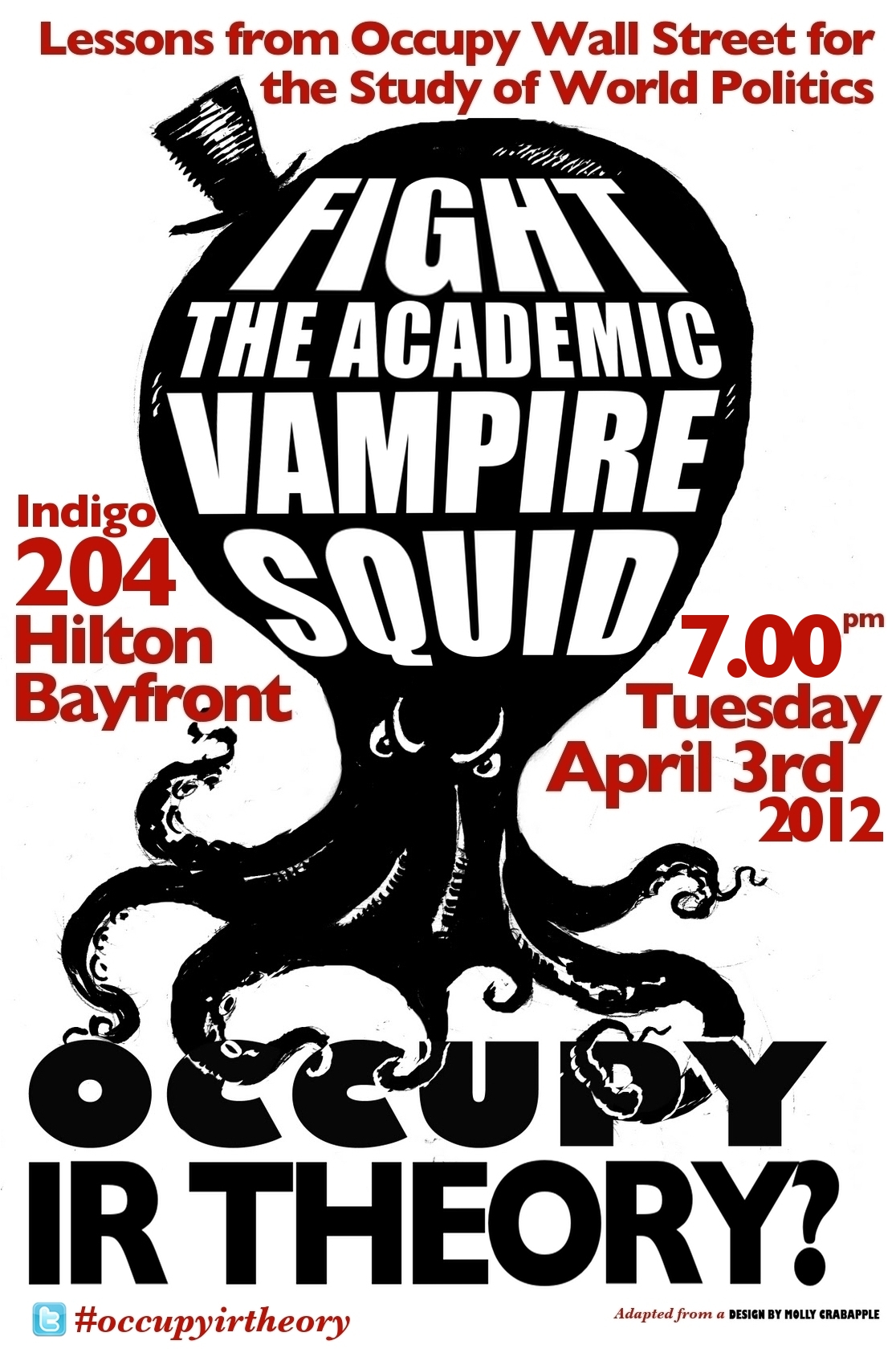
#occupyirtheory, International Studies Association (San Diego) Edition

ISA 2012 is just around the corner, and it will doubtless be as hectic and awkward and joyous as ever. Robbie and I will be appearing at an event on #occupy and its relevance for IR on Tuesday at 7 in Indigo 204 at the Hilton Bayfront. We’ll be joining Lucian Ashworth, Lara Coleman, Nicholas Kiersey and Wanda Vrasti (all chaired by Jason Weidner) for what I’m sure will be an exciting roundtable discussion. More importantly, it will be brief, with most of the session given over to a General Assembly-style discussion of what IR can learn from #occupy, what #occupy might get from IR, and how we might take the spirit and organisational form into the discipline itself (or not).

The hope is that the slightly later starting time will allow people to go both to the various Section receptions and meetings (briefly) and to come to this, whilst still leaving reasonable evening time for food and the rest. Please do get involved over at Facebook (see also the #occupyirtheory group and #occupyirtheory blog) and let interested IR-types know. Readers may also be (should also be!) interested in a recent forum from the Journal of Critical Globalisation Studies on ‘Occupy IR/IPE’, featuring Nick and Wanda (as well as Colin Wight, Michael J. Shapiro, Patrick Jackson and others), which I’ve parcelled together as a single pdf for your delectation here.

Hope to see you there!

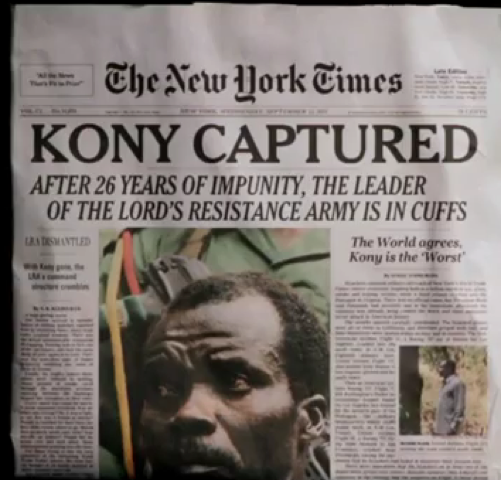
#Kony2012 from Advocacy to Militarisation

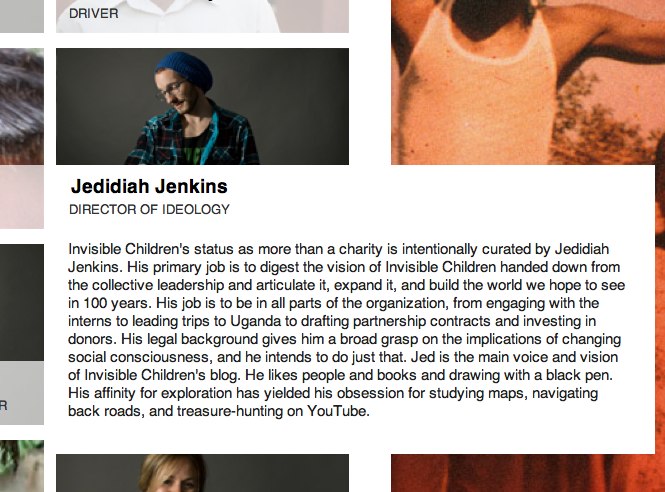
Although the attention spike and mainstream media attention on #Kony2012 has receded, not least thanks to Jason ‘Radical’ Russell’s own brush with infamy, the implications of muscular-liberalism-as-social-media-experiment continue to unfold. My feed at least continues to be peppered with anger towards Invisible Children from informed activists and scholars (although Norbert Mao, for one, takes a much more positive view and Jason Stearns makes a few qualifications of the anti-case worth reading). On Saturday, CEO Ben Keesey and ‘Director of Ideas Development’ Jedidiah Jenkins (formerly ‘Director of Ideology’: yes, really) released a short teaser video promising a sequel to #Kony2012 and declaring that the campaign was “working”. Staying stubbornly loyal to the understanding of foreign policy decision-making expressed in the original narrative, this was said to be because the people at the top were now being forced to respond to an issue they previously hadn’t cared about/known about, all thanks to the public pressure of predominantly young activist-citizens. The major consequence of this pressure being the introduction on March 12 of a Resolution in the US House of Representatives, sponsored by Jim McGovern (a Democrat) and Ed Royce (a Republican), to end Kony’s atrocities and bring justice to Norther Uganda. There’s now a Senate version of the Resolution too, taken by Keesey and Jenkins to dispel those loose accusations of ‘slacktivism’ against Invisible Children and its supporters.

But what does the Resolution actually ask for? Having reaffirmed previous declarations, it:

…calls on the Secretary of State and heads of other government agencies to undertake diplomatic efforts with partner nations focused on—
(A) expanding the number of capable regional military forces deployed to protect civilians and pursue LRA commanders; (B) enhancing cooperation and cross-border coordination among regional governments; and (C) promoting increased contributions from European and other donor nations for regional security efforts.

Now that’s a rather curious formulation of “diplomatic efforts”. Nowhere in the text is there any mention of the human rights records of the Ugandan or DRC armies, nor any suggestion that they are anything but (albeit junior) ‘partners’ in this military endeavour. The preamble makes repeated mention of ‘help’ to regional governments, and one line of text hints at problems (to “address shortcomings in current efforts”), but it is clear that these are deficiencies of coordination and military effectiveness, not of human rights concerns. The claims previously made in defence of the campaign (“we do not defend any of the abuses perpetrated by the Ugandan government or by the Ugandan army”) have rather evaporated in the transition to a formal Resolution, and Keesey and Jenkins make no complaint of that elision. Although recently rather keen to harness #Kony2012’s popularity, Human Rights Watch and others have long catalogued systematic abuses by the UPDF which match the Lord’s Resistance Army closely for brutality. The record of the FARDC (the army of the Democratic Republic of Congo) is worse still. Exact and proportional figures are hard to pinpoint, but there is no question that they are major (and quite possibly the main) perpetrators of rape, terrorism and atrocity in Eastern DRC.

All of this sets a brutal precedent. The vagueness of the call for action and policy detail, lost amongst the emotion ratcheting of being a ‘doer’ rather than a ‘sayer’, opened the door to any number of Liberal Saviour Hawk Military Industrial fantasies (to adapt Teju Cole). This is what groups like the Association of Concerned Africa Scholars warned of, a not-so-creeping militarisation of East and Central Africa. As apparently obvious as stopping Kony’s evil in a hail of righteous bullets cycles seems to Russell and Co., the cycle of insurgency and counter-insurgency tends to be draped at each stage in stark aggressions, with those regional military partners enacting their own ‘invisible’ massacres as they go.

Conspiratorial ideas of Invisible Children as a front for the US government aside, there is clearly a whole set of non-humanitarian interests at play here. I doubt there is any real appetite, and certainly very little capacity, in policy circles for any kind of escalation of direct US military involvement in the area, but then ‘support’ and ‘advice’ for regional allies and proxies has more traditionally been the mark of foreign policy. What those exponential click counts will translate into in policy terms thus remains open, but the signs aren’t great.

Dr Sabaratnam, I Presume?

Hot on Roberto’s heels, and the third of us to achieve doctorhood since the inception of The Disorder Of Things, our very own Meera today survived the critical questioning of Robbie Shilliam and Christopher Cramer. She is henceforth Dr Sabaratnam, certified by virtue of her thesis: Re-Thinking the Liberal Peace: Anti-Colonial Thought and Post-War Intervention in Mozambique. For the record, I’m assured that any violence inflicted was purely intellectual.

Call for Contributions: The Global Political Economy of the 1%

Tim Di Muzio (Wollongong) is putting together an edited volume on The Global Political Economy of the 1% which Disordered readers might be interested in contributing to. The full call is here. Abstracts of 250 words or less are due by 30 April 2012 with first full drafts by 1 November 2012. Tim can be emailed with submissions or for more details here.

While the internationalized Occupy Wall Street movement faces many strategic and organizational challenges, one of its major accomplishments has been its ability to draw global attention to the massive disparity of income, wealth and privilege held by 1% of the population. Such attention comes amidst a relatively synchronized global financial crisis, a mounting first world debt crisis in parts of Europe and the United States and the intensification of neoliberal policies. While political science and sociological study has shed light on elites and the wealthy in the past, with some recent popular exceptions, there has been a dearth of research on the culture, politics, built environments and psychology of the global rich in the new gilded age.

To redress this gap in the literature, this edited volume calls for a more focused and engaged study on what could be called the global political economy of the 1%. Such a project could help shed light on the massive chasm between this elite class of wealth holders and the rest of the global working class – the majority of whom subsist on less than US$2 a day and increasingly live in informal settlements as the dialectic of dispossession and urbanization continues its historical dance. Of course, it should be emphasized that a global political economy of the 1% does not preclude (and nor should it) the unavoidable social relations between the 1% and the 99%. However, recent literature has already enriched our understanding of how poverty, unprotected workers, and the everyday life practices of the seemingly mundane impact upon the wider global political economy. So a keen, yet nonrestrictive, focus on the political economy of 1% and the global income/wealth hierarchy is welcome.

All abstracts will be accepted and reviewed with sincerity. Selections for inclusion in the volume will be evaluated on the basis of original content, coherence and consistency with the general theme as well as the necessity of creating coherent sub-themes. Sub-themes are suggested here to organize research questions but are not necessarily the themes of the volume (contingent upon contributions).

Topics and questions that could be addressed in such a volume include but are not limited to the following: The Usual Suspects: Identifying the 1%The Social Reproduction of the 1%; Culture, Consumption and the 1%; and Power, Resistance and the 1%.

Kony 2012 and The Choir of Saviors: You got a song you wanna sing for me?

You got a song you wanna sing for me?
Sing a song, singing man.
Sing another song, singing man.
Sing a song for me.
One for the pressing, two for the cross,
Three for the blessing, four for the loss.
Kid holdin’ a weapon, walk like a corpse
In the face of transgression, military issue Kalash
Nikova or machete or a pitchfork.
He killing ’cause he feel he got nothin’ to live for
In a war taking heads for men like Charles Taylor
And never seen the undisclosed foreign arms dealer.
Thirteen-year-old killer, he look thirty-five,
He changed his name to Little No-Man-Survive.
When he smoke that leaf shorty believe he can fly.
He loot and terrorize and shoot between the eyes.
Who to blame? Its a shame the youth was demonized.
Wishing he could rearrange the truth to see the lies
And he wouldn’t have to raise his barrel to target you,
His heart can’t get through the years of scar tissue.

-“Singing Man“, The Roots

60 million people and counting have now heard about Invisible Children’sKony 2012“. Criticism of the group has been substantial and judicious. The group has defended themselves. Humorous memes are proliferating. Over-exposure has already begun to create awareness fatigue. Yet there is a serious issue largely unaddressed: the most troubling elements of the “Kony 2012” phenomenon are not unique to Invisible Children, but reflect serious moral and political problems with the pursuit of international criminal justice, and in particular the mission and politics of the International Criminal Court and their controversial prosecutor, Luis Moreno-Ocampo.

To put it bluntly: while Jason Russell addresses his audience in the same way he addresses his five-year-old son Gavin, which is clearly inappropriate given the complexity of the issues he’s asking us to consider, Russell’s framing of the evil of Joseph Kony and “our” responsibility to stop him is importantly similar to the narrative of international criminal law, and Ocampo in particular. We should not be too quick to denounce the moral idiocy of Russell as a personal failing – his sentimental and messianic film represents a revealing apotheosis rather than a transgressive break from our sense of international justice. There are unpleasant resonances between Russell and Ocampo – the ICC prosecutor has already praised the group, saying,

“They’re giving a voice to people who before no-one knew about and no-one cared about and I salute them.”

But the commonalities run deeper than a strategic endorsement and should give us pause before we conclude that while Invisible Children may be unscrupulous and ill-informed, some form of outside intervention is needed to save the children of the Great Lakes region of Africa (to say  nothing of the adults being killed) – and yes, an arrest warrant and possible trial by the ICC is as much an intervention as a military invasion. Russell’s call to “stop Kony” is disturbing beyond his narcissism and the organisation’s inept policies and campaigns, his messianic moralising, in which he positions himself (and those like him who just need to be roused to action) as the hero for the powerless victim, is a single melody line in the score that guides the choir singing for international justice. His self-regarding indignation, and our discomfort, should inspire introspection into the desires that lead us to demand that Kony stand trial at the ICC or to insist that “we” must do something to stop the evil that besets that part of Africa.

Continue reading