Cavity Searches in Intern(ation)al Relations

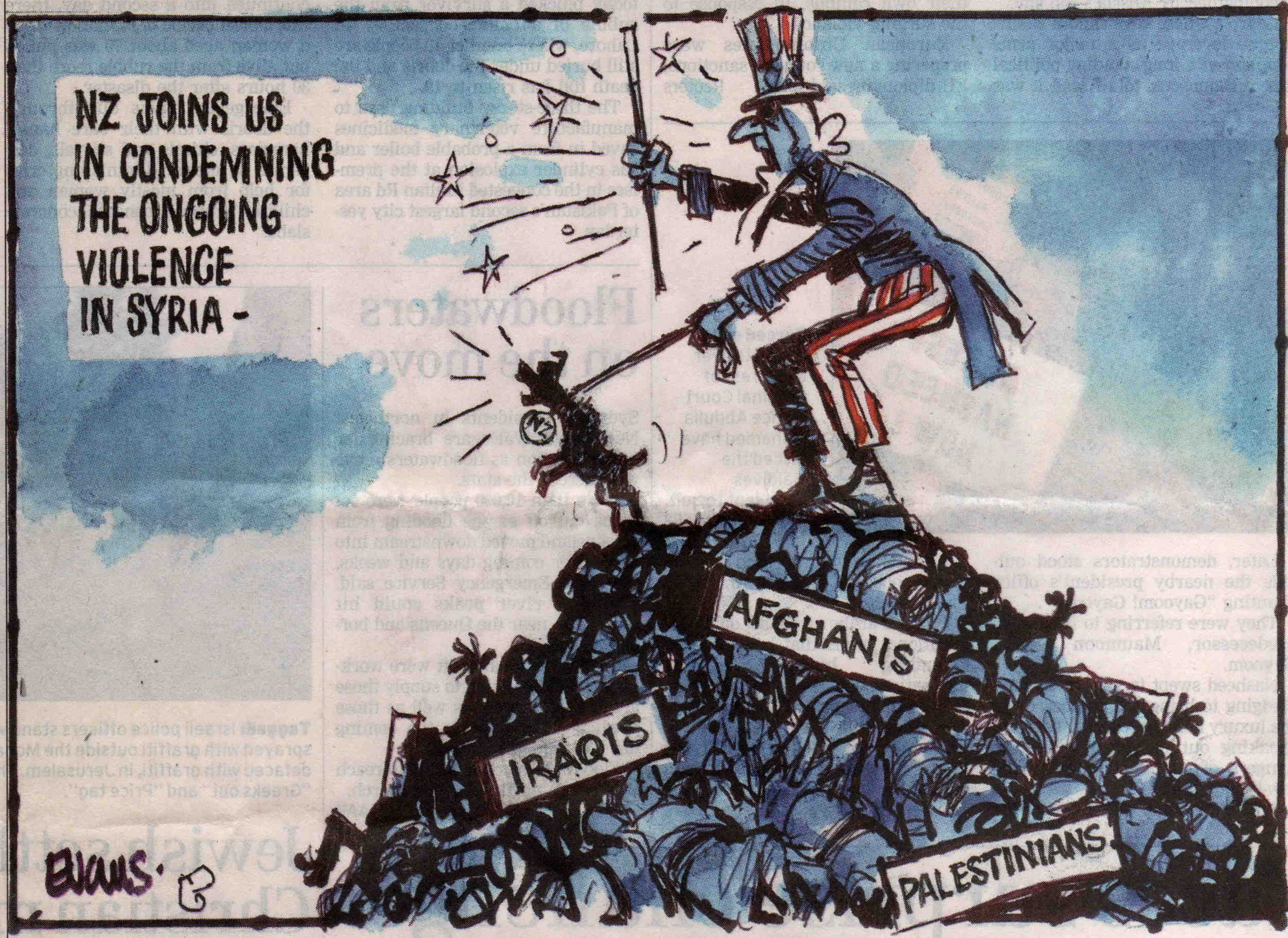
In the most darkly comic scene in Mohammed Hanif’s brilliant A Case of Exploding Mangoes, General Zia—the thinly mustachioed dictator of Pakistan from 1977-88—suffering from a bad case of worms, enlists the services of the physician of his Saudi friend Prince Naif. ‘Birather, bend please’, requests Dr. Sarwari, in a strange mixture of Arabic and American accents. Zia unfastens his belt, slips his trousers down and leans forward, laying his right cheek on his desk. His head is between two flags, Pakistan’s national flag and the flag of the Pakistan Army, as Dr. Sirawar slips a lubricated probing finger into his itchy rectum. The allegory is crystal clear: this is Pakistan being fucked by Saudi and US money and weapons during the anti-Soviet jihad in Afghanistan.

In Mohsin Hamid’s The Reluctant Fundamentalist, the terror attacks of September 11 provide the pivotal moment in the transformation of young Pakistani Princeton graduate Changez Khan from Wall Street analyst to Islamist radical. Watching 9/11 unfold on television while away on a work trip, Khan feels something akin to schadenfreude, as if the attacks were payback for the daily humiliation of being Muslim in America, giving vent to a reservoir of grievance hitherto fiercely suppressed, even denied, in his pursuit of the American dream. Returning to the US, Changez can see that Americans see him differently. In Mira Nair’s film version of the book, he is separated from his white colleagues at immigration and subjected to a cavity search: this is Pakistan being fucked by the US in the aftermath of 9/11.

Continue reading

A Crisis of Immediacy

I wonder if other writers feel as though they are throwing words by the hopeful fistful into a void, into the place where an audience might be. This hoped-for-reader is on my mind because I feel I should apologise for having taken so long to think these thoughts and align them so that I can throw them into that void.

There is no reason for apologies, however, because my hoped-for-reader doesn’t know that my current thoughts are inspired by a planned but only partly written series of posts from two-and-a-half years ago. Yet I feel I am writing an overdue assignment on the last day of class.

My thoughts are not timely. I worry this means they are no good. This is a strange feeling, to worry not that the words that carry our thoughts are inadequate but rather that they have gestated too long, such that tossing them into the void ceases to be a hopeful act of communication and becomes rather like dropping a crumpled page into the nearest bin.

Artwork from wraphome.org

Artwork from wraphome.org

Those many months past I wanted to write more about the economic crisis, about the disaster in the making that was “austerity”. In particular I wanted to consider what virtues might help us to navigate what seemed an all-encompassing crisis. But the moment has passed, surely. Right? There’s talk now of recovery even in Britain and signs of changing attitudes in Europe. Continue reading

A Right To The World: On Syria and an Idea of International Public Order

P1 aniang

A guest post from Amy Niang on the contours of ‘international community’, following previous interventions from Siba Grovogui in relation to Libya, Robbie on provinciality in International Relations and John M. Hobson et al. on Eurocentrism in international political theory. Amy teaches international relations at the University of the Witwatersrand and she is affiliated with the Centre of Africa’s International Relations (CAIR). She gained her PhD from the University of Edinburgh in 2011. She has taught International Relations, political theory and African history in South Africa, Scotland and Japan. Her research interests are in the history of state formation, political theory and Africa’s international relations, and she has commented regularly on democracy, civil society and Western intervention in Africa.


The Syria crisis has sparked many debates in scholarly and media circles, not least around the way in which the ‘international community’ should exercise its responsibility to Syrians and to the protection of human rights, particularly in the aftermath of the alleged use of chemical weapons on Syrian civilians. The lack of consensus on the most appropriate response, within the limits of international law, raised a number of questions.

There were times when we were told that a military attack was imminent, others when cautious voices against a military campaign seemed to have the moral upper hand. In the days following the discovery of the use of chemical weapons, the U.S. made public its position on the question, based on the conviction that the Syrian government was responsible. In the general uproar that that ensued, the recent examples of Afghanistan and Iraq guided many deliberations on the wisdom of another humanitarian intervention. Like Barack Obama, many commentators believe in the existence of a red line that delineates the contours of a hypothetical morality, its alleged violation by Syria warranted punishment if the red line was to be pushed back. Many others however warned against acting on an impulse of outrage, Libya is a vivid example of how an ill-conceived intervention can be more damaging than the situation it originally sought to fix.

P3 Hypocrisy-Irony

From the polarized debates, two declarations in particular piqued my interest. The first one was Barack Obama’s Address to the Nation of September 10th, 2013. The second one was the Declaration of the Forum for Former African Heads of State and Government (the Africa Forum) on September 5th, 2013. The first one was as usual widely followed in America and beyond. The second went unnoticed partly because it was of little news worthiness for commentators of world affairs, partly because no one expected Africans to formulate any coherent view on the Syrian question. The first was delivered as an authoritative pronouncement on how a putative ‘we’ (i.e. the international community) should interpret international law and what shape its moral responsibility – here merely one embodiment of the West – should be engaged. Continue reading

Dr Srnicek, I Presume?

Hot on Elke’s heels comes the news of the world’s latest doctor. Nick Srnicek, PhD. Awarded for his original thesis Representing Complexity: The Material Construction of World Politics, examined by Professors Iver Neumann and Alex Preda. A certain mastery thus attained.

Dr Nick

Living Knowledge Traditions and the Priestly Caste of the Western Academy

comte

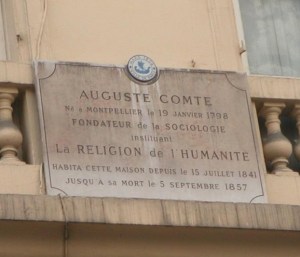
The Western Academy, especially in its social science and humanities wings, incorporates as a priestly caste. Perhaps Kant is the first high priest of this caste when he argues for the Aufklärer to become a corporate entity equivalent to the hierocracy and nobility but exceptional in its duty to provide a truly public service of reasoning. The psalm of this priestly caste is “have the courage to use your own understanding”, its catechism: to singularly possess and hold aloft the flame of revelation, known as science, or, nowadays, the modern episteme. Even Marx holds the flame aloft when he takes Hegel’s Philosopher, who breathes world spirit, and makes him inhabit the skin of the Communist.

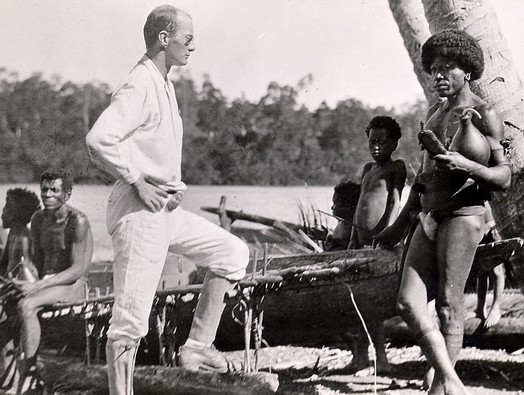
This priestly caste, as it founds the church of modernity, is instantly and integrally involved in founding a broader colonial division of labour.  These new priests conjure up the traditional/modern divide by the use of history –  differentiating old and new European Western societies – and by the use of anthropology (later, sociology too), by differentiating the colonized from the colonized. The living knowledge traditions of the colonized are pronounced dead on arrival in the present. And their cosmologies, philosophies, social practices – are entombed into opaque “cultures” the contents of which can only be clearly illuminated by the keepers of the flame. 

19_malinowski

Ultimately this mapping of difference works through race, gender and class coordinates so that even the “poor” living in the West, as well as un-mastered women and single mothers intersect with (post-)colonized subjects to become part of this opacity. The episteme of the Western Academy thus differentiates between the knowers and the known.

In this respect, the modern episteme is as seminal as gunboats to the maintenance of colonial difference. Key to this difference is not just the attribution of extra-ordinary exploitation, oppression and dispossession to colonized peoples but also their epistemic erasure, i.e., the outlawing of the possibility and desirability of intentional self-determining community amongst the colonized and their post-colonized descendents. It is in the colonial world and not Europe where Europeans develop the art of objectifying peoples into populations such that the basic competency of the colonized to self-define is deemed absent by the instruments and mores of European sanctioned international law. Postcolonial populations have only been able to become peoples under very specific conditionalities; and many who make the transition become the new police of colonial difference. Those who fall between or prefer a third way become the ungoverned, or ungovernable.

Continue reading

Dr Schwarz, I Presume?

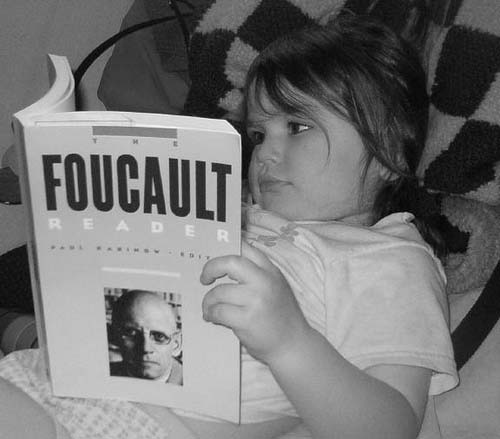
And so, after some delay due to storm, and just a month after The Disorder Of Things turned three, our own Elke was closely quizzed by Professors Patrick Hayden and Chris Brown. The cause? The defence of her doctoral thesis: The Biopolitical Condition: Rethinking the Ethics of Political Violence in Life-Politics. Arendt, Foucault, and drones. Now passed, certified, set free. Without corrections. Henceforth, Dr Schwarz.

Elke Foucault

Not actually Elke.

Teach It, And They Will Come

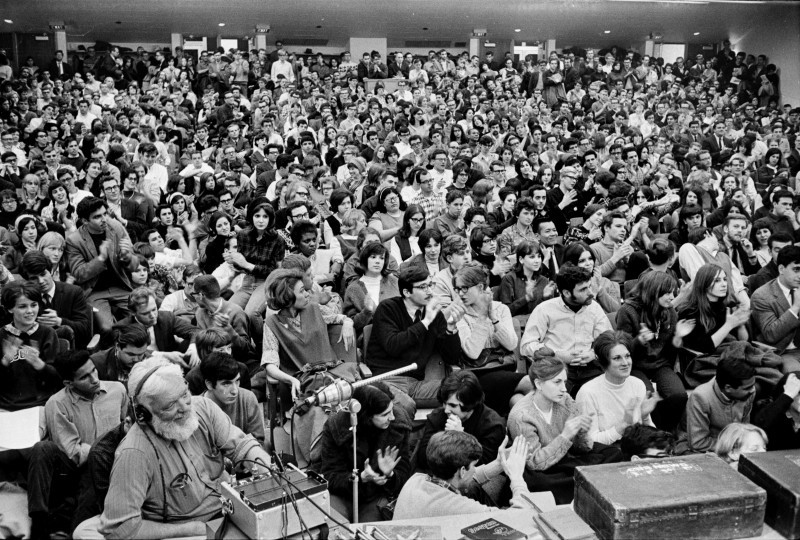
1960s Teach In

As another term approaches its zenith, we at The Disorder engage in a novel public service: making available a range of our module reading lists. Ready-made bibliographies, crib-sheets, self-help guides, or just objects of curiosity, to do with as you will. We have focused on our more specialised courses, on the assumption that there is a relative dearth of taught programmes on these issues, or taught from these perspectives. Most of the readings remain inaccessible online, although there are libraries still in existence where they may be found. You will also miss out on our great personal charms. Nevertheless, enjoy.

Just click on the titles for the full PDFs. May a thousand ideas bloom!


Joe (Lecturer in International Relations, City University)

Myths and Mysteries in World Politics (co-taught with Aggie Hirst and Amin Samman): This is a ten-week course that runs in the first term and is compulsory for all our undergraduate students. The idea behind it is that we wanted to provide an introduction to “theory” that not only avoided the numerous “isms” but which also harnessed the students’ interest in politics. So, the course is organised around key ideas in politics and we push students to think philosophically about what world politics is, as well as how they are already engaged in it. We hope to develop a critical sensibility by getting students to realise how much they already know, or think they know, about world politics and then encouraging them to look more deeply – hence the “Myths and Mysteries” title. The course is structured in three parts: there’s an initial week where we talk about what “politics” means and ask students to consider their own placement in the political world (this is also the topic of their first essay), then we cover “Power”, “Ethics”, “Violence” and “Law” as big conceptual ideas before turning to a section that looks at the institutions of world politics (broadly conceived), including “Empire”, “Capitalism”, “The State”, “Money” and “History”. In the end, the primary hope is to build intellectual skills – reading, writing, thinking – and introduce them to big ideas in politics rather than indoctrinate them in disciplinary debates.

Continue reading

Assessing Ernst Jünger: Prophet, Mystic, Accelerationist

Following on from the two previous posts (here and here), this final entry will conclude the story of Ernst Jünger’s intellectual trajectory from exalted warrior-poet to withdrawn mystic. I will then propose a brief assessment of Jünger’s legacy and contemporary relevance to our present concerns, notably to a putative political accelerationism. You can find here the full academic article on Ernst Jünger and the problem of nihilism that I published in 2016.

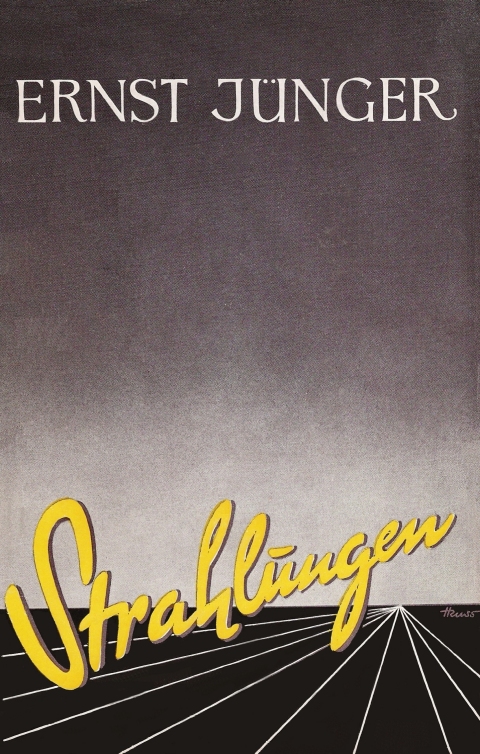
We pick up our story with the entry of Germany into the Second World War and Jünger’s new conscription into military service. Now aged 44, his experience of the war would however be quite different from the one that had so decisively shaped him as a young man. Following the successful French campaign, he would spend most of the war in an administrative posting in Paris where he assiduously frequented the literary and artistic circles, meeting collaborationist figures like Pierre Drieu La Rochelle and Louis-Ferdinand Céline but also Pablo Picasso and Jean Cocteau. As during the first war, Jünger kept a diary that would eventually be published in 1948 under the title of Strahlungen (“Radiations”). However we encounter within it a markedly different tone, reflective of the different circumstances in which he found himself but also indicative of a retreat from the ideas he had espoused up to the early 1930s. Devoid of much enthusiasm for the war, his writings appear at times almost indifferent to the wider drama playing itself out across Europe but become progressively more somber as the fate of Germany darkens, reports of atrocities in the East filter through, and his eldest son is killed in Italy.[1] Already looking ahead to the end of the conflict, Jünger also worked during the war on an essay called The Peace that proposed a vision of a united federal Europe and was circulated among the internal opposition to Hitler in the Wehrmacht. Several of these figures would be subsequently involved in the failed attempt on the Führer’s life in July 1944, a plot Jünger was seemingly aware of but took no direct part in.

ej1949am

The end of the war would nevertheless see Jünger being called to account for his inter-war writings. Having refused to submit to denazification, he would find himself barred from publishing for four years and he returned to live in the German countryside where he would reside until the end of his life. His remarkable longevity would grant him the opportunity for an abundant literary production, penning novels, essays and diaries ranging from science-fiction and magical realism to early ecological thinking and reflections on his multiple experiences with psychedelics. I will however restrict myself here to discussing Jünger’s immediate post-war writings since we find within them a clear statement of both the continuities and breaks with his prior thinking. Of particular importance is the text that he originally composed in 1950 on the occasion of the Festschrift for Martin Heidegger’s sixtieth birthday, Über die Linie (“Over the Line”).

Continue reading

Ernst Jünger on Total Mobilisation in the Age of the Worker

You can find here the full academic article on Ernst Jünger and the problem of nihilism that I published in 2016.

In this post, I will examine Ernst Jünger’s interwar writings, particularly as he moved from his recollections and reflections on the Great War (see earlier post) to a more ambitious analysis of the social and political turmoil that ensued. Sharpening his central problematique of nihilism and its overcoming, he would see in the commotions of his time the sign that the timorous bourgeois liberal societies of the nineteenth century were about to be swept away by a new technological age of total societal mobilisation and armed conflict. Anticipating and heralding the advent of the totalitarian regimes that were germinating as he wrote, the obvious points of convergence between these writings and fascist ideology have unsurprisingly made them Jünger’s most controversial. As objectionable as his political views were in their own right, Jünger was nonetheless never a National Socialist, spurning the advances made to him by the Party and having little truck with its “blood and soil” creed. He did however develop keen insights into the historical escalation of war and accompanying demands of total mobilisation alongside a withering critique of liberal societies’ preeminent concern with security and comfort.

7598547562(2)

Demobilised in 1923, Jünger spent the next three years studying zoology and developing a life-long passion for entomology (he reputedly amassed a collection of 40,000 beetles, even giving his name to a species he is credited with discovering). During those years, he also read philosophy, particularly the works of Nietzsche and Spengler. Departing from the university in 1926, Jünger then began a period of intense writing for nationalist publications and participation in the circles of the Conservative Revolutionary movement, becoming notably close to Ernst Niekisch, the central ideologist of National-Bolshevism. To enter into a detailed consideration of the ideological content of such seemingly paradoxical constellations would take us too far from our central object but it is nonetheless useful to remind ourselves of the ideological complexity and fluidity of Weimar Germany that are all too often repressed when we view the period from a post-WWII standpoint. Jünger’s independent streak also meant his associations ranged more widely than most, frequenting during this time left-wing writers such as Bertolt Brecht, Erich Mühsam, and Ernst Toller. It is within this eclectic milieu and the context of generalised crisis that his political thought was formed, leading to the publication of a series of essays in the first few years of the 1930s. Fascinated by the social and cultural effects of photography, Jünger also put together several collections of photobooks from which I have drawn the images that accompany this post.[1]

Continue reading

Ernst Jünger and the Search for Meaning on the Industrial Battlefield

This is the first in a series of posts on the German war veteran and author Ernst Jünger that draw on research I have presented at seminars at the University of CambridgeUniversity of East Anglia  and University of Sussex over the last year or so.  [Edit: The follow-up posts can now be found here and here]. You can find here the full academic article on Ernst Jünger and the problem of nihilism that I published in 2016.

A complex and controversial character, Ernst Jünger is mostly known today for the vivid autobiographical account of life in the trenches of the Great War he penned in Storm of Steel, one of the defining literary works produced by its veterans. Alongside its unapologetic celebration of war, it contains an unflinching, at times clinical, description of the unprecedented destruction wrought by the advent of modern industrial war. As we approach the centenary of the First World War, the text has lost none of its evocative power and is likely to remain a lasting document of the soldierly experience.

Ernst Jünger in 1919

Ernst Jünger in 1919

Jünger’s subsequent writings, published throughout a long life that ended in 1998 at the ripe old age of 102, are however far less well known in the English-speaking world and many of them remain untranslated to this day. And yet I want to argue that, as problematic a figure as he is, the trajectory of Jünger’s thought and work is worthy of our attention in that it crystallises in a particularly stark and vivid fashion some of the tensions and internecine struggles of the twentieth century. Jünger liked to refer to himself as a seismograph registering the underlying tectonic shifts that prefigured the tremors of his age and in the often exalted and rapturous form that took his writings they can indeed be read as a wilful exacerbation of contemporaneous trends, his failings as much his own as that of his times.

Jünger wrestled in particular with the problem of meaning and human agency in a world increasingly dominated by technology and instrumental rationality that appeared to reach their paroxysm in total war. Inheriting his philosophical outlook from Nietzsche, he understood the problem of the age to be that of nihilism, of the devaluation of all values and the increasing inability to posit any goals towards which life should tend after the ‘death of God.’ He came to view the domination of technique as central to the growth of nihilism, a proposition that appears in an inchoate but nonetheless suggestive form in Nietzsche’s own writings. This Nietzschean perspective would so come to dominate Jünger’s outlook and work that Martin Heidegger would not hesitate to dub him ‘the only genuine continuer of Nietzsche.’[1]

Continue reading