Decolonising the Anglosphere

Alex at Red Fort

A guest post from Alexander Davis, who is a PhD candidate in international relations at the University of Adelaide, Australia. Alex holds a research MA on India’s international colonial history from the University of Tasmania and his PhD dissertation is a postcolonial examination of India’s relationship with the Anglosphere, supervised by Priya Chacko, Kaniskha Jayasuriya and Carol Johnson. This post provides an outline of his critique of the ‘Anglosphere’, which follows from previous discussion on The Disorder of Things by our own Srdjan Vucetic, and acts as an introduction to the themes of his forthcoming dissertation. Alex can also be found over at Twitter.[1]


Why India? Why the Anglosphere?

The term ‘Anglosphere’ refers to a distinctly murky combination of states, peoples or cultures with an implication of both cultural superiority and closer international relationships on the basis of a shared identity. Even dictionary definitions of the term illustrate the difficult. For some, Anglosphere is based simply on the English language, for others it includes the ‘cultural values’ associated with the political development of Great Britain. Srdjan’s recent book on the Anglosphere shows excellently how the idea of the Anglosphere is rooted in its colonial history and is an expression of Anglo-western superiority. Because of my previous research and teaching interest in India’s colonial history, the idea of the ‘Anglosphere’ struck me as an assertion of cultural superiority and dominance, suspiciously similar to colonial justifications for imperial rule. Once we realize this, India, just as it was central to the British empire, becomes central to understanding contemporary discourse on ‘Anglosphere’. The first question I asked, sensibly enough I thought, was ‘is India in the Anglopshere?’ I have since realized deep inadequacies of this question, which in turn has led me towards to believe in need for a decolonisation of the Anglosphere subject.
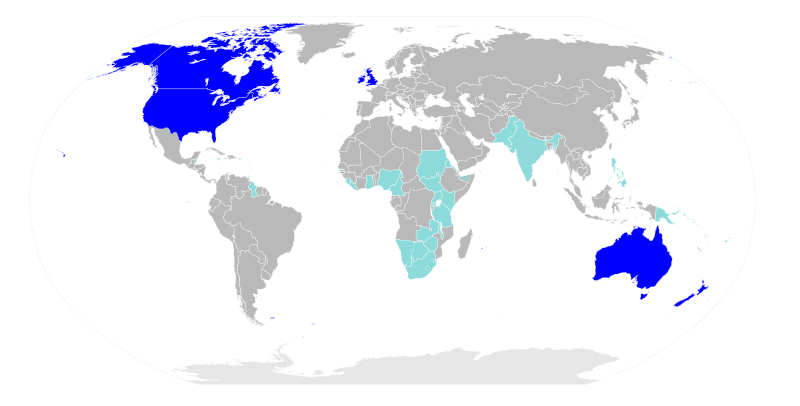
800px-Anglospeak_svg

Thinking the Anglosphere through India

In order to understand contemporary Anglosphere discourse, and the position in which India fits within the concept, we first need to understand its historical context. An early form of contemporary Anglosphere debates on India can be in England on the future of the British empire at the turn of the 20th century which turned into a discussion on the concept of ‘Greater Britain’. This idea was to be federation between Britain and her colonies might look like. Some thinkers at this time saw India as central to the empire, and therefore central to any ‘Greater Britain’. Sir Charles Dilke originally began to use ‘Greater Britain’ as shorthand for the British empire as a whole, but later argued it should only be the ‘English-speaking, white-inhabited, and self-governed lands’. Others, such as historian John Seeley, took up the idea, initially including India on the inside as a territory of the Crown. However, later, in the same book, he argued Greater-Britain needed to be racially homogenous, declaring India to be ‘…all past and, I may almost say, has no future’.

Winston Churchill’s work on the ‘English-Speaking Peoples’, itself an echo of Alfred Taylor’s ‘English Speaking Races’, emphasizes the supposed superiority and unity of these peoples. Conservative historian Andrew Roberts has recently taken it upon himself to follow up on Churchill’s work. Roberts cuts down the magnitude of his chosen topic by ignoring English-speakers outside the geographical centers of the Anglosphere. His approach to India and colonial history is revealed by his depiction, and ultimate defense, of General Dyer’s massacre at Amritsar. This is the worst example of ‘imperial’ history I can think of. Roberts goes so far as to defend Dyer from the propaganda of the nasty Indian nationalists. Even the British government no longer defends this event, though on a recent trip to India, David Cameron declined to apologize for it. Roberts defends the massacre even though many of Dyer’s victims were English-speaking. Leaving the victims out of the ‘English-Speaking peoples’ is a final act of humiliation and dehumanization.

Just as the debaters over ‘Greater Britain’ were unsure of where India might fit with the concept, contemporary Anglospherists are unsure of what to do with India. Continue reading

Activism, Academia and Black Community Struggles

A little while ago Adam Elliot Cooper from Ceasefire Magazine interviewed Stafford Scott, along with myself, on Black community struggles, activism and academia in Britain. Stafford Scott was a co-founder of the Broadwater Farm Defence Campaign in 1985, and is now a consultant on racial equality and community engagement as well as co-ordinator of Tottenham Rights. The interview revolved around a one day workshop run by Dr Joy de Gruy in Tottenham last October, funded by Tottenham Rights and the Centre for Public Engagement, Queen Mary University of London.


Adam: Black community struggle has been an integral part of the way in which we understand the politics of race, class and empire in Britain today. Black communities and activists have led this struggle. But academics have played a role too. Stafford, in October 2013 you brought Dr Joy de Gruy over from the US to Tottenham to run a one day workshop on Post-Traumatic Slave Syndrome. Why Dr Joy, and why Tottenham?

ScreenHunter_18 Apr. 17 19.50Stafford: It’s relatively simple to be quite honest. Why Tottenham? Because in 2011 parts of Tottenham burned as a result of the shooting of a young black male called Mark Duggan. It hit the headlines. As a result of some of us going to the police station rioting broke out and then spread across the country. We saw the media and the government’s reactions to those riots and it really was to dismiss the youths as feral criminals looking to make money out of someone’s death. It was dismissed as an opportunity for people’s materialistic natures to come out. What I wanted to do was put a total different perspective to it – a historical perspective. So I wanted to look at why rioting broke out. I was there, and I don’t believe that it was simply about Mark Duggan’s killing and the way in which his family was treated. I believe that there was a history – a context – to it, that some people chose not to examine. Duggan’s killing was the straw that broke the camel’s back.

We had different events in 2013. One was about the uprising that took place on Broadwater Farm and the killing of Cynthia Jarrett, the killing of Joy GardnerRoger Sylvester and Mark Duggan – four people who died in Tottenham, with involvement of the police. So this was to help the community come to terms with recent traumatic events. We brought Dr Joy over to look at historic events that have caused us great trauma.

ScreenHunter_17 Apr. 17 19.50Adam: Dr Joy, a professor of social work, is famous for developing an analytical framework called Post-Traumatic Slave Syndrome and for developing practical programmes that address the challenges of Black communities in the United States. So Dr Joy’s work is not only based on scholarship in the traditional sense but also research that has come out of participating in the struggles that Black communities face in the United States. Robbie, do you see similar work happening in Britain?

Robbie: I think historically there certainly was, you could see that kind of thing happening. Today I think it’s far less the case and that’s to do with a number of significant transformations in British society and in academia. Continue reading

The Marking Boycott And Its Aftermath

Justice League Super Hero Strike

In the face of a UK higher education marking boycott due to start in 11 days time, universities have come forth with a new pay offer. Having unilaterally imposed a 1% rise (read: real terms cut) for 2013/14, they are now proposing 2% for 2014/15, with a small bonus for those on the lowest band to bring them up to a living wage level (at Sussex, that’s an increase on the existing annual pay of £13,621). A consultative ballot is open to union members, and the boycott is delayed. It seems likely that there will be appetite for the deal, given the general tone of despondency and how drained staff are by repeated small scale actions and by mounting work pressures. There had, after all, been doubts that a boycott could compete with aggressive tactics from management (including threats to deduct full pay from anyone who participated in the boycott).

We might be emboldened by this concession from UCEA (the employers’ association). It shows, as more ‘militant’ elements had predicted, that greater returns would be achieved with the threat of a marking boycott than with all the 2-hour and single day strikes put together.[1] A first offer, before the boycott has even begun. Could we not win more than these peanuts (only just a real terms increase, following five cuts in a row, going by Consumer Price Index)?

Sort of.

Continue reading

What We Talked About At ISA: Rhythm, Time and History

With thanks to Elisabetta Brighi and Xavier Guillaume for putting together the Rhythms of the International roundtable and their inspiring contributions, to Robbie Shilliam for his song, and Kyle Grayson for his spirited and thoughtful engagement. And by no means least, to the pleasingly sizeable and lively crowd who gave the last panel of the last day such a buzz.

Below is a write-up of my contribution to the roundtable, in which I reflected on the relationship of rhythm and history, and drew out some of the potential disruptions that a different rhythmic sensibility might have on our conception of history.


What is rhythm?

To my shame, colleagues, and partly out of curiosity, I looked it up in the dictionary. Shame, because if you are looking something up in a dictionary before giving a talk on it, you probably shouldn’t be giving a talk on it. Curiosity, because I wanted to know how they would define ‘rhythm’ in words rather than in noises.

The dictionary answers were not particularly edifying. One definition spoke of ‘repeated, regular beats’, another of a ‘regulated succession’ of beats. Thud, thud, thud. Boom, boom, boom. Boom, thud, boom, thud. These definitions felt flat, and rather forbidding. But I suppose this is because they were the generic definitions of all kinds of ‘rhythm’, and not just the samba playing in my head.

Using some thinking developed earlier in some work on music and politics, I started again, with a different question:

What is the relationship of rhythm and time?

This yielded a much more direct answer: it is the production of rhythm that makes time itself knowable. In the making of music, rhythm generates movement and flow, and makes it possible for sounds to synchronise and arrange themselves. Continue reading

What We Talked About At ISA: Abstraction, Authenticity, Objection

Our traditional post-conference binge series returns, with posts on talks given at the International Studies Association conference (this one was in Toronto, in March 2014).


Far Side Anthropologists

0. Prelude

Since our theme is accidental fieldwork, I will begin with an account of my accident. In the course of a PhD thesis mainly on concepts, theories and narratives of wartime sexual violence, I spent three and a half weeks in the Eastern Democratic Republic of Congo. That time barely deserves the term ‘fieldwork’, but it wasn’t desk work, and it wasn’t familiar. Working partly for an NGO, I spoke principally to agents of the humanitarian international, from ActionAid to various branches of the UN. I was partly working for others, and partly scoping out a more in-depth period of fieldwork, one that never materialised. I socialised in the same bars as those internationals, and sat by the same hotel pools. But I did not then seek to interrogate their peculiar brand of international practice. Nor have I returned to it since.

Perhaps this accounts for why my over-riding sense was one of discomfort. At some level I expected that my time away would enrich the thesis by locating my abstractions in concrete situations and real persons. Perhaps I would experience what so many seem to, and fall for the location itself, returning again and again, and slowly acquiring language, cultural cues, a taste for the food and the air. Instead I felt strangely detached, and implicated in performances not of my choosing (the expert, the knowing colleague, the route to international support, the disaster tourist). I returned more attached to conceptual inquiry, and more suspicious (I was already quite suspicious) of appeals to ‘the real world’ and its informants. My disconnection (from other ‘internationals’, from locals, from Goma itself) became clearer sometime later, sitting in a hotel suite at an ISA panel, listening to others talk about the same place, and some of the same buildings, in terms of their own discomfort and dislocation.

1. Narrative Is A Metacode

Not all representations of the field are alike. Let us distinguish three. Continue reading

The Causes of the Great War: An Autobiographic Take

The assassination of Franz Ferdinand and his wife Sophia on June 28, 1914 set of a chain of events that a few weeks later led to an all-out war involving virtually all key European powers and their enormous overseas empires at the time.   How did this happen?

AmericanSplendor01-1

As a born and raised Sarajevan, I was socialized from an early age to think about the causes of the Great War – a question that happens to be one of the most studied in all of human history.  I vividly recall my first primary school trip to “Princip’s footsteps” – markings embedded into the sidewalk signifying the spot from where the assassin, Gavrilo Princip, fired at the Viennese couple.  We boys took turns to stand in the footprints and re-enacted the killing; the girls giggled.  There was no doubt that this behaviour was desirable:  with our teachers we read out the message on a nearby plaque that explained, in solemn Cyrillic script and even more solemn Aorist, how the assassin’s shots expressed the will of “our people” to be free of foreign tyranny.  Is it true that Sophia was pregnant?, a classmate asked.   Yes, said one teacher, but this was an accident. Princip’s bullet hit her only after it ricocheted off the car.  It was intended for General Potiorek, Austria’s military governor.

Continue reading

Every Ghetto, Every City

Really insightful video on displacement in Washington DC from Al Jazeera English. This piece traces a dynamic that is seen across the US and around the globe – including example of residents fighting for a human right to housing and featuring One DC.


And some tunes to go along with the news…


Between Fetishization and Thrift? A Response to Dave Eden’s Autonomy: Capitalism, Class and Politics.

Nick faceAhoi, Disorders! We’re thrilled to host a guest post by Nicholas J. Kiersey, Assistant Professor at Ohio University, indefatigable student of Foucault, Italian Autonomism and Deleuze and Guattari, plus a die-hard fan of Battlestar Galactica. Nick is the author of papers on governmentality in Global Society, the biopolitics of the war on terror in New Political Science, everyday neoliberalism in the Journal of Critical Globalisation Studies, and is due to be published on the occupy movement and affective labour in the financial crisis in Global Discourse and Global Society respectively. Oh, and he’s also Irish. That’s also important. Below is Nick’s review of Dave Eden’s new book on Autonomist thought, which one can only hope has not gone entirely unnoticed because it’s one of the finest on the subject!

All quotes in the below are to Eden’s text, unless otherwise stated.


Eden Autonomy

No doubt, a return to the commodity is a risky venture. As Dave Eden puts it in his exceptional new book, certain framings of the power of the commodity can lead to an embrace of austerity, a “romanticization of poverty” or, worse, “a reactionary anti-capitalism”. Nevertheless, he asserts, a return to the commodity may ultimately be required. Currently popular framings of social movements, such as those of Hardt and Negri, he notes (citing Franco Berardi), offer very bright and “jolly” interpretations of the possibilities of the age, pretty much ignoring the need for a critique of the commodity form altogether. As such, they appear to have little sense of what it is that keeps capitalism going, or what it is that might finally send it on its way! However, while Eden wishes to convince us that we cannot do without the critique of the commodity, it is unclear if he ultimately achieves this goal. For his argument stands or falls on his ability to convince us that it is possible both to embrace this critique and remain faithful to an internal theory of capitalist power. This is a difficult circle to square and, by the end of the book, Eden seems to have done little to address it – an irony given that this is actually one of the areas where the targets of his critique are especially strong.

At the heart of Eden’s explanation of Autonomism, its virtues and its flaws, is the “Copernican inversion” of Marxism in which Mario Tronti asserts that the true dynamic force behind capitalism’s development is the workers rather than capital. Starting from this core observation, Eden proceeds to offer a survey and critque of Tronti’s heirs, particularly Antonio Negri. For Negri, the current order in world power is defined most completely by the antagonism between ‘Empire’ and the ‘multitude,’ where the latter term endeavors to expand the definition of the proletariat in order to capture not only the vitality of “labour as a whole” but to encompass the full diversity of the identities which compose it, and Empire is the power which dominates the multitude. Breaking with traditional Marxism, however, Empire is not capitalism. Rather, it is a multi-valent regime which proscribes democracy in order to bolster a global order of things which is capitalist, statist, racist, and gendered, among other things. Challenging this power, however, the Multitude realises the creative possibilities of today’s intellectual and affectively efficacious labour, and incorporates them in its struggle for self-actualisation.

Continue reading

What Does It Mean To Start An Open Access Journal?

Following earlier interviews with Editors at Ethics & Global Politics and the newly open Cultural Anthropology, we present yet another insight into how to do open access, this time with Professor Kim Weeden of Cornell, a Deputy Editor of the new open access journal Sociological Science, which launched earlier this year. As the name suggests, this is a sociology journal (and a ‘general interest’ one at that), indicating yet another field in which open access is being taken seriously whilst International Relations languishes (not withstanding para-IR examples like Ethics & Global Politics and our friends at the Journal of Critical Globalisation Studies). So what can we learn from the Sociological Science model? As usual, I’ve stuck some thoughts on at the end.


Sociological Science

1. Who initiated Sociological Science, and why?

Dissatisfaction with the traditional publication process, and in particular the peer review system, has been festering in sociology for a while. Seems like everyone has a tale of a paper that sat for months before an initial decision, received multiple rounds of “revise and resubmits” that extended the review process to several years, or was rejected because it reported on a replication study, didn’t make enough of a “theoretical contribution” regardless of the quality of the empirical analysis, or espoused truly novel ideas that ruffled the feathers of a single anonymous reviewer. Even papers that experienced relatively smooth sailing in the traditional review process can be 1-2 years on the wrong side of fresh before they finally see the light of day.

A couple of colleagues, including our Editor-in-Chief Jesper Sørensen, got together and started brainstorming alternatives. They recruited a few other like-minded colleagues to the cause, and this founding group hammered out the details. The founding group morphed into the current 7-person editorial board, which includes sociologists on the faculty of Cornell, MIT, NYU, Stanford, and Yale. All of us have tenure, and are at a stage in our careers where we have the energy and social capital to devote to starting a journal.

2. How has the launch of Sociological Science been funded?

We’re a volunteer effort. The founding group and core editorial team did all the legwork to set up the journal: incorporating as a non-profit, devising the editorial model, setting a fee structure, advertising through social media, creating the web site, hiring copy editors, working with libraries so that the journal is indexed in abstract search databases, you name it.

The Stanford Graduate School of Business has generously funded a temporary, part-time managing editor to help with the launch. Our next task is to raise the funds to make the managing editor position permanent.

3. Sociological Science uses a system of Article Processing Charges (APCs), charged at different rates depending on author seniority. How did this decision come about?

We’re a non-profit entity, so our goal in setting fees is to cover the costs of publishing, no more and no less. We decided on APCs as the easiest and fairest way to cover these costs.

Continue reading

Ah, Ça Ira, Ça Ira! Iconographies of the French Revolution

Last month, Stanford University and the Bibliothèque Nationale de France jointly released a vast online collection of documents and images from the French Revolution via the French Revolution Digital Archive. With around 14,000 high-resolution images, it is an overwhelmingly large collection but the website is thankfully very user-friendly with content tagged in multiple ways and organised according to various themes. This is undoubtedly a fantastic resource for not only historians but also a wider audience interested in the tumultuous events of the late eighteenth century considered by many to mark the start of political modernity.

Drawn into the archive, I spent quite some time trawling through it with a particular eye for caricatures, satirical illustrations, and other allegorical depictions of the revolution. I have compiled here a selection of those images I found most striking or noteworthy along with translations and contextual information where necessary. Hopefully these will be of some interest to readers of this blog. As I have no academic specialism in this period of history, I am very much approaching the material as a layman. I therefore more than welcome any corrections or additions to my readings of these images that I’ll gladly include in updates.

Chasse patriotique à la grosse bête (1789)

Patriotic Hunt of the Great Beast (1789) [link]

“Posterity will tell us that in 1789 on the 12th July around four o’clock in the evening, several people claimed to have seen in the vicinity of Paris, on the road to Versailles, a Beast of an enormous size and a shape so extraordinary as to have never before seen the like. The news spread universal alarm in the city and put its people in a state of violent agitation. Cries of “to arms, to arms” were heard everywhere without any being found; it seemed that the Beast had swallowed them all along with their munitions. New weapons as extraordinary as the animal that had to be combated were immediately forged. On the 13th, people continued to agitate themselves, arming themselves and running after the Beast without being able to encounter it. On the the following day of the 14th, forever memorable for the France that suffers, a hundred thousand individuals ran to the Hotel des Invalides from which they carried away canons and sixty thousand rifles, such that there were two hundred thousand armed men who tracked down the Beast everywhere. Suspecting that it had retreated to the Bastille, the people flew to it with heroic courage and this lair of Despotism, despite its hundred bronze mouths vomiting fire, was taken by assault in two hours. With this victory appeared the monster with a hundred heads; its hideous form revealed that it was of an aristocratic kind; suddenly our bravest hunters seized upon her from all sides and it was to whom would cut the most heads. This monster that dragged behind it desolation, famine and death disappeared instantly under a hundred different forms and fled languidly abroad, taking with it the despair and shame of its defeat.”

Continue reading