The Politics of Austerity: Emergency Economics and Debtocracy

austerity |ôˈsteritē| noun – sternness or severity of manner or attitude
It was possible, therefore, to commit a sin without knowing that you committed it, without wanting to commit it, and without being able to avoid it. Sin was not necessarily something that you did: it might be something that happened to you.

– George Orwell, “Such, Such Were the Joys”

Why what have you thought of yourself?

Is it you then that thought yourself less?

Is it you that thought the President greater than you?

Or the rich better off than you? or the educated wiser than you?

 I do not affirm that what you see beyond is futile, I do not advise that you stop,

I do not say leadings you thought great are not great,

But I say that none lead to greater than these lead to.

– Walt Whitman, “A Song for Occupations,” Leaves of Grass

The Politics of Austerity – Part I

This is the first in a series of posts that look at the political implications of the ongoing global economic crisis. I begin by examining the way that crisis is being used to attack the very idea of democracy through an assertion of the political imperatives of “the market” and the violation, bending and re-writing of the law by capitalist elites. I conclude by laying out how understanding the economic crisis in political terms shapes our ability to respond to it.

In the second post I’ll look at the ethos of austerity, which justifies the pain inflicted on largely innocent people, while suggesting that an affirmative democratic response to the economic crisis must begin with its own ethos, which I suggest should be an ethos of care for the world – which can provide orientation and inspiration for political struggles seeking to address the deeper causes of our current crisis. In the third post, I turn to the structures of the economy and of politics that define the current crisis, looking at the banking crisis, the bailouts, the politics of recovery/austerity and also reflecting of the structural imperatives of capitalism that led us to crisis. This, then, leads to the question of how to respond to the politics of austerity, and of what alternative actions are available to us, which is where the fourth and final post will pick up – with an affirmation of a caring ethos that supports a radically democratic economic vision.

Emergency Economics

In a previous post I briefly highlighted Bonnie Honig’s work, Emergency Politics, to examine the way that the ethical case for austerity is made; most basically, the existence of a supreme emergency, in this case economic, justifies actions that would normally be considered unacceptable. Honig’s work looks at how the appeal to emergency is used to reassert the exceptional political power of the sovereign over and against the law, with a focus on the reassertion of sovereignty witnessed over the past ten years in response to the threat of terrorist attack in the US and Europe.

Rather than accepting the necessarily intractable conflict between the power of the sovereign and the power of the law, Honig attempts to deflate this paradox by turning her attention to the always ongoing contestation that defines democratic politics, a contest over both the content of the law and the institutional embodiment of sovereign power. She suggests, then, that attending to the ambiguities of the “people”, who are both the democratic sovereign and a diffuse multitude, as well as the political element in the law – as new laws come into being through political action – enables us to avoid thinking about emergencies as moments of exception in which the rule of law is lost to the play of political power, while also acknowledging the limits of established law in moments of profound crisis. By undermining the exceptional nature of crises and emergencies Honig alters the challenge we face when circumstances force us to make choices or carry out actions we know are harmful and wrong by asking what we (democratic publics and citizens) can do to survive an emergency with our integrity in tact.

What do we need to do to ensure our continuity as selves and/or our survival as a democracy with integrity? Our survival depends very much on how we handle ourselves in the aftermath of a wrong. We will not recover from some kinds of tragic conflict. But when faced with such situations, we must act and we must inhabit the aftermath of the situation in ways that promote our survival as a democracy.

I continue to find this a useful way to understand our current economic crisis. Appeals to austerity depend upon the exceptional state created by crisis in order to justify the pain inflicted upon masses of people and the priority given to private interests (the markets, investors and bankers) over democratic publics. So, as democratically enacted laws must bow before the sovereign power threatened by exceptional attacks, so economic justice and democratic equality must bow before the commands of market forces, of economic inevitability, in this time of crisis.

The economic version of this argument is stronger still. While the space of political contestation that remains open when we accept the framing of emergency politics is limited, it does exist in the clashing of opposing sovereigns. The prospect of a substantive alternative to neoliberal economic ideology is dim, a light flickering weakly on antiquated appeals for a return to Keynesianism or watered down triangulations of the moderate-middle that sell off dreams of a just economy bit by bit – capitalist realism in action.
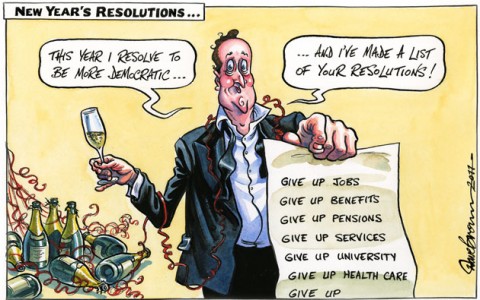
Honig awakens us to an important aspects of our current crisis: that “the market” is not in fact supremely sovereign, and the move to re-establish and further neoliberal policies and push through austerity measures requires an engagement in democratic politics – albeit one that undermines the notion of the public itself and seeks to use the power of the law to subvert democracy. Recognising the current crisis in these terms not only challenges us to consider how to survive our current troubles without giving up democratic virtues, it also reinvigorates and clarifies the political challenge we face. Emergency economics – with its assertion of debtocracy over democracy – is not an inevitable response to the crisis, it is a political one that we can, and should, fight against.
Continue reading

Sociology Is A Martial Art

A May Day found object (appropriately enough). Pierre Carles’ 2001 documentary on Pierre Bourdieu, in seven connected parts (missing, unfortunately the end). Besides the biographical, cinematic and intellectual value, it may also be of interest to Disordered readers for the scattered touches on science and its relation to politics and on the character and reproduction of inequality.


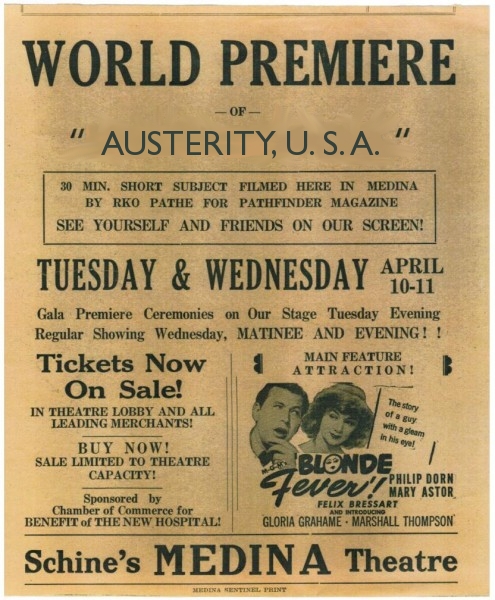
Austerity, USA

I’ve just returned from the “motherland” and bring tidings from a strange and far away place: Austerity, USA.

Gin and Tacos gave me a special gift just in time for Christmas. It seems the matriculating class of House Republicans have big plans for the country. The austerity fear mongering has reached new heights of hyperbolic cynicism as Republicans try to make it possible for states to declare bankruptcy. You can find details, with extra rage, here. The key points are that bankruptcy proceedings would allow states to renege on contracts with public sector unions and contract out public services, walk away from public sector pension obligations, and sell off public land, parks and buildings. A refutation of this obviously stupid and destructive policy, with the appropriate amount of anger and vulgarity, can also be found on Gin and Tacos, here. Finally, here’s the plan from the ideologues themselves, in case you thought we were making this shit up.

As if that were not enough to get the blood boiling, the incoming House Republicans have re-written the rules for the federal budget. The new rules will alter the current pay as you go scheme, which requires offsetting entitlement increases or tax cuts with tax increases or benefit cuts – which they did before in 2000, before the Democrats reinstate the rule in 2006. Geniuses that they are, the incoming Republican majority plans to eliminate the necessity of offsetting tax cuts – details here, and the actual new rules here. For the time being it seems that, at least in the US House of Representatives, we’ll be pretending that tax cuts do not cost money and are an effective way to cut the deficit and boost economic growth, all evidence to the contrary. When I add this to the pre-Christmas compromise on the Bush Tax Cuts, which not only extended an expensive and unwarranted tax cut to the wealthiest 2% of US taxpayers but also added an extra cut to inheritance tax as well, there is enough bad news here to push any angry leftist from thundering rage to child-like weeping. Continue reading

Protest: the legality of the Emergency Budget’s gender impact, Monday 6th December

Even a top line assessment of the budget measures show 72 per cent of cuts will be met from women’s income as opposed to 28 per cent from men’s. This is because many of the cuts are to the benefits that more women than men rely on, and the changes to the tax system will benefit far more men than women.

Support Fawcett’s bid for a judicial review of the budget

**JOIN US TO PROTEST OUTSIDE THE HIGH COURT**

12.30 pm – 2pm, Monday 6th December, Royal Courts of Justice, the Strand, London WC2A 2LL

Continue reading

Ethics of Austerity 3: Cynicism, Sincerity and Fear

“You ain’t never been no virgin, kid, you were fucked from the start.”

-Titus Andronicus, “A Pot in Which to Piss

Police Vodafone protesters oxford street

Police protect Vodafone store from the threat of public exposure of truth.

And you have to wonder what it will take for serious people to realize that punishing the populace for the bankers’ sins is worse than a crime; it’s a mistake.

Paul Krugman

Of obedience, faith, adhesiveness;

As I stand aloof and look there is to me something profoundly

affecting in large masses of men following the lead of those who

do not believe in men.

-Walt Whitman, “Thought”

Hypothesis

The winter air has turned cold enough, has pressed in with its full weight, so that there is no more space for lies. The truth of crisis is that the powerful and the wealthy do not take responsibility, they assign it; they do not suffer their follies or their sins, they pay their penance in the currency of our lives.

We’ve spent the last few years living with the anxiety of impending doom, spurred on by hustlers of panic, addled prophets of economic Reformation, and Janus-faced managers of public interest.

Yet, despite the prolonged disaster-foreplay, the consummation of this crisis was always going to be “us against them” and never “we’re all in it together.” Continue reading

The fallacious reasoning of Theresa May

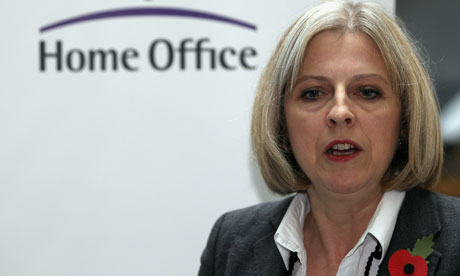
Last week’s speech by Home Secretary Theresa May on the government’s intention to repeal some recent equality legislation was ironically and comprehensively overshadowed by the media frenzy about the impending lavish nuptials of the future King of the Realm to a Lowly Commoner. This may help to explain a little why the vacuous, fallacious and bizarre reasoning at the heart of it has been largely unremarked upon.

Overall, the speech sought to justify the repeal of the clause of the 2010 Equality Act which required public bodies to consider how they might address relevant socioeconomic disadvantages when making strategic decisions.  My interest in this post is not to make the political case for this clause or not – rather it is to explore the reasoning offered by May in the speech that seeks to banish it into a category unrelated to inequalities of gender, race, religion, physical ability and so on.

The core tension emerges because throughout the speech May is desperate to present herself as a champion for gender-, age-, race- and sexual-orientation-based equality (ps nice U-turn, T), whilst trying to deny any place to socioeconomic aspects of equality. This is right at the heart of the New Conservative ideology that Cameron wants to promote – a socially enlightened politics of ‘fairness’ in a Big Society of ‘individuals’, that hugs hoodies whilst denying that socioeconomic disadvantage should be something that the government seeks to address. Continue reading

Ethics of Austerity 2: Interlude of Broken Glass

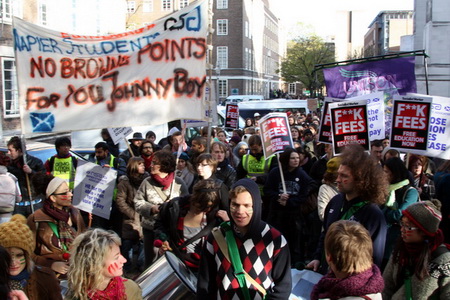
There’s always a surprising disconnect between experience and public reality when you attend an event that goes on to become an “event.” On such occasions, I find myself wondering how my experience can run so counter to the public narratives that emerge. Yesterday’s (10 Nov.) protest march in London is no different.

Here are some media images that reflect the protest I attended:

But the images that defined the “event” were slightly different. We’ve all seen them on the TV, in the papers, and on the web.

What I don’t want to do is engage in hand wringing over a protest hijacked by violent fringe elements, or tut at those smashing up the office building or gathered outside to watch. Instead, I want to do the opposite, I want to imagine myself as the one who failed, failed to fully grasp that it wasn’t just a sunny afternoon of political play acting. Continue reading

Neoliberalism Strikes Back, or Is This Really a Crisis?

A post from Roberto Roccu.


Of course it is. Yet, Colin Hay hits the right note when he points out that if crises are conceived as moments of radical questioning and change of existing paradigms, then what we see today is not a crisis, but rather a “catastrophic equilibrium”. Indeed, now that the reverberations of the rhetoric of London’s G20 in April 2009 have faded, it appears that the measures adopted both on a national and on the global scale are concerned with shoring up the old growth model based on flexible accumulation, in the attempt to restore its economic profitability, regardless of its social unsustainability.

Rather than downplaying the magnitude of the economic problems we face, Hay’s aim is to show how in a period when all the material conditions for speaking in terms of a crisis are present, with all the potential implications for a radical reconfiguration of our economic policies and political economies, the ideational discourse is still dominated by the very paradigm that created such material conditions. This fits well with Hay’s account of the genesis of neoliberalism, which emerged as the solution to a discursively-boosted epochal crisis of Keynesianism in times where material conditions were far from being as severe as the ones we face today.

It would be easy to dismiss Hay for “being too academic”, particularly in a context where what he calls the pathologies of the neoliberal paradigm have infected all of the developed world with very real consequences for those individuals and groups that have lost their jobs and are experiencing a dramatic increase in their social insecurity. Still, identifying the distinction between existing material conditions and the missing narrative for linking those conditions and framing a coherent and credible political project is extremely fruitful. This is the hiatus where capitalist realism as an ideology and a practice has prospered. In this respect, the regained profitability of the capital accumulation regime has brought about two seemingly parallel yet interrelated trends, that are most visible in the developed country struck hardest by the crisis, the US.

On the one hand, the rise of the Tea Party movement. The mainstream press has set its focus on the populist, anti-intellectual and anti-establishment aspects of the phenomenon. Yet, their fundamentalist neoliberalism – best expressed in the call to “return to the principles of Austrian economics” – has largely gone unnoticed. On the other hand, the ever clearer and stronger political position taken by Murdoch’s media empire against the Obama administration and more generally against any kind of state intervention in the economy is equally relevant. The daily space granted to Glenn Beck on Fox appears to me as the most evident trait d’union between these two trends.

On this side of the Atlantic, dismissing these phenomena as something alien would be misleading and dangerous. And not only because Murdoch’s empire extends well within Europe, and he is even now launching an offensive on the British media. Most importantly from a social standpoint, is the other trend – the rise of populist, worryingly xenophobic yet economically conventional movements – which is manifesting itself with a surprising regularity, even in countries like Sweden, that our diehard clichés still like to characterise as “welfare paradises”.

The analysis of what is happening in the European space is rendered more complex by the presence of a further level of decision-making, located on a larger spatial scale than the state. Now, all of us have become accustomed to hear about the democratic deficit within the EU. One of its major consequences is that the struggle for influence does not follow institutionalised forms, and lobbying is by and large the name of the game. Within this context, the effective mobility and mobilisation of capital and of its allies on the EU scale (and beyond) confronts a mobility of labour that remains mostly on paper, as the bulk of the jobs that are neither highly skilled nor unskilled are still largely allocated on a national basis. As a consequence, it has proven incredibly hard to mobilise working forces beyond the national scale.

Even the rampant xenophobia – exemplified by the rise of parties such as the Northern League in Italy, the Freedom Party in the Netherlands, the Swedish Democrats in Sweden, and the list could go on to include at the least fifteen of the EU’s twenty-seven members – must be seen as a fragment that begs for relations with the whole. And in the Europe of the four freedoms of movement (people, goods, services, capital), where the mobilisation of capital is effectively globalised and the mobilisation of labour is still limited by national boundaries, it comes as no surprise that the genuine anger of the working class(es) is channelled towards an attack of the only one freedom that can credibly be limited by national authorities: the movement of people.

And yet, there would be plenty of material to start from in the direction of some Europe-wide coordination. From the Spanish general strike to the recent demonstrations in the Netherlands to industrial action on the London Underground to the French general strike of this Tuesday. Unfortunately, very little has been happening on the European scale. And as long as capital is more powerful to begin with and better organised on a larger scale whereas labour is weaker and sometimes divided also on the national scale, the prospects for resisting, reversing and subverting the current neoliberal offensive appear to be dire indeed.