Fratriarchy, Homoeroticism and Military Culture

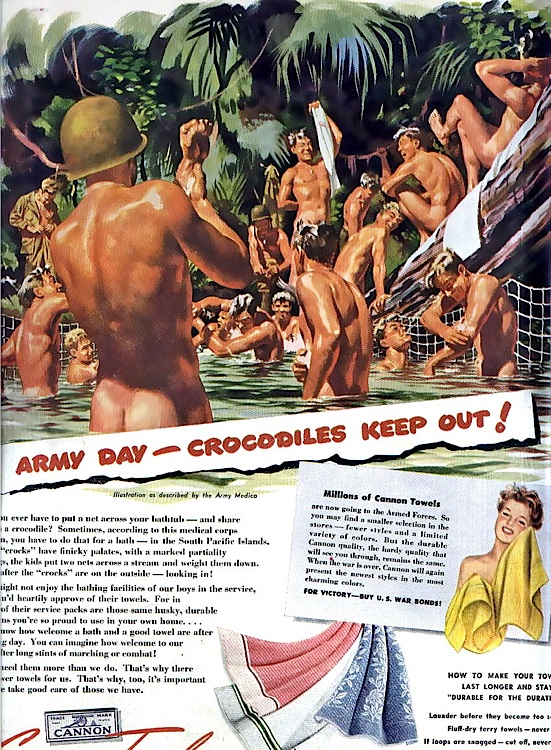
The ever-excellent Sociological Images offers up this 1940s advert, and others like it, as an example of how images previously taken to be innocent consumer bait for stereotypical homemakers now appear to us as dripping with homoeroticism. They may have added too that this half-ironic, half-nostalgic distance is what endears us to such images, which we then enjoy as vintage objects, for all that we know about the true historical context in which they were produced.

One common idea, which relates nicely to military bathing aesthetics (cannon towels? really?) is that many bonding behaviours in nominally heterosexual, male-dominated groups are in fact homosexual, but in a disavowed or repressed way. The scrum, the shared shower, the bunk-beds, the exclusion of women not only from the fields of play and war, but also from the various celebrations and carnivals that follow, all seem to indicate a desire for intimacy that cannot be named as such.

In the excellent Bring Me Men (which deserves its own dedicated review), Aaron Belkin identifies a more complex relation. In becoming military men, there is a need not only to disavow femininity, but also to become intimate with the ‘unmasculine’ and the ‘queer’. Rather than identifying a direct alignment of the masculine with the military, or seeing gender norms as accidental in their intersection with the military, there is instead a constitutive tension between the masculine and the unmasculine (or, we might say, between the strongly heteronormative and the homosexual). Basic training relies on a traumatic ambiguity, continually casting initiates as by turns masculine and unmasculine, so that no soldier can ever be sure that they were sufficiently on the ‘right side’ of the line. As one Marine put it: “The opposite of feminine? No. To me, what is masculine? I don’t know. [pause] And I’ve worked so hard at being it”. The continual ambiguity – what Belkin calls discipline as collapse – interacts with surveillance and punishment to produce the soldier-subject.

More brutally: Continue reading

The Cursory Pedant: War Rape, the Human Security Report and the Calculation of Violence

“Cursory and pedantic”. So says IntLawGrrls’ Fionnuala Ní Aoláin of the just released Human Security Report 2012 (hereafter HSR). You may recall the team behind the HSR from their last intervention, which upset the applecart over the estimate of 5.4 million excess deaths in Congo (DRC) since 1998 and which also claimed a six decade decline in global organised violence. The target this time round is a series of putative myths about wartime sexual violence (those myths being: that extreme sexual violence is the norm in conflict; that sexual violence in conflict is increasing; that strategic rape is the most common – and growing – form of sexual violence in conflict; that domestic sexual violence isn’t an issue; and that only males perpetrate rape and only females are raped), each of which the authors claim to overturn through a more rigorous approach to available evidence. Along the way an account is also given of the source of such myths, which is said to be NGO and international agency funding needs, which lead them to highlight the worst cases and so to perpetuate a commonsense view of war rape that is “both partial and misleading”.

Megan MacKenzie isn’t impressed either, especially by HSR’s take on those who currently study sexual violence:

[HSR’s view is] insulting because it assumes that those who work on sexual violence – like me – those who have sat in a room of women, where over 75% of the women have experienced rape – as I have – listening to story after story of rape, forced marriage, and raising children born as a result of rape, it assumes that we are thinking about what would make the best headline, not what are the facts, and not what would help the survivors of sexual violence.

Laura Shepherd (who like Ní Aoláin and Megan has written at some length on these issues) took a slightly different approach: “It makes not one jot of difference whether rates of [incidents of conflict-related sexual violence] are increasing, decreasing or holding entirely steady: as long as there are still incidents of war rape then the issue demands serious scholarly attention rather than soundbites”. Activists are concerned less by what the report says than by how it will be interpreted and the effects this will have on victims and survivors of rape (the danger, in Megan’s words, that “painting rape as random is another means to detach it from politics”). By contrast, Laura Seay (who has previously addressed similar issues in relation to Congo) is very supportive: “it’s hard to find grounds on which to dispute most of these claims. The evidence is solid”. Andrew Mack (who directs the HSR) similarly replied that the data supports HSR’s claims and that, despite criticisms, it had been checked rigorously.

So what is going on here?

Continue reading

What We Talked About At ISA: The U.S. Military-Industrial Complex, Part 2

Part two of a post on my presentation at this year’s ISA. Part one is here.


So what would be the normative-political case for the Military-Industrial Complex (MIC)? As Ledbetter notes, the defence industry never had a shortage of defenders, proponents, beneficiaries, and apologists. Various critiques of the MIC notwithstanding, numerous American commentators are now firmly united in the belief that their country needs a large defence budget in order to protect and project its identities and interests in the world. According to Maddow, this collective belief had a lot to do with the discursive and institutional success of the infamous “Team B” reports on Soviet power, which so profoundly enthused Ronald Reagan and his administration, leading to the gigantic military buildup in the 1980s. Maddow’s assessment is worth citing at length:

The Think Tanks and Very Important Committees of the permanent national security peanut gallery are now so mature and entrenched that almost no one thinks they’re creepy anymore, and national security liberals have simply decided it’s best to add their own voices to them rather than criticize them. But like we lefties learned in trying (and failing) to add a liberal network to the all-right-wing, decades-old medium of political talk radio, the permanent defense gadfly world can’t really grow a liberal wing. It’s an inherently hawkish enterprise. Where’s the inherent urgency in arguing that the threats aren’t as bad as the hype, that military power is being overused, that the defense budget could be safely and wisely scaled back, that maybe this next war doesn’t need us? The only audience for defense wonkery is defense enthusiasts, and they’re not paying the price of admission to hear that defense is overrated.

But knotted into the right-wing discourse on defence spending is a number of corollary arguments that are associated with a variety of lefty positions in the U.S. context.  America’s mainstream media outlets rarely fail to acknowledge how the twinning of the country’s economic and armed forces not only creates high-skilled jobs, but also – and critically – keeps them in the country. The move is mainly rhetorical. Not only have successive U.S. administrations encouraged American defence industry to globalize, but there is also little evidence to suggest that defence spending creates more jobs relative to spending on, say, health care or education (see, for example, Pollin and Garrett-Peltier, 2011). I would suggest, then, that what lies behind contemporary pro-MIC arguments is, in fact, a creative and complex combination of certain economic theories, (realist?) beliefs in war (or the threat of war) as a manifest destiny of the international system, as well as an overarching (liberal?) commitment to a powerful, sovereign state capable of exercising global leadership (aka., a “force for good”, in still favoured New Labour parlance.)

Let us revisit the pro-MIC rhetoric from the era of “Team B.” In a footnote, Ledbetter directs the reader to The Lonely Warriors (1970) by John Stanley Baumgartner, who is described as “one notable true defender of the MIC.” Written by an expert in public management and business administration, Baumgartner’s book makes three arguments for the MIC: 1) defending the free world is a moral thing to do (“Sputnik is only one example of the reasons for MIC”); 2) by definition, defence is a big enterprise and all big enterprises (directly or indirectly, the MIC employs one in ten Americans) occasionally make big mistakes, especially when they respond to the murky and changing specifications set by the government (“the tiger” or “the monster”) and its contracting officers; and last, 3) “unconscionable profit” is not so unconscionable in comparative terms (profit on sales, profit on investment, price/earning ratios etc. tend to be below the industrial average).

Continue reading

What We Talked About At ISA: The U.S. Military-Industrial Complex, Part I

Earlier this year, the U.S. government set out to reduce its vast defence budget. On 5 January, Barack Obama became the first U.S. president to hold a press conference at the Pentagon. What prompted it was the release of Sustaining U.S. Global Leadership: Priorities for 21st Century Defence, a “strategic guidance” document outlining the national blueprint for “deterring and defeating aggression,” while reducing record budget deficits “through a lower level of defence spending.” (The document also attracted much media attention because it offered a rare glimpse into the strategic thinking of a president who seems to refuse to be associated with a “doctrine.”) In his State of the Union address three weeks later, Obama reinstated his belief that paring defence sending could help “pay down our debt.” The Pentagon’s FY2013 budget projection followed on 13 February, with a request for $614 billion in funding: $525 billion for the base budget and $88 billion for the so-called overseas contingency operations. FY2012 budget request, the Pentagon noted, was bigger.

Pundits in the US have been debating the meaning of the coming defence cuts, starting with the question of whether there will, in fact, be any cuts in the first place. This debate will probably intensify as the election date approaches, although, indicatively, Obama’s strategic guidance contains no “East of Suez” moments, and his Pentagon speech was a candid expression about the need to stay the course: “Over the next 10 years, the growth in the defence budget will slow, but the fact of the matter is this: It will still grow, because we have global responsibilities that demand our leadership… I firmly believe, and I think the American people understand, that we can keep our military strong and our nation secure with a defence budget that continues to be larger than roughly the next 10 countries combined” (emphasis mine; also, “10” appears to be way too low).

Much remains to be said about the type, magnitude, and sequence of the coming changes to America’s defence, and the electoral 2012 will be too short to say it all. The first round of projected budget cuts (“$487 billion”) takes into consideration the provisions of the self-flagellating Budget Control Act from August 2011. The second round of cuts (“$500 billion”) refers the so-called automatic sequestration cuts, also specified in the Act, which will take effect in January 2013 if Congress does find “alternative” ways to control the budget. U.S. Secretary of Defense Leon Panetta described these automatic cuts as the “doomsday scenario,” a label that Congress’s bipartisan supercommittee will no doubt keep in mind as it looks for those alternatives (such as, for example, legislation to reverse the Act). In the end, what will change is the ordering of America’s military priorities, but not the militarization of America’s “global responsibilities” (to use Obama’s own label) as such. Behind it, after all, are multiple and reinforcing structural factors that make real cuts difficult. One of them is “defence industry,” which some pundits and watchdog organizations like to call, somewhat retrospectively, the “military-industrial complex” (MIC).

As a conceit, the MIC goes back at least to World War I, but it is popularly dated to Eisenhower’s ‘Farewell Address’ in 1961. As far as US presidential speeches/speechwriting goes, Eisenhower’s was a tour de force in every respect, but the reason why we read it today – or, rather, search for it on YouTube – is for the parts where the president urges the American citizens to pay attention to the “conjunction of an immense military establishment and a large arms industry [that is] new in the American experience,” while advising the American government to “guard against the acquisition of unwarranted influence, whether sought or unsought, by the military-industrial complex.”

Continue reading

#Kony2012 from Advocacy to Militarisation

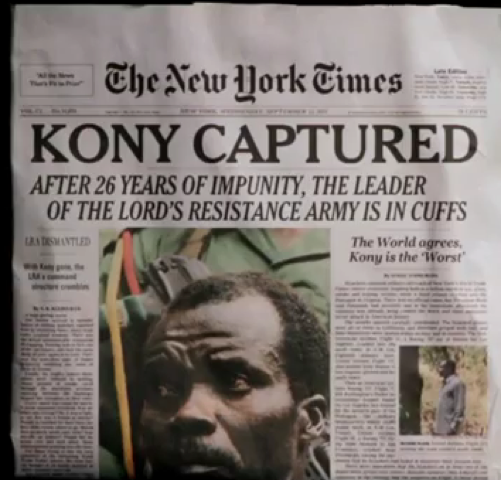
Although the attention spike and mainstream media attention on #Kony2012 has receded, not least thanks to Jason ‘Radical’ Russell’s own brush with infamy, the implications of muscular-liberalism-as-social-media-experiment continue to unfold. My feed at least continues to be peppered with anger towards Invisible Children from informed activists and scholars (although Norbert Mao, for one, takes a much more positive view and Jason Stearns makes a few qualifications of the anti-case worth reading). On Saturday, CEO Ben Keesey and ‘Director of Ideas Development’ Jedidiah Jenkins (formerly ‘Director of Ideology’: yes, really) released a short teaser video promising a sequel to #Kony2012 and declaring that the campaign was “working”. Staying stubbornly loyal to the understanding of foreign policy decision-making expressed in the original narrative, this was said to be because the people at the top were now being forced to respond to an issue they previously hadn’t cared about/known about, all thanks to the public pressure of predominantly young activist-citizens. The major consequence of this pressure being the introduction on March 12 of a Resolution in the US House of Representatives, sponsored by Jim McGovern (a Democrat) and Ed Royce (a Republican), to end Kony’s atrocities and bring justice to Norther Uganda. There’s now a Senate version of the Resolution too, taken by Keesey and Jenkins to dispel those loose accusations of ‘slacktivism’ against Invisible Children and its supporters.

But what does the Resolution actually ask for? Having reaffirmed previous declarations, it:

…calls on the Secretary of State and heads of other government agencies to undertake diplomatic efforts with partner nations focused on—
(A) expanding the number of capable regional military forces deployed to protect civilians and pursue LRA commanders; (B) enhancing cooperation and cross-border coordination among regional governments; and (C) promoting increased contributions from European and other donor nations for regional security efforts.

Now that’s a rather curious formulation of “diplomatic efforts”. Nowhere in the text is there any mention of the human rights records of the Ugandan or DRC armies, nor any suggestion that they are anything but (albeit junior) ‘partners’ in this military endeavour. The preamble makes repeated mention of ‘help’ to regional governments, and one line of text hints at problems (to “address shortcomings in current efforts”), but it is clear that these are deficiencies of coordination and military effectiveness, not of human rights concerns. The claims previously made in defence of the campaign (“we do not defend any of the abuses perpetrated by the Ugandan government or by the Ugandan army”) have rather evaporated in the transition to a formal Resolution, and Keesey and Jenkins make no complaint of that elision. Although recently rather keen to harness #Kony2012’s popularity, Human Rights Watch and others have long catalogued systematic abuses by the UPDF which match the Lord’s Resistance Army closely for brutality. The record of the FARDC (the army of the Democratic Republic of Congo) is worse still. Exact and proportional figures are hard to pinpoint, but there is no question that they are major (and quite possibly the main) perpetrators of rape, terrorism and atrocity in Eastern DRC.

All of this sets a brutal precedent. The vagueness of the call for action and policy detail, lost amongst the emotion ratcheting of being a ‘doer’ rather than a ‘sayer’, opened the door to any number of Liberal Saviour Hawk Military Industrial fantasies (to adapt Teju Cole). This is what groups like the Association of Concerned Africa Scholars warned of, a not-so-creeping militarisation of East and Central Africa. As apparently obvious as stopping Kony’s evil in a hail of righteous bullets cycles seems to Russell and Co., the cycle of insurgency and counter-insurgency tends to be draped at each stage in stark aggressions, with those regional military partners enacting their own ‘invisible’ massacres as they go.

Conspiratorial ideas of Invisible Children as a front for the US government aside, there is clearly a whole set of non-humanitarian interests at play here. I doubt there is any real appetite, and certainly very little capacity, in policy circles for any kind of escalation of direct US military involvement in the area, but then ‘support’ and ‘advice’ for regional allies and proxies has more traditionally been the mark of foreign policy. What those exponential click counts will translate into in policy terms thus remains open, but the signs aren’t great.
All Your Brain Are Belong To Us: Neuroscience Goes To War

The Royal Society has just released a fascinating report entitled “Neuroscience, Conflict and Security” that examines the increasing role that neuroscientific research is playing in the military today (thanks to Nick for drawing my attention to it). Indeed, as was reported by Wired’s Danger Room a couple of years ago, the US Air Force has been soliciting  research proposals for “innovative science and technology projects to support advanced bioscience research” that include “bio-based methods and techniques to sustain and optimize airmen’s cognitive performance”, “identification of individuals who are resistant to the effects of various stressors and countermeasures on cognitive performance” and “methods to degrade enemy performance and artificially overwhelm enemy cognitive capabilities.” Likewise, DARPA (the Defense Advanced Research Projects Agency that gave us the Internet) has long shown significant interest in the potential military applications of neuroscience.

As the Royal Society report puts it, military neuroscience can be seen to have “two main goals: performance enhancement, i.e. improving the efficiency of one’s own forces, and performance degradation, i.e. diminishing the performance of one’s enemy” (p.1). It is with reference to these two goals that I will attempt in this post to make some sense of the wider context and implications of neuroscience’s entanglement with contemporary martial practices.

Continue reading

How is Rape a Weapon of War?

This post summarises a piece for the European Journal of International Relations just published online. An inconsequentially different pre-publication version is also available for anyone unable to breach the pay wall.

UPDATE (8 March): Sage have kindly made the full EJIR paper open access until early April, so you can now get it directly that way too.


I’m sure you have reasons
A rational defence
Weapons and motives
Bloody fingerprints
But I can’t help thinking
It’s still all disease.

Fugazi, ‘Argument’ (2001)

‘Weapon of War’ could be many explanations and I’m not sure of any of them.

UNHCR official, Goma, Democratic Republic of Congo, June 2010

1. War Rape in the Feminist Imaginary

Rape is a weapon of war. Such is the refrain of practically all contemporary academic research, political advocacy and media reporting on wartime sexual violence. Once considered firmly outside the remit of foreign policy, rape is today labelled as a ‘tactic of war’ by US Secretaries of State who pledge to eradicate it and acknowledged as a war crime and constituent act of genocide at the highest levels of international law and global governance, a development which for some amounts to the ‘international criminalization of rape’. This idea of rape as a weapon of war has a distinctly feminist heritage. Opposed to the historical placement of gendered violence within the hidden realm of the private, feminist scholarship was the first to draw out the connections between sexual violence and the history of war, just as feminists fought to make rape in times of nominal peace a matter for public concern. Feminist academics have, then, pioneered a view of sexual violence as a form of social power characterised by the operations and dynamics of gender. Sexual violence under feminist inquiry is thus politicised, and forced into the public sphere.

But the consensus that rape is a weapon of war obscures important, and frequently unacknowledged, differences in our ways of understanding and explaining it. Continue reading

Book launch: A Liberal Peace?

Tuesday 14th February 2012, 5.30pm-7.00pm

Westminster Forum, 5th Floor, Department of Politics and International Relations, University of Westminster, 32-38 Wells Street, London W1 (nearest tube Oxford Circus)

Panel with Editors David Chandler and Meera Sabaratnam, followed by publisher’s reception

All welcome

The 1990s was a weird decade for all kinds of reasons. The dice that were thrown into the air as the Soviet Union retreated landed in a particularly intriguing configuration for those politicians, public functionaries and academics from wealthy countries and institutions concerned with ‘peace’ and ‘development’. Their missions, marginalised for decades under concerns for national (i.e. military) security, were quite suddenly elevated as symbols of the new world order and installed as defining foreign policy priorities of wealthy states. Continue reading

Body Politics: Corporeal Suffering, Memes and Power/Resistance, with Special Reference to #Occupy, Tahrir Square, ‘Hunger’ (2008) and Rage Against The Machine

*some extremely disturbing images ahead* (and some humorous deployments of Impressionism and Leonardo DiCaprio).


Two weeks ago, Karin Fierke presented a paper at our theory workshop on self-immolation as speech act (part of a forthcoming book entitled The Warden’s Dilemma: Self-Sacrifice, Agency and Emotion in Global Politics with Cambridge University Press). She focused principally on Thich Quang Duc, the South Vietnamese Buddhist monk who set himself alight and burned to death, silent and still, in Saigon in June of 1963, and on Norman Morrison, an American Quaker who copied Duc’s example in November 1965 by combusting his own flesh outside the Pentagon office of Robert McNamara, then the United States Secretary of Defence implementing Operation Rolling Thunder, the rain of fire which infamously unleashed a greater tonnage of bombs on Vietnams North and South than the total dispatched during the entirety of the Second World War.

This mimesis, an affinity not only of form but also of sacrificial politics, was cited as a mechanism for rupturing the symbolic order. Both Duc and Morrison engaged in a corporeal self-violence so forceful that it not only offended senses, but in fact extended a certain community. An act, substituting for speech, argument or manifesto, which forced itself on high politics and forged an international sensibility until that point lacking. One more contemporary dimension of that imitation and repetition is that many must have encountered the image the same way I did, which was via the front cover of Rage Against The Machine’s pugnacious, convulsively political eponymous debut in 1992. And not just the image, but a vague sense of the story imparted by sleeve notes (and lyrics today associated both with opposition to the media grip of Simon Cowell and with visions of the riotous encounter).

Self-immolation persists in a certain tradition of struggle, but the relevance of these themes – the body, sacrifice, the edifice of politics and protest, the circulation of images – has coalesced potently in the wake of recent events (on which more in a moment). Continue reading

Atrocity Porn, the Resource Curse and Badvocacy in ‘Unwatchable’ (2011)

Lest it need saying, *trigger warning*.


Unwatchable lasts just over 6 minutes, but is intended to linger far longer. A project of Save The Congo, it was apparently turned down by larger charities on the grounds that it was too extreme. Deploying liberal doses of slo-mo and orchestral overture, it shows an armed assault on a whiter-than-white (and blonder-than-blonde) family somewhere in rural England. The teenage daughter is gang-raped on the kitchen table while her father is forced to watch, and her parents are eventually mutilated and killed on their front lawn while the soldiers laugh and film them on mobile phones. At one point we see a soldier cowering to avoid the scenes wrought by his comrades. The youngest daughter is killed trying to escape. In other words, a BBFC 18-rated piece of atrocity porn doubling as a viral advocacy campaign.

A small clickable box sits screen top-right throughout. It reads: ‘Make It Stop’. The tagline: ‘Warning: this film contains sexualised violence you and your mobile phone manufacturer may find disturbing’. The pay off being that this is really about the DRC, but that it will take this happening to white people for you to notice. Yes, this is another campaign about the resource curse and another entry in the catalogue of rape atrocity ratcheting, now with the obligatory twitter hashtag (#bloodminerals) and a petition demanding: a) that EU companies be forced into transparent supply chains for coltan and the like; and b) that ‘swift and severe’ action be taken against any party responsible for violence.

Kate at Wronging Rights picks up on the incoherence of Save the Congo’s accompanying claims:

W…T…F…? Rape is cheaper and much more effective than guns or bullets??? No.  Rape is not a “cheap” coercive strategy.  It’s time-consuming and it exposes the perpetrators to injury and potential STD infection. Armed groups absolutely use it anyway, but not because it’s cheaper than bullets.

And, [i]f armed groups were to raid a village and force the population to leave by shooting at them, NGOs could be alerted and the UN would have to react??  This is surely news to the scores of NGOs, both local and international, who have worked tirelessly to document and publicize the use of rape as a weapon of war throughout the last decade and a half of conflict in the region.

Look, I realize that grassroots activism often plays a fundamental role in political change, and has been particularly important to the history of the human rights movement, but seriously, this “the news made me sad / I can haz NGO?” nonsense has got to stop.  Time to invoke Amanda’s “Love Actually Test” on a wider scale, I think.

Bizarre and untenable as such ideas may be (say what?), the key points of Save the Congo’s analysis are ones now commonly repeated as part of the general ‘weapon of war’ narrative. Continue reading