Anyone who followed the controversy over the fictitious Gay Girl in Damascus blog, created by Edinburgh-based US graduate student Tom MacMaster writing as Amina Arraf, might have despaired of the prospects of subalterns speaking for themselves. Female, lesbian, Arab, and an anti-Assad protester, MacMaster’s Amina quickly became a posterchild of the Arab Spring for a wide swath of the liberal media and activist blogosphere. For those cognizant of contemporary critiques of homonationalism against the backdrop of pervasive homophobia, Amina’s dispatches from the frontline seemed a perfect embodiment of left liberal fantasies about the possibilities for progressive sexual politics in a time of revolution. Yet if critics such as Joseph Massad have been accused of dismissing subjects who don’t conform to their theoretical predilections, the Amina hoax gestured at an opposite, if no less insidious, temptation: that of desperately seeking subjects who confirmed theoretical utopia.
Solidarity
Open Access: HEFCE, REF2020 and the Threat to Academic Freedom
This is the text of a document prepared by Meera and me on Article Processing Charges as currently understood and the serious risks we think they pose to academic freedom and funding, broadly understood (previous discussed by several contributors to our open access series). It is also available as a pdf, and we encourage academics to think carefully about the issues foregrounded, and to act accordingly.

Summary
- The Government is pushing academic publishing to a ‘pay-to-say’ model in order to achieve open access to publicly funded research
- This ‘gold’ route to open access, which levies Article Processing Charges (as proposed in the Finch Report and taken up by RCUK and HEFCE) poses a major problem for academics in the UK:
- It threatens academic freedom through pressures on institutions to distribute scarce APC resources and to judge work by standards other than peer review
- It threatens research funding by diverting existing funds into paying for publications (and private journal profits) rather than into research
- It increases academic inequality both across and within institutions, by linking prestige in research and publishing to the capacity to pay APCs, rather than to academic qualities
- It threatens academic control of research outputs by allowing for commercial uses without author consent
- In response, academics should:
- Practice and lobby for ‘green’ open access of all post-peer reviewed work within journals and institutions
- Lobby against proposed restrictions on REF2020 and against compliance pressure for ‘gold’ open access
- Demand clear policies from Universities around open access funds
- Ensure institutional resources are not unnecessarily spent on APCs
- Protect the integrity of scholarly journals by rejecting the pressure for ‘pay-to-say’ publishing
Open Access: Rushing Implementation
Many academics have been ardent supporters of the open access principle (that peer-reviewed academic work should be freely available and easily accessible to anyone), and were excited when the Government made steps to advance it. However, it has become clear that the implementation of this policy via REF2020 will have very serious negative consequences for all academic authors and institutions, unless authors and institutions themselves start to take action and make their voices heard. It is critical that academics understand what is happening and lobby our pro-VCs of Research, our VCs and Universities UK to defend both academic freedom and open access.
The timescale for action and decision-making is now incredibly short. Several policies, including that of the Government and of RCUK were declared immediately with the release of the Finch Report, totally accepting its views without wider consultation. HEFCE is going to open and close a very quick consultation period early in 2013 in order to issue guidance ahead of REF2020. Some universities have been given until March 2013 to determine what to do with open access funds that they were given in November. And it was only on 29 November 2012 that the first indications from HEFCE were given as to their intentions, at the Academy of Social Sciences (ACSS) conference on Implementing Finch. The timetable for finalising the details of this complex policy is thus extremely short and does not allow for adequate discussion of its serious consequences. Despite this, academics can still play an important role in resisting the threats posed.
So, What is Happening?
In summary, academic journals are being moved from a ‘pay-to-read’ model to a ‘pay-to-say’ model.
A Global Story of Psalms 68:31 | Against the Provinciality of the Twenty Years Crisis

‘Moses and his Ethiopian Wife’, by Jacob Jordaens, c. 1650
Princes shall come out of Egypt; Ethiopia shall soon stretch out her hands unto God
Psalms 68:31 is part of the global story of colonialism, enslavement, the “civilizing mission” and self-liberation. It is a story that is central to the Twenty Years Crisis that constitutes the originating point of International Relations as a self-proclaimed discipline. But it is a story that is largely absent when this originating point is commemorated.
We can pick up the story of Psalms 68:31 with the King James version of the Bible, translated into the vernacular in 1611. At this time it is practice to denote things African through the name Aethiops. More than just a polity south of Egypt, Ethiopia also encompasses Black Africa as a whole. By 1773, catechisms are being developed around Psalm 68:31 that directly address African enslavement in the Americas and the prospects of abolition, emancipation and liberation.
There are two key interpretations. One, cultivated by white abolitionists and subsequently used by Europeans who embark upon an African “civilizing mission”, holds that it is they – white/Europeans – who are God’s children. Hence, it is white/Europeans to whom Ethiopia is stretching for her hands for deliverance from slavery and primitivism. The other, cultivated by the enslaved and their downpressed descendants, holds that the Bible is their story – the “half never told“. Africans will therefore righteously deliver their own selves from bondage.
The first catechism appears as early as 1773 in the letters of Anthony Benezet, a French-born Quaker living in North America. Scouring through the Bible to find divine authority for the abolitionist cause, Benezet notes: “beloved friend, the passage we are seeking for is Psalms 68, 31.”; and “the people called Ethiopians are definitely African negros due to Jeremiah 13,23 – “can the Ethiopian change his skin?”. Abolitionists – especially British ones – are most concerned that the enslavement practised by white and European “Christians” would denigrate their status as the most civilized amongst humanity. By Benezet’s time, it is already a belief amongst the intellectual caste of white/Europeans that they are the people chosen by God to express his Providence, through commerce and colonisation.
What We Talked About at ISA 2012: A Human Right to Housing
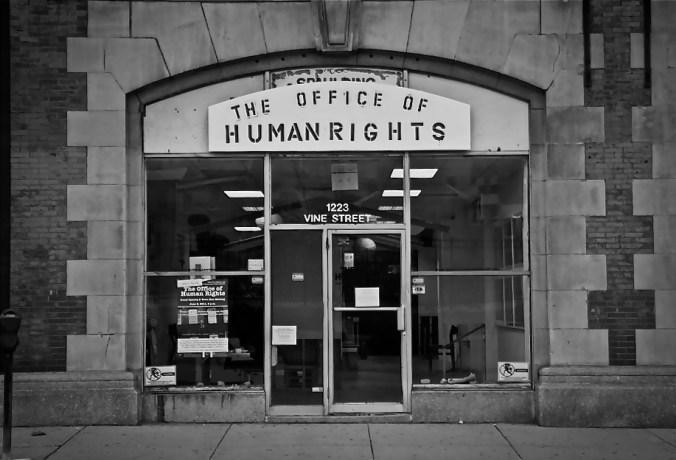
Housing is a Human Right Exhibition, Philadelphia (original photo by Annie Seng)
-“I Ain’t Got No Home in this World” by Woodie GuthrieI ain’t got no home. I’m just a roamin’ round, just a wandering worker, I go from town to town. And the police make it hard wherever I may go. And I ain’t got no home in this world anymore.
My brothers and my sisters they’re stranded on this road. A hot and dusty road that a million feet have trod. Rich man took my home and drove me from my door. And I ain’t got no home in this world anymore.
Was a farmin’ on the shares and always I was poor. My crops I lay into the banker’s store. My wife took down and died upon the cabin floor. And I ain’t got no home in this world anymore.
Now as I look around it’s mighty plain to see this world is such a great and funny place to be. Ah, the gamblin’ man is rich and the working man is poor. And I ain’t got no home in this world anymore.
Beginnings Are Difficult
How to start something new? This question troubles the academic as well as the activist. At the moment it troubles me both as a question of inquiry and as a meta-question of method.
In my previous work I have argued that human rights should be judged first and foremost by the consequences they bring about. Do human rights enable new forms of politics? Do they enable politics that increase the control we have over our lives, or that reduce the suffering and humiliation we are exposed to? Or do they confine us in a liberal subjectivity that makes wider visions of justice impossible, which push us to reconcile our beautiful revolutionary dreams to the limited horizon that contemporary liberal capitalism imposes?
I have offered a qualified defense of human rights as a democratising ethos, which suggests that human rights can enable everyday people to challenge the terms of legitimate political authority, including the institutional shape of their government and the makeup of their communities. This is done by formally opening up the identity of “rights holder” to anyone, regardless of their social position. This opening, however, is only formal and in that formality human rights have an ambiguous significance. For this reason, I have argued that to think of human rights as a democratising ethos also requires that we attend to the politics of human rights. This means that ensuring that human rights support democracy and equality is a political struggle as well as an ethical vision.
It’s Really Kicking Off In Quebec
 Despite some news coverage and discussions on Twitter, we’ve seen little on the continuing educational and political crisis in Quebec. Hence, a guest post from our friend and colleague Philippe Fournier. Philippe teaches political thought and International Relations at the Université de Montréal and the Université du Québec à Montréal. He has published research on Foucault and International Relations, Governmentality in the contemporary United States and Violence and Responsibility. He is currently working on the government of security in the US and on the theoretical conflation of sovereign power and government in Foucault. His other research interests include critical cultural theory and political economy.
A little background info and some thoughts on the student crisis in Quebec, which has been going on for 101 days now and shows no signs of waning in the face of the government’s disturbing intransigence. The recent adoption of Bill 78, which circumvents the right to protest without prior notice and gives the police the right to change a demonstration’s itinerary, among other things, has shocked and angered many Quebecers and made the news worldwide. On Tuesday May 22, over 250 000 people expressed their discontent with the current government and it was quite a sight.

Ever since the ‘quiet revolution’ in the early 1960s, which saw the institution of important social provisions and the attribution of several socio-economic entitlements to the francophone majority, Quebec has been holding fast to its social-democratic heritage. Jean Charest’s liberal party, in power since 2003, is determined to fight off the modern-day antichrist of debt and rationalise state activity. The Charest government’s attack on hard fought social entitlements, including accessible post-secondary education (Quebec has the lowest tuition fees in Canada), has been going steady since 2003 but has intensified since 2008. Quebecers were told that it was no longer reasonable to expect affordable public services and that it was high time that we join the pay as you go party.
What is at play in this conflict is no less than the fate of social-democratic expectations in Quebec. These expectations are actively discouraged and discredited by the current political elite. The demands for a tuition freeze by sizeable portions of Quebec’s students are considered unreasonable in many quarters, and seen as a plane expression of bad faith and overindulgence by a majority of Canadians, seemingly stuck in a Stephen Harper induced stupor. The words ‘pragmatic’, ‘realistic’ and ‘rational’ have been duly appropriated by the partisans of deregulation, free-enterprise and individual responsibility. Any suggestions that the latter orientations are based on an ideological choice are ridiculed; they simply express a sounder and more logical way to manage society.
Up to now, there seemed to be a dour resignation to the decimation of our social programs. This young generation of Quebecers, which many had touted as completely apathetic and apolitical, has taken a resolute stand against restricting access to a public good, against the further commodification of knowledge and against the uncompromising law and order approach of an arrogant and irresponsible government. Those that have taken to the streets day after day and sacrificed their terms and put their professional lives on hold for the students that will come after them, have shown extraordinary resilience and bravery. It came as a surprise to many, because they did it on their own, with little or no help from their political science professors, who have long abandoned critical thinking for functionalist replications of reality sanctioned by government money.
What We Talked About At ISA: From #occupyirtheory to #OpenIR?
A write up of my comments at the #occupyirtheory event in San Diego. The event itself was both hope-filled and occasionally frustrating, not least for the small group of walk-outs, apparently ‘political’ ‘scientists’ lacking in any conception of what it actually means to engage in the political (note: this bothered me especially, but was a rather minor irritation in the grander scheme of things). Despite the late hour, there were between 40 and 60 people there throughout, and a number of very positive things have come of it. It looks like there’ll be some gathering at BISA/ISA to discuss further, and we’re pitching something for the Millennium conference on some of the themes addressed below, and there will of course be ISA 2013 too. In the meantime, there’s the Facebook group, the blog, and a mailing list. The term OpenIR is owed to Kathryn Fisher, and seems to several of us to be a better umbrella term for the many things we want to address in the discipline and the academy. I also just want to give a public shout-out to Nick, Wanda, Robbie and Meera for doing so much on this.

The #occupy practice/meme has antecedents. Physical manifestations of a ‘public’, horizontalism, prefigurative politics and more can be traced in all sorts of histories. One such lineage is the foreshadowing of Zucotti Park in recent struggles over education. Take the slogan in March 2010 over privatisation at the University of California, which was ‘STRIKE / OCCUPY / TAKEOVER’. Or Middlesex, where students resisting the dismantling of the Philosophy Department in that same year unfurled a banner during their occupation, one that proclaimed: ‘THE UNIVERSITY IS A FACTORY! STRIKE! OCCUPY!’.
I want briefly, then, to think about the space of the university in our discussions of #occupy. There have been rich and suggestive calls to re-politicise ourselves as academic-activists, to look again at our work and its claims, and to turn our abilities, such as they are, to projects of resistance and transformation. But we risk a displacement. When we talk of ‘the street’, or politics enacted in the reconfigured space of #occupy, or of the ‘real world’ that we must be relevant to, we already miss the university itself as that factory in which we labour. We are tempted by a view of ourselves as leaving ivory towers to do politics, instead of seeing those towers themselves as spaces of politics. As if our institutions and practices were not already part of the world.
Whether you see #occupy as transformational or nor, or whether you simply prefer a different vocabulary, I think a demand remains: a demand to politicise our own positionality. This politicisation can have many dimensions, but I want to suggestively highlight four, each being a sphere in which we should be diagnosing and transforming our own practices.
Call for Contributions: The Global Political Economy of the 1%

Tim Di Muzio (Wollongong) is putting together an edited volume on The Global Political Economy of the 1% which Disordered readers might be interested in contributing to. The full call is here. Abstracts of 250 words or less are due by 30 April 2012 with first full drafts by 1 November 2012. Tim can be emailed with submissions or for more details here.
While the internationalized Occupy Wall Street movement faces many strategic and organizational challenges, one of its major accomplishments has been its ability to draw global attention to the massive disparity of income, wealth and privilege held by 1% of the population. Such attention comes amidst a relatively synchronized global financial crisis, a mounting first world debt crisis in parts of Europe and the United States and the intensification of neoliberal policies. While political science and sociological study has shed light on elites and the wealthy in the past, with some recent popular exceptions, there has been a dearth of research on the culture, politics, built environments and psychology of the global rich in the new gilded age.
To redress this gap in the literature, this edited volume calls for a more focused and engaged study on what could be called the global political economy of the 1%. Such a project could help shed light on the massive chasm between this elite class of wealth holders and the rest of the global working class – the majority of whom subsist on less than US$2 a day and increasingly live in informal settlements as the dialectic of dispossession and urbanization continues its historical dance. Of course, it should be emphasized that a global political economy of the 1% does not preclude (and nor should it) the unavoidable social relations between the 1% and the 99%. However, recent literature has already enriched our understanding of how poverty, unprotected workers, and the everyday life practices of the seemingly mundane impact upon the wider global political economy. So a keen, yet nonrestrictive, focus on the political economy of 1% and the global income/wealth hierarchy is welcome.
All abstracts will be accepted and reviewed with sincerity. Selections for inclusion in the volume will be evaluated on the basis of original content, coherence and consistency with the general theme as well as the necessity of creating coherent sub-themes. Sub-themes are suggested here to organize research questions but are not necessarily the themes of the volume (contingent upon contributions).
Topics and questions that could be addressed in such a volume include but are not limited to the following: The Usual Suspects: Identifying the 1%; The Social Reproduction of the 1%; Culture, Consumption and the 1%; and Power, Resistance and the 1%.
Precarity Everywhere

A recent piece by Michael Bérubé highlights one of the invisible problems of higher education in America (and elsewhere) – namely, the rise of the adjunct as the hegemonic form of the modern day academic. This is in both a qualitative way (with flexibility and monetization becoming some of the prime measures for every academic), but also in a quantitative way (Bérubé cites data that shows more than 2 out of every 3 faculty members are now contingent workers).
While American political discourse often portrays academics as highly-paid, impossible-to-fire liberals, the data in fact shows virtually the opposite (though admittedly academics are likely disproportionately “liberals”). Increasingly the expectation of graduate students leaving university is that:
(a) an academic position will be incredibly difficult to find (I have numerous anecdotes of friends applying for hundreds of jobs and only getting 3-5 interviews, let alone job offers)
(b) when a job is found, it will be contract work
(c) when a job is found, it will involve the workload of a full professor
(d) when a job is found, it will pay 20-75% of a full professor’s salary
(e) in a year (perhaps longer depending on the contract), this process will be repeated
Colouring Lessons: Reflections On The Self-Regulation Of Racism
 A guest post, following Srdjan’s and Robbie’s contributions on the meaning and structure of contemporary racism, by Elizabeth Dauphinee. Elizabeth is Associate Professor in the Department of Political Science at York University in Toronto. She is the author of The Ethics of Researching War: Looking for Bosnia and co-editor of The Logics of Biopower and the War on Terror: Living, Dying, Surviving. Her work has appeared in Security Dialogue, Dialectical Anthropology, Review of International Studies and Millennium. Her current research interests involve autoethnographic and narrative approaches to international relations, Levinasian ethics and international relations theory, and the philosophy of religion.
The idea promulgated by Bet 115 that racism can and will meet its demise in a few short decades is based on the assumption that humans are self-regulating creatures, capable of recognizing and assessing their beliefs in an objective way and making appropriate corrections as needed. In order to explore this assumption, we need to inquire into the relationship between the self as an individual entity, capable of navigating and responding to the external world in an objective, disinterested way, and the social sphere, which may so entirely constitute us that we are incapable of thinking beyond the ‘texts’ (or scripts) of our socio-cultural milieus. In simpler terms, the question is: do we create the world, or does the world create us?
In order to rightly consider this question, it is important to understand the implications of the answers one might be tempted to choose. It is also important to realise that each of us has a personal investment in the answer we might make. If we are individuals capable of willfully altering the world, then it makes sense to say that we can overcome racism (yet one is left with a lingering sense of bewilderment over why we have not done so). If we are fundamentally shaped and inextricably bound by the social sphere in which our ideas are formed, then we might lack the agency to escape the racism that seems to form a cornerstone of the institutions of our historico-political condition. Of course, there are few who would accept that our ability to self-regulate is an either/or proposition. Rather, it is probably better to understand it as a ‘both/and’ state of affairs. In short, we shape and are shaped by the worlds we occupy. How, exactly, this is so is difficult to pick apart and navigate despite all of social science’s failed attempts to sharpen the distinction between the self and the worlds the self occupies. It inevitably flattens the complexity of social relations, and often ignores the tensions and contradictions that animate people’s views and beliefs. By way of example, let us consider the question with which we began: are we, or are we not, self-regulating creatures? The very structure of the question assumes that one will make answer either one way or the other. It leaves little room to suggest that both propositions are true, but in different ways and with different implications.
Body Politics: Corporeal Suffering, Memes and Power/Resistance, with Special Reference to #Occupy, Tahrir Square, ‘Hunger’ (2008) and Rage Against The Machine
*some extremely disturbing images ahead* (and some humorous deployments of Impressionism and Leonardo DiCaprio).

Two weeks ago, Karin Fierke presented a paper at our theory workshop on self-immolation as speech act (part of a forthcoming book entitled The Warden’s Dilemma: Self-Sacrifice, Agency and Emotion in Global Politics with Cambridge University Press). She focused principally on Thich Quang Duc, the South Vietnamese Buddhist monk who set himself alight and burned to death, silent and still, in Saigon in June of 1963, and on Norman Morrison, an American Quaker who copied Duc’s example in November 1965 by combusting his own flesh outside the Pentagon office of Robert McNamara, then the United States Secretary of Defence implementing Operation Rolling Thunder, the rain of fire which infamously unleashed a greater tonnage of bombs on Vietnams North and South than the total dispatched during the entirety of the Second World War.
This mimesis, an affinity not only of form but also of sacrificial politics, was cited as a mechanism for rupturing the symbolic order. Both Duc and Morrison engaged in a corporeal self-violence so forceful that it not only offended senses, but in fact extended a certain community. An act, substituting for speech, argument or manifesto, which forced itself on high politics and forged an international sensibility until that point lacking. One more contemporary dimension of that imitation and repetition is that many must have encountered the image the same way I did, which was via the front cover of Rage Against The Machine’s pugnacious, convulsively political eponymous debut in 1992. And not just the image, but a vague sense of the story imparted by sleeve notes (and lyrics today associated both with opposition to the media grip of Simon Cowell and with visions of the riotous encounter).
Self-immolation persists in a certain tradition of struggle, but the relevance of these themes – the body, sacrifice, the edifice of politics and protest, the circulation of images – has coalesced potently in the wake of recent events (on which more in a moment). Continue reading
 The Disorder Of Things