Size Matters: Reflecting on Perspective, Positionality and Critique After #ISA2015

… so I tweeted on the last day of the 56th Annual Convention of the International Studies Association. I was exhausted by that point, numbed and overwhelmed at the sheer volume of thoughts I had asked my poor brain to process over the previous four days. I was ready to crawl into bed and sleep for a week, but I still had to get home, back to Sydney from whence I came, which I duly did, over the course of the next 37 hours.

I stared blindly out of the aeroplane window as we circled around Sydney, thinking about nothing much at all, noticing the Opera House and the Sydney Harbour Bridge and how tiny they looked, how much like models, how insignificant. And in the taxi on the way home (and yes, I am acknowledging my privilege as I write this, that is kind of the point of this blog, I think…), I asked the driver to please take the bridge, not the tunnel. There is something about the view from the Eastern Distributor, which brackets Circular Quay with the Harbour Bridge on one side and the Opera House on the other, that feels to me like coming home.

photo of sydney opera house

Sydney Opera House. Photo by LJS.

As we drove, and the iconic structures came into view, I thought, somewhat mindlessly, how much bigger they seemed close up. Like I said, I was exhausted, not able to conjure much more than this rather banal observation. Objects in the rear view mirror may be closer than they appear, but objects on the ground, when you’re close up, feel much more significant. Continue reading

What We Did At ISA 2015: Tripping Over The Color Line

To write poetry after Auschwitz is barbaric. –Adorno

Through all the sorrow of the Sorrow Songs there breathes a hope—a faith in the ultimate justice of things. The minor cadences of despair change often to triumph and calm confidence. Sometimes it is faith in life, sometimes a faith in death, sometimes assurance of boundless justice in some fair world beyond. But whichever it is, the meaning is always clear: that sometime, somewhere, men will judge men by their souls and not by their skins. Is such a hope justified? Do the Sorrow Songs sing true? –Du Bois

plantation map

On the Great River Road that runs along the Mississippi River there is a stretch called Plantation Alley between Baton Rouge and New Orleans. This section of the river had over 300 sugarcane plantations in the middle of the 19th century. Today the Great River Road is actually a complex series of small roads crossing the Mississippi again and again. Those roads are dotted with oil refineries and the occasional small town, but where the roads run along the river front they are dominated by old plantation homes. The antebellum structures attract throngs of visitors, in tour buses and rental cars, searching for an authentic Plantation Adventure and to experience true Southern Splendor. Plantations, it seems, are family friendly fun, providing a window into the rich history and culture of the South. This is an unsettling sales pitch.

While driving to Lafayette, Louisiana, we decided to stop at the Laura Plantation, where their award as “2007’s Best Louisiana Attraction” is prominently displayed. We chose the Laura Plantation because it was billed as a more serious tour, focused on the history of the plantation rather than costumed play acting and antique fetishism that is apparently rife at other plantations.  We arrived in time for the last tour of the day and drifted into the gift shop to buy tickets. We paid our money and were advised to use the toilets before we began. The shop was filled with memorabilia from the plantation itself, from Plantation Alley and the Great River Road, as well as an ambiguous but discernible thing we can call Southern Heritage. As we waited for the tour to begin, watching the other visitors and browsing the extensive collection of inessential collectibles, it was strange to see that no one displayed any signs of discomfort in this setting or with the history about which we were queuing up to learn.  Continue reading

What We Talked About At ISA2015: A Debate Around John Hobson’s ‘The Eurocentric Conception of World Politics’

Below is the text of my intervention at a roundtable organized by Alina Sajed entitled ‘Race and International Relations—A Debate Around John Hobson’s The Eurocentric Conception of World Politics‘. TDoT has hosted a symposium on the book: you can read an initial post by John, commentaries from Meera, Srdjan and Brett, and a reply from John. I’ve tried not to cover the same ground.

While race and racism have recently become topics of increasing interest in the rather parochial world of IR scholarship, few books have ranged so widely across time and thinkers as John Hobson’s The Eurocentric Conception of World Politics. This is a monumental work of scholarship that accumulates a staggering amount of evidence, were further proof necessary, of the white supremacist and/or Eurocentric foundations of IR as a discipline (I use the ‘and/or’ advisedly, because much of the debate that the book has generated and some of my own critique focuses on the complex relationship between the formations that Hobson identifies as ‘scientific racism’ and ‘Eurocentric institutionalism’, about which more in due course). So whatever my problems with the book, I want to endorse it as a deeply necessary intervention in the IR academy. Nonetheless, I find myself in sharp disagreement with some of its central claims in ways that have not been fully addressed in earlier discussions. I will focus here on two areas of disagreement: first, the book’s treatment of Marx, Lenin and Marxism in general; and second, its crucial distinction between ‘scientific racism’ and ‘Eurocentric institutionalism’.

Why focus on a critique of Marxism as Eurocentric and/or imperialist? (Again the ‘and/or’ seems necessary because Hobson’s careful mapping of European thought finds conjunctions of racism and/or Eurocentrism with both imperialist and anti-imperialist sensibilities). Partly this comes out of my own intellectual investment in denying what I believe to be the false choice that is often presented between Marxism and postcolonialism. As such, I find myself troubled as much by Marxist work that repudiates postcolonialism as I am by the opposite tendency (which I think is at work in this book). But partly this also comes out of a sense that if Marxism were in fact as Eurocentric and/or imperialist as Hobson suggests, this would leave inexplicable its enormous appeal in the Third World both in the heyday and aftermath of the great decolonization and liberation movements that it informed. More prosaically, I think Hobson’s readings of Marx and Lenin are temporally truncated and therefore somewhat misleading.

Continue reading

Reading across the ‘Colour Line’: Texts, Traditions, and Academic Solidarity

ShowFullImageA guest post by Prof Gurminder K Bhambra, University of Warwick

Four incidents in the last week have caused me to check the calendar and confirm that I hadn’t accidentally time-travelled back a generation. Debates on which I had believed there to have been some (positive) movement over the last couple of decades seem to have made such little impact on many colleagues that it was as if the earlier debates had never happened. I outline the first three incidents briefly before going on to discuss the fourth in greater detail; I do so in order to reflect on their implications and consequences for academic work and engagement.

**********************************

bebop-2014-flyer-names-low-resA community statement was circulated by colleagues in Germany protesting against the development of an academic programme of Black Studies that did not include Black scholars or thinkers or engage with Black scholarship. It seems astonishing, in 2015, to have to rehearse the arguments, again, about why setting up a programme addressing the distinct experiences of a particular group of people and not including people – academics, activists, and others – who have had such experiences and have produced scholarship articulating that experience is problematic. Just so that people don’t misunderstand me here: I am NOT saying that only people with the experience can ever study or talk about such experiences. However, I am saying that to set up a programme for study without the participation of people whose experiences and writing are putatively central to it is problematic. There has been so much discussion on this topic that to repeat the mistakes of earlier times seems deliberately willful and it is this willfulness that requires to be addressed.

Since starting to write this piece, the director of the programme has disbanded it, apparently temporarily, in favour of an open debate about how to move forward in light of the criticisms being raised. Instead of disbanding, why not restructure on the basis of the criticisms and by taking them into account? They are not new.

**********************************

europeislamSecondly, the professional association that I consider to be my academic ‘home’ has advertised its forthcoming annual conference theme as ‘Fragmented Societies: Migrating Peoples’. As another colleague suggested, why not just call it ‘Migrating Peoples Fragmenting Societies’ and do away with the niceties and apparent distance created through the use of the colon. Thus far, there has been no response from the professional association to the suggestion that the wording of the conference theme be changed to avoid it sounding like a UKIP-sponsored conference.

**********************************

The third incident involves the setting up of expert panels at an international conference where all the experts chosen are from north America. There is not a single all-male panel; but all the panelists on all four panels are white. When concern about this was expressed on social media, one response was:

“Moronic tokenism, mk 2. Not satisfied with gender equality on panels at XXX? Rant about people’s skin colour instead”

Continue reading

The Global Transformation: The Making of the Modern World

This guest post by Barry Buzan and George Lawson marks the beginning of a symposium on their book The Global Transformation: History, Modernity and the Making of International Relations (Cambridge University Press, 2015). Barry is a Fellow of the British Academy, Emeritus Professor in the LSE Department of International Relations and a Senior Fellow at LSE IDEAS. He was formerly Montague Burton professor in the Department of International Relations, LSE. Among his books are, with Richard Little, International Systems in World History (2000); with Ole Wæver, Regions and Powers (2003); From International to World Society? (2004); with Lene Hansen, The Evolution of International Security Studies (2009); and An Introduction to the English School of International Relations (2014). George Lawson is an Associate Professor of International Relations at LSE. His research focuses on the interface between International Relations and Historical Sociology, and on processes of radical change, most notably revolutions. He is the author of Negotiated Revolutions (2005) and the editor (with Chris Armbruster and Michael Cox) of The Global 1989 (2010).

Team BG

Update: Julian’s response, Jeppe’s response, Jamie’s response and the authors’ rejoinder are now live.


The core argument of The Global Transformation is straightforward: during the 19th century, a ‘global transformation’ remade the basic structure of international order. This transformation involved a complex configuration of industrialization, rational state-building, and ideologies of progress. What do we mean by these terms?

  • By industrialization we mean both the commercialization of agriculture and the two-stage industrial revolution, which together both shrank the planet and generated an intensely connected system of global capitalism. The extension of capitalism brought new opportunities for accumulating power, not least because of the close relationship between industrialization and dispossession. Indeed, industrialization in some places (such as Britain) was deeply interwoven with the forceful de-industrialization of others (such as India).
  • By rational state-building, we mean the process by which administrative and bureaucratic competences were accumulated and ‘caged’ within national territories. This process was not pristine. Rather, as we show in the book, processes of rational state-building and imperialism were co-implicated – most 19th century nation-states in the West were imperial nation-states, and imperialism ‘over there’ fed into rational state-building ‘at home’: the modern, professional civil service was formed in India before being exported to Britain; techniques of surveillance, such as fingerprinting and file cards, were developed in colonies and subsequently imported by the metropoles; cartographic techniques used to map colonial spaces were reimported into Europe to serve as the basis for territorial claims,. Domestically, rational states provided facilitative institutional frameworks for the development of industry, technological innovations, weaponry and science; abroad, they provided sustenance for imperial policies. Both functions were underpinned by ‘ideologies of progress’.
  • By ‘ideologies of progress’, we mean assemblages of beliefs, concepts and values that address how polities, economies and cultural orders relate to each other, how individuals and groups fit into these assemblages, and how human collectivities should be governed. In the book, we highlight the impact of four such ideologies: liberalism, socialism, nationalism and ‘scientific racism’, all of which were rooted in ideas of classification, improvement, control and progress (including ‘scientific racism’, many of whose proponents favoured a ‘forward policy’ in which European imperialism was hardened, both to safeguard white gains and to combat miscegenation with ‘backward’ peoples). Again, there was a dark side to these ideologies (and not just with ‘scientific racism’) – the promise of progress was linked closely to a ‘standard of civilization’ which served as the legitimating currency for coercive practices against ‘barbarians’ (understood as peoples with an urban ‘high culture’ – the ‘Oriental Despotisms’ of the Ottomans, Indians, Chinese, etc.) and ‘savages’ (understood as peoples without an urban ‘high culture’ – virtually everyone else). These ideas ended the long dominance of the dynastic state and defined the social framework of modernity. Nothing of comparable weight has come into being since, so these ideas, and the interplay amongst them, not only defined the dynamics of legitimacy and conflict during the 20th century, but continue to dominate the 21st

The three components of the global transformation were mutually reinforcing. Continue reading

Why Torture When Torture Does Not Work? Orientalism, Anti-Blackness and the Persistence of White Terror

A guest post from Melanie Richter-Montpetit, responding to the disclosure of the Senate Torture Report in December. Melanie is currently lecturer in international security at the University of Sussex, having recently gained her PhD from York University in Toronto. Her work on issues of subjectivity, belonging and political violence has also been published in Security Dialogue and the International Feminist Journal of Politics.


a land on which no slave can breathe.

– Frederick Douglass (1846)[i]

I had to leave; I needed to be in a place where I could breathe and not feel someone’s hand on my throat.

– James Baldwin (1977)[ii]

I can’t breathe.

– Eric Garner (2014)

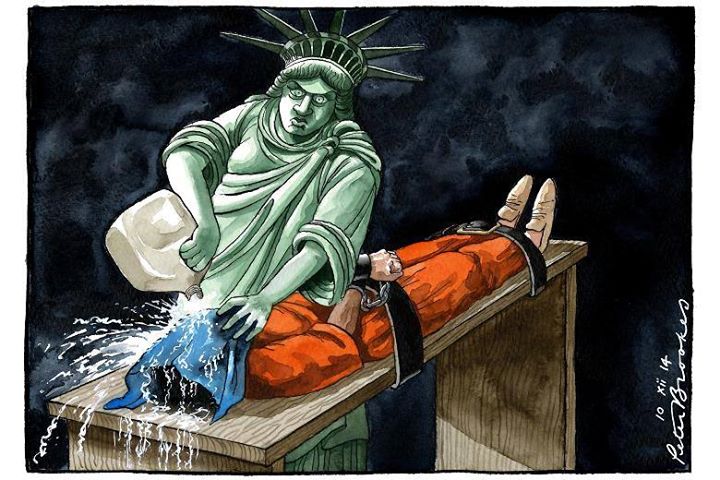
 America Waterboards

No, bin Laden was not found because of CIA torture.[iii] In fact, the US Senate’s official investigation into the CIA’s post-9/11 Detention and Interrogation program concludes that torture yielded not a single documented case of “actionable intelligence.” If anything, the Senate Torture Report[iv] – based on the review of more than six million pages of CIA material, including operational cables, intelligence reports, internal memoranda and emails, briefing materials, interview transcripts, contracts, and other records – shows that the administration of torture has led to blowbacks due to false intelligence and disrupted relationships with prisoners who cooperated. What went “wrong”? How is it possible that despite the enormous efforts and resources invested in the CIA-led global torture regime, including the careful guidance and support by psychologists[v] and medical doctors, that the post-9/11 detention and interrogation program failed to produce a single case of actionable data? Well, contrary to the commonsense understanding of torture as a form of information-gathering, confessions made under the influence of torture produce notoriously unreliable data, and the overwhelming majority of interrogation experts and studies oppose the collection of intelligence via the use of torture. This is because most people are willing to say anything to stop the pain or to avoid getting killed and/or are simply unable to remember accurate information owing to exhaustion and trauma.[vi]

So if torture is known not work, how come, then, that in the wake of 9/11 the U.S. at the highest levels of government ran the risk of setting up a torture regime in violation of international and domestic law? Why alienate international support and exacerbate resentments against “America” with the public display of controversial incarceration practices, as in Guantánamo Bay, instead of simply relying on the existing system of secret renditions? Furthermore, in the words of a former head of interrogations at Guantánamo Bay, most of the tortured and indefinitely detained are “Mickey Mouse” prisoners,[vii] reportedly known not to be involved in or not to have any information on criminal or terrorist activity against the U.S. and its allies. Drawing on previously published work, I will explore this puzzle by addressing two key questions: What is the value of these carceral practices when they do not produce actionable intelligence? And, what are some of the affective and material economies involved in making these absurd and seemingly counterproductive carceral practices possible and desirable as technologies of security in the post-9/11 Counterterrorism efforts?

Against the exceptionalism[viii] of conceiving of these violences as “cruel and unusual,” “abuse” or “human rights violations”[ix] that indicate a return to “medieval” methods of punishment, the post-9/11 US torture regime speaks to the constitutive role of certain racial-sexual violences in the production of the US social formation. Contrary to understandings of 9/11 and the authorization of the torture regime as a watershed moment in U.S. history “destroying the soul of America,”[x] the carceral security or pacification practices documented in the Senate Torture Report and their underpinning racial-sexual grammars of legitimate violence and suffering have played a fundamental role in the making of the US state and nation since the early days of settlement.[xi] The CIA Detention and Interrogation program[xii] targeting Muslimified subjects and populations was not only shaped by the gendered racial-sexual grammars of Orientalism, but – as has been less explored in IR[xiii]is informed also by grammars of anti-Blackness, the capture and enslavement of Africans and the concomitant production of the figure of the Black body as the site of enslaveability and openness to gratuitous violence.[xiv]

Continue reading

#BlackLivesMatter, The New Black Liberation Movement

Maia PalA guest post from Maïa Pal, recently returned from San Francisco. Maïa is currently a Lecturer in International Relations at Oxford Brookes University. Her main research is on the historical sociology of extraterritorial jurisdiction and Marxist theories of international law. She also researches UK student occupations as counter-conduct in the context of a political economy of higher education, and has blogged on student protests in the UK and Québec. And you can follow her on Twitter too.


Photo by Amanda Arkansassy Harris

Photo by Amanda Arkansassy Harris

After all, if someone is lost, and that person is not someone, then what and where is the loss, and how does mourning take place?

10 years after Judith Butler asked this question in her work Precarious Life, San Francisco organisers Thea Matthews, aged 27 and Etecia Brown, aged 24, gave me some answers.[1] ‘Leaderful’, ‘sustainable’, ‘multidimensional’: “BlackLivesMatter is more than a hashtag, logo or slogan, it’s a lifestyle.” Their demands against police brutality are practical, short-term and realistic. The demands consist of ensuring enforcement, transparency, mental health awareness in training, demilitarisation, two-way accountability, and community work. ‘Police should be like fire-fighters, heroes with red trucks!’, we chuckled.

Some of these demands are already being implemented; in Portland, New York, Richmond. As public policy solutions they could be quickly put in place. Nevertheless, it is absolutely clear that such goals, however important and at the core of the movement, barely scratch the surface of the problem. BlackLivesMatter activists want to achieve long-lasting institutional change and an end to the more covert social, political and economic subjugation of black people. They explicitly revive the terms of colonisation and slavery because these do not belong to the past; an experience both organisers have observed and lived through personally. Without equal access to education, jobs, and political representation; with lower life expectancy, socially and in front of a police gun; with mental health conditions, fear and loss of hope in their humanity, black people are still in chains.

The point here is not to engage a discussion on the history and intricate forms of these processes of exploitation, white supremacy and patriarchy. Although necessary and important, this piece discusses instead resistance to these processes, and specifically to what these organisers aptly described as ‘psychological warfare’. This resistance means healing people who are suffering, have lost all power and hope for resisting, and building communities that care for each other beyond the myths of freedom, property and consumerism.

Continue reading

Confronting the Global Colour Line

Race and Racism in IR

Our edited volume Race and Racism in International Relations: Confronting the Global Colour Line has now been published. We asked some of the contributors to give us their thoughts on what has been (both deliberately and unwittingly) overlooked by the discipline of International Relations with regard to questions of race and racism; the challenges posed by (re)centring these vital questions; and how IR may atone for its implication in empire. At your service, Sankaran Krishna, Debra Thompson, Srdjan Vucetic and John Hobson.

What has been the least investigated aspect of race and racism in IR?

Sankaran Krishna

The question makes me want to laugh because to me mainstream IR is all about how not to talk about race and racism while constantly appearing to talk about the relations between different kinds of peoples and countries. I came to IR only at the PhD level. My masters in modern history had acquainted me with the history of colonialism, racism, genocide, man-made holocausts like the Great Bengal famine, the slave trade, and other such events, on a world-scale in the post-Columbian (ie; post-1492) era. In my first IR courses in the United States the focus seemed to be on how can we understand the social world through models that pretend humans are unthinking molecules or inanimate entities. Stuff like Bueno de Mesquita’s War Trap (I kept waiting for someone to tell me that was a joke, like they do on Candid Camera.) It was a few years later that I realized that the penchant for abstract theorization, distaste for historical specificity and woolly stuff like ideology, and fetish for numbers – all voiced in deep manly intonations about analytical rigor – were nothing but an assiduous refusal to face the world in all its racial violence and splendor. In other words it’s the absence of considerations of race and racism that coheres the discipline.

When you widen the frame beyond mainstream IR and include those at the margins – thinkers like DuBois immediately come to mind – and especially take into account writings over the last few decades, the picture is a lot better. From my point of view, there has been a tendency in self-proclaimed dissident literatures to be inadequately critical of the racial conditions of their own emergence: invocations of the Global South or postcoloniality or marginality or the colour line can themselves become fetishized and serve as screens preempting a closer inquiry into racial difference and the consequences of othering. Continually calling out the protean forms in which race and racism manifest themselves historically and contemporarily seems, to me at any rate, a worthwhile vocation.

What is the most important theoretical challenge to IR posed by an engagement with race and racism?

Debra Thompson Continue reading

Toward a Racial Genealogy of the Great War

dusan-bjelic-portretA second guest post in our series on The Global Colonial 1914-18 from Dušan I. Bjelić. Dušan received both his B.A. (1976) and M.A. (1981) in Sociology from the University of Belgrade and then earned his Ph.D in Sociology from Boston University in 1989, joining the University of Southern Maine Department of Sociology and Criminology in 1990. His area of interest is the colonizing application of psychoanalysis and psychiatry to the Balkans. Professor Bjelić co-edited Balkan as Metaphor: Between Globalization and Fragmentation with Obrad Savić (Cambridge, MA: The MIT Press, 2002). He has also published two books of his own: Galileo’s Pendulum: Science, Sexuality and the Body-Instrument Link, (SUNY Press, 2003) and Normalizing the Balkans: Geopolitics of Psychiatry and Psychoanalysis (Ashgate, 2011). His published works can be accessed at Academia.edu.


“Just as there is no wedding dinner without meat so there is no war without slaves.”

Serb soldier on the Balkan Front.[1]

A man was looking for something he had lost under the street lights; another man, the joke goes, approached and asked him what he was looking for. “I am looking for my lost keys,” “Did you lose them here?” “No,” the first man responded, “I lost them on the dark side of the street.” “But, why are you looking here?” “Because this is where the light is.” This joke illustrates well the paradox of the national paradigm in European historiography of the Great War. The assumption that the European sovereign nation is the sole agent of modern history naturally motivates European historiography to frame the Great War within a national paradigm and foreclose its colonial dimension. A related trope to the above joke pertains to race and its relation to the national histories of Europe; the black face of a slave, according to Frantz Fanon, can be seen during the night only under the porch light of the master, but when the slave goes into the dark his face becomes invisible. The deployment of colonial soldiers in the Great War as “warrior races” or, “martial races” to fight on behalf of their masters, and the absence of the Black history of slavery from the history of the Great War is in fact the history written from the master’s porch. While the invisibility of the black face foreclosed Black history from the national paradigm of the Great War, it was nonetheless useful as a racial weapon in the war.

By deploying almost a million non-white troops in the European theater of war—France’s 500,000 Africans and Asians, Britain’s 200,000 Indians and Africans, America 200,000 black soldiers, Germany’s 11,000 Africans (only in East Africa)—race was used as a “weapon of war” to advance an unprecedented slaughter among the white nations. [2] R. J. Vincent socked it to the revisionist historians when he wrote, “not only were the whites laying to rest the notion of their instinctive comity by butchering each other in such unprecedented numbers, but they were also showing their neglect of race in favour of nation in using non-white troops to advance the slaughter.”[3] Those historians committed to the national paradigm acknowledge the contribution of colonial solders in the Great War only as an auxillary force rather than as the point of the return of race as the constitutive violence of European Modernity. Many of the former slaves forcefully recruited and disciplined as racial instruments of forced labour, punishment and extermination became the site of colonial violence and operated as a microcosm for the War. The colonial soldier was the cause and the consequence of the Great War. Continue reading

The Global Colonial 1914-18: A mini-series

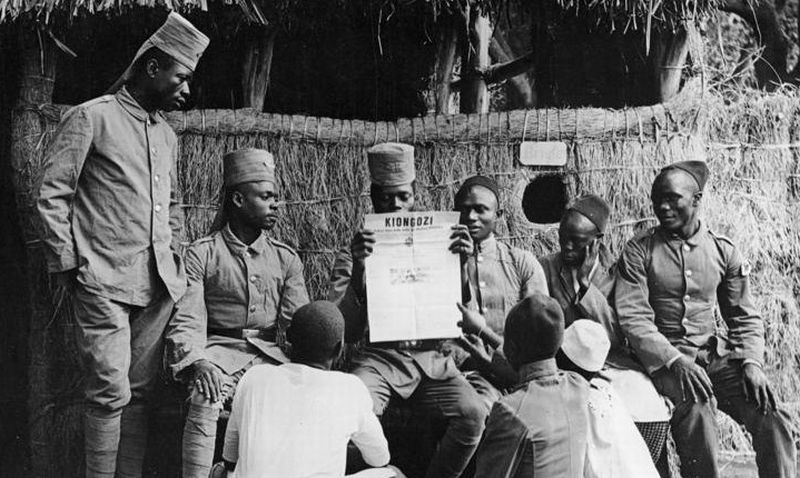
Askaris fighting for Germany listen to the news.

Askaris fighting for Germany listen to the news.

The Disorder of Things hosts a short series of posts connected to the event ‘The Global Colonial 1914-18‘, held at SOAS on 18th September 2014, and co-organised by the Colonial / Postcolonial / De-colonial Working Group of the British International Studies Association.

Our first post is by Lucian M. Ashworth, who discusses the breakdown of the colonial armed peace, as viewed by contemporary observers.

Our second post is by Dušan I. Bjelić, who offers a racial genealogy of the Great War.

Our third post is by Meera Sabaratnam, who suggests a contrapuntal reading of the war based in colonised Mozambique.

Our fourth and final post contains a transcript and video of the public roundtable which took place at the end of the day, featuring Hakim Adi, Catriona Pennell, Parmjit Singh, Martin Spafford and Charles Tripp, in which the colonial dimensions of the war are discussed, as well as their implications for teaching and commemorating the period today.

This post serves as a permanent link for the series.