Looking Beyond Spring for the Season: Common and Uncommon Grounds

This is the second part in a series of five posts from Siba Grovogui, Professor of International Relations and Political Theory at John Hopkins University. The first part is here. The series will consider the character and dimensions of the tension between the African Union and ‘the West’ over interventions in Africa. Responsibility for visuals adheres solely to Pablo K.


As I indicated in my last post, the decision by the African Union (or AU) to not endorse the current military campaign in Libya has been mistaken by many observers and commentators alternatively as a sign of African leaders’ antipathy to political freedom and civil liberties; a reflexive hostility to former colonial powers, particularly France and Great Britain; a suspicion of the motives of the United States; and more. The related speculations have led to the equally mistaken conclusion that the African Union is out of step with the spirit of freedom sweeping across the Middle East and North Africa (or MENA). The absurdity of the claim is that the only entity that imposed any outline of solution agreeable to Gaddafi has been the African Union and this is that Gaddafi himself would not be part of any future leadership of the country. But the AU has insisted on an inclusive negotiated settlement. The purpose of this series of essays is not therefore to examine the meaning and implications of the absence of ‘Africa’ on the battlefield of Libya, but to point to the larger geopolitical implications of the intervention for international order, global democratic governance, and the promotion of democratic ideals and political pluralism in the region undergoing revolution and beyond.

To begin, it is not just ‘Africa’, ‘African indecision’, and ‘African non-Normativity’ that are at stake in the characterization of African actions or inactions. Much of what is construed as ‘lack’ or ‘absence’ in Africa is also intended to give sustenance to the idea of the indispensability of the West – composed on this occasion by France, Great Britain, the United States, and tangentially Canada – to the realization of the central ends of the MENA Spring. The myth of the centrality of the West to the imaginary of freedom everywhere is inscribed in the name given to the events under description. In the US at least, the Arab Spring evokes many other ‘Springs’ all located in the West (including the 1968 Prague Spring or the 1989 collapse of the Soviet Union and its satellite states). Likewise, ‘Jasmine’, the emblem of the Tunisian revolt has been advanced as evocative of the Ukrainian ‘Orange’ and other colour-coded European events. These allusions have justifications but they are seldom evoked comparatively to elucidate the originality and specificity of the MENA revolutions. In this latter regard, even the suggestion of an Arab Spring assumes that the majorities in the countries involved are Arab. This is not always the case in North Africa but Orientalism obliges!

The fact is that the ongoing revolutions in MENA are at once specific and universal in their own ways. Continue reading

Racist Lies, Oslo Edition: Jihadists, Lone-Wolves, and the Far-Right

Last week (Friday 22 July), a man brought a brutal plan to its grim conclusion in Oslo and Utoeya. After years of festering in resentment and roiling with anger, he worked up the conviction to act on his beliefs. He methodically worked out how to make and plant a home-made bomb. He coldly calculated an ambush of young women and men participating in a political summer camp.

He detonated his car bomb and killed 8 people, as well as damaging the prime minister’s office and several buildings in the area. While the city reacted to the terrifying scene, this man calmly made his way to a summer camp on the island of Utoeya dressed as a policeman, armed with an automatic rifle and enough ammunition to carry out an hour-long attack on the residents of the camp. He killed 68 people before surrendering.

Lie No. 1:

As shocking as the attack in Oslo was, it was apparently less shocking than the identity of this angry and violent man. Right-wing media outlets predictably lead with the unconfirmed story that the attack was carried out by Jihadists. But even mainstream commentators and more responsible media outlets ran with the Islamic terror story without evidence and have pushed the angle even after it was revealed that the perpetrator was a white, Christian, “nationalist” from Norway.

Why did the press so quickly and thoroughly misrepresent the story? We can talk about a knee-jerk response or blame faulty reporting, but there’s a simpler and more troubling dynamic at work here. That answer is that “we” expect angry and violent men committing these type of attacks to be Muslim, non-white, non-European.

Even as the true perpetrator of last Friday’s attacks was found and his own racist views made public, the media and the public struggled to accept and understand Anders Breivik because of their own entrenched racism. The hands that commit such violence are supposed to be brown hands, hands that pray to a false and violent God, hands raised in angry protests in far away countries, hands reaching out to choke white victims. Our image of violence reveals the violence of our images.

The blithe accusation of Muslim extremists and the immediate belief that the attacks in Oslo must have been perpetrated by Al-Qaeda, or some other shadowy network, reveal how deeply racist narratives are embedded in “our” understanding of the world.

Continue reading

A Kind Of Blank Spot

[M]y wife and I realized you cannot pay attention to everything, so I said to myself “one continent that I am going to leave aside is Africa.” I preferred to concentrate on Europe and China. I did a pretty good deal of work on China because I saw it ripe to become one of the most important parts of the world of which I knew nothing. So, I proceeded to do a lot of work on China in order to know something about it. But Africa is kind of a blank spot for me, apart from casual observation. Even though, I would say that the whole notion of anarchy applies very well to Africa.

In fact, a criticism people used to make to me was that Africa was clearly an anarchic arena, and yet African states did not fight much among themselves. How, then, would a Realist like myself explain that? Well, I did by invoking Turney-High’s book in anthropology, which was published—I believe—in the 1920s. There, he made the very valid point that countries have to obtain a certain level of self-consciousness as being a political entity, and a certain level of competence before they are able to fight one another. Turney-High’s illustration was very clear with his study of the peoples he referred to as the “Californians,” who were such a primitive people that they did not have the ability to form groups or fight as a group. A consciousness and competence at a certain level is needed before a group is able to systematically impose on another group—whether in the form of warfare or in other ways. I think that, for a long time, Africa was in that condition, and that, as it proceeds away from that condition, African countries will be able to fight wars against one another. In a historical sense, though, that is an implication of advancement.

Kenneth N. Waltz, ‘Theory Talks #40: The Physiocrat Of International Politics’, 3 June 2011

Race, Gender and Nation in ‘Game Of Thrones’ (2011)

Mostly garlanded by images poached from Winter Is Coming, Bitches. Also, *spoiler alert*. And now subject to discussion in a critical post by Charli Carpenter over at Duck Of Minerva.


At first sight, Game Of Thrones offers something rather different to the standard fantasy fare. Where Lord Of The Rings and its ilk deal in arch dialogue and grand quests, it provides a more gritty and twisted landscape, peopled with dwarves, bastards, spoilt brats, noblewomen who still breast-feed their near-pubescent sons, eunuchs, exiled criminals and incestuous twins. In one conversation, Baelish and Varys even discuss a Lord who enjoys sex with beautiful cadavers (fresh ones only). A fantasy not only of palaces and mystical objects, but also of the gutter.

There is a near-scandalous thrill to this aesthetic realism, especially when measured alongside the allegoral formality of The Chronicles Of Narnia or the cinematic marathons derived from Tolkien’s high Toryism. Where those source materials and corporate cinema required that sexuality be wrapped in chaste folds and circumvented as the higher union of pure love, Game Of Thrones can indulge lust, rutting and the explicit mention of rape. There’s even talk of homosexuality (although not for any of the linchpin characters with whom we are expected to identify). Bared breasts are the order of the day. Childhood tales filtered by HBO.

But this apparent radicality doesn’t go very deep, and in significant ways covers for a narrative saturated with race-thought and misogyny. Continue reading

What We (Should Have) Talked About at ISA: Poststructural and Postcolonial Thought

…(drumroll)… We are collectively joyous at being able to introduce a new contributor to The Disorder Of Things: Robbie Shilliam, currently at the Victoria University of Wellington and author of a slightly staggering array of critical texts (on the impact of German intellectuals on IR; the Black Atlantic in modernity; the Haitian Revolution; race and sovereignty; and the imperatives of decolonial thinking, among others). Cross-posted at Fanon/Deleuze.


At the recent ISA conference in Montreal, I participated in a lively, weighty and difficult roundtable on postcolonial and poststructural approaches to International Relations. Alina Sajed had supplied the panellists with a provocation by way of refuting Dipesh Chakrabarty’s famous injunction that Europe was the inadequate and indispensible to frame the epistemological constellations of “modernity”. Sajed challenged the panellists to debate whether Europe was in fact dispensable as well as inadequate. There was certainly a spectrum of opinions given and positions taken on the function, possibility and desirability of the relationship between poststructural and postcolonial approaches. As a form of reflection I would like to lay out some thoughts by way of clarifying for myself what the stakes at play are in this discussion and where it might productively lead.

For myself I do not read the Europe that Chakrabarty considers in terms of the historical expansion and exercise of material colonial power. I read it in terms of a fantasy that captures the imagination. At stake is a conception of the whys, hows and shoulds of people suffering, surviving, accommodating, avoiding, resisting and diverting the colonial relation and its many neo- and post- articulations. In this particular respect, I take Frantz Fanon’s position and agree with Sajed: “Europe” must be dispensed with. In any case, as Ashis Nandy has shown, the monopolisation of the meaning of Europe by a fascistic figure (rational, male, hyper-patriarchal, white, civilized, propertied) has required the re-scripting of the pasts of peoples in Europe and a concomitant distillation of the traditions of European thought themselves so as to accord to this fantasy figure. Europe is a fantasy through and through, but one that damages different peoples with different intensities. And those who look in a mirror and experience no significant cognitive dissonance when they proclaim “European” can still count themselves, to different degrees, as being a thoughtful protagonist in a contested human drama. For others, there is only the promise of living this drama vicariously through the thought of others. That is why “Europe” is dispensable, even though for some peoples Europe has never been indispensible; regardless, it must be dispensed with.

Let me explain a little more what I mean by all of this. Europe is first and foremost a sense of being that constructs its empathy and outreach in terms of a self whereby all who cannot intuitively be considered of European heritage are categorized into two entities. First, they might be the “other” – foils to the understanding of the self. Their emptied presence is to be filled as the verso to the internal constitution of the European self. If they are lucky, they are given a kind of non-speaking part in the drama. In fact, they usually are lucky. Much critical European thought – and certainly almost all of canonized European thought – speaks volumes about the ”other” but only so as to fill in the European “self” with greater clarity.

Second, they might be the “abject” – the entity that is impossible for the self to bear a relationship to, although even this impossibility will be instructive to the inquiring European self. Abjects, under the European gaze, are reduced to a primal fear out of which an intensity of feeling is engendered that wills the drama of human (European) civilization. Defined in excess to the other/abject, the internal life of the European self can substitute itself for humanity at large in all times and spaces, and develop itself as a richly contradictory being that overflows its meaning and significance.

I do not know whether other colonialisms predating and contemporaneous to the European project matched this audacity. And in a significant sense, it really does not – and should not – matter. After all, the lure of making comparison is the precise methodology through which the European self overflows to define all others by a lack. I do though want to hazard a particular claim at this point, which might or might not bear up to scrutiny: the prime “others” of European colonialism were the indigenous peoples of the Americas. And while we owe much to Kristeva’s work on the term, the prime “abjects” of European colonialism were the enslaved Africans bought over to the Americas.

Continue reading

What We Talked About At ISA: Critique in Anti-Colonial Thought: Fanon and Cabral as Philosophers of Being, knowledge and ethics

I saw folk die of hunger in Cape Verde and I saw folk die from flogging in Guiné (with beatings, kicks, forced labour), you understand? This is the entire reason for my revolt.”.[1]


I sincerely believe that a subjective experience can be understood by others; and it would give me no pleasure to announce that the black problem is my problem and mine alone and that it is up to me to study it…Physically and affectively. I have not wished to be objective. Besides, that would be dishonest: It is not possible for me to be objective.”.[2]

For some time, I have been preoccupied by the connections between the ways in which we see, analyse and interpret the world, and the forms of political action to which this gives rise. In general, for critical social theory, the challenge is how to think about the world such as to understand and overcome structures of injustice or violence in it.  As a particular instance of this, the anti-colonial movement of the middle part of the twentieth century provides much food for thought, not least when so many point to patterns of colonialism and imperialism in world politics today.

In the paper I presented to the International Studies Association conference a few weeks ago, I offer a particular reading of Frantz Fanon and Amílcar Cabral as philosophers of being, knowledge and ethics.  Commonly, but not exclusively, these two figures are understood as having important things to say about revolt and resistance – Cabral is portrayed as the arch-pragmatist who emphasises the need for political unity and realistic objectives, whereas Fanon is frequently engaged for his affirmative treatment of violence in an anti-colonial context.  In this sense, they are largely approached as political thinkers and activists rather than philosophers per se.

Yet, their systems of thought stem from distinctive, and in important ways shared, philosophical commitments on the nature of being (ontology), ways of constructing knowledge (epistemology) and the ethical foundations of engagement (um, ethics). These foundations are strong, coherent and compelling points of departure and important in terms of understanding what kind of future order they envisaged.  What are these, and how do they support an anti-colonial political programme? What is the relevance of this intellectual legacy today? Continue reading

What We Talked About At ISA: The Monstrous Masculine: War Rape, Race/Gender, and the Figure of the Rapacious African Warrior

If there is something in these utterances more than youthful inexperience, more than a lack of factual knowledge, what is it? Quite simply it is the desire – one might indeed say the need – in Western psychology to set Africa up as a foil to Europe, a place of negations at once remote and vaguely familiar in comparison with which Europe’s own state of spiritual grace will be manifest.

Chinua Achebe, ‘An Image of Africa’ (1978)

Sometimes it seems that we’re merely Constructions made out of yarn, paper & wood with threads rising from our toes and fingertips. We pretend to talk and act as though we were alive but actually we don’t have any choice in the matter. Some secret power directs us.

Evan S. Connell, The Diary Of A Rapist (1966)

1. Rape, Ultra-Violence and Beethoven

When we speak of men in feminism, we might speak generally or specifically, of properties of maleness and masculinity or of things done by particular men (and usually some combination of the two). What is at stake is the distinction between masculinity as a set of internal properties and as a set of relational, and hence contingent, ones. Although this can be taken as denying any substance at all to that category ‘man’, it is perhaps just as well to say that we all build our own subdivided orders of maleness – from men we know, knew, or think we are; from our salient models of true and false and ambiguous masculinity; from the postures and poses we take as appropriate towards them; and from the frames we adopt for dealing with variety, with all the space for the exemplar, the exception, the masquerade and the average that they bring.

The monstrous masculine is one such model, or rather a set of models united by family resemblance. An object of horror, the monstrous masculine is a repository for tropes that identify the hideous excesses and obscene pleasures of maleness. Channelling Barbara Creed (and some Sjoberg and Gentry), it is a set of tropes and themes in our imaginaries of social action, frequently evoking, among others, ideas of a limitless and aggressive sexuality, a cold and calculating self-regard and/or a submerged, if frequently actualised, hatred of women and Woman that borders on the instinctual. In accounts of wartime sexual violence, this figure of the rapacious warrior (usually African) comes to be represented in terms of the calculating soldier-strategist (who chooses rape as a hyper-efficient means to an accumulatory end); the angry soldier-rapist (expressing a deep desire and sexuality); or the habitual soldier-ritualist (enacting the memes and symbolic imperatives of a community, culture or even race).

Think of the figure of the unreason-laced psychopath rapist, whether in the version Joanna Bourke examines as the ‘rapacious degenerate’ or that which Susan Brownmiller addresses as the ‘police-blotter rapist’: “[t]he typical American perpetrator of forcible rape…little more than an aggressive, hostile youth who chooses to do violence to women”. Such protagonists are common in popular representations of rape. In A Clockwork Orange, Alex and his droogs prowl the streets and lanes of town and country, opportunistically submitting the unlucky to attacks driven by a relentless juvenile machismo. And in the scandalous Irréversible, rape is also the product of a subterranean drive. ‘Le Tenia’ does not even search his victim for money as an afterthought – his priorities are only to enact his spontaneous lust and be called ‘daddy’ as he does so.

The monstrous masculine unites conceptions and intimations of masculinity as pathology. This is the Real of a “terrifying dimension, as the primordial abyss which swallows everything, dissolving all identities”. Put otherwise, it embodies in its most psychoanalytic inflection the idea (following Nick Cave) that the desire to possess her is a wound.

Continue reading

Martin Luther King as an international thinker?

Monday 17 January marked the official US holiday honoring Martin Luther King, Jr. While watching Monday’s Democracy Now! program, featuring substantive excerpts from King’s speeches,  the clarity with which he connected the domestic fight for equality to international politics, in particular poverty and war, struck me. The international aspects of King’s thinking, I believe, are important for two reasons.

King’s Radicalism

First, it challenges the interpretation of King as an insufficiently radical leader offered by some critics, and the co-option of King’s legacy not only by “moderate” liberals but also by conservative political figures in the US. King has become a symbol in the public consciousness of a safe reformism and a favorite icon for the type of liberal who abhors radicalism above any other political sin. As Michael Eric Dyson says, “Thus King becomes a convenient icon shaped in our own distorted political images. He is fashioned to deflect our fears and fulfill our fantasies. King has been made into a metaphor of our hunger for heroes who cheer us up more than they challenge or change us.”

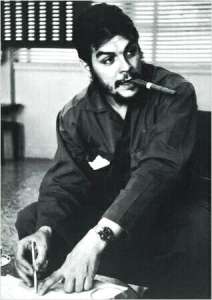
A personal anecdote to illustrate the point: a couple of years ago while handing over the editorship of Millennium to the incoming editorial team, one of the new editors commented on the large poster of Che Guevara that hangs on the Millennium office door. The Che poster, so far as I know, predates most of us currently associated with the journal, therefore I suggested it should stay. I then asked why Che should go. My colleague suggested that Che’s participation in revolutionary violence made him an inappropriate icon – in many academic disciplines this might be a rather devastating point, but International Relations is full of characters far more violent and less admirable than Comrade Che – see Paul’s post on Kissinger, for example.

When asked who might better grace the walls of the office my colleague suggested Martin King or Mohandas Gandhi (a political figure subject to a similar post-hoc liberal deification), with their key qualification as acceptable iconography being that they had not participated in political violence. While I have a great deal of sympathy for non-violence, my own introduction to both King and Gandhi came through the study of non-violence political strategy, the liberal (and I think my colleague would gladly accept that identification) embrace of King or Gandhi, paired with the repudiation of Che, is (unintentionally?) disingenuous.

It’s a disingenuous embrace because it insists that the first rule of acceptable political action is a renunciation of physical violence, while at the same time turning a blind eye to the violence institutionalized in the state through everyday police brutality and legalized/legitimized imperial warfare, as well as the structural violence inherent to global capitalism. This misses the radical content of non-violence as practiced by King and obscures the link that exists between non-violent agitation and armed resistance. The political commitments and motivations of King and Che are remarkably similar, even as their fundamental orientations (Marxism vs. Christianity) and tactics (non-violent direct action vs. guerrilla insurgency) diverged. Continue reading

Rape & Rape Prevention: A Cod-Evolutionary Perspective

Rape is an evolutionary adaptation. More than that, it now appears that anti-rape strategies are evolutionary too, which for women means increased strength at certain stages of the menstrual cycle, increased general distrust of men and hatred of black men in particular. Taking Darwin in vain, this is the argument put together by Jesse Bering at Slate.

We should probably start by getting our definitional house in order. In an admirable example of rigging the answer by misspecifiying the question Bering names rape as “the use of force, or threat of force, to achieve penile-vaginal penetration of a woman without her consent“. So men are biologically incapable of being raped, women incapable of raping, and the sexual-reproductive organs the only legible site for sexualised aggression (no anal here please!).

Hardly surprising, given this terminological firing gun, that rape emerges as a phenomena only comprehensible in procreational terms. This is a narrower agenda even than saying that it is somehow ‘evolutionary’, itself already less than saying it has something to do with ‘biology’ (the possibility of rape being about ‘sex’, socially understood, or ‘power’ stands at yet further removes).

The quality of proof offered doesn’t fare much better. Take the study on racist attitudes and menstrual cycles, results we’re at risk of ignoring with our rampant ‘political correctness’ (*yawn*). Turns out women from this sample (77 white undergraduates) scored higher on fear-of-rape metrics of black men when they were most vulnerable biologically to impregnation. Bering takes this as supporting an evolutionary adaptation against ‘out-groups’, although he concedes that ‘cultural transmission’ may play a role.

The study itself suggests something rather less conclusive. It found that implicit race bias (non-conscious stereotyped associations of the form ‘black-physical’) was much more strongly correlated with rising fertility than explicit bias. Its metrics for race bias were all clearly consistent with a sociological or interpretive account of race (which is to say that race is a social, not a biological category, and that its meaning is historically and politically determined, not the outcome of adaptive ancestral behaviour). The data is also somewhat partial, as its relation to some wider questions. There is no comment on the fact that, for example, race bias remains fairly pronounced even where there is no ‘conception risk’, nor any significant attempt to cite work on general levels of race bias in general populations as a comparator or to examine variation among degree of bias in the women studied and the possible sources for those differences.

Continue reading