Human Rights Contested – Part II

This is a continuation of my previous post

Who Are Human Rights For?

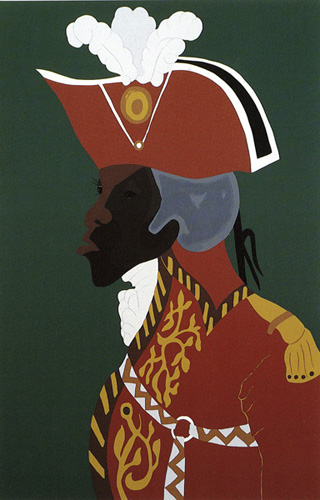
All of the authors take account of the ambiguous history of human rights, in which they can be said to have inspired the Haitian, American and French revolutions, while also justifying the counterrevolutionary post-Cold War order dominated by the United States. Yet recognising this ambiguity without also acknowledging the distinctive reconstruction of contemporary human rights that makes them part of a neo-liberal international order and the unequal power that makes such a quasi-imperial order possible would be irresponsible. A primary contribution made collectively by these texts is that they clearly diagnose the way human rights have been used to consolidate a particular form of political and economic order while undercutting the need for, much less justification of, revolutionary violence. Williams says of Amnesty International’s prisoners of conscience, who serve as archetypal victims of human rights abuse,

the prisoner of conscience, through its restrictive conditions, performs a critical diminution of what constitutes “the political.” The concept not only works to banish from recognition those who resort to or advocate violence, but at the same time it works to efface the very historical conditions that might come to serve as justifications – political and moral – for the taking up of arms.

Human rights, then, are for the civilised victims of the world, those abused by excessive state power, by anomalous states that have not been liberalised – they are not for dangerous radicals seeking to upset the social order.

Continue reading

And there will be the most beautiful silence never heard

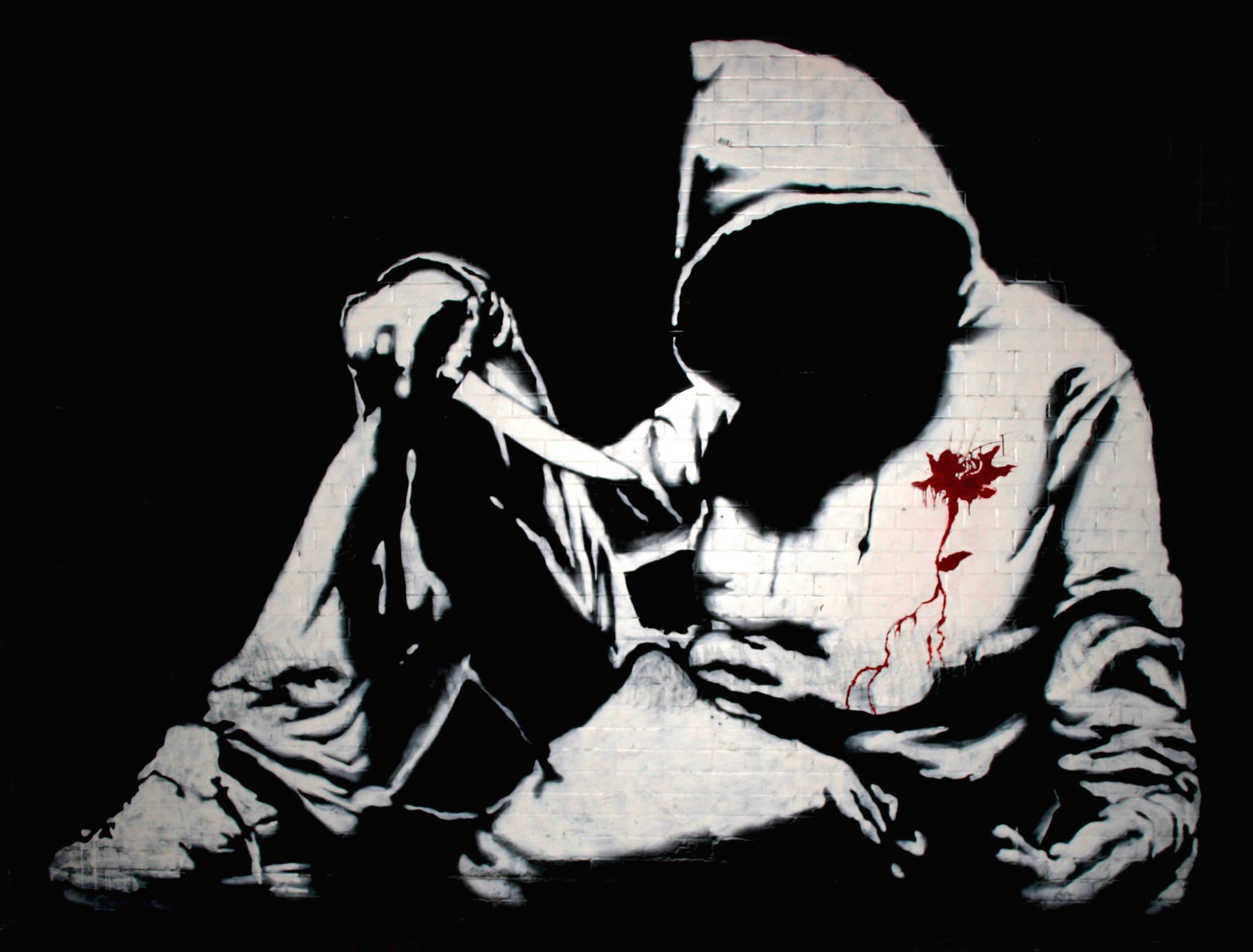
Dinosauria, We

Born like this
Into this
As the chalk faces smile
As Mrs. Death laughs
As the elevators break
As political landscapes dissolve
As the supermarket bag boy holds a college degree
As the oily fish spit out their oily prey
As the sun is masked
We are
Born like this
Into this
Into these carefully mad wars
Into the sight of broken factory windows of emptiness
Into bars where people no longer speak to each other
Into fist fights that end as shootings and knifings
Continue reading

Dalston: A Worm’s Eye View

(…cheers…) Please welcome, in your traditional way, the latest in the expanding list of Disorder-ed contributors. Rahul Rao, currently Lecturer in International Security at SOAS, author most recently of the fascinating Third World Protest: Between Home and the World, as well as a number of articles on cosmopolitanism, world order and empire. He is currently working on projects aimed at provincialising Westphalia and introducing queer theory to IR.


There is a great deal that I don’t understand about the world, but I do know a little about that part of it where the Kingsland Road becomes Stoke Newington Road (London N16/E8, if that’s how you work). As the dust clears from what BBC Panorama recently called The August Riots – as if to distinguish them from those to come in September, October, November and December – it is difficult to walk around without wondering whether everyone is judging everyone else on the basis of age, race, class and sartorial preference. Multiculturalism in Dalston can sometimes feel like a polite version of separate-but-equal with the hipsters (mostly white, but equal opportunity for those with the right facial hair, skinny jeans, loafers with no socks, university education, fixie bikes and Apple accoutrements) patronising hipster cafés, the Turks hanging out in members-only social clubs, the Caribbeans in venues such as Open the Gate. Everyone goes to the Turkish restaurants, but gastronomy has always been the least challenging site for racial mixing. As gentrification has proceeded apace – a phenomenon driven by middle class professionals like myself – I cannot help but notice that Dalston Superstore is always full and the Caribbean restaurant in Centerprise (East London’s oldest and most famous black bookshop) often empty. (Oddly, the spell check on this blog thinks that the word ‘gentrifying’ does not exist and suggests replacing it with ‘petrifying’. There might be something to that.)

On August 8 when the riots reached Hackney, Dalston hit the headlines as the place where the riots caused little damage, its Turkish and Kurdish business owners much feted for their role in beating back the rioters. I have to confess to an immediate reaction (always a betrayal of one’s class identification) of gratitude to a local community of people who trusted and knew each other well enough to work together at a moment’s notice – a community to which I do not belong, but on whose efforts I was able to free-ride (like Zoe Williams, I watched these events on a live feed, it never having occurred to me that I could have gone on to my high street to defend anything). In the cold light of dawn, second thoughts: when the facade of the Leviathan had cracked, security had become a function of ethnic solidarity. Welcome to Sarajevo.

The reaction of the local business owners in Dalston poses two questions. Continue reading

Primitive Accumulation; Or, A Virtual Read-In on the London Riots

The blogosphere has a million corners, countless nooks and several large echo-chambers, complete with their own centres of self-congratulatory gravity. All have been aflame over the last week, saturating events, riots and insurgencies with the weight of historical expectation, the political memory of past iteration and the awesome condescension of easy interpretation. Gaps persist: gender and the dynamics of formally opposed masculinities have escaped all but the most cursory attention. It is one paradox of all this profuse commentary that decrying the statements and manifestos of others is the most satisfying and patronising manifesto of all. At its worst, it engages in the fullest of narcissisms (let’s make this about us and the quality of our analysis) whilst proudly displaying its contempt for thought (now is not the time for theory!). And of course, the problems and challenges are real. Much more real than we can face, too real for the sordid postures of moralising (I denounce Satan and all his works!) and liable to stay as real once we paper over them and return to our default settings.

Oh, and I find myself in unsurprising agreement with Joe and Meera (although I think Ken Livingstone’s attempts to make the link to cuts and social marginalisation is more ham-fisted than shameful). Which is all by way of introduction. There are reams to be written on the way the punditocracy and assorted commentariat are deploying (and misapplying) categories of cause, the unstable and multiple uses made of ‘politics’, the questions of historical precedent and historical return, and on and on. Exhaustion at the war of position prevents any such post. Instead, a mix-tape of diagnosis and critique, with both the smooth joins and the subtle dissonances that implies. More useful than a 1,000 faux-fresh words.

—————–

These looters are doing what they’re supposed to; grabbing the goods they see in the shops and can’t buy in a recession. They loot the bling – the sports shoes, gold watches, mobile phones and plasma TVs; and you can recognize the very poor when you see a woman looting potatoes from a corner shop. These acquisitive looters are certainly copying the gold standard of a social contract eroded by and evaporating with the money. These are riots in the cause of consumer goods. Burning and robbing other people’s things is one thing, but soon enough, and with no social cause or justice worth the name, people too become indistinguishable from things: witness the widely-circulated photo of the woman leaping for her life from a burning building; such potential deaths still threaten to bring the house down on top of us. This whole distressing episode began with the police shooting dead a black man in north London they said was a gunman; no evidence he fired a shot, we’re told, but the man was already indistinguishable from his gun.

Gabriel Gbadamosi, ‘The Blazing Light In August’

Continue reading

Reading violence: what’s political about the London riots(?)

To reiterate somewhat, there is a politics to these riots. Panicking, political leaders and many others, have queued up to deny this, labelling it “pure violence,” “criminality, pure and simple“, or “mindless violence“. Over and over again, the distance between the rioters and the ‘community’ or ‘Londoners’ has been set up and reinforced. This is not without some public backing. After all, many Londoners are, rightly, angry, frightened, upset, frustrated, shocked and saddened by the sight of homes and businesses not just smashed but burning voraciously into the night whilst looters showed off their new gear. We were a world away, it seemed, from the specific, dignified, coherent demands for justice being made by Mark Duggan’s family and their supporters. Many asked themselves: what do they want? The answer seemed to be: trainers. What could be political about stealing from Foot Locker?

First things first. This post is not about constructing a narrative of social apologia via moral determinism – i.e. the idea that people couldn’t help themselves, or were bound to do it by their economic status etc. Between this and the ‘mindless violence’ line of argument, there are plenty of fools (sadly many, powerful, wealthy, and in charge of your country) trading in pretty stupid accounts of human behaviour and social causation. Continue reading

The Politics of Austerity: Emergency Economics and Debtocracy

austerity |ôˈsteritē| noun – sternness or severity of manner or attitude
It was possible, therefore, to commit a sin without knowing that you committed it, without wanting to commit it, and without being able to avoid it. Sin was not necessarily something that you did: it might be something that happened to you.

– George Orwell, “Such, Such Were the Joys”

Why what have you thought of yourself?

Is it you then that thought yourself less?

Is it you that thought the President greater than you?

Or the rich better off than you? or the educated wiser than you?

 I do not affirm that what you see beyond is futile, I do not advise that you stop,

I do not say leadings you thought great are not great,

But I say that none lead to greater than these lead to.

– Walt Whitman, “A Song for Occupations,” Leaves of Grass

The Politics of Austerity – Part I

This is the first in a series of posts that look at the political implications of the ongoing global economic crisis. I begin by examining the way that crisis is being used to attack the very idea of democracy through an assertion of the political imperatives of “the market” and the violation, bending and re-writing of the law by capitalist elites. I conclude by laying out how understanding the economic crisis in political terms shapes our ability to respond to it.

In the second post I’ll look at the ethos of austerity, which justifies the pain inflicted on largely innocent people, while suggesting that an affirmative democratic response to the economic crisis must begin with its own ethos, which I suggest should be an ethos of care for the world – which can provide orientation and inspiration for political struggles seeking to address the deeper causes of our current crisis. In the third post, I turn to the structures of the economy and of politics that define the current crisis, looking at the banking crisis, the bailouts, the politics of recovery/austerity and also reflecting of the structural imperatives of capitalism that led us to crisis. This, then, leads to the question of how to respond to the politics of austerity, and of what alternative actions are available to us, which is where the fourth and final post will pick up – with an affirmation of a caring ethos that supports a radically democratic economic vision.

Emergency Economics

In a previous post I briefly highlighted Bonnie Honig’s work, Emergency Politics, to examine the way that the ethical case for austerity is made; most basically, the existence of a supreme emergency, in this case economic, justifies actions that would normally be considered unacceptable. Honig’s work looks at how the appeal to emergency is used to reassert the exceptional political power of the sovereign over and against the law, with a focus on the reassertion of sovereignty witnessed over the past ten years in response to the threat of terrorist attack in the US and Europe.

Rather than accepting the necessarily intractable conflict between the power of the sovereign and the power of the law, Honig attempts to deflate this paradox by turning her attention to the always ongoing contestation that defines democratic politics, a contest over both the content of the law and the institutional embodiment of sovereign power. She suggests, then, that attending to the ambiguities of the “people”, who are both the democratic sovereign and a diffuse multitude, as well as the political element in the law – as new laws come into being through political action – enables us to avoid thinking about emergencies as moments of exception in which the rule of law is lost to the play of political power, while also acknowledging the limits of established law in moments of profound crisis. By undermining the exceptional nature of crises and emergencies Honig alters the challenge we face when circumstances force us to make choices or carry out actions we know are harmful and wrong by asking what we (democratic publics and citizens) can do to survive an emergency with our integrity in tact.

What do we need to do to ensure our continuity as selves and/or our survival as a democracy with integrity? Our survival depends very much on how we handle ourselves in the aftermath of a wrong. We will not recover from some kinds of tragic conflict. But when faced with such situations, we must act and we must inhabit the aftermath of the situation in ways that promote our survival as a democracy.

I continue to find this a useful way to understand our current economic crisis. Appeals to austerity depend upon the exceptional state created by crisis in order to justify the pain inflicted upon masses of people and the priority given to private interests (the markets, investors and bankers) over democratic publics. So, as democratically enacted laws must bow before the sovereign power threatened by exceptional attacks, so economic justice and democratic equality must bow before the commands of market forces, of economic inevitability, in this time of crisis.

The economic version of this argument is stronger still. While the space of political contestation that remains open when we accept the framing of emergency politics is limited, it does exist in the clashing of opposing sovereigns. The prospect of a substantive alternative to neoliberal economic ideology is dim, a light flickering weakly on antiquated appeals for a return to Keynesianism or watered down triangulations of the moderate-middle that sell off dreams of a just economy bit by bit – capitalist realism in action.
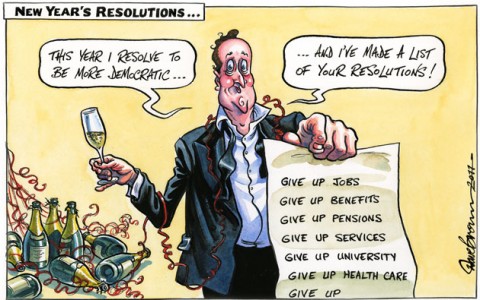
Honig awakens us to an important aspects of our current crisis: that “the market” is not in fact supremely sovereign, and the move to re-establish and further neoliberal policies and push through austerity measures requires an engagement in democratic politics – albeit one that undermines the notion of the public itself and seeks to use the power of the law to subvert democracy. Recognising the current crisis in these terms not only challenges us to consider how to survive our current troubles without giving up democratic virtues, it also reinvigorates and clarifies the political challenge we face. Emergency economics – with its assertion of debtocracy over democracy – is not an inevitable response to the crisis, it is a political one that we can, and should, fight against.

Continue reading

Martin Luther King as an international thinker?

Monday 17 January marked the official US holiday honoring Martin Luther King, Jr. While watching Monday’s Democracy Now! program, featuring substantive excerpts from King’s speeches,  the clarity with which he connected the domestic fight for equality to international politics, in particular poverty and war, struck me. The international aspects of King’s thinking, I believe, are important for two reasons.

King’s Radicalism

First, it challenges the interpretation of King as an insufficiently radical leader offered by some critics, and the co-option of King’s legacy not only by “moderate” liberals but also by conservative political figures in the US. King has become a symbol in the public consciousness of a safe reformism and a favorite icon for the type of liberal who abhors radicalism above any other political sin. As Michael Eric Dyson says, “Thus King becomes a convenient icon shaped in our own distorted political images. He is fashioned to deflect our fears and fulfill our fantasies. King has been made into a metaphor of our hunger for heroes who cheer us up more than they challenge or change us.”

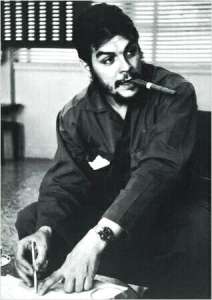
A personal anecdote to illustrate the point: a couple of years ago while handing over the editorship of Millennium to the incoming editorial team, one of the new editors commented on the large poster of Che Guevara that hangs on the Millennium office door. The Che poster, so far as I know, predates most of us currently associated with the journal, therefore I suggested it should stay. I then asked why Che should go. My colleague suggested that Che’s participation in revolutionary violence made him an inappropriate icon – in many academic disciplines this might be a rather devastating point, but International Relations is full of characters far more violent and less admirable than Comrade Che – see Paul’s post on Kissinger, for example.

When asked who might better grace the walls of the office my colleague suggested Martin King or Mohandas Gandhi (a political figure subject to a similar post-hoc liberal deification), with their key qualification as acceptable iconography being that they had not participated in political violence. While I have a great deal of sympathy for non-violence, my own introduction to both King and Gandhi came through the study of non-violence political strategy, the liberal (and I think my colleague would gladly accept that identification) embrace of King or Gandhi, paired with the repudiation of Che, is (unintentionally?) disingenuous.

It’s a disingenuous embrace because it insists that the first rule of acceptable political action is a renunciation of physical violence, while at the same time turning a blind eye to the violence institutionalized in the state through everyday police brutality and legalized/legitimized imperial warfare, as well as the structural violence inherent to global capitalism. This misses the radical content of non-violence as practiced by King and obscures the link that exists between non-violent agitation and armed resistance. The political commitments and motivations of King and Che are remarkably similar, even as their fundamental orientations (Marxism vs. Christianity) and tactics (non-violent direct action vs. guerrilla insurgency) diverged. Continue reading

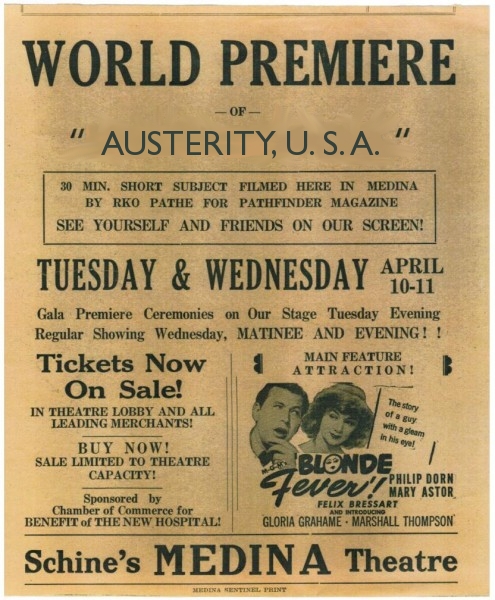
Austerity, USA

I’ve just returned from the “motherland” and bring tidings from a strange and far away place: Austerity, USA.

Gin and Tacos gave me a special gift just in time for Christmas. It seems the matriculating class of House Republicans have big plans for the country. The austerity fear mongering has reached new heights of hyperbolic cynicism as Republicans try to make it possible for states to declare bankruptcy. You can find details, with extra rage, here. The key points are that bankruptcy proceedings would allow states to renege on contracts with public sector unions and contract out public services, walk away from public sector pension obligations, and sell off public land, parks and buildings. A refutation of this obviously stupid and destructive policy, with the appropriate amount of anger and vulgarity, can also be found on Gin and Tacos, here. Finally, here’s the plan from the ideologues themselves, in case you thought we were making this shit up.

As if that were not enough to get the blood boiling, the incoming House Republicans have re-written the rules for the federal budget. The new rules will alter the current pay as you go scheme, which requires offsetting entitlement increases or tax cuts with tax increases or benefit cuts – which they did before in 2000, before the Democrats reinstate the rule in 2006. Geniuses that they are, the incoming Republican majority plans to eliminate the necessity of offsetting tax cuts – details here, and the actual new rules here. For the time being it seems that, at least in the US House of Representatives, we’ll be pretending that tax cuts do not cost money and are an effective way to cut the deficit and boost economic growth, all evidence to the contrary. When I add this to the pre-Christmas compromise on the Bush Tax Cuts, which not only extended an expensive and unwarranted tax cut to the wealthiest 2% of US taxpayers but also added an extra cut to inheritance tax as well, there is enough bad news here to push any angry leftist from thundering rage to child-like weeping. Continue reading

Ethics of Austerity 3: Cynicism, Sincerity and Fear

“You ain’t never been no virgin, kid, you were fucked from the start.”

-Titus Andronicus, “A Pot in Which to Piss

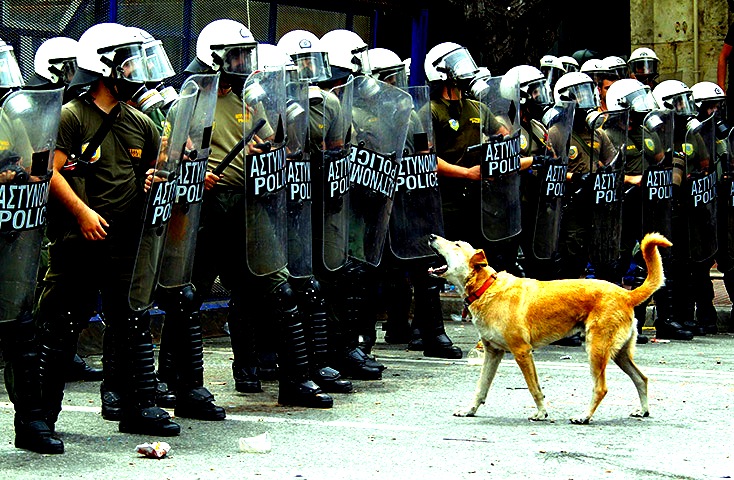
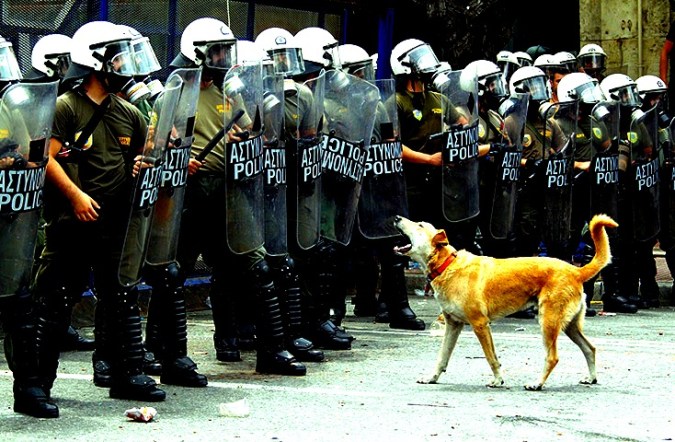
Police Vodafone protesters oxford street

Police protect Vodafone store from the threat of public exposure of truth.

And you have to wonder what it will take for serious people to realize that punishing the populace for the bankers’ sins is worse than a crime; it’s a mistake.

Paul Krugman

Of obedience, faith, adhesiveness;

As I stand aloof and look there is to me something profoundly

affecting in large masses of men following the lead of those who

do not believe in men.

-Walt Whitman, “Thought”

Hypothesis

The winter air has turned cold enough, has pressed in with its full weight, so that there is no more space for lies. The truth of crisis is that the powerful and the wealthy do not take responsibility, they assign it; they do not suffer their follies or their sins, they pay their penance in the currency of our lives.

We’ve spent the last few years living with the anxiety of impending doom, spurred on by hustlers of panic, addled prophets of economic Reformation, and Janus-faced managers of public interest.

Yet, despite the prolonged disaster-foreplay, the consummation of this crisis was always going to be “us against them” and never “we’re all in it together.” Continue reading

Inequality and the Human(e) Development Index

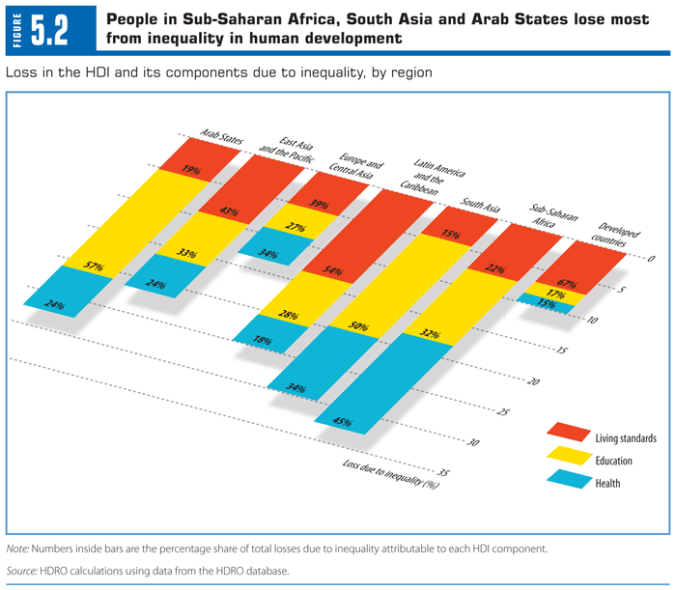
The UN Development Programme (UNDP) has for the last 20 years pioneered seemingly innovative approaches to development that have substantially redefined the terms on which development aid is conceived, offered and spent. The publishing of the first Human Development Report in 1990 was a bold move which made a case for measuring and judging countries’ developmental status in a way which focused on quality of life indicators as well as macro-economic statistics – an idea now which is completely mainstream and commonplace amongst donor governments and development practitioners.  It also proposed the notion of ‘human security‘ in 1994; a subversive response to the ‘securitisation’ agenda emerging in the wake of the Cold War which sought to broaden both the referent of security and the range of relevant concerns.  It was absolutely instrumental in pushing the Millennium Development Goals agenda – an incredibly ambitious and detailed set of targets for international development practice that served to underpin widespread agreement for the expansion of development funding across donor governments.

Its recent decision to measure inequality as a constituent part of development through its apparent role in determining the quality of life is, in this context, really interesting. On one level, it is indicative of the development community’s constant reflexivity – a term often used by David Williams – which recalibrates the tenor of its activities according to whatever the relevant crisis is supposed to be. Having been roundly critiqued and lambasted for the MDGs’ complicity with impoverishing neoliberal economic structures, we can read this ‘equality turn’ as the UNDP’s attempt to once more place itself on the vanguard of a more humane and responsive development agenda, moving itself away from the territory that the IFIs are starting to encroach upon.

It will be interesting to see whether and how the donors follow down this particular road. To a certain extent, the UNDP’s previous ‘innovations’ on human development, particularly with regard to adjusting for gender inequality, levels of absolute poverty and service provision, have all found various champions amongst western development agencies, all of whom have incorporated these issues seemingly deeply into their approaches to development, albeit perhaps through substantially de-radicalising the most substantive aspects of critique.

Inequality as an issue however poses a much more substantive threat to the international development agenda when pushed too far – not only does it cast doubt on the shining beaconof the self-made rich in the global South, but specifically, it starts to push against the foundational myth that ‘development abroad’ can be achieved with no corresponding change in the fortunes of ‘developed’ countries, a key threat to donor sanguinity and compliance with the UNDP’s more radical agendas. After all, if it is true within countries that vast inequalities impact on quality of life through skewing access to the goods that constitute human well-being, why would this also not be true between countries? The nonsense and yet widespread idea that some countries merely have to ‘catch up’ with others is belied by the inequality point but poses the much harder question for western countries and populaces to deal with: do I support international development enough to sacrifice any aspect of my own well-being?

As argued on an earlier post, the failure of highly-moralising development and anti-poverty agendas to deal at all with the central problem of inequality, both international and domestic, has been egregious and pervasive over the last 20 years, and looks to remain so in the future. The UNDP’s intervention is no doubt a timely one, although given the history of its more radical proposals, one which will probably be so watered down in practice as to be meaningless. Furthermore, by bringing this question within the competence of the ‘development’ policy specialists rather than engaging it as a public political question in ‘developing’ and ‘developed’ countries, the potential for getting to grips with the depth of this challenge seem remote.