The Offshore World

In amongst a typically judicious review of Treasure Islands and Winner-Take-All Politics, David Runciman draws a suggestive comparison between the contemporary politics of financial ‘mobility’ and the legacy of colonialism.

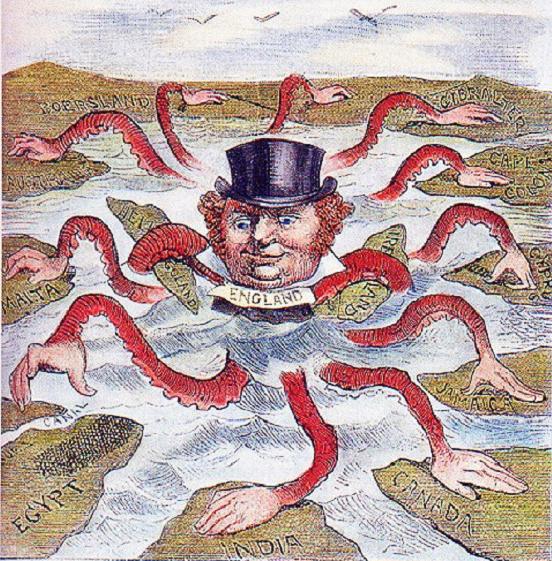
Shaxson’s book explains how and why London became the centre of what he calls a ‘spider’s web’ of offshore activities (and in the process such a comfortable home for the likes of Saif Gaddafi). It is because offshore is the offshoot of an empire in decline. It perfectly suited a country with the appearance of grandeur and traditionally high standards, but underneath it all a reek of desperation and the pressing need for more cash.

As Shaxson shows, many of the world’s most successful tax havens are former or current British imperial outposts…What such places offer are limited or non-existent tax regimes, extremely lax regulation, weak local politics, but plenty of the trappings of respectability and democratic accountability. Depositors are happiest putting their money in locations that have the feel of a major jurisdiction like Britain without actually being subject to British rules and regulations (or British tax rates)…

…The other thing most of these places have in common is that they are islands. Islands make good tax havens, and not simply because they can cut themselves off from the demands of mainland politics. It is also because they are often tight-knit communities, in which everyone knows what’s going on but no one wants to speak out for fear of ostracism. These ‘goldfish bowls’, as Shaxson calls them, suit the offshore mindset, because they are seemingly transparent: you can see all the way through – it’s just that when you look there’s nothing there.

In some senses this confirms an established story. Imperialism 101. For others, it will unsettle the idea of globalisation and inter-dependence as essentially the negation of great power politics.

Continue reading

Austerity, USA

I’ve just returned from the “motherland” and bring tidings from a strange and far away place: Austerity, USA.

Gin and Tacos gave me a special gift just in time for Christmas. It seems the matriculating class of House Republicans have big plans for the country. The austerity fear mongering has reached new heights of hyperbolic cynicism as Republicans try to make it possible for states to declare bankruptcy. You can find details, with extra rage, here. The key points are that bankruptcy proceedings would allow states to renege on contracts with public sector unions and contract out public services, walk away from public sector pension obligations, and sell off public land, parks and buildings. A refutation of this obviously stupid and destructive policy, with the appropriate amount of anger and vulgarity, can also be found on Gin and Tacos, here. Finally, here’s the plan from the ideologues themselves, in case you thought we were making this shit up.

As if that were not enough to get the blood boiling, the incoming House Republicans have re-written the rules for the federal budget. The new rules will alter the current pay as you go scheme, which requires offsetting entitlement increases or tax cuts with tax increases or benefit cuts – which they did before in 2000, before the Democrats reinstate the rule in 2006. Geniuses that they are, the incoming Republican majority plans to eliminate the necessity of offsetting tax cuts – details here, and the actual new rules here. For the time being it seems that, at least in the US House of Representatives, we’ll be pretending that tax cuts do not cost money and are an effective way to cut the deficit and boost economic growth, all evidence to the contrary. When I add this to the pre-Christmas compromise on the Bush Tax Cuts, which not only extended an expensive and unwarranted tax cut to the wealthiest 2% of US taxpayers but also added an extra cut to inheritance tax as well, there is enough bad news here to push any angry leftist from thundering rage to child-like weeping. Continue reading

Ethics of Austerity 3: Cynicism, Sincerity and Fear

“You ain’t never been no virgin, kid, you were fucked from the start.”

-Titus Andronicus, “A Pot in Which to Piss

Police Vodafone protesters oxford street

Police protect Vodafone store from the threat of public exposure of truth.

And you have to wonder what it will take for serious people to realize that punishing the populace for the bankers’ sins is worse than a crime; it’s a mistake.

Paul Krugman

Of obedience, faith, adhesiveness;

As I stand aloof and look there is to me something profoundly

affecting in large masses of men following the lead of those who

do not believe in men.

-Walt Whitman, “Thought”

Hypothesis

The winter air has turned cold enough, has pressed in with its full weight, so that there is no more space for lies. The truth of crisis is that the powerful and the wealthy do not take responsibility, they assign it; they do not suffer their follies or their sins, they pay their penance in the currency of our lives.

We’ve spent the last few years living with the anxiety of impending doom, spurred on by hustlers of panic, addled prophets of economic Reformation, and Janus-faced managers of public interest.

Yet, despite the prolonged disaster-foreplay, the consummation of this crisis was always going to be “us against them” and never “we’re all in it together.” Continue reading

‘Immediate Commodifiability’; Or, A Virtual Teach-In on Austerity in Education

As a public service, some of the best of recent (and older) diagnosis and critique, largely an extension of work already done over at Infinite ThØught:

It is fascinating, and very revealing, to see how Browne’s unreal confidence in the rationality of subjective consumer choice is matched by his lack of belief in reasoned argument and judgment. The sentence that immediately follows the vacuous one about students’ ‘wants’ reads: ‘We have looked carefully at the scope to distribute funding by some objective metric of quality; but there is no robust way to do this and we doubt whether the choices of a central funding body should be put before those of students.’ It is, first of all, striking that the only alternative envisaged to the random play of subjective consumer choice is an ‘objective metric of quality’, i.e. some purely quantitative indicator. And second, it is no less striking that instead of allowing that an informed judgment might be based on reasons, arguments and evidence, there are simply the ‘choices’ made by two groups, treated as though they are just two equivalent expressions of subjective preference. We can have the money for a national system of higher education distributed either in accordance with the tastes of 18-year-olds or in accordance with the tastes of a group of older people in London: there’s no other way to do it.

Stefan Collini, Browne’s Gamble

György Lukács used to say that the objective unity of the capitalist order was never so apparent as in a phase of crisis. Then, the relative autonomy of expansionary times, which were so often asserted as the reality of social relations, would be abruptly suspended. The power of discretion would flow back to the centre, to the strategic politics of the state and to those prepared to launch a fundamental challenge to it.

What is objectionable is the ascendency of quantification, the emergence of quantifiability as a qualifying condition of relevance and admissibility. A species of transcendental reductionism. We need look no further than the familiar, degraded world of academic research. Scientific and scholarly projects, we all know, do well in these times to internalise the definitions, the priorities and the timescales of the REF as a main condition of finding institutional support. Reputation – the regard of one’s peers and serious audiences – is a frothy measure of achievement if it cannot be captured in scores and tables…League tables generally do not only reduce particular and distinct activity to a single numerical scale. As numerical procedures, they offer perverse compensation by generating distinctions where none can credibly be thought to exist in reality. 10 or 15 institutions differ within the space of 1%. But the visual code of the table – equal spacing in the plane of the vertical – renders such trivia grave and lapidary, carves them in stone…These processes of quantification and financialisation are effecting a progressive abstraction of university functions, in which exchange value is the homogeneous substance of working life. Now the labour of perfecting and defending these processes calls for an equally abstract organisational stratum of leader-managers, in a classic process of bureaucratisation.

Francis Mulhern, Humanities and University Corporatism

Wendy Brown, Why Privatisation Is About More Than Who Pays

Continue reading

Ethics of Austerity 2: Interlude of Broken Glass

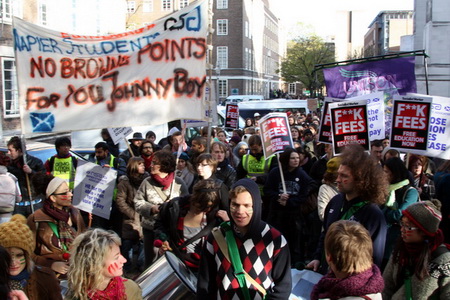
There’s always a surprising disconnect between experience and public reality when you attend an event that goes on to become an “event.” On such occasions, I find myself wondering how my experience can run so counter to the public narratives that emerge. Yesterday’s (10 Nov.) protest march in London is no different.

Here are some media images that reflect the protest I attended:

But the images that defined the “event” were slightly different. We’ve all seen them on the TV, in the papers, and on the web.

What I don’t want to do is engage in hand wringing over a protest hijacked by violent fringe elements, or tut at those smashing up the office building or gathered outside to watch. Instead, I want to do the opposite, I want to imagine myself as the one who failed, failed to fully grasp that it wasn’t just a sunny afternoon of political play acting. Continue reading

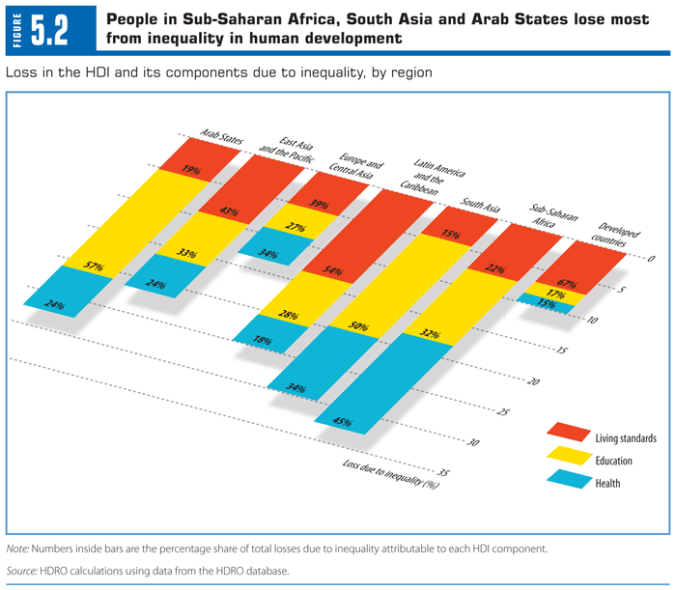
Inequality and the Human(e) Development Index

The UN Development Programme (UNDP) has for the last 20 years pioneered seemingly innovative approaches to development that have substantially redefined the terms on which development aid is conceived, offered and spent. The publishing of the first Human Development Report in 1990 was a bold move which made a case for measuring and judging countries’ developmental status in a way which focused on quality of life indicators as well as macro-economic statistics – an idea now which is completely mainstream and commonplace amongst donor governments and development practitioners.  It also proposed the notion of ‘human security‘ in 1994; a subversive response to the ‘securitisation’ agenda emerging in the wake of the Cold War which sought to broaden both the referent of security and the range of relevant concerns.  It was absolutely instrumental in pushing the Millennium Development Goals agenda – an incredibly ambitious and detailed set of targets for international development practice that served to underpin widespread agreement for the expansion of development funding across donor governments.

Its recent decision to measure inequality as a constituent part of development through its apparent role in determining the quality of life is, in this context, really interesting. On one level, it is indicative of the development community’s constant reflexivity – a term often used by David Williams – which recalibrates the tenor of its activities according to whatever the relevant crisis is supposed to be. Having been roundly critiqued and lambasted for the MDGs’ complicity with impoverishing neoliberal economic structures, we can read this ‘equality turn’ as the UNDP’s attempt to once more place itself on the vanguard of a more humane and responsive development agenda, moving itself away from the territory that the IFIs are starting to encroach upon.

It will be interesting to see whether and how the donors follow down this particular road. To a certain extent, the UNDP’s previous ‘innovations’ on human development, particularly with regard to adjusting for gender inequality, levels of absolute poverty and service provision, have all found various champions amongst western development agencies, all of whom have incorporated these issues seemingly deeply into their approaches to development, albeit perhaps through substantially de-radicalising the most substantive aspects of critique.

Inequality as an issue however poses a much more substantive threat to the international development agenda when pushed too far – not only does it cast doubt on the shining beaconof the self-made rich in the global South, but specifically, it starts to push against the foundational myth that ‘development abroad’ can be achieved with no corresponding change in the fortunes of ‘developed’ countries, a key threat to donor sanguinity and compliance with the UNDP’s more radical agendas. After all, if it is true within countries that vast inequalities impact on quality of life through skewing access to the goods that constitute human well-being, why would this also not be true between countries? The nonsense and yet widespread idea that some countries merely have to ‘catch up’ with others is belied by the inequality point but poses the much harder question for western countries and populaces to deal with: do I support international development enough to sacrifice any aspect of my own well-being?

As argued on an earlier post, the failure of highly-moralising development and anti-poverty agendas to deal at all with the central problem of inequality, both international and domestic, has been egregious and pervasive over the last 20 years, and looks to remain so in the future. The UNDP’s intervention is no doubt a timely one, although given the history of its more radical proposals, one which will probably be so watered down in practice as to be meaningless. Furthermore, by bringing this question within the competence of the ‘development’ policy specialists rather than engaging it as a public political question in ‘developing’ and ‘developed’ countries, the potential for getting to grips with the depth of this challenge seem remote.

The University, Limited.

The double assault of the Browne Report and Wednesday’s Comprehensive Spending Review have understandably led to despair and anger among academics in the humanities and social sciences. The reasons are manifold: the apparent belief by Cable and Willetts that only science matters, an insidious privatisation of public institutions, further debt for those least able to pay, massive cuts in teaching budgets, and education as a source of funds for bank bail-outs, not to mention rank hypocrisy from men educated for free and now pulling up the ladder while telling the rest of us that their schemes are not only fair, but progressive too.

This knot of anxiety deserves some dissection. The necessity, in the midst of a storm, for calm and sober reflection. Such is my rhetorical mode today. The main strand of existing critique centres on the implications for inequality. Higher fees, under such an account, can only increase the unwillingness of the poorest to attend universities, and so transform them into bastions of privilege.

But this isn’t quite right. Continue reading

The Ethics of Austerity

Today, the Con-Lib Coalition announces their full plan for spending cuts. Although many bits have been leaked, this will be the first chance we have to take the full measure of what is to come. Much has been and will be written about how these cuts are necessary, and even that they don’t go far enough.

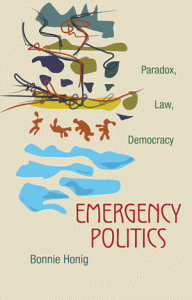
And while much has been said about the economic arguments for and against the cuts proposed by Mr. Osborne, what is not talked about enough, or with sufficient care, is the ethics of austerity. By this I mean the ethical claims that have been made to prepare the ground for the austerity measures announced today. To borrow a phrase from the political theorist Bonnie Honig, we are seeing the culmination of a discourse of emergency politics.

Emergency Politics

While Honig uses the idea of emergency politics to get at how the threat of emergency is deployed to reassert the sovereignty of the state over the democratic sovereignty of the people as the source of law and legitimate political power, I want to suggest that the financial crises has resulted in a similar discourse, which claims we are in a state of emergency economics.

What the claim of emergency economics does, by framing our current experience in terms of emergency, is reaffirm the sovereignty of the capitalist markets over democratic society by presenting us with a catastrophic choice. We must accept the radical restructuring of public life out of necessity; there is no alternative but catastrophe. To discuss solutions is to waste time; to insist on the imperative of democratic values is to court disaster; to oppose the hasty reform of fundamental elements of the social order is to be a dangerous ideologue. Emergency economics are hardly unique to the UK, but today we are witnessing a clear expression of its consequences.

Continue reading

Neoliberalism Strikes Back, or Is This Really a Crisis?

A post from Roberto Roccu.


Of course it is. Yet, Colin Hay hits the right note when he points out that if crises are conceived as moments of radical questioning and change of existing paradigms, then what we see today is not a crisis, but rather a “catastrophic equilibrium”. Indeed, now that the reverberations of the rhetoric of London’s G20 in April 2009 have faded, it appears that the measures adopted both on a national and on the global scale are concerned with shoring up the old growth model based on flexible accumulation, in the attempt to restore its economic profitability, regardless of its social unsustainability.

Rather than downplaying the magnitude of the economic problems we face, Hay’s aim is to show how in a period when all the material conditions for speaking in terms of a crisis are present, with all the potential implications for a radical reconfiguration of our economic policies and political economies, the ideational discourse is still dominated by the very paradigm that created such material conditions. This fits well with Hay’s account of the genesis of neoliberalism, which emerged as the solution to a discursively-boosted epochal crisis of Keynesianism in times where material conditions were far from being as severe as the ones we face today.

It would be easy to dismiss Hay for “being too academic”, particularly in a context where what he calls the pathologies of the neoliberal paradigm have infected all of the developed world with very real consequences for those individuals and groups that have lost their jobs and are experiencing a dramatic increase in their social insecurity. Still, identifying the distinction between existing material conditions and the missing narrative for linking those conditions and framing a coherent and credible political project is extremely fruitful. This is the hiatus where capitalist realism as an ideology and a practice has prospered. In this respect, the regained profitability of the capital accumulation regime has brought about two seemingly parallel yet interrelated trends, that are most visible in the developed country struck hardest by the crisis, the US.

On the one hand, the rise of the Tea Party movement. The mainstream press has set its focus on the populist, anti-intellectual and anti-establishment aspects of the phenomenon. Yet, their fundamentalist neoliberalism – best expressed in the call to “return to the principles of Austrian economics” – has largely gone unnoticed. On the other hand, the ever clearer and stronger political position taken by Murdoch’s media empire against the Obama administration and more generally against any kind of state intervention in the economy is equally relevant. The daily space granted to Glenn Beck on Fox appears to me as the most evident trait d’union between these two trends.

On this side of the Atlantic, dismissing these phenomena as something alien would be misleading and dangerous. And not only because Murdoch’s empire extends well within Europe, and he is even now launching an offensive on the British media. Most importantly from a social standpoint, is the other trend – the rise of populist, worryingly xenophobic yet economically conventional movements – which is manifesting itself with a surprising regularity, even in countries like Sweden, that our diehard clichés still like to characterise as “welfare paradises”.

The analysis of what is happening in the European space is rendered more complex by the presence of a further level of decision-making, located on a larger spatial scale than the state. Now, all of us have become accustomed to hear about the democratic deficit within the EU. One of its major consequences is that the struggle for influence does not follow institutionalised forms, and lobbying is by and large the name of the game. Within this context, the effective mobility and mobilisation of capital and of its allies on the EU scale (and beyond) confronts a mobility of labour that remains mostly on paper, as the bulk of the jobs that are neither highly skilled nor unskilled are still largely allocated on a national basis. As a consequence, it has proven incredibly hard to mobilise working forces beyond the national scale.

Even the rampant xenophobia – exemplified by the rise of parties such as the Northern League in Italy, the Freedom Party in the Netherlands, the Swedish Democrats in Sweden, and the list could go on to include at the least fifteen of the EU’s twenty-seven members – must be seen as a fragment that begs for relations with the whole. And in the Europe of the four freedoms of movement (people, goods, services, capital), where the mobilisation of capital is effectively globalised and the mobilisation of labour is still limited by national boundaries, it comes as no surprise that the genuine anger of the working class(es) is channelled towards an attack of the only one freedom that can credibly be limited by national authorities: the movement of people.

And yet, there would be plenty of material to start from in the direction of some Europe-wide coordination. From the Spanish general strike to the recent demonstrations in the Netherlands to industrial action on the London Underground to the French general strike of this Tuesday. Unfortunately, very little has been happening on the European scale. And as long as capital is more powerful to begin with and better organised on a larger scale whereas labour is weaker and sometimes divided also on the national scale, the prospects for resisting, reversing and subverting the current neoliberal offensive appear to be dire indeed.
The Paradoxes of Inequality

In the wake of the financial crisis, and the re-establishment of massive corporate profits during a vertiginous economic period, the issue of inequality has become increasingly prominent amongst critical thinkers. The recognition that the period of neoliberalism has been beneficial in a massively asymmetrical way to the richest is a powerful argument against the neoliberal dogma. Yet with countries like the UK disproportionately cutting government spending on the poor, it seems that the only thing changing is the ease with which the poorest can be attacked.

(h/t: Consider the Evidence)

Continue reading