Primitive Accumulation; Or, A Virtual Read-In on the London Riots

The blogosphere has a million corners, countless nooks and several large echo-chambers, complete with their own centres of self-congratulatory gravity. All have been aflame over the last week, saturating events, riots and insurgencies with the weight of historical expectation, the political memory of past iteration and the awesome condescension of easy interpretation. Gaps persist: gender and the dynamics of formally opposed masculinities have escaped all but the most cursory attention. It is one paradox of all this profuse commentary that decrying the statements and manifestos of others is the most satisfying and patronising manifesto of all. At its worst, it engages in the fullest of narcissisms (let’s make this about us and the quality of our analysis) whilst proudly displaying its contempt for thought (now is not the time for theory!). And of course, the problems and challenges are real. Much more real than we can face, too real for the sordid postures of moralising (I denounce Satan and all his works!) and liable to stay as real once we paper over them and return to our default settings.

Oh, and I find myself in unsurprising agreement with Joe and Meera (although I think Ken Livingstone’s attempts to make the link to cuts and social marginalisation is more ham-fisted than shameful). Which is all by way of introduction. There are reams to be written on the way the punditocracy and assorted commentariat are deploying (and misapplying) categories of cause, the unstable and multiple uses made of ‘politics’, the questions of historical precedent and historical return, and on and on. Exhaustion at the war of position prevents any such post. Instead, a mix-tape of diagnosis and critique, with both the smooth joins and the subtle dissonances that implies. More useful than a 1,000 faux-fresh words.

—————–

These looters are doing what they’re supposed to; grabbing the goods they see in the shops and can’t buy in a recession. They loot the bling – the sports shoes, gold watches, mobile phones and plasma TVs; and you can recognize the very poor when you see a woman looting potatoes from a corner shop. These acquisitive looters are certainly copying the gold standard of a social contract eroded by and evaporating with the money. These are riots in the cause of consumer goods. Burning and robbing other people’s things is one thing, but soon enough, and with no social cause or justice worth the name, people too become indistinguishable from things: witness the widely-circulated photo of the woman leaping for her life from a burning building; such potential deaths still threaten to bring the house down on top of us. This whole distressing episode began with the police shooting dead a black man in north London they said was a gunman; no evidence he fired a shot, we’re told, but the man was already indistinguishable from his gun.

Gabriel Gbadamosi, ‘The Blazing Light In August’

Continue reading

Looking Beyond Spring for the Season: Common and Uncommon Grounds

This is the second part in a series of five posts from Siba Grovogui, Professor of International Relations and Political Theory at John Hopkins University. The first part is here. The series will consider the character and dimensions of the tension between the African Union and ‘the West’ over interventions in Africa. Responsibility for visuals adheres solely to Pablo K.


As I indicated in my last post, the decision by the African Union (or AU) to not endorse the current military campaign in Libya has been mistaken by many observers and commentators alternatively as a sign of African leaders’ antipathy to political freedom and civil liberties; a reflexive hostility to former colonial powers, particularly France and Great Britain; a suspicion of the motives of the United States; and more. The related speculations have led to the equally mistaken conclusion that the African Union is out of step with the spirit of freedom sweeping across the Middle East and North Africa (or MENA). The absurdity of the claim is that the only entity that imposed any outline of solution agreeable to Gaddafi has been the African Union and this is that Gaddafi himself would not be part of any future leadership of the country. But the AU has insisted on an inclusive negotiated settlement. The purpose of this series of essays is not therefore to examine the meaning and implications of the absence of ‘Africa’ on the battlefield of Libya, but to point to the larger geopolitical implications of the intervention for international order, global democratic governance, and the promotion of democratic ideals and political pluralism in the region undergoing revolution and beyond.

To begin, it is not just ‘Africa’, ‘African indecision’, and ‘African non-Normativity’ that are at stake in the characterization of African actions or inactions. Much of what is construed as ‘lack’ or ‘absence’ in Africa is also intended to give sustenance to the idea of the indispensability of the West – composed on this occasion by France, Great Britain, the United States, and tangentially Canada – to the realization of the central ends of the MENA Spring. The myth of the centrality of the West to the imaginary of freedom everywhere is inscribed in the name given to the events under description. In the US at least, the Arab Spring evokes many other ‘Springs’ all located in the West (including the 1968 Prague Spring or the 1989 collapse of the Soviet Union and its satellite states). Likewise, ‘Jasmine’, the emblem of the Tunisian revolt has been advanced as evocative of the Ukrainian ‘Orange’ and other colour-coded European events. These allusions have justifications but they are seldom evoked comparatively to elucidate the originality and specificity of the MENA revolutions. In this latter regard, even the suggestion of an Arab Spring assumes that the majorities in the countries involved are Arab. This is not always the case in North Africa but Orientalism obliges!

The fact is that the ongoing revolutions in MENA are at once specific and universal in their own ways. Continue reading

The Politics of Austerity: Emergency Economics and Debtocracy

austerity |ôˈsteritē| noun – sternness or severity of manner or attitude
It was possible, therefore, to commit a sin without knowing that you committed it, without wanting to commit it, and without being able to avoid it. Sin was not necessarily something that you did: it might be something that happened to you.

– George Orwell, “Such, Such Were the Joys”

Why what have you thought of yourself?

Is it you then that thought yourself less?

Is it you that thought the President greater than you?

Or the rich better off than you? or the educated wiser than you?

 I do not affirm that what you see beyond is futile, I do not advise that you stop,

I do not say leadings you thought great are not great,

But I say that none lead to greater than these lead to.

– Walt Whitman, “A Song for Occupations,” Leaves of Grass

The Politics of Austerity – Part I

This is the first in a series of posts that look at the political implications of the ongoing global economic crisis. I begin by examining the way that crisis is being used to attack the very idea of democracy through an assertion of the political imperatives of “the market” and the violation, bending and re-writing of the law by capitalist elites. I conclude by laying out how understanding the economic crisis in political terms shapes our ability to respond to it.

In the second post I’ll look at the ethos of austerity, which justifies the pain inflicted on largely innocent people, while suggesting that an affirmative democratic response to the economic crisis must begin with its own ethos, which I suggest should be an ethos of care for the world – which can provide orientation and inspiration for political struggles seeking to address the deeper causes of our current crisis. In the third post, I turn to the structures of the economy and of politics that define the current crisis, looking at the banking crisis, the bailouts, the politics of recovery/austerity and also reflecting of the structural imperatives of capitalism that led us to crisis. This, then, leads to the question of how to respond to the politics of austerity, and of what alternative actions are available to us, which is where the fourth and final post will pick up – with an affirmation of a caring ethos that supports a radically democratic economic vision.

Emergency Economics

In a previous post I briefly highlighted Bonnie Honig’s work, Emergency Politics, to examine the way that the ethical case for austerity is made; most basically, the existence of a supreme emergency, in this case economic, justifies actions that would normally be considered unacceptable. Honig’s work looks at how the appeal to emergency is used to reassert the exceptional political power of the sovereign over and against the law, with a focus on the reassertion of sovereignty witnessed over the past ten years in response to the threat of terrorist attack in the US and Europe.

Rather than accepting the necessarily intractable conflict between the power of the sovereign and the power of the law, Honig attempts to deflate this paradox by turning her attention to the always ongoing contestation that defines democratic politics, a contest over both the content of the law and the institutional embodiment of sovereign power. She suggests, then, that attending to the ambiguities of the “people”, who are both the democratic sovereign and a diffuse multitude, as well as the political element in the law – as new laws come into being through political action – enables us to avoid thinking about emergencies as moments of exception in which the rule of law is lost to the play of political power, while also acknowledging the limits of established law in moments of profound crisis. By undermining the exceptional nature of crises and emergencies Honig alters the challenge we face when circumstances force us to make choices or carry out actions we know are harmful and wrong by asking what we (democratic publics and citizens) can do to survive an emergency with our integrity in tact.

What do we need to do to ensure our continuity as selves and/or our survival as a democracy with integrity? Our survival depends very much on how we handle ourselves in the aftermath of a wrong. We will not recover from some kinds of tragic conflict. But when faced with such situations, we must act and we must inhabit the aftermath of the situation in ways that promote our survival as a democracy.

I continue to find this a useful way to understand our current economic crisis. Appeals to austerity depend upon the exceptional state created by crisis in order to justify the pain inflicted upon masses of people and the priority given to private interests (the markets, investors and bankers) over democratic publics. So, as democratically enacted laws must bow before the sovereign power threatened by exceptional attacks, so economic justice and democratic equality must bow before the commands of market forces, of economic inevitability, in this time of crisis.

The economic version of this argument is stronger still. While the space of political contestation that remains open when we accept the framing of emergency politics is limited, it does exist in the clashing of opposing sovereigns. The prospect of a substantive alternative to neoliberal economic ideology is dim, a light flickering weakly on antiquated appeals for a return to Keynesianism or watered down triangulations of the moderate-middle that sell off dreams of a just economy bit by bit – capitalist realism in action.
Honig awakens us to an important aspects of our current crisis: that “the market” is not in fact supremely sovereign, and the move to re-establish and further neoliberal policies and push through austerity measures requires an engagement in democratic politics – albeit one that undermines the notion of the public itself and seeks to use the power of the law to subvert democracy. Recognising the current crisis in these terms not only challenges us to consider how to survive our current troubles without giving up democratic virtues, it also reinvigorates and clarifies the political challenge we face. Emergency economics – with its assertion of debtocracy over democracy – is not an inevitable response to the crisis, it is a political one that we can, and should, fight against.

Continue reading

On Objecting to the New College of the Humanities; Or, Who Would Pay £18,000 a Year to Listen to this Outdated Victorian Rationalism When They Could Buy Themselves a Second-Hand Copy of John Stuart Mill?

Yes, this is more comment on the New College, a.k.a. Grayling Hall, a.k.a. Grayling’s Folly, a.k.a. North Oxford in Bedford Square (NOBS), a.k.a. The Ultimate Scab University.

It won’t have escaped your notice that there has been a flurry of disgust, disbelief, protest and rage at the announcement of the New College of the Humanities (an aside: ‘of the’ Humanities? Why not ‘for the’ Humanities?). There have also been a number of responses that pretty much add up to ‘meh’: to wit, there are some bad things, but also some good things about Grayling’s Folly. And then there has been some welcoming of this project, and its ‘chutzpah’. Since we are in a downward vortex of vanishing funding and academic status, why not expand where we can? And why damn the entrepreneurial? As Brian Leiter puts it:

NCH is just the natural continuation of the elimination of 75% of government funding for higher education and 800% increases in tuition in the space of a few years. If the Brits can’t even keep the Tories out of office, and if their party of the Left is now in bed with the Neoliberals, it’s really hard to see why one should think “petitioning” the government for more government funding for higher ed will produce any results. The battle to be won is at the polls, and NCH is just a symptom of the battle already lost.

All this makes me think it’s worth clarifying the case against, and the potential mitigating factors. Continue reading

The New School for Privatised Inquiry

UPDATE (5 June): Now crossposted at Campaign for the Public University and at Critical Legal Thinking. The New College of the Humanities has already been called The Ultimate Scab University. I should have titled the post that.

Nina Power also has a call for boycott up and a running info post exposing, amongst other things, that many of the Professors involved have bought shares in the New College. A strange kind of workers’ management, but one apparently meant to incentivise its intellectual labourers through the lure of profits on thought. See also the expanding discussion at Leiter Reports and A.C. Grayling’s defence (in reply to the Birkbeck Student Union Chair).


In 1919, John Dewey and others founded The New School for Social Research, intended to offer a democratic and general education for those excluded by existing structures. On the faculty side, this meant a staunch defence of academic freedom in the face of increasing censorship and a climate of intellectual fear. For students, it meant evening classes, an open structure of instruction and the ability to engage in inquiry despite exclusion from the other universities of the time. A fascinating legacy even before it became a refuge for forces of critique fleeing Fascist Europe.

Now there is a new New School. A New College in fact. A.C. Grayling, Richard Dawkins, Ronald Dworkin and Peter Singer (yes, Peter Singer), amongst others, have inaugurated this new space for privatised inquiry. Tuition fees will be £18,000 a year. While the original New School aimed for “an unbiased understanding of the existing order, its genesis, growth and present working”, the New College gives you the skills “needed for success in this complex and competitive world”. There will be courses in how to do slick presentations and on effective working-with-others. Ironically enough, there will also be instruction in ‘applied ethics’ and ‘critical thinking’ (will education and the public good be topics of study I wonder?). The TV-friendly, rent-a-theory Professoriate glistens, although it seems unlikely that many classes will actually be taken by Niall Ferguson and Steven Pinker (visiting Professors only). Many other stars already hold other posts. And a closer look indeed reveals that ‘conveners and other teaching staff’ might bear somewhat more of the teaching load than advertised.

Four heads of major private schools sit on the Advisory Board. Intriguingly, the formal academic entry requirements seem rather low. Some funds are available for those from more deprived backgrounds (news reports suggest around 20% of entrants will get some kind of ‘assisted place’), but otherwise there is just some loose talk about ‘using a tuition fee loan’, although I assume this won’t be on the preferential rates and deferral plans available through the more antiquated public institutions. As Martin McQuillan intimated, it also seems that Grayling et al. have some inside info on the forthcoming White Paper, at least enough to calculate that their fees-and-hand-outs combination will not be penalised by standards on access and equality for degree-granting institutions (since it also seems that qualifications from the New College will count as endorsed by the University of London).

This is the hour for the experiment; and London is the place…

Which is all by way of saying that New College represents a new stage in business ontology. Today the public provision of humanities is framed again and again as unsustainable, unproductive and antiquated. London Met, which educates more black and ethnic minority students than the whole Russell Group combined, is facing the closure of 70% of its undergraduate courses, predominantly drawn from its humanities and arts provision, all overseen by a political elite who received their free educations in cognate subjects. UK higher education is systematically and chronically under-funded thanks to a governing class that has been spending less on schooling and free inquiry than any of its ‘competitors’ for several decades now. There is nothing natural about the emergence of a market which will bear the dubious pricing of Grayling’s project, and no objective need for the fresh sources of private investment that he cites as somewhere in support of the endeavour. We do indeed need ‘a new model’, but not this one.

The Meaning of David Willetts: The Future University Between State & Market

One of the principle battle-cries of the education movement has been that the coalition’s plans amount to a privatisation of the university system. This conclusion is arrived at by a focus on the withdrawal of teaching funding and the increased role given to ‘good relations’ with the private sector. These criticisms stand, but they repeat a common misunderstanding of the neo-liberal project as merely removing the state (call it the laissez-faire fallacy), rather than reorientating the state in a particular way to benefit certain sections and classes of society. The government is obviously complicit in promoting such tropes, which reinforce its narrative of supporting the grassroots and entrepreneurs and civil society and volunteers and champagne and candy for everyone. Hence their frankly playgroup standards of messaging. The Big Society is yellow and smiley-face! The Big Government is red and angry-sad-face!

But we now learn that the government has settled on a rather interventionist approach to all the lovely knowledge we are tasked to produce. ‘Two-minds’ Willetts has decided that the Arts & Humanities Research Council will be allowed to distribute £100 million in research monies each year, but only on condition that it accepts a ‘revision’ of the Haldane Principle (“that decisions on individual research proposals are best taken by researchers themselves through peer review”) and so spends a ‘significant’ amount of that money on research into the Big Society. Under the new ‘understanding’, the government continues to ‘value’ and ‘recognise’ the importance of academic independence, but wishes only to propose the merest of commonsensical adjustments:

At the other end of the spectrum there are decisions that ultimately must be for Ministers, albeit informed by external advice; these include the overall size of the funding for science and research and its distribution between the Research Councils, the National Academies and Higher Education research funding. In addition, every Government will have some key national strategic priorities such as addressing the challenges of an ageing population, energy supply or climate change. The research base has an important role to play in addressing such priorities and the Research Councils, with the support of independent advice, have proposed research programmes to tackle them. It is also appropriate for Ministers to ask Research Councils to consider how best they can contribute to these priorities, without crowding out other areas of their missions. But it is for the Research Councils to decide on the specific projects and people to fund within these priorities, free from Ministerial interference. Similarly, Ministers have a legitimate role in decisions that involve long term and large scale commitments of national significance.

The overall mood is civil-service vague, but elements of the language are importantly precise. Continue reading

Ethics of Austerity 3: Cynicism, Sincerity and Fear

“You ain’t never been no virgin, kid, you were fucked from the start.”

-Titus Andronicus, “A Pot in Which to Piss

Police Vodafone protesters oxford street

Police protect Vodafone store from the threat of public exposure of truth.

And you have to wonder what it will take for serious people to realize that punishing the populace for the bankers’ sins is worse than a crime; it’s a mistake.

Paul Krugman

Of obedience, faith, adhesiveness;

As I stand aloof and look there is to me something profoundly

affecting in large masses of men following the lead of those who

do not believe in men.

-Walt Whitman, “Thought”

Hypothesis

The winter air has turned cold enough, has pressed in with its full weight, so that there is no more space for lies. The truth of crisis is that the powerful and the wealthy do not take responsibility, they assign it; they do not suffer their follies or their sins, they pay their penance in the currency of our lives.

We’ve spent the last few years living with the anxiety of impending doom, spurred on by hustlers of panic, addled prophets of economic Reformation, and Janus-faced managers of public interest.

Yet, despite the prolonged disaster-foreplay, the consummation of this crisis was always going to be “us against them” and never “we’re all in it together.” Continue reading

Inequality and the Human(e) Development Index

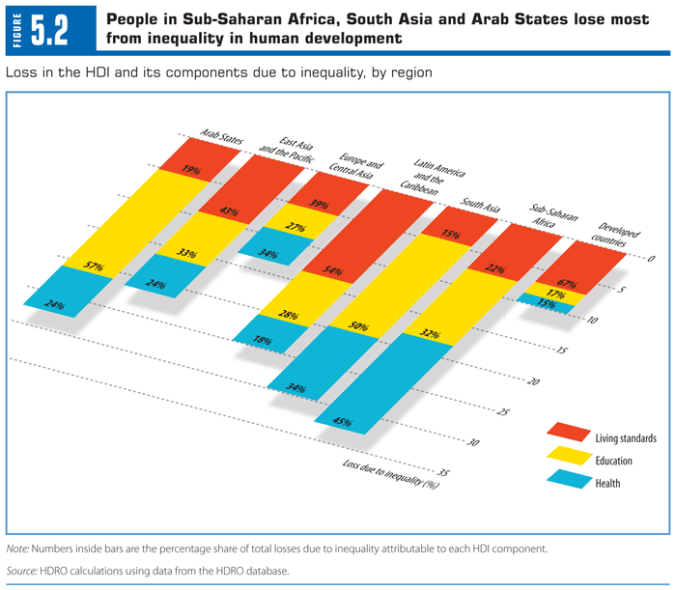
The UN Development Programme (UNDP) has for the last 20 years pioneered seemingly innovative approaches to development that have substantially redefined the terms on which development aid is conceived, offered and spent. The publishing of the first Human Development Report in 1990 was a bold move which made a case for measuring and judging countries’ developmental status in a way which focused on quality of life indicators as well as macro-economic statistics – an idea now which is completely mainstream and commonplace amongst donor governments and development practitioners.  It also proposed the notion of ‘human security‘ in 1994; a subversive response to the ‘securitisation’ agenda emerging in the wake of the Cold War which sought to broaden both the referent of security and the range of relevant concerns.  It was absolutely instrumental in pushing the Millennium Development Goals agenda – an incredibly ambitious and detailed set of targets for international development practice that served to underpin widespread agreement for the expansion of development funding across donor governments.

Its recent decision to measure inequality as a constituent part of development through its apparent role in determining the quality of life is, in this context, really interesting. On one level, it is indicative of the development community’s constant reflexivity – a term often used by David Williams – which recalibrates the tenor of its activities according to whatever the relevant crisis is supposed to be. Having been roundly critiqued and lambasted for the MDGs’ complicity with impoverishing neoliberal economic structures, we can read this ‘equality turn’ as the UNDP’s attempt to once more place itself on the vanguard of a more humane and responsive development agenda, moving itself away from the territory that the IFIs are starting to encroach upon.

It will be interesting to see whether and how the donors follow down this particular road. To a certain extent, the UNDP’s previous ‘innovations’ on human development, particularly with regard to adjusting for gender inequality, levels of absolute poverty and service provision, have all found various champions amongst western development agencies, all of whom have incorporated these issues seemingly deeply into their approaches to development, albeit perhaps through substantially de-radicalising the most substantive aspects of critique.

Inequality as an issue however poses a much more substantive threat to the international development agenda when pushed too far – not only does it cast doubt on the shining beaconof the self-made rich in the global South, but specifically, it starts to push against the foundational myth that ‘development abroad’ can be achieved with no corresponding change in the fortunes of ‘developed’ countries, a key threat to donor sanguinity and compliance with the UNDP’s more radical agendas. After all, if it is true within countries that vast inequalities impact on quality of life through skewing access to the goods that constitute human well-being, why would this also not be true between countries? The nonsense and yet widespread idea that some countries merely have to ‘catch up’ with others is belied by the inequality point but poses the much harder question for western countries and populaces to deal with: do I support international development enough to sacrifice any aspect of my own well-being?

As argued on an earlier post, the failure of highly-moralising development and anti-poverty agendas to deal at all with the central problem of inequality, both international and domestic, has been egregious and pervasive over the last 20 years, and looks to remain so in the future. The UNDP’s intervention is no doubt a timely one, although given the history of its more radical proposals, one which will probably be so watered down in practice as to be meaningless. Furthermore, by bringing this question within the competence of the ‘development’ policy specialists rather than engaging it as a public political question in ‘developing’ and ‘developed’ countries, the potential for getting to grips with the depth of this challenge seem remote.

The Ethics of Austerity

Today, the Con-Lib Coalition announces their full plan for spending cuts. Although many bits have been leaked, this will be the first chance we have to take the full measure of what is to come. Much has been and will be written about how these cuts are necessary, and even that they don’t go far enough.

And while much has been said about the economic arguments for and against the cuts proposed by Mr. Osborne, what is not talked about enough, or with sufficient care, is the ethics of austerity. By this I mean the ethical claims that have been made to prepare the ground for the austerity measures announced today. To borrow a phrase from the political theorist Bonnie Honig, we are seeing the culmination of a discourse of emergency politics.

Emergency Politics

While Honig uses the idea of emergency politics to get at how the threat of emergency is deployed to reassert the sovereignty of the state over the democratic sovereignty of the people as the source of law and legitimate political power, I want to suggest that the financial crises has resulted in a similar discourse, which claims we are in a state of emergency economics.

What the claim of emergency economics does, by framing our current experience in terms of emergency, is reaffirm the sovereignty of the capitalist markets over democratic society by presenting us with a catastrophic choice. We must accept the radical restructuring of public life out of necessity; there is no alternative but catastrophe. To discuss solutions is to waste time; to insist on the imperative of democratic values is to court disaster; to oppose the hasty reform of fundamental elements of the social order is to be a dangerous ideologue. Emergency economics are hardly unique to the UK, but today we are witnessing a clear expression of its consequences.

Continue reading

Neoliberalism Strikes Back, or Is This Really a Crisis?

A post from Roberto Roccu.


Of course it is. Yet, Colin Hay hits the right note when he points out that if crises are conceived as moments of radical questioning and change of existing paradigms, then what we see today is not a crisis, but rather a “catastrophic equilibrium”. Indeed, now that the reverberations of the rhetoric of London’s G20 in April 2009 have faded, it appears that the measures adopted both on a national and on the global scale are concerned with shoring up the old growth model based on flexible accumulation, in the attempt to restore its economic profitability, regardless of its social unsustainability.

Rather than downplaying the magnitude of the economic problems we face, Hay’s aim is to show how in a period when all the material conditions for speaking in terms of a crisis are present, with all the potential implications for a radical reconfiguration of our economic policies and political economies, the ideational discourse is still dominated by the very paradigm that created such material conditions. This fits well with Hay’s account of the genesis of neoliberalism, which emerged as the solution to a discursively-boosted epochal crisis of Keynesianism in times where material conditions were far from being as severe as the ones we face today.

It would be easy to dismiss Hay for “being too academic”, particularly in a context where what he calls the pathologies of the neoliberal paradigm have infected all of the developed world with very real consequences for those individuals and groups that have lost their jobs and are experiencing a dramatic increase in their social insecurity. Still, identifying the distinction between existing material conditions and the missing narrative for linking those conditions and framing a coherent and credible political project is extremely fruitful. This is the hiatus where capitalist realism as an ideology and a practice has prospered. In this respect, the regained profitability of the capital accumulation regime has brought about two seemingly parallel yet interrelated trends, that are most visible in the developed country struck hardest by the crisis, the US.

On the one hand, the rise of the Tea Party movement. The mainstream press has set its focus on the populist, anti-intellectual and anti-establishment aspects of the phenomenon. Yet, their fundamentalist neoliberalism – best expressed in the call to “return to the principles of Austrian economics” – has largely gone unnoticed. On the other hand, the ever clearer and stronger political position taken by Murdoch’s media empire against the Obama administration and more generally against any kind of state intervention in the economy is equally relevant. The daily space granted to Glenn Beck on Fox appears to me as the most evident trait d’union between these two trends.

On this side of the Atlantic, dismissing these phenomena as something alien would be misleading and dangerous. And not only because Murdoch’s empire extends well within Europe, and he is even now launching an offensive on the British media. Most importantly from a social standpoint, is the other trend – the rise of populist, worryingly xenophobic yet economically conventional movements – which is manifesting itself with a surprising regularity, even in countries like Sweden, that our diehard clichés still like to characterise as “welfare paradises”.

The analysis of what is happening in the European space is rendered more complex by the presence of a further level of decision-making, located on a larger spatial scale than the state. Now, all of us have become accustomed to hear about the democratic deficit within the EU. One of its major consequences is that the struggle for influence does not follow institutionalised forms, and lobbying is by and large the name of the game. Within this context, the effective mobility and mobilisation of capital and of its allies on the EU scale (and beyond) confronts a mobility of labour that remains mostly on paper, as the bulk of the jobs that are neither highly skilled nor unskilled are still largely allocated on a national basis. As a consequence, it has proven incredibly hard to mobilise working forces beyond the national scale.

Even the rampant xenophobia – exemplified by the rise of parties such as the Northern League in Italy, the Freedom Party in the Netherlands, the Swedish Democrats in Sweden, and the list could go on to include at the least fifteen of the EU’s twenty-seven members – must be seen as a fragment that begs for relations with the whole. And in the Europe of the four freedoms of movement (people, goods, services, capital), where the mobilisation of capital is effectively globalised and the mobilisation of labour is still limited by national boundaries, it comes as no surprise that the genuine anger of the working class(es) is channelled towards an attack of the only one freedom that can credibly be limited by national authorities: the movement of people.

And yet, there would be plenty of material to start from in the direction of some Europe-wide coordination. From the Spanish general strike to the recent demonstrations in the Netherlands to industrial action on the London Underground to the French general strike of this Tuesday. Unfortunately, very little has been happening on the European scale. And as long as capital is more powerful to begin with and better organised on a larger scale whereas labour is weaker and sometimes divided also on the national scale, the prospects for resisting, reversing and subverting the current neoliberal offensive appear to be dire indeed.