Deconstructing Power and Resistance: A Response to Rossdale

A third commentary in our symposium on Chris Rossdale’s Resisting Militarism: Direct Action and the Politics of Subversion (Edinburgh, 2019), from Rachel Zhou. Rachel is a Phd candidate in the Department of International Relations, London School of Economics and Political Science. Her doctoral research focuses on the making of female soldiers in the post-WWII era. Rather than taking the “existence” of female soldiers for granted, she examines “female soldiers” as historically constructed subjects which are constitutive of the politics of war. In particular, she looks at how “small” wars in the post-1945 era as transnational and imperial encounters render thinkable and possible the emergence of female soldiers and shape the subjectivities/experiences of (different) female soldiers. She takes a multidisciplinary approach that encompasses the fields of military/war history, poststructuralist feminist, critical race and postcolonial theories. She is the review article editor of Millennium: Journal of International Studies. Rossdale’s Resisting Militarism is currently discounted with use of the code NEW30 at the EUP site, and the last reply and a rejoinder will follow in the next days; all posts will be collected for future perusal here.


Is resistance possible? How could resistance be carried out? Is resistance outside or external to power it resists? Is a radical escape from power possible? These questions are perennial but now further ignited by movements taking place during a global pandemic which accentuates and exposes systems of power. Chris Rossdale’s Resisting Militarism: Direct Action and the Politics of Subversion offers answers but poses more questions.

This book is rooted in an intimate and careful interrogation of “the performances, negotiations, and debates which surround” anti-militarist direct action in UK, but transcends the ethnography with its major contributions to debates on the politics of resistance and the relations between power and resistance. Treating direct action practices as “a fruitful site through which to read the politics of both militarism and resistance” (p. 6), it successfully and provocatively unpacks how anti-militarist politics resist, subvert, are shaped by, and reproduce militarism. The intimacy between militarism and anti-militarism is critically reflected on through meticulous accounts of the “internal” politics of antimilitarist resistance, which are read in relation to, not apart from, what it is against. Sherry Ortner points out there is an “impulse to sanitize the internal politics” of resistance in studies of resistance so that “the ambivalent complexity” of resistance is usually rendered invisible, which contributes to an inadequate analysis (1995, pp. 176-180). Resisting Militarism does not repeat this pitfall and also moves beyond just taking the “internal” politics of anti-militarist practices seriously. Instead, it would challenge the very binary between “internal” and “external”. The “internal” politics identified by Ortner is “within all the local categories of friction and tension” (p. 177). But Rossdale reads these frictions and tensions among anti-militarists, including those surrounding how an anti-militarist group is organised, whether focusing on the spectacular, how to approach security, illegality, pacifism and nonviolence, and the gendered and racialised politics of the movement”, not as “internal” politics per se. In Resisting Militarism they are interrogated in relation to “external” politics not only because how “internal” politics matters to its engagements with militarism, but more importantly as attempts to determine the particular nature and micro-politics of militarism and the imperatives of resistance as well as the relationship between militarism and anti-militarism (pp. 6-7). With a particular understanding of power and the concept of prefiguration, the book provocatively disrupts the boundaries between means and ends and between resistance and power.

Thus, Resisting Militarism brilliantly demonstrates how militarism and anti-militarism are antagonistic and co-constitutive (or antagonism is always already co-constitutive) and that while power relations can be revealed by examining attempts to uproot them, spaces and practices of resistance are always already produced by and, “potentially, reproductive of precisely that which is resisted” (p. 139). This move is rare even among the works situating power and resistance in the same analytical framework and taking their intimate relationships seriously. Usually they only focus on how a certain form of resistance is produced by a form of power but not on how resistance is complicit and reproduces what it is against. Thus, they still tend to eschew a deconstructive approach to resistance taken by Resisting Militarism, as if being critical of resistance could give more ground and energy to power. Starve and Immolate: The Politics of Human Weapons by Banu Bargu (2016) is another example which places power and resistance in one framework. Similarly, it also successfully demonstrates how resistance is shaped by power. However, its analysis might be criticised for overlooking how necroresistance could reproduce the logics of a “biosovereign assemblage” (Bargu, p. 53) that it is against. Rendering resistance innocent could simplify the operations of power as well as the complex relationships between power and resistance, and create spaces for imaginations of easy and straightforward resistance and thus a clean escape from power. Resisting Militarism is more cautious and actively seeks to be self-reflective. Not only (some) antimilitarist practices take a deconstructive approach to militarism. Resisting Militarism also seeks to deconstruct anti-militarism and calls for keeping antagonistic contestation in play as well as “a ceaseless openness to deconstruct that contestation” (p. 270). Remaining open to deconstruction and affirmative gestures in resistance could be the best hopes for resisting in a world where the subject, freedom and resistance are shaped and fundamentally entangled with power.

The brilliant book thus has made significant contributions to debates on the politics of resistance. My review should stop here. Also, to offer any critique is difficult because of its constant self-reflections. However, no critique could be exactly against what this book calls for — “antagonistic contestation and a ceaseless openness to deconstruct that contestation” (p. 270). The critiques may not be antagonistic since they follow the approach Resisting Militarism takes but seeks to make some implications more explicit, ask what could be further elaborated on and whether it reproduces what it critiques, and thus they are immanent critiques.

Continue reading
On Prefiguration, Diversity of Tactics, and a New Anti-Militarism

The second post in our symposium on Chris Rossdale’s Resisting Militarism: Direct Action and the Politics of Subversion (Edinburgh, 2019), currently discounted with use of the code NEW30 at the EUP site. Today we feature Erica Chenoweth, the Berthold Beitz Professor in Human Rights and International Affairs at Harvard Kennedy School, where they research and teach on international politics, social movements, and political violence and its alternatives. Erica directs the Nonviolent Action Lab at Harvard’s Carr Center for Human Rights Policy, where they study how people can create transformative social and political change using creative, disruptive, people power. They are currently writing a book with Zoe Marks on the role of women’s frontline participation on the outcomes and aftermath of mass movements over the past 120 years. Erica is the author of Civil Resistance: What Everyone Needs to Know (Oxford, 2021), co-editor of Civil Action and the Dynamics of Violence (Oxford, 2019) with Deborah Avant, Marie Berry, Rachel Epstein, Cullen Hendrix, and Timothy Sisk, co-editor of the The Oxford Handbook of Terrorism (Oxford 2019) with Richard English, Andreas Gofas, and Stathis Kalyvas, co-author of The Politics of Terror (Oxford, 2018) with Pauline Moore, and co-author of Why Civil Resistance Works (Columbia, 2011) with Maria J. Stephan. Erica also co-hosts the blog Political Violence @ a Glance and is an occasional contributor to The Monkey Cage, where they publish regular reports about trends in US protest, counter-protest, and state response based on data collected with Jeremy Pressman through the Crowd Counting Consortium. Further posts and a rejoinder will follow this week; all will be collected for future perusal here.


I thank Chris Rossdale for the opportunity to read his excellent book, Resisting Militarism: Direct action and the politics of subversion, and I am glad to engage with his ideas here. The book recounts the current state of the UK’s anti-militarism movement, as well as debates and faultlines within the movement. This is also a book written for a movement by one of its protagonists. Rossdale is motivated to study the anti-militarism movement as a participant and observer of the movement so as to better resist militarism (p. 8). It is a critical read for those concerned with anti-militarism, the peace movement, and broader debates within progressive and radical left movements more generally.

At the outset of the book, Rossdale defines militarism as “ ‘the social and international relations of the preparation for, and conduct of, organized political violence’ ” (p. 3, quoting Stavrianakis & Selby 2013). Rossdale views anti-militarism as “a particular politics which seeks to reveal, disrupt, and subvert the social processes through which violence is made possible. It is an ethic of resistance, which recognizes that its task is never complete, and that it must adapt to new forms and sites of militarism just as militarism adapts to new constellations of resistance” (p. 270). The book therefore emphasizes prefigurative politics—the process of creating and negotiating intentional relationships between those involved in the movement to experiment with new and equitable political realities.

Rossdale’s autoethnographic approach adds credibility to the work, and it provides numerous avenues for engaging directly with key fault lines and movement dynamics that might otherwise be easy to overlook from a distance. The book is chock-full of useful reflections about what motivates (and what ails) the contemporary anti-militarism movement in the UK in ways that resonate far beyond the anti-militarism struggle in this case. The book is important and well-researched. Rossdale should be commended for his thorough citation practices, as well as his engagement with a variety of critical approaches—particularly those of queer theory and feminist theory. The book makes numerous productive critiques about the anti-militarist movement’s need to overcome its perpetual whiteness and to center the most vulnerable in the movement’s articulation of its vision and in participants’ relationships with one another. It is also very productive that Rossdale keeps the focus on the largest sources of violence—state-led violence and the military industrial complex—while advocating for the interpretation of violence in context.

Taking Rossdale on his own terms, I first make one general observation, and then I engage with three unresolved issues that arise over the course of the book.

Continue reading

Resisting the Attractions of Anti-Militarism

After an overlong hiatus, we return to our mission with a symposium on Chris Rossdale’s Resisting Militarism: Direct Action and the Politics of Subversion (Edinburgh, 2019). The introductory chapter of Resisting Militarism is available to read here, and the whole book is soon to be released in paperback, discounted with use of the code NEW30 at the EUP site. For the first post in our series we are joined again by Anna Stavrianakis, Professor of International Relations at the University of Sussex, UK, where she researches and teaches on the international arms trade, (in)security and militarism. Anna is the author of Taking Aim at the Arms Trade. NGOs, Global Civil Society and the World Military Order (Zed, 2010) and co-editor (with Jan Selby) of Militarism and International Relations. Political Economy, Security Theory (Routledge, 2012)She is an editor at Security Dialogue, where she co-edited (with Maria Stern) the special issue on “Militarism and Security: Dialogue, Possibilities and Limits” (2018). Anna is currently working on a variety of projects associated with the arms trade and the war in Yemen, one recent result being ‘Controlling Weapons Circulation in a Postcolonial Militarised World’ in Review of International Studies. Further posts will follow this week; all will be collected for future perusal here.


As a fellow traveller in the world of anti-militarist activism, it was both a pleasure and an education to engross myself in Chris Rossdale’s new book, Resisting Militarism. I happened to see Chris on a sunny summer’s day in Brighton in June 2019, shortly after the Court of Appeal issued its judgment that the UK government had acted unlawfully in continuing to licence weapons exports to Saudi Arabia given its conduct in the war in Yemen. I wanted to raise a toast to the tenacious persistence of Campaign Against Arms Trade and to celebrate their legal victory. But even with my caveat that the hard work of translating a legal decision into meaningful political change remained, Chris was reluctant to savour the moment and curious as to how I could be in celebratory mood, given what we both know about the UK government’s commitment to arms sales, in particular those to the Middle East. Resisting Militarism helps me better understand Chris’ sceptical curiosity and his relentless questioning of what constitutes success and what an anti-militarist politics entails.

Through the combination of detailed, fine-grained ethnographic description that can only emerge from years of being part of a movement, and high theory dispatched with a light touch, Resisting Militarism helps readers understand (anti)-militarism as both concept and practice. Chris is very much present in the analysis but unassumingly so. Centering gender, sexuality and race as the social relations that scholars and activists need to foreground in understanding, engaging with and challenging militarism, he outlines a prefigurative politics of engagement with power, authority and domination as the thread that weaves the intimate and the geopolitical together.

There are two core contributions that I find particularly compelling about Chris’ analysis. First is the way he breathes life into abstract definitions of militarism. Mobilising the definition that Jan Selby and I gave in our 2012 edited volume Militarism and International Relations, of militarism as “the social and international relations of the preparation for, and conduct of, organised political violence”, Chris gives purchase to it for the study of contemporary British anti-militarism by filling it with a focus on gender, sexuality and race as the core social relations that variously bolster and challenge, and always permeate, militarism and anti-militarism. In short, “militarism is not a thing that can be smashed, but a series of social relations that must be disassembled by relating otherwise” (p. 38). Crucially, this means there is no ‘outside’ of militarism: there is no separating everyday life from the preparation for organized violence. No-one is exempt from it – not even the anti-militarist movement. Chris is interested in “the depths of our imbrication within militarised relations of power” (p38) – and once we acknowledge that, the question of how we agitate for an anti-militarist present and future looks rather different from what many accounts of militarism and anti-militarism offer.

Continue reading

Are We at War? The Rhetoric of War in the Coronavirus Pandemic

The seventh contribution to our growing collection of writings on Covid-19 and this moment of crisis. Federica Caso is currently a teaching assistant at the University of Queensland, where she also completed her PhD in 2019. Her expertise is on militarisation and war memory in liberal societies. She also works on the politics of culture, art, and gender. Her most recent publication is titled “The Political Aesthetics of the Body of the Soldier in Pain” which features in Catherine Baker’s edited volume  Making War on Bodies.


In this pandemic, the war rhetoric has spread as fast as the coronavirus itself. Recently, US President Donald Trump has characterised himself as a wartime president. Hospitals are preparing for war and healthcare workers are heralded as the frontline soldiers in the war against COVID-19. Economists ask how the coronavirus war economy will change the world. Wartime terms such as shelter-in-place, panic-buying, and lockdown have entered our daily and most mundane conversations.

The language of war is so normalised that in a recent episode of the New York Times’ podcast The Daily, a medical doctor answers questions from US American children about the coronavirus using war metaphors. We have come to believe that these children, aged no more than 6 and raised in ‘peacetime’ and prosperity, naturally know about invasion, bombing, weapons, and strategic warfare. We have come to believe that this is the best language to teach them about life processes.

It is important to pay attention to the language that we use to describe the coronavirus pandemic because it determines how we respond to it.

The War Metaphor

This is not the first time that the language of war is stretched to contexts that are not legalistically wartimes. In the last fifty years, we have heard of the war of drugs, the war on poverty, the war on crime, and the war on plastic.

War is a powerful metaphor. It is an effective, immediate, and emotive tool to communicate urgency to the general public. It also conveys a sense of struggle and righteousness that can justify exceptional measures.

Continue reading

Apocalypse Yesterday?

The first in a series of posts over the coming weeks on the Coronavirus crisis and its multiple aspects, contradictions and possible futures. They will be collected here. This first is from Paul David Beaumont, who is currently finalising his PhD dissertation, The Grammar of International Status Competition, at the Department of International Environmental and Development Studies at the Norwegian University of Life Sciences. Paul tweets @BeaumontPaul​ and his research is available to view on his Academia profile. See also his post from December 18, 2019 on Brexit Futures.


The corona crisis is not the beginning of the apocalypse but a symptom; we have been in the apocalypse for a while now. Akin to how the industrial revolution occurred over a far longer period than we normally associate with “revolutions”, apocalypses seldom occur overnight either. In this regard, humans have systematically misread the paradigmatic apocalypse scenario: the asteroid. Rather than wiping out humanity in one big bang, as Deep Impact would have it, it took decades for the mass extinctions to unfold. Similarly, even if COVID 19 does prompt mass deaths and/or societal collapse, if there are any historians still around to argue over the origins of our demise, they will be unlikely to pay much heed to the Corona outbreak itself.

Instead, I expect they will puzzle over a paradox that did not befall the dinosaurs. How did humans manage to create a society so technologically advanced that they could predict the apocalypse(s), develop the technology to stop it (them), yet adamantly and proudly refuse to do so?

With regards to humankind’s inability to halt climate change or the destruction of the world’s biodiversity, future historians will likely and rightly probably lean heavily on the collective dilemma to explain our failure to act. However, pandemic preparation is not a collective action problem for the state. States can prepare for pandemics without requiring all others to do so too, nor can other states necessarily free-ride from one state’s preparations.

Continue reading

Fatal Collaborations

A guest post from Chris Rossdale, issued in the midst of the latest round of UK university strikes over pensions, pay, precarity, workload and inequality. Chris is Lecturer in Politics and International Relations at the University of Bristol. He writes about militarism, race and colonialism, social movements and political resistance. His book Resisting Militarism was published last year with Edinburgh University Press, and will be the topic of a Disorder symposium coming to a screen near you soon. You can also find Chris on Twitter here.


In January 2020, hundreds of students at SOAS staged a walk out, joining staff on the steps of the Bloomsbury campus to protest against yet another round of budget cuts. Once again, the institution was at the front line in the long struggle against the neoliberal restructuring of British universities, its position here an enduring product of the collision between aggressive management and well-organised staff and students. This time, administrators had announced that a budget shortfall would be filled by cancelling unfunded research leave for lecturers. Activists expect that this will also entail slashing the hours of sessional teaching staff, the ‘fractionals’ whose inspiring and successful unofficial strike action in 2014 presaged the more determined University and College Union (UCU) action we see today.

SOAS also made headlines last year when students learned that the institution was taking money from the Ministry of Defence (MoD) in return for providing academic expertise and training to the British armed forces. Research by the Decolonizing Our Minds society revealed that SOAS has received at least £400,000 since the end of 2016 to deliver ‘Regional Study Weeks’ to the MoD’s ‘Defence Cultural Specialist Unit’ (DCSU). Currently active in at least 22 countries including Afghanistan, Chad and Chile, the DCSU is similar to the widely-criticised Human Terrain System developed by the US to support operations in Iraq and Afghanistan. It involves the MoD supplementing its forces with specialists in the culture of societies where British operations are active, in pursuit of a gentler form of domination in ‘rapidly expanding neo-colonial context[s]’. The Regional Study Weeks are opportunities for academics to teach DCSU staff about the social and political contexts of particular regions, while highlighting the resulting ‘implications for UK military missions’. SOAS academics made up the largest portion of those teaching, but the weeks have included faculty from LSE, St Andrews, Cambridge, KCL, UCL, Lancaster and De Montfort. As the students’ report states, this academic collaboration with the armed forces facilitates a project that, at best, ‘is useful for crafting more inclusive forms of imperial governance’, and at worst, is used to ‘either destroy or “neutralize” potential sites of resistance with insider information’.

Reports of SOAS’s links with the MoD caused a scandal, but this apparent deviation masked a deeper reality. Collaborations between British universities and military institutions are no aberration – they are the overwhelming norm. A recent report by students at the University of Oxford revealed that the institution’s research council grants active in 2019 included over £80m linked to the MoD, and that nearly 40% of its £420m in science council grants are paired with military-related bodies. BAE Systems has spent millions partnering with over ten universities developing new technologies for stealth drones. Thales, Europe’s third largest arms company, are proud to announce that they are involved with over £146m in Engineering and Physical Sciences Research Council (ESPRC) funded research, working with over 20 institutions. My own institution, Bristol, received £3m from the Atomic Weapons Establishment between 2010 and 2016, while researchers at Surrey have worked with Lockheed Martin on improving components in armored vehicles. These examples are indicative, not exhaustive; very few institutions can claim to be free of these connections. Universities disingenuously attempt to emphasise the civilian applications of this research in their public-facing communications; however the reality is that the British university system is intimately entangled in systems of military production.

Continue reading

Reinventing Language

Catherine Charrett BiopicA guest post from Catherine Charrett. Catherine is a Lecturer in Politics and International Relations at Queen Mary University of London and will be teaching at the University of Westminster from September 2019. Catherine uses transdisciplinary methods to explore and present research on technologies of security and policing in the Occupation of Palestine and is the author of The EU, Hamas and the 2006 Palestinian Elections: A Performance in Politics (Routledge, 2019). Catherine created a 45-minute solo performance piece based on the material in this blog post and entitled The Vein, the Fingerprint Machine and the Automatic Speed Detector. You can view a trailer for the show here. Please get in touch with Catherine for further information about booking or viewing the performance piece.


Invent a hope for speech,
invent a direction, a mirage to extend hope.
And sing, for the aesthetic is freedom/
***
I say: The life which cannot be defined
except by death is not a life”

(Darwish, 2007)

The poetic means that form is loosened from technical function.

(Larkin, 2013: 335)

Below are two texts. The first is a deconstruction of a transcribed Israeli ‘start-up’ competition in the weapons industry. I attended this event in the Dan Panorama Hotel, Tel Aviv (Jaffa) on 18 July 2018. I witnessed and recorded the technologisation and capitalisation of killing Palestinians and other racially marked bodies – hosted by Israel, attended by international spectators. To take a break from this show I walked down the street, and I came across a sigh of relief in the shape of a mosque, the Hasan Bek Mosque, Jaffa. The second text below is a historical rendering of that mosque as described in the Journal of Palestine Studies by the late Shafiq al-Hout. Al-Hout, born and raised in Jaffa, was a founding member of the Palestinian Liberation Organisation (PLO), and never ceased to fight for the Palestinian right to return.

In this intervention, my hope is to play with the form of language to disrupt what Carol Cohn described as the internal ‘logic’ of technostrategic language. As academics of international relations often we are prone to repeating the technostrategic language, which Cohn says has been invented by mathematicians, salesmen, economists and political scientists to invent a truth, which makes it possible to think the unthinkable (1987: 715).  This language capitalises upon and reproduces phallic imagery, competitive male sexuality and the promise of male creationism. In the first text I offer a deconstructive parody of some of these mechanisms. Non-official tongue, slang, sarcasm, colloquialism resist the totalitarianism of administrative language, says Herbert Marcuse. In playing with language, I hope to performatively critique the techno-fetishization that continues to circulate around Israel’s high-tech industry, and around high-tech solutions in the security industry more generally.

The reference for the ‘logic’ of technostrategic speech, argues Cohn is the weapon itself ‘(1987: 715). There is however, another reference point, the one who will be targeted, the one who will be ‘sacrificed’ for apparent technological evolution, those who will serve as the “literal raw materials” for white security (Agathangelou, 2013 cited in Howell and Richter-Montpetit, 2019). Drawing inspiration from Katherine McKittrick (2011; 2014) I include the second text as an expression of Palestinian life before and beyond the rupture of violent European/ Israeli expansionism, dispossession and racial extraction into Palestinian livelihoods.

Poetry is often unquantifiable in terms of material weight, but the fact that it has lasted for as long as humankind has been using language suggests that its value lies in its presence as a fact of language within which people search for meaning, for echoes to the sounds of their souls and the music of their minds.

(Alshaer 2016).

***

Continue reading

Fight to Live, Live to Fight: Veteran Activism after War

A guest post from Ben Schrader, on the topic of his new book, Fight to Live, Live to Fight: Veteran Activism After War, published today with SUNY Press. Ben recently completed a visiting professorship with the Bard Globalization and International Affairs program in conjunction with Central European University. He is a war veteran turned peace activist turned academic. He has published in the Journal of Narrative Politics on ‘Auto-Archeology and Political Affect of War’ (2014) as well as in Critical Military Studies on ‘The Affect of Veteran Activism’ (2017). Ben has a number of other published non-academic works, from think pieces to poetry. He is currently living precariously on the job market. Ben is also a board member for the anti-war organization About Face: Veterans Against War.


Me in Iraq

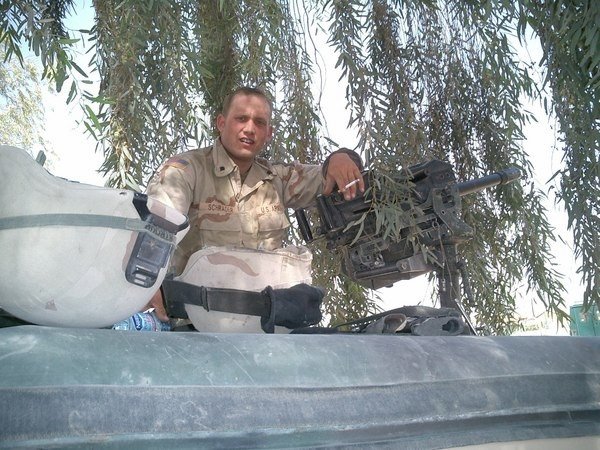
Taking in some shade while on patrol in Iraq.

From 2001-2005 I served in the US Army as a 19D Cavalry Scout. I was stationed in Vilseck, Germany and went on two deployments, one to Kosovo from 2002-2003 for a peacekeeping mission, and one to Baqubah, Iraq, where I was a part of my units Quick Reaction Force, so if anything happened in our sector we were the first people that were called. Needless to say I saw a lot of combat. While in Iraq, I began to become disillusioned with the mission, as the reasons we had been given for why we were in Iraq did not seem to align with what we were seeing on the ground. I left the military upset, confused, and as if I had been betrayed by my own country, so to understand my experience I did two things. First and foremost, I joined the group Iraq Veterans Against the War (IVAW), now known as About Face: Veterans Against War. This gave me a tool to channel much of my anger and also connected me with other veterans who were questioning the things they experienced in Iraq. One of the primary tactics I found with IVAW, parrhesia—speaking truth to power—worked to expose the lies that I saw (as well as the truths that have been hidden from civil society), while also working to help me heal by releasing the burden of these truths.

Me at RNC with Rage

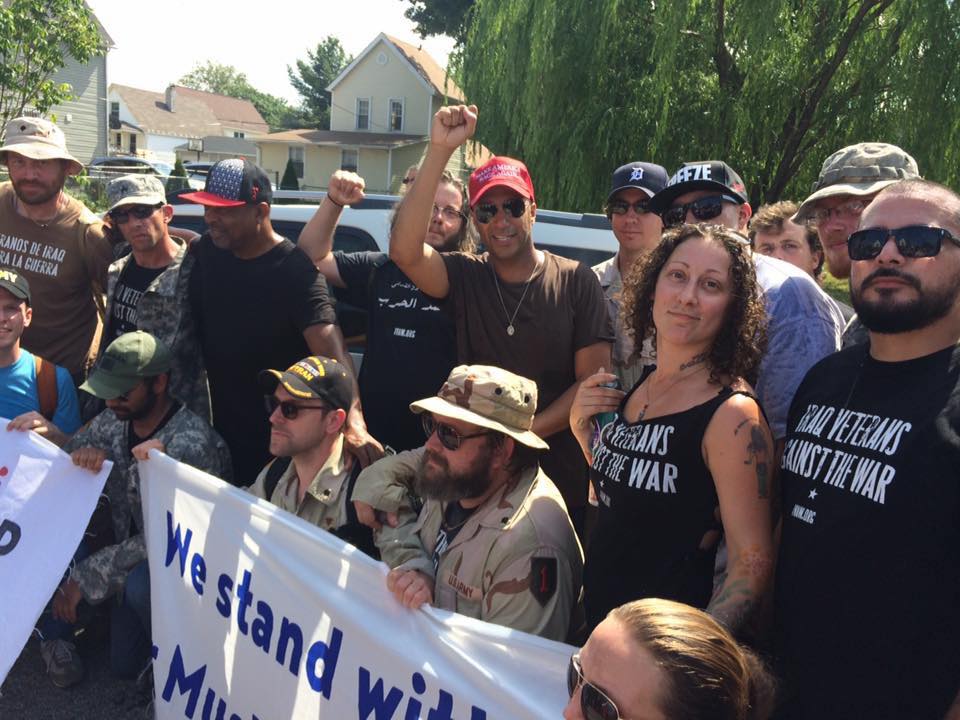
IVAW marching with the Prophets of Rage at the 2016 Republic National Convention

The second thing I did was I went back to school. I studied sociology to understand the human and societal impacts of war, and I studied political science to understand the gears and processes of war. Between my activism and academia, I began to see many connections not just on an international level but also on a local level, whereas many of the inequities that Americans face could be tied to different aspects of militarism. This drove me deeper into understanding these connections, as I learned about them in the classroom as a student, and on the streets as an activist. I began to expand my activism and my formal learning beyond just understanding militarism as I got an MA in ethnic studies; examining intersectionality, white supremacy, and colonialism; as well as marching for racial justice, advocating for gender equality, and fighting against homophobia. I then moved on to a PhD where I would work to tie all this together into the project I’m writing about today: a look at military veterans who came home to be social justice activists.

While the project is entangled with my own experiences as a soldier and an activist (as I utilize embodied auto/ethnographic research), my examination of other activists took place over the course of a year. In 2013-2014 I drove around North America interviewing veterans from all walks of life. I started by reaching out to veteran activists that I knew to see if they knew other veterans who would be willing to be interviewed. My only requirement was that they considered themselves “social justice activists,” and that they had served in the US military. In all I ended up interviewing twenty-two veteran activists, twenty of them being in the US, one in Mexico, and one in Canada. I hadn’t begun with the categories of activism I wanted to understand but as one interview led to another categories began to form, as I found veterans who were not only engaged in antiwar activism but also a part of the Occupy movement, doing environmental work, addressing issues of sexual assault in the military, working on immigration issues, and trying to help veteran communities heal from the traumas of war. In some cases, I spent an hour with them conducting an open-ended interview, in other cases I spent a day or two with them observing the work that they were doing. Each interview was different, but all were fruitful. Within the book I primarily highlight two veterans per chapter and their work as an activist, as I do what my former advisor Michael Shapiro calls staging encounters between theory and event. I draw much inspiration from Critical Military Studies as I examine the many ways that war and the military effect the self, groups, and society. Furthermore, these veterans are what Victoria Basham and Paul Higate call geocorporeal actors, not only as soldiers, but also afterwards as veteran activists. I therefore weave these veterans’ stories with my own, from my experiences in war to my engagement with them as interviewees. I try to tell these stories in a manner that is accessible for anyone to grasp both the impacts of war and some of the theoretical concepts around identity formation, militarism, and problems these veterans are addressing around social justice issues.

Continue reading

The Internationalist Disposition and US Grand Strategy

img_3010A guest post from Stephen Pampinella, continuing our occasional series on left/progressive foreign policy in the 21st century. Stephenis Assistant Professor of Political Science and International Relations at the State University of New York (SUNY) at New Paltz. His research interests include US state building interventions, hierarchy in international relations, race and postcolonialism, US grand strategy, and national security narratives. He is on leave from SUNY New Paltz during Spring 2019 and is conducting research on the practice of diplomacy in the Ecuadorian Foreign Ministry in Quito, Ecuador.


Alex Colás’ “The Internationalist Disposition” provides an excellent framework for evaluating foreign policy debates in the Democratic Party. The failures of the War on Terror combined with the emergence of economic and environmental threats have led many to engage in a far-reaching reappraisal of US foreign relations based on left critiques. This new approach toward foreign affairs is called progressive internationalism. It attempts to resolve the tension between adopting greater military restraint and remaining engaged in global governance.

But in recent weeks, establishment voices have sought to reassert their control over foreign policy debates by arguing for the necessity of US hegemony and classic liberal internationalist forms of cooperation. Colás’ methodological internationalism illustrates why traditional US foreign policy approaches will fail to provide actual security for ordinary Americans. It also suggests (somewhat counterintuitively) what kinds of grand strategies could do so. A great power concert strategy, in which the United States pursues a balance of power among its rivals while committing to more democratic forms of international cooperation, can best resolve the non-state threats to US democracy generated by its own liberal order.

Continue reading

Returning the Gaze: A Reply to The Eye of War Symposium

The final post in our symposium on The Eye of War as Antoine responds to his interlocutors. All the entries in this series are collated here.


I have read each of the fantastic contributions made to the symposium with real pleasure and intellectual thrill. I feel very fortunate to have my work engaged with so thoroughly and generously by four wonderful scholars who each brought something unique to the conversation. Each entry is too rich in suggestive lines of thought to fully do any of them justice here and so I will only be able to selectively engage their contributions. I know however that they will continue to fire synapses for some time to come and I am very grateful to each participant for that gift. Big thanks also go to Paul for suggesting the symposium in the first place and organising it.

Katharine’s comments focus on the book’s early genealogy of the martial gaze, noting the uncommon historical perspective it brings to contemporary accounts of military targeting. It is certainly the case that much of the abundant scholarship produced on drones has a strong presentist feel, often emphasising the alleged revolutionary character of these weapon systems. Some of the best contributions have produced enriching accounts of their antecedents, either through a history of unmanned weapons (Grégoire Chamayou, Ian Shaw) or of aerial bombing (Derek Gregory), but these remain nevertheless conditioned by the starting point of the drone to which such histories lead by design. Notwithstanding its reference in the book’s subtitle (call it a sop to the marketing imperatives of academic publishing), The Eye of War’s enquiry was never motivated by the drone – indeed, the project was initiated before it became an object of sustained academic study – and it only explicitly features fleetingly in the final analysis. Instead, military perception was to be the investigation’s central object with the primary task being to trace its conceptual fundaments and technical milestones as far back as possible.

As outlined in my introductory post, the crucible for the contemporary manifestation of military perception that I settle on is the Italian Renaissance in which we can see an intertwined rationalisation of vision and mathematisation of space cohere. Katharine usefully supplements this account by connecting it to the Cartesian worldview that systematised what was arguably already implicit in the cultural expression of linear perspective (see also her recent article in the special issue on “Becoming Weapon” I had a hand in). As I note in the book, Martin Jay famously identified the originary “scopic regime” of modernity as one of “Cartesian perspectivalism” with its “understanding of vision as monocular, static, fixed and immediate, distant and objectifying, purely theoretic and disincarnated.” The notion of a rapacious drive for mastery over the world underlying modern epistemology is of course itself a well-rehearsed critique, as is the idea that this project has ironically ended up in a supposedly sovereign subject being increasingly dominated by its creations. If The Eye of War has any claim to originality in this regard, it is in underlining that the martial dimension of this reversal is still insufficiently appreciated.

Continue reading