The Poisonous Drivel of Dr Denis MacShane MP

UPDATE (31 May): Crooked Timber have picked up the issue too. And MacShane has replied (in the comments at openDemocracy). His riposte is aptly characterised by Michael Otsuka as a “simulacrum of a genuine apology”. In short, having called into question the intellectual faculties of an LSE Professor and described her views as poisonous drivel (not that they were her views you’ll remember), MacShane now claims he meant no offence. Having taken words out of context, mis-attributed intentions and views to Phillips and not considered the conditions in which the question was posed, MacShane now complains that he is taken out of context, that the complainants don’t understand his views and that they haven’t considered the conditions in which his question was posed. Yes, really. Readers can surely decide for themselves, although we should not think too highly of a rear-guard ‘apology’ which begins “Gosh, well it makes a change from the BNP and Europhobes having a go” and ends “I just wish I was 100 per cent certain that…there is not a scintilla of concern out there in academistan that rather than posit an either/or argument a stand might be taken”. Yes, academistan. And in case you’re puzzled by what the ‘scintilla of concern’ refers to, it’s not the academic freedom issues raised by the Association for Political Thought and it’s not about elected Members trawling reading lists for cod-incriminating questions with which to verbally bash named academics. Instead what is meant is that by protesting his error, we supposedly signal that we’re not that bothered about the wrongs of sex trafficking and prostitution. What to say about such logic? Concerned members of the Association for Political Thought can apparently add their names to the statement by contacting Elizabeth Frazer (Oxford): elizabeth.frazer@new.ox.ac.uk.

UPDATE (30 May): Happy to see that this issue has been picked up by Liberal Conspiracy, openDemocracy, Feminist Philosophers and others. There’s now a statement with signatures from members of the Association for Political Thought condemning Denis MacShane in appropriately harsh terms (although I think it’s a tad hard on Fiona Mactaggart who, after all, was responding off the cuff to an unsolicited intervention, and did somewhat trim her comments by talking about ‘sufficient challenge’ to all views). People certainly keep following links here, more than a week on. I’m not aware of any response from MacShane himself, although I know from several readers that his office has been contacted about this matter. He certainly hasn’t tweeted about it. Perhaps these new developments might convince him of the need to correct some of his own views.


LSE-bashing is certainly in vogue. Following the travesties of GaddafiGate, some are eager to find further fault. Enter the Rt Hon Dr Denis MacShane MP (PhD in International Economics, Birkbeck, 1990). During a Commons debate earlier this week on human trafficking, he responded to the citing of an LSE report on the treatment of victims thusly:

Mr MacShane: My hon. Friend mentioned the London School of Economics. Is she aware of its feminist political theory course, taught by Professor Anne Phillips? In week 8 of the course, students study prostitution. The briefing says:

“If we consider it legitimate for women to hire themselves out as low-paid and often badly treated cleaners, why is it not also legitimate for them to hire themselves out as prostitutes?”

If a professor at the London School of Economics cannot make the distinction between a cleaning woman and a prostituted woman, we are filling the minds of our young students with the most poisonous drivel.

Fiona Mactaggart: I share my right hon. Friend’s view about those attitudes. I hope that the LSE provides sufficient contest to Professor Phillips’s frankly nauseating views on that issue.

Quentin Letts of The Daily Mail, a patronising faux-wit at the best of times, has now picked up the scent and is ready to draw the appropriate conclusions:

Legitimate academic inquiry? Or evidence of drift towards the position of seeing prostitutes as ‘sex workers’? (They’ll want membership of the British Chambers of Commerce next.)…Phillips, a past associate of David Miliband, bores for Britain on the global feminism circuit. I am told she has the hide of an elk. But why, at a time of university cuts, do we need a Gender Institute?

And so ignorance compounds ignorance. MacShane, and by extension Letts, deal in both misrepresentation and in condescending intellectual proscription. Continue reading

In Terrorem, University of Nottingham Branch

In case you missed the news, an IR scholar was last week suspended from the University of Nottingham for the paper he delivered at the BISA Conference in April. Dr Rod Thornton works and teaches on terrorism, war and counter-insurgency and had apparently written up an analysis of the 2008 ‘extremism’ false alarm at Nottingham for the purposes of exploring how universities and the state go about dealing with students and their research interests.

Following complaints from others at Nottingham, BISA yanked the paper from the online system, so comment on Dr Thornton’s claims is moot. The academic freedom issues at stake are, however, very much alive. Particularly of interest are the grounds on which Nottingham have sought to defend their decisions, both in the initial case and in dealing with Thornton’s internal dissension:

[Academic] freedom is the freedom to question, to criticise, to put forward unpopular ideas and views – it is not the freedom to defame your co-workers and attempt to destroy their reputations as honest, fair and reasonable individuals.

It is important to remember that the original incident, almost three years ago, was triggered by the discovery of an al-Qaida training manual on the computer of an individual who was neither an academic member of staff, nor a student, and in a school where one would not expect to find such material being used for research purposes.

This is disingenuous at several levels. Continue reading

The Qaddafi Controversy, Regurgitated

You might have thought that the realities of muscular interventionism in Libya had by now trumped the apologetics of constructive engagement. But Benjamin Barber has other ideas. His counter-attack to the nay-sayers deploys several connected themes, all of which appeal, once again, to the purported political realism of befriending Saif Gaddafi and the corresponding idealism and naivety of opposing such benevolent stewardship.

First, the attacks on the fortunate son have been “overwrought”, and have materially endangered the chances of peace by pissing him off. Second, Saif remains “a man divided, torn between years of work on behalf of genuine reform that at times put him at risk”, and thus still open to our charms. Third, he is even now working for civil society and democracy, pressuring his father to release journalists and in effect continuing the work of his foundation as a fifth column within the regime. Yes, Saif has been naughty (I’m not angry, I’m just disappointed), but his intentions are still at least partly good, and failure to achieve a better Libya through a rapprochement with him ultimately condemns we who would rather cling to the saddle of our high-horse than descend into the messy realities of progress.

The riposte is bold, and at least has the merit of maintaining the original analysis, no matter how much short-term developments may seem to degrade it. But the rationalisation, wrapped in what Anthony Barnett so aptly characterises as a ‘cult of sincerity’, falls somewhat short. The central meme, repeated by David Held, represents Saif Gaddafi as an enforcer-cum-reformer of near schizophrenic proportions. While it is (now) readily admitted that he is personally responsible for human wrongs, it also becomes necessary to insist on his internal, and magnificently cloaked, commitment to human rights. This may work for those who knew him personally and remain invested in his personal quirks and charms, but can hardly stand as a recommendation for his role as good faith mediator. As Barber himself argues (with a different intent and a suspect logic) if Saif is both revolution and reaction then he is also neither, and therefore a cipher for the projection of political fantasies.

These justifications repeat binaries of politics/morality and realism/idealism in dismissing critics (we were engaged in a calculated politics while you luxuriate in abstract ethics). Yet they also almost attempt, ham-fisted and inchoate, to escape them. After all, the defence is not that Saif is merely our bastard. Nor is it that he is a true rebel son, prepared to overthrow not only the personal dynamic of filial submission but also the political fatherhood of little green books, torture prisons and outré couture. He is said to be both, flickering and indistinct, as if this commends him. As if he can only change things because he is the natural heir of the old order. He moves between our worlds, you see. A Venn-diagrammed endorsement.

Continue reading

The AHRC Writes Back (Kind Of)

Today the Arts & Humanities Research Council responded to yesterday’s piece in The Observer claiming that the government had readjusted the rules (specifically The Haldane Principle) to increase their control over the direction of research in the UK within the state’s ‘national priorities’. Shorter version: the Tories didn’t pressure us, we’re completely independent and the funding to ‘The Big Society’ is coincedental.

Iain Pears is on the case. As he notes, it’s simply not convincing that the approved language suddenly appeared in the relevant documents unconnected with the political agenda of the governing party. The pressure may have been implicit, and the relationship might have been more informal and complicit than hierarchical, but the consequences for research are much the same.

But the AHRC not only wants to defend itself from these specific charges but also to maintain the legitimacy of the government setting overall priorities. Once again, the exact mechanics are expected to be taken on trust. Indeed, in 2009 a Commons Select Committee (Innovation,  Universities, Science and Skills, since you asked) addressed this exact point. While agreeing ‘in theory’ that the government had a role in setting overarching strategy, the relevant MPs (hardly a selection of Parliamentary rebels) put their collective figure on the aspects of policy that still concern us most:

Continue reading

The Meaning of David Willetts: The Future University Between State & Market

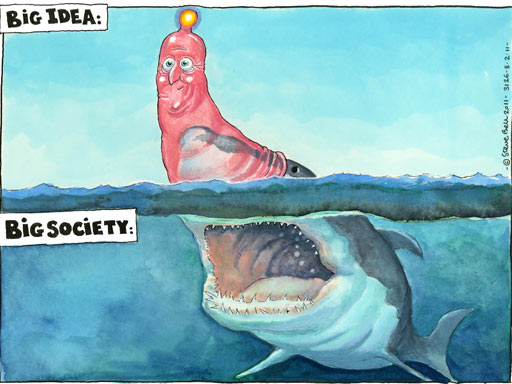
One of the principle battle-cries of the education movement has been that the coalition’s plans amount to a privatisation of the university system. This conclusion is arrived at by a focus on the withdrawal of teaching funding and the increased role given to ‘good relations’ with the private sector. These criticisms stand, but they repeat a common misunderstanding of the neo-liberal project as merely removing the state (call it the laissez-faire fallacy), rather than reorientating the state in a particular way to benefit certain sections and classes of society. The government is obviously complicit in promoting such tropes, which reinforce its narrative of supporting the grassroots and entrepreneurs and civil society and volunteers and champagne and candy for everyone. Hence their frankly playgroup standards of messaging. The Big Society is yellow and smiley-face! The Big Government is red and angry-sad-face!

But we now learn that the government has settled on a rather interventionist approach to all the lovely knowledge we are tasked to produce. ‘Two-minds’ Willetts has decided that the Arts & Humanities Research Council will be allowed to distribute £100 million in research monies each year, but only on condition that it accepts a ‘revision’ of the Haldane Principle (“that decisions on individual research proposals are best taken by researchers themselves through peer review”) and so spends a ‘significant’ amount of that money on research into the Big Society. Under the new ‘understanding’, the government continues to ‘value’ and ‘recognise’ the importance of academic independence, but wishes only to propose the merest of commonsensical adjustments:

At the other end of the spectrum there are decisions that ultimately must be for Ministers, albeit informed by external advice; these include the overall size of the funding for science and research and its distribution between the Research Councils, the National Academies and Higher Education research funding. In addition, every Government will have some key national strategic priorities such as addressing the challenges of an ageing population, energy supply or climate change. The research base has an important role to play in addressing such priorities and the Research Councils, with the support of independent advice, have proposed research programmes to tackle them. It is also appropriate for Ministers to ask Research Councils to consider how best they can contribute to these priorities, without crowding out other areas of their missions. But it is for the Research Councils to decide on the specific projects and people to fund within these priorities, free from Ministerial interference. Similarly, Ministers have a legitimate role in decisions that involve long term and large scale commitments of national significance.

The overall mood is civil-service vague, but elements of the language are importantly precise. Continue reading

Excuses In Our Sleep: Libya, the Arms Trade, Universities and the Political Economy of Human Rights

A common purpose
Gains value as a common goal
Let’s flail together
If we must flail at all.
Deep in the heart of the battle
Caught in the switch of the flow
Freedom from notes, she sells freedom from songs
She sells freedom and arms Eritrea.
I could have made these excuses in my sleep
As if anyone had doubted them at all
But if we arm Eritrea we won’t have to pay her
And everyone can go home.

Future Of The Left, ‘Arming Eritrea’ (2009)

This now fairly-widely disseminated video of Saif Gaddafi brandishing his militarised manhood and promising death can only fuel the paroxysms of guilt and denial afflicting those previously enamoured of him. Not a topic to be neglected, fersure, and one that will be returned here at The Disorder Of Things soon (I promise). But there is another element at play, and one rather more materially linked to massacre and repression. Where are the guns coming from?

Last month, The Guardian engaged in one of its periodic moments of data-explication, borrowing somewhat from Dan O’Huiginn to set out which regimes get UK arms exports, and how much. Since David Cameron is unashamed in his claims that we’re merely helping democracies protect themselves (barring minor hiccups), the numbers and relations make interesting reading. The conventional (if perhaps flawed) metric for such political goods as freedom and democracy is that provided by Freedom House. The top five Middle East and North African beneficiaries of UK military export licences in 2009-2010 were Algeria (£270 million), Saudi Arabia (£64 million), Libya (almost £34 million), the United Arab Emirates (almost £16 million) and Jordan (£12 million).

Every single one is listed as ‘Not Free’ in the Freedom House Index for 2010.

Continue reading

Serious Obstacles; Or, Why Is The UK Government Undermining International Protections Against Gendered Violence?

Today is the 100th International Women’s Day. The Government has been announcing its latest action plan on violence against women and girls (including some bold promises for increased funding for rape crisis centres) accordingly. But The Times reports that British officials have, in the same moment, been deliberately undermining a draft convention against violence against women at the Council of Europe. Specifically:

Britain objects to the words, “violence against women is understood as a violation of human rights”. Instead, it wants “violence against women constitutes a serious obstacle for women’s enjoyment of human rights”.

Even more damningly, our representatives apparently want the convention to apply only to gendered violence carried out in ‘peacetime’ and not to violations in war. Today’s Home Office announcements make reference to various avenues and promises of international ‘co-operation’, but say nothing about this specific charge. Media reports are similarly silent so far.

This is extraordinary. The timing is brutally ironic, although that is likely down to the Editors at The Times. But why would William Hague and co., newly championing freedoms elsewhere, suddenly seek to undermine international cooperation on this front?

Continue reading

Libyan cash and the LSE: a deeper problem

As Qaddafigate rolls on, and its luminaries publicly distance themselves or fall on their swords, a repeated line marks the public justification: there was no influence over research, there was no influence over research, there was no influence over research.  This is, as far as anyone can see, true – there is no evidence, even in the most scathing denunciations, to suggest that there was any attempt to influence the outcomes of the research programme. Even so, the School have rapidly appointed an investigation into this very issue.

Whilst many have been relieved by this, I find myself more deeply disturbed. Why is it that the regime of an eccentric and violent autocrat can slide into bed so easily with a research programme on governance and democratisation? Continue reading

The Anti-Feminist Backlash in an Age of Austerity

I suppose, in a way, British men are like white people were in Nineties South Africa or young Germans after the Second World War. We are expected to go through a period of atonement for the sins of our fathers. To be treated worse than we merit because of crimes previously committed in our name: in this case the crime of feeding, protecting, loving and nurturing women in accordance with our biological imperative. They don’t want that any more. They want to be linesmen. And so we have to let them tell us endlessly how they wish we were all dead.

Thus spake a gourmand and professional waffler last week, a child-of-privilege educated at Westminster and Oxford, who, despite these handicaps, manages to articulate for us the crisis of contemporary masculinity. Apparently two compatriots got caught up in some garden-variety lechery of the career-halting kind. Their trials and tribulations, although obviously upsetting for them on a personal level, at least had the merit for many of acting as a flashpoint for opposition. That is, a common-sense opposition to the political correctness surrounding the damages wrought on men by feminism and feminists. Finally, people can begin to speak out.

It is rather tempting to pursue the bizarre line of metaphorical reason here (if ‘sexist crimes’ are merely love expressed biologically, and if British men today are like post-fascist South Africans and Germans, does that make apartheid and Nazi rule the equivalents of a natural and benevolent stewardship? Did they even involve ‘real’ crimes?). But we should resist that. Coren is but a symptom, and should not detain us overlong in picking the low-hanging fruit. The triggering events are themselves already old news, the detritus of the news cycle now rendered especially vulgar and tattling by some actual struggles for justice.

The tropes at play have been with us for some time, inflecting what are essentially public relations SNAFUs with the full force of mythological sex wars. But these themes do seem to be becoming increasingly familiar. Those who grumbled about the rise of such minimal concessions as equal pay legislation in the halcyon days of economic vibrancy now have the pressures of austerity with which to buttress their case. Outrage at the redundancy of a favourite sports broadcaster spirals rather quickly into a diagnosis of women’s ‘special treatment’ in our society and the counter-sexism of a gender settlement in which men are no longer authorised to authentically, organically, just be themselves. Castrated. Emasculated. Prostrated.

Continue reading

The fallacious reasoning of Theresa May

Last week’s speech by Home Secretary Theresa May on the government’s intention to repeal some recent equality legislation was ironically and comprehensively overshadowed by the media frenzy about the impending lavish nuptials of the future King of the Realm to a Lowly Commoner. This may help to explain a little why the vacuous, fallacious and bizarre reasoning at the heart of it has been largely unremarked upon.

Overall, the speech sought to justify the repeal of the clause of the 2010 Equality Act which required public bodies to consider how they might address relevant socioeconomic disadvantages when making strategic decisions.  My interest in this post is not to make the political case for this clause or not – rather it is to explore the reasoning offered by May in the speech that seeks to banish it into a category unrelated to inequalities of gender, race, religion, physical ability and so on.

The core tension emerges because throughout the speech May is desperate to present herself as a champion for gender-, age-, race- and sexual-orientation-based equality (ps nice U-turn, T), whilst trying to deny any place to socioeconomic aspects of equality. This is right at the heart of the New Conservative ideology that Cameron wants to promote – a socially enlightened politics of ‘fairness’ in a Big Society of ‘individuals’, that hugs hoodies whilst denying that socioeconomic disadvantage should be something that the government seeks to address. Continue reading