Donald Trump has a thing for rebuking America’s democratic allies and their leaders—his latest target being Australia’s prime minister, Malcolm Turnbull. The UK appears to be an exception to this trend. In his first interview with the British press as president-elect, Trump explained that the UK has a “special place” in his half-Scottish heart and pledged to support a post-Brexit UK-US trade deal. Reportedly a big fan of Winston Churchill—and of Boris Johnson’s Churchill Factor—he also asked the UK government to loan him a Churchill bust that his Republican predecessor George W. Bush kept in the Oval Office.
International Relations
“Global Britain”: Theresa May’s Ersatz Vision
A guest post by Seán Molloy, Reader in International Relations, University of Kent
Now that the contours of post-Brexit UK foreign policy are clearer following the Prime Minister’s ‘Global Britain’ speech, the time has come to ask the most critical question: is the project feasible? The central thrust of Theresa May’s pitch is that freed from ‘inflexible’ Brussels mordant grip the UK will soar to new heights. ‘Global Britain,’ May confidently asserts, will be a trading dynamo.
Nobody who lived through the referendum campaign could agree with the Prime Minister that the vote on June 23 was a declaration of Britain’s determination to build a “truly global” Britain. Insofar as the depiction of Britain as an economic titan destined for global greatness once free of the EU featured in the referendum it was a distant also-ran compared to immigration, the fabled £350m per week to be lavished on the NHS, and the restoration of British sovereignty. These objectives were all domestic in nature and not consistent with the Prime Minister’s characterisation of Brexit as the expression of a confident, thrusting nation about the take the commercial world by storm. The electorate voted with its eyes open, but its gaze was primarily fixed upon the perceived domestic consequences of EU membership and other grievances related to the operation of globalisation rather than an insistence upon seizing external opportunities.
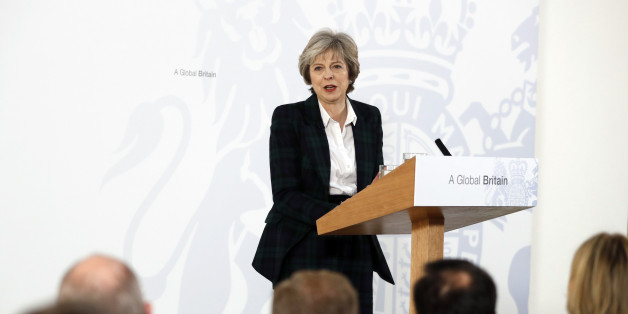
If what was genuinely at stake in the referendum eluded the Prime Minister, the full scale of its effects also seem to be absent from her articulation of the policies her government is poised to enact.
Fake Becomes Legit: Disinformation, Social Media and Democracy
 In our final post centring on the US presidential inauguration, Ulises Ali Mejias reflects on the phenomenon of ‘fake news’ and the role of social media. Ulises is associate professor at the State University of New York at Oswego. He is the author of Off the Network: Disrupting the Digital World (2013, University of Minnesota Press). With Nick Couldry, he is currently writing a book on data as a capitalist social relation.
The previous two inauguration pieces can be found here and here.
While we didn’t exactly predict the rise of ‘fake news’, in 2013 a Russian colleague and I completed an academic article on the disinformation tactics used during the Russia-Ukraine conflict. Like many others, we started to recognize the ways in which citizens generate, consume and distribute false information by interacting with old and new media, contributing to a social order where lies acquire increasing authority. While we focused on the Russia-Ukraine case, we felt it was important to point out that these tactics might serve as a template for future scenarios, including in Western democracies.
The article will not see the light of day until this year, four years after it was finished. Interestingly, part of the reason it has taken so long to get it published is that some reviewers felt our argument should omit references to Western democracies. The sentiment seemed to be that this kind of stuff could not happen here.
That was, of course, before the 2016 US presidential elections.
Can’t Lose For Winning: Victory In The Trump Presidency

 In our second post marking the inauguration of the latest president of the United States, Andrew Hom and Cian O’Driscoll reflect on what “winning” means for Trump and his followers — semantically, operationally, ideologically. Andrew is lecturer in international relations at the University of Edinburgh and works on timing, temporality, and the politics of victory in IR theory. Cian, a specialist on victory in just war theory and international ethics, is senior lecturer in politics at the University of Glasgow. This post is based on the ESRC-funded project ‘Moral Victories: Ethics, Exit Strategies, and the Ending of Wars’ (ES/L013363/1) and an ESRC Impact Acceleration Grant (ES/M500471/1). Edit: The other two posts in this series can be found here and here.
Donald Trump has been one of the most critically scrutinized political figures in recent history. But what has so far escaped much attention is how Trump promised to ‘Make America Great Again’ by ‘winning’ on all fronts. Yet victory has long been a centrepiece of Trump’s vision for American renewal. Here is Trump on the stump in April 2016:
You’re going to be so proud of your country. […] We’re going to turn it around. We’re going to start winning again: we’re going to win at every level, we’re going to win economically […] we’re going to win militarily, we’re going to win with healthcare and for our veterans, we’re going to win with every single facet, we’re going to win so much, you may even get tired of winning, and you’ll say “please, please, it’s too much winning, we can’t take it anymore” and I’ll say “no it isn’t”, we have to keep winning, we have to win more, we’re going to win more!
This repeated themes he had been expressing since the Republican primaries, and victory resurfaced in Trump’s inaugural address: ‘America will start winning again, winning like never before.’
What in the world is populist foreign policy?
Andrew Priest is senior lecturer in Modern US History at the Univers ity of Essex. He is co-editor, with Andrew Johnstone, of US Presidential Elections and Foreign Policy: Candidates, Campaigns, and Global Politics from FDR to Bill Clinton (University of Kentucky, forthcoming 2017), and he is currently writing a new book on US foreign policy and notions of empire in the post-Civil War period. Here, the day before Donald Trump is inaugurated as the 45th US president, Andrew sets him in the context of American populism through the centuries and offers some thoughts on Trump’s foreign policy in the making.
Edit: This is the first in a three-part series of posts around the presidential inauguration. The other two can be found here and here.
As hard as it is to believe, only on Friday will Donald Trump finally become president of the United States. During the ultra-marathon that is the modern presidential election, which has given way to a transition period that has felt almost as long, Trump has given us many hints but few details of what his presidency will actually bring. While strident in his views about America’s place in the world, he shows little interest in the details of foreign policy and disdain for diplomatic niceties. This will have important implications for Trump’s role as architect of American foreign policy for the next four years.

American populists L-R: Andrew Jackson, Donald J. Trump, Thomas Jefferson, Ross Perot, and Huey “The Kingfish” Long.
The many deaths of Fidel Castro
A few weeks ago, when I checked Twitter and saw that Fidel Castro had died, the news felt strangely distant. True, Fidel was a giant of the twentieth century rather than the twenty-first, but I think that feeling of observing the news of his death from afar had more to do with the fact that we (Cubans and Cuba-watchers, journalists, scholars, beret-wearing backpackers) have already been living with the spectre of his death for so long. And, as he has faced death so many times through the years, the mere fact of his death – now material, tangible – seems hardly enough to stop him from living on.

Political cartoon by Graeme Mackay, 2 August 2006.
Business As Usual: Donald Trump and American Empire
This is a guest post by Jeanne Morefield, Professor of Politics at Whitman College and a Professorial Fellow at the Institute for Social Justice, Australian Catholic University.  Her scholarship works primarily at the intersection of political theory, history, and international relations with a particular focus on the political discourses of British and American imperialism. She is the author of Empires Without Imperialism: Anglo-American Decline and the Politics of Deflection(Oxford, 2014) and Covenants Without Swords: Idealist Liberalism and the Spirit of Empire (Princeton, 2005) and has published articles in journals such asPolitical Theory, History of Political Thought, Theory and Event as well as numerous chapters for edited volumes on the history of international and imperial thought. Jeanne is currently Co-President of the Association for Political Theory and is writing a book on the political thought of Edward Said.
Although it seems like an eternity, it was actually just over a month ago that those legions of Republican and Democratic pundits and professors of International Relations associated with the foreign policy establishment – in all the overlapping, echo-chamberish, reinforcing glory that Ben Rhodes termed “The Blob” – were busy issuing dire warnings about a Trump foreign policy. From realists, to liberal internationalists, to neoconservative ranters, a huge swath of foreign policy regulars committed themselves to the idea that Trump demonstrated “a predisposition to strategic recklessness” and that his espoused policies amounted to “a de facto withdrawal from the liberal world order.” Words like “crackpot,” “temperamentally unsuited,” and “the Islamic State’s dream candidate” came pouring out of a seemingly crestless wave of professorial and think-tank generated articles, op-eds, and open letters while journalists took to the Twittersphere to proclaim Trump’s foreign policy vision “dangerous,” “unprecedented,” and “terrifying.”
In Robert Kagan’s words, if elected, Trump’s “ultimately self-destructive tendencies would play out on the biggest stage in the world, with consequences at home and abroad that one can barely begin to imagine.” The mood was perhaps best captured by Jeffrey Isaac in his last ditch attempt before the election to convince the – largely fictional but rhetorically useful – hordes of leftist hold-outs to vote Democratic. While his concern was domestic, the ultimatum he presented beautifully reflected the broad sentiments of the foreign policy establishment. The choice before us was simple: “Clinton or barbarism.”
Then Trump won, the barbarians entered the gates, and in a matter of days many of these same harbingers-of-doom were confidently assuring us that, while they still had a few doubts, all would be well on the foreign policy front.
Not surprisingly, Western Civilization’s most dogged empire-whisperer Niall Ferguson – crowing with satisfaction at his prescient decision not to couch his pre-election warnings about Trump as support for Clinton – jumped quickly on the Trump-possibility bandwagon. Not only, he argued, did it appear that Trump’s foreign policy limned more closely to that of Ferguson’s outsized hero (Henry Kissinger), it could potentially shore up liberalism’s core principles by more forcefully opposing the oppression of women, gays, and people of different faiths in the name of Islam.
Citizens Of Nowhere
In her speech to the 2016 Conservative Party conference, Theresa May threw down a gauntlet:
…if you believe you’re a citizen of the world, you’re a citizen of nowhere. You don’t understand what the very word ‘citizenship’ means.
For anyone wondering who or what met the cut, May was helpfully expansive, populating this rather arcane placeholder with the figures of the boss who earns a fortune but doesn’t look after his staff, the international company that eludes the snares of tax law, the ‘household name’ that refuses cooperation with anti-terrorist authorities, and the director who takes out massive dividends while knowing that the company pension is about to go bust. Basically, fat cats with the odd public intellectual thrown in. May contrasted the spectre of the rootless cosmopolitan with the ‘spirit of citizenship’, which, in her view, entailed ‘respect [for] the bonds and obligations that make our society work’,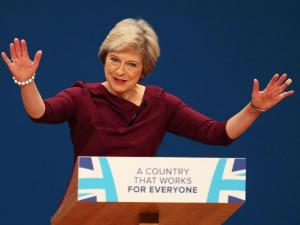 ‘commitment to the men and women who live around you’, ‘recognizing the social contract that says you train up local young people before you take on cheap labour from overseas.’ And perhaps astonishingly, for a Conservative Prime Minister, May promised to deploy the full wherewithal of the state to revitalize that elusive social contract by protecting workers’ rights and cracking down on tax evasion to build ‘an economy that works for everyone’. Picture the Brexit debate as a 2X2 matrix with ideological positions mapped along an x-axis, and Remain/Leave options mapped along a y-axis to yield four possibilities: Right Leave (Brexit), Left Leave (Lexit), Right Remain (things are great) and Left Remain (things are grim, but the alternative is worse). Having been a quiet Right Remainer in the run-up to the referendum, May has now become the Brexit Prime Minister while posing, in parts of this speech, as a Lexiter (Lexiteer?).
Queer International Relations (V)
The fifth post in our symposium on Cynthia Weber’s Queer International Relations: Sovereignty, Sexuality and the Will to Knowledge is from Dianne Otto. You can read Cynthia’s introductory post and responses to it here. 
Dianne Otto holds the Francine V. McNiff Chair in Human Rights Law at Melbourne Law School and was Director of the Institute for International Law and the Humanities (IILAH) 2012-2015. Her research, in the field of public international law and human rights law, aims to meld critical legal theory with transformative practice. Dianne’s research covers a broad field including addressing gender, sexuality and race inequalities in the context of international human rights law, the UN Security Council’s peacekeeping work, the technologies of global ‘crisis governance’, threats to economic, social and cultural rights, and the transformative potential of people’s tribunals and other NGO initiatives. She is editor of the forthcoming collection, Queering International Law: Possibilities, Alliances, Complicities, Risks (Routledge 2017). Recent publications include Rethinking Peacekeeping, Gender Equality and Collective Security (co-edited with Gina Heathcote, Palgrave-Macmillan 2014); three edited volumes, Gender Issues and Human Rights (Edward Elgar Publishing, Human Rights Law Series, 2013); and ‘Feminist Approaches to International Law’ in Anne Orford and Florian Hoffman (eds), The Oxford Handbook of The Theory of International Law (2016).
Cynthia Weber’s ‘queer intellectual curiosity’ takes the reader on a journey of discovery that uncovers the manifold ways that tropes of (homo)sexuality have helped to institute, legitimate, authorize and sustain white, western, civilized, capitalist, (neo)liberal ‘statecraft as mancraft’.[1] She sets out to reveal what happens to our understanding of international politics, and in particular its constructions of state sovereignty, when the variable of sexuality is included in mappings of its relations of power. Along the way, she makes a powerful case for the importance of conversations between queer theory and international relations theory by showing how sexuality works as a fundamental organizing principle in international politics (and, I would argue, in international law as well).
Cynthia searches for, and finds, proliferating figurations of the ‘homosexual’ in international affairs and asks what work these figures are doing, especially in relation to sexualizing sovereign subjectivities, which invest the modern state with authority and legitimacy. Drawing on a somewhat dizzying selection of queer/postmodern theoretical and methodological approaches (beautifully explicated in chapter 2), she shows how these figurations also do work beyond the state to sexualize the formal and informal ways that international relations are arranged, including in regional organizations like the European Union and global security campaigns like the ‘war on terror’.
“Not My President”: Trumpocracy and Dissent
This is a guest post by Eric Grynaviski, an Associate Professor of Political Science and International Affairs at George Washington University. He is the author of Constructive Illusions (Cornell, 2014). He studies sociological approaches to cooperation and conflict, and international ethics.
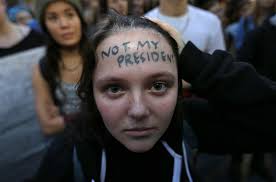
In the wake of the election, people are rejecting the idea that Trump represents them in office. Academics and journalists are calling attention to what loyalty and patriotism mean in the context of such a divisive election. President Obama has called for everyone to rally to Trump, and he asked Trump to make everyone feel included in his America. Protestors oppose this view with the simple message that “Trump is not my president.”
A lot is being written on the subject of national unity, but I want to reflect on what this means. Calls to national unity suppose that Trump is the legitimate representative of the public. But, the idea of being representative and legitimate in this election is more ambiguous than at any moment in American history since I’ve been alive.
Surprisingly, the idea that “Trump is not my president” has been criticized by political scientists and some Democratic politicians. I want to describe some differences between three criticisms of the view that “Trump is not my president.” To do so, I am going to turn to Carl Schmitt. Schmitt was a legal thinker and philosopher during the Weimar-era who ended up supporting the Nazi party. Why turn to Schmitt now? Unfortunately, we are facing some of the same dilemmas Weimar-era Germany did. Deeply racist politicians are entering the White House, the public is divided, and the stakes are quite high for minorities living in the United States. Writing in the 1920s and 1930s, Schmitt faced the question about what it means to say someone is not “their” president head-on during a period of political bitterness and acrimony. Much of the rhetoric against “Trump is not my president” could come straight from Weimar Germany.
One way of thinking about the question about whether Trump is not my president focuses on whether Trump represents people, even when his policies and rhetoric diverge from their preferences and beliefs. Schmitt replied yes. Trump represents you even if you disagree with him in every respect, even if we transition from a Trumpocracy to a Trumpikatorship (a Trump Dictatorship). The president is the only person who is elected by all voters, so he is the only person to represent all voters. Schmitt’s idea is that there is some homogeneity within a country (something held in common) that can, and should, be represented by a single person.
Unfortunately, I worry that some of the people calling for unity are coming from this perspective. When people say we need to pull together because we are all Americans and our strength is in unity—and thus we need to endorse Trump’s representation of us—they are making this argument. The question is “what is unity?” Some interpretations of Schmitt focus on his anti-Semitism: all Germans have in common a natural aversion to being prey to the Jews. I do not think this was his original meaning (though it changed over time). In the 1920s, I think he meant that all Germans are Germans, which marks them as different from the French, the Poles, or any other group. And whatever differences Germans have with one another, they are still special because they are different from non-Germans. In other words, Schmitt did not have any content within his calls for unity: it was an empty message appealing to the unity of the nation without giving the nation any content.
A Schmitt-like claim that Trump represents “us” and is therefore “my president” also seems a bit hollow. The normal rhetoric we use to give substance to being American is based in ideals, such as tolerance and liberty. Trumpocracy clearly does not connect with those ideals. Calling for unity because we have something in common does not work when the person we are supposed to rally to does not share that something. In this sense, one can easily say “Trump is not my president” because I am not racist, sexist, xenophobic, etc.

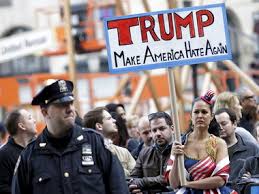
The second argument Schmitt emphasizes is the danger of refusing to accept a new leader as president. Andrew Sabl reaches this conclusion on the Monkey Cage, when he writes, “people are likely to disagree over who is the best leader, especially in diverse societies divided by religion, culture and ethnic identity. Indeed, these disagreements may easily lead to war between different factions, each with its own preferred leader or petty warlord.” In other words, the only alternative to accepting an election outcome is civil war. Schmitt echoes this view. For him, the alternative to accepting the government is declaring war on the government; there is no middle ground. Therefore, the rhetoric that “Trump is not my president” is dangerous, inviting chaos.
This stability argument is wrong because it distorts what people mean when they claim “Trump is not my president.” I do not think that most people on the streets mean “Trump is not the president-elect of the United States,” at least that is not what they mean yet (see below). Instead, it is a claim about representation. People are saying that Trump does not represent their views, and his views are so repugnant that they will oppose his presidency at every opportunity. The Trump-picketers—the Women’s March on Washington, for example—will not initiate events that will end with tanks rolling down D.C. streets. These protestors pose no genuine threat to the American constitutional system, just as there was no genuine threat during the Civil Rights March or during demonstrations against abortion rights.
There is also a giant leap in this argument. Sabl argues that “we must accept the authority of leaders we thoroughly hate.” This gives me the most pause because of the connection to Schmitt. For Schmitt, the danger of civil war is so real that we need to pass a great deal of authority into the hands of the president. With the growth of executive powers in the United States, Trump, with a flick of a pen, can wipe out an incredible amount of our national environmental protections, begin a war, dramatically expand Guantanamo Bay, and in the modern world, even assassinate American citizens abroad (e.g., following precedents set in the War on Terror). Unlike Nazi Germany, the American political system historically allows citizens to fight as hard as possible to limit the authority of hated leaders. We can accept someone as president, but still fight as hard as possible to narrow their authority and constrain their choices. Congress, the Court, and the public (through voice) can undermine presidential authority, and doing so is part and parcel of the American experience. [Spoiler: We almost always fail. Today I bet we regret creating such a strong presidency.]
Saying “Trump is not my president” and refusing to accept Trump’s authority therefore strike me as reasonable, if people mean Trump does not represent their views and they refuse to be complacent when he uses his authority to do things they find disastrous. Raising the specter of civil war does not seem helpful.
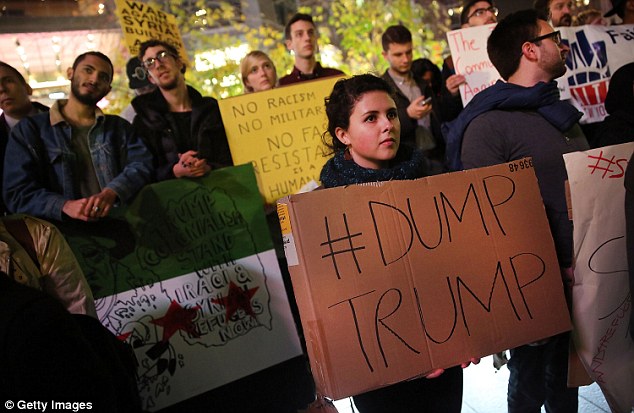
A third view is that “Trump is not the president.” This claim is the most radical. This perspective would say something like the following: Trump is so morally repugnant, and would be such a disaster of a leader, that he is ineligible to be president. One might give this a constitutional interpretation. The Constitution requires people to be 35 to enter office, hoping that this will lead to mature and sensible office-holders. It is a maturity test rather than an age test per se. Because Trump is less qualified for office then most 34-year-olds, his election ignores the founders’ intentions in writing the Constitution (see (gated) Spann’s argument, sure it may not be the best argument but good enough for many).
This is the most dangerous version, and one that I suspect at least some people in this country are considering. This view of how to oppose Trump is also Schmittian in a sense. One reason why Schmitt favored the growth of executive powers is that sometimes you need to break the rules in order to save the rules. In exceptional moments—when the Communists are at the gates—having one’s hands tied by constitutional processes prevents decisions that need to be made to save those the society. Rejecting Trump along these lines does not need to be violent. We could resurrect the idea of a “general strike,” in which people simply refuse to go to work until he resigns.
I never thought I would say this in my lifetime, but I can imagine a scenario for the next four years in which the public wants to pursue this route (see Nexon’s post). Trump may overstep the bounds of his constitutional powers when in office. In the debates, he already said that he may not respect the norms of constitutional rule and respect the outcome of the election. Beyond constitutional norms, if Trump follows through on just some of his campaign rhetoric, the first 100 days of his term may see irreparable damage to the global environment, racists in the White House, deportation of millions of immigrants, and the FBI investigating political opponents. His campaign and its surrogates are describing protesters as communists, paid plants, and so on.
In this case, the claim that “Trump is not the president” is the most politically important because it denies that Trump has a legitimate claim on his office. The difference from Schmitt is that instead of turning to the president to suspend the constitution, it turns to the public to save the constitution from Trump.
At the moment, these seem like dark times. Looking to Weimar may be the best analogy because it is the period of time in which an imperial presidential system appeared the most necessary and the most dangerous. Protestors have figured this out (and the importance of hair jokes).
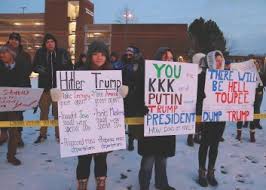
The question is if people move from the idea that Trump does not represent them to the view that political action needs to be taken to remove Trump. Unlike others, I find that “Trump is not my president” is a BEAUTIFUL expression of what people mean.

 The Disorder Of Things
