Colouring Lessons: Race Is A Structure Of Oppression, And Is Alive And Well

Race is a structure of oppression. So long as the structure remains, so does race. However, while there is plenty of talk about ethnicity and social cohesion, pathological cultures, and broken communities, race is usually mentioned only in its disavowal. And racism? Few would profess to that habit; most would comfortably label racism as a reactionary attitude. But to what imaginary golden mean? It is a privilege to believe that racism is a reaction rather than a catalysing agent of oppression. Meanwhile, all of us are variously implicated in this structure of oppression called race.

Even on the left, race is seen to be somewhat passé, and happily so now that the next world crisis in capital accumulation has arrived and we can all finally re-focus on the real thing: class. But what is the difference between race and class? Is it the difference between superstructure and base? Race does involve identification, both in order to oppress and in order to redeem. Yet in this respect, it is no more or less an identity than class. With the exception of Black Marxism, what the left has historically been unable or unwilling to consider is that, as a structure of oppression, race runs deeper than class.

Marx’s masterful hermeneutic shift from contract to class involved leaving behind the realm of exchange – wherein all things were of equivalent value and all transactions were equitable – and entering into the realm of production – wherein value was consistently expropriated and relations were exploitative. Nevertheless, in the colonial world, Marxism was more often used as a weapon for struggle and less so as a faith to guide contemplation. One reason for this engagement is that class exploitation never quite explained the reality of oppression experienced under the colonial exigencies of the world market.

In truth, Marx did not shift his hermeneutic far enough from liberalism and its obsession with civil society. Continue reading

And there will be the most beautiful silence never heard

Dinosauria, We

Born like this
Into this
As the chalk faces smile
As Mrs. Death laughs
As the elevators break
As political landscapes dissolve
As the supermarket bag boy holds a college degree
As the oily fish spit out their oily prey
As the sun is masked
We are
Born like this
Into this
Into these carefully mad wars
Into the sight of broken factory windows of emptiness
Into bars where people no longer speak to each other
Into fist fights that end as shootings and knifings
Continue reading

Dalston: A Worm’s Eye View

(…cheers…) Please welcome, in your traditional way, the latest in the expanding list of Disorder-ed contributors. Rahul Rao, currently Lecturer in International Security at SOAS, author most recently of the fascinating Third World Protest: Between Home and the World, as well as a number of articles on cosmopolitanism, world order and empire. He is currently working on projects aimed at provincialising Westphalia and introducing queer theory to IR.


There is a great deal that I don’t understand about the world, but I do know a little about that part of it where the Kingsland Road becomes Stoke Newington Road (London N16/E8, if that’s how you work). As the dust clears from what BBC Panorama recently called The August Riots – as if to distinguish them from those to come in September, October, November and December – it is difficult to walk around without wondering whether everyone is judging everyone else on the basis of age, race, class and sartorial preference. Multiculturalism in Dalston can sometimes feel like a polite version of separate-but-equal with the hipsters (mostly white, but equal opportunity for those with the right facial hair, skinny jeans, loafers with no socks, university education, fixie bikes and Apple accoutrements) patronising hipster cafés, the Turks hanging out in members-only social clubs, the Caribbeans in venues such as Open the Gate. Everyone goes to the Turkish restaurants, but gastronomy has always been the least challenging site for racial mixing. As gentrification has proceeded apace – a phenomenon driven by middle class professionals like myself – I cannot help but notice that Dalston Superstore is always full and the Caribbean restaurant in Centerprise (East London’s oldest and most famous black bookshop) often empty. (Oddly, the spell check on this blog thinks that the word ‘gentrifying’ does not exist and suggests replacing it with ‘petrifying’. There might be something to that.)

On August 8 when the riots reached Hackney, Dalston hit the headlines as the place where the riots caused little damage, its Turkish and Kurdish business owners much feted for their role in beating back the rioters. I have to confess to an immediate reaction (always a betrayal of one’s class identification) of gratitude to a local community of people who trusted and knew each other well enough to work together at a moment’s notice – a community to which I do not belong, but on whose efforts I was able to free-ride (like Zoe Williams, I watched these events on a live feed, it never having occurred to me that I could have gone on to my high street to defend anything). In the cold light of dawn, second thoughts: when the facade of the Leviathan had cracked, security had become a function of ethnic solidarity. Welcome to Sarajevo.

The reaction of the local business owners in Dalston poses two questions. Continue reading

Primitive Accumulation; Or, A Virtual Read-In on the London Riots

The blogosphere has a million corners, countless nooks and several large echo-chambers, complete with their own centres of self-congratulatory gravity. All have been aflame over the last week, saturating events, riots and insurgencies with the weight of historical expectation, the political memory of past iteration and the awesome condescension of easy interpretation. Gaps persist: gender and the dynamics of formally opposed masculinities have escaped all but the most cursory attention. It is one paradox of all this profuse commentary that decrying the statements and manifestos of others is the most satisfying and patronising manifesto of all. At its worst, it engages in the fullest of narcissisms (let’s make this about us and the quality of our analysis) whilst proudly displaying its contempt for thought (now is not the time for theory!). And of course, the problems and challenges are real. Much more real than we can face, too real for the sordid postures of moralising (I denounce Satan and all his works!) and liable to stay as real once we paper over them and return to our default settings.

Oh, and I find myself in unsurprising agreement with Joe and Meera (although I think Ken Livingstone’s attempts to make the link to cuts and social marginalisation is more ham-fisted than shameful). Which is all by way of introduction. There are reams to be written on the way the punditocracy and assorted commentariat are deploying (and misapplying) categories of cause, the unstable and multiple uses made of ‘politics’, the questions of historical precedent and historical return, and on and on. Exhaustion at the war of position prevents any such post. Instead, a mix-tape of diagnosis and critique, with both the smooth joins and the subtle dissonances that implies. More useful than a 1,000 faux-fresh words.

—————–

These looters are doing what they’re supposed to; grabbing the goods they see in the shops and can’t buy in a recession. They loot the bling – the sports shoes, gold watches, mobile phones and plasma TVs; and you can recognize the very poor when you see a woman looting potatoes from a corner shop. These acquisitive looters are certainly copying the gold standard of a social contract eroded by and evaporating with the money. These are riots in the cause of consumer goods. Burning and robbing other people’s things is one thing, but soon enough, and with no social cause or justice worth the name, people too become indistinguishable from things: witness the widely-circulated photo of the woman leaping for her life from a burning building; such potential deaths still threaten to bring the house down on top of us. This whole distressing episode began with the police shooting dead a black man in north London they said was a gunman; no evidence he fired a shot, we’re told, but the man was already indistinguishable from his gun.

Gabriel Gbadamosi, ‘The Blazing Light In August’

Continue reading

Reading violence: what’s political about the London riots(?)

To reiterate somewhat, there is a politics to these riots. Panicking, political leaders and many others, have queued up to deny this, labelling it “pure violence,” “criminality, pure and simple“, or “mindless violence“. Over and over again, the distance between the rioters and the ‘community’ or ‘Londoners’ has been set up and reinforced. This is not without some public backing. After all, many Londoners are, rightly, angry, frightened, upset, frustrated, shocked and saddened by the sight of homes and businesses not just smashed but burning voraciously into the night whilst looters showed off their new gear. We were a world away, it seemed, from the specific, dignified, coherent demands for justice being made by Mark Duggan’s family and their supporters. Many asked themselves: what do they want? The answer seemed to be: trainers. What could be political about stealing from Foot Locker?

First things first. This post is not about constructing a narrative of social apologia via moral determinism – i.e. the idea that people couldn’t help themselves, or were bound to do it by their economic status etc. Between this and the ‘mindless violence’ line of argument, there are plenty of fools (sadly many, powerful, wealthy, and in charge of your country) trading in pretty stupid accounts of human behaviour and social causation. Continue reading

The Politics of Austerity: Emergency Economics and Debtocracy

austerity |ôˈsteritē| noun – sternness or severity of manner or attitude
It was possible, therefore, to commit a sin without knowing that you committed it, without wanting to commit it, and without being able to avoid it. Sin was not necessarily something that you did: it might be something that happened to you.

– George Orwell, “Such, Such Were the Joys”

Why what have you thought of yourself?

Is it you then that thought yourself less?

Is it you that thought the President greater than you?

Or the rich better off than you? or the educated wiser than you?

 I do not affirm that what you see beyond is futile, I do not advise that you stop,

I do not say leadings you thought great are not great,

But I say that none lead to greater than these lead to.

– Walt Whitman, “A Song for Occupations,” Leaves of Grass

The Politics of Austerity – Part I

This is the first in a series of posts that look at the political implications of the ongoing global economic crisis. I begin by examining the way that crisis is being used to attack the very idea of democracy through an assertion of the political imperatives of “the market” and the violation, bending and re-writing of the law by capitalist elites. I conclude by laying out how understanding the economic crisis in political terms shapes our ability to respond to it.

In the second post I’ll look at the ethos of austerity, which justifies the pain inflicted on largely innocent people, while suggesting that an affirmative democratic response to the economic crisis must begin with its own ethos, which I suggest should be an ethos of care for the world – which can provide orientation and inspiration for political struggles seeking to address the deeper causes of our current crisis. In the third post, I turn to the structures of the economy and of politics that define the current crisis, looking at the banking crisis, the bailouts, the politics of recovery/austerity and also reflecting of the structural imperatives of capitalism that led us to crisis. This, then, leads to the question of how to respond to the politics of austerity, and of what alternative actions are available to us, which is where the fourth and final post will pick up – with an affirmation of a caring ethos that supports a radically democratic economic vision.

Emergency Economics

In a previous post I briefly highlighted Bonnie Honig’s work, Emergency Politics, to examine the way that the ethical case for austerity is made; most basically, the existence of a supreme emergency, in this case economic, justifies actions that would normally be considered unacceptable. Honig’s work looks at how the appeal to emergency is used to reassert the exceptional political power of the sovereign over and against the law, with a focus on the reassertion of sovereignty witnessed over the past ten years in response to the threat of terrorist attack in the US and Europe.

Rather than accepting the necessarily intractable conflict between the power of the sovereign and the power of the law, Honig attempts to deflate this paradox by turning her attention to the always ongoing contestation that defines democratic politics, a contest over both the content of the law and the institutional embodiment of sovereign power. She suggests, then, that attending to the ambiguities of the “people”, who are both the democratic sovereign and a diffuse multitude, as well as the political element in the law – as new laws come into being through political action – enables us to avoid thinking about emergencies as moments of exception in which the rule of law is lost to the play of political power, while also acknowledging the limits of established law in moments of profound crisis. By undermining the exceptional nature of crises and emergencies Honig alters the challenge we face when circumstances force us to make choices or carry out actions we know are harmful and wrong by asking what we (democratic publics and citizens) can do to survive an emergency with our integrity in tact.

What do we need to do to ensure our continuity as selves and/or our survival as a democracy with integrity? Our survival depends very much on how we handle ourselves in the aftermath of a wrong. We will not recover from some kinds of tragic conflict. But when faced with such situations, we must act and we must inhabit the aftermath of the situation in ways that promote our survival as a democracy.

I continue to find this a useful way to understand our current economic crisis. Appeals to austerity depend upon the exceptional state created by crisis in order to justify the pain inflicted upon masses of people and the priority given to private interests (the markets, investors and bankers) over democratic publics. So, as democratically enacted laws must bow before the sovereign power threatened by exceptional attacks, so economic justice and democratic equality must bow before the commands of market forces, of economic inevitability, in this time of crisis.

The economic version of this argument is stronger still. While the space of political contestation that remains open when we accept the framing of emergency politics is limited, it does exist in the clashing of opposing sovereigns. The prospect of a substantive alternative to neoliberal economic ideology is dim, a light flickering weakly on antiquated appeals for a return to Keynesianism or watered down triangulations of the moderate-middle that sell off dreams of a just economy bit by bit – capitalist realism in action.
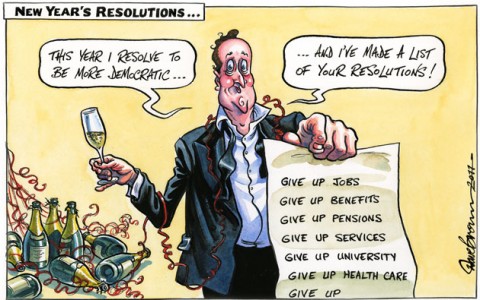
Honig awakens us to an important aspects of our current crisis: that “the market” is not in fact supremely sovereign, and the move to re-establish and further neoliberal policies and push through austerity measures requires an engagement in democratic politics – albeit one that undermines the notion of the public itself and seeks to use the power of the law to subvert democracy. Recognising the current crisis in these terms not only challenges us to consider how to survive our current troubles without giving up democratic virtues, it also reinvigorates and clarifies the political challenge we face. Emergency economics – with its assertion of debtocracy over democracy – is not an inevitable response to the crisis, it is a political one that we can, and should, fight against.

Continue reading

Grayling’s Eminence; Or, For That Kind Of Money, I Would Demand A Team Of Live-In, Round-The-Clock Tutors, Ready To Fill Me In About Renaissance Art Or Logical Positivism At The Snap Of A Finger.


I do feel somewhat sorry for A.C. Grayling. Following his sudden exit from the Birkbeck scene, former colleagues sent a short but apt letter to The Guardian, expressing appropriate levels of dismay and resistance to the innovation of the New College of the Humanities. They raised basically two objections. First, that the New College is for-profit, substituting the business of teaching in place of the vocation of research. And second, that it is in the ‘vanguard’ of efforts to link education to wealth, partly via a leaching of public resources.

Although many prominent names were used to unveil New College, few seem in sight now that it is under sustained attack (Peter Singer, where are you?). And Grayling, somewhat to his credit, keeps replying to the antiquated nay-sayers desperately clinging to the sinking ship of public provision. Perhaps the fullest public defence has come in response to the Birkbeck letter. Although garlanded by academic niceties (“with respect”; “I would be very grateful”), the ultimate conclusion is that his critics lack some basic faculties of reason: “I have seen only an emotional case for scapegoating our project”.

Surely, then, there are firm responses to the proliferating critiques? Grayling’s fuller case for New College turns primarily on the idea that students are being under-charged rather than over-charged. The relevant comparisons? That an MSc in Finance at LSE for an overseas student costs almost £26,000 (with many other programmes charging in the £15-21,000 range) and that a DPhil in cardiovascular medicine at Oxford will set you back nearly £27,000 if you’re not from the EU. The point being that high fees for some already subsidise lower fees for others. Now, you’ll notice what has been done here: £18,000 for an undergraduate degree for all students is being justified on the grounds that you can find a handful of prominent programmes elsewhere that charge more than this for masters programmes for non-EU students.

As an argument for justice it has some merits (Why the disparity here? What are the ‘real’ costs of educating a doctor or financial specialist?). But as a defence of New College as prosaic rather than parasitic it doesn’t stand up to much. And I’m sure there’s a latin term for this kind of fallacy. A direct comparison with liberal arts funding in the US would have offered us more, but that would have required admitting that there is something new about the New College in the UK setting. You’ll recall that, before people starting off letting flares at Grayling’s talks, this was very much the selling point of New College. Its online welcome still announces: “New College of the Humanities is a new concept in university-level education”.

Lots of the new then, which makes it worth thinking through some of the older ideas of the university, as Steve Fuller did so wonderfully back in February. But there is something yet more damning in Grayling’s reply. He says that his project can’t be vanguardist. In a repeat of the AHRC debacle, apparently bright people conclude that you can’t be complicit if the Minister didn’t call you directly and tell you to do something. Grayling clarifies that he is under no compulsion of Government and has no love for the current reconstitution of UK higher education, as if that matters. Moreover, “we cannot be in the vanguard of what has long been happening”. This is the crux of a claim made before: that New College is simultaneously following an economic pathway outside of its control and that it will have no detrimental impact outside of its own halls.

Other engaged in privatised education do happen to think that the New College will accelerate some market openings. But notice that Grayling can’t have it both ways. His argument against allegations of vanguardism is that New College is too small and insignificant for anyone to follow its lead. But his argument for an £18,000 fee compares New College to comparatively small and unrepresentative courses which charge more than he intends to (about 80 people take that MSc in Finance at LSE). An accidentally immanent critique, this mode of argument illustrates exactly how a vanguardist framing works, and has worked over the last years. Find an institution that charges more than you do and has a good reputation. Point out that you could do more, and do it better, if you had their money. Campaign for that outcome while ignoring or dismissing arguments for higher levels of public investment. Repeat. Change the discursive and economic landscape in a series of comparative expansions.

Grayling suggests high fees elsewhere as justification for his high fees, but then expects us to believe that his high fees (which are much more clearly comparable with undergraduate provision than are the courses he cites) won’t be used by anyone anywhere to militate for a further uncapping or greater move to student debt and ‘consumer-led’ education over equal access and public goods. It is hard to see the logic in such a position, not least when it already provides indications of how such an appeal by others would run:

Note one thing: the deafening silence of the vice-chancellors in the controversy over our college project. Why? Because as the individuals most acutely involved in battling with impossible arithmetic, they understand the realities.

Please.

Andrew McGettigan’s excellent and much circulated analysis points out that marketisation requires the softening up of older providers via the introduction of one or more exemplars of new learning: 1) independent, non-profit providers like the University of Buckingham; 2) private, for-profit providers like BPP and now NCH (perhaps owned by people like Apollo); 3) Edexcel in relation with colleges; 4) Cameron’s planned ‘Big Society University’; and 5) globalised multi-nationals. New College has to be viewed in this context and not, as Grayling wants, as some minor footnote. Here’s McGettigan:

The new market conditions must first be created. A significant amount of intervention is required to bring about a ‘level playing field’ in which new, more commercial, operations can compete successfully to drive down costs. The first steps here have already been achieved. First, the complete removal of central funding to arts, humanities and social science degrees exposes the established provision to potential competition in a manner that gives the lie to Willetts’s claim that the cuts have been ‘scrupulously neutral’. (No new provider is currently planning to offer STEM degrees, which are expensive to run and require large overhead and start-up costs.) Second, students at private establishments have already been granted access to the student loans and grants…Third, when viewed in conjunction with the new visa restrictions on overseas students (a political decision affecting an otherwise independent and substantial income stream) and the cuts just announced from HEFCE for the 2011/12 budget, we can conclude that universities are being softened up. Prior to a major reorganization of higher education these cuts are punitive and part of a concerted effort to destabilize the sector for the entry of new agents… What is proposed does not simply benefit small, niche operations but creates the conditions for ‘creative chaos’ similar to that to be unleashed on the National Health Service.

On Objecting to the New College of the Humanities; Or, Who Would Pay £18,000 a Year to Listen to this Outdated Victorian Rationalism When They Could Buy Themselves a Second-Hand Copy of John Stuart Mill?

Yes, this is more comment on the New College, a.k.a. Grayling Hall, a.k.a. Grayling’s Folly, a.k.a. North Oxford in Bedford Square (NOBS), a.k.a. The Ultimate Scab University.

It won’t have escaped your notice that there has been a flurry of disgust, disbelief, protest and rage at the announcement of the New College of the Humanities (an aside: ‘of the’ Humanities? Why not ‘for the’ Humanities?). There have also been a number of responses that pretty much add up to ‘meh’: to wit, there are some bad things, but also some good things about Grayling’s Folly. And then there has been some welcoming of this project, and its ‘chutzpah’. Since we are in a downward vortex of vanishing funding and academic status, why not expand where we can? And why damn the entrepreneurial? As Brian Leiter puts it:

NCH is just the natural continuation of the elimination of 75% of government funding for higher education and 800% increases in tuition in the space of a few years. If the Brits can’t even keep the Tories out of office, and if their party of the Left is now in bed with the Neoliberals, it’s really hard to see why one should think “petitioning” the government for more government funding for higher ed will produce any results. The battle to be won is at the polls, and NCH is just a symptom of the battle already lost.

All this makes me think it’s worth clarifying the case against, and the potential mitigating factors. Continue reading

The New School for Privatised Inquiry

UPDATE (5 June): Now crossposted at Campaign for the Public University and at Critical Legal Thinking. The New College of the Humanities has already been called The Ultimate Scab University. I should have titled the post that.

Nina Power also has a call for boycott up and a running info post exposing, amongst other things, that many of the Professors involved have bought shares in the New College. A strange kind of workers’ management, but one apparently meant to incentivise its intellectual labourers through the lure of profits on thought. See also the expanding discussion at Leiter Reports and A.C. Grayling’s defence (in reply to the Birkbeck Student Union Chair).


In 1919, John Dewey and others founded The New School for Social Research, intended to offer a democratic and general education for those excluded by existing structures. On the faculty side, this meant a staunch defence of academic freedom in the face of increasing censorship and a climate of intellectual fear. For students, it meant evening classes, an open structure of instruction and the ability to engage in inquiry despite exclusion from the other universities of the time. A fascinating legacy even before it became a refuge for forces of critique fleeing Fascist Europe.

Now there is a new New School. A New College in fact. A.C. Grayling, Richard Dawkins, Ronald Dworkin and Peter Singer (yes, Peter Singer), amongst others, have inaugurated this new space for privatised inquiry. Tuition fees will be £18,000 a year. While the original New School aimed for “an unbiased understanding of the existing order, its genesis, growth and present working”, the New College gives you the skills “needed for success in this complex and competitive world”. There will be courses in how to do slick presentations and on effective working-with-others. Ironically enough, there will also be instruction in ‘applied ethics’ and ‘critical thinking’ (will education and the public good be topics of study I wonder?). The TV-friendly, rent-a-theory Professoriate glistens, although it seems unlikely that many classes will actually be taken by Niall Ferguson and Steven Pinker (visiting Professors only). Many other stars already hold other posts. And a closer look indeed reveals that ‘conveners and other teaching staff’ might bear somewhat more of the teaching load than advertised.

Four heads of major private schools sit on the Advisory Board. Intriguingly, the formal academic entry requirements seem rather low. Some funds are available for those from more deprived backgrounds (news reports suggest around 20% of entrants will get some kind of ‘assisted place’), but otherwise there is just some loose talk about ‘using a tuition fee loan’, although I assume this won’t be on the preferential rates and deferral plans available through the more antiquated public institutions. As Martin McQuillan intimated, it also seems that Grayling et al. have some inside info on the forthcoming White Paper, at least enough to calculate that their fees-and-hand-outs combination will not be penalised by standards on access and equality for degree-granting institutions (since it also seems that qualifications from the New College will count as endorsed by the University of London).

This is the hour for the experiment; and London is the place…

Which is all by way of saying that New College represents a new stage in business ontology. Today the public provision of humanities is framed again and again as unsustainable, unproductive and antiquated. London Met, which educates more black and ethnic minority students than the whole Russell Group combined, is facing the closure of 70% of its undergraduate courses, predominantly drawn from its humanities and arts provision, all overseen by a political elite who received their free educations in cognate subjects. UK higher education is systematically and chronically under-funded thanks to a governing class that has been spending less on schooling and free inquiry than any of its ‘competitors’ for several decades now. There is nothing natural about the emergence of a market which will bear the dubious pricing of Grayling’s project, and no objective need for the fresh sources of private investment that he cites as somewhere in support of the endeavour. We do indeed need ‘a new model’, but not this one.

Sociology Is A Martial Art

A May Day found object (appropriately enough). Pierre Carles’ 2001 documentary on Pierre Bourdieu, in seven connected parts (missing, unfortunately the end). Besides the biographical, cinematic and intellectual value, it may also be of interest to Disordered readers for the scattered touches on science and its relation to politics and on the character and reproduction of inequality.