 A guest post from Stephen Pampinella, continuing our occasional series on left/progressive foreign policy in the 21st century. Stephenis Assistant Professor of Political Science and International Relations at the State University of New York (SUNY) at New Paltz. His research interests include US state building interventions, hierarchy in international relations, race and postcolonialism, US grand strategy, and national security narratives. He is on leave from SUNY New Paltz during Spring 2019 and is conducting research on the practice of diplomacy in the Ecuadorian Foreign Ministry in Quito, Ecuador.
Alex Colás’ “The Internationalist Disposition” provides an excellent framework for evaluating foreign policy debates in the Democratic Party. The failures of the War on Terror combined with the emergence of economic and environmental threats have led many to engage in a far-reaching reappraisal of US foreign relations based on left critiques. This new approach toward foreign affairs is called progressive internationalism. It attempts to resolve the tension between adopting greater military restraint and remaining engaged in global governance.
But in recent weeks, establishment voices have sought to reassert their control over foreign policy debates by arguing for the necessity of US hegemony and classic liberal internationalist forms of cooperation. Colás’ methodological internationalism illustrates why traditional US foreign policy approaches will fail to provide actual security for ordinary Americans. It also suggests (somewhat counterintuitively) what kinds of grand strategies could do so. A great power concert strategy, in which the United States pursues a balance of power among its rivals while committing to more democratic forms of international cooperation, can best resolve the non-state threats to US democracy generated by its own liberal order.

 Two summers ago, the British government announced that it would pass laws requiring landlords to evict tenants who do not hold valid visas. As part of her efforts to convince poor African migrants that ‘
 A guest post from Ida Danewid. Ida is a PhD candidate in International Relations at the London School of Economics and Political Science. Her work focuses on decolonial theory, global ethics, and the politics of solidarity. She is the editor of
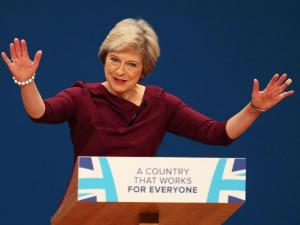 ‘commitment to the men and women who live around you’, ‘recognizing the social contract that says you train up local young people before you take on cheap labour from overseas.’ And perhaps astonishingly, for a Conservative Prime Minister, May promised to deploy the full wherewithal of the state to revitalize that elusive social contract by protecting workers’ rights and cracking down on tax evasion to build ‘an economy that works for everyone’. Picture the Brexit debate as a 2X2 matrix with ideological positions mapped along an x-axis, and Remain/Leave options mapped along a y-axis to yield four possibilities: Right Leave (Brexit), Left Leave (Lexit), Right Remain (things are great) and Left Remain (things are grim, but the alternative is worse). Having been a quiet Right Remainer in the run-up to the referendum, May has now become the Brexit Prime Minister while posing, in parts of this speech, as a Lexiter (Lexiteer?).
 This is the first comment, following Joe’s
 Earlier this year I visited
  The Disorder Of Things