Queer International Relations: A Symposium

The Disorder of Things is delighted to host a symposium on Cynthia Weber’s new book Queer International Relations: Sovereignty, Sexuality and the Will to Knowledge. We kick off the symposium with an inaugural post from Cynthia, followed by replies over the next few days from Joan Cocks, Antke Engel, Cyril Ghosh and Dianne Otto. We will conclude the symposium with a reply from Cynthia. cw-headshot

Cynthia Weber is Professor of International Relations at the University of Sussex.  She has written extensively on sovereignty, intervention, and US foreign policy, as well as on feminist, gendered and sexualized understandings and organizations of international relations.

UPDATE (22/11/2016): a response from Joan Cocks.

UPDATE (23/11/2016): a response from Antke Engel.

UPDATE (24/11/2016): a response from Cyril Ghosh.

UPDATE (25/11/2016): a response from Dianne Otto.

UPDATE (27/11/2016): a response from Cynthia Weber.


What is ‘homosexuality’? Who is ‘the homosexual’? Queer Studies scholars have long engaged with these questions, as well as with a vast array of additional questions about gender variant, gender non-conforming and gender expanding people. They have done so not to answer these questions but to trace how what Michel Foucault calls the will to knowledge about ‘homosexuality’ and ‘the homosexual’ drives various hegemonic discourses of normalization. By focusing on, for example, techniques of medicalization, psychologization, and (self)disciplinization, Queer Studies scholars demonstrate how ‘normal’ and ‘perverse’ subjectivities are always produced as/in relation to complex understandings of sexes, genders and sexualities, which they read intersectionally through (amongst other things) race, class and ability. What Queer Studies scholars less often do is theorize how the will to knowledge about sexualities is a specifically sovereign will that makes possible and presupposes specifically sexualized sovereign subjectivities (although see, for example, Berlant’s work on sovereignty).

International Relations (IR) scholars, in contrast, regard sovereignty as among their core concerns. This leads them to pose an alternative set of questions in their research, including: What is ‘sovereignty’?; Who is (the always presumptively male, masculinely-engendered) ‘sovereign man’?; and What arrangements of national and international politics does ‘sovereign man’ authorize? Foucauldian and other social constructivist and poststructuralist IR scholars ask these questions not to answer them but to trace how the will to knowledge about ‘sovereignty’ and ‘sovereign man’ drive various hegemonic discourses of normalization. By focusing on, for example, the social construction of nation-states as sovereign, justifications for intervention in the name of sovereignty, and sovereignly-authorized international economic distributions of wealth, these IR scholars demonstrate how ‘normal’ and ‘perverse’ international subjectivities and international orders are always produced as/in relation to complex understandings of sovereignty. What IR scholars less often do is theorize how the will to knowledge about sovereignty is a specifically sexualized will that makes possible and presupposes specifically sexualized sovereign subjectivities (although see Peterson’s work).

Continue reading

Trumped: Beyond the Whitelash

The election of a manifestly incompetent, billionaire bigot as president of the USA has come as a shock to many people, as indeed it should, and a vigorous debate has emerged over the causes. Many progressives, rightly horrified by the vile, nativist and sexist rhetoric of Trump’s campaign, seem to be concluding that it is this rhetoric that explains his success. Trump’s victory – enabled above all by white men – exposes the appeal of retrograde sentiment on gender – because voters rejected a highly-qualified woman for a self-declared ‘pussy-grabber’ – and race – since his supporters endorsed or at least disregarded his intensely racist rhetoric and policy pledges. Trump’s win thus expresses a ‘whitelash’ – a vile defence of threatened, white, male privilege. However, while sexists and racists undoubtedly supported Trump en masse, this thesis cannot explain how he was able to win. Indeed, it distracts attention from the most glaring cause of the outcome: the rot at the heart of America’s democratic system in general and of the Democratic Party in particular.

Continue reading

When White Men Rule The World

A shorter version of this post appears at the Oxford University Press blog. It was invited – if that’s the right word – some months ago as a tie-in with the new edition of The Globalization of World Politics. Obviously, I was planning on writing about questions of imperial feminism and intersectionality. Things didn’t turn out that way. Apologies for repetition of good sense already promulgated elsewhere, and for the inevitable commentary fatigue.


Donald Trump

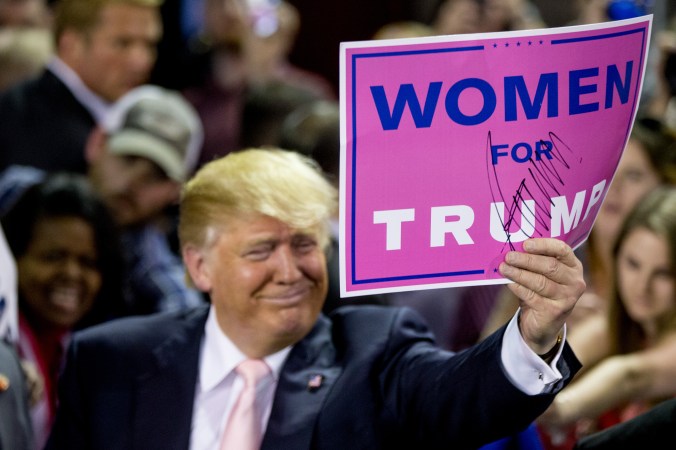
If Hillary Rodham Clinton had triumphed in last Tuesday’s presidential election, it would have been a milestone for women’s political representation: a shattering of the hardest glass ceiling, as her supporters liked to say. Clinton’s defeat in the electoral college (but not the popular ballot, where she narrowly triumphed by about 640,000 votes at last count) is also the failure of a certain feminist stratagem: namely, the cultivation of a highly qualified, centrist, establishment (and comparatively hawkish) female candidate, measured in speech and reassuringly moderate in her politics. But the victory of Donald Trump tells us just as much about the global politics of gender, and how it is being remade.

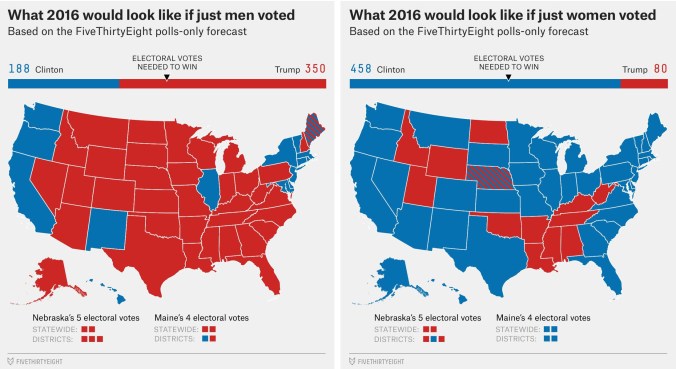
The election itself was predicted to be the most divided by sex in US history. Polls from a few weeks before the election had Clinton’s lead among women at the highest level for a presidential candidate since records began in 1952. A widely shared meme celebrated the trend and declared that “women’s suffrage is saving the world”. Activists from the ‘alt-right’ (a conglomerate of neo-Nazis, xenophobes, men’s rights types, lapsed libertarians and professional agitators) trolled in response that the 19th amendment should be repealed. Time called the election a ‘referendum on gender’; The New Yorker a question of ‘manifest misogyny’.

if-just-men-and-women-voted-meme

In the end, the politics of race mediated the politics of gender: white women were by many leagues more comfortable with Trump’s candidacy than women of colour. As Kimberlé Crenshaw pointed out on Wednesday morning, the claim for a singular female worldview – one that could be mobilised to ordain Clinton ‘Madame President’ – collapses under the pressure of other cross-cutting histories, interests, and ideologies (the idea that women share a common political perspective has of course been under attack within feminist theory for many decades). As has now been much rehearsed, NBC’s exit polls measured a 10% lead for Trump among white women, and an almost 20% lead amongst white women between the ages of 45 and 64. By contrast, CNN data indicated that 94% of black women voted for Clinton. Opinions now vary on how much blame to apportion suburban white women, or what have been called ‘Ivanka voters’, for the result. Somewhat confoundingly, Pew Research finds that the overall gender gap was indeed larger than in the last presidential elections (with women leaning Democrat). In either case the most significant shifts took place within the cohort of white voters (in favour of the Republicans).

And yet the power of race and racism in deciding the election should not be taken to mean that gender is irrelevant after all. As predicted, it was white men who voted for Trump in the greatest numbers. Trump is moreover symbolic of, and personally implicated in, a resurgent strain of misogynistic thinking: regularly dismissive of the intelligence and professionalism of women, speaking about them as sex objects or harridans, and fuelling conspiracy theories and denialism over sexual assault. And although the collapse in the predicted female vote for Clinton is surprising, it is at the same time no novelty to observe that women may also disqualify a politician on the basis of her sex – for example, in setting higher standards for female than male candidates, in believing that only men are aggressive enough for politics, or in judging women more harshly on their appearance and demeanour.  Continue reading

Upsetting the Theory: Rights for Housing and Queers

The second post on our forum on Joe Hoover’s Reconstructing Human Rights, from DoT’s Anthony Langlois. You can read Joe’s opening post here and Karen Zivi’s commentary here.


 As I was reading Joseph Hoover’s fabulous new book, a critical debate was going on at the peak human rights institution of the global political system. The Human Rights Council, an institution to which UN Secretary General Ban Ki-moon suggests “all victims of human rights abuse should be able to look…as a forum and springboard for action”, was debating a resolution to establish a UN Independent Expert on Protection Against Violence and Discrimination based on Sexual Orientation and Gender Identity. On June 30, 2016, after extensive debate, in which much opposition was expressed, the Human Rights Council voted in favour of this UN Special Procedure, establishing the office of the Independent Expert on Sexual Orientation and Gender Identity (SOGI).

It is a harsh reality that in many countries around the world, lesbians, gays, bisexuals, trans* and others of queer and diverse sexual orientation, gender identity and expression (LGBTQ) are not able to look to human rights institutions for support and protection, or, those institutions find themselves constrained and unable to offer such support and protection openly, or at all. The creation of the SOGI expert by the UN is in part a recognition of this, and it is seen by many as a critical further step in the UN’s recent activism on this routinely neglected area of human rights concern.

sogiexpertnow

But as well as allegedly being “progress” in the human rights agenda of freedom and emancipation, it should cause us to pause and think. What does it mean that Human Rights have only come lately to queer communities, if at all?

Hoover does not directly consider this question. But the debate about gay rights, human rights for queers more broadly, and their place in IR, plays a role like that which Hoover shows the right to housing to play. Hoover uses the right to housing to destabilise, challenge, pluralize, democratize and reconfigure our received ideas of human rights. I would suggest that this is also precisely what happens, or, at least, what can happen, when human rights meets sexual orientation and gender identity expression, as well. Continue reading