Mind the Gap: Evaluating the Success of Sanctions

This is the third in a series of posts on Lee Jones’ Societies Under Siege: Exploring How International Economic Sanctions (Do Not) Work. We are delighted to welcome Dr Clara Portela,  she is Assistant Professor of Political Science at Singapore Management University. She is the author of the monograph European Union Sanctions and Foreign Policy, for which she received the 2011 THESEUS Award for Promising Research on European Integration. She recently participated in the High Level Review of United Nations sanctions, in the EUISS Task Force on Targeted Sanctions and has consulted for the European Parliament on several occasions.

A further response will follow from  Katie Attwell, followed by a response from Lee. You can find Lee’s original post here and Elin Hellquist’s here.


The volume undoubtedly makes a key contribution to the field – indeed, one that was sorely needed: an evaluation of how sanctions interact with the economic and political dynamics in the target society, and more specifically, how they affect domestic power relations. This agenda is not entirely new in sanctions scholarship. It had been wisely identified by Jonathan Kirshner in a famous article as far back as in 1997. However, having pointed to the need to ascertain how sanctions affect the internal balance of power between ruling elites and political opposition, and the incentives and disincentives they faced, this analytical challenge had not been taken up by himself or any other scholar so far. The book also contributes to a highly promising if still embryonic literature: that of coping strategies by the targets, briefly explored in works by Hurd or Adler-Nissen.

Departing from the idea that whether sanctions can work can only be determined by close study of the target society and estimating the economic damage required to shift conflict dynamics in a progressive direction, the study proposes a novel analytical framework: Social Conflict Analysis. The volume concludes that socio-political dynamics in the target society overwhelmingly determine the outcomes of sanctions episodes: “Where a society has multiple clusters of authority, resources, and power rather than a single group enjoying a monopoly, and where key groups enjoy relative autonomy from state power and the capacity for collective action, sanctions may stand some chance of changing domestic political trajectories. In the absence of these conditions, their leverage will be extremely limited” (p.182).
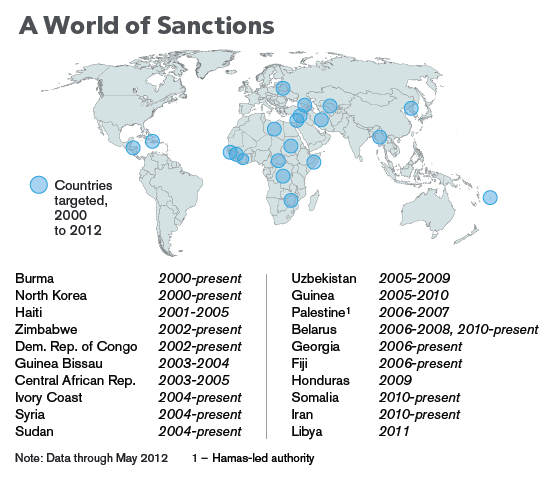
World of Sanctions

Source: Peterson Institute for International Economics

Continue reading

Shoddy Sanctions

photoEH

This is the second in a series of posts on Lee Jones’ Societies Under Siege: Exploring How International Economic Sanctions (Do Not) Work. We are delighted to welcome Dr Elin Hellquist, a Swedish Research Council International Postdoctoral Fellow at the Freie Universität, Berlin and the Department of Political Science, Stockholm University. Elin’s research is currently focused on the historical origins of different regional sanctions policies. She is also interested in the prospect that sanctions used by regional organizations against members could mature to take ground from foreign policy sanctions, as well as the implications of such a development for international relations at large.  Her most recent article is in International Relations.

Further responses will follow from guest authors Clara Portela and Katie Attwell over the next few days. You can find Lee’s original post here.


The debate about the effectiveness of sanctions is among the most tired in international relations scholarship. Rather than tackling the big political, social and ethical issues related to the practice of punishing one another in international relations, the literature has relentlessly debated what percentage of sanctions cases have been successful. Articles on sanctions in our finest journals have battled measurement technicalities and how to design maximally efficient sanctions instruments. In the real world, change always comes. Sooner or later, with or without sanctions, regimes fall, political prisoners are released, nuclear deals are made, and elections are held. If sanctions are involved, sanctions optimists are quick to attribute such changes to their use. Yet, it is hardly ever possible to say whether sanctions specifically, among an infinite number of co-existing factors, have caused a certain political outcome.

At first view, Lee Jones’ book Societies under Siege might appear yet another book on sanctions effectiveness. It is not. Instead, Lee brings us behind the scenes of three of the most influential sanctions cases in modern times: South Africa, Burma/Myanmar, and Iraq. Relying on a thorough historical-sociological analysis, we are led deep into these societies to understand how sanctions have worked to reshape social conflicts and thereby possibly influence politics (for better or worse).  The message is clear: in order to understand sanctions we have to understand the domestic context inside out. This message is both timely and timeless. It is an extremely timely wake-up call reminding any remaining intervention optimists of the moral and practical responsibility that follows from using sanctions without a qualified idea of how they will work on the ground. Highlighting the importance of local conditions is also a timeless message to an IR audience that far too often disregards qualitative difference in the search for quantifiable measurements. Sanctions do transform societies, Lee argues, but they can only be expected to contribute to political change if a number of favourable conditions allow so (e.g. the South African case).

This post will not repeat or summarize the arguments that Lee makes with wit and skill. Buy the book, or ask your library to do so. You will have the pleasure to read an unusually elegant and thought-provoking piece of solid scholarly work. What I would like to do is to pick up the ball where I think that Lee left it and draft a few propositions that complement and sometimes challenge Societies under Siege. I will propose that beyond their workings in the target states, sanctions also operate by (re)drawing normative boundaries in international relations. I will use the example of blacklists to underscore how sanctions work through a combination of material and symbolic features. Finally, I will follow-up on Lee’s discussion of the ethics of sanctions. In light of his findings, I will argue that the use of foreign policy sanctions should be minimized in accordance with the ‘harm principle’. Continue reading

Societies Under Siege: Exploring How International Economic Sanctions (Do Not) Work

This is the first in a series of posts on Lee Jones’ Societies Under Siege: Exploring How International Economic Sanctions (Do Not) Work. Responses will follow from guest authors Elin Hellquist, Clara Portela and Katie Attwell over the next few days.


It doesn’t seem to matter what the international crisis is: be it an inter-state war (Russia-Ukraine), civil strife (Syria), gross violations of human rights (Israel), or violent non-state actors on the rampage (ISIS, al-Qaeda), the ‘answer’ from governments and civil society always seems to be the same: impose economic sanctions. In the mid-20th century, only five countries were targeted by sanctions; by 2000, the number had increased tenfold. Once an obscure, rarely used and widely dismissed form of statecraft, sanctions are now clearly central to the exercise of power in international relations – particularly when dominant powers are reluctant to put ‘boots on the ground’.

My new book, Societies Under Siege: Exploring How International Economic Sanctions (Do Not) Work, is the first comparative effort to explore how these sanctions ‘work’ in practice – on the ground, in target states. This post introduces the book and the forum that will follow.

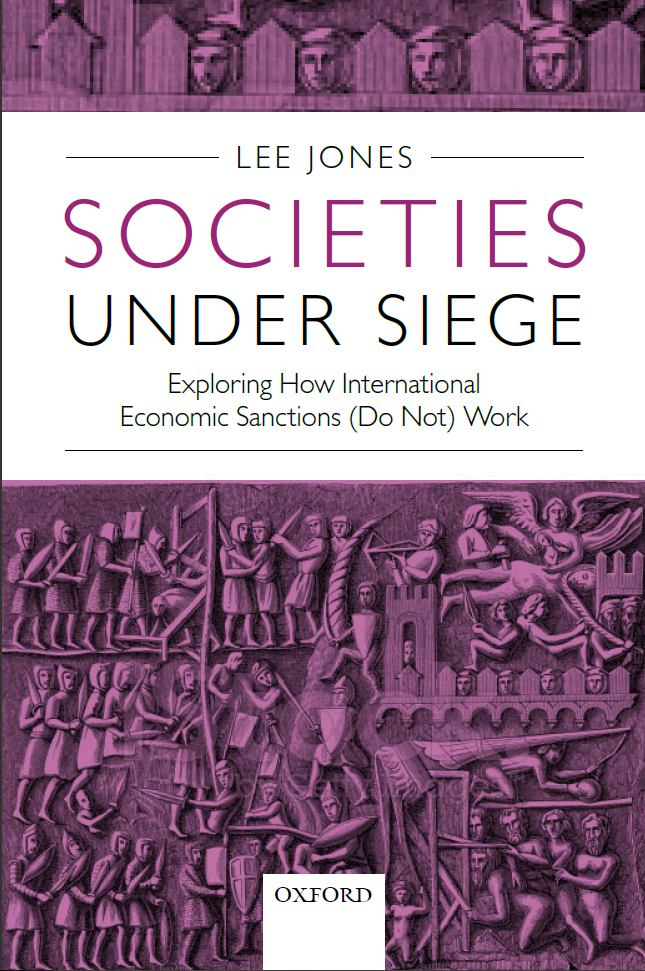
Societies Under Siege cover. The image is an engraving of a (failed) siege during the Albigensian crusade.

Societies Under Siege cover. The image is an engraving of a (failed) siege during the Albigensian crusade.

Continue reading

The Dissonance Of Things #4: Leftist Foreign Policy After Corbyn

The fourth of our monthly podcasts, turning our attention with ever greater political precision to Corbynmania, Jacorbynism, #JezWeCan, or however you prefer to characterise the arrival of Jeremy Corbyn as Leader of the UK Labour Party. Since before his victory, Corbyn has been stalked by, and occasionally celebrated for, his views on international politics, from the crisis in Ukraine and associated Great Power rivalries to his views on Hamas and from the (non-)renewal of Trident to the UK’s future role in NATO. David Cameron, for one, has attempted to securitise Corbyn, repeatedly arguing that “the Labour Party is now a threat to our national security, our economic security and your family’s security”.

And so we ask: what is a leftist foreign policy? Is such a thing even possible? Should the left, in whatever form, be seeking to capture, remake or resist foreign policy? What do the wishlist strands of a left foreign policy look like? Lee, Meera and I are herded into some kind of order by Kerem, and joined by Chris Emery of the University of Plymouth. author of US Policy in Iran: The Cold War Dynamics of Engagement and Strategic Alliance 1978-81 and this post on the history of covert action in Iran.

As ever, consume, cogitate, argue, and share, share, share. Past and future casts are available on soundcloud.

Further resources, including articles discussed in the podcast:

Thinking Internationally About The Arms Trade

A guest post, following our recent podcast on the arms trade and its discontents, from Anna Stavrianakis. Anna is a Senior Lecturer in International Relations at the University of Sussex. Her research focuses on the arms trade, arms transfer control and militarism.


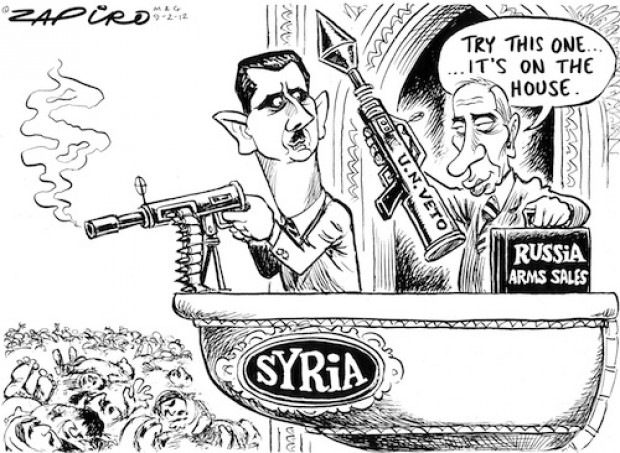
Zapiro - Russia Syria Arms Trade

September 2015, ExCel Centre, London: Stop The Arms Fair activists block the road and prevent military vehicles entering the Defence and Security Equipment International (DSEI) exhibition. They are protesting against one of the largest arms fairs in the world – sending a message to the UK government and arms companies that “inviting representatives of repressive regimes and their armed forces to hob-nob and do dodgy deals at DSEI … with representatives from the UK government and unscrupulous arms companies from around the world IS NOT OK.” Two weeks previously, Cancun, Mexico: Control Arms activists build a life-size sand sculpture of a Stormer 30 tank on Baracuda Beach, Cancun, calling on states to save lives! by ensuring the toughest possible standards at the first Conference of State Parties to the Arms Trade Treaty, the biggest game in town for contemporary international arms transfer control.

These two campaigns share the language of “dodgy deals” but are otherwise quite different visions of the arms trade and its control. The Control Arms campaign focuses on encouraging, informing and embarrassing diplomats into agreeing a multilateral treaty that enshrines higher common international standards and establishes stronger norms against arms transfers that violate human rights and international humanitarian law. The Stop The Arms Fair coalition, meanwhile, takes direct action to halt the operation of arms fairs in the UK by physically blockading the exhibition centre, in protest at the relationship between arms companies and the UK government, and the relationships between the UK government and authoritarian, repressive and war-fighting foreign governments.

I’ve written in the past about the international politics of NGO and campaign group strategy – whether reformist, insider approaches are more effective than transformist, outsider ones – in the context of debates about global civil society. Yet what continues to trouble me, intellectually and politically, is a raft of questions about the operation of the arms trade itself. Namely: where, or with whom, does political responsibility lie for the negative effects of the arms trade in a world of formally national states that are home to internationalising arms companies and operate in a multilateral system based on sovereignty? What social forces drive the arms trade, how does their power operate, what is the character of the problems they generate, and how should scholars and activists best respond? Competing understandings of the operation of the arms trade can be seen in the varied activist responses to it: is the problem one of lack of regulation, the need for improved multilateral action, improved normative standards and international law, as per the Arms Trade Treaty? Or is the problem the relationship between the state and arms capital, and government promotion of the trade, as per the anti-DSEI protests? In the case of DSEI, how are we to understand the operation of internationalising arms capital that has an intimate yet fractious relationship with national states? And in the case of the Arms Trade Treaty, how should we make sense of efforts to create a level playing field of respect for human rights and humanitarian law in the context of a vastly asymmetric and hierarchical world military order?

Thinking theoretically, I have come to see that a large part of the difficulty in answering these questions lies in the grip that methodological nationalism continues to hold on IR as a discipline. Continue reading

Three Theses on ISIS: The Universal, the Millenarian, and the Philistine

Nimer SultanyA warm welcome to Nimer Sultany who brings us a guest post on thinking about ISIS. Nimer is Lecturer in Public Law, School of Law, SOAS, University of London. He holds an SJD from Harvard Law School. He practiced human rights law in Israel/Palestine, and was the director of the Political Monitoring Project at Mada al-Carmel – The Arab Research Center for Applied Social Research. His recent publications include: “The State of Progressive Constitutional Theory: The Paradox of Constitutional Democracy and the Project of Political Justification” in the Harvard Civil Rights – Civil Liberties Law Review and “Religion and Constitutionalism: Lessons from American and Islamic Constitutionalism” in the Emory International Law Review.


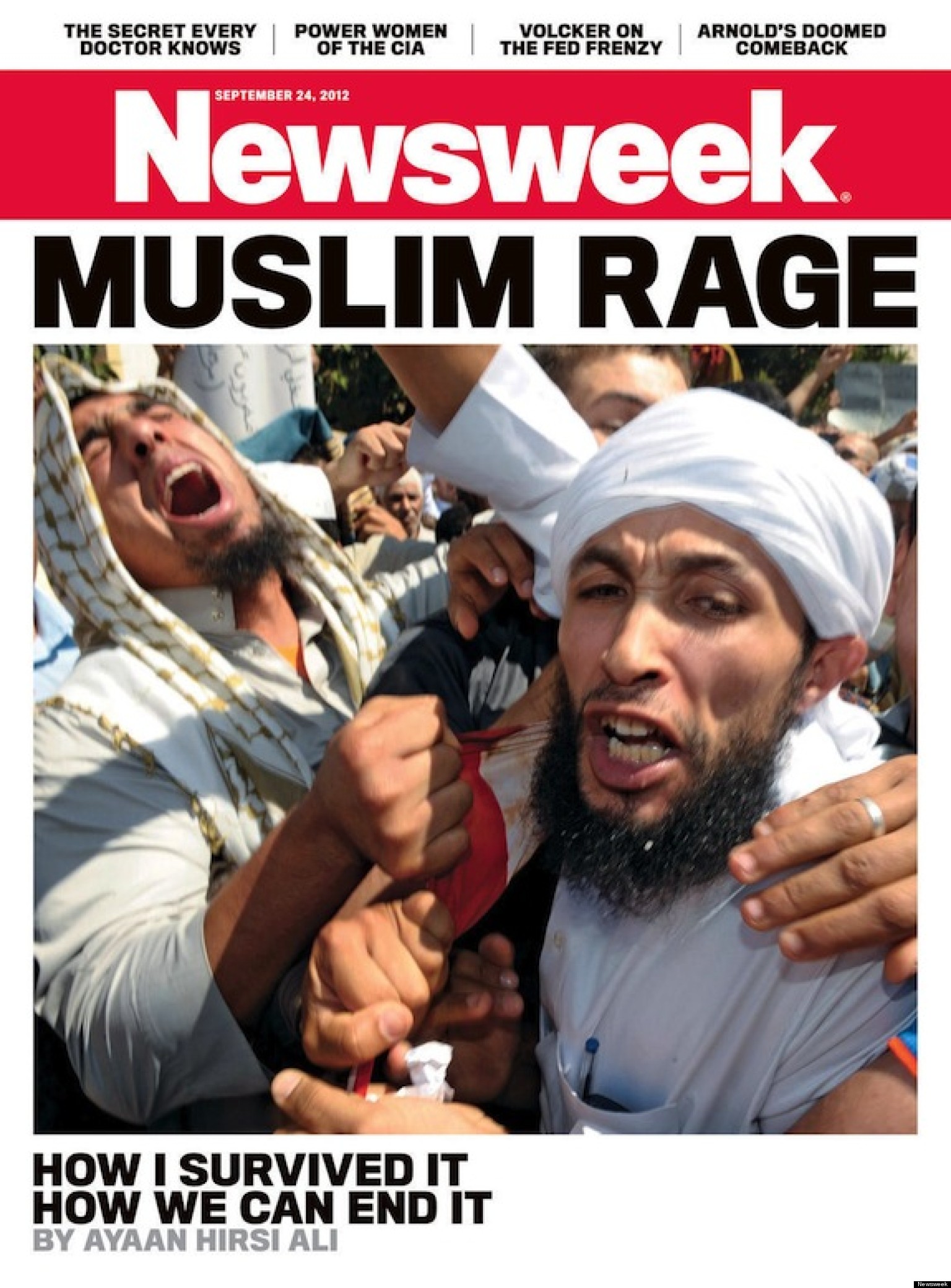
The ruthless brutality of the Islamic State in Iraq and Syria (ISIS or ISIL) unfolds before our eyes on the screens. As commentators struggle to explain and understand it, it becomes convenient to revive old Orientalist tropes. Beyond the spectacular brutality, the reason that ISIS invites attention (both fascination and fear) is that it seems easy to fit in confrontational narratives of Islam (us v. them, anti-American, etc.). Muslims are clearly angry at something. In his infamous article “The Roots of Muslim Outrage”, Bernard Lewis simplistically explained that Muslims are envious of, and angry at, Western modernity and secularism. The U.S. magazine Newsweek illustrated this knee jerk reaction, and recourse to run of the mill thinking patterns, in a Muslim Rage cover in September 2012.

o-NEWSWEEK-MUSLIM-COVER-facebook

In his book “Covering Islam” (1981) Edward Said has effectively critiqued these binary simplifications that dominate not only journalistic discourse about “Islam”, but also expert-talk about Islam. For Said, all attempts to conceptualise other cultures are a value-laden interpretive exercise. He showed the deficiencies of orthodox writings on—and views of—Islam, and called for “antithetical knowledge” to challenge the orthodoxy’s claims of value-free objectivity.

It seems little has changed, however, since Said wrote his book in the wake of the Iranian revolution. In this brief commentary I want to examine three attempts to understand ISIS. These are long treatments in respected liberal media outlets. To use Said’s phrase, these are treatments that fit in different “communities of interpretation.” These three essays are all aware of the need to provide “context” for ISIS. However, their contextualisation differs. The success of this contextualisation in shedding a light on ISIS varies. Let me call these interpretive techniques: universalization; Millenarian confrontation; and intellectual bewilderment. These three attempts operate mostly on the ideational/ cultural domain.

Continue reading

Governing Borderless Threats

Southeast Asia’s recent Rohingya refugee crisis, and the parallel and still-unfolding horrors in the Mediterranean, are stark and tragic reminders of how the nature of international security has changed in recent decades. Traditionally, security involved building military strength to deter or repel attacks by other states. Today, beyond a tiny handful of ‘flashpoints’, so-called ‘non-traditional’ security issues dominate: irregular migration, drug trafficking, terrorism, piracy, pandemic disease, environmental degradation, transnational organised crime and cybersecurity – to name but a few. How are states and international organisations dealing with these challenges, and what does this tell us about global politics today?

The latest “boat people” crisis

Continue reading

The Preventing Sexual Violence Initiative and Its Critics

I have a piece out in the latest International Affairs on the UK government’s Preventing Sexual Violence Initiative (PSVI), better recognised as that thing William Hague did with Angelina Jolie(-Pitt) when he was still Foreign Secretary. As well as an important project in its own right, the Initiative might be read as signalling a new front in ethical foreign policy, and another success story in feminist activism around sexual violence (alongside the rise of ‘governance feminism’ and what have been called ‘femocrats’ in the UN and elsewhere). The role of the UK as a diplomatic and political presence becomes more important still against the background of rising attention to gender in global policy discourse in recent decades (conventionally referred to as the ‘Women, Peace and Security’, or WPS, agenda). Alternatively, the PSVI might be understood as a cause without demonstrable success, already fading from the scene along with Hague, its main advocate. And from either a conventionally Realist or a more radical activist perspective, the chances of a Foreign Office-led policy initiative making any feminist ground would seem slim.

Against this background, and building on a few years of following the Initiative’s progress, I stake out a preliminary analysis of three planks of the PSVI’s work. First, its wholesome embrace of ‘weapon of war’ thesis. Second, the great emphasis on ending impunity as the most effective means to reduce atrocity. And third, the repeated foregrounding of men and boys as ignored victims of sexual and gender-based violence. The headline conclusion is that, despite its promise, the initiative has thus far achieved little on its own technical terms, and its underlying approach to gender violence in conflict is in important senses limited. The conceptual bases of this relative failure lie in an unduly simplistic account of where and why such violence happens and an inability to reckon with the lack of evidence for strong deterrence effects or the significant resource challenges involved in supporting local and national justice programmes. By contrast, the PSVI stands as an important moment in the opening out of policy understandings of gender violence, although there nevertheless remain important ambiguities over ‘gender neutrality’ in practice, and therefore a likelihood of disputes over resources.

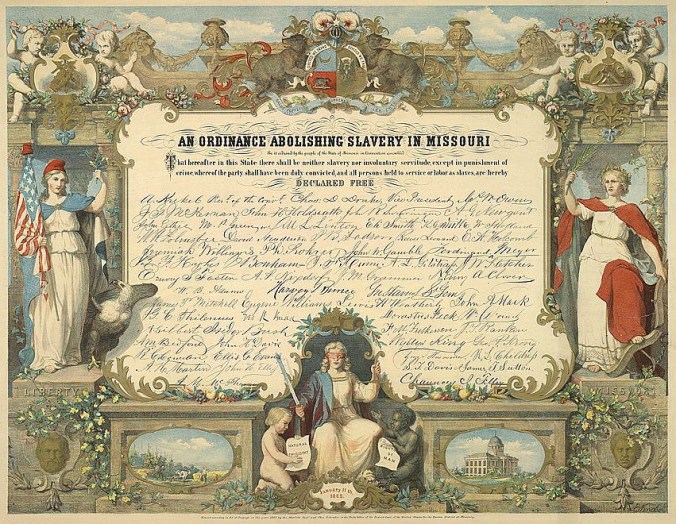
Missouri Emancipation Ordinance

The arrival of the Hague-Jolie Initiative onto the WPS scene was unexpected. The Conservative manifesto for the 2010 general election made no mention of wartime sexual atrocity, and was utterly conventional in its references to human rights. UK support for Security Council resolutions aside, activities on sexual violence have historically come from the Department for International Development (DFID), and with the exception of the attention generated during the London summit, the UK government has not made much of the initiative in its public relations since. The PSVI is thus heavily identified with William Hague personally, and can be traced to his epiphany over the role of genocidal rape in Bosnia. Hague, who is also the biographer of William Wilberforce, has framed war rape as similar to slavery in its immorality and argued for the role of the UK as an abolitionist force, repurposing standard diplomatic practice to progressive ends. This is to seek nothing less, in his words, than “the eradication of rape as a weapon of war, through a global campaign to end impunity for perpetrators, to deter and prevent sexual violence, to support and recognise survivors, and to change global attitudes that fuel these crimes”.

Continue reading

O (fuck you) Canada!

Our very first guest rant, courtesy of Sankaran Krishna of the University of Hawai`i at Manoa.


Fuck Canada

Okay, I need to get something off my chest. I am sick and tired of the way “Canada” is positioned as a beacon of progressive socialistic state policies and a peaceful, enlightened citizenry. I am sick and tired of hearing white, liberal colleagues assert during every Presidential election in the United States that if “… Dole/ Bush / McCain / Romney … wins, I am moving to Canada.” I am also sick of the way Canada’s educational system, its health care system, its gun control policies, and a variety of other practices are contrasted favorably with the United States and held up to the latter as a model worth emulating. I am sick of American tourists abroad putting Canada stickers on their backpacks as a way of immunizing themselves from opprobrium. I am sick of all the evocations of Canadian politeness and niceness and what not, conveniently forgetting that in every war-making venture the United States has been in since its founding, the Canadians have been there right alongside. I am sick of all this for at least three reasons.

One, it effaces the conjoined history of both the United States and Canada as settler-colonial societies constructed on the violent usurpation of the lands of indigenous peoples and continued into the present through their ongoing dispossession and marginalisation. Do people not realize the enormous privilege inhering in the idea that you can just move to another country because you don’t agree with election results in your own? That the very idea of such a movement reenacts the originary violence that created both societies?

Two, in this entire imaginary that depicts the US and Canada as contrasts (as distinct from being overwhelmingly similar settler colonies), the unspoken locus of enunciation is white. How does the alleged contrast between the two societies look like from the perspective of someone from one of the pre-contact indigenous groups in either of these nations? What does it look like from Black or South Asian or East Asian or other immigrant (or “arrivant” as Jodi Byrd terms them) perspectives? These questions do not seem to be within the frame of analysis when Canada is presented as a liberal wet-dream in contrast to the United States.

Third, instead of contrasting them, might it not be better to see Canada as the alibi that normalises the extremity that is the United States? And the US as the egregious violence that sanitizes and renders more benign the incredible violence that is Canada? To twist Baudrillard, in different ways Canada and the US serve towards each other the same function that Disneyland does in rendering the rest of Los Angeles real.

So the next time you hear some allegedly liberal colleague, friend, whatever of yours praise Canada and offer it as a salutary contrast to the benighted United States, say something like “a pox on both (y)our houses” – and you can add any expletives that seem appropriate and tactically permissible at that moment.

What We Talked About at ISA2015: State Transformation and the Rise of China

At this year’s ISA, Shahar Hameiri and I talked about our new research project on state transformation and rising powers, with specific reference to China. In a nutshell, we suggest that, like other states, those of so-called ‘rising powers’ are undergoing epochal transformations associated with transformations in the global political economy since the late 1970s, profoundly conditioning how they are ‘rising’.

Continue reading