On Torture: Engraving Power

…(cymbal crash)… We have a new Author of Disorder (or is that Disordered Author?). Please welcome, in your virtual way, Elke Schwarz, a PhD student at the LSE working with Kim Hutchings on Hannah Arendt, Michel Foucault, Walter Benjamin, biopolitics and political violence.


‘How does one man assert his power over another, Winston?’. Winston thought. ‘By making him suffer,’ he said. ‘Exactly. By making him suffer. Obedience is not enough’

George Orwell, Nineteen Eighty-Four (1948)

The killing of Bin Laden last month has given new fuel to the claim that torture, as a tool in the securitization tool kit of a neo-conservative US government, actually has its place and validity in a liberal society. How absurd this artificial claim is has been highlighted in many a news source but incidents like this keep the so-called Torture Debate alive and well, as the normalising process unfolds. The practice of torture has become much more widely seen as a ‘necessary evil’ available to a liberal State in the pursuit of the protection of its population, if not humanity at large. A recent study conducted by the Red Cross has shown that as many as 59% of the American teenagers surveyed and 51% of adults accept torture as a means to garner information. When tyrannies torture, however, it continues to be a widely condemned affair and the international community shows no shortage of outrage.

Torture as a practice of and within otherwise liberal societies can only enter the realm of the morally permissible if it is detached from its illiberal roots and the discourses and practices allow societal norms to be such that a violation of the human bodies of some serves as a means to ensure the survival and proliferation of others in the pursuit of information finding. And it is precisely this clinical mask of the instrumental dimension of torture as an means of truth-gathering that the torturer’s power can be understood in terms of their insecurities and vulnerabilities. Facilitated by the display of the fiction of power, the ultimate objective of torture is one of domination in times where political power is challenged and status disputed.

It is perhaps not surprising that torture should emerge as a radical example of routines of illegal acts enacted in the most corporeal sense for the alleged securitisation and greater good for the greatest number of ‘good’ people whose sanctity of life has become precarious. In the wake of 9/11 this increased precariousness of American life has served as a warrant for the now infamous ‘gloves off’ approach instituted by Bush Junior’s neo-conservative posse. The problem is: the gloves have stayed off, even with Obama in command.
Continue reading

On Objecting to the New College of the Humanities; Or, Who Would Pay £18,000 a Year to Listen to this Outdated Victorian Rationalism When They Could Buy Themselves a Second-Hand Copy of John Stuart Mill?

Yes, this is more comment on the New College, a.k.a. Grayling Hall, a.k.a. Grayling’s Folly, a.k.a. North Oxford in Bedford Square (NOBS), a.k.a. The Ultimate Scab University.

It won’t have escaped your notice that there has been a flurry of disgust, disbelief, protest and rage at the announcement of the New College of the Humanities (an aside: ‘of the’ Humanities? Why not ‘for the’ Humanities?). There have also been a number of responses that pretty much add up to ‘meh’: to wit, there are some bad things, but also some good things about Grayling’s Folly. And then there has been some welcoming of this project, and its ‘chutzpah’. Since we are in a downward vortex of vanishing funding and academic status, why not expand where we can? And why damn the entrepreneurial? As Brian Leiter puts it:

NCH is just the natural continuation of the elimination of 75% of government funding for higher education and 800% increases in tuition in the space of a few years. If the Brits can’t even keep the Tories out of office, and if their party of the Left is now in bed with the Neoliberals, it’s really hard to see why one should think “petitioning” the government for more government funding for higher ed will produce any results. The battle to be won is at the polls, and NCH is just a symptom of the battle already lost.

All this makes me think it’s worth clarifying the case against, and the potential mitigating factors. Continue reading

The Poisonous Drivel of Dr Denis MacShane MP

UPDATE (31 May): Crooked Timber have picked up the issue too. And MacShane has replied (in the comments at openDemocracy). His riposte is aptly characterised by Michael Otsuka as a “simulacrum of a genuine apology”. In short, having called into question the intellectual faculties of an LSE Professor and described her views as poisonous drivel (not that they were her views you’ll remember), MacShane now claims he meant no offence. Having taken words out of context, mis-attributed intentions and views to Phillips and not considered the conditions in which the question was posed, MacShane now complains that he is taken out of context, that the complainants don’t understand his views and that they haven’t considered the conditions in which his question was posed. Yes, really. Readers can surely decide for themselves, although we should not think too highly of a rear-guard ‘apology’ which begins “Gosh, well it makes a change from the BNP and Europhobes having a go” and ends “I just wish I was 100 per cent certain that…there is not a scintilla of concern out there in academistan that rather than posit an either/or argument a stand might be taken”. Yes, academistan. And in case you’re puzzled by what the ‘scintilla of concern’ refers to, it’s not the academic freedom issues raised by the Association for Political Thought and it’s not about elected Members trawling reading lists for cod-incriminating questions with which to verbally bash named academics. Instead what is meant is that by protesting his error, we supposedly signal that we’re not that bothered about the wrongs of sex trafficking and prostitution. What to say about such logic? Concerned members of the Association for Political Thought can apparently add their names to the statement by contacting Elizabeth Frazer (Oxford): elizabeth.frazer@new.ox.ac.uk.

UPDATE (30 May): Happy to see that this issue has been picked up by Liberal Conspiracy, openDemocracy, Feminist Philosophers and others. There’s now a statement with signatures from members of the Association for Political Thought condemning Denis MacShane in appropriately harsh terms (although I think it’s a tad hard on Fiona Mactaggart who, after all, was responding off the cuff to an unsolicited intervention, and did somewhat trim her comments by talking about ‘sufficient challenge’ to all views). People certainly keep following links here, more than a week on. I’m not aware of any response from MacShane himself, although I know from several readers that his office has been contacted about this matter. He certainly hasn’t tweeted about it. Perhaps these new developments might convince him of the need to correct some of his own views.


LSE-bashing is certainly in vogue. Following the travesties of GaddafiGate, some are eager to find further fault. Enter the Rt Hon Dr Denis MacShane MP (PhD in International Economics, Birkbeck, 1990). During a Commons debate earlier this week on human trafficking, he responded to the citing of an LSE report on the treatment of victims thusly:

Mr MacShane: My hon. Friend mentioned the London School of Economics. Is she aware of its feminist political theory course, taught by Professor Anne Phillips? In week 8 of the course, students study prostitution. The briefing says:

“If we consider it legitimate for women to hire themselves out as low-paid and often badly treated cleaners, why is it not also legitimate for them to hire themselves out as prostitutes?”

If a professor at the London School of Economics cannot make the distinction between a cleaning woman and a prostituted woman, we are filling the minds of our young students with the most poisonous drivel.

Fiona Mactaggart: I share my right hon. Friend’s view about those attitudes. I hope that the LSE provides sufficient contest to Professor Phillips’s frankly nauseating views on that issue.

Quentin Letts of The Daily Mail, a patronising faux-wit at the best of times, has now picked up the scent and is ready to draw the appropriate conclusions:

Legitimate academic inquiry? Or evidence of drift towards the position of seeing prostitutes as ‘sex workers’? (They’ll want membership of the British Chambers of Commerce next.)…Phillips, a past associate of David Miliband, bores for Britain on the global feminism circuit. I am told she has the hide of an elk. But why, at a time of university cuts, do we need a Gender Institute?

And so ignorance compounds ignorance. MacShane, and by extension Letts, deal in both misrepresentation and in condescending intellectual proscription. Continue reading

The AHRC Writes Back (Kind Of)

Today the Arts & Humanities Research Council responded to yesterday’s piece in The Observer claiming that the government had readjusted the rules (specifically The Haldane Principle) to increase their control over the direction of research in the UK within the state’s ‘national priorities’. Shorter version: the Tories didn’t pressure us, we’re completely independent and the funding to ‘The Big Society’ is coincedental.

Iain Pears is on the case. As he notes, it’s simply not convincing that the approved language suddenly appeared in the relevant documents unconnected with the political agenda of the governing party. The pressure may have been implicit, and the relationship might have been more informal and complicit than hierarchical, but the consequences for research are much the same.

But the AHRC not only wants to defend itself from these specific charges but also to maintain the legitimacy of the government setting overall priorities. Once again, the exact mechanics are expected to be taken on trust. Indeed, in 2009 a Commons Select Committee (Innovation,  Universities, Science and Skills, since you asked) addressed this exact point. While agreeing ‘in theory’ that the government had a role in setting overarching strategy, the relevant MPs (hardly a selection of Parliamentary rebels) put their collective figure on the aspects of policy that still concern us most:

Continue reading

The Meaning of David Willetts: The Future University Between State & Market

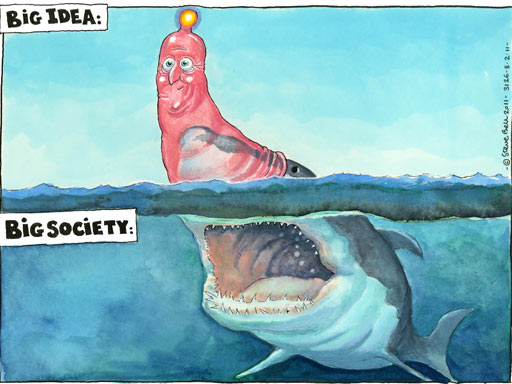
One of the principle battle-cries of the education movement has been that the coalition’s plans amount to a privatisation of the university system. This conclusion is arrived at by a focus on the withdrawal of teaching funding and the increased role given to ‘good relations’ with the private sector. These criticisms stand, but they repeat a common misunderstanding of the neo-liberal project as merely removing the state (call it the laissez-faire fallacy), rather than reorientating the state in a particular way to benefit certain sections and classes of society. The government is obviously complicit in promoting such tropes, which reinforce its narrative of supporting the grassroots and entrepreneurs and civil society and volunteers and champagne and candy for everyone. Hence their frankly playgroup standards of messaging. The Big Society is yellow and smiley-face! The Big Government is red and angry-sad-face!

But we now learn that the government has settled on a rather interventionist approach to all the lovely knowledge we are tasked to produce. ‘Two-minds’ Willetts has decided that the Arts & Humanities Research Council will be allowed to distribute £100 million in research monies each year, but only on condition that it accepts a ‘revision’ of the Haldane Principle (“that decisions on individual research proposals are best taken by researchers themselves through peer review”) and so spends a ‘significant’ amount of that money on research into the Big Society. Under the new ‘understanding’, the government continues to ‘value’ and ‘recognise’ the importance of academic independence, but wishes only to propose the merest of commonsensical adjustments:

At the other end of the spectrum there are decisions that ultimately must be for Ministers, albeit informed by external advice; these include the overall size of the funding for science and research and its distribution between the Research Councils, the National Academies and Higher Education research funding. In addition, every Government will have some key national strategic priorities such as addressing the challenges of an ageing population, energy supply or climate change. The research base has an important role to play in addressing such priorities and the Research Councils, with the support of independent advice, have proposed research programmes to tackle them. It is also appropriate for Ministers to ask Research Councils to consider how best they can contribute to these priorities, without crowding out other areas of their missions. But it is for the Research Councils to decide on the specific projects and people to fund within these priorities, free from Ministerial interference. Similarly, Ministers have a legitimate role in decisions that involve long term and large scale commitments of national significance.

The overall mood is civil-service vague, but elements of the language are importantly precise. Continue reading

The Anti-Feminist Backlash in an Age of Austerity

I suppose, in a way, British men are like white people were in Nineties South Africa or young Germans after the Second World War. We are expected to go through a period of atonement for the sins of our fathers. To be treated worse than we merit because of crimes previously committed in our name: in this case the crime of feeding, protecting, loving and nurturing women in accordance with our biological imperative. They don’t want that any more. They want to be linesmen. And so we have to let them tell us endlessly how they wish we were all dead.

Thus spake a gourmand and professional waffler last week, a child-of-privilege educated at Westminster and Oxford, who, despite these handicaps, manages to articulate for us the crisis of contemporary masculinity. Apparently two compatriots got caught up in some garden-variety lechery of the career-halting kind. Their trials and tribulations, although obviously upsetting for them on a personal level, at least had the merit for many of acting as a flashpoint for opposition. That is, a common-sense opposition to the political correctness surrounding the damages wrought on men by feminism and feminists. Finally, people can begin to speak out.

It is rather tempting to pursue the bizarre line of metaphorical reason here (if ‘sexist crimes’ are merely love expressed biologically, and if British men today are like post-fascist South Africans and Germans, does that make apartheid and Nazi rule the equivalents of a natural and benevolent stewardship? Did they even involve ‘real’ crimes?). But we should resist that. Coren is but a symptom, and should not detain us overlong in picking the low-hanging fruit. The triggering events are themselves already old news, the detritus of the news cycle now rendered especially vulgar and tattling by some actual struggles for justice.

The tropes at play have been with us for some time, inflecting what are essentially public relations SNAFUs with the full force of mythological sex wars. But these themes do seem to be becoming increasingly familiar. Those who grumbled about the rise of such minimal concessions as equal pay legislation in the halcyon days of economic vibrancy now have the pressures of austerity with which to buttress their case. Outrage at the redundancy of a favourite sports broadcaster spirals rather quickly into a diagnosis of women’s ‘special treatment’ in our society and the counter-sexism of a gender settlement in which men are no longer authorised to authentically, organically, just be themselves. Castrated. Emasculated. Prostrated.

Continue reading

Rape & Rape Prevention: A Cod-Evolutionary Perspective

Rape is an evolutionary adaptation. More than that, it now appears that anti-rape strategies are evolutionary too, which for women means increased strength at certain stages of the menstrual cycle, increased general distrust of men and hatred of black men in particular. Taking Darwin in vain, this is the argument put together by Jesse Bering at Slate.

We should probably start by getting our definitional house in order. In an admirable example of rigging the answer by misspecifiying the question Bering names rape as “the use of force, or threat of force, to achieve penile-vaginal penetration of a woman without her consent“. So men are biologically incapable of being raped, women incapable of raping, and the sexual-reproductive organs the only legible site for sexualised aggression (no anal here please!).

Hardly surprising, given this terminological firing gun, that rape emerges as a phenomena only comprehensible in procreational terms. This is a narrower agenda even than saying that it is somehow ‘evolutionary’, itself already less than saying it has something to do with ‘biology’ (the possibility of rape being about ‘sex’, socially understood, or ‘power’ stands at yet further removes).

The quality of proof offered doesn’t fare much better. Take the study on racist attitudes and menstrual cycles, results we’re at risk of ignoring with our rampant ‘political correctness’ (*yawn*). Turns out women from this sample (77 white undergraduates) scored higher on fear-of-rape metrics of black men when they were most vulnerable biologically to impregnation. Bering takes this as supporting an evolutionary adaptation against ‘out-groups’, although he concedes that ‘cultural transmission’ may play a role.

The study itself suggests something rather less conclusive. It found that implicit race bias (non-conscious stereotyped associations of the form ‘black-physical’) was much more strongly correlated with rising fertility than explicit bias. Its metrics for race bias were all clearly consistent with a sociological or interpretive account of race (which is to say that race is a social, not a biological category, and that its meaning is historically and politically determined, not the outcome of adaptive ancestral behaviour). The data is also somewhat partial, as its relation to some wider questions. There is no comment on the fact that, for example, race bias remains fairly pronounced even where there is no ‘conception risk’, nor any significant attempt to cite work on general levels of race bias in general populations as a comparator or to examine variation among degree of bias in the women studied and the possible sources for those differences.

Continue reading

The fallacious reasoning of Theresa May

Last week’s speech by Home Secretary Theresa May on the government’s intention to repeal some recent equality legislation was ironically and comprehensively overshadowed by the media frenzy about the impending lavish nuptials of the future King of the Realm to a Lowly Commoner. This may help to explain a little why the vacuous, fallacious and bizarre reasoning at the heart of it has been largely unremarked upon.

Overall, the speech sought to justify the repeal of the clause of the 2010 Equality Act which required public bodies to consider how they might address relevant socioeconomic disadvantages when making strategic decisions.  My interest in this post is not to make the political case for this clause or not – rather it is to explore the reasoning offered by May in the speech that seeks to banish it into a category unrelated to inequalities of gender, race, religion, physical ability and so on.

The core tension emerges because throughout the speech May is desperate to present herself as a champion for gender-, age-, race- and sexual-orientation-based equality (ps nice U-turn, T), whilst trying to deny any place to socioeconomic aspects of equality. This is right at the heart of the New Conservative ideology that Cameron wants to promote – a socially enlightened politics of ‘fairness’ in a Big Society of ‘individuals’, that hugs hoodies whilst denying that socioeconomic disadvantage should be something that the government seeks to address. Continue reading

Flunking Economics 101: The not-so-new UK policy for international poverty reduction

There has been a considerable amount of noise about the new directions for international development under the coalition government – not least the keenness it has shown in ringfencing the GDP aid target as part of keeping up its ethical and progressive image, and the enthusiasm it has seemingly shown in pushing for fairer trade practices within the context of the Doha round of negotiations. Last night, in a policy-focused speech to a packed Sheikh Zayed Theatre at the LSE, the new Minister for International Development, Andrew Mitchell, laid out his vision for poverty reduction through mechanisms of growth and wealth creation, which would be driven through the encouragement of the private sector in the context of pursuing the Millennium Development Goals.  This policy would be centred around a re-orientation towards private-sector driven growth and enterprise, through which the poorest in developing countries could ‘lift themselves out of poverty’.

He began, as many speeches do at the LSE, with an aphorism attributed to George Bernard Shaw: “The greatest of evils and worst of crimes is poverty”, a phrase dripping with urgent moral responsibility and irreproachable purpose, before going on to promise that the new government’s international development strategy would be ‘non-ideological’ and committed to ‘what works’ in poverty reduction. It is a very great shame, however, that he did not begin with some basic definitions of poverty, since this would have clearly exposed the intellectual, and ultimately political, black hole at the centre of a poverty reduction strategy based primarily on growth. Continue reading