What We Talked About At ISA: Critical Pedagogies?

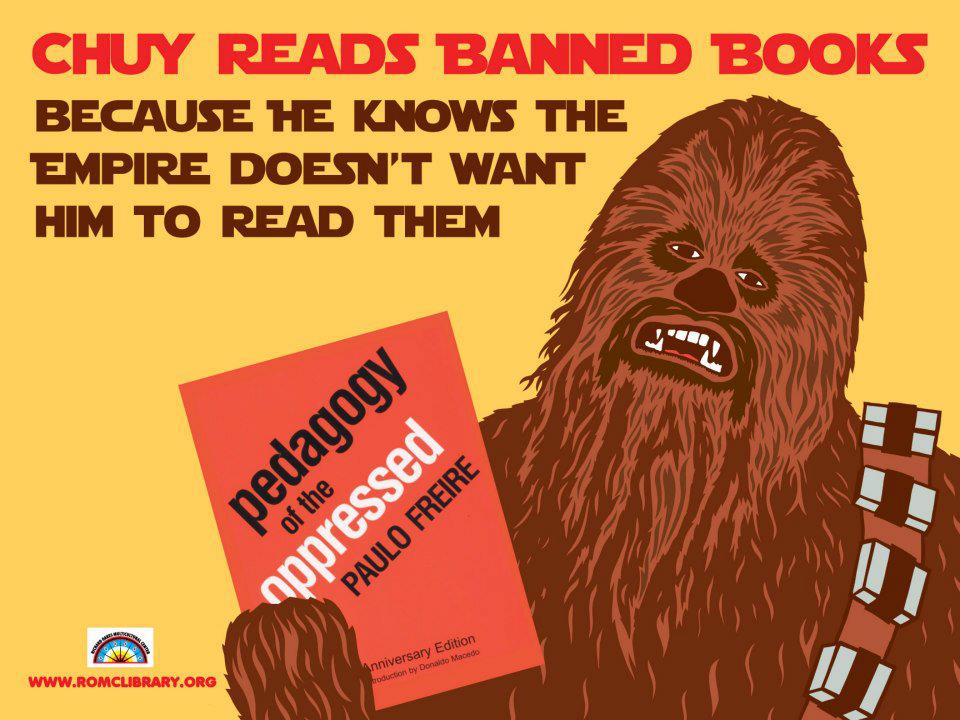
Chuy Pedagogy Of The Oppressed

There is something seductive about the idea of critical pedagogies. In an age where the figure of academic is beset on all sides by voracious spectres – the Taxpayer, the Minister, the Entrepreneur, the Curious Public, the Student-Consumer, the Management Consultant – it offers the idea that what happens in the classroom may still matter. More than matter: might in some way emancipate. This promise is perhaps particularly strong in academic International Relations, where those of various ‘marginal’ persuasions might argue that teaching against the grain undoes the destructive commonsense of global politics. That critical pedagogies help us bring back in the human, the ethical, the powerful, those daily experiences shot through with international politics, although our students don’t always see it. Even the titles hint at grand transformation: Pedagogy of the Oppressed!

Don’t get me wrong. I want to be seduced. More than that, I am all too ready to concur with many who also sat on the panel (‘What Do We Teach? How Do We Teach It?: Critical Pedagogies and World Politics’) convened by Meera in San Francisco (they were: Naeem Inayatullah, Laura J. Shepherd, David Blaney, Andrea Paras, Daniel Bendix and Chandra Danielzik). To agree that, since so much mainstream International Relations speaks the discourse of power, it is necessary to reveal its fictions and silences. To agree that narratives and memoirs have their place, alongside such ‘political’ terms as racism, patriarchy and class. To agree that it is better to start with Todorov and The Conquest of  America than it is to begin from a world of ahistorical self-help states. To agree with programmes for interventionist anti-racist education.

But I am also somewhat cautious. Some of that might be read as a spur to critical pedagogy by another name, and some as a delineating of criticality’s limit, at least insofar as that term is often discussed. Call these somewhat speculative micro-interventions the unapologetic curriculum, marginal resistance and real academic politics (always with the rule of three).

Continue reading

What We Talked About At ISA: Teaching Gender and War: Some Reflections on Negotiating the Five Stages of Feminist Consciousness/Grief in Undergraduate Students

Victoria BashamA guest post in our current series on ISA presentations from Victoria Basham, who is Senior Lecturer in Politics at the University of Exeter. Victoria’s research draws on feminist and sociological theory to explore militaries, militarism and militarization. In War, Identity and the Liberal State (Routledge, 2013), she draws on original fieldwork research with members of the British Armed Forces to offer insights into how their everyday experiences are shaped by, and shape, a politics of gender, race and sexuality that not only underpins power relations in the military, but the geopolitics of wars waged by liberal states. Victoria is also a working towards the launch of a new interdisciplinary and global journal called Critical Military Studies which seeks to provide a space for dialogue among scholars questioning the very idea of military organisation and armed force, and seeking to offer new insights into organised and state-sanctioned violence by exploring its wider significance and effects.


Despite the burgeoning literature highlighting the significance of gender to global politics, research into international studies curricula suggests that gender is rarely dealt with extensively or even adequately by ‘top ranking’ UK Politics and International Relations (IR) departments. A cursory glance at popular, introductory undergraduate textbooks in Politics and International Relations also reveals that whilst feminism may be included as an approach, accounts of power as institutionally situated remain dominant. As such, many undergraduates only experience brief introductions to feminism, gender, and issues of sexual identity, if anything at all. So when I was given the chance to design and teach two research-led undergraduate courses in 2009, I saw it as an important opportunity: both to provide students with insights into how gender animates global politics, and to engage in a form of ‘feminist pedagogy’ by encouraging students to look at themselves and the world around them critically and analytically, through the interlocking lenses of gender, race, class and sexuality.

My experience of delivering these courses over the past few years has been largely positive. On more than one occasion students have commented that engaging with feminist theories and praxis had ‘opened their eyes’. However, in other students the experience of studying the global through gendered and postcolonial lenses elicited confusion, anger and pain on their part, at least initially. Indeed, as I have continued to teach these courses, I have often thought of student reactions as akin to Kübler-Ross and Kessler’s five stages of grief or what Patti Lather has aptly called ‘stages of feminist consciousness’.

One possible reason for this is that for feminists, the question of ‘What is Politics?’ necessarily includes accounts of power that are personal, emotional, and everyday. Given that trying to account for how power shapes and is shaped by people’s daily lives is not always readily accessible through a focus on institutions and the like – the usual stuff of politics and IR analysis – many feminist teachers are likely to encourage their students to think through how ‘the personal is political’ in their experiences and to re-personalise an often depersonalised and sanitised set of issues including war. Many of my students (though not all, and rarely, it should be said, in a linear fashion) experience moments of denial, anger, bargaining, depression and acceptance when taking my courses. Moreover, in reacting to their comments and in trying to anticipate their turmoil I often find myself angry, disbelieving, in negotiating mode, saddened and sometimes having to accept, and very grudgingly I’ll admit, that not all of them believe that gender is as significant to war as I do.

Continue reading

What We Talked About At ISA: Cognitive Assemblages

HFT

What follows is the text of my presentation for a roundtable discussion on the use of assemblage thinking for International Relations at ISA in early April.


In this short presentation I want to try and demonstrate some of the qualities assemblage thinking brings with it, and I’ll attempt to do so by showing how it can develop the notion of epistemic communities. First, and most importantly, what I will call ‘cognitive assemblages’ builds on epistemic communities by emphasising the material means to produce, record, and distribute knowledge. I’ll focus on this aspect and try to show what this means for understanding knowledge production in world politics. From there, since this is a roundtable, I’ll try and raise some open questions that I think assemblage thinking highlights about the nature of agency. Third and finally, I want to raise another open question about how to develop assemblage theory and ask whether it remains parasitic on other discourses.

Throughout this, I’ll follow recent work on the concept and take ‘epistemic communities’ to mean more than simply a group of scientists.[1] Instead the term invokes any group that seeks to construct and transmit knowledge, and to influence politics (though not necessarily policy) via their expertise in knowledge. The value of this move is that it recognises the necessity of constructing knowledge in all areas of international politics – this process of producing knowledge isn’t limited solely to highly technical areas, but is instead utterly ubiquitous.

1 / Materiality

Constructivism has, of course, emphasised this more general process as well, highlighting the ways in which identities, norms, interests, and knowledge are a matter of psychological ideas and social forces. In Emanuel Adler’s exemplary words, knowledge for IR “means not only information that people carry in their heads, but also, and primarily, the intersubjective background or context of expectations, dispositions, and language that gives meaning to material reality”.[2] Knowledge here is both mental, inside the head, and social, distributed via communication. The problem with this formulation of what knowledge is, is that decades of research in science and technology studies, and in cognitive science, have shown this to be an impartial view of the nature of knowledge. Instead, knowledge is comprised of a heterogeneous set of materials, only a small portion of which are in fact identifiably ‘social’ or ‘in our heads’. It’s precisely this heterogeneity – and more specifically, the materiality of knowledge – that assemblage thinking focuses our attention on.

Knowledge is inseparable from measuring instruments, from data collection tools, from computer models and physical models, from archives, from databases and from all the material means we use to communicate research findings. In a rather persuasive article, Bruno Latour argues that what separates pre-scientific minds from scientific minds isn’t anything to do with a change inside of our heads.[3] There was no sudden advance in brainpower that made 17th century humans more scientific than 15th century humans, and as philosophy of science has shown, there’s no clear scientific method that we simply started to follow. Instead, Latour argues the shift was in the production and circulation of various new technologies which enabled our rather limited cognitive abilities to become more regimented and to see at a glance a much wider array of facts and theories. The printing press is the most obvious example here, but also the production of rationalised geometrical perspectives and new means of circulating knowledge – all of this contributed to the processes of standardisation, comparison, and categorisation that are essential to the scientific project. Therefore, what changed between the pre-scientific to the scientific was the materiality of knowledge, not our minds. And it’s assemblage thinking which focuses our attention on this aspect, emphasising that any social formation is always a collection of material and immaterial elements.

In this sense, questions about the divide between the material and the ideational can be recognised as false problems. The ideational is always material, and the constructivist is also a materialist.

Continue reading

What We Talked About At ISA: ‘Afghan Masculinities’: The Construction of the Taliban as Sexually Deviant

Taliban 1

The paper I presented earlier this month at the International Studies Annual Conference held in San Francisco looks at how Afghan masculinities have been represented in and by Anglo-American media. The words ‘Afghan man’ conjure up a certain image, a pathologised figure that is now associated with most males in Afghanistan. The paper analyses this figure of the ‘militant’ Afghan man, most strikingly captured by descriptions of the Taliban and juxtaposes it with the less popular, though still familiar trope of the ‘damned’ Afghan man, embodied in the figure of the Afghan President, Hamid Karzai. But here I focus on a particular construction of the Taliban as sexually deviant, (improperly) homosexual men.

Jasbir Puar, in her trenchant appraisal of today’s war machine and the politics of knowledge that sustains it argues that the depictions of masculinity most widely disseminated in the post 9/11 world are terrorist masculinities:

failed and perverse, these emasculated bodies always have femininity as their reference point of malfunction and are metonymically tied to all sorts of pathologies of the mind and the body – homosexuality, incest, pedophilia, madness and disease.

Whilst representations of al-­Qaeda as pathologically perverse have permeated the Western mainstream, the Taliban because of its historically low international profile has escaped that level of media frenzy. The attention it does get, however, is almost always mired in Orientalist fantasies of Eastern men as pathologically disturbed sodomisers. The ‘high jack this fags’ scrawled on a bomb attached to the wing of an attack plane bound for Afghanistan by a USS Enterprise Navy officer, while in no way ubiquitous, is certainly an edifying example of our image of the Taliban as perverse and not quite “normal”.

This perversity of the Taliban has been largely attributed to their madrassa upbringing, an all-­male environment and their concomitant attitude towards women. Continue reading

What We Talked About At ISA 2013: The Practice Turn and Global Ethics

We're talking about practice!

I want to address the use of practice theory in global ethics rather than International Relations or social science broadly. I am neither a social scientist nor a social theorist. My interests are in political and ethical theory, in asking questions about the good in political life. Nonetheless, questions of ethics are an important part of the turn to practice theory because such a reorientation has much to add to how we think about questions of global ethics. I also hope that my reflections on, and uses of, practice theory may be of interest to those who see themselves as social scientists.

In global ethics there is a constant concern with the issue of justification, with determining how we know what is right or good – and especially how we know that what we know is really right or good. What is surprising is how little time is spent considering the details of what is right or good in specific situations. This question it seems is already known, either because we can deduce it through some rational rule or distill it from some social tradition. This is a crude map, but hopefully adequate to place ourselves.

Even among more dissident scholars the focus is on how justifications fail, or how our justifications reproduce undesirable social consequences – the exclusion of the other, the marginalization of women – and these are absolutely vital insights. However, what remains under-examined is what we take to be right or wrong, good or bad, the substantive and at times contradictory content of our ethics. Along with this there is a lack of concern with how we think when we are being ethical, with what social role ethical claims have and with how social institutions and traditions depend upon ethical claims.

Continue reading

If I Was Crooked Timber, I’d Demand A Recount…

Disordered Ducks

Despite our justified renunciation of audit culture and academic hierarchy, we cannot not acknowledge the receipt tonight of OAIS (Outstanding Achievement in International Studies Weblogging) awards for both categories in which we were entered: best individual blog post (for John Hobson’s guest post on race and Eurocentrism) and for best group blog. How we won out over Cohen, Green and Wood on sexual violence and the Human Security Report will remain one of the great mysteries of democracy (seriously, go read), but we’re grateful nevertheless. Shout-outs too to Wronging Rights and Justice In Conflict, unjustly neglected.

May the stale halls of established academia shake with the news of our collective arrival.

Bluster By The Bay, ISA 2013 Edition

Academic DuckNext week, the massed ranks of global IR will descend on San Francisco Bay. There will be congregation, dispute, commiseration, boorishness, ingratiation, laughter, inebriation and the occasional sparkling insight. There will also be the first ever International Studies Blogging Reception, co-constituted by Sage and Duck Of Minerva. It will be on the Thursday, in Yosemite A, at 7.30pm. There will be prizes (we were nominated for some) and some speechifying, and also drinks. So come to that, do.

We’ll also be doing various turns of our own. The list is a bit long (we’re clearly an over-active bunch), but we’re on panels with names like ‘Advancing Post-Colonial Approaches to World Politics’, ‘Inquiry as Invention: Bringing Stories to Tell’ and ‘Vulnerability and Ethics in Global Politics’. So Ctrl-F us in the programme and say hi afters. We’ll also be doing our usual ‘What We Talked About At ISA’ thing, so there’s really no danger of missing out on our assembled wit/wisdom. Hope to see some or many of you there, and don’t forget Megan MacKenzie’s ISA guide. The advice is pitched at grad students, but is pretty sound all round. That said, rules are also for the breaking, so don’t forget to enjoy it.

(Im)Possibly Queer International Feminisms

Wehrmacht DragWe’ve previously mentioned the 2013 International Feminist Journal of Politics annual conference – on the topic of ‘(Im)Possibly Queer International Feminisms’. It turns out that there is extra reason to trumpet its existence: our very own Rahul Rao (author these excellent posts) will be one of the conference keynotes, alongside such others as Lisa Duggan (NYU), Jon Binnie (Manchester Met), Vivienne Jabri (Kings), V. Spike Peterson (Arizona), Laura Sjoberg (Florida), Rosalind GaltAkshay Khanna, and Louiza Odysseos (all Sussex)! A lot of other exciting papers will be on display, some of which I’ll be associated with. And there’s also a pre-conference workshop on Queer, Feminist and Social Media Praxis. Clearly not an occasion to miss.

The full call is as follows:

(Im)possibly Queer International Feminisms

The 2nd Annual IFjP Conference
May 17-19, 2013
University of Sussex, Brighton, England

The aim of this conference is to serve as a forum for developing and discussing papers that IFjP hopes to publish.  These can be on the conference theme or on any other feminist IR-related questions.

Feminists taught us that the personal is political.  International Relations feminists taught us that the personal is international.  And contemporary Queer Scholars are teaching us that the international is queer.  While sometimes considered in isolation, these insights are connected in complex and sometimes contradictory ways. This conference seeks to bring together scholars and practitioners to critically consider the limits and possibilities of thinking, doing, and being in relation to various assemblages composed of queer(s), international(s), and feminism(s).

Questions we hope to consider include:  Who or what is/are (im)possibly queer, (im)possibly international, (im)possibly feminist, separately and in combination?  What makes assemblages of queer(s), international(s) and feminism(s) possible or impossible?  Are such assemblages desirable – for whom and for what reasons?  What might these assemblages make possible or impossible, especially for the theory and practice of global politics?

We are interested in papers and panels that explore these questions through theoretical and/or practical perspectives, be they interdisciplinary or located within the discipline of International Relations.

Sub-themes include (Im)Possibly Queer/International/Feminist:

  • Heteronormativities/Homonormativities/Homonationalisms
  • Embodiments/Occupations/Economies/Circulations
  • Temporalities/‘Successes’/‘Failures’
  • Emotions/Desires/Psycho-socialities
  • Technologies/Methodologies/Knowledges/Epistemologies
  • Spaces/Places/Borders/(Trans)positionings
  • States/Sovereignties/Subjectivities
  • Crossings/Migrations/Trans(gressions)
  • (In)Securities

We invite submissions for individual papers or pre-constituted panels on any topic pertaining to the conference theme and sub-themes. We also welcome papers and panels that consider any other feminist IR-related questions.

Any inquiries should be addressed to the conference coordinator, Joanna Wood, at cait@sussex.ac.uk

Abstracts should be no more than 250 words.

Deadline for submissions: January 31, 2013

We will, however, confirm acceptance of submissions before the deadline if we receive abstracts early.  Early submission is therefore recommended.

Please submit your abstract here.

Open Access: News and Reflections from the ACSS Conference

Last week, the first big public event discussing the Open Access policy announced in July was held at the Royal Statistical Society by the Academy of Social Sciences. If you are interested, many of the presentations from the event are already available online, with more write-ups to follow, as well as a promised YouTube video of the entire event. The programme promised and delivered a good range of speakers, and not least Dame Janet Finch herself.  I went along for the first day, thinking that this might be an open space to learn about the issues and have discussions about the policy, involving a wide range of affected parties.

Janet Finch

I did learn a lot, although what I mainly learned was that no one was really prepared to take any real responsibility for a policy to which a lot of eminent and well-informed people had very serious objections. Finch insisted that she had to stick to a brief which did not involve ‘destabilising’ the publishing system. No one was there to answer from either BIS or RCUK, who both adopted the policy immediately upon the publication of the report in July. HEFCE, who have not formally announced a position yet, however indicated at the conference that they are very likely to adopt the RCUK model for REF2020. Continue reading

Call for Papers: The Power of Rights and/or the Rights of Power in Global Politics

Call for Papers for the 1st European Workshops for International Studies (EWIS), 5th – 8th June 2013, Tartu (http://www.sgir.eu/upcoming.php)

Workshop 12: The Power of Rights and/or the Rights of Power in Global Politics

Conveners: Louiza Odysseos and Anna Selmeczi

While detractors of human rights have long argued that they form the moral and intellectual keystone of a liberal hegemony, their proponents have countered that ‘human rights are meant to be good news for the underprivileged, the downtrodden, and the dispossessed’ (Dallmayr), historically demarcating the growing power of the king and, later, the state and today enabling the politics of resistance in symbolic, discursive and legal terms. This proposed workshop seeks to combine theoretical discussions and empirical examinations to explore how human rights are essential to both the sustenance of hegemony and to the politics of resistance in global politics. The workshop will examine how human rights instruments and discourses aim to curtail power while often legitimating and reinforcing its operations in distinct political and ethical ways. It will facilitate discussions exploring how rights ‘enable disciplinary projects’ (Golder) by channeling practices of resistance into legal frameworks that delimit campaigns for justice. Central to its objectives is to assess how human rights also provide opportunities for challenging such projects of power, opportunities that are grounded on a rethinking of humanity as the ‘community of the governed’ understood within the history of colonialism.

A number of scholars have expressed interest in interrogating this important dualism of human rights. The workshop therefore would generate discussions about the emergence of human rights’ subjectivities and discourses within struggles towards emancipation that have had varying success in challenging preexisting power relations, for example, in the recent waves of protest in the Middle East. Other potential contributions would analyse how neoliberal technologies of governing use the discourses of human worth to discipline human rights in cases of immigration; how the tension between human and positive rights incites resistance practices by political subjects in the case of undocumented migrants; how, in varied geographical locations such as India, South Africa, Italy and Mexico, neoliberal governmental rationalities deny the subjectivity of the rights-bearing citizen to the poor; how direct action by activists seeks to reconstruct particular rights as strategies of resistance, such as the right to housing in the midst of the global financial crisis.

Please submit your 200 words abstract online through the EWIS website:
https://docs.google.com/spreadsheet/viewform?formkey=dC05d3BnaVp4V3R3b2NCVXV3bmxoM2c6MQ.

Deadline: 15 December 2012. Applicants will be notified by 15 January 2013 about the outcome of the selection process.