Mother, stepmother, perfidious Albion—whatever metaphor one prefers to employ, Britain has always been important to Canada. But what is Canada to Britain? It depends on whom you ask.
This post originally appeared on Open Canada.
Mother, stepmother, perfidious Albion—whatever metaphor one prefers to employ, Britain has always been important to Canada. But what is Canada to Britain? It depends on whom you ask.
This post originally appeared on Open Canada.
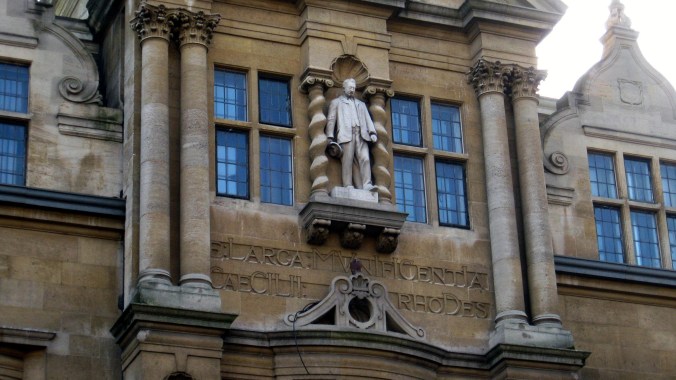
Even commentators sympathetic to the aims of Rhodes Must Fall in Oxford (RMFO) have been at pains to point out that the removal of the statue of Cecil Rhodes on the facade of Oriel College is not the most significant element of the campaign’s platform. Amia Srinivasan observes that ‘Neither the Cape Town nor the Oxford campaign has ever been just about statues.’ Amit Chaudhuri laments that ‘it would be…sad if Rhodes Must Fall in Oxford became identified with the statue in Oriel College alone’ because its ambition beyond the removal of the statue, namely that of decolonising education, is more significant. David Olusoga worries that by building their manifestos around calls for the taking down of statues, the more complex and worthy ideas around decolonisation raised by these campaigns have been ‘distorted into a simple right-wrong, yes-no statue debate’. I don’t disagree (much) with these views and indeed, if you want a right-wrong, yes-no answer, this essay will disappoint. But they beg the question of what statues mean and why we keep putting them up if they are so easily relegated to an epiphenomenal register of political discourse.
It’s worth remembering that RMFO itself has never downplayed the significance of the statue in the way that some of those writing in solidarity with it have done. It describes its mission as that of decolonising ‘the institutional structures and physical space in Oxford and beyond’ (emphasis mine) and lists as its first aim the intention to tackle ‘the plague of colonial iconography (in the form of statues, plaques and paintings) that seeks to whitewash and distort history’. In addition, it aims to reform the Eurocentric curricula to which university students continue to be subject and to address the under-representation and lack of welfare provision for black and minority ethnic staff and students at Oxford. One way to think about the place of the statue in this debate is to see it as a means to an end: as Srinivasan rightly notes, ‘complaints of structural racism and calls for curriculum reform don’t draw public attention like the toppling of a statue, and the RMF leaders know this.’ But while clarifying that its campaign is indeed ‘about more than a statue’, RMFO nonetheless insists that
statues and symbols matter; they are a means through which communities express their values. The normalised glorification of a man who for so many is a symbol of their historical oppression is a tacit admission that – as it stands – Oxford does not consider their history to be important. This is incompatible with a community that posits itself as progressive, enlightened and intellectually honest.
Without wanting to suggest that the success of RMFO should be judged by whether the statue falls or endures (it shouldn’t), I want to think with RMFO about what the expressive function of statues entails. Writing in a very different context, Judith Butler has famously worried that the relegation of injustices to the realm of the ‘merely cultural’ effectively downgrades the urgency with which they demand redress. For ‘merely cultural’ read ‘merely symbolic’, and the risk of disappearance of the demand for iconographic decolonisation (exactly what Oriel College might wish for) becomes obvious: if RMFO is about more than ‘just’ a statue and if we all agree that the statue is ‘merely symbolic’, then we might as well get beyond, behind, and beneath the symbol to address its putative ‘real’ while leaving the symbol itself intact. Meanwhile the possibility that the ‘merely symbolic’ has material consequences remains unexplored.
***

Churchill’s Westminster College audience, March 5, 1946 (Life/Getty Images)
This year is the seventieth anniversary of Winston Churchill’s “Iron Curtain” speech, a.k.a. “Sinews of Peace,” a.k.a., the Fulton address, which means that we will soon be hearing all about it once again. The speech is central to the iconography of the Cold War, of anti-communism, and of Anglo-American specialness. Countless historians, biographers and rhetoreticians have examined almost every aspect of it: when and where it was written, whether it was pre-approved by others, including President Truman, and, indeed, how it was received. On the last point, we know that the speech was met with a mixture of cheers and boos. The reactions tended to be politically and ideologically determined. Conservative politicians and the media praised the speech for its realism about the nature of the postwar settlement: at last someone had the courage to publicly say that the victor nations could not forever be friends. In contrast, most liberals, socialists, and communists condemned the speech as inflammatory. With so many hopes pinned to the newly created United Nations Organization (UNO), the last thing the world needed was geopolitical tension between the Western powers and the Soviet Union, they argued. But that was not all. Some leftists went further still. Churchill’s notion the Anglo-American “special relationship” and “fraternal association” constituted the ultimate sinew of world peace smacked of racial supremacism, they said.
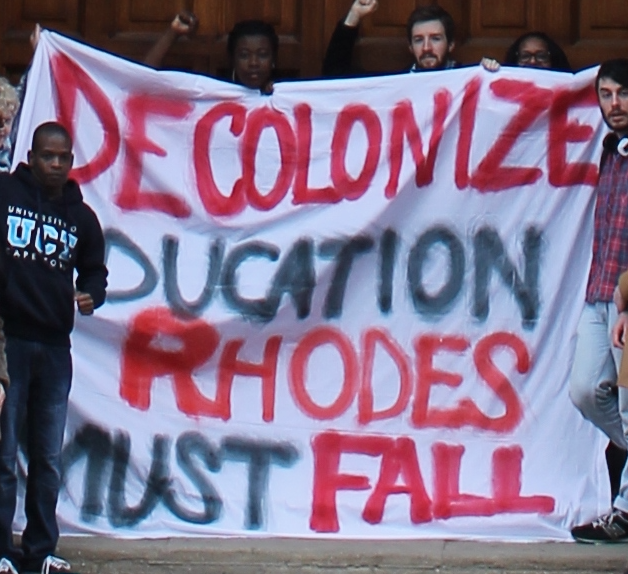
In this month’s podcast I’m joined Dalia Gebrial from Rhodes Must Fall Oxford and two stalwarts of TDOT, Meera and Robbie, to discuss ‘Decolonising the Academy’. We take a look at the Rhodes Must Fall campaign and its implications for understanding the relationship between higher education, coloniality and ‘race’. We also ask why is my curriculum white? What can be done change the way in which knowledge is produced and taught in universities? Finally, we explore how decolonising the academy might relate to anti-colonial and anti-racist struggles taking place outside of the university.
Listen via iTunes or through the Soundcloud player below.
The final piece, and rejoinder, in The Disorder Of Things forum on The Black Pacific.
I have to say, I really didn’t know what to expect from my interlocutors. Perhaps that’s because I have little idea what kind of response to expect from the book and who its readership might be. In any case, these varied and passionate responses are a joy to engage with.
Heloise, you not only provide a lucid introduction to some of the key themes and provocations of my book; you also usefully connect its arguments to broader intellectual and political currents in the world of development, especially regarding indigenous struggles in and over the Americas. Olivia, you provide a striking engagement with the politics of intellectual investment, one that in many ways exceeds the strictures of my book to become a general mediation upon ethics and method. Ajay, you poetically and critically reflect on solidarity building across/besides territory and culture, and in so doing you begin to ask pertinent questions about “groundings” with reference to Turtle Island. Krishna, yours unfolds as a forceful defence of the urgency to focus intellectually upon the materiality of dispossession.
I’m going to engage with your response, Krishna, at some length. But firstly, I want to call attention to and amplify some of the questions that Olivia and Ajay ask.
 Our fourth commentary on The Black Pacific. Olivia U. Rutazibwa is Lecturer in European and International Development Studies at the University of Portsmouth, UK. Currently she is a Postdoctoral Fellow at the Käte Hamburg Kolleg/ Centre for Global Cooperation Research, Duisburg in Germany where she looks into ways to decolonise the scholarship on sovereignty and self-determination, drawing from philosophies and practices of autonomous recovery in Somaliland, Agaciro in Rwanda and Black Power in the US. She is the former Africa desk editor and journalist at the Brussels based quarterly MO* Magazine and continues to write monthly op-eds for them.
When I first started reading Robbie Shilliam’s The Black Pacific last April, I was only a couple of pages in when I shot him the following email: “Sitting on a sunny terras [sic] by the waterfront in Antwerp and reading your book. It is not often that I feel deeply comforted, healing, cared for and utterly inspired reading an academic text… At some point I’ll hopefully have more eloquent ways to share my thoughts with you on your book, for now it’s just feelings…J”
Today, more than half a year later, the point of ‘more eloquence’ has supposedly arrived, but I doubt that I will ever truly reach it when it comes to this remarkable book.
In what follows I will share some preliminary thoughts on The Black Pacific, rather than venture into a full on book review. The book challenges our traditional (read: colonial) ways of doing research so convincingly and profoundly, that a conventional review would not do it justice. Too many of our research ways continue to be concerned with the generalizable and the linear. Divisive categorisations still play an important role and we end up with consumable knowledge at the service of the (oppressive) control of reality and peoples. Too often then, academic conversations, ideally conceived as open spaces for dialogue, exchange and creation, ossify into zones of judgementality, oxygenised by a misguided belief that there are indeed some absolute truths out there. The Black Pacific speaks a radically different language.
To me, it sang like Rebel Music at the heart of the (IR) academy and as such, it was a source of comforting discomfort. More on that later.
The third commentary in our forum on Robbie’s The Black Pacific, this time from Ajay Parasram. Ajay is a lecturer and Doctoral Candidate at Carleton University in Ottawa, unceded Algonquin Territory. His dissertation considers the gradual de-politicization of the colonial norm of “total territorial rule” emerging out of the collision of local and European ontologies of territory in mid-19th century Ceylon (Sri Lanka). One or two more posts to come before Robbie’s rejoinder.
I read The Black Pacific while walking through Coast Salish territories on Turtle Island, known in colonial vernacular as Washington State, USA, and the Lower Mainland of British Columbia, Canada. Attesting to the wide reaching applicability of the ideas advanced within this book, I engage it by drawing examples from Turtle Island, where I live.
The Black Pacific asks readers to reconnect with our shared humanity through cultivating a decolonial science of “deep relation.” This starkly contrasts with the prevailing “colonial science” of categorical separation and developmental hierarchy that is essential to ‘uni-versal’ modernity. To understand the distinction between “deep relation” and “categorical separation,” Shilliam says “We must start by acknowledging that the manifest world is a broadly (post)colonial one, structured through imperial hierarchies that encourage the one-way transmission of political authority, social relations and knowledge from the centres outwards” (20). Colonial science depends on the rigid separation of manifest and spiritual domains, as well as the separation of people into categories such as “enslaved, indentured, native, free, poor and masters. None can relate sideways to each other. They are fixated by the gaze of Britannica, the master” (23).
The Black Pacific is a nuanced, multifaceted call to abandon the science of separation that renders “profane” the myriad knowledges that people cultivate globally. The distinction offered between knowledge production/consumption vs. knowledge cultivation makes a valuable methodological contribution to decolonial research by treating the past (as opposed to History) as something in need of oxygenation:
Unlike knowledge production/consumption (a subaltern under-taking), knowledge cultivation turns matter around and folds it back on itself so as to rebind and encourage growth. This circulatory process of oxygenation necessarily interacts with a wider biotope, enfolding matter from diverse cultivations. (128-129)
The second commentary in our forum on Robbie Shilliam’s The Black Pacific. Sankaran Krishna teaches politics at the University of Hawai`i at Manoa and can be reached at this email. He would like to thank Jairus Grove, Jonathan Goldberg-Hiller and Akta Kaushal for their comments; the usual disclaimers apply.
Robbie Shilliam’s The Black Pacific: Anti-Colonial Struggles and Oceanic Connections is an unusual work in many ways. Not too many, if any at all, in the field of international relations have a sentence like this one as their impetus: “Let the hungry be fed, the naked clothed, the sick nourished, the ancients protected and the infants cared for” (p. 185). Shilliam centers colonialism – the legacy of Columbus and Cook- as the event that broke the world. In a sentence of startling brevity and insight, he demolishes the self-contained history of European rise to dominance as he notes, “The whakapapa (a Maori word which can be glossed here as ‘genealogy’- SK) of global capital starts with colonialism – a plantation on expropriated land next to a provision ground – and not in a factory next to an enclosure” (p. 185). The making of the west, of industrialization, capitalism, modernity, science and rationality, is coeval with – or more accurately, is preceded and produced by- the unmaking of the rest of the world through colonial conquest: Africa and Oceania, Natives and Negroes, Shem and Ham, Maui (a god within Hawaiian and Oceanic mythic history) and Legba (from West African Fon cosmologies).
This fractured and alienated world of ours is produced and reproduced through what Shilliam describes as a ‘colonial science’ that cuts, divides, opposes and exploits. It’s a world in which the modal being is one who runs for cover when it begins to rain without sparing a thought for others who may be getting drenched. To this epistemology of colonial science, Shilliam posits an alternative, ‘decolonial science’ that emerges from the deep solidarities that always have and continue to bind together those who were colonized, and the many victims of the rapacious drive of global capital.
The first commentary in our forum on Robbie’s The Black Pacific. Heloise Weber is Senior Lecturer in International Relations and Development Studies at the University of Queensland. Her main research interests are in the Global Politics of Development/Critical Development Studies and Global/International Political Economy (GPE/IPE), and relations of inequality. Heloise is the author most recently of Rethinking the Third World: International Development and World Politics, with Mark T. Berger (Palgrave, 2014) and ‘Reproducing Inequalities through Development: The MDGs and the Politics of Method’ in Globalizations.
The prophet therefore channels the binding skills of Tāne/Māui and Legba so that colonized History can give way to decolonial pasts. And key among these skills is the use of voice. (p. 135)
Robbie Shilliam presents more than a beautiful and inspiring account of how through ‘grounding’ with the world we can cultivate deep relations that heal colonial wounds and further a ‘project of restitutive justice’. The Black Pacific is itself a whakapapa (a groundation of deep relation) for mana motuhake (self-determination) with the project of restitutive justice at its core.
As the sub-title suggests The Black Pacific is about rendering anticolonial struggles and/through oceanic connections. In this sense, it is a decolonial project that
seeks to bind the manifest colonized world back to uncolonized spiritual hinterlands, the colonized present back to decolonial pasts, (post) colonized peoples to other (post)colonized peoples, and the children of Legba to the children of Tāne/Māui. (p. 30)
More specifically, it is about how through deep relations – spiritual and material– indigenous peoples of Aotearoa NZ have been connecting – with ‘more multiple and diverse peoples than European Settlers’ (p.31). Shilliam retrieves
the deep relation between the descendants of Africa and Oceania as part of the broader politics and narrative of the pan-Maori anti-colonial struggle for mana motuhake, a struggle that must involve tātou tātou– I and I. (p. 31)
The first in a forum on Robbie’s recently released The Black Pacific: Anti-Colonial Struggles and Oceanic Connections (Bloomsbury, 2015). A number of commentaries will follow in the coming week.
May 1979. A Black theatre troupe from London called Keskidee, along with a RasTafari band called Ras Messengers, land at Auckland airport, Aotearoa New Zealand. They have been invited by activists to undertake a consciousness-raising arts tour of predominantly Māori and Pasifika communities. They are driven almost immediately to the very tip of the North Island. There, at a small hamlet called Te Hāpua, Keskidee and Ras Messengers are greeted by Ngati Kuri, the local people of the land.  An elder introduces his guests to the significance of the place where they now stand. Cape Reinga is nearby, where departing souls leap into the waters to find their way back to Hawaiki, the sublime homeland. The elder wants to explain to the visitors that, although they hold an auspicious provenance – the Queen of England lives amongst them in London – Ngāti Kuri live at ‘the spiritual departure place throughout the world’. The elder concludes with the traditional greeting of tātou tātou – ‘everyone being one people’. Rufus Collins, director of Keskidee, then responds on behalf of the visitors:
You talked of your ancestors, how they had taken part in our meeting, and I do agree with you because if it was not for them you would not be here. You talked of our ancestors, taking part and making a meeting some place and somewhere; the ancestors are meeting because we have met. I do agree with you.
But Collins also recalls the association made between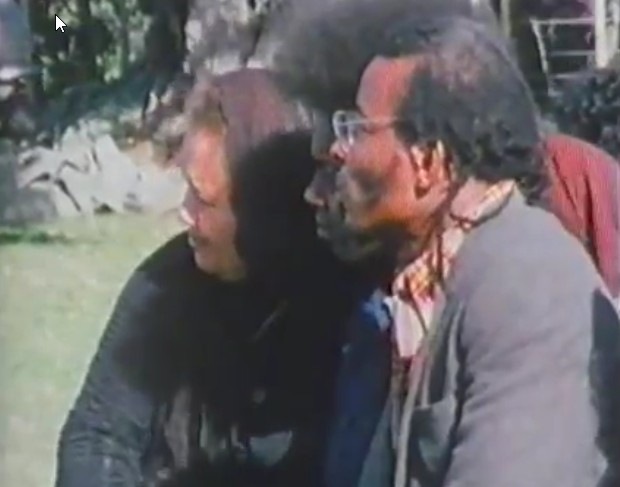 the visitors and English royalty, and there he begs to differ: ‘we are here despite the Queen’. Then the Ras Messengers begin the chant that reroutes their provenance from the halls of Buckingham Palace to the highlands of Ethiopia: “Rastafari come from Mount Zion.”
This meeting is emblematic of the story that I tell of The Black Pacific wherein Maori and Pasifika struggles against land dispossession, settler colonialism and racism enfold within them the struggles of African peoples against slavery, (settler) colonialism and racism. Sociologically, historically and geographically speaking, these connections between colonized and postcolonized peoples appear to be extremely thin, almost ephemeral. But those who cultivate these connections know otherwise. How do they know?
 The Disorder Of Things