Precarity Everywhere

A recent piece by Michael Bérubé highlights one of the invisible problems of higher education in America (and elsewhere) – namely, the rise of the adjunct as the hegemonic form of the modern day academic. This is in both a qualitative way (with flexibility and monetization becoming some of the prime measures for every academic), but also in a quantitative way (Bérubé cites data that shows more than 2 out of every 3 faculty members are now contingent workers).

While American political discourse often portrays academics as highly-paid, impossible-to-fire liberals, the data in fact shows virtually the opposite (though admittedly academics are likely disproportionately “liberals”). Increasingly the expectation of graduate students leaving university is that:

(a) an academic position will be incredibly difficult to find (I have numerous anecdotes of friends applying for hundreds of jobs and only getting 3-5 interviews, let alone job offers)

(b) when a job is found, it will be contract work

(c) when a job is found, it will involve the workload of a full professor

(d) when a job is found, it will pay 20-75% of a full professor’s salary

(e) in a year (perhaps longer depending on the contract), this process will be repeated

Continue reading

Colouring Lessons: Race Is A Structure Of Oppression, And Is Alive And Well

Race is a structure of oppression. So long as the structure remains, so does race. However, while there is plenty of talk about ethnicity and social cohesion, pathological cultures, and broken communities, race is usually mentioned only in its disavowal. And racism? Few would profess to that habit; most would comfortably label racism as a reactionary attitude. But to what imaginary golden mean? It is a privilege to believe that racism is a reaction rather than a catalysing agent of oppression. Meanwhile, all of us are variously implicated in this structure of oppression called race.

Even on the left, race is seen to be somewhat passé, and happily so now that the next world crisis in capital accumulation has arrived and we can all finally re-focus on the real thing: class. But what is the difference between race and class? Is it the difference between superstructure and base? Race does involve identification, both in order to oppress and in order to redeem. Yet in this respect, it is no more or less an identity than class. With the exception of Black Marxism, what the left has historically been unable or unwilling to consider is that, as a structure of oppression, race runs deeper than class.

Marx’s masterful hermeneutic shift from contract to class involved leaving behind the realm of exchange – wherein all things were of equivalent value and all transactions were equitable – and entering into the realm of production – wherein value was consistently expropriated and relations were exploitative. Nevertheless, in the colonial world, Marxism was more often used as a weapon for struggle and less so as a faith to guide contemplation. One reason for this engagement is that class exploitation never quite explained the reality of oppression experienced under the colonial exigencies of the world market.

In truth, Marx did not shift his hermeneutic far enough from liberalism and its obsession with civil society. Continue reading

On the Abstraction of Contemporary Crisis

On the Abstraction of Contemporary Crisis
Or, Why Today Feels Different From the 1930s

One of the oddities of the ongoing economic crisis is its apparent separation from everyday life.[1] Consumers still consume, luxury items are still produced. Starbucks is still filled with coffee drinkers, and Apple still sells its overpriced goods. Scanning the media, one finds its coverage devoid of lengthy soup lines or surges in tent cities. While most have had to cut back on their indebtedness, there hasn’t been a collapse on the scale of the Great Depression. This is in spite of some measures suggesting the current crisis is as deep in some ways.


Continue reading

Beneath The University, The (Digital) Commons

UPDATE (8 September): In the comments, Lee Jones reminds me of the Directory of Open Access Journals, which gives some more info on existing outlets. Monbiot also tweeted details of a petition to make all publicly-funded research available for free within a year of publication, which you should sign (yes, I know it’s just a petition, but start somewhere OK?)


1. Any time someone puts a lock on something that belongs to you, and doesn’t give you a key, the lock is not there for your benefit;

2. It’s hard to monetise fame, but it’s impossible to monetise obscurity;

3. Information doesn’t want to be free. People do.

Despite the focus on the artist and her output, Cory Doctorow’s three propositions for understanding copyright against creativity also speak to the products of the university (and both videos are worth watching). In short, the addition of copyright ‘protection’ to your work acts to restrict it, doesn’t actually drive higher resources to artists, and can’t really work in practice, thus requiring extending circles of criminalisation and monitoring. Contemporary copyright is a way of creating an obstacle course, one where the people who put in the work of limiting access are also the ones who you pay down the line for the access. In short, “they have created a problem that they know how to solve, and it works for them”.

In July, Aaron Swartz was charged under US federal hacking laws for downloading more than a few academic articles via MIT. It was about 4.8 million papers, since you ask. Wired reports that the penalty for this may amount to 35 years in prison and a $1 million fine. Worse, there is some evidence that the prosecution is being driven by the state rather than JSTOR alone. He’s due in court this Thursday. After some germination, both George Monbiot and Ben Goldacre have entered the fray with astute and biting pieces on the profitable stupidity of these arrangements and their detrimental impact on the free exchange of knowledge, scientific progress, the public good, etcetera.

The problems of intellectual property and who gets to profit from it are general, but the scandal is in the specificity of different productive spheres. After all, an artist is not like a university lecturer.

Continue reading

The Politics of Austerity: Emergency Economics and Debtocracy

austerity |ôˈsteritē| noun – sternness or severity of manner or attitude
It was possible, therefore, to commit a sin without knowing that you committed it, without wanting to commit it, and without being able to avoid it. Sin was not necessarily something that you did: it might be something that happened to you.

– George Orwell, “Such, Such Were the Joys”

Why what have you thought of yourself?

Is it you then that thought yourself less?

Is it you that thought the President greater than you?

Or the rich better off than you? or the educated wiser than you?

 I do not affirm that what you see beyond is futile, I do not advise that you stop,

I do not say leadings you thought great are not great,

But I say that none lead to greater than these lead to.

– Walt Whitman, “A Song for Occupations,” Leaves of Grass

The Politics of Austerity – Part I

This is the first in a series of posts that look at the political implications of the ongoing global economic crisis. I begin by examining the way that crisis is being used to attack the very idea of democracy through an assertion of the political imperatives of “the market” and the violation, bending and re-writing of the law by capitalist elites. I conclude by laying out how understanding the economic crisis in political terms shapes our ability to respond to it.

In the second post I’ll look at the ethos of austerity, which justifies the pain inflicted on largely innocent people, while suggesting that an affirmative democratic response to the economic crisis must begin with its own ethos, which I suggest should be an ethos of care for the world – which can provide orientation and inspiration for political struggles seeking to address the deeper causes of our current crisis. In the third post, I turn to the structures of the economy and of politics that define the current crisis, looking at the banking crisis, the bailouts, the politics of recovery/austerity and also reflecting of the structural imperatives of capitalism that led us to crisis. This, then, leads to the question of how to respond to the politics of austerity, and of what alternative actions are available to us, which is where the fourth and final post will pick up – with an affirmation of a caring ethos that supports a radically democratic economic vision.

Emergency Economics

In a previous post I briefly highlighted Bonnie Honig’s work, Emergency Politics, to examine the way that the ethical case for austerity is made; most basically, the existence of a supreme emergency, in this case economic, justifies actions that would normally be considered unacceptable. Honig’s work looks at how the appeal to emergency is used to reassert the exceptional political power of the sovereign over and against the law, with a focus on the reassertion of sovereignty witnessed over the past ten years in response to the threat of terrorist attack in the US and Europe.

Rather than accepting the necessarily intractable conflict between the power of the sovereign and the power of the law, Honig attempts to deflate this paradox by turning her attention to the always ongoing contestation that defines democratic politics, a contest over both the content of the law and the institutional embodiment of sovereign power. She suggests, then, that attending to the ambiguities of the “people”, who are both the democratic sovereign and a diffuse multitude, as well as the political element in the law – as new laws come into being through political action – enables us to avoid thinking about emergencies as moments of exception in which the rule of law is lost to the play of political power, while also acknowledging the limits of established law in moments of profound crisis. By undermining the exceptional nature of crises and emergencies Honig alters the challenge we face when circumstances force us to make choices or carry out actions we know are harmful and wrong by asking what we (democratic publics and citizens) can do to survive an emergency with our integrity in tact.

What do we need to do to ensure our continuity as selves and/or our survival as a democracy with integrity? Our survival depends very much on how we handle ourselves in the aftermath of a wrong. We will not recover from some kinds of tragic conflict. But when faced with such situations, we must act and we must inhabit the aftermath of the situation in ways that promote our survival as a democracy.

I continue to find this a useful way to understand our current economic crisis. Appeals to austerity depend upon the exceptional state created by crisis in order to justify the pain inflicted upon masses of people and the priority given to private interests (the markets, investors and bankers) over democratic publics. So, as democratically enacted laws must bow before the sovereign power threatened by exceptional attacks, so economic justice and democratic equality must bow before the commands of market forces, of economic inevitability, in this time of crisis.

The economic version of this argument is stronger still. While the space of political contestation that remains open when we accept the framing of emergency politics is limited, it does exist in the clashing of opposing sovereigns. The prospect of a substantive alternative to neoliberal economic ideology is dim, a light flickering weakly on antiquated appeals for a return to Keynesianism or watered down triangulations of the moderate-middle that sell off dreams of a just economy bit by bit – capitalist realism in action.
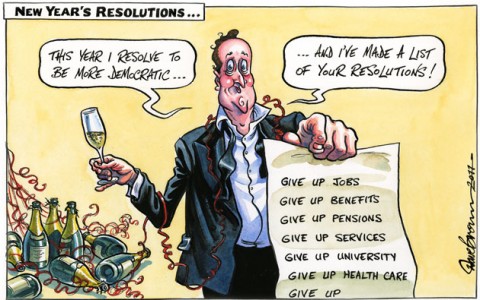
Honig awakens us to an important aspects of our current crisis: that “the market” is not in fact supremely sovereign, and the move to re-establish and further neoliberal policies and push through austerity measures requires an engagement in democratic politics – albeit one that undermines the notion of the public itself and seeks to use the power of the law to subvert democracy. Recognising the current crisis in these terms not only challenges us to consider how to survive our current troubles without giving up democratic virtues, it also reinvigorates and clarifies the political challenge we face. Emergency economics – with its assertion of debtocracy over democracy – is not an inevitable response to the crisis, it is a political one that we can, and should, fight against.

Continue reading

The Patriarchal Dividend At War

Thursday’s Masculinity/Violence Symposium was lovely, thanks for asking. Lots of people came, which was heartening, and they all had great stuff to say, which was exciting. It bodes well for the International Feminist Journal of Politics special issue (*hint*). Here’s more or less what I said on the day, incorporating a splash of revisions and a dollop of answers and critiques provided by the audience. The day itself deserves some kind of report of its own, and I hope to make some time for it, or perhaps just extract some highlights from the papers presented.


Being part of something potent and comprehensible amid chaos, witnessing death and destruction as a participant and testing yourself in the masculine ritual of war remain elemental to the formation of soldierly identity. To tour as a soldier is to become a male exemplar, to take the chance of looking upon horror from the inside, to attempt to neutralize its voyeuristic allure through becoming its agent…The performance of soldiering is plastic and infinitely variable, shifting through the cautious cadences of the defense phase to the aggressive, rolling bounds of the ‘advance to contact’, always to end in ‘the fight-through’. ‘Fighting-through’ is the end of the dance, the culmination point where the dancers become the dance, where the fighting body achieves a sensuous unity with grenades, bullets and the bayonet.

Shane Brighton, ‘The Embodiment of War: Reflections on the Tour of Duty’ (2004)

War is not simply a breakdown in a particular system, but a way of creating an alternative system of profit, power and even protection.

David Keen, The Economic Functions of Violence in Civil Wars (1998)

From prehistoric times to the present, I believe, rape has played a critical function. It is nothing more or less than a conscious process of intimidation by which all men keep all women in a state of fear.

Susan Brownmiller, Against Our Will: Men, Women & Rape (1975)

Conceptualising masculinity in terms of relations of hegemony and subordination and marginalisation and authorisation, Raewyn Connell proposed that men receive rewards as participants in male gender orders, and that this takes the form of status, command and material assets. This is the patriarchal dividend. Inequality on the scale observable in contemporary societies is, in Connell’s words, “hard to imagine without violence”, which is taken to have an important enforcement role both in terms of maintaining men’s power over women through acts like rape and in setting patterns among men. Extending this reasoning to the practice of war, it is plausible to see violence in general, and extreme acts like rape in particular, as an instrument of this enforcement, protecting or extending the patriarchal dividend. Soldiers in this sense become the frontline troops for the collective of men, just as domestic violence, street-level intimidation and rape fulfil the same functions outside of the war system.

Evidence from Chris Coulter’s work in Sierra Leone exemplifies how such a process may work. She reports that the majority of those abducted as ‘bush wives’ by the Rebel United Front (RUF) appear to have been raped. The creation of RUF rebel villages where commanders lived and the abducted were taken reflected the sociological structure of ‘peacetime’ arrangements: a pseudo-family structure with commanders at the head of a number of ‘bush wives’, subordinate males and occasionally elderly residents. The forms of labour assigned to women also followed the patriarchal imperatives of reproduction: fetching water and firewood, cleaning, and preparing food. Traditional roles like the ‘mamy queen’, who would look after young girls and prepare them for marriage, were also replicated within the camp structure. These arrangements were stable, to the extent that hierarchies among bush wives also manifested themselves, with the favoured wives of powerful commanders themselves taking on responsibilities for distributing arms and ammunition and holding power over other wives and children within camps.

In the context of masculinities, I take this kind of perspective to suggest that there are what we might call enforcer masculinities at work in war. This is to say that there are patterns of behaviour, representations and identities which, in the practice of violence, secure benefits for patriarchy as a system. A Debt Paid in Coin and Sweat.

Continue reading

Protest: the legality of the Emergency Budget’s gender impact, Monday 6th December

Even a top line assessment of the budget measures show 72 per cent of cuts will be met from women’s income as opposed to 28 per cent from men’s. This is because many of the cuts are to the benefits that more women than men rely on, and the changes to the tax system will benefit far more men than women.

Support Fawcett’s bid for a judicial review of the budget

**JOIN US TO PROTEST OUTSIDE THE HIGH COURT**

12.30 pm – 2pm, Monday 6th December, Royal Courts of Justice, the Strand, London WC2A 2LL

Continue reading

Ethics of Austerity 3: Cynicism, Sincerity and Fear

“You ain’t never been no virgin, kid, you were fucked from the start.”

-Titus Andronicus, “A Pot in Which to Piss

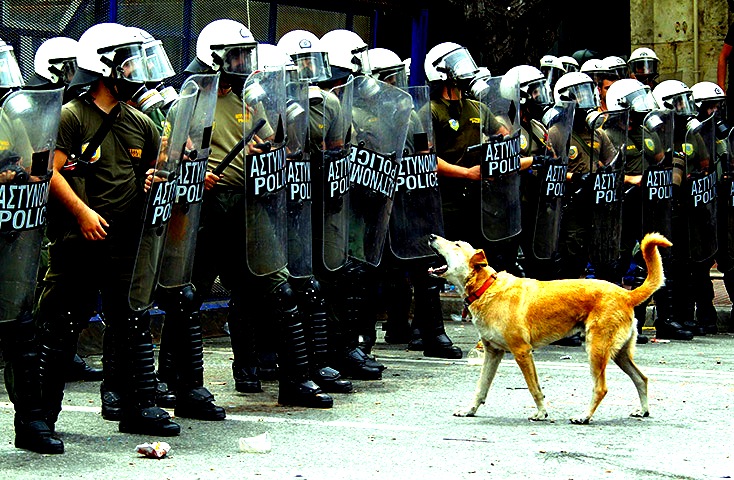
Police Vodafone protesters oxford street

Police protect Vodafone store from the threat of public exposure of truth.

And you have to wonder what it will take for serious people to realize that punishing the populace for the bankers’ sins is worse than a crime; it’s a mistake.

Paul Krugman

Of obedience, faith, adhesiveness;

As I stand aloof and look there is to me something profoundly

affecting in large masses of men following the lead of those who

do not believe in men.

-Walt Whitman, “Thought”

Hypothesis

The winter air has turned cold enough, has pressed in with its full weight, so that there is no more space for lies. The truth of crisis is that the powerful and the wealthy do not take responsibility, they assign it; they do not suffer their follies or their sins, they pay their penance in the currency of our lives.

We’ve spent the last few years living with the anxiety of impending doom, spurred on by hustlers of panic, addled prophets of economic Reformation, and Janus-faced managers of public interest.

Yet, despite the prolonged disaster-foreplay, the consummation of this crisis was always going to be “us against them” and never “we’re all in it together.” Continue reading

Policing as protesting by other means?

In the discussions of the ‘evenements’ of November so far, many have rightly focused on the significance of the student protest for politics, on which there are excellent discussions here and here. But what are the police up to? And what might their participation in this spectacle tell us? Continue reading

Neoliberalism Strikes Back, or Is This Really a Crisis?

A post from Roberto Roccu.


Of course it is. Yet, Colin Hay hits the right note when he points out that if crises are conceived as moments of radical questioning and change of existing paradigms, then what we see today is not a crisis, but rather a “catastrophic equilibrium”. Indeed, now that the reverberations of the rhetoric of London’s G20 in April 2009 have faded, it appears that the measures adopted both on a national and on the global scale are concerned with shoring up the old growth model based on flexible accumulation, in the attempt to restore its economic profitability, regardless of its social unsustainability.

Rather than downplaying the magnitude of the economic problems we face, Hay’s aim is to show how in a period when all the material conditions for speaking in terms of a crisis are present, with all the potential implications for a radical reconfiguration of our economic policies and political economies, the ideational discourse is still dominated by the very paradigm that created such material conditions. This fits well with Hay’s account of the genesis of neoliberalism, which emerged as the solution to a discursively-boosted epochal crisis of Keynesianism in times where material conditions were far from being as severe as the ones we face today.

It would be easy to dismiss Hay for “being too academic”, particularly in a context where what he calls the pathologies of the neoliberal paradigm have infected all of the developed world with very real consequences for those individuals and groups that have lost their jobs and are experiencing a dramatic increase in their social insecurity. Still, identifying the distinction between existing material conditions and the missing narrative for linking those conditions and framing a coherent and credible political project is extremely fruitful. This is the hiatus where capitalist realism as an ideology and a practice has prospered. In this respect, the regained profitability of the capital accumulation regime has brought about two seemingly parallel yet interrelated trends, that are most visible in the developed country struck hardest by the crisis, the US.

On the one hand, the rise of the Tea Party movement. The mainstream press has set its focus on the populist, anti-intellectual and anti-establishment aspects of the phenomenon. Yet, their fundamentalist neoliberalism – best expressed in the call to “return to the principles of Austrian economics” – has largely gone unnoticed. On the other hand, the ever clearer and stronger political position taken by Murdoch’s media empire against the Obama administration and more generally against any kind of state intervention in the economy is equally relevant. The daily space granted to Glenn Beck on Fox appears to me as the most evident trait d’union between these two trends.

On this side of the Atlantic, dismissing these phenomena as something alien would be misleading and dangerous. And not only because Murdoch’s empire extends well within Europe, and he is even now launching an offensive on the British media. Most importantly from a social standpoint, is the other trend – the rise of populist, worryingly xenophobic yet economically conventional movements – which is manifesting itself with a surprising regularity, even in countries like Sweden, that our diehard clichés still like to characterise as “welfare paradises”.

The analysis of what is happening in the European space is rendered more complex by the presence of a further level of decision-making, located on a larger spatial scale than the state. Now, all of us have become accustomed to hear about the democratic deficit within the EU. One of its major consequences is that the struggle for influence does not follow institutionalised forms, and lobbying is by and large the name of the game. Within this context, the effective mobility and mobilisation of capital and of its allies on the EU scale (and beyond) confronts a mobility of labour that remains mostly on paper, as the bulk of the jobs that are neither highly skilled nor unskilled are still largely allocated on a national basis. As a consequence, it has proven incredibly hard to mobilise working forces beyond the national scale.

Even the rampant xenophobia – exemplified by the rise of parties such as the Northern League in Italy, the Freedom Party in the Netherlands, the Swedish Democrats in Sweden, and the list could go on to include at the least fifteen of the EU’s twenty-seven members – must be seen as a fragment that begs for relations with the whole. And in the Europe of the four freedoms of movement (people, goods, services, capital), where the mobilisation of capital is effectively globalised and the mobilisation of labour is still limited by national boundaries, it comes as no surprise that the genuine anger of the working class(es) is channelled towards an attack of the only one freedom that can credibly be limited by national authorities: the movement of people.

And yet, there would be plenty of material to start from in the direction of some Europe-wide coordination. From the Spanish general strike to the recent demonstrations in the Netherlands to industrial action on the London Underground to the French general strike of this Tuesday. Unfortunately, very little has been happening on the European scale. And as long as capital is more powerful to begin with and better organised on a larger scale whereas labour is weaker and sometimes divided also on the national scale, the prospects for resisting, reversing and subverting the current neoliberal offensive appear to be dire indeed.