Decolonising Intervention: A Symposium

The Disorder of Things‘ own founding contributor, Meera Sabaratnam, has published her first book: Decolonising Intervention: International Statebuilding in Mozambique, with Rowman and Littlefield International. We are delighted to host a symposium on the book, starting with Meera’s opening post, and to be followed over the next week or so by reviews from Marta Iñiguez de Heredia, Lee Jones, Amy Niang and Megan Mackenzie, and a final response from the author. If tweeting, please use #DecolonisingIntervention! The book is available as an Open Access free PDF download here. -LJ

Update: posts by Marta, Lee, Amy, Megan and Meera are now available. The whole symposium is available here.
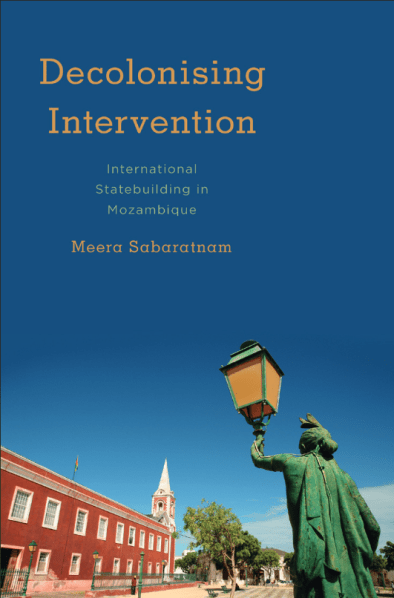

Cover of the book Decolonising Intervention, which features the former Governor's house on Ilha de Moçambique, now a museum, plus a rusting colonial lamp-post

Things look different depending on where you stand.

This is a simple proposition, but one which, if pursued a little further, deeply challenges dominant approaches to social science, many of which are premised on ignoring or denying the partial character of the social-scientific gaze.

I don’t disagree with the ambition per se of attempting to open up our own understanding of a phenomenon through deep and wide-ranging research; indeed this is what I love about being a scholar. Furthermore, just because things look different depending on where you stand, does not mean you cannot learn more about something, or learn to understand it better. I do not reject the possibility of a better and wider understanding just because points of departure are always partial.

Yet, the first step for studying complex social phenomena must be a recognition of and a grappling with this proposition.

Beyond this, various feminist, anti-colonial and Marxist thinkers have advanced a further proposition: that power relations can be better understood when you look at them ‘from below’, i.e. from the perspective of the disempowered parties.

This stems from the idea that relations of power put different cognitive demands on people by virtue of that relationship.

Grizelda cartoon

Patricia Hill Collins for example points out that domestic labourers must acquire an intimacy both with the ways of thinking of their employers/masters, and with their own sense of how to navigate and survive in this system.

And W.E.B. Du Bois famously drew attention to what many continue to call ‘double consciousness’ – that is, the idea that African-Americans had to apprehend and negotiate the racist negations of mainstream American society, whilst simultaneously cultivating a distinctive intellectual tradition rooted in historical and contemporary attempts at flourishing.

If they are right, then scholars engaging with relations of power from any field of study – and particularly in the field of ‘political science’ – should be especially interested in the perspectives and experiences of the relatively disempowered as a point of departure for analysis. Continue reading

Reply

In this final post in our symposium on  Laust Schouenborg’s International Institutions in World History: Divorcing International Relations Theory from the State and Stage Models, Laust responds to his interlocutors.

You can read the other posts in the symposium here.


It is a rare privilege to be afforded the time to reflect on the characteristics of social relations across history, and moreover to have those ideas published. It is even rarer to have such an outstanding group of scholars respond to those ideas. I am truly humbled and thankful, and my comments should be read in this light. In the spirit of academic debate, I will discuss where I disagree with some of the contributors’ observations, and where they may have misinterpreted parts of my argument. However, to paraphrase Yale, I generally think that there is more that unites us than divides us. I am so happy that they all see the value of the book as an intellectual project, and that most of them agree with the general thrust of my argument, of course with several important qualifications. Let me also extend a special thank you to L.H.M. Ling and Hendrik Spruyt who participated in the 2017 ISA roundtable that inspired the present symposium, but who were nevertheless prevented from contributing to the latter.

It is not possible to respond to all of the contributors’ individual concerns. Therefore, I will attempt to address those that I believe are the most significant and those that are shared by several of the them. This should by no means be read as a diminishing of the force of those arguments passed by. Hopefully I will get an opportunity to respond to those arguments in person or in a different forum.

Probably the most important issue to settle is the status of functionalism in my book. This is because it is the basis for the alternative theoretical framework I propose, and for what we can achieve with it. It is also an issue with a substantial room for misinterpretation, because my functionalism is of a specific kind. While most of the contributors seem sympathetic to my critique of the state and stage models, several are nevertheless concerned about different aspects related to functionalism. Continue reading

The Report of the Death of ‘Polities’ was an Exaggeration: Comments on Laust Schouenborg’s International Institutions in World History

This is the fourth comment, following Laust’s opening post, by Benjamin de Carvalho. Benjamin  is a senior research fellow at NUPI. His research interests are, broadly speaking, between three fields: He works on issues of broader historical change such as the formation of the nation-state in Europe, sovereignty, and the role played by confessionalization and religion.

The other posts for this forum are available here.


Laust Schouenborg invited me to take part in this symposium on his latest book, a request I was thrilled to accept, given that the book had for some time already been on the list of books I wanted to read. Having now read and engaged with Schouenborg’s work, I am very glad I accepted.

International Institutions in World History (IIWH) is an ambitious and thought-provoking work, which I would recommended to any scholar of IR seeking to understand not only the world beyond the state, but also our current predicament. I found his emphasis on social institutions stimulating and on the whole convincing, and really believe he is onto something. That being said, as he himself concludes, the book marks the beginning of an endeavor rather than its end. And as is the case with any broad claim, the proof of the pudding lies in the eating. Schouenborg’s three cases, while illustrative of his claim about the “universality” of his institutions, nevertheless leave something to be desired. Granted, nomad Central Asia, Polynesia, and the Central African rainforest are pretty much as remote places as one could have picked to engage on such a trip of discovery from New York and Roskilde. And if his framework of international institutions can be found (or even be useful in analyzing) there, then they must be at least fairly universal, is the thought. But then again, while illustrating their occurrence, their utility to the analyst is to me still a bit unclear. While it does structure his accounts, it seems to me that the analysis could have been brought further. Furthermore, for the whole framework to knock out the state (or polities, for that matter) altogether, the book would also have had to tackle some more common cases and demonstrate its utility by superimposing the findings to those of other works in a more sustained and systematic way. Continue reading

The Whole and Its Parts

This is the third comment, following Laust’s opening post, by Yale Ferguson. Yale is a Professorial Fellow in the Rutgers University-Newark Division of Global Affairs and Emeritus Distinguished Professor of Global and International Affairs.  His publications include 12 books and over 60 book chapters and articles. Among his latest books with Richard W. Mansbach (Iowa State) are Globalization: The Return of Borders to a Borderless World?; A World of Polities: Essays in Global Politics; and Remapping Global Politics: History’s Revenge and Future Shock. He and Mansbach have a new book in progress, War and Political Evolution in the Ancient Mediterranean.

The other posts for this forum are available here.


It is a pleasure for me to take part in this symposium on Laust Schouenborg’s International Institutions in World History (hereafter IIWH), as it was to read his thoughtful and provocative book. Reviewers are always saying that some study is a must-read or should be on every scholar’s and serious student’s bookshelf. Well, occasionally such accolades are merited, and for those of us interested in IR theory and history, they certainly are in the case of Laust’s book. His is indeed a landmark study, and I not only enjoyed but profited from reading it, not least in considering Laust’s observations about my own work with Richard Mansbach on Polities. Laust has read essentially everything relevant to his concerns, set forth other authors’ positions with care and respect, and then explained how he begs to differ. In this little piece, I hope to do the same for Laust.

There are so many things I like about IIWH that I cannot begin to mention them all, so I will simply list a few specifics and then move on to what I see as central issues in the book as a whole. First, the list:

  1. Laust’s focus is on social institutions seen as “made up of patterned practices, ideas and norms” (emphasis in original). Social institutions are what they do on a regular basis, what ideas sustain them (and they convey), and what they regard (and do not regard) as legitimate behavior.
  2. He looks at social institutions from a multi-disciplinary perspective, including IR, anthropology, archaeology, and historical sociology. He weighs their respective contributions to his subject, mixes and matches what he can from them, and then advances his own distinct theoretical position.
  3. His approach in IIWH is also proudly and even militantly cross-cultural and trans-historical.
  4. The empirical second section of the book is a broad study of “three extreme or marginal historical cases: nomad Central Asia, the Central African rainforest and Polynesia.” Laust has the audacity to suggest that he has gone to those extremes or margins to highlight the “universality” of his four functional categories versus the “limitations” of the “state-based framework” he attributes to almost everyone else, including those advancing “stage” models.
  5. Laust insists, quite rightly, that there is no useful or reasonable basis for labeling the likes of his case-study societies and their institutions as “primitive.”
  6. He boldly maintains that we can and should view “the functional activities relevant to corporate social actors or polities” and their “interactions” as falling into only four basic categories: legitimacy and membership, regulating conflicts, trade, and governance.
  7. Last in this list, I have special reasons for liking Laust’s observations about war in his discussion of “regulating conflict.” He notes that war is often viewed as a “social evil” or at best (like Bull) a “necessary evil” to help maintain order. However, Laust comments: “In many past societies, including the three [that are his cases], war did not always carry a “negative connotation.” “On the contrary, it was often celebrated. Hence, we are “allowed to consider the possibility that war might be the dominant mode of social interaction, so to speak.” In fact, Mansbach and I are currently writing a book focusing on war and polities in the ancient Mediterranean that argues war was the primary driver of political evolution for thousands of years and speculates about how far one can push that connection into the present and future.

Continue reading

The Uses of Functionalism

This is the second comment, following Laust’s opening post, by Cornelia Navari. Cornelia is honorary senior lecturer at the University of Birmingham (U.K.) and visiting professor of international affairs at the University of Buckingham (U.K.). Her current research is into international regulatory regimes and involves several linked projects covering regime development.

The other posts for this forum are available here.


To an English School (ES) theorist, and in the context of that theory, the first thing Laust’s argument calls to mind are the structural affinities between the ES and the early days of anthropology. Indeed, it highlights the relation of the English School to, particularly, British anthropology, whose great breakthrough (to remind ourselves) was in the idea of functionalism in relation to social institutions. To recall, what the functional anthropologist was looking for in social practices was the key to social stability among pre-modern peoples, and he rated institutions in relation to their contribution to social stability. Laust has picked up, quite rightly in my view, the correspondence between the ES concept of world order, the institutions of world order such as great power management, and the anthropologist’s idea of social stability.

His argument is also spot-on in relating order or stability to, more particularly, institutionalisation. I don’t think he gives enough credit to Kalevi Holsti (indeed, he doesn’t seem to credit him at all, but who stated it much more boldly in his 2004 Taming the Sovereigns): you cannot have order without institutions.  Equally, however, Hedley Bull, the originator of the ES concern with institutions, features prominently in his argument, and Bull claimed to have identified the basic institutions that provided for world order. In the same manner, Laust’s categories are the functions that he expects any social order to provide. This point will become more important as we proceed. Continue reading

A New Language for a New World

This is the first comment, following Laust’s opening post, by Erik Ringmar. Erik is Lecturer in Political Science in the Department of Political Science at Lund University. He works on topics such as international history, international relations, cultural sociology, and social theory.
The other posts for this forum are available here.


The basic insight that drives the argument presented in this book is that we need a new way of thinking about international politics which does not privilege European experiences and the idea of a sovereign state. This is required since we need to be able to talk about other parts of the world, about European history before the rise of the state, and about a future in which the state no longer will be with us. World history, simply put, is not about the state, and it really isn’t the case that der Gang Gottes in der Welt daß der Staat ist. And people who claim that this is the case — not only Hegel, but all philosophers of history from Adam Ferguson to Walt Whitman Rostow — are simply mistaken. Compare the recently fashionable idea of a “failed state.” To identify a state as having failed is to identify it as not living up to a European standard. It is like saying that a woman is a “failed man.”

Laust Schouenborg‘s suggestion is to dispense with state-talk in favor of a discussion of political functions. We should stop talking about what political entities are and focus instead on what they do. Perhaps we could think of this as a move from ontology to practice. We are in Durkheimian territory, in other words, or Talcott Parsonian. The state, says Schouenborg, can be disaggregated into four functions having to do with 1) legitimacy and membership; 2) conflict regulation; 3) trade, and 4) governance.

Since all polities of whichever kind they may be fulfill these basic functions, this, not the state, should be our focus. Instead of a state-centered vocabulary which only allows us to talk sensibly only about Europe, a function-centered vocabulary allows us to talk sensibly about all of world history and everyone everywhere.  This taxonomy provides a “basic grid,” says Schouenborg, which is neutral between historical and geographical contexts. “So, my general argument in this book is not only that four functional categories can be used to capture social institutions throughout history. I also argue that we should discard the main alternative conceptual framework in the form of the state and the attendant stage models.” Continue reading

My personal genealogy of International Institutions in World History

The Disorder of Things is delighted to host a symposium on Laust Schouenborg’s new book International Institutions in World History: Divorcing International Relations Theory from the State and Stage ModelsWe kick off the symposium with an inaugural post from Laust, followed by replies over the next few days from Erik Ringmar, Cornelia Navari, Yale Ferguson, and Benjamin de Carvalho. We will conclude the symposium with a reply from Laust.

Laust is Associate Professor in the Department of Social Sciences and Business at Roskilde University. His research interests fall within International Relations theory, particularly the English School approach, disarmament, security studies and world history.

You will be able to find all the posts for this forum here.


I must say that I have some rather grand ambitions with this book – perhaps too grand. I aim to put International Relations (IR) theory on a new footing and to challenge the role of the state and stage models, not just in IR, but also in our sister disciplines in the social sciences, most notably anthropology, archaeology and sociology. I did not start out with these grand ambitions. Initially, the book was meant to be a short foray into history to test some ideas I had developed in a 2011 piece in the journal International Relations.[i] However, as so often happens (the beauty of scientific discovery), the project went through a metamorphosis. A more complex creature emerged (probably not as pretty as the original if I am to pursue the analogy with Kafka’s famous book). The project did not change direction as such, but I became aware that I could use the initially conceived inquiry to support a sustained attack on two cherished (as well as loathed) concepts in the social sciences: the state and stage models. For the purposes of this symposium, it might be interesting to engage in a bit of genealogy and trace the evolution of the book from its somewhat humble beginnings to its eventual larger and ambitious claims. If you prefer the more polished or ex post facto story, I refer you to the actual book.

It all began with Hedley Bull, Barry Buzan and Jack Donnelly. While only the former two are traditionally associated with the English School (ES) of IR, all three had thought about the institutions of international society. Most readers are probably familiar with the five institutions that were discussed in Bull’s landmark contribution The Anarchical Society: international law, diplomacy, war, the balance of power and the great powers.[ii] These five are still central to ES debates, but have been supplemented by a long list of additional institutions identified by various authors.[iii] In the mid-2000s, Buzan and Donnelly separately started to address how all these institutions might be organised into functional (as referring to activity) categories, thus laying the groundwork for a theory of international institutions.[iv] I was very intrigued by this, and tried to think with them in this endeavour. In doing so, and I suppose partly as a consequence of my prior training as a historian, I was very conscious of the risk of formulating categories that were biased towards modern history. By this I mean the abstracting of social elements of modern societies into universal principles applicable at all times and in all places. Another way of describing this is through the ‘comparativist challenge’. It goes a little something like this. Assume that we are interested in comparing societies across history and across cultures and regions of the whole world. Not just societies from European history of the past millennium, or even Western civilization over the past five millennia, but potentially societies drawn from all human history on this planet. How can we do this objectively? How can we neutrally compare? What are the benchmarks that can be applied in this exercise? Continue reading

Historicizing Liberalism and Empire: On Duncan Bell’s Reordering the World

This the sixth post in the forum on Duncan Bell’s Reordering the World: Essays on Liberalism and EmpireRichard Devetak is Associate Professor and Head of School of Political Science and International Relations at the University of Queensland, Australia. He has published on the history of international thought, contemporary theoretical debates in international relations, humanitarian intervention, the ‘war on terror’, and globalisation’s implications for justice and the state. His major contribution has been in the area of international relations theory, more specifically in the exposition and analysis of Frankfurt School Critical Theory and post-structuralism. His current research interests include: the history of international thought and the history of the states-system.

Duncan Bell’s Reordering the World: Essays on Liberalism and Empire is a superb study of liberalism and liberal visions of empire. For its historicization and contextualization of both liberalism and liberal empire, Bell’s Reordering the World challenges many of the theory-driven assumptions that colour contemporary political and international relations theory. Extensive knowledge of Victorian Britain and the intellectual terrain of its political thought enable Bell to cast new light not just on the past, but on our present ways of thinking – especially the ways we try to grapple with the past, deal with colonial legacies, and understand liberalism and liberal world orders.

One of the features I appreciated most about Reordering the World was its will to resist easy (or lazy) theorizing that is intended to advertise the theorist’s enlightened and postcolonial moral superiority over past thinkers. The purpose of the book is not to engage in moral or theoretical self-fashioning; rather, it is to write history – to engage with the past as a historical object of enquiry, not a philosophical or moral one. That is not to say that moral or philosophical registers are entirely absent from the book, they aren’t. But it is to say that Bell does not allow them to overwhelm or pre-empt the historical material or argument. Bell maintains a firmly and unapologetically historical approach throughout. And it is this stance, I suggest, that enables Bell to produce the insights that permit better understandings of liberalism and its colonial legacies.

Continue reading

Liberalism in and out of Time

This is the fifth post on Duncan Bell’s Reordering the World: Essays on Liberalism and Empire. Dr Kathy Smits is Associate Professor in Politics and International Relations at the University of Auckland, New Zealand. She is the author of several articles on liberalism and identity politics, and of Reconstructing Post-Nationalist Liberal Pluralism: From Interest to Identity (Palgrave Macmillan, 2005) and Applying Political Theory (Palgrave Macmillan, 2009). She is currently working on projects exploring multiculturalism, biculturalism and national identity in New Zealand, and comparative multiculturalism policies in New Zealand, Australia and Britain.  

As Duncan Bell points out in the Coda to this broad-ranging, richly textured and masterly exploration of the relationship between liberalism, Empire and imperialism in nineteenth century British thought, it is virtually impossible to step outside liberalism in contemporary politics and political thinking.  In its protean expression as ideology, normative philosophy and discursive field, liberalism ‘virtually monopolizes political theory and practice in the Angloworld’ (371).  And yet the ways in which it has been shaped by history and political practice, at both domestic and global levels, have been very unevenly excavated and revealed.  We’re familiar with the relationship between seventeenth and eighteenth century liberalism, from Locke (although Bell tells a surprising account of Locke’s recent ascendancy in the liberal canon), and early capitalism, and with liberalism’s origins in Protestant thinking (or as Larry Siedentop has recently argued, with Christian thinking pre-Reformation.)  But its more modern development — as the dominant ideology in Anglo politics in the 19th and 20th centuries, during the period in which British colonial expansion left an ineradicable stamp of race and empire on British political and social thought — has not been fully explored until now.

Bell’s Reordering the World traces meticulously the relationship between liberal ideas, public discourse, and the legitimizations and experience of British imperialism in the mid to late 19th century.  In this period, as he shows here and in his earlier The Idea of Greater Britain[i], the development of Britain’s settler colonies shaped liberal arguments for the Empire, liberalism’s assumptions about race, and its prescriptions for world order.   This is an impressive and invaluable collection of essays, which range in subject from how we conceptualize political philosophy, to the ideas about time and space that underlie arguments for empire, to the work of academic apologists for, and critics of empire who are now almost forgotten, but who shaped debates in their day.  Bell draws on recent scholarship about the imperial and raced heritage of liberalism, but goes far beyond previous accounts.  As other contributors to this symposium have pointed out, Bell points out the ambiguities and contradictions deep within liberalism that emerge in its relationship to imperialism, looking further afield from the canon of liberal thinkers like J.S. Mill, whose complicity in the legitimization of empire has been well documented.  He examines the work of ‘public moralists’, academics, and others in the public sphere of Victorian Britain, both those who unabashedly defended the empire, and those who expressed skepticism and ambivalence.  It’s worth pointing out here that this is a study of public discourse, rather than popular social views and attitudes, and does not dislodge Bernard Porter’s argument that imperialism had a surprisingly small impact on ordinary British society.[ii]

Continue reading

Reordering the World and the Canadian Question

This is the fourth post in our forum on Duncan Bell’s Reordering the World: Essays on Liberalism and Empire. Lucian Ashworth is Professor at the Department of Memorial University of Newfoundland. He is the author of numerous books including ‘A History of International Thought. From the Origins of the Modern State to Academic International Relations’ (London: Routledge, 2014).

On 1st July 2017 the Canadian government celebrated the 150th anniversary of the coming into force of the British North America Act. This Act, the first of a series of successful attempts to federate the colonies and territories of British North America into one jurisdiction, was interpreted as Canada’s 150th birthday, and across the country both public and private entities found ways to mark the occasion. Although the government orchestration of Canada Day only dates from 1958 (when it was known as Dominion Day, and had a distinctly ‘we are British and not American’ feel to it), the choice of the day has given Canada the same kind of clear benchmark date for its beginning as the US has with the 4th of July. Yet the celebrations have not occurred without significant pushback, especially from Indigenous people. Not only do they dispute the origin date (their own histories are far older than 1867), but the intervening 150 years are seen as a cavalcade of colonization and broken promises.

Reading Duncan Bell’s Reordering the World while the year-long build up to the Canada 150 celebrations gathered steam, I could not but continue to make connections between the book’s discussion of the links between liberalism and settler colonialism, and the ongoing realities of those links in the society that I am living in. The discussions in Bell’s book are the everyday realities of living in Canada. In this sense, I live in the embodiment of what Bell calls ‘a comforting fallacy about the occupation of new lands’ that his built upon ‘a legacy of expropriation and horrific violence.’ (2016: 48) What is even more unsettling is the way that Bell is also able to demonstrate that, rather than settler colonialism being an unfortunate deviation from liberalism, the rise of liberalism (and global liberal orders) is reinterpreted as bound up with the ‘second settler empire’ that emerged after the secession of the American 13 colonies. (2016: 371-2) The settler colonies, along with the United States, were seen by liberals as expressions of the virtues and potential of the Anglo world. Even anti-imperialist British liberals would endorse settler colonialism within the Empire, (2016: 369) as the colonies were ‘reimagined as spaces of virtue and desire.’ (2016: 365)

The development of the settler societies into fully functioning settler states, according to Bell, changed the way that Indigenous resistance to colonization was treated. Before the settler state this resistance was handled from the point of view of diplomatic resolution (and war). The recognition of Indigenous societies as separate ‘nations’ has been explored well in Maya Jasanoff’s discussion of British relations with the loyalist Mohawks under Joseph Brant (2011), although the threat always existed that this relation between de jure equals would turn in to an absorption of the Mohawks into the British Empire. The new settler states did just that, turning a diplomatic relationship into a question of criminal law. Resistance was now a crime against the settler state. (2016: 365)

Continue reading