Capital, the State and War: The Risks of Method

CraigA forum contribution from Campbell Craig, the first in our series responding to Alex Anievas’ new book, Capital, the State and War. Campbell is Professor in International Politics at Aberystwyth University, and the author of several books, including Glimmer of a New Leviathan: Total War in the thought of Niebuhr, Morgenthau and Waltz (2003), The Atomic Bomb and the Origins of the Cold War (2008, with Sergey Radchenko), and more recently America’s Cold War: the Politics of Insecurity (2012, with Fredrik Logevall). Campbell’s work has appeared in World Politics, Ethics & International Affairs and the Review of International Studies. He is also currently finishing an article on the nuclear revolution and neo-Trotskyism.
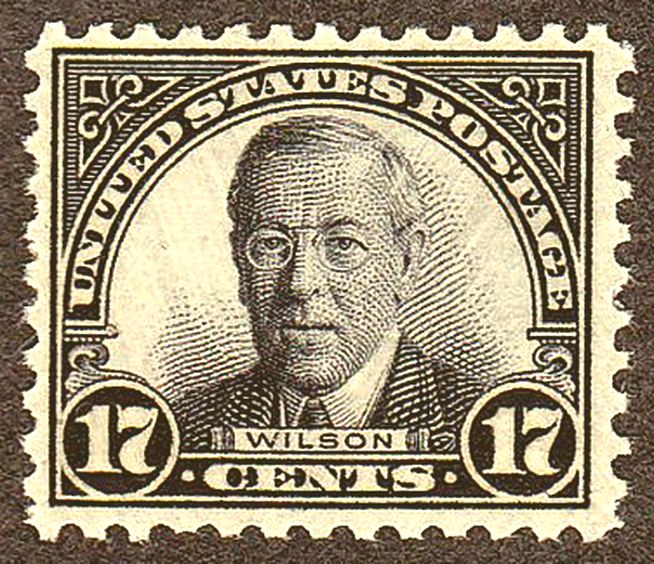

Woodrow Wilson 17c Stamp

In 1959 Kenneth Waltz published Man, the State and War, a study of three different levels of analysing international relations and their attempts to answer the question why war recurs. Waltz tackled his subject by demonstrating how the two most common levels of analysis – human nature, and regime type – ran into insuperable logical obstacles, and especially the problem of reductionism that social theorists such as Durkheim and Lakatos identified. His solution was to posit a third level – anarchy, or, as his title suggested, war – that could explain the recurrence of war without succumbing to the reductionist fallacy. The result was a study that has shaped the field of modern international relations more than any other single volume.

Anievas, as the title suggests, seeks to build upon Waltz’s ambition in his new book. He argues that the Marxian theory of uneven and combined development (UCD), a concept invented by Trotsky which explains international conflict by pointing to the uneven economic competition among more and less developed states whose economies are intertwined, can be used to theorise contemporary IR. This is a project being undertaken by other scholars, most notably Justin Rosenberg, but Anievas’s book is the most ambitious and thorough attempt yet to deploy Trotsky’s idea in a systematic way. However, Anievas’s method is quite different from the one used by Waltz (and Rosenberg). Rather than developing a logical or epistemological case for UCD, Anievas tries to use it as a means of shaping a detailed historical explanation of the two world wars of the twentieth century. What he is trying to do, as far as I can see, is to use UCD as a tool to explain and revise a key historical problem, as theorists in other schools of IR have done, rather than put forward an abstract case for the theory in the first place—a necessary move, for Anievas, because extant work on UCD suffers from “unsustainably high levels of analytical abstraction” (57). He concludes that the pressures of UCD upon capitalist states (particularly Germany, Great Britain, and the US) effectively explain the two world wars, and that they paved the way for a ‘proto-Cold War’ between the West and the USSR that began basically with the formation of the Soviet state in 1917.

In many ways the book is an impressive work. The narrative chapters on German, British, and American foreign relations are rich with historical detail and focused, often polemical argumentation. The engagement with competing theories is intensive and Anievas’s mastery of the debates among the neo-Marxian left is evident. Yet I was in the end not convinced by some of the main historical claims of the book nor by the method Anievas has deployed. In the spirit of Anievas’s blend of historical and theoretical inquiry, I will now present two critiques of the work from the respective points of view of the historian and the IR theorist.

Continue reading

Capital, The State and War: Rethinking the Geopolitics of Capitalist Modernity in the Era of the Two World Wars

A guest post from Alex Anievas to inaugurate a brief symposium on his book anievasCapital, the State, and War: Class Conflict and Geopolitics in Thirty Years’ Crisis, 1914-1945 (Michigan University Press, 2014), which will unfold over the next few days. Alex is a Leverhume Early Career Researcher at the Department of Politics and International Studies at the University of Cambridge. He is editor or co-editor of numerous books (including Race and Racism in International Relations and The Longue Durée of the Far-Right, both of which have previously previewed at The Disorder). His work has also appeared in the European Journal of International Relations, the Cambridge Review of International Affairs, Millennium and the Review of International Studies.

The manuscript that would become Capital, the State, and War: Class Conflicts and Geopolitics in the Thirty Years’ Crisis, 1914-1945 developed, like so many first books, out of my PhD thesis[1] In its final form, Capital, the State, and War endeavours to offer nothing less than a systematic and radical reinterpretation and historical sociological reconceptualisation of some of the main geopolitical and socioeconomic fault-lines of the 1914-1945 period. It does so through the theoretical prism of uneven and combined development, demonstrating in the process the various problems with extant historiographical interpretations and IR theorisations of this crucial epoch in the development and remaking of modern world politics. But given the rather substantial differences between what I had originally envisioned the PhD thesis to be and what it became, it’s worth briefly discussing the origins of the project and how it changed in the process of researching and writing it.

I. Origins

My PhD project was originally conceived as an intervention into the contemporary debates on the ‘resurgence’ of US imperialism in the wake of the wars in Afghanistan and Iraq – very much a radicalising moment in my own intellectual and political trajectory – and the concomitant return to Marxist theories of imperialism and empire. My aim then was to essentially rethink and ‘update’ the classical Marxist theories of imperialism and, in particular, Lenin and Bukharin’s theory of inter-imperial rivalry which, whatever its faults, still captured an essential aspect of contemporary imperialism. I was then heavily influenced by a number recent Marxist works on imperialism, particularly David Harvey’s 2003 The New Imperialism (along with his earlier, more theoretically sophisticated The Limits to Capital) and Alex Callinicos’ The New Mandarins of American Power.

Both studies, in their different ways, sought to retain the fundamental insights of the classical Marxist theories of imperialism (e.g. the persistence of historically-differentiated forms of inter-imperial rivalries rooted within the inherently competitive dynamics of capital accumulation), whilst dispensing with their more economically determinist and instrumentalist features. They did so, in particular, by reconceptualising imperialism as the intersection of two analytically distinct, but historically interconnected, ‘capitalist’ and ‘territorial’ logics of economic and geopolitical competition. While critical of certain aspects of this kind of approach – particularly, Harvey and Callinicos’ relatively undigested incorporation of a ‘proto-realist’ conception of ‘the international’ – my initial thought was that, if rooted in a stronger conception of the spatio-temporal dynamics of capitalist development and expansion that produced the somewhat porous but nonetheless identifiable ‘territorial logic of power’ – regionality – inherently arising out of the processes of capital accumulation in space and time, this perspective could provide a more adequate historical materialist theory of geopolitics.[2] At this stage in the development of the project, this is how I originally envisaged the role of Trotsky’s concept of ‘uneven and combined development’ – a kind of supplementary theory that could be employed in capturing the spatio-temporal dynamics of capitalist development in reconstructing a modified Marxist theory of imperialism. Add in a more attentive focus to the relations between capitalists and state managers and the role of ideology in structuring foreign policymaking processes and I thought this would do.

Continue reading

Landlessness and the Life of Seamen

This post is Part 3 in a series of dispatches posted from a 130, 000 ton container ship. More here.


OLYMPUS DIGITAL CAMERA

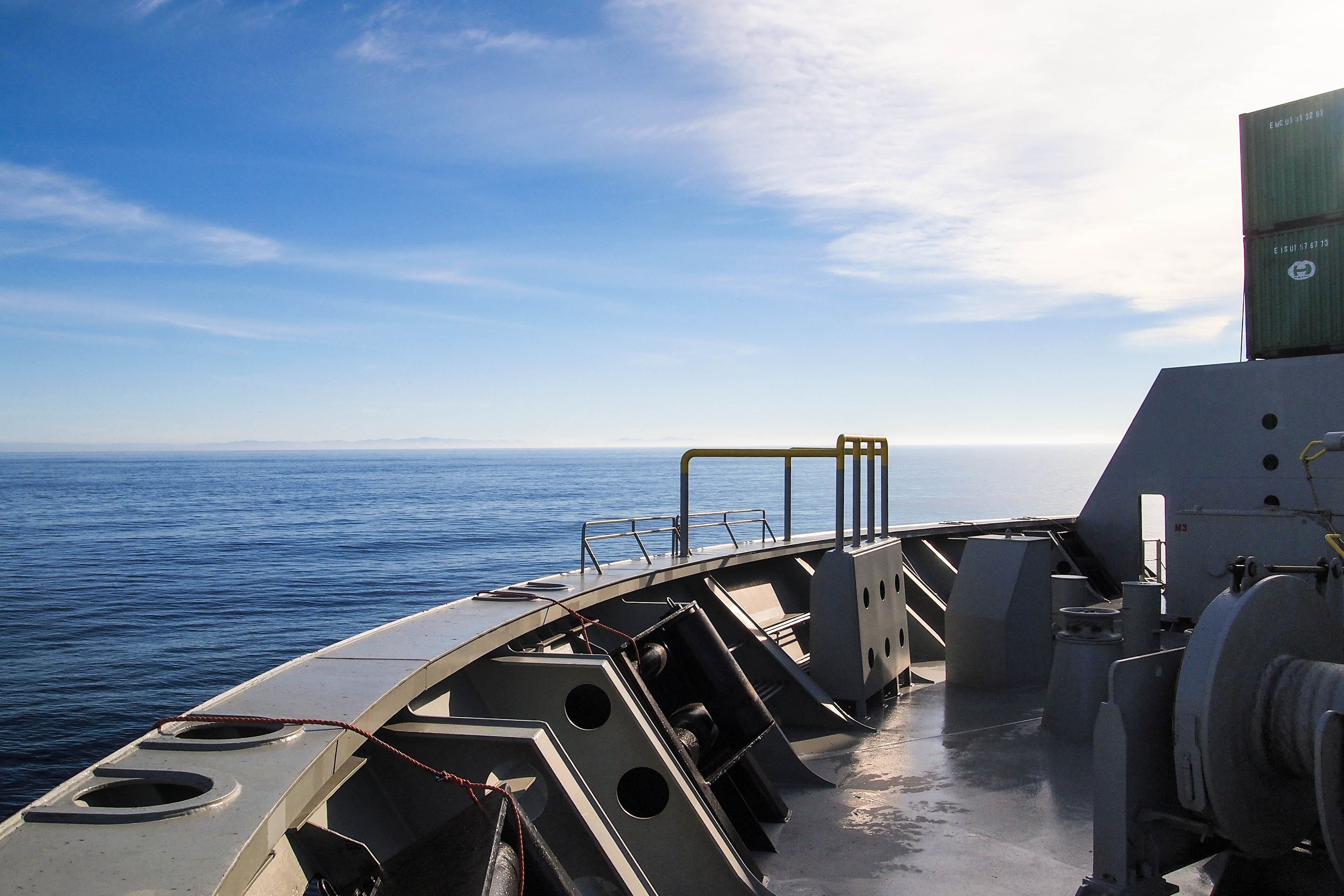
The bow of the ship is the only place on the Ever Cthulhu that affords a modicum of silence. To get there, you walk down the length of the narrow grey deck, flanked on one side by containers crowded into towering stacks that scrape and creak against each other as the ship cuts through the waves, and on the other by the powerful sweep of a wind so strong that you have to fight not to be blown backwards. At the foremost tip of the ship, you climb a few steps onto a large open deck painted grey and surrounded by giant chains and fat coils of synthetic rope, and suddenly, the mechanical roar of the ship falls away.

Having finally wended our way out of the US ports, the Ever Cthulhu has been traveling across the massive pacific ocean for more than a week now. Yesterday, we cleared the frigid Kamchatka Peninsula. The snow and ice beating against the ship for the past week has melted away, and the deck crew that has been trapped inside cleaning the walls and floors of the accommodations are now back to work on the endless task of the seaman: fighting against perpetual rust. “You know Sissyphus?”, The captain asks one day as we take a walk around the deck. “Working on a ship, it’s like that. You are fighting forever against the saltwater eating away at your vessel. The biggest enemy of the ship is not pirates, it’s corrosion.” Today, the ship has been awash in the sounds of grinding, scraping, hammering and drilling, scraping rust off and painting over it in an endless cycle that repeats itself every two months. All of this is set to the background soundtrack of an endlessly roaring engine that suffuses the air and shakes the accommodations with a throbbing, pulsating, machinic hum.

But on the bow, penned in from the wind and rage by the Ever Cthulhu’s bulwark, you can look outward onto an endless, unbroken horizon of ocean in near quiet, and almost think that the ship is barely moving. A quick step up onto a grilled ladder quickly dismisses this fantasy of a softly drifting ship: peering over the edge of the ship’s prow towards the churning waters below reveals the ship’s bulberous bow, a 1,000 ton snout-like protrusion of pure aerodynamic steel that cuts through the ocean, almost heaving the liquid blue upwards before pushing it back powerfully against the hull, where the waves churn themselves into a cerulean blue froth and then crest outwards in a diagonal wake. I can’t judge how far we are from the ocean’s surface, so I spit into the sea – crude, really – and count the seconds it takes to hit the waves. Seven. By the time it reaches the sea below, my ball of spit has already flown several meters behind me. We are forging ahead at a speed (18 knots per hour) beyond my bodily comprehension of motion. When you are surrounded by nothing but this limitless, shifting, liquid expanse, stretching in all directions for days before hitting land, all distance becomes incalculable.

Continue reading

The Quiet Port is Logistics’ Nightmare

Dispatch #2 from Charmaine’s ethnography of a container ship comes to us from the port of Tacoma, where the ship is currently experiencing severe delays. Continue to follow the Ever Cthulhu with the tag ‘Slow Boat to China’.


Source: author

Source: author

It is 3am on a Wednesday when we pick up the Port Angeles pilot who will take the ship through the Puget Sound. All day, we have been sailing through a fog that has hung so thickly around the ship that it has seemed we are drifting through clouds. The fog has delayed our pilot by four hours: sailing through the Puget Sound’s narrow channel is already a formidable task, made Herculean by the fact that no one can see past the ship’s nose. Take that, multiply it by the fact that the port of Tacoma is situated in a tight bottleneck of an inlet, that an unusual volume of vessels are docked in anchorages clogging passage to the port, and that the captain is being hounded by the charterer to get us to berth on time, and you get the shipper’s molotov cocktail. Short of risking navigating by radar, avoiding ships via yellow blips on a screen, waiting the fog out is the best option. At dinner, the captain sighs. “Fog, congestion, work slowdowns: at this rate, we will never get to China.”

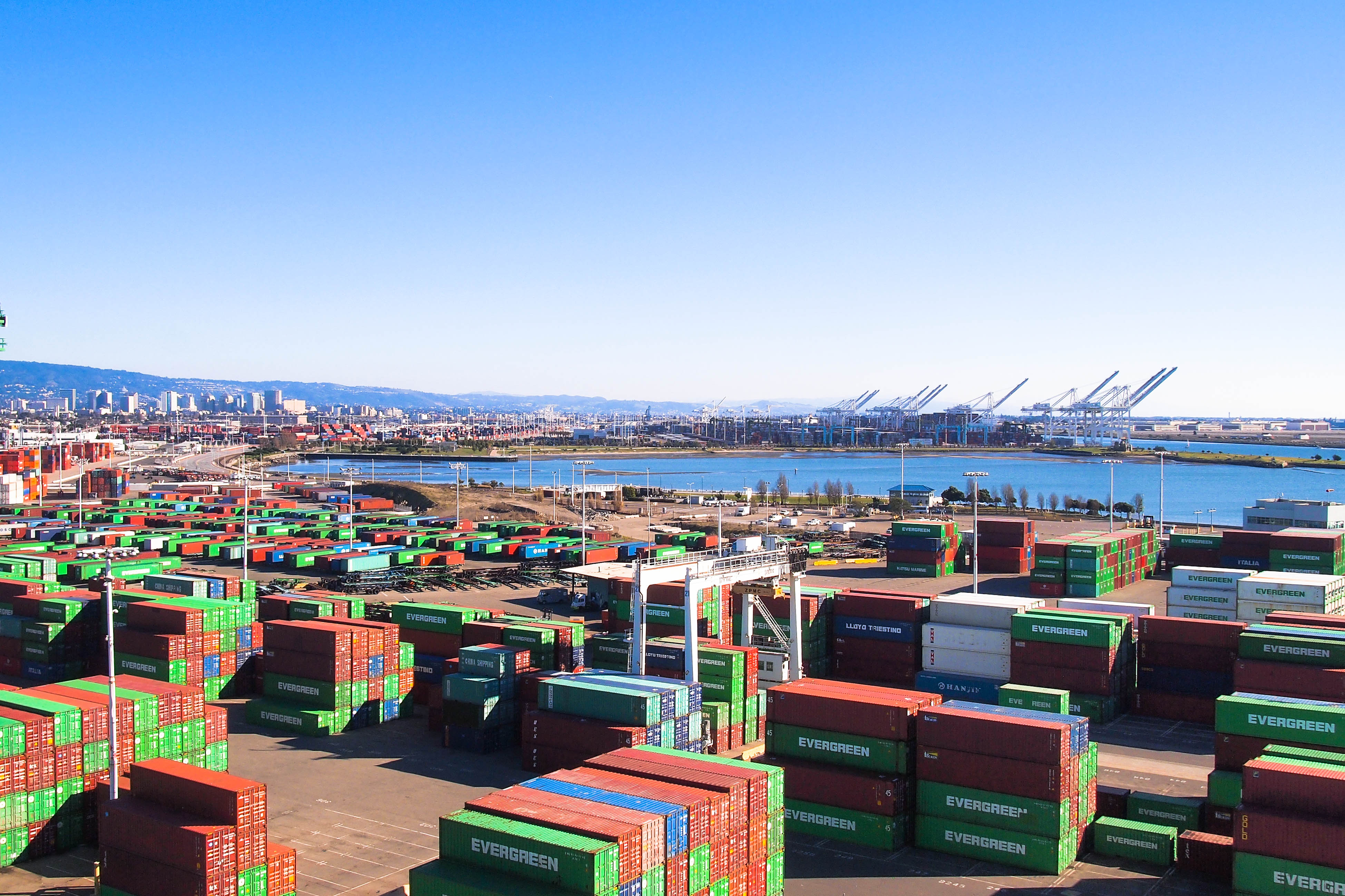
There is a massive traffic jam on the ocean, and the Ever Cthulhu is stuck in the thick of it. Already, we have been delayed for almost two weeks: the ship stayed for five days longer than the forecasted two in both Oakland and Los Angeles, and is expected to be in Tacoma for ten. Regularity, it turns out, can no longer be expected in the logistics industry, and my 26-day trip on the Ever Cthulhu is turning into a 40-day one. All along the West Coast, ports and berths have been choked with vessels in every terminal, and waiting ships have crowded into anchorages for days in far higher numbers than the captain has ever seen. Imagine the ripple effects of all this congestion: if a single ship takes six days longer than the usual 2.5 to be unloaded at berth, and ships that have been waiting experience those same delays when their turn at berth arrives, those backlogs reverberate outward in unfathomable ways, affecting ships’ travel times to other ports around the world, trucking rates inland, air freight pricing, rail service delays across the U.S., and the availability of empty containers in China.

The reasons for this coast-wide congestion are unclear. In July, when the current International Longshore and Warehouse Union (ILWU) contract ran out, more than 70 multinational maritime companies and ocean carriers represented by the Pacific Maritime Association (PMA) began to negotiate a new contract with the ILWU for the 29 U.S. West Coast ports in its jurisdiction. The process soon turned ugly. The PMA blamed the increasing port congestion on an organised work slowdown by the union, alleging that the ILWU was deliberately not dispatching enough gangs to the waterfront. The union vehemently denied this, and countered that the PMA was deliberately mounting a smear campaign against them by cutting the number of workers at terminals and cancelling critical night shifts that would speed the cargo operations. The media, of course, lapped this all up, blaming rotten agricultural productions, anchored ships, and delayed shipment arrivals on the ILWU, one outlet going so far as to ask whether longshoremen were “spoiling Christmas”.

Continue reading

Between Innocence and Deconstruction: Rethinking Political Solidarity

The third and final post in our short resilience and solidarity forum, this time from Chris Rossdale. Chris lectures in International Relations at Royal Holloway, University of London. His research focuses on anti-militarist social movements and radical political theory. He has also recently edited a special issue of Globalizations on radical political subjectivities, his own contribution exploring the relationship between Emma Goldman and Friedrich Nietzsche through the concept of dance. He can be reached by email thusly.


The ethos of solidarity remains one of the left’s most powerful and enduring ideas, a clarion call for collective struggle in the face of international borders and neoliberal individualism. At the time of writing, my social media feeds are awash with calls for solidarity with Ferguson; thousands also turned out to a solidarity protest at the US embassy. Last week I attended a solidarity fundraiser for the Kurdish Red Crescent, took part in an action organised to coincide with UN International Day of Solidarity with the Palestinian People, and circulated a petition in solidarity with students who experienced police violence at the University of Warwick. Rarely a day passes at present without some fresh discussion about the particular politics involved in different forms of solidarity with those suffering from the outbreak of Ebola. Across different modes, the practice of solidarity is a part of our everyday political conduct.

Rossdale_pic1

Protestors march after gathering outside the American Embassy in London November 26, 2014, to show solidarity with the family of black teenager Michael Brown who was shot and killed by a police officer in August in Missouri. REUTERS/Paul Hackett

On the one hand, this is clearly a good thing, enabling common political, financial and emotional resources to be shared in important and useful ways. Distance, whether spatial or cultural, can be an alienating force, and practices of solidarity can serve as a powerful redress to such alienation, asserting collectivity and community in the face of division. In this piece, however, my intention is to outline a critique of much of what passes for solidarity, and suggest that more radical or deconstructive understandings are needed if we wish to produce more substantive challenges to political domination.

The particular practices of solidarity I have in mind are those which occur in those contexts (which are many) in which the imbalance of power directly privileges, at least in some forms, one party over another – whether this is in the context of cis-male solidarity in feminist projects, citizen solidarity in migrant and refugee struggles, or, the particular case study I discuss below, Jewish-Israeli solidarity with Palestinians. Continue reading

Governing Through Resilience: Implications for Solidarity and Political Action

The second guest post in our solidarity and resilience forum, this time from Tudor Vilcan. Tudor is a doctoral candidate at the University of Southampton. He seeks to critically investigate how discourses of resilience are put to use as ways to govern society. He is also interested in complexity theories, new materialism and critiques of neoliberalism.


This contribution represents a sum of reflections about solidarity and political action in the context of resilience policies based on a presentation given at the Political Action, Resilience and Solidarity Workshop organized at King’s College London in September 2014. I suggest that there is room to think about political action and solidarity in the context of resilience policies. Political action and solidarity are developed through encouraging individuals and communities to take ownership of their own risk management and build generic adaptive capacities. I argue that the meaning of political action and solidarity is changed in this context, as it provides a localized social engagement that at the same time evacuates political concerns from consideration. For resilience policies to succeed in properly connecting with individuals and communities, they need to find a level of engagement that is not just social, but also political.

Vilcan_pic1

Resilience has become an important idea, especially in the last few years. It has been developed and applied in the context of the environment, threats and hazards, development or thinking about change. More importantly, it has started to make its way into policy making, becoming one way in which society can be governed. At its core, resilience proposes to be a property or capacity of groups, communities or societies to cope with disruptions and still maintain their basic functions.

There is an acute absence of contributions that seek to draw links between resilience on one side and political action and solidarity on the other. This might be because we are told that resilience is about the strengthening of society as a whole to better tolerate shocks and rebuild if necessary. It appears to go beyond concerns with formal politics and deliver a model for governing society that is more appropriate to the interdependent and complex world in which we are living. Such a model emphasizes the need for connections, diversity, broadened participation or devolved governance. It signals a move away from the centralized approaches to policy making to emphasize that society must be seen as a large array of networks, systems and critical infrastructures whose disruption or failure can have catastrophic domino effects. When resilience is conceptualized in such way, political action and solidarity can be seen to represent atavisms of a time when static, concrete political and social categories were popular. In today’s complex and fluid world, they don’t appear to have the same purchase.

Continue reading

Why We’re Not Ditching Resilience Yet…

A guest post in our resilience and solidarity symposium from Rhys Kelly and Ute Kelly. Rhys is a Lecturer in Conflict Resolution at the Division of Peace Studies, University of Bradford. His work currently focuses on the pressing challenges posed by ecological crises (including climate change) and resource depletion (including ‘peak oil’). Retaining a long-standing interest in (peace) education, Rhys’ work is now broadly concerned with investigating what kinds of individual and social learning are needed and possible in the context of increasing global insecurity, which might support just and peaceful transitions to more resilient, ‘sustainable’ communities. Ute is a Lecturer in Peace Studies at the University of Bradford. Her current research interests arise from the intersection of two areas that she has been interested in – the theory and practice of participatory engagement processes (particularly dialogue and deliberation), and the emerging interdisciplinary field of social-ecological resilience. Ute is interested in exploring the communicative and collaborative dimensions of resilience, the relationships between people and the places in which they find themselves, and approaches to enhancing resilience at different levels and in a range of contexts. She also teaches a module on ‘Peace, Ecology and Resilience’ within the BA in Peace Studies, encouraging students to explore the meanings, uses and limitations of ‘resilience’. Rhys and Ute are jointly engaged in exploring the meanings of ‘resilience’ on the ground, particularly for people who have been trying to engage with the converging ecological, economic and energy crises facing us today. Relevant recent joint publications include ‘An Education in Homecoming: Peace Education as the pursuit of Appropriate Knowledge’Journal of Peace Education (2013); and ‘Towards Peaceful Adaptation? Reflections on the purpose, scope, and practice of peace studies in the 21st Century’, Peace Studies Journal (2013).


Those who responded:
engaged with resilience,
thoughtfully active.

‘I want you’, she said,
‘to ditch ‘resilience’ now’.
How, then, to resist?

Part of a sequence of haikus about ‘10 days in September 14’ for a collective zine, these two fragments are an attempt to convey Ute’s experience of the workshop on ‘Political Action, Solidarity and Resilience’. The first tried to describe the people who responded to a survey we had created to gather reflections on ‘resilience’.[i] The responses to our survey were thoughtful and reflective, and most came from people who are critical of the status quo and trying to respond to a set of crises that includes climate change and the degradation of ecosystems, energy depletion, austerity, conflict, inequality and injustice. Interestingly, many of our respondents appreciated the opportunity to reflect on their own understandings of ‘resilience’, on the contexts in which they had seen the concept appear, and on its strengths and limitations.

Kelly_pic1

The second haiku poses a question that emerged from some of the discussions at the workshop itself – in particular, a tendency on the part of some of the contributors to dismiss the idea that ‘resilience’ might be a helpful concept, to conflate a focus on ‘resilience’ with neoliberal agendas, and/or to construct ‘resilience’ and ‘resistance’ as mutually exclusive concepts.

Such a construction, we feel, is too narrow, too caught up in looking at how ‘resilience’ has been used in some (not all) academic and policy discourses, and too dismissive of genuine attempts to grapple with ‘the fragility of things’, with a real sense of converging crises. Continue reading

Solidarity and Resilience: A Forum

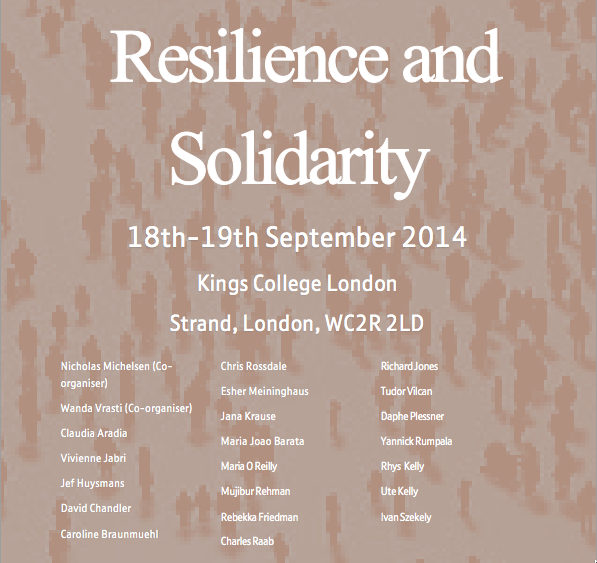
Between 19-21 September 2014, resident blogger Wanda and King’s College partner-in-crime, Nicholas Michelsen, organised a workshop with the theme of Solidarity & Resilience at King’s College, London. Before the special issue hits the stands, we have gathered for our readership a small forum of contributions to sample some of the hot topics discussed over that weekend. The organisers would also like to use this opportunity to thank all those who participated in the event. It was really a tremendous gathering that shattered many old ideas and made possible new ones!


Screen Shot 2015-01-07 at 13.34.02

As most good things happen, the “Political Action, Resilience and Solidarity” workshop was born over post-conference drinks. A few of us were musing over the proliferation of the term resilience at the 2013 EISA in Warsaw, when someone chimed in the concept’s obvious rival, solidarity. Had we forgotten about this term? Perhaps even declared it dead? The level of excitement grew and we just knew we had to organize an event about this strange pair. Exactly one year later, we met again at King’s College in London, with much appreciated support from the Open University and Westminster University, to unpack the hidden genealogies of these two concepts and muse over their possible associations/combinations.

We hosted panels approaching the matter from the perspective of political theory, conflict studies, governmentality and social movements. In almost every case, resilience appeared to be more malleable (sometimes infinitely malleable perhaps to its detriment and our suspiciousness), befitting contemporary challenges, and just plain… resilient. Solidarity, on the other hand, required complex theorizing, lacked a practical anchoring, was at times entirely absent from some panels, and made a strong comeback only on the closing roundtable thanks to the benevolence of some Marxists speakers.

Certainly, we would not want to do something as simplistic and rash as to declare a winner. Practices of solidarity would certainly benefit from a dose of resilience, and investments in resilience would certainly be a lot richer if they drew upon the latent democratic culture and transformative impetus of solidarity. But it was hard at the end of the two-day event to not feel like we had found ourselves on the threshold between two worlds. There is a great force pushing against the spirit of Enlightenment thinking, with its “enthusiasm for revolution” and its half technocratic, half romantic belief in human-led progress and perfectibility. That force is variously known as complex systems analysis, new materialism, flat ontology or the Anthropocene, all of which describe a connectivity-volatility-fragility nexus for which resilience emerges as the proper mode of action.

Continue reading

The Global Colonial 1914-18: A Public Roundtable

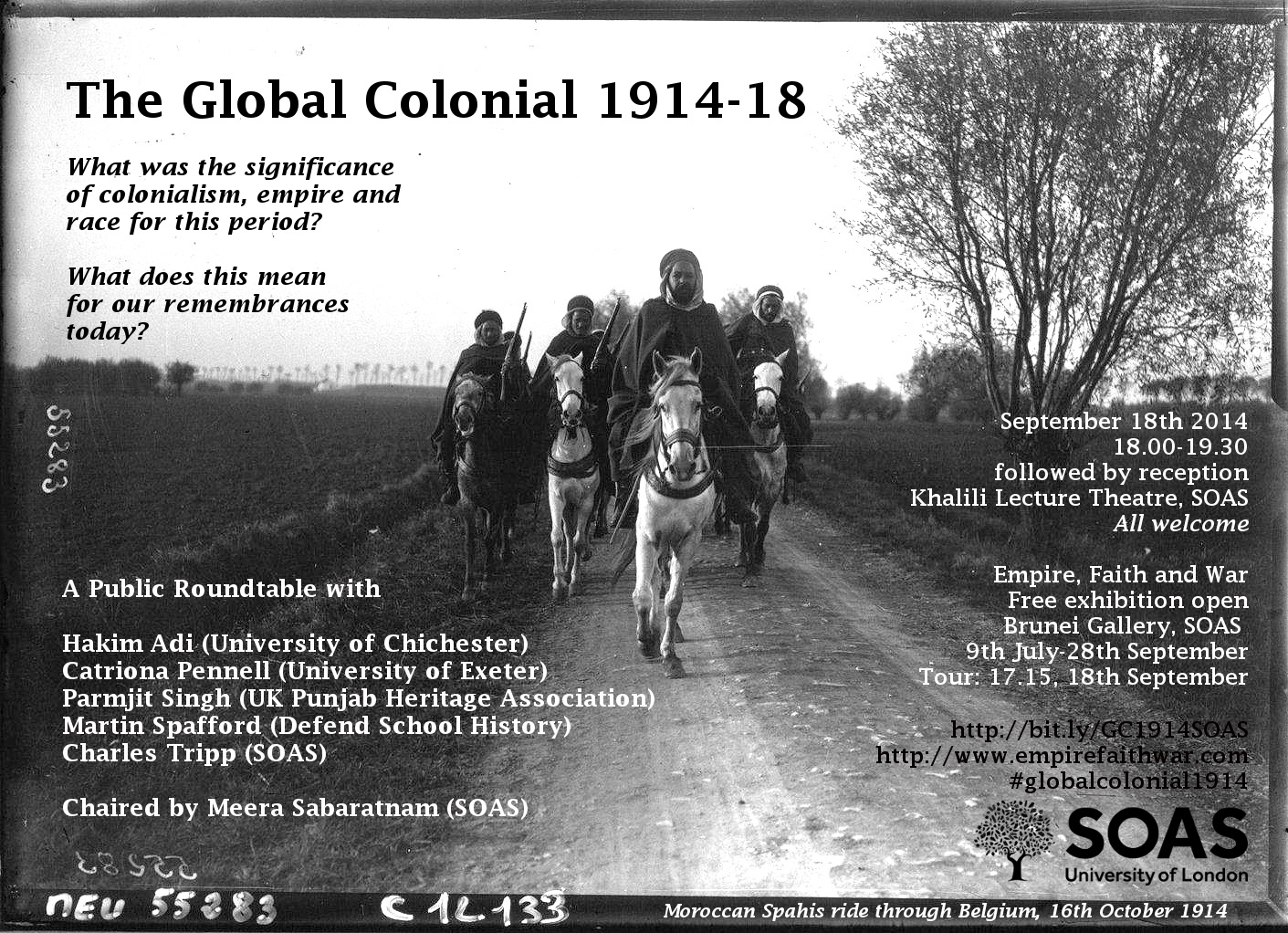
This is the fourth and final post in our series on The Global Colonial 1914-18, which is the video and transcript of the public event which took place at SOAS on September 18th 2014. Links to previous posts and the series as a whole can be found here. Many thanks to our speakers Hakim Adi, Catriona Pennell, Parmjit Singh, Martin Spafford and Charles Tripp for their contributions, as well as the audience for their incisive questions.

Global Colonial 1914 poster


M = Meera Sabaratnam

C = Charles Tripp

H = Dr Hakim Adi

P = Parmjit Singh

CP = Catriona Pennell

MS = Martin Spafford

M:       Okay. Hello, everybody and welcome. Thanks very much for coming. My name is Meera Sabaratnam, I’m a lecturer here at SOAS in international relations. And tonight we’re delighted to host a roundtable on the Global Colonial 1914-18. So obviously this is triggered by a number of contemporary events, not least the centenary of World War One, which you’ll have seen all over the news. But one of the stories I suppose, that gets told less often is the role of the wider world in the way that the war unravelled but also as a theatre of war. And in the place of where the war stood as part of the global context. So what else was going on, multiple revolutions, uprisings. So this is a moment in which the war is an important part of a global order which is undergoing substantial amounts of change. I should say this event is also sponsored…has been organised through the British International Studies Association and their working group on colonial, post-colonial and de-colonial research questions.

And this particular group tries to look at the elements of coloniality and colonialism in how the modern world came to be and what that means for when we understand globalisation and global history. I’m delighted to have a roster of speakers here tonight covering not just all of the sort of main areas, the regions that we’re studying in SOAS, namely Asia, Africa and Middle East. But also researchers and teachers who have been involved in how World War One is remembered in the classroom as a form of public cultural memory. Each of our speakers is going to speak for about 10 minutes. And then after that we’ll open it up for questions. Please do be forthcoming with your questions and we hope to have a good discussion afterwards, okay. I’d first like to welcome Professor Charles Tripp who is professor of Middle East here at SOAS. Thanks.

C:        Thank you very much, Meera. It sounds rather grand, I’m not the professor of Middle East, I’m professor of politics in the Middle East. But why not, grander? I was asked to talk today about the relationship between what was happening in the Middle East and what happened to the Middle East in and around the First World War. And I must admit straight off, I’m not a historian, so I don’t work on the first war particularly but clearly anybody who works in the politics of the Middle East is well aware of the fact that legacies of the First World War and what happened to the region are still very much there and indeed are being revived in the press in one form or another as they talk about Syria and Iraq at the moment. But what I wanted to really try and do is to pick out two themes if I can, in the time allotted. One is the notion that as with many other parts of the world, much was happening before the First World War that the First World War changed the course of, if you like. So in a sense one of the dangers of looking, which of course happens now to some extent in the press and elsewhere, is to see the Middle East purely as the Middle East as a political entity, whatever that is, as a kind of creation of European intervention, the First World War.

But what I’m trying to argue is that actually there were processes long before that that had been going on and that in some ways the European intervention set back in various significant ways that had an effect for the future as well. So the first part is really to think about what had been happening in the 50 years or so before the First World War in the region, we now think of as the Middle East, the Ottoman Empire, Qajar, Iran, North Africa. And I want to look at two themes which are intertwined but really revolve around the same emerging idea and notion which is the idea of the autonomous citizen, which again was quite a novel, a radical idea with hugely radical implications for the dispensations of power. But the two themes that they were intertwined with was, one, the struggle against despotism and the other, struggle against colonialism, both of these seemed to be deeply repressive of the idea of the autonomous citizen. And in some senses therefore what you’re looking at in the long…well, the period before the First World War in the 40 or 50 years, whether it’s in the Ottoman Empire, the Qajar Empire, Iran, in Egypt, you have a struggle against local despotism for constitutionalism. A precarious constitutionalism which is often of course therefore sabotaged by those who would rather not see it. But nevertheless very powerful in the mobilisation of the politics of these regions. Continue reading

Toward a Racial Genealogy of the Great War

dusan-bjelic-portretA second guest post in our series on The Global Colonial 1914-18 from Dušan I. Bjelić. Dušan received both his B.A. (1976) and M.A. (1981) in Sociology from the University of Belgrade and then earned his Ph.D in Sociology from Boston University in 1989, joining the University of Southern Maine Department of Sociology and Criminology in 1990. His area of interest is the colonizing application of psychoanalysis and psychiatry to the Balkans. Professor Bjelić co-edited Balkan as Metaphor: Between Globalization and Fragmentation with Obrad Savić (Cambridge, MA: The MIT Press, 2002). He has also published two books of his own: Galileo’s Pendulum: Science, Sexuality and the Body-Instrument Link, (SUNY Press, 2003) and Normalizing the Balkans: Geopolitics of Psychiatry and Psychoanalysis (Ashgate, 2011). His published works can be accessed at Academia.edu.


“Just as there is no wedding dinner without meat so there is no war without slaves.”

Serb soldier on the Balkan Front.[1]

A man was looking for something he had lost under the street lights; another man, the joke goes, approached and asked him what he was looking for. “I am looking for my lost keys,” “Did you lose them here?” “No,” the first man responded, “I lost them on the dark side of the street.” “But, why are you looking here?” “Because this is where the light is.” This joke illustrates well the paradox of the national paradigm in European historiography of the Great War. The assumption that the European sovereign nation is the sole agent of modern history naturally motivates European historiography to frame the Great War within a national paradigm and foreclose its colonial dimension. A related trope to the above joke pertains to race and its relation to the national histories of Europe; the black face of a slave, according to Frantz Fanon, can be seen during the night only under the porch light of the master, but when the slave goes into the dark his face becomes invisible. The deployment of colonial soldiers in the Great War as “warrior races” or, “martial races” to fight on behalf of their masters, and the absence of the Black history of slavery from the history of the Great War is in fact the history written from the master’s porch. While the invisibility of the black face foreclosed Black history from the national paradigm of the Great War, it was nonetheless useful as a racial weapon in the war.

By deploying almost a million non-white troops in the European theater of war—France’s 500,000 Africans and Asians, Britain’s 200,000 Indians and Africans, America 200,000 black soldiers, Germany’s 11,000 Africans (only in East Africa)—race was used as a “weapon of war” to advance an unprecedented slaughter among the white nations. [2] R. J. Vincent socked it to the revisionist historians when he wrote, “not only were the whites laying to rest the notion of their instinctive comity by butchering each other in such unprecedented numbers, but they were also showing their neglect of race in favour of nation in using non-white troops to advance the slaughter.”[3] Those historians committed to the national paradigm acknowledge the contribution of colonial solders in the Great War only as an auxillary force rather than as the point of the return of race as the constitutive violence of European Modernity. Many of the former slaves forcefully recruited and disciplined as racial instruments of forced labour, punishment and extermination became the site of colonial violence and operated as a microcosm for the War. The colonial soldier was the cause and the consequence of the Great War. Continue reading