What We Talked About At ISA: From #occupyirtheory to #OpenIR?

A write up of my comments at the #occupyirtheory event in San Diego. The event itself was both hope-filled and occasionally frustrating, not least for the small group of walk-outs, apparently ‘political’ ‘scientists’ lacking in any conception of what it actually means to engage in the political (note: this bothered me especially, but was a rather minor irritation in the grander scheme of things). Despite the late hour, there were between 40 and 60 people there throughout, and a number of very positive things have come of it. It looks like there’ll be some gathering at BISA/ISA to discuss further, and we’re pitching something for the Millennium conference on some of the themes addressed below, and there will of course be ISA 2013 too. In the meantime, there’s the Facebook group, the blog, and a mailing list. The term OpenIR is owed to Kathryn Fisher, and seems to several of us to be a better umbrella term for the many things we want to address in the discipline and the academy. I also just want to give a public shout-out to Nick, Wanda, Robbie and Meera for doing so much on this.


The #occupy practice/meme has antecedents. Physical manifestations of a ‘public’, horizontalism, prefigurative politics and more can be traced in all sorts of histories. One such lineage is the foreshadowing of Zucotti Park in recent struggles over education. Take the slogan in March 2010 over privatisation at the University of California, which was ‘STRIKE / OCCUPY / TAKEOVER’. Or Middlesex, where students resisting the dismantling of the Philosophy Department in that same year unfurled a banner during their occupation, one that proclaimed: ‘THE UNIVERSITY IS A FACTORY! STRIKE! OCCUPY!’.

I want briefly, then, to think about the space of the university in our discussions of #occupy. There have been rich and suggestive calls to re-politicise ourselves as academic-activists, to look again at our work and its claims, and to turn our abilities, such as they are, to projects of resistance and transformation. But we risk a displacement. When we talk of ‘the street’, or politics enacted in the reconfigured space of #occupy, or of the ‘real world’ that we must be relevant to, we already miss the university itself as that factory in which we labour. We are tempted by a view of ourselves as leaving ivory towers to do politics, instead of seeing those towers themselves as spaces of politics. As if our institutions and practices were not already part of the world.

Whether you see #occupy as transformational or nor, or whether you simply prefer a different vocabulary, I think a demand remains: a demand to politicise our own positionality. This politicisation can have many dimensions, but I want to suggestively highlight four, each being a sphere in which we should be diagnosing and transforming our own practices.

Continue reading

#occupyirtheory, International Studies Association (San Diego) Edition

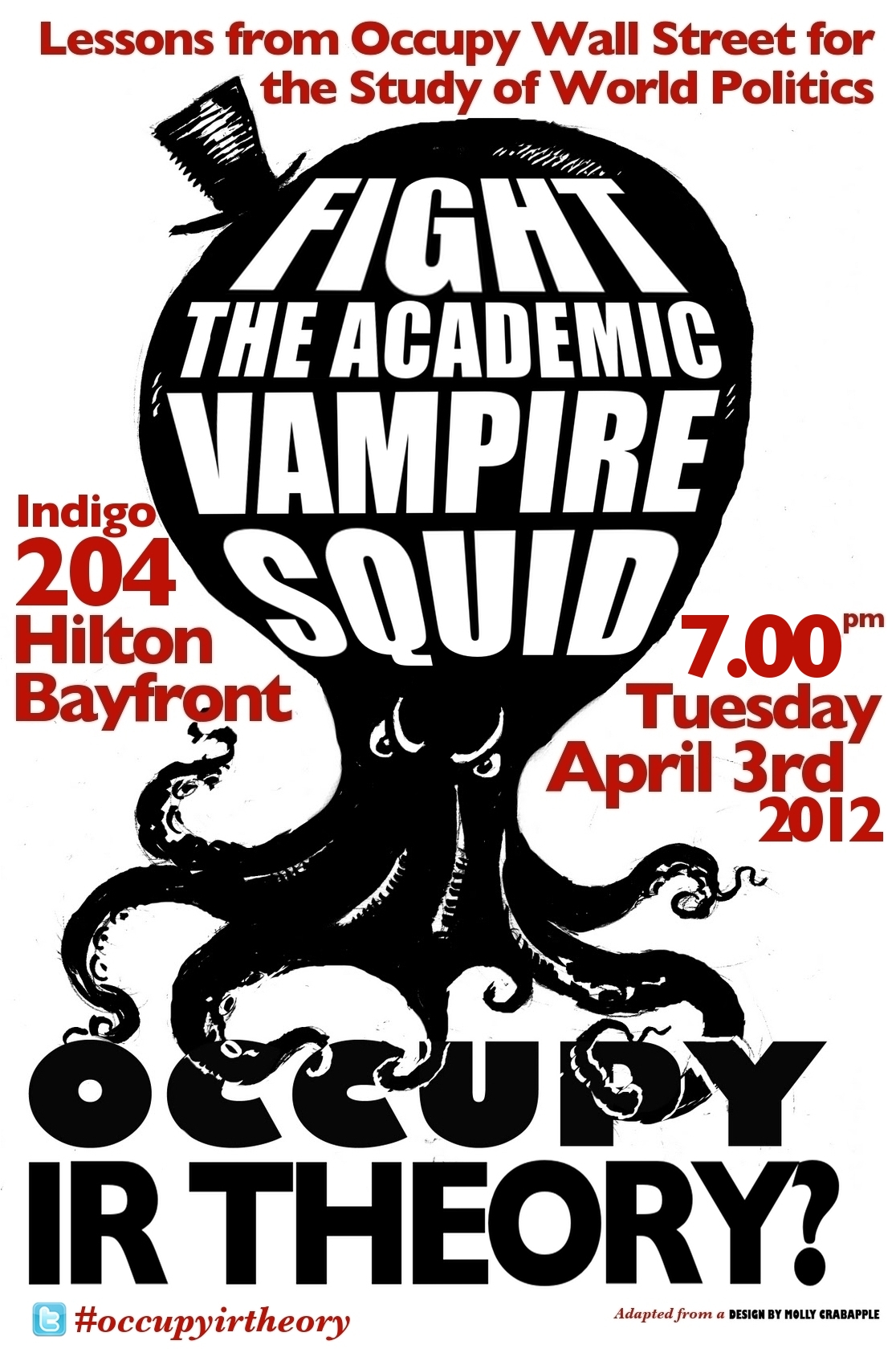
ISA 2012 is just around the corner, and it will doubtless be as hectic and awkward and joyous as ever. Robbie and I will be appearing at an event on #occupy and its relevance for IR on Tuesday at 7 in Indigo 204 at the Hilton Bayfront. We’ll be joining Lucian Ashworth, Lara Coleman, Nicholas Kiersey and Wanda Vrasti (all chaired by Jason Weidner) for what I’m sure will be an exciting roundtable discussion. More importantly, it will be brief, with most of the session given over to a General Assembly-style discussion of what IR can learn from #occupy, what #occupy might get from IR, and how we might take the spirit and organisational form into the discipline itself (or not).

The hope is that the slightly later starting time will allow people to go both to the various Section receptions and meetings (briefly) and to come to this, whilst still leaving reasonable evening time for food and the rest. Please do get involved over at Facebook (see also the #occupyirtheory group and #occupyirtheory blog) and let interested IR-types know. Readers may also be (should also be!) interested in a recent forum from the Journal of Critical Globalisation Studies on ‘Occupy IR/IPE’, featuring Nick and Wanda (as well as Colin Wight, Michael J. Shapiro, Patrick Jackson and others), which I’ve parcelled together as a single pdf for your delectation here.

Hope to see you there!

Call for Contributions: The Global Political Economy of the 1%

Tim Di Muzio (Wollongong) is putting together an edited volume on The Global Political Economy of the 1% which Disordered readers might be interested in contributing to. The full call is here. Abstracts of 250 words or less are due by 30 April 2012 with first full drafts by 1 November 2012. Tim can be emailed with submissions or for more details here.

While the internationalized Occupy Wall Street movement faces many strategic and organizational challenges, one of its major accomplishments has been its ability to draw global attention to the massive disparity of income, wealth and privilege held by 1% of the population. Such attention comes amidst a relatively synchronized global financial crisis, a mounting first world debt crisis in parts of Europe and the United States and the intensification of neoliberal policies. While political science and sociological study has shed light on elites and the wealthy in the past, with some recent popular exceptions, there has been a dearth of research on the culture, politics, built environments and psychology of the global rich in the new gilded age.

To redress this gap in the literature, this edited volume calls for a more focused and engaged study on what could be called the global political economy of the 1%. Such a project could help shed light on the massive chasm between this elite class of wealth holders and the rest of the global working class – the majority of whom subsist on less than US$2 a day and increasingly live in informal settlements as the dialectic of dispossession and urbanization continues its historical dance. Of course, it should be emphasized that a global political economy of the 1% does not preclude (and nor should it) the unavoidable social relations between the 1% and the 99%. However, recent literature has already enriched our understanding of how poverty, unprotected workers, and the everyday life practices of the seemingly mundane impact upon the wider global political economy. So a keen, yet nonrestrictive, focus on the political economy of 1% and the global income/wealth hierarchy is welcome.

All abstracts will be accepted and reviewed with sincerity. Selections for inclusion in the volume will be evaluated on the basis of original content, coherence and consistency with the general theme as well as the necessity of creating coherent sub-themes. Sub-themes are suggested here to organize research questions but are not necessarily the themes of the volume (contingent upon contributions).

Topics and questions that could be addressed in such a volume include but are not limited to the following: The Usual Suspects: Identifying the 1%The Social Reproduction of the 1%; Culture, Consumption and the 1%; and Power, Resistance and the 1%.

Precarity Everywhere

A recent piece by Michael Bérubé highlights one of the invisible problems of higher education in America (and elsewhere) – namely, the rise of the adjunct as the hegemonic form of the modern day academic. This is in both a qualitative way (with flexibility and monetization becoming some of the prime measures for every academic), but also in a quantitative way (Bérubé cites data that shows more than 2 out of every 3 faculty members are now contingent workers).

While American political discourse often portrays academics as highly-paid, impossible-to-fire liberals, the data in fact shows virtually the opposite (though admittedly academics are likely disproportionately “liberals”). Increasingly the expectation of graduate students leaving university is that:

(a) an academic position will be incredibly difficult to find (I have numerous anecdotes of friends applying for hundreds of jobs and only getting 3-5 interviews, let alone job offers)

(b) when a job is found, it will be contract work

(c) when a job is found, it will involve the workload of a full professor

(d) when a job is found, it will pay 20-75% of a full professor’s salary

(e) in a year (perhaps longer depending on the contract), this process will be repeated

Continue reading

Rewriting International Relations

A small cascade of Millennium-related news and IR from Elsewhere. First, our very own Nick was recently elected as Co-Editor (with Edmund H. Arghand and Maria Fotou) to oversee the journal for Volume 41 (2012-2013) on the basis of a conference proposal on ‘Materialism and World Politics’ (full CfP details forthcoming soon). Second, the Millennium blog has had a facelift (ongoing tweaks to be made to its façade), so go have a look.

Third, and perhaps most importantly, the Northedge Essay Competition is now open. So if you’re a post-graduate student (PhD or advanced Masters) in IR or cognate fields, and you have some exceptional work lying fallow, spruce it up and submit. The deadline is 30 January 2012, and the winning essay will appear in Millennium 41(1). Previous winners have been very good indeed.

Fifth, the journal’s social media tentacles are growing, so do the following thing on Twitter and the liking thing on Facebook, if you are of that bent. Finally, a reminder that Millennium‘s weekly Editorial Board meetings are open to all LSE postgraduates (MSc and PhD) who are engaged and interested. If you fit that description and for some reason aren’t already involved, do email the Editors for details.

Elsewhere, BISA’s Historical Sociology and IR Working Group also has a new look, and a particularly awesome and growing resources page. And there’s now an Occupy IR Theory blog and associated hashtag (#occupyirtheory, natch), which is worth both a virtual engagement and a flesh-world contribution. Similarly, if for any reason you are unaware of David Campbell’s blog on visual culture and international politics, rectify yourselves!

Has the Left given up on Economics?

With the biggest economic crisis since the Great Depression continuing to slowly unfold, one of the most surprising consequences has been a non-event: the dearth of high-quality economic theorizing in leftist groups. [1] This is in spite of the opportunity the crisis presents for alternative economies, and in spite of the economic conundrum that developed economies find themselves in: too indebted for stimulus and too weak for austerity. This differend between austerity and stimulus indexes the insufficiency of either and yet few have taken up the necessity of thinking proper alternatives.

The leftist response to the economic crisis has instead been mostly been to focus on piecemeal reactions against government policies. The student movement arose as a response to tuition fee and EMA changes; the right to protest movement arose as a response to heavy-handed police treatment; and leftist parties have suggested a mere moderation of existing government policies. The project to bring about a fully different economic system has been shirked in favour of smaller-scale protests. There is widespread critique, but little construction.

Admittedly, the left is not entirely devoid of high-level economic theorizing. Rather, the more specific problem is that those few who do such work are a relatively tiny minority and are typically marginalized within the leftist scene. The attention and effort of the leading intellects of leftism (at least in the UK) are on social issues, race issues, rights issues, and identity issues. All important, to be sure, but there is no equivalent attention paid to economic issues.

Continue reading

On the Abstraction of Contemporary Crisis

On the Abstraction of Contemporary Crisis
Or, Why Today Feels Different From the 1930s

One of the oddities of the ongoing economic crisis is its apparent separation from everyday life.[1] Consumers still consume, luxury items are still produced. Starbucks is still filled with coffee drinkers, and Apple still sells its overpriced goods. Scanning the media, one finds its coverage devoid of lengthy soup lines or surges in tent cities. While most have had to cut back on their indebtedness, there hasn’t been a collapse on the scale of the Great Depression. This is in spite of some measures suggesting the current crisis is as deep in some ways.


Continue reading

Primitive Accumulation; Or, A Virtual Read-In on the London Riots

The blogosphere has a million corners, countless nooks and several large echo-chambers, complete with their own centres of self-congratulatory gravity. All have been aflame over the last week, saturating events, riots and insurgencies with the weight of historical expectation, the political memory of past iteration and the awesome condescension of easy interpretation. Gaps persist: gender and the dynamics of formally opposed masculinities have escaped all but the most cursory attention. It is one paradox of all this profuse commentary that decrying the statements and manifestos of others is the most satisfying and patronising manifesto of all. At its worst, it engages in the fullest of narcissisms (let’s make this about us and the quality of our analysis) whilst proudly displaying its contempt for thought (now is not the time for theory!). And of course, the problems and challenges are real. Much more real than we can face, too real for the sordid postures of moralising (I denounce Satan and all his works!) and liable to stay as real once we paper over them and return to our default settings.

Oh, and I find myself in unsurprising agreement with Joe and Meera (although I think Ken Livingstone’s attempts to make the link to cuts and social marginalisation is more ham-fisted than shameful). Which is all by way of introduction. There are reams to be written on the way the punditocracy and assorted commentariat are deploying (and misapplying) categories of cause, the unstable and multiple uses made of ‘politics’, the questions of historical precedent and historical return, and on and on. Exhaustion at the war of position prevents any such post. Instead, a mix-tape of diagnosis and critique, with both the smooth joins and the subtle dissonances that implies. More useful than a 1,000 faux-fresh words.

—————–

These looters are doing what they’re supposed to; grabbing the goods they see in the shops and can’t buy in a recession. They loot the bling – the sports shoes, gold watches, mobile phones and plasma TVs; and you can recognize the very poor when you see a woman looting potatoes from a corner shop. These acquisitive looters are certainly copying the gold standard of a social contract eroded by and evaporating with the money. These are riots in the cause of consumer goods. Burning and robbing other people’s things is one thing, but soon enough, and with no social cause or justice worth the name, people too become indistinguishable from things: witness the widely-circulated photo of the woman leaping for her life from a burning building; such potential deaths still threaten to bring the house down on top of us. This whole distressing episode began with the police shooting dead a black man in north London they said was a gunman; no evidence he fired a shot, we’re told, but the man was already indistinguishable from his gun.

Gabriel Gbadamosi, ‘The Blazing Light In August’

Continue reading

Reading violence: what’s political about the London riots(?)

To reiterate somewhat, there is a politics to these riots. Panicking, political leaders and many others, have queued up to deny this, labelling it “pure violence,” “criminality, pure and simple“, or “mindless violence“. Over and over again, the distance between the rioters and the ‘community’ or ‘Londoners’ has been set up and reinforced. This is not without some public backing. After all, many Londoners are, rightly, angry, frightened, upset, frustrated, shocked and saddened by the sight of homes and businesses not just smashed but burning voraciously into the night whilst looters showed off their new gear. We were a world away, it seemed, from the specific, dignified, coherent demands for justice being made by Mark Duggan’s family and their supporters. Many asked themselves: what do they want? The answer seemed to be: trainers. What could be political about stealing from Foot Locker?

First things first. This post is not about constructing a narrative of social apologia via moral determinism – i.e. the idea that people couldn’t help themselves, or were bound to do it by their economic status etc. Between this and the ‘mindless violence’ line of argument, there are plenty of fools (sadly many, powerful, wealthy, and in charge of your country) trading in pretty stupid accounts of human behaviour and social causation. Continue reading

The Politics of Austerity: Emergency Economics and Debtocracy

austerity |ôˈsteritē| noun – sternness or severity of manner or attitude
It was possible, therefore, to commit a sin without knowing that you committed it, without wanting to commit it, and without being able to avoid it. Sin was not necessarily something that you did: it might be something that happened to you.

– George Orwell, “Such, Such Were the Joys”

Why what have you thought of yourself?

Is it you then that thought yourself less?

Is it you that thought the President greater than you?

Or the rich better off than you? or the educated wiser than you?

 I do not affirm that what you see beyond is futile, I do not advise that you stop,

I do not say leadings you thought great are not great,

But I say that none lead to greater than these lead to.

– Walt Whitman, “A Song for Occupations,” Leaves of Grass

The Politics of Austerity – Part I

This is the first in a series of posts that look at the political implications of the ongoing global economic crisis. I begin by examining the way that crisis is being used to attack the very idea of democracy through an assertion of the political imperatives of “the market” and the violation, bending and re-writing of the law by capitalist elites. I conclude by laying out how understanding the economic crisis in political terms shapes our ability to respond to it.

In the second post I’ll look at the ethos of austerity, which justifies the pain inflicted on largely innocent people, while suggesting that an affirmative democratic response to the economic crisis must begin with its own ethos, which I suggest should be an ethos of care for the world – which can provide orientation and inspiration for political struggles seeking to address the deeper causes of our current crisis. In the third post, I turn to the structures of the economy and of politics that define the current crisis, looking at the banking crisis, the bailouts, the politics of recovery/austerity and also reflecting of the structural imperatives of capitalism that led us to crisis. This, then, leads to the question of how to respond to the politics of austerity, and of what alternative actions are available to us, which is where the fourth and final post will pick up – with an affirmation of a caring ethos that supports a radically democratic economic vision.

Emergency Economics

In a previous post I briefly highlighted Bonnie Honig’s work, Emergency Politics, to examine the way that the ethical case for austerity is made; most basically, the existence of a supreme emergency, in this case economic, justifies actions that would normally be considered unacceptable. Honig’s work looks at how the appeal to emergency is used to reassert the exceptional political power of the sovereign over and against the law, with a focus on the reassertion of sovereignty witnessed over the past ten years in response to the threat of terrorist attack in the US and Europe.

Rather than accepting the necessarily intractable conflict between the power of the sovereign and the power of the law, Honig attempts to deflate this paradox by turning her attention to the always ongoing contestation that defines democratic politics, a contest over both the content of the law and the institutional embodiment of sovereign power. She suggests, then, that attending to the ambiguities of the “people”, who are both the democratic sovereign and a diffuse multitude, as well as the political element in the law – as new laws come into being through political action – enables us to avoid thinking about emergencies as moments of exception in which the rule of law is lost to the play of political power, while also acknowledging the limits of established law in moments of profound crisis. By undermining the exceptional nature of crises and emergencies Honig alters the challenge we face when circumstances force us to make choices or carry out actions we know are harmful and wrong by asking what we (democratic publics and citizens) can do to survive an emergency with our integrity in tact.

What do we need to do to ensure our continuity as selves and/or our survival as a democracy with integrity? Our survival depends very much on how we handle ourselves in the aftermath of a wrong. We will not recover from some kinds of tragic conflict. But when faced with such situations, we must act and we must inhabit the aftermath of the situation in ways that promote our survival as a democracy.

I continue to find this a useful way to understand our current economic crisis. Appeals to austerity depend upon the exceptional state created by crisis in order to justify the pain inflicted upon masses of people and the priority given to private interests (the markets, investors and bankers) over democratic publics. So, as democratically enacted laws must bow before the sovereign power threatened by exceptional attacks, so economic justice and democratic equality must bow before the commands of market forces, of economic inevitability, in this time of crisis.

The economic version of this argument is stronger still. While the space of political contestation that remains open when we accept the framing of emergency politics is limited, it does exist in the clashing of opposing sovereigns. The prospect of a substantive alternative to neoliberal economic ideology is dim, a light flickering weakly on antiquated appeals for a return to Keynesianism or watered down triangulations of the moderate-middle that sell off dreams of a just economy bit by bit – capitalist realism in action.
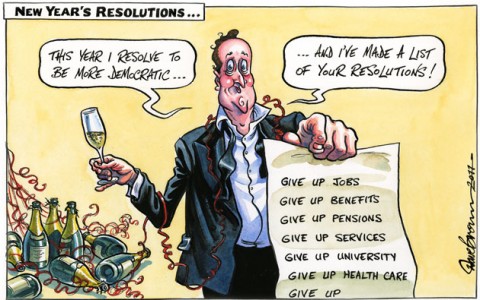
Honig awakens us to an important aspects of our current crisis: that “the market” is not in fact supremely sovereign, and the move to re-establish and further neoliberal policies and push through austerity measures requires an engagement in democratic politics – albeit one that undermines the notion of the public itself and seeks to use the power of the law to subvert democracy. Recognising the current crisis in these terms not only challenges us to consider how to survive our current troubles without giving up democratic virtues, it also reinvigorates and clarifies the political challenge we face. Emergency economics – with its assertion of debtocracy over democracy – is not an inevitable response to the crisis, it is a political one that we can, and should, fight against.

Continue reading