Obama’s Ohio Report

My Ohioans did it again.  In every election since 1964 (and almost every time since 1904), the winner of this state ended up taking the presidency – hence the clichés “America’s bellwether” and “as Ohio goes, so goes America”.  Having spent six years of my life studying politics at The Ohio State University not so long ago, I can’t help but identify and sympathize with Buckeye voters, a group of people that every four years gets to decide the fate of the U.S. and, some might add, the world. This is a heavy burden for many reasons, including being exposed to the fanfare of presidential candidate fly-ins (82 of them this time), thousands of attack-counterattack TV ads (that typically target only “undecideds” and/or “independents”), as well as dozens of phone calls and door knocks reminding you to get out and vote for the right person (in the final week of the 2008 campaign, Team Obama said it knocked on a million Ohio doors per day).

The phrase “key battleground state” that every news outlet likes to attach to Ohio refers to its electoral-college vote clout (the 2010 Census reapportionment gives it 18 votes until 2020) as well as its recent record in presidential elections, which is marked by small margin-of-victory numbers (4.6 percentage points in 2008, 2 in 2004, etc.). The state has a remarkable red-blue balance overall; since 1998, the state voted for three Democratic and three Republican candidates each). Also remarkable were the results of pre-election state polling in October, which showed a tied (or at least tightening) race between President Barack Obama and his GOP challenger Mitt Romney (see, for example, the discussion of the RCP poll of polls from 30 October).

To be sure, electoral pathologists – those friends of yours obsessing about assorted ‘paths to presidency’ – had probably explained to you that each candidate could have won an electoral majority without Ohio (e.g. Obama would have had to grab one or two bigger states considered tossups plus all reliably blue states, and Romney would have had to hold onto all normally red states while pulling off multiple upsets elsewhere). This type of electoral math is both fun and fantastic, but reason tends to swiftly restore the status quo ante: it’s all about “Ohio, Ohio, Ohio!

Tuesday’s drama ended right after 11 pm Eastern Time, when the news organizations called Ohio for Obama; less than two hours later, Romney conceded the race.  To examine this outcome, let us begin with two issues identified by the media as key to this election: the auto and coal industries, and the thousands of jobs each of them provides to the state. (Compare, The Globe and Mail’s Ohio postcard of 25 October or The Economist of 27 October to the endorsement editorials in The Columbus Dispatch [Romney], The Cincinnati Enquirer [Romney], The Plain Dealer [Obama], or my favourite OH newspaper, The Blade [Obama]). In a nutshell, while some Ohioans liked what the president did with the former (that 2009 bailout of GM and Chrysler helped the manufacturing sector in the northern part of the state), others hated what he did with the latter. (Being viewed as too green on energy was expected to hobble Obama’s re-election chances in the coal-mining counties of the Appalachian part of the state).
Whatever the explanatory merits of simple storylines like these, unofficial returns bear this one out. The website of Ohio Secretary of State’s office has Obama winning by about 2 percentage points, which is lower than in 2008. The president indeed carried the populous Cuyahoga County (centered on Cleveland) plus a string of smaller counties in the northeast by sufficiently large margins, while Romney won large parts of the coal country.  What went on elsewhere in the state was more important, however. Though Romney ran strong in most traditionally Republican rural areas, he severely underperformed in the remaining half dozen big urban counties, which account for almost 40% of the statewide vote. Even Hamilton County (Cincinnati), historically a GOP bastion, went to Obama by about 20,000 votes again. (For the county-by-county comparisons over time, see Rich Exner’s page at The Plain Dealer; U.S. politics junkies might also consult a map of the 2008 precinct-by-precinct results provided by Stanford’s Spatial Social Science Lab).

Demographically, Obama probably carried the state in the same manner as he did four years ago.  How many Ohioans voted will not be known until late-arriving absentee ballots and provisional ballots are counted, but the turnout (about 68%) can safely be described as well above average. This surely helped the president: by getting its base to register and ballot (including via early in-person voting), the Obama campaign succeeded in maximizing Ohio’s Democratic potential once again (against a stream of ‘voter fraud’ legislation targeting qualified minority voters). What exit polls seem to be suggesting is that the president bested his challenger among female, young, college-educated as well as minority voters.  And what of Ohio’s white working class males (those without a university degree), who sit at the center of any “annoying, all-purpose pet theory” of U.S. presidential elections? Here, it appears that the president succeeded in avoiding a large margin of defeat, and it will be interesting to see why. The success in capitalizing on Romney’s casino capitalism sounds like a plausible hypothesis (and a nice extension of the auto bail-out storyline); but let’s recall that in 2008 Obama won 56% of votes from union households, which was lower than the national average.

What about the role played by ‘non-fundamentals’, specifically Obama’s race? Estimating this particular effect is challenging at any level of analysis, but both survey-based and non-survey-based studies have suggested that in 2008 Obama lost about 5 percentage points of the national popular vote due to racial intolerance on the part of some voters. A meaningful decline in this number would be my candidate for a feel-good story of the 2012 election.


Note: Cross-posted at the CIPS Blog, and meant to be read in conjunction with “Pre-Election Facebook Rants, #652

Pre-Election Facebook Rants, #652

Posted without comment; thanks James Sadri.

<rant> What I used to dislike about the Iranian elections is what I dislike about all national elections today: they’re all fake. There is a choice but it’s not a meaningful one. With the Iranian elections the argument would be: Ahmadinejad or Karroubi/Mousavi, it doesn’t matter, the real power is with Khamenei the Supreme Leader. So you can elect the Iranian President but you can’t elect the Supreme Leader. Well that’s the situation we’ve all got today, even in the US. There is a Supreme Leader casting a long shadow over every national ‘democratic’ process. You can vote for Obama/Romney, Cameron/Brown/Clegg – whoever – but those are all fake choices, where you’re always choosing between the lesser of two evils, never for the world you really want. You can’t vote to stop 20,000 kids dying today because of lack of access to clean water. You can’t vote to stop all war. You can’t vote for people to have the same freedom of movement regardless of where they’re born. You can’t vote to stop extreme disparities of wealth. You can’t vote to stop climate change. That’s because if you do any of these things at the national level you’re shooting yourself in the foot. Increase labour protection or environmental regulation and the factories and cash will go to our enemies. Increase foreign ‘aid’ and it means less for our struggling people. Try to cap carbon emissions and you’re killing business competitiveness. Our Supreme Leader is national competition. We sacrifice the societies we really want to build – peaceful, harmonious, more equal ones – for violent dysfunctional ones that are hopefully slightly richer than those across the map lines. Nobody seems to question the race to the bottom – we seem only to be focused on being the fastest zombies. The world has globalised yet our politics remains pitifully – pathetically – parochial. So while I’ll be hoping that Romney doesn’t win tomorrow, I’m going to remember that there’s a Supreme Leader out there who’s pissing on all your national elections. And he doesn’t have a beard. </rant>

Female Terrain Systems: Engagement Officers, Militarism, and Lady Flows

One of the more interesting interventions made at Friday’s Gender, Militarism and Violence roundtable came from Vron Ware on the topic of a photo exhibit about the British Army’s Female Engagement Officers. The exhibit is funded by the Poppy Appeal, which was itself subject to some debate as a sentimental memorialism allocating funds in the service of a imperial-nostalgic self-image. The pictures, collected by a female former RAF Sergeant, are presumably understood by military and civilian leaders to be a significant public relations resource in illustrating the flexibility, equity and decentness of Anglo-American-Western ‘involvement’ in Afghanistan. Manifestations of cultural sensitivity, postfeminist integration and armies as state-building reconciliation services. And yet someone decided, both on the Army website and Twitter account, that the best image to lead with was that of knickers on a washing line. A puerile social media engagement.

The rest of the images, and the media coverage of them, focus heavily on assorted ‘personal’ issues experienced by the women. Gaze on their beauty products! See how they control their lustrous hair! Peak in on their need for mementos of home! Marks of difference indeed, although none of the coverage I have seen broaches the possibility that men too might stash deodorant in their tents, or manage their body hair to maintain professional standards, or display reminders of loved ones waiting at home. Instead, as any gender-sensitive observer might expect, the specially femininity of these troops displaces all other dimensions of war/peace/development/security (an impression encouraged by some of the subjects themselves). The BBC even recently juxtaposed the death of a female army medic with an image of another woman coming out of the shower tent. A soft voyeurism on military women as leaky bodies and as somehow out of place. But not just that. The juvenilia comes packaged together with the idea of the Female Engagement Officers as crucial to a kind of military effectiveness:

Captain Crossly told the London Evening Standard that one of the highlights of the tour was ‘seeing the absolute fascination of women in the compound when I removed my helmet and protective glasses to speak to them in their own language’.

She added: ‘Women are known throughout the world to bring people together, to focus on family and community. Just by being female, even in military uniform, you are seen to promote such things and are therefore more accepted.’

Lieutenant French said: ‘The photographs demonstrate the more feminine traits of female soldiers can be used as a strength on operations.’

Continue reading

Fratriarchy, Homoeroticism and Military Culture

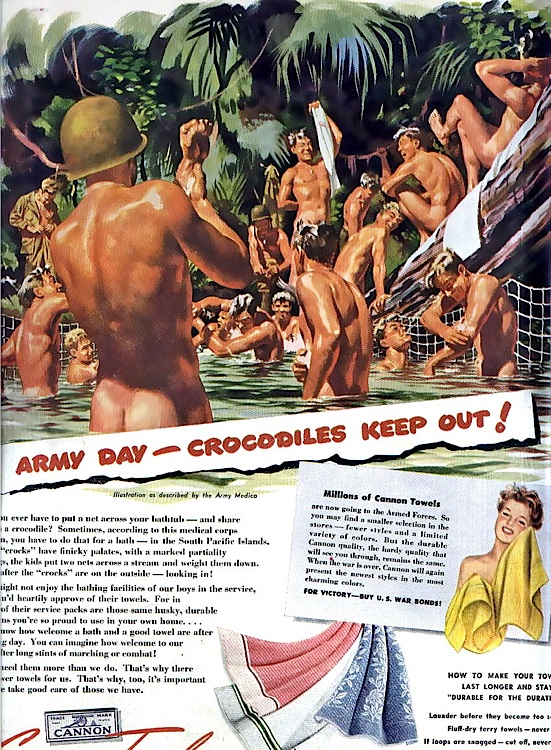
The ever-excellent Sociological Images offers up this 1940s advert, and others like it, as an example of how images previously taken to be innocent consumer bait for stereotypical homemakers now appear to us as dripping with homoeroticism. They may have added too that this half-ironic, half-nostalgic distance is what endears us to such images, which we then enjoy as vintage objects, for all that we know about the true historical context in which they were produced.

One common idea, which relates nicely to military bathing aesthetics (cannon towels? really?) is that many bonding behaviours in nominally heterosexual, male-dominated groups are in fact homosexual, but in a disavowed or repressed way. The scrum, the shared shower, the bunk-beds, the exclusion of women not only from the fields of play and war, but also from the various celebrations and carnivals that follow, all seem to indicate a desire for intimacy that cannot be named as such.

In the excellent Bring Me Men (which deserves its own dedicated review), Aaron Belkin identifies a more complex relation. In becoming military men, there is a need not only to disavow femininity, but also to become intimate with the ‘unmasculine’ and the ‘queer’. Rather than identifying a direct alignment of the masculine with the military, or seeing gender norms as accidental in their intersection with the military, there is instead a constitutive tension between the masculine and the unmasculine (or, we might say, between the strongly heteronormative and the homosexual). Basic training relies on a traumatic ambiguity, continually casting initiates as by turns masculine and unmasculine, so that no soldier can ever be sure that they were sufficiently on the ‘right side’ of the line. As one Marine put it: “The opposite of feminine? No. To me, what is masculine? I don’t know. [pause] And I’ve worked so hard at being it”. The continual ambiguity – what Belkin calls discipline as collapse – interacts with surveillance and punishment to produce the soldier-subject.

More brutally: Continue reading