How Many Buddhists Are There in Northern Ireland?

Danny Boyle’s Olympics opening extravaganza was many things, but one thing it was not was a history lesson. If you were looking for any acknowledgement of the place of empire in the British national narrative, you would have had to concentrate quite ferociously during the hauntingly beautiful Abide With Me section, sung by Emeli Sandé, to see Akram Khan’s dance troupe mime the whipping of slaves (1:21:04 into the BBC’s coverage of the event). It’s possible that I simply imagined this because I was looking so hard. Anachronistically, moments before, Empire Windrush had arrived on stage, without context, like a Caribbean cruise ship blown off course (Columbus revenge). Two moments that you would have missed if you’d blinked, leaving you mystified about how the opening ceremony, Team GB, and indeed Britain itself had become such a multiracial spectacle.

In the reams of mostly laudatory commentary that has followed the ceremony, some have suggested that it might not have been appropriate to stage imperial conquest and plunder on an occasion that was meant to welcome the world to London. The insinuation that opening ceremonies should be mind-numbingly ‘fun’ is belied precisely by what made this one meaningful. Boyle deserves credit for trying to do history—any history at all, however potted—and indeed what makes his exclusions telling and problematic was precisely the emotional depth and maturity with which he was able to stage historical trauma (the Industrial Revolution, the World Wars, 7/7) and individual vulnerability (children in hospital, the references to children’s literature evoking the darkness of growing up) without detracting from the spirit of celebration. Yet some traumas are clearly easier to commemorate, some dead easier to remember, than others. Boyle’s history was curiously blinkered, resolutely domestic, almost wilfully blind to anything that happened outside this ‘green and pleasant land’. (An alternative potted history entitled ‘How to Keep Your Land Green and Pleasant’ might read ‘Step 1: export surplus population, preferably of the lower orders, preferably to places quite far away; Step 2: export dirty industries; Step 3: repeat step 2 for as long as you are able to.) The problem may have begun with the title—Isles of Wonder—that foreshadowed the geographically circumscribed view of history with which we were presented. Indeed the extraordinary, infuriating and continuing dilemma of British identity is that only the cultural right does geographical justice to Britain’s role in forging the modern world, albeit in registers of racism and supremacism. If Boyle’s historical imagination is anything to go by, the left, it would seem, prefers amnesia.

Continue reading

The End Of IR Theory As We Know It…

A guest post on the state of International Relations from Felix Berenskoetter. Felix is Lecturer in International Relations at SOAS, University of London. He holds a PhD from the LSE and works on theories and concepts in IR; politics of space and time; critical approaches to European Security, and dynamics of friendship and estrangement in transatlantic relations. Felix has published articles in various journals, is a former editor of Millennium and co-editor of Power in World Politics (Routledge, 2007). He is also co-founder and current chair of the ISA Theory Section.


In case you missed it, recent ISA and BISA conferences saw panels contemplating whether ‘IR Theory’ has come to an end. This question, posed by the editors of EJIR, was discussed by a range of distinguished scholars whose answers ranged from ‘yes’ to ‘no’, in the process reflecting on the meaning of ‘theory’ and ‘end’. While state of the art exercises can be tiring, the contributions will be worth reading when they appear in an EJIR special issue later this year.

Yet I could not help wondering what the answers would have been had the panels featured not established professors, but junior scholars at the start of their career. Indeed, would it not be more adequate to have the latter group engage this question? After all, they tend to be the ones teaching introductory IR courses, which are expected to give an overview of theoretical arguments and debates. And they enter the profession with a significant research project under their belt (the PhD), which informs their first wave of publications and likely influences future projects that will shape the field. So what does that generation think of ‘IR Theory’? What theories and what kind of theorizing is prevalent in their teaching and writing? Continue reading

Flag-waving And Drowning: On The New Branding Policy Of UKaid

They say that discretion is the better part of valour. But DfID, or at least its boss, has decided otherwise. It was announced last month that “Aid from Britain will now be badged with a Union Flag when it is sent overseas, as a clear symbol that it comes from the United Kingdom.” In these times of urgently, relentlessly celebrating Britishness in all possible ways, this little ‘tweak’ to development policy may have slipped under the radar.

The ministerial statement in the press release is worth quoting in full, because it is both strange and revealing of a particular – and, I think, regressive – political turn in international development policy:

“For too long, Britain has not received the credit it deserves for the amazing results we achieve in tackling global poverty. Some in the development community have been reluctant to ‘badge’ our aid with the Union Flag.

“I disagree: I believe it is important that aid funded by the British people should be easily and clearly identified as coming from the UK. It is right that people in villages, towns and cities around the world can see by whom aid is provided.

“British aid is achieving results of which everyone in the United Kingdom can be proud. And I am determined that, from now on, Britain will not shy away from celebrating and taking credit for them.” Continue reading

The Lost Empire

News of Pankaj Mishra’s upcoming LSE talk on the ruins of empire made me think of Derek Walcott’s  poem:

THE LOST EMPIRE

I
And then there was no more Empire all of a sudden.
Its victories were air, its dominions dirt:
Burma, Canada, Egypt, Africa, India, the Sudan.
The map that had seeped its stain on a schoolboy’s shirt
like red ink on a blotter, battles, long sieges.
Dhows and feluccas, hill stations, outposts, flags
fluttering down in the dusk, their golden aegis
went out with the sun, the last gleam on a great crag,
with tiger-eyed turbaned Sikhs, pennons of the Raj
to a sobbing bugle. I see it all come about
again, the tasselled cortege, the clop of the tossing team
with funeral pom-poms, the sergeant major’s shout,
the stamp of boots, then the volley; there is no greater theme
than this chasm-deep surrendering of power
the whited eyes and robes of surrendering hordes,
red tunics, and the great names Sind, Turkistan, Cawnpore,
dust-dervishes and the Saharan silence afterwards.

II
A dragonfly’s biplane settles and there, on the map,
the archipelago looks as if a continent fell
and scattered into fragments; from Pointe du Cap
to Moule à Chique, bois-canot, laurier cannelles,
canoe-wood, spicy laurel, the wind-churned trees
echo the African crests; at night, the stars
are far fishermen’s fires, not glittering cities,
Genoa, Milan, London, Madrid, Paris,
but crab-hunters’ torches. This small place produces
nothing but beauty, the wind-warped trees, the breakers
on the Dennery cliffs, and the wild light that loosens
a galloping mare on the plain of Vieuxfort make us
merely receiving vessels of each day’s grace,
light simplifies us whatever our race or gifts.
I’m content as Kavanagh with his few acres;
for my heart to be torn to shreds like the sea’s lace,
to see how its wings catch colour when a gull lifts.

Dr El-Khairy, I Presume?

We’re on a roll now. On Friday, Omar became the fourth of us to ascend the greased pole of academic accreditation since we began cultivating this little corner of the internet. Forever more to be known as Dr El-Khairy, his burgeoning cultural insurgency notwithstanding. The work in question? American Statecraft for a Global Digital Age: Warfare, Diplomacy and Culture in a Segregated World. And who said it was good enough? Faisal Devji and Eyal Weizman, actually. So there. And I have promises in writing that he will be telling us more about it all real soon.

Feminist Notes, part I

By including what violates women under civil and human rights law, the meaning of “citizen” and “human” begins to have a woman’s face. As women’s actual conditions are recognized as inhuman, those conditions are being changed by requiring that they meet a standard of citizenship and humanity that previously did not apply because they were women. In other words, women both change the standard as we come under it and change the reality it governs by having it applied to us. This democratic process describes not only the common law when it works but also a cardinal tenet of feminist analysis: women are entitled to access to things as they are and also to change them into something worth our having.

Thus women are transforming the definition of equality not by making ourselves the same as men, entitled to violate and silence, or by reifying women’s so-called differences, but by insisting that equal citizenship must encompass what women need to be human, including a right not be sexually violated and silenced. This was done in the Bosnian case by recognizing ethnic particularity, not by denying it. Adapting the words of the philosopher Richard Rorty, we are making the word “woman” a “name of a way of being human.” We are challenging and changing the process of knowing and the practice of power at the same time.

-Catharine MacKinnon, “Postmodernism and Human Rights,” Are Women Human?

What We Talked About At ISA: @Hannah_Arendt – A Hypothetical Exploration of Hannah Arendt in Cybersphere

‘Social Media Drawing’ by Tjarko Van Der Pol

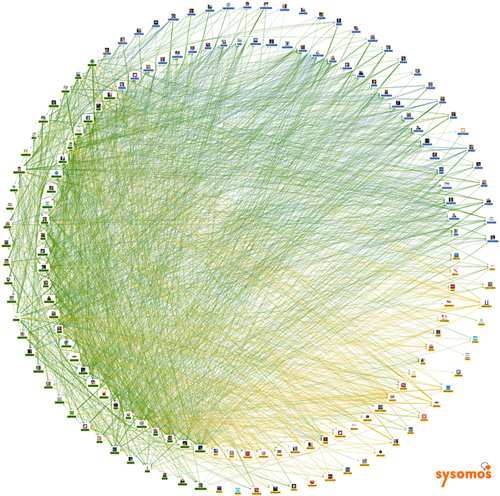
This year’s general conference theme for ISA in San Diego centred on ‘Power, Principles and Participation in the Global Information Age’ and, expectedly, gave rise to a proliferation of papers on the value, consequences and effectiveness of platforms such as Facebook, Twitter and other social media in the context of international relations and global politics. Having spent the past three years trying to disentangle the thoughts of one of the more intriguing political theorists on power and politics – Hannah Arendt – it has always struck me that she might have had a word or two to say about the supernova that is social networking as such. I couldn’t help picturing her vigorously engaging with a medium like Twitter, firing off Tweets to relevant interlocutors – @karlmarx no, I think that’s where you’re wrong and dangerous: #history is not ‘made’ by men and #violence not the midwife for a new society! Perhaps even: Yep: RT @karljaspers When #language is used without true significance, it loses its purpose as a means of communication and becomes an end in itself – hashtag and all. Or, on the other hand, flatly dismissing platforms such as Facebook as vanity spheres of little or no substance for political interaction. So I pitched in my paper as a playful thought experiment as to how she might have loved or loathed online social networks as viable platforms and public spheres for the creation of power and conduct of politics proper. This is a somewhat abbreviated version of the full-length paper, which can be found here.

The potency of social networking sites, as channels of communication and a medium for people from all corners of the world to meet in a virtual realm and engage with shared ideas – political or otherwise – has become indisputable. Not least since the Arab Spring uprisings of 2011, where bodies and voices were galvanized to part-take in various acts of revolt and revolution in Egypt, Tunisia, Syria and Libya, facilitated through online networks like Twitter and Facebook, have people discovered the enormous potential for a transnational coming-together in a shared cause. These networks thus appear to present themselves as a global public realm in a virtual space, transcending geographic limitations and boundaries, broadening the scope of possible political impact considerably. But with such a young medium it is perhaps wise to take a step back from the hype and ask how effective are these networks in creating actual political power? In how far can we understand the possibility to mobilize and plan in a non-spatial realm, through social networks, to constitute the generation of power and the actualization of political action? My paper sought to address these questions with an Arendtian lens – for better or for worse.

Inside the Political Twittersphere. Sysomos

Continue reading

What We Talked About at ISA 2012: A Human Right to Housing

Housing is a Human Right Exhibition, Philadelphia (original photo by Annie Seng)

I ain’t got no home. I’m just a roamin’ round, just a wandering worker, I go from town to town. And the police make it hard wherever I may go. And I ain’t got no home in this world anymore.

My brothers and my sisters they’re stranded on this road. A hot and dusty road that a million feet have trod. Rich man took my home and drove me from my door. And I ain’t got no home in this world anymore.

Was a farmin’ on the shares and always I was poor. My crops I lay into the banker’s store. My wife took down and died upon the cabin floor. And I ain’t got no home in this world anymore.

Now as I look around it’s mighty plain to see this world is such a great and funny place to be. Ah, the gamblin’ man is rich and the working man is poor. And I ain’t got no home in this world anymore.

-“I Ain’t Got No Home in this World” by Woodie Guthrie

Beginnings Are Difficult

How to start something new? This question troubles the academic as well as the activist. At the moment it troubles me both as a question of inquiry and as a meta-question of method.

In my previous work I have argued that human rights should be judged first and foremost by the consequences they bring about. Do human rights enable new forms of politics? Do they enable politics that increase the control we have over our lives, or that reduce the suffering and humiliation we are exposed to? Or do they confine us in a liberal subjectivity that makes wider visions of justice impossible, which push us to reconcile our beautiful revolutionary dreams to the limited horizon that contemporary liberal capitalism imposes?

I have offered a qualified defense of human rights as a democratising ethos, which suggests that human rights can enable everyday people to challenge the terms of legitimate political authority, including the institutional shape of their government and the makeup of their communities. This is done by formally opening up the identity of “rights holder” to anyone, regardless of their social position. This opening, however, is only formal and in that formality human rights have an ambiguous significance. For this reason, I have argued that to think of human rights as a democratising ethos also requires that we attend to the politics of human rights. This means that ensuring that human rights support democracy and equality is a political struggle as well as an ethical vision.

Continue reading

Friday is for Beautiful Revolutionary Dreams and Pragmatist Notes

Imagination is the chief instrument of the good. It is more or less a commonplace to say that a person’s ideas and treatment of his fellows are dependent upon his power to put himself imaginatively in their place. But the primacy of the imagination extends far beyond the scope of direct personal relationships. Except where “ideal” is used in conventional deference or as a name for a sentimental reverie, the ideal factors in every moral outlook and human loyalty are imaginative. The historic alliance of religion and art has its roots in this common quality. Hence it is that art is more moral than moralities. For the latter either are, or tend to become, consecrations of the established order. The moral prophets of humanity have always been poets even though they spoke in free verse or by parable. Uniformly, however, their vision of possibilities has soon been converted into a proclamation of facts that already exist and hardened into semi-political institutions. Their imaginative presentation of ideals that should command thought and desire have been treated as rules of policy. Art has been the means of keeping alive the sense of purposes that outrun evidence and of meanings that transcend indurated habit.

-John Dewey, Art as Experience

Materialism and World Politics conference

Materialism and World Politics

20-22 October, 2012
LSE, London, UK

Registration is now open here for anyone who wants to attend.


Scheduled Speakers:

Keynote: The ontology of global politics
William Connolly (Johns Hopkins University)

Opening Panel: What does materialism mean for world politics today?
John Protevi (Louisiana State University)
More TBC

Closing Panel: Agency and structure in a complex world
Colin Wight (University of Sydney)
Erika Cudworth (University of East London)
Stephen Hobden (University of East London)
Diana Coole (Birkbeck, University of London)

ANT/STS Workshop keynote:
Andrew Barry (University of Oxford)

ANT/STS Workshop roundtable:
Iver Neumann (LSE)
Mats Fridlund (University of Gothenburg)
Alberto Toscano (Goldsmiths, University of London)
More TBC

*******

The annual conference for volume 41 of Millennium: Journal of International Studies will take place on 20-22 October, 2012 at the London School of Economics and Political Science. This includes 2 days of panels and keynotes on the weekend, and a special Monday workshop on actor-network theory (ANT), science and technology studies (STS), and alternative methodologies. Space for the latter is limited though, so let Millennium know of your interest in attending it as soon as possible.

The theme of this year’s conference is on the topic of materialism in world politics. In contrast to the dominant discourses of neorealism, neoliberalism and constructivism, the materialist position asks critical questions about rational actors, agency in a physical world, the role of affect in decision-making, the biopolitical shaping of bodies, the perils and promises of material technology, the resurgence of historical materialism, and the looming environmental catastrophe. A large number of critical writers in International Relations have been discussing these topics for some time, yet the common materialist basis to them has gone unacknowledged. The purpose of this conference will be to solidify this important shift and to push its critical edges further. Against the disembodied understanding of International Relations put forth by mainstream theories, this conference will recognize the significance of material factors for world politics.