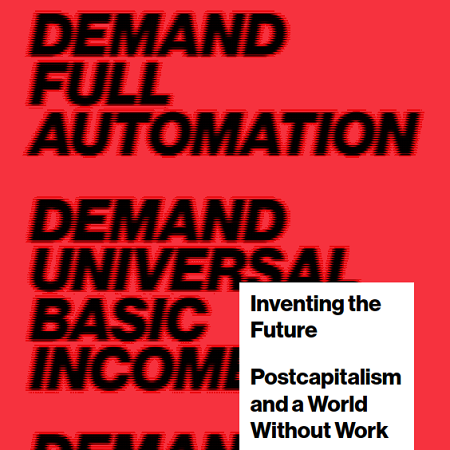
(Why We Can’t) Let the Machines Do It: A Response to Inventing the Future

The fourth post in our (already pretty popular) forum on Nick and Alex Williams’ Inventing the Future, this time from Sophie Lewis and David M. Bell. Sophie is at the University of Manchester, writing up a PhD on surrogacy’s uneven ‘cyborg’ geography and thinking about its utopian potential. She has written about surrogates for JacobinThe New Inquiry, and The Occupied Times; currently, excerpts are included in the 2015 “Technotopia” symposium. She also writes with the Out of the Woods (anticapitalist ecology) collective. She has co-translated Bini Adamczak’s Communism For Kids and written things that appear in Mute, Open Democracy, the ‘Demanding the Future’ tumblr, and on Novara WireDavid M. Bell is a Research Associate on the ‘Imagine’ project in the Department of Geography, University of Sheffield. He is interested in the potentials and dangers of utopia(nism) within, against and beyond capital, the state and itself. He has written on the politics of musical improvisation, utopian fiction and participatory arts practice; and is currently working on two book projects: Rethinking Utopia: Place, Power, Affect, to be published by Routledge in 2016; and A Future History of Sheffield: Art Practice, Hope and the City, with Jessica Dubow and Richard Steadman-Jones.


To The Future! But Whose?

To The Future! But Whose?

1. 

Inventing the Future provides a ‘plausible programme for ‘a world free of work’. It ‘shows us how we can organise’ to ‘realise a postcapitalist world’. So state its back-cover endorsements by Mark Fisher and Paul Mason. You should never judge a book by its blurb, but these claims are not to be sniffed at: here are two prominent thinkers of the UK left positioning this book as, if not a blueprint for utopia, a blueprint for utopianism – a roadmap that doesn’t quite cover the future but certainly takes us to its outskirts. The hyperbole continues away from Verso’s official promotional campaign too: Novara Media founder Aaron Bastani has publicly suggested that Corbyn’s Shadow Cabinet receive copies of the book’s chapters as bedtime reading pamphlets. We are not so sure. There is much of value in Inventing the Future (hereafter ItF); and it certainly opens up space for thinking about what might be and how we might get there. But there are serious questions about who this future is for, whose labour (re)produces it, and who it will continue to exclude.

Before the reader is let in on how we can invent the future, however, they need to be disabused of various notions that are holding it back. These are grouped together under the rubric of ‘folk politics’ – a supposed ‘constellation of ideas and intuitions within the contemporary left that informs the common-sense ways of organising, acting and thinking politics’ (p. 10). Its key features are the privileging of ‘local particularisms’; the spatially and temporally ‘immediate’ (and ‘unmediated’); ‘resistance’; and the ‘natural’. The attitude that Srnicek and Williams (hereafter S&W) take to this assemblage is remarkably similar to Marx and Engels’ position on utopian socialism: it was necessary in that it locally kept alive the possibility of alternative ways of living while large-scale political change was impossible, but once the material conditions for totalizing political change (supposedly) arrive, revolutionaries should embrace them and move beyond their quaintly uninspiring New Lanarks, exchange banks and workers’ associations. The time! is! (was!) now! (then!).

Against ‘folk politics’, S&W believe that a return to universalism is necessary for the invention of the future. Whilst acknowledging the colonial history (p. 76) of the universal and rejecting ‘Eurocentricism’ (pp. 77-78), they nonetheless argue that abandoning this structure of thought entails ‘licensing all sorts of oppressions as simply the inevitable consequence of plural cultural forms.’ (p. 77) This seems odd given that so many Indigenous and pre-colonial practices, identities, sexualities and cosmologies with liberatory potential have been destroyed in the name of universalism; and whilst these are acknowledged with the claim that there are non-European forms of ‘reason’, ‘science’, ‘progress’ and ‘freedom’ (p. 77), we are not convinced that these decidedly European terms are the most suitable labels for them. (What does ‘progress’ mean for cultures whose temporalities are nonlinear, for example?). We are more heartened, however, by the call for a universalism that is ‘pluri-versal’ and ‘does not entail homogeneity…does not necessarily involve converting diverse things into the same kind of thing’ (here, S&W refer to capitalism’s ability to sustain and draw power from diverse forms of social organization); and which ‘must recognise the agency of those outside Europe…in building truly planetary and universal futures.’ (p. 78) Continue reading
Postcapitalist Ecology: A Comment on Inventing the Future

The third post, and second guest, in the Disorder’s forum on Nick and Alex Williams’ Inventing the Future. Joseph Kay writes on climate change and libertarian communism with the collaborative blog Out of the Woods.


Having drafted the following comment on Nick Srnicek and Alex Williams’ (henceforth S&W) Inventing the Future: Postcapitalism and a World Without Work, it reads more critically than I expected. In mitigation, I should say that I’m on-board with many of the key themes of the book. I am wholly sympathetic to anti-work politics, generally in favour of automating away toil (with qualifications which will become apparent), and agree that the replacement of global capitalism requires scalability, comfort with complexity, long-term strategy, utopian imagination, and a plurality of organisational forms and infrastructure.

The critical tenor of what follows arises less from disagreement as such, than from my focus on what appear to be the ecological silences in the text. In particular, I focus on the implied conception of nature imported through S&W’s adoption of an avowedly modern rhetoric of progress and control, and on the unmentioned premises of both the project of full automation, and their more general contention that “we are usually not better off taking the precautionary path” (p.177). My argument is not to reject a high-tech, low-work future, but to outline some of the problems to be addressed in rendering such a ‘hyperstitional’ image ecological.

Modernity and the Ideology of Nature

Early on in Inventing the Future, S&W summarise their thesis:

If complexity presently outstrips humanity’s capacities to think and control, there are two options: one is to reduce complexity down to a human scale; the other is to expand humanity’s capacities. We endorse the latter position.

Read in an ecological light, the conjunction of ‘think and control’ affords two readings. The first and obvious reading is that their argument is situated within what Neil Smith called the ideology of nature. Smith argued that the ideology of nature had two poles. The first, a modernising politico-theological argument which saw scientific progress as the means to conquer and subdue nature. Here, the imaginary is mechanical, and separation from – as dominion over – nature is understood as an emancipatory process.

Continue reading

Accelerationism Without Accelerationism

The second post in our forum on Nick and Alex Williams’ Inventing the Future, from Steven Shaviro. Steven is the DeRoy Professor of English at Wayne State University. He blogs at The Pinocchio Theory.


The term accelerationism was coined by Benjamin Noys in 2010, in order to designate a political position that he rejected. In Noys’ account, accelerationism is the idea that things have to get worse before they can get better. The only way out of capitalism is the way through. The more abstract, violent, inhuman, contradictory, and destructive capitalism becomes, the closer it gets to tearing itself apart. Such a vision derives, ultimately, from the famous account of capitalism’s inherent dynamism in the Communist Manifesto. For Marx and Engels, capitalism is characterized by “constant revolutionising of production, uninterrupted disturbance of all social conditions, everlasting uncertainty and agitation… All that is solid melts into air, all that is holy is profaned.” Far from deploring such developments, Marx and Engels see them as necessary preconditions for the overthrow of capitalism itself.

The trouble with accelerationism, according to Noys, is that it celebrates “uncertainty and agitation” as revolutionary in its own right. It doesn’t have any vision of a future beyond disruption. In the 1970s, Deleuze and Guattari suggest that we need, not to withdraw from capitalism, but “to go still further… in the movement of the market, of decoding and deterritorialization,” At the same time, Jean-François Lyotard exults over capitalism’s “insane pulsions” and “mutant intensities.‟ By the 1990s, Nick Land ecstatically anticipates the dissolution of humanity, as the result of “an invasion from the future” by the “cyberpositively escalating technovirus” of finance capital. Today, transhumanists see Bitcoin, derivatives, algorithmic trading, and artificial intelligence as tools for destroying the social order altogether, and for freeing themselves from the limits of the State, of collectivity, and even of mortality and finitude. This is what happens when “creative destruction” – as Joseph Schumpeter calls it, in his right-wing appropriation of Marx – is valued in and of itself.

In 2013, responding to all these currents, Nick Srnicek and Alex Williams published their “#Accelerate: Manifesto for an Accelerationist Politics.” In this text, they seek to reclaim accelerationism as a genuine project for the left – one that can pick up the tools of capitalist modernity, and detourn them to liberatory ends. This is not a matter of celebrating disruption for its own sake; Srnicek and Williams emphatically reject Nick Land’s “myopic yet hypnotising belief that capitalist speed alone could generate a global transition towards unparalleled technological singularity.” Instead, Srnicek and Williams return to Marx’s own suggestion that Continue reading

Inventing the Future

The opening post in our latest forum, on Nick and Alex Williams’ new book, Inventing the Future. Commentaries will follow over the week, and Nick and Alex will respond soon thereafter with a rejoinder to points raised. All will eventually be available under this tag url.


Inventing the Future Cover - square

Today kicks off a symposium on our new book, Inventing the Future: Postcapitalism and a World Without Work. On a surface level, it is a book analysing post-work, the global crisis of surplus populations, and the challenges of rebuilding the contemporary left. Yet it is also a book designed to intervene in the current political conjuncture. It is written to produce discussions, rather than close them down; to spark debate, rather than dictate; and hopefully to persuade people of the utility of its prescriptions. As such, this blog event is the perfect avenue to inaugurate what we hope will be a series of productive engagements. Rather than simply summarising the book here, it is perhaps more useful if we briefly outline some of the debates we sought to contribute to.

The first such debate is the question concerning the dismal state of the left. While some find elements of hope in the contemporary left, for most it has been a series of marginal successes at best, and outright defeats at worst. In the book we attempt to offer a new explanation for why this is the case. Without rejecting the contributing factors of objective changes in the organisation of capitalism, and subjective changes in the self-understanding of class, we try to add a third explanation based upon a widespread common sense amongst the left. It is what we call ‘folk politics’: an intuitive set of beliefs that leads those on the left to instinctually turn towards immediacy as the solution to political problems. It finds greater and lesser expression in a series of recent movements, and while sometimes explicitly valorised, more often than not it goes on unconsciously in practices and habits. Our argument is that this folk political common sense tends to lead movements to organise and do politics in a way which constrains the possibility of escaping a global capitalism. This does not mean that folk politics should be rejected or dismissed; rather we simply try to point to its wide circulation and strategic insufficiency.

On a second level, the book seeks to generate discussion about what the future should look like. Too often, the activist and academic left only offers visions of the future in negative terms: the end of wage-labour, the end of racism, the end of sexism, the end of colonialism. These are all agreeable, of course, but ultimately remain empty signifiers. If we want a better world, we need to have some idea of where we are going. This doesn’t mean taking the opposite tack, and outlining a detailed plan for a future society (as with Parecon and New Socialism, for example). Rather it means setting out a series of broad proposals for what should be desired, what can be achieved, and how to get there. We have no illusions about the errors, biases, and limitations that our own proposals will include. We are, indeed, keenly aware of the limits of a small book written for a general audience. But the point of setting out a vision of the future and a series of demands is to lay our cards on the table for others to take up, critique, or reject. It is too easy to adopt a comfortable critical stance against the world.

Finally, discussions about the problems of the left and visions of the future must come together in debates over how to rebuild the power of the left and bring about a new future. To this end, our argument is for a counter-hegemonic strategy across an ecology of organisations, intervening in newly discovered and constructed points of leverage. While we try to give some concrete content to these broad proposals, we have also intentionally pitched these ideas at a level which allows them to be taken up in different forms across different countries and under different conditions. It is our hope that people who are convinced by our analysis and proposals will then take up these broad ideas and translate them into their own specific circumstances. We offer the book as a possibility – one among many – of what the future could look like.

-Nick Srnicek and Alex Williams

Let’s Talk About the “Ugly Briton”: Shashi Tharoor on Winston Churchill

October is always a good time to catch up on one’s correspondence from July.  “FYI,” noted a friend though FB’s messaging system, linking to this:

The video’s title, “Dr Shashi Tharoor MP – Britain Does Owe Reparations,” sums it up.  The other videos from the same debate event are worth watching, too, but Tharoor’s is quite simply a must-see for anyone interested in the British Empire.  Indeed, you have probably seen it already.  With 3 million views, 6000+ comments plus what seem to be hundreds of reactions by all kinds of people in all kinds of media of communication, this one 15-minute video alone can legitimate Oxford Union Society claim’s that it aims “to promote debate and discussion not just in Oxford University, but across the globe.”

Why is it that Oxford Union struck social media gold with this debate but not with some others (“socialism does (not) work,” anyone)?  Even if it is safe to assume that “many” people would be familiar the reparations argument in general and even that “some” would be familiar with Britain’s reparations to the Maori, the fact is that “no one” had given a fig about the case for Indian reparations [1].  My scare quotes are meant to signal that these quantifications are relative.  It was a century ago that Dadabhai Naoroji, known to some as the Grand Old Man of India, argued that “immediate” self-government, a.k.a. swaraj, would constitute Britain’s “reparation”.  But this is precisely the point: reparations-talk becomes itself only when subjected to a sufficient degree of metropolization or mainstreaming [2].  White academics like Boris Bittker started paying attention to the legal argument for “black reparations” only in 1969, after James Forman famously stood up in a New York City church to argue that white churches owed a lot of money to a lot of people.

Continue reading

Ethics in the Service of Violence in Israel/Palestine

A guest post from James Eastwood. James is a PhD candidate at the School of Oriental and African Studies (SOAS). This post is partly based on his latest article, ‘”Meaningful Service”: Pedagogy at Israeli Pre-Military Academies and the Ethics of Militarism’, forthcoming in the European Journal of International Relations.


Die you fuck, die you son of a whore, die, die, die you son of 66 whores.

These are the words that Ahmad Salih Manasra, a 13-year-old Palestinian boy, heard as he lay bleeding in the street on 12th October 2015. The insults were yelled by an Israeli passer-by, who recorded the child on video as he lay helpless on the ground. Ahmad was taken to hospital in a critical condition. His cousin Hasan Khalid, who was shot at the same time, is dead.

Israeli police later released a video depicting the alleged chain of events leading up to these incidents. It shows two young boys carrying knives attempting to attack a passer-by, followed by an alleged stabbing which takes place off-camera. In the ensuing pursuit, the elder of the two boys – Hasan – appears to run at the police with a knife. They shoot him dead, without attempting to immobilise him. According to Israeli media, Ahmad was hit by a car as he ran away. But the video circulated on social media shows him lying some distance from the road on a tramline. Palestinian news sources, which had originally claimed that Ahmad was shot dead, now suggest that he was run down by an Israeli patrol car and then beaten.

The graphic video of Ahmad Manasra is only the most shocking to emerge from a series of shootings of Palestinians by Israeli police and soldiers as they scramble to respond to a spate of un-coordinated knife-attacks. 50 Palestinians have been shot dead since the beginning of October, with hundreds more injured. Meanwhile, 9 Israelis have been killed in stabbing and traffic ramming incidents, with dozens more wounded. Last Tuesday witnessed the most serious escalation of the attacks, with separate incidents occurring almost simultaneously across Israel and the occupied territories. Protests have erupted in the West Bank and Gaza, while Israeli authorities have ramped up police and military presences and have introduced checkpoints and barriers around Palestinian neighbourhoods in East Jerusalem.

The wave of public panic over the stabbings has re-ignited a longrunning controversy in Israel over the rules of engagement for police officers and soldiers dealing with suspects, wanted assailants, and protestors.

Continue reading

Laughter, the Canadian election and the niqab debate

Screen Shot 2015-10-20 at 8.09.09 AM

Let me begin by clarifying: I’m not talking about laughing at the niqab, but at the niqab debate (or #niqabdebate) as it has become known in Canada in the last six weeks. The niqab debate that loomed so large in the 2015 federal election, a record 78-day campaign that reached its finale Monday night, and that may (arguably) have precipitated the collapse of the social democratic alternative (arguably) in Canada. The debate provoked by Conservative race-baiting in an impressively cynical bid to profit from the seldom-acknowledged but very real prejudice of white Canadians. The bullshit niqab debate.

Let me back up a bit.

In 2011, the Canadian federal government banned the wearing of face-covering garments during the swearing of citizenship oaths. This, it was said, was to ensure that the oath was actually said – that is, that the prospective citizen’s lips were moving – a problem that could be solved by standing within earshot. It served no purpose for identification either, as all candidates for citizenship have, by the time they reach the point of swearing an oath, already braved a gauntlet of background checks, paperwork, regulation photos, and meetings with officials. They also reveal their faces to an official for identification purposes immediately prior to the ceremony. More to the point, as journalist Justin Ling so aptly said only a few weeks ago, “All would-be citizens are required to actually sign the oath of citizenship, which is the legal part of becoming a citizen. For the oral exam part of the ceremony, you may as well be reciting ‘Hypnotize’ by Notorious B.I.G.”

Continue reading

The Dissonance Of Things #4: Leftist Foreign Policy After Corbyn

The fourth of our monthly podcasts, turning our attention with ever greater political precision to Corbynmania, Jacorbynism, #JezWeCan, or however you prefer to characterise the arrival of Jeremy Corbyn as Leader of the UK Labour Party. Since before his victory, Corbyn has been stalked by, and occasionally celebrated for, his views on international politics, from the crisis in Ukraine and associated Great Power rivalries to his views on Hamas and from the (non-)renewal of Trident to the UK’s future role in NATO. David Cameron, for one, has attempted to securitise Corbyn, repeatedly arguing that “the Labour Party is now a threat to our national security, our economic security and your family’s security”.

And so we ask: what is a leftist foreign policy? Is such a thing even possible? Should the left, in whatever form, be seeking to capture, remake or resist foreign policy? What do the wishlist strands of a left foreign policy look like? Lee, Meera and I are herded into some kind of order by Kerem, and joined by Chris Emery of the University of Plymouth. author of US Policy in Iran: The Cold War Dynamics of Engagement and Strategic Alliance 1978-81 and this post on the history of covert action in Iran.

As ever, consume, cogitate, argue, and share, share, share. Past and future casts are available on soundcloud.

Further resources, including articles discussed in the podcast:

Humble/Brag

'Make A Sad Painting Happy', by Karl Habegger,

‘Make A Sad Painting Happy’, by Karl Habegger.

The Disorder Of Things is five. Five years old. Very almost 780,000 views from over 326,000 visitors. 12,000-odd email subscribers (surely some of whom are not bots). Two plastic ducks. An accelerating series of book symposia, the new aural assault of podcasts, a gang of regular contributors (finger-clicking their way, West Side Story-like, through a conference corridor near you), 81 guest spots, and even some official and really real academic products. Along with all our, ya know, blog posts. Popular ones on tele-fantasy politics, bullshit jobs, left solidarity, open access, and bad dissertations. Lesser read ones on Blairite exculpation, humane indexing, and Barry O in Ohio. Everything in between. But then we’re also established cynics on the possibility of capturing the ephemera of quality with the crude tools of quantity, so take that all with a fist of salt.

Blogs are dead, yet we persist, zombie-like, refusing to just let it go. We’ll be eating jelly and ice cream until we throw up to celebrate. Maybe you should too.

Thinking Internationally About The Arms Trade

A guest post, following our recent podcast on the arms trade and its discontents, from Anna Stavrianakis. Anna is a Senior Lecturer in International Relations at the University of Sussex. Her research focuses on the arms trade, arms transfer control and militarism.


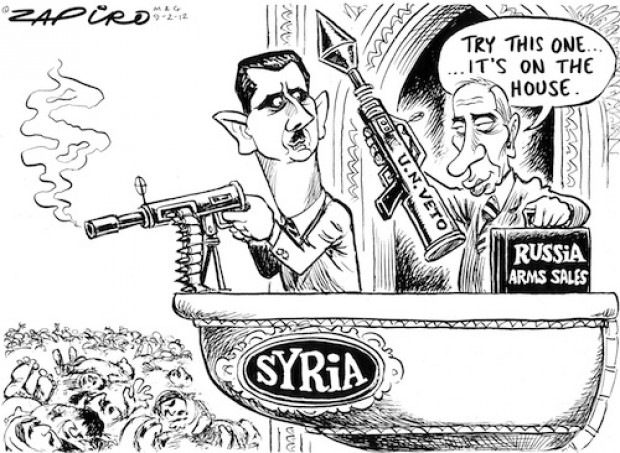
Zapiro - Russia Syria Arms Trade

September 2015, ExCel Centre, London: Stop The Arms Fair activists block the road and prevent military vehicles entering the Defence and Security Equipment International (DSEI) exhibition. They are protesting against one of the largest arms fairs in the world – sending a message to the UK government and arms companies that “inviting representatives of repressive regimes and their armed forces to hob-nob and do dodgy deals at DSEI … with representatives from the UK government and unscrupulous arms companies from around the world IS NOT OK.” Two weeks previously, Cancun, Mexico: Control Arms activists build a life-size sand sculpture of a Stormer 30 tank on Baracuda Beach, Cancun, calling on states to save lives! by ensuring the toughest possible standards at the first Conference of State Parties to the Arms Trade Treaty, the biggest game in town for contemporary international arms transfer control.

These two campaigns share the language of “dodgy deals” but are otherwise quite different visions of the arms trade and its control. The Control Arms campaign focuses on encouraging, informing and embarrassing diplomats into agreeing a multilateral treaty that enshrines higher common international standards and establishes stronger norms against arms transfers that violate human rights and international humanitarian law. The Stop The Arms Fair coalition, meanwhile, takes direct action to halt the operation of arms fairs in the UK by physically blockading the exhibition centre, in protest at the relationship between arms companies and the UK government, and the relationships between the UK government and authoritarian, repressive and war-fighting foreign governments.

I’ve written in the past about the international politics of NGO and campaign group strategy – whether reformist, insider approaches are more effective than transformist, outsider ones – in the context of debates about global civil society. Yet what continues to trouble me, intellectually and politically, is a raft of questions about the operation of the arms trade itself. Namely: where, or with whom, does political responsibility lie for the negative effects of the arms trade in a world of formally national states that are home to internationalising arms companies and operate in a multilateral system based on sovereignty? What social forces drive the arms trade, how does their power operate, what is the character of the problems they generate, and how should scholars and activists best respond? Competing understandings of the operation of the arms trade can be seen in the varied activist responses to it: is the problem one of lack of regulation, the need for improved multilateral action, improved normative standards and international law, as per the Arms Trade Treaty? Or is the problem the relationship between the state and arms capital, and government promotion of the trade, as per the anti-DSEI protests? In the case of DSEI, how are we to understand the operation of internationalising arms capital that has an intimate yet fractious relationship with national states? And in the case of the Arms Trade Treaty, how should we make sense of efforts to create a level playing field of respect for human rights and humanitarian law in the context of a vastly asymmetric and hierarchical world military order?

Thinking theoretically, I have come to see that a large part of the difficulty in answering these questions lies in the grip that methodological nationalism continues to hold on IR as a discipline. Continue reading