Trump, Russia, and the Global Right: IR’s Difficulty with the Political Present

Christopher McIntosh is a Visiting Assistant Professor in Political Studies at Bard College whose published research examines the concept of war, “terrorism,” and the intersection of time and temporality in international politics. He most recently co-edited a volume called Time, Temporality, and Global Politics, and he is currently completing a book project entitled, Theorizing the Interim: IR as Study of the Present.

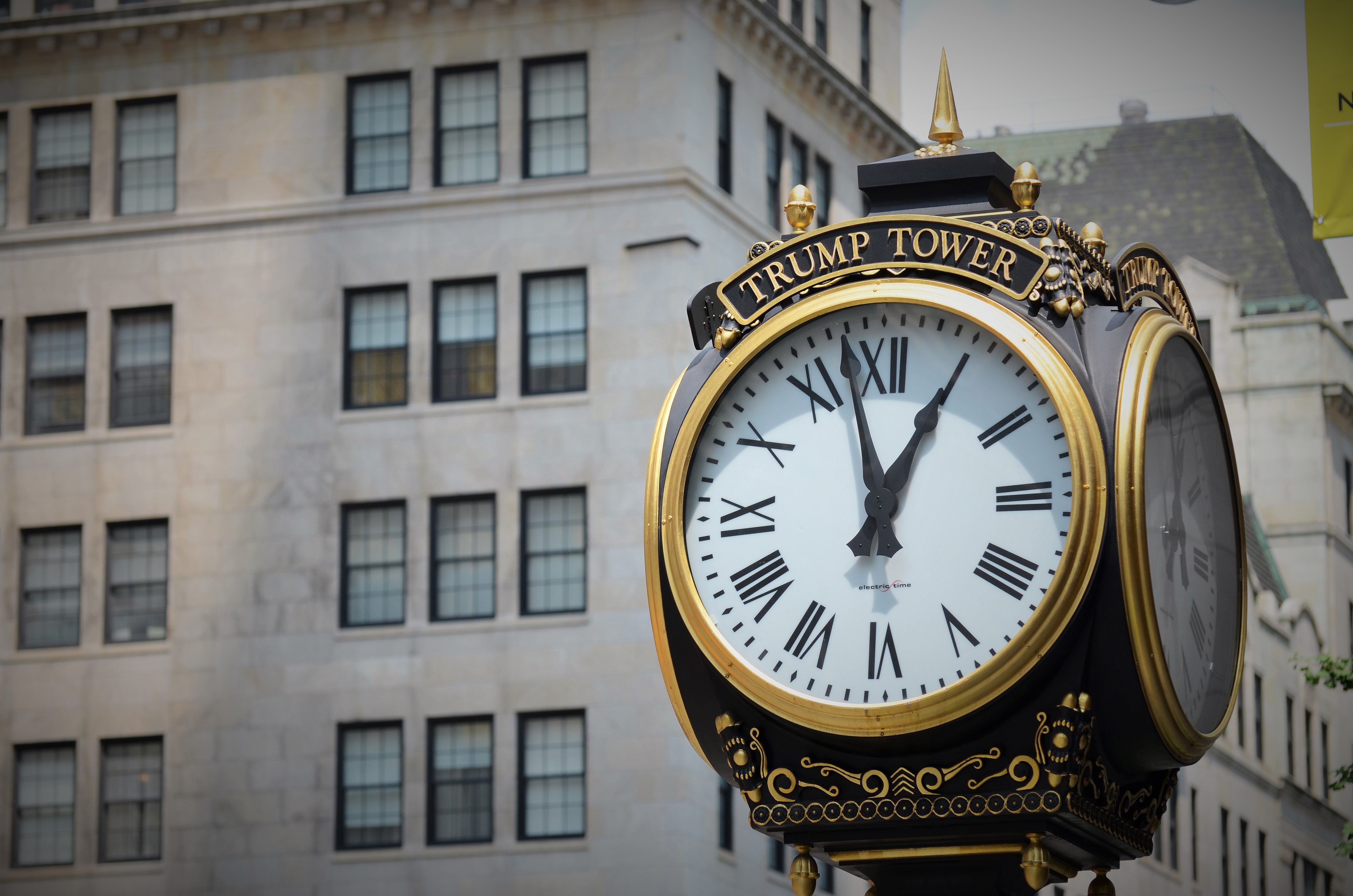
Given recent events in the United States and Europe, it appears IR scholars have fallen victim, in the words of Robert F. Kennedy (among others), to an ancient “Chinese curse”: “may [you] live in interesting times.” From my position as an American citizen writing in the United States, American politics—both foreign and domestic—appears completely consumed by Trump’s actions, the moves of his “administration,” and the role of Russia in the 2016 election and potentially beyond. Nationally televised Congressional hearings during the day and seemingly daily “bombshell” news stories breaking at night have made it appear as if the US polity is in a unique, ongoing crisis. As overwhelming as it sometimes appears, as IR scholars we cannot afford to look away, as much as we might like to do so. By all accounts, these are, indeed, “interesting times.” Trump’s rise and the rise of the global right potentially upends much of what we think we know and could create a series of natural experiments that confirm or disconfirm our theories.

Continue reading

Militarism in the Age of Trump, Part II

Based on a paper I am co-authoring with Bryan Mabee. See Part I here.

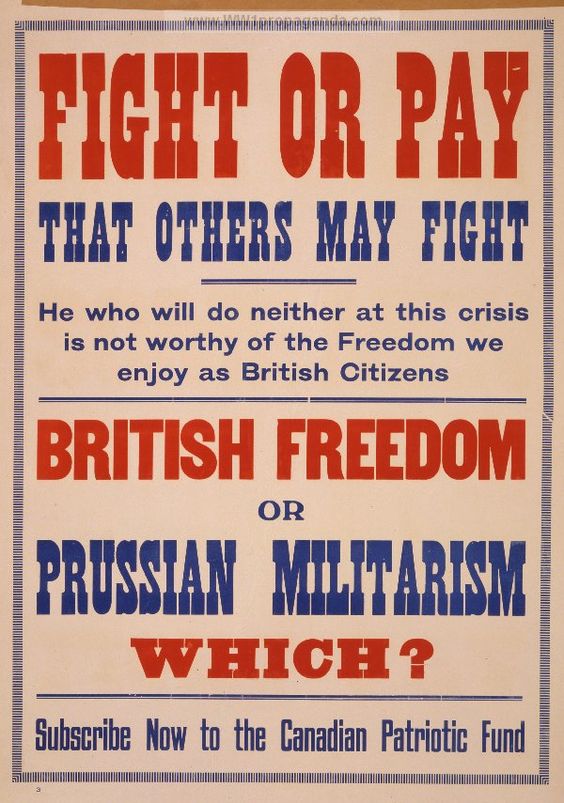
Nation-statist militarism is the default (‘normal’) setting for militarism in international and global life.  Following Mann, this manifestation of militarism is characterized by some form of civilian control over the armed forces and a state-led economic and social mobilization of ‘destructive’ forces. (Alternative labels are ‘Westphalian militarism’ and even ‘Keynesian militarism’). In claiming the monopoly of legitimate violence, the nation-state prioritized territorial defence; planned, built and consumed from its own arsenals; and engaged in military recruitment practices that reflected and reinforced the prevailing social structures of the nation (whether professionalized or constricted).

This type subsumes what Mann refers to ‘authoritarian militarism’ and ‘liberal militarism’, his main examples coming from Europe–the absolutist polities and their twentieth century authoritarian descendants (e.g. Germany, Russia) versus the polities deriving from the constitutional regimes (e.g. Britain, France).  It even subsumes the militarisms of the post-1945 nuclear age, which include, in Mann’s terminology, sub-types like ‘deterrence-science militarism’ (‘techno-scientific militarism’) and ‘spectator sport militarism.’

Continue reading

Militarism in the Age of Trump, Part I

Part I of a post based on a paper I am co-authoring with Bryan Mabee, Senior Lecturer at Queen Mary, University of London. Bryan is the author of Understanding American Power (Palgrave, 2013), The Globalization of Security (Palgrave, 2009) and co-editor with Alejandro Colás, Mercenaries, Pirates, Bandits and Empires (Hurst/Oxford University Press, 2010).  The paper is being prepared for “Militarism and Security,” a workshop organized later this month at the School of Global Studies, University of Gothenburg by Anna Stravianakis (for her latest appearance on this blog see The Dissonance of Things No 3) & Maria Stern.

Update: Part II added on 18/03/17.

With Donald Trump as the president of the United States, militarism is once again becoming a hot topic. Trump’s appointment of right-wing generals to senior posts in both the White House and his cabinet legitimate militaristic policy discourses and positions, as do the president’s pronouncements about the need to “modernize” the country’s nuclear capability, put America’s enemies “on notice,” massively “rebuild” the military, hold “more military parades” in American cities, deploy the national guard to “restore order” (and possibly “hunt illegal immigrants”) and “streamline” U.S. defence exports.

And all of this is only the proverbial tip of the iceberg. For one thing, the Trump presidency merely empowers an already deeply militaristic and militarized American culture, one that is forever in love with guns and prisons and forever reticent to acknowledge the inherently racialized dimensions of both. For another thing, Trump’s top advisor is the “ethnonationalist” Steven Bannon, who is so influential in the White House that some describe him, tongue only halfway in cheek, as the actual president of the United States. Apparently, Bannon reasons that war between the U.S. and China is likely, given the thorny nature of international disputes in the South China Sea. One could in fact say that beneath the visible iceberg lie powerful and long-standing militarized realities—most of which have been ignored, temporized or marginalized in the earlier, ‘normal’ periods.
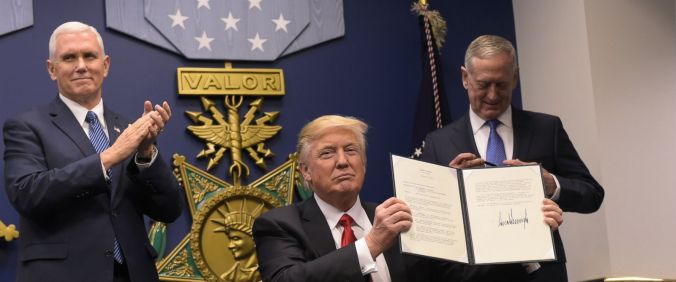
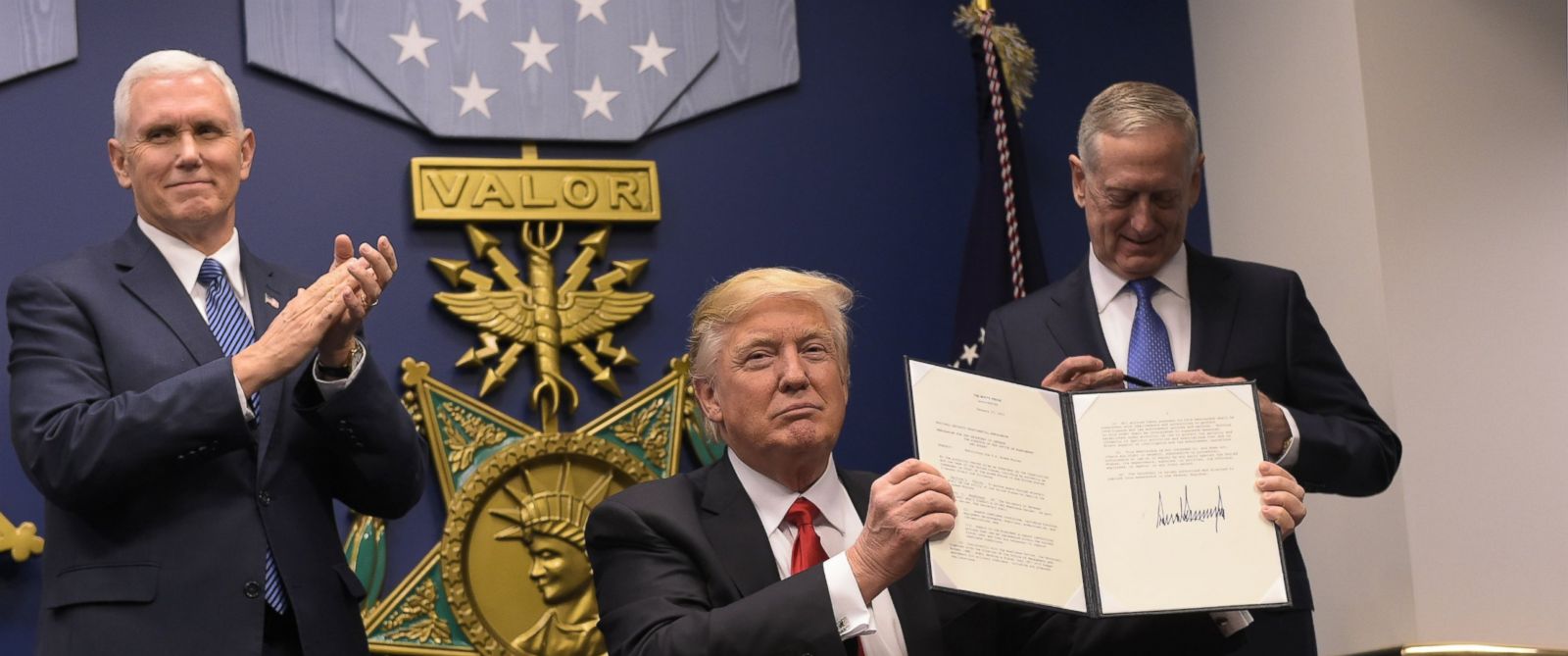
ABC News

Can Critical Security Studies (CSS) help us illuminate militarism in the age of Trump? On one level, yes. Militarism is central to the field’s go-to framework on securitization—meaning, the scrutiny of the ways in which constitutional or ‘normal’ politics are transformed, via speech acts, into ‘exceptions’. The above image, Trump signing the Executive Order banning immigrants, dual nationals and US residents with citizenships from seven Muslim-majority countries from entering the country, suspend refugee admission and bar all Syrian refugees indefinitely, can be said to capture ‘exceptionalist militarism’ at work. Yet, beyond theorizing this one form of militarism, CSS has mostly been silent on the ‘classic’ concern of the literature on militarism—its sources, consequences, and the changing character.

In this two-part post we build on insights from historical sociology to develop a typology of militarism that CSS schools could consider as they try to make sense of political violence today.

Continue reading

A Faustian Special Relationship

Donald Trump has a thing for rebuking America’s democratic allies and their leaders—his latest target being Australia’s prime minister, Malcolm Turnbull. The UK appears to be an exception to this trend. In his first interview with the British press as president-elect, Trump explained that the UK has a “special place” in his half-Scottish heart and pledged to support a post-Brexit UK-US trade deal. Reportedly a big fan of Winston Churchill—and of Boris Johnson’s Churchill Factor—he also asked the UK government to loan him a Churchill bust that his Republican predecessor George W. Bush kept in the Oval Office.

Continue reading

Can’t Lose For Winning: Victory In The Trump Presidency

media_185980_enx161127205934_70462-jpg-pagespeed-ic-1ww2qbdqbIn our second post marking the inauguration of the latest president of the United States, Andrew Hom and Cian O’Driscoll reflect on what “winning” means for Trump and his followers — semantically, operationally, ideologically. Andrew is lecturer in international relations at the University of Edinburgh and works on timing, temporality, and the politics of victory in IR theory. Cian, a specialist on victory in just war theory and international ethics, is senior lecturer in politics at the University of Glasgow. This post is based on the ESRC-funded project ‘Moral Victories: Ethics, Exit Strategies, and the Ending of Wars’ (ES/L013363/1) and an ESRC Impact Acceleration Grant (ES/M500471/1). Edit: The other two posts in this series can be found here and here.

Donald Trump has been one of the most critically scrutinized political figures in recent history. But what has so far escaped much attention is how Trump promised to ‘Make America Great Again’ by ‘winning’ on all fronts. Yet victory has long been a centrepiece of Trump’s vision for American renewal. Here is Trump on the stump in April 2016:

You’re going to be so proud of your country. […] We’re going to turn it around. We’re going to start winning again: we’re going to win at every level, we’re going to win economically […] we’re going to win militarily, we’re going to win with healthcare and for our veterans, we’re going to win with every single facet, we’re going to win so much, you may even get tired of winning, and you’ll say “please, please, it’s too much winning, we can’t take it anymore” and I’ll say “no it isn’t”, we have to keep winning, we have to win more, we’re going to win more!

This repeated themes he had been expressing since the Republican primaries, and victory resurfaced in Trump’s inaugural address: ‘America will start winning again, winning like never before.’

Continue reading

“But What On Earth Is Whiteness That One Should So Desire It?”

This is the fifth post in our symposium on White World Order, Black Power Politics, which will be followed shortly by a response from the author. Earlier responses are here from Naeem, Nivi and Srdjan. This piece expands on, and in some senses muddies, a short review I wrote of the book for a symposium in Perspectives in Politics.


This book is an indispensable and provocative account of the genesis of International Relations in the US as a discipline expressly concerned with the maintenance and expansion of global white supremacy. It is an enormously significant contribution to the understanding of the past, present and future of how we study world politics, which has thus far ‘disappeared’ racism and racial politics from its foundational narratives. [1]  It seems, this time anyway, that people are paying attention – the book is receiving wide acclaim and attention in the roundtables, symposia and review sections of the very journals, conferences and institutions that constitute the historical objects of its narrative. Does this mean that the ‘rising tide’ of calls for the discipline to deal with its racist foundations are being answered?

We will have to wait and see. Vitalis’s book makes some important headway in that direction but the rearguard is already being mobilised. Gideon Rose’s capsule review for Foreign Affairs, the journal once named for Race Development, perfectly captures precisely how this rearguard can function, in the process re-inscribing the ‘norm against noticing’ the operation of racism and white supremacy in both world politics and the discipline (IR) that claims to study it. Marking the book as ‘flawed’ and ‘political’, Rose accepts that the origins of the discipline were racialized and characterized by discussions about race relations. However, his rhetoric effectively consigns the analytic case that there are continuities in these ideas to a conspiratorial form of politics (attributing to Vitalis, bizarrely, a rather childish view of the US as ‘evil’).

Matt Wuerker, The Military Industrial Complex

Matt Wuerker, The Military Industrial Complex

The most prominent of these linkages in the text is Vitalis’s juxtaposition of Lorthrop Stoddard’s The Rising Tide of Color, which foretold of coming race wars in the twentieth century, with Samuel Huntington’s The Clash of Civilizations which does the same for the twenty-first (4, 62-4, 177).  It is true that Vitalis does not work through a point by point analysis of the two texts; however, it is also equally demonstrated that there are clear overlaps in form and content between the arguments. Both are grounded in the belief in coherent civilizations existing in fundamentally antagonistic relations, of which the white (or Western) is the most advanced and against which others will attempt to rise. For Rose to refuse to acknowledge the argumentation at all, even in a capsule review, seems odd until one reads the same reviewer’s graceful, generous assessment of Huntington’s famous work in the same journal in 2013, commemorating the 20th anniversary of its publication:

The origins of “The Clash of Civilizations?” lie in the conjunction of a special scholar and a special time. By the beginning of the 1990s, Samuel P. Huntington was already one of the most important social scientists of the second half of the twentieth century, having authored major works in every subfield of political science. The hallmarks of his efforts were big questions, strong answers, independent thought, and clear expression. The end of the Cold War, meanwhile, had ushered in a new era of international relations along with a host of questions about what would drive it. Drawn, as always, to the major practical and theoretical questions of the day, Huntington set himself the task of limning this new world.

The more he thought about it, the more he decided that most existing analyses were heading in the wrong direction. The future was not likely to be an easy run toward democracy, peace, and harmonious convergence, nor was it likely to be a return to the old games of traditional great-power politics or ideological rivalry. “The great divisions among humankind and the dominating source of conflict will be cultural,” he concluded; “the clash of civilizations will dominate global politics. [Rose, Foreign Affairs, The Clash at 20]

What can we make of this? Continue reading

White World Order, Black Power Politics: A Symposium

vitalis-e1458738905580This is the first post in the symposium on Robert Vitalis’s, White World Order, Black Power Politics: The Birth of American International Relations (Ithaca: Cornell University Press, 2015). Professor Vitalis (who also answers to ‘Bob’) teaches at the University of Pennsylvania. His first book, When Capitalists Collide: Business Conflict and the End of Empire in Egypt, was published in 1995. His second book, America’s Kingdom: Mythmaking on the Saudi Oil Frontier, published in 2005 was named a book of the year by The Guardian. He has been a fellow at the Woodrow Wilson International Center for Scholars (2009), Rockefeller Foundation (2003), the International Center for Advanced Study, NYU (2002), the American Council of Learned Societies (2002), and the MacArthur-SSRC International Peace and Security Program (1998). He was a MacArthur Award nominee in 1998. Below is his introduction to our symposium.

*Update*

Naeem’s response is here; Nivi’s is here and Srdjan’s is here.


80140100646100L

White World Order, Black Power Politics may well be the only book discussed in this symposium series that isn’t primarily concerned with theory, or at least the only one by an author who does not self identify as a theorist, teaching in a department that does not recognize what I do as “IR.”  It is also less an intellectual history, which might allow it to pass as theory, than it is an institutional history. So I am grateful for the interest in it here.

28522646._UY1280_SS1280_That said, it is indeed a critical history. The records of professors, schools, research organizations, and foundations in the early twentieth century United States reveal a past that bears scant resemblance to the “practitioner histories” or insider accounts of great debates invented about the discipline of international relations in the second half of the century, which are the ones most specialists tell themselves and their students until now. In fact, the more I learned and labored in the archives the more I came to see the problem as similar to the one I wrestled with in my last book, America’s Kingdom: Mythmaking on the Saudi Oil Frontier. The history that U.S. oil companies invented after World War II about their early and unshaken commitment to a “partnership in progress” with the Saudi people, at a moment when criticism of U.S. imperialism was on the rise in the Eastern Province and across the globe, is the one that books repeated uncritically for decades. The firms’ private records though revealed a dramatically different reality. I developed an account of the exploitative order in place in the oil camps, the racial science that justified it in the minds of the American engineers and managers, and the failed efforts of Arab and other workers to bring about its end. I likened what I did in that book to “reverse engineering” particular processes of mythmaking. I’ve done more or less the same thing for a sector of the U.S. academy in White World Order. Continue reading

The EU Referendum: “We will burn it all down” – War, Blackmail and the Case for the European Union

This is a post in our EU referendum forum. Click here for the introduction with links to all the contributions.


Our next guest contributor to the EU forum is Philip Cunliffe. Philip is Senior Lecturer in International Conflict at the University of Kent and editor-in-chief of the journal International Peacekeeping. He is co-editor, with Chris Bickerton and Alex Gourevitch, of Politics Without Sovereignty (UCL Press, 2007), and author of Legions of Peace: UN Peacekeepers from the Global South (Hurst, 2014).  His most recent book, co-edited with Kai Michael Kenkel, is Brazil as a Rising Power: Intervention Norms and the Contestation of Global Order (Routledge, 2016).

It’s often heard that the European Union (EU) is a peace project – an institution engineered to bring peace, prosperity and stability to a war-torn continent that was at the core of global conflict over the last century. This was the animus behind UK Prime Minister David Cameron’s speech on 9 May 2016, in which he claimed that Britain leaving the EU could lead to renewed rivalries, geopolitical tension and ultimately war in Europe. It is one of the most powerful, popular and enduring claims given in defence of the EU and one that drastically raises the political stakes in the debate over Brexit.

Given that this claim comes from our political leaders, it is a remarkably menacing way of eliciting popular support: Vote for us, they seem to be saying, vote for the European Union, or war will be the result ... That political elites could threaten voters so brazenly while implying their own powerlessness to control the course of events at the same time speaks to the strength of popular (mis)conceptions about the origins of conflict in Europe.

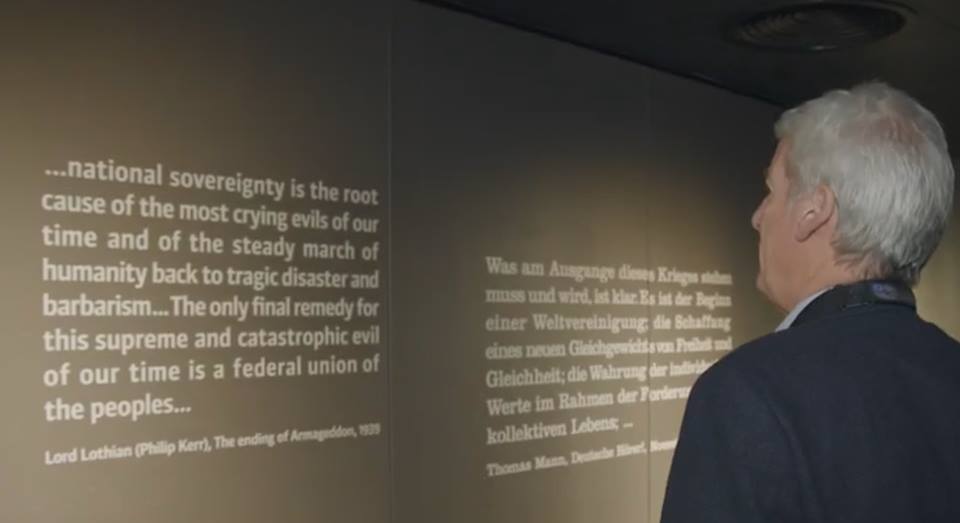
A screenshot from "Paxman in Brussels" (BBC), shot in the EU visitors' centre (h/t Ben Pile)

A screenshot from “Paxman in Brussels” (BBC), shot in the EU visitors’ centre (h/t Ben Pile)

Continue reading

Bernie Sanders For Commander-In-Chief

Jesse headshotA timely guest post from Jesse Crane-Seeber. Jesse  grew up in the woods of Ithaca, New York where he graduated from a democratically run public alternative high school. After a BA in “Resisting Hegemony” (a major of his own design) at Ithaca College, he earned a Ph.D. in International Relations at American University.  His dissertation ‘Making War’ analyzed the occupation of Iraq in terms of how U.S. soldiers’  negotiated and made sense of their surroundings, their missions, and the people they tried to help and/or harm. His research involved participant observation, living with military families, analyzing official documents, and sifting through hundreds of hours of soldier-uploaded video content. He teaches at North Carolina State University, and is currently finishing Fifty Shades of Militarism, a study of the fetishization of all things military in the contemporary United States. The views in the post are those of Jesse Crane-Seeber as a private citizen and do not reflect those of North Carolina State University. Obviously.


“coming of age during the plague
of reagan and bush
watching capitalism gun down democracy
it had this funny effect on me
i guess”

– Ani DiFranco, Your Next Bold Move

In recent months, the United States has seen a substantial rebellion against Hillary Clinton’s status as heir-apparent of the Democratic Party. Combined with the contemporary Republican Party’s confusion about whether to embrace regime change, free-trade, or multilateral institutions (even those like NATO that secure US hegemony in the world), the current election cycle offers US voters an unusual set of choices that may not be fully appreciated by those caught in the horse race and name calling of an expensive election.

It is normal to be cynical about what any individual nation can do, never mind a particular leader. Technological change, ecological collapse, international regime complexes, not to mention economic activity, all help explain the limits of what any nation can do. But the President of the United States is not a generic national leader. As the chief architect of the post-World War II political and economic order, the US retains outsized influence, even as we reach peer-peer levels of economic output with the EU and China.

While Secretary Clinton and Senator Sanders voted alike 93% of the time they were both in the Senate, the contrast in how they might impact global politics is much, much larger. One oft-repeated critique of Sanders has been his lack of foreign policy experience, knowledge, or, well, policy. As Ignatius put it, “Foreign policy is the hole in Sanders’s political doughnut.” Several enterprising writers reached out to foreign policy and IR scholars sympathetic to Sanders’ campaign for comment, while a few political scientists have directly addressed the nature of a future Sanders Administration’s foreign policy.

As a critic of the Washington/New York policy expert class and the ways that US Political Science reproduces and authorizes it, what I find troubling is not what ‘experts’ have been saying, but what they haven’t. With the exception of Charli Carpenter’s embrace of Sanders’ willingness to acknowledge what he doesn’t know about foreign policy, all of these commentators seem to reduce US foreign policy to positions on which countries to bomb, (and maybe relations with Israel). More than once, he has been characterized as a ‘realist’ against Clinton’s hawkish liberal interventionist instincts. While that is basically fair and correct, even if the meaning of ‘realist’ in policy debates has little resemblance to the theories I teach under that name, this discussion has been far too narrow. Just this week, an open letter by 20 ‘foreign policy experts’ has explicitly endorsed Sanders’ approach to foreign policy. Going beyond the standard arguments (which I detail below), they draw attention to a wider range of issues that Sanders can lead on. While their arguments and my own line up fairly neatly, it’s important to have a bit more of an extended discussion of the issues involved than their short statement allowed.

Yielding to the dominant view, if only for a moment, I turn first to the Democratic candidates’  approaches to national security and armed force.

Continue reading

The Futures Past of the Women, Peace and Security Agenda

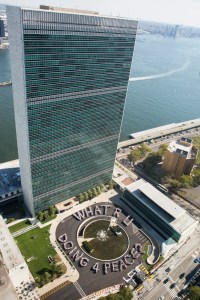
"What are you doing for Peace?" Launch Event

UN Secretariat staff mark the occasion of the 70th anniversary of the United Nations. 17 September 2015. UN Photo/Rick Bajornas.

This essay is a much abridged and lightly edited version of an article of the same name by Paul Kirby and Laura J. Shepherd published on 8 March 2016 in International Affairs.

UNSCR 1325, the foundational resolution of the eight that form the Women, Peace and Security (WPS) policy architecture, has strikingly few critics – or, at least, few who would openly dispute its headline ambition: to achieve global gender equality. It seems particularly appropriate to celebrate the WPS agenda on International Women’s Day, adopted by the United Nations in recognition of the ongoing global struggle for women’s rights. Our modest contribution to IWD celebrations this year is the launch of a special issue of International Affairs, which documents the advances and limits of the WPS agenda. These are traced in the various articles across multiple registers, from the implementation of WPS principles and provisions by regional organizations to the heteronormative dynamics of participation, prevention and protection. And yet, as the contributors show, the much-noted gap between WPS ambitions and current realities is not merely a report on imperfect implementation: rather, it takes us to the heart of what the WPS agenda is, and what it might become.

In our article, we discuss various elements, or ‘pillars’ of the Women, Peace and Security agenda, to evaluate where gains have been made under the auspices of this architecture. The ‘pillars’ are generally identified as ‘protection’, ‘participation’, ‘prevention’ and ‘relief and recovery’, with a fifth – the normative dimension – sometimes included. WPS principles govern activity in each of these domains. Women’s participation in peace agreements, for example, is somewhat more consistent than it was before the WPS agenda was inaugurated, and yet remains disappointing given initial ambitions. From 2005 onwards, there has been a notable increase in the number of peace agreements dealing with multiple aspects of gender security and participation.  The 2015 global study on the implementation of Resolution 1325 found that the proportion of peace agreements since 2000 making reference to women was 27 per cent, more than double the level over the period 1990–2000.  Given the emphasis in the WPS agenda on women as both makers and beneficiaries of peace, this trend towards inclusion is clearly welcome. Yet, as Radhika Coomaraswamy and her colleagues observed: ‘The present programmes put forward by the international community tend to be extremely narrow: just to bring a female body to the table’. Continue reading