What We Talked About At ISA: @Hannah_Arendt – A Hypothetical Exploration of Hannah Arendt in Cybersphere

‘Social Media Drawing’ by Tjarko Van Der Pol

This year’s general conference theme for ISA in San Diego centred on ‘Power, Principles and Participation in the Global Information Age’ and, expectedly, gave rise to a proliferation of papers on the value, consequences and effectiveness of platforms such as Facebook, Twitter and other social media in the context of international relations and global politics. Having spent the past three years trying to disentangle the thoughts of one of the more intriguing political theorists on power and politics – Hannah Arendt – it has always struck me that she might have had a word or two to say about the supernova that is social networking as such. I couldn’t help picturing her vigorously engaging with a medium like Twitter, firing off Tweets to relevant interlocutors – @karlmarx no, I think that’s where you’re wrong and dangerous: #history is not ‘made’ by men and #violence not the midwife for a new society! Perhaps even: Yep: RT @karljaspers When #language is used without true significance, it loses its purpose as a means of communication and becomes an end in itself – hashtag and all. Or, on the other hand, flatly dismissing platforms such as Facebook as vanity spheres of little or no substance for political interaction. So I pitched in my paper as a playful thought experiment as to how she might have loved or loathed online social networks as viable platforms and public spheres for the creation of power and conduct of politics proper. This is a somewhat abbreviated version of the full-length paper, which can be found here.

The potency of social networking sites, as channels of communication and a medium for people from all corners of the world to meet in a virtual realm and engage with shared ideas – political or otherwise – has become indisputable. Not least since the Arab Spring uprisings of 2011, where bodies and voices were galvanized to part-take in various acts of revolt and revolution in Egypt, Tunisia, Syria and Libya, facilitated through online networks like Twitter and Facebook, have people discovered the enormous potential for a transnational coming-together in a shared cause. These networks thus appear to present themselves as a global public realm in a virtual space, transcending geographic limitations and boundaries, broadening the scope of possible political impact considerably. But with such a young medium it is perhaps wise to take a step back from the hype and ask how effective are these networks in creating actual political power? In how far can we understand the possibility to mobilize and plan in a non-spatial realm, through social networks, to constitute the generation of power and the actualization of political action? My paper sought to address these questions with an Arendtian lens – for better or for worse.
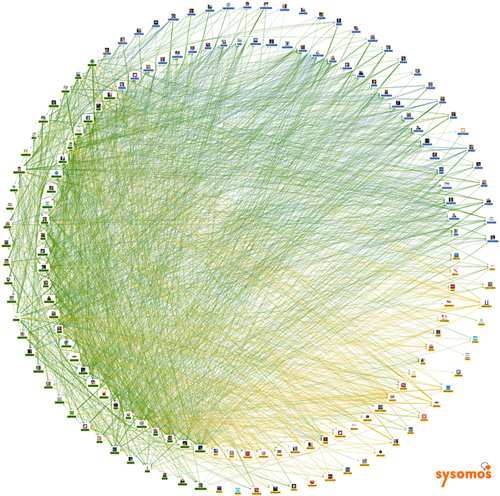
Inside the Political Twittersphere. Sysomos

Continue reading

Open Access, Harvard Delight Edition

An extraordinary and delightful communiqué from Harvard on journal pricing has surfaced (early reactions here and here and here). It was actually issued almost a week back, but the Twitter hive mind (or my corner of it) appears only now to have noticed (h/t to JamieSW for that). The contents are pretty extraordinary, even too good to be true. The preamble is brutal about the current state of the journal system, observing that Harvard spent almost $3.75 million last year on bundled journal provision from some publishers (10% of all collection costs and 20% of all periodical costs for 2010); that “profit margins of 35% and more suggest that the prices we must pay do not solely result from an increasing supply of new articles”; that “[t]he Library has never received anything close to full reimbursement for these expenditures from overhead collected by the University on grant and research funds”; and that “[i]t is untenable for contracts with at least two major providers to continue on the basis identical with past agreements. Costs are now prohibitive” (I’m guessing one provider at least is Elsevier).

Then some options-cum-recommendations for Faculty are laid out:

1. Make sure that all of your own papers are accessible by submitting them to DASH in accordance with the faculty-initiated open-access policies.

2. Consider submitting articles to open-access journals, or to ones that have reasonable, sustainable subscription costs; move prestige to open access.

3. If on the editorial board of a journal involved, determine if it can be published as open access material, or independently from publishers that practice pricing described above. If not, consider resigning.

4. Contact professional organizations to raise these issues.

5. Encourage professional associations to take control of scholarly literature in their field or shift the management of their e-journals to library-friendly organizations.

6. Encourage colleagues to consider and to discuss these or other options.

7. Sign contracts that unbundle subscriptions and concentrate on higher-use journals.

8. Move journals to a sustainable pay per use system.

9. Insist on subscription contracts in which the terms can be made public.

Note in particular point 3. Harvard is asking its academics to seriously consider resigning from major journals if substantive good-faith moves are not made towards open access or “sustainable subscription costs” (read: a major reversal of current practice). As previously suggested, only serious insurgencies within major centres of academic prestige will undo the private stranglehold on knowledge-in-common. On those grounds, I’m tempted to giddy excitement. The question, of course, is which other major institutions (and which serious academic figures) will have the solidarity and good sense to follow this example. As a rallying point, social sciences and social theory need some version of The Cost Of Knowledge manifesto that spans the entire issue of journals and knowledge production. At the very least, we now have a new rhetorical device: open access is good enough for Harvard: why isn’t it good enough for you?

What We Talked About At ISA: From #occupyirtheory to #OpenIR?

A write up of my comments at the #occupyirtheory event in San Diego. The event itself was both hope-filled and occasionally frustrating, not least for the small group of walk-outs, apparently ‘political’ ‘scientists’ lacking in any conception of what it actually means to engage in the political (note: this bothered me especially, but was a rather minor irritation in the grander scheme of things). Despite the late hour, there were between 40 and 60 people there throughout, and a number of very positive things have come of it. It looks like there’ll be some gathering at BISA/ISA to discuss further, and we’re pitching something for the Millennium conference on some of the themes addressed below, and there will of course be ISA 2013 too. In the meantime, there’s the Facebook group, the blog, and a mailing list. The term OpenIR is owed to Kathryn Fisher, and seems to several of us to be a better umbrella term for the many things we want to address in the discipline and the academy. I also just want to give a public shout-out to Nick, Wanda, Robbie and Meera for doing so much on this.


The #occupy practice/meme has antecedents. Physical manifestations of a ‘public’, horizontalism, prefigurative politics and more can be traced in all sorts of histories. One such lineage is the foreshadowing of Zucotti Park in recent struggles over education. Take the slogan in March 2010 over privatisation at the University of California, which was ‘STRIKE / OCCUPY / TAKEOVER’. Or Middlesex, where students resisting the dismantling of the Philosophy Department in that same year unfurled a banner during their occupation, one that proclaimed: ‘THE UNIVERSITY IS A FACTORY! STRIKE! OCCUPY!’.

I want briefly, then, to think about the space of the university in our discussions of #occupy. There have been rich and suggestive calls to re-politicise ourselves as academic-activists, to look again at our work and its claims, and to turn our abilities, such as they are, to projects of resistance and transformation. But we risk a displacement. When we talk of ‘the street’, or politics enacted in the reconfigured space of #occupy, or of the ‘real world’ that we must be relevant to, we already miss the university itself as that factory in which we labour. We are tempted by a view of ourselves as leaving ivory towers to do politics, instead of seeing those towers themselves as spaces of politics. As if our institutions and practices were not already part of the world.

Whether you see #occupy as transformational or nor, or whether you simply prefer a different vocabulary, I think a demand remains: a demand to politicise our own positionality. This politicisation can have many dimensions, but I want to suggestively highlight four, each being a sphere in which we should be diagnosing and transforming our own practices.

Continue reading

#occupyirtheory, International Studies Association (San Diego) Edition

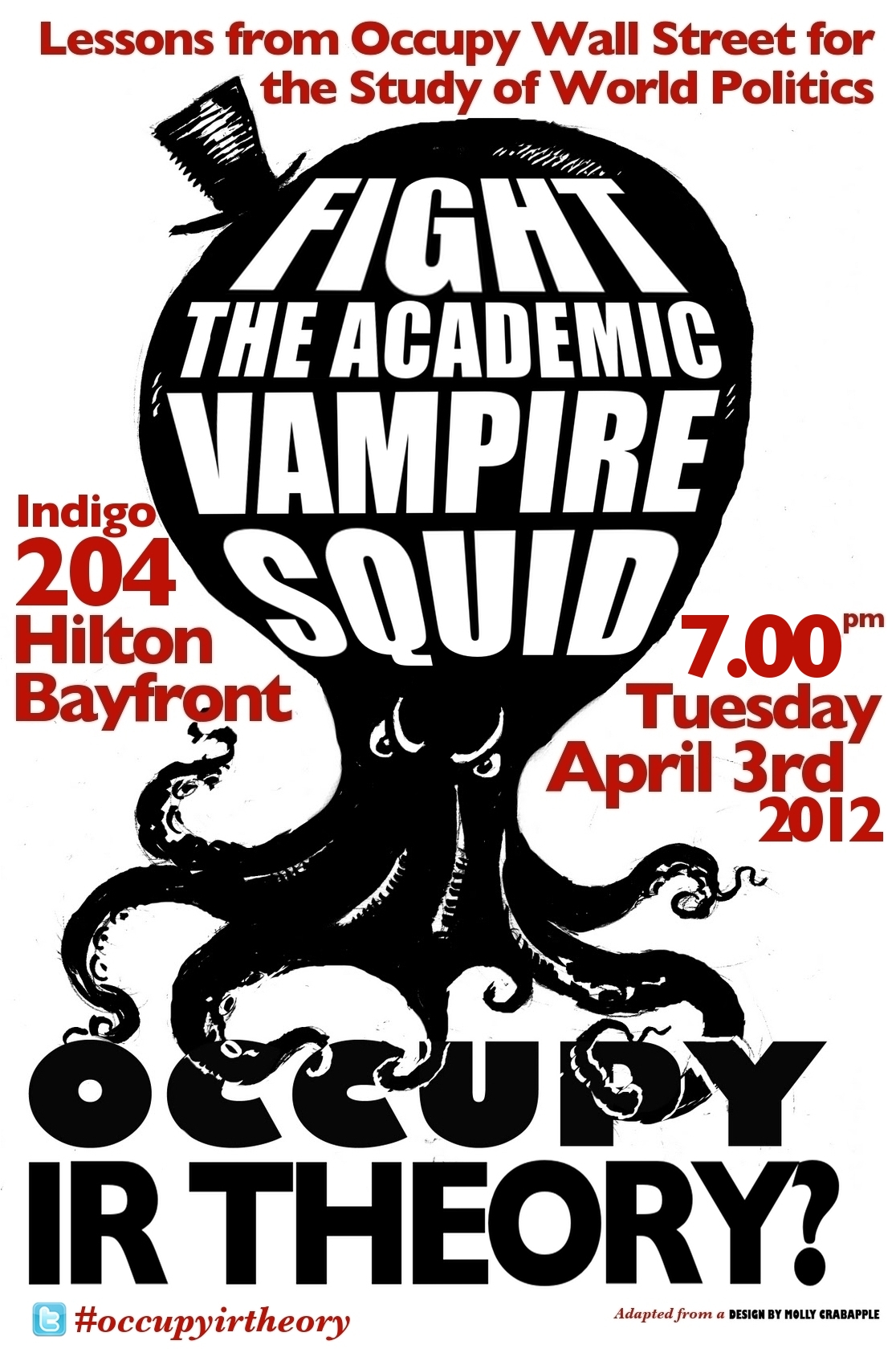
ISA 2012 is just around the corner, and it will doubtless be as hectic and awkward and joyous as ever. Robbie and I will be appearing at an event on #occupy and its relevance for IR on Tuesday at 7 in Indigo 204 at the Hilton Bayfront. We’ll be joining Lucian Ashworth, Lara Coleman, Nicholas Kiersey and Wanda Vrasti (all chaired by Jason Weidner) for what I’m sure will be an exciting roundtable discussion. More importantly, it will be brief, with most of the session given over to a General Assembly-style discussion of what IR can learn from #occupy, what #occupy might get from IR, and how we might take the spirit and organisational form into the discipline itself (or not).

The hope is that the slightly later starting time will allow people to go both to the various Section receptions and meetings (briefly) and to come to this, whilst still leaving reasonable evening time for food and the rest. Please do get involved over at Facebook (see also the #occupyirtheory group and #occupyirtheory blog) and let interested IR-types know. Readers may also be (should also be!) interested in a recent forum from the Journal of Critical Globalisation Studies on ‘Occupy IR/IPE’, featuring Nick and Wanda (as well as Colin Wight, Michael J. Shapiro, Patrick Jackson and others), which I’ve parcelled together as a single pdf for your delectation here.

Hope to see you there!

Academia in the Age of Digital Reproduction; Or, the Journal System, Redeemed

It took at least 200 years for the novel to emerge as an expressive form after the invention of the printing press.

So said Bob Stein in an interesting roundtable on the digital university from back in April 2010. His point being that the radical transformations in human knowledge and communication practices wrought by the internet remain in their infancy. Our learning curves may be steeper but we haven’t yet begun to grapple with what the collapsing of old forms of social space means. We tweak and vary the models that we’re used to, but are generally cloistered in the paradigms of print.

When it comes to the university, and to the journal system, this has a particular resonance. Academics find themselves in a strange and contradictory position. They are highly valued for their research outputs in the sense that this is what determines their reputation and secures their jobs (although this is increasingly the value of the faux-market and the half-assed quality metric). This academic authority, won by publications, is also, to some extent, what makes students want to work with them and what makes them attractive as experts for government, media and civil society. They are also highly valued in a straight-forward economic sense by private publishing houses, who generate profit from the ability to sell on the product of their labour (books and articles) at virtually no direct remuneration, either for the authors or for those peer reviewers who guarantee a work’s intellectual quality. And yet all (OK, most) also agree that virtually nobody reads this work and that peer review is hugely time-consuming, despite being very complicated in its effects. When conjoined with the mass noise of information overload and the extension and commercialisation of higher education over the last decades, our practices of research, dissemination and quality control begin to take on a ludicrous hue. As Clifford Lynch nicely puts it, “peer review is becoming a bottomless pit for human effort”.

This is an attempt to explore in more detail what the potentialities and limits are for academic journals in the age of digital reproduction. Once we bracket out the sedimented control of current publishers, and think of the liveliness of intellectual exchange encountered through blogs and other social media, a certain hope bubbles up. Why not see opportunity here? Perhaps the time is indeed ripe for the rebirth of the university press, as Martin Weller argues:

the almost wholesale shift to online journals has now seen a realignment with university skills and functions. We do run websites and universities are the places people look to for information (or better, they do it through syndicated repositories). The experience the higher education sector has built up through OER, software development and website maintenance, now aligns nicely with the skills we’ve always had of editing, reviewing, writing and managing journals. Universities are the ideal place now for journals to reside.

Continue reading

‘You, Decorous Bureaucrats Of Angelic Leagues’: A Brief Review of ‘I Melt The Glass With My Forehead’ (2012)

I’ve just seen Martin McQuillan and Joanna Callaghan‘s ‘I Melt The Glass With My Forehead’: A Film About £9,000 Tuition Fees, How We Got Them, and What To Do About It.[1] It does pretty much what it says on the tin, charting the issues talking-heads style. Readers not already deeply involved in the UK higher education system and its various problems will find it particularly enlightening, and the parade of would-be-Ministers making promises soon to be broken is worth the anger-energy alone.

Two things struck me. The first was LSE Public Policy Professor Nick Barr, who, despite making a lonely case for some of the fee changes, nevertheless foregrounded a few crucial issues. Most obviously neglected by higher education activists, there’s the importance of pre-university education, which remains much more important in determining entry, ‘success’ and social mobility than any fee/loan/tax increase. Moreover, as we’ve seen before, there’s the uncomfortable truth that the Browne proposals were more redistributive than the old system, although the Government’s decision to cap fees removed this potential. Linking these dimensions is the fundamental tension of contemporary higher education, which is of matching mass participation with high quality. On Barr’s account, this cannot happen from general taxation alone without something giving. Of course, this only remains a challenge of public policy under certain comparatively narrow parameters, and, as Howard Hotson reminds us, the system being ‘reformed’ for its own good was actually the best in the world when viewed as the combination of overall quality and parity across institutions (and if you haven’t yet read Hotson on the Ivy League, do).

Second, and relatedly, the focus of our reflections seems already to have congealed around fees, and fees alone. Even on the narrow topic of student finances, the question of living costs is almost totally absent. A few voices from another age mention it, but there seems no place in our moral calculus for considering the differential between those who must support themselves and those who have the supporting done for them. But there’s also something evidently arbitrary in discussing fees without a whisper about the REF, or the impact agenda, or the generalised role of the university as a producer of public goods (and I don’t just mean Ancient Norse) in an age of austere retrenchment. Notwithstanding the manifold critiques of Browne and Willetts (charlatanism being primary among them, at least for McQuillan and Callaghan), all this misses the critical perspective provided by Andrew McGettigan, placing the fees SNAFU within a wider ecology of political economy and long-term transformation. We learn just this week of the next stage of this process at London Met, where all in-house admin is being offered for private bidding and where 229 ‘posts’ (read: jobs) are to be abolished across seven faculties (this coming after the closure of 70% of undergraduate courses).

This all matters because the public discussion of the future university is increasing, even amidst our wholesale crisis of economy. In typical academic style, it’s coming too late for the bait-and-switch, but if the renewal of energy around the idea of a public university is to mean anything, it cannot be a mere retreat. Barr’s argument that teaching grant must be restored in the next Parliament seems both commonsensical and strangely unimaginable, but there are other stagnant pits of the old to avoid alongside the risks of the new.


[1] The title is borrowed from a banner at an anti-fees demo, quoting a 1915 poem by Vladimir Mayakovsky mentioned by Dan Hancox in the film. I borrowed ‘You, Decorous Bureaucrats Of Angelic Leagues’ from the same place. It seemed somehow more appropriate.

Body Politics: Corporeal Suffering, Memes and Power/Resistance, with Special Reference to #Occupy, Tahrir Square, ‘Hunger’ (2008) and Rage Against The Machine

*some extremely disturbing images ahead* (and some humorous deployments of Impressionism and Leonardo DiCaprio).


Two weeks ago, Karin Fierke presented a paper at our theory workshop on self-immolation as speech act (part of a forthcoming book entitled The Warden’s Dilemma: Self-Sacrifice, Agency and Emotion in Global Politics with Cambridge University Press). She focused principally on Thich Quang Duc, the South Vietnamese Buddhist monk who set himself alight and burned to death, silent and still, in Saigon in June of 1963, and on Norman Morrison, an American Quaker who copied Duc’s example in November 1965 by combusting his own flesh outside the Pentagon office of Robert McNamara, then the United States Secretary of Defence implementing Operation Rolling Thunder, the rain of fire which infamously unleashed a greater tonnage of bombs on Vietnams North and South than the total dispatched during the entirety of the Second World War.

This mimesis, an affinity not only of form but also of sacrificial politics, was cited as a mechanism for rupturing the symbolic order. Both Duc and Morrison engaged in a corporeal self-violence so forceful that it not only offended senses, but in fact extended a certain community. An act, substituting for speech, argument or manifesto, which forced itself on high politics and forged an international sensibility until that point lacking. One more contemporary dimension of that imitation and repetition is that many must have encountered the image the same way I did, which was via the front cover of Rage Against The Machine’s pugnacious, convulsively political eponymous debut in 1992. And not just the image, but a vague sense of the story imparted by sleeve notes (and lyrics today associated both with opposition to the media grip of Simon Cowell and with visions of the riotous encounter).

Self-immolation persists in a certain tradition of struggle, but the relevance of these themes – the body, sacrifice, the edifice of politics and protest, the circulation of images – has coalesced potently in the wake of recent events (on which more in a moment). Continue reading

Rewriting International Relations

A small cascade of Millennium-related news and IR from Elsewhere. First, our very own Nick was recently elected as Co-Editor (with Edmund H. Arghand and Maria Fotou) to oversee the journal for Volume 41 (2012-2013) on the basis of a conference proposal on ‘Materialism and World Politics’ (full CfP details forthcoming soon). Second, the Millennium blog has had a facelift (ongoing tweaks to be made to its façade), so go have a look.

Third, and perhaps most importantly, the Northedge Essay Competition is now open. So if you’re a post-graduate student (PhD or advanced Masters) in IR or cognate fields, and you have some exceptional work lying fallow, spruce it up and submit. The deadline is 30 January 2012, and the winning essay will appear in Millennium 41(1). Previous winners have been very good indeed.

Fifth, the journal’s social media tentacles are growing, so do the following thing on Twitter and the liking thing on Facebook, if you are of that bent. Finally, a reminder that Millennium‘s weekly Editorial Board meetings are open to all LSE postgraduates (MSc and PhD) who are engaged and interested. If you fit that description and for some reason aren’t already involved, do email the Editors for details.

Elsewhere, BISA’s Historical Sociology and IR Working Group also has a new look, and a particularly awesome and growing resources page. And there’s now an Occupy IR Theory blog and associated hashtag (#occupyirtheory, natch), which is worth both a virtual engagement and a flesh-world contribution. Similarly, if for any reason you are unaware of David Campbell’s blog on visual culture and international politics, rectify yourselves!

Commodification, the Academic Journal Racket and the Digital Commons

David, my erstwhile ‘parasitic overlord’ from when I was co-editing Millennium, points me to some posts by Kent Anderson of the Society for Scholarly Publishing, who defends the industry on a number of grounds from Monbiot’s polemic against the journal racket. The comments threads on both pieces are populated by academics who agree with Monbiot and by publishing industry colleagues who agree with Anderson (and who alternate between dismissing and being personally offended by the original Monbiot column). The core counter-argument is that this anti-corporate, out of touch, ‘wannabe-academic’ day dreaming is old hat, and stands up no better now than it did when it was demolished at some unspecified point in the past.

Most crucially, Monbiot’s central exhibit (that companies consistently make 30-40% margins on the distribution of work already paid for by the public purse) is almost entirely passed over. Anderson coyly suggests that maybe publisher margins are that high, but maybe they’re not. Despite working rather closer to the heart of matters financial than do the rest of us, he provides no settling of accounts either way. In any case, however much it costs, and however much publishers make, it’s good value, apparently by definitional fiat. Since libraries keep paying the money, and since academics keep submitting papers, it is ‘idealism’ (remember that?) to complain about the current balance of power.

This is the familiar circular logic of neoliberal reason: privatised arrangements are beneficial because they will make the system more efficient and less costly. But if the rate of profit does not fall in line with the expectations of open competition, then it must mean that the rates charged are true equilibrium prices. Nevertheless, complainants citing high margins are referred to the benefits of privatised arrangements and assured that competition will bring prices down. Even though £200 million each year, or 10% of all research funding distributed by HEFCE (the academic funding council for England), ends up being spent on journal and database access by academic libraries. [1]

Continue reading

Beneath The University, The (Digital) Commons

UPDATE (8 September): In the comments, Lee Jones reminds me of the Directory of Open Access Journals, which gives some more info on existing outlets. Monbiot also tweeted details of a petition to make all publicly-funded research available for free within a year of publication, which you should sign (yes, I know it’s just a petition, but start somewhere OK?)


1. Any time someone puts a lock on something that belongs to you, and doesn’t give you a key, the lock is not there for your benefit;

2. It’s hard to monetise fame, but it’s impossible to monetise obscurity;

3. Information doesn’t want to be free. People do.

Despite the focus on the artist and her output, Cory Doctorow’s three propositions for understanding copyright against creativity also speak to the products of the university (and both videos are worth watching). In short, the addition of copyright ‘protection’ to your work acts to restrict it, doesn’t actually drive higher resources to artists, and can’t really work in practice, thus requiring extending circles of criminalisation and monitoring. Contemporary copyright is a way of creating an obstacle course, one where the people who put in the work of limiting access are also the ones who you pay down the line for the access. In short, “they have created a problem that they know how to solve, and it works for them”.

In July, Aaron Swartz was charged under US federal hacking laws for downloading more than a few academic articles via MIT. It was about 4.8 million papers, since you ask. Wired reports that the penalty for this may amount to 35 years in prison and a $1 million fine. Worse, there is some evidence that the prosecution is being driven by the state rather than JSTOR alone. He’s due in court this Thursday. After some germination, both George Monbiot and Ben Goldacre have entered the fray with astute and biting pieces on the profitable stupidity of these arrangements and their detrimental impact on the free exchange of knowledge, scientific progress, the public good, etcetera.

The problems of intellectual property and who gets to profit from it are general, but the scandal is in the specificity of different productive spheres. After all, an artist is not like a university lecturer.

Continue reading