Death To Open Access! Long Live Open Access!

A few weeks ago at the Millennium conference, some of us got together to talk about open access and the political economy of knowledge (re)production in our little corner of academia (“us” being Colin Wight, David Mainwaring, Nivi Manchanda, Nathan Coombs, Meera and me). Over the remainder of this week, we’ll be posting those reflections here for your delectation because, some discussion notwithstanding, labourers in today’s university-factories need to get talking about these things, and fast.


Open Access appears to be here. The Finch Report has recommended it, the Government has endorsed it, and there even seem to be some monies newly available for it. The battle is won, and the age of unfettered academic-public intercourse is upon us. Well, not quite. Finch’s preference for Gold Open Access, in which journals continue to receive revenues and make profits and in which academics (or their institutions) pay a fee of several thousand pounds per article for the pleasure (the so called Article Processing Charge (APC) system, which will receive greater attention in later posts), is deeply problematic (well-reasoned explanations for why available from Stevan Harnad and Peter Coles (Telescoper), with more qualified views, even cautious support, from Stephen Curry and Repository Man). Also, the monies aren’t new, and have instead been extracted from existing research budgets (and what a complete and utter surprise that is).

This is all cause for serious concern, and relates closely to the kinds of arguments that are developed and deployed in favour of Open Access (or, to be more provincial about it, Open IR). There are three kinds of arguments for opening up the journal system, arguments from access, ethics and cost, and we are in danger of letting the first overwhelm the different, and better, cases made in the name of the second and third.

The first set of arguments has to do with the problem of access: that the journal system is broken because it creates barriers to the circulation of academic knowledge. The journal as usually conceived was an ingenious and appropriate method for collating and distributing knowledge in the 18th century, but is now redundant. And yet journals – with their pay walls – remain the only (or at least the principal) vector for success or employment in academic life. This is doubly problematic since the various metrics that journal comparisons and prestige enable themselves then become vectors of discipline and control, even in the face of the many, many reasoned objections to such measures.

Continue reading

Navigating Neoliberalism: Political Aesthetics in an Age of Crisis

For those who are interested, here’s a copy of the talk I gave last weekend on the technological sublime, machine perception, and cybernetic economies. Held in the beautiful Treignac area at The Matter of Contradiction: Ungrounding the Object event, it was a lot of fun and filled with some fascinating discussions. Many thanks to the Treignac Projet for inviting me and organizing the event. Check out more of their work here.

What We Talked About At ISA: @Hannah_Arendt – A Hypothetical Exploration of Hannah Arendt in Cybersphere

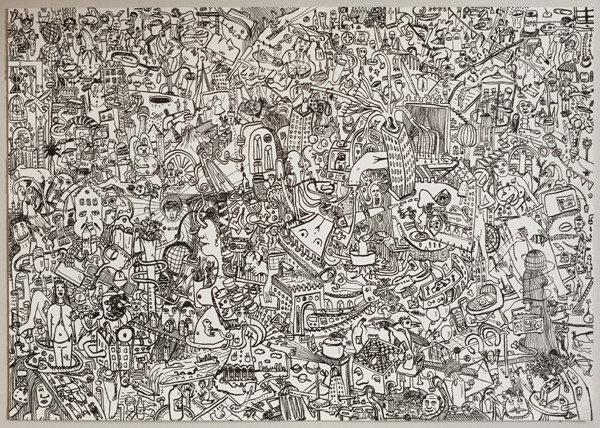
‘Social Media Drawing’ by Tjarko Van Der Pol

This year’s general conference theme for ISA in San Diego centred on ‘Power, Principles and Participation in the Global Information Age’ and, expectedly, gave rise to a proliferation of papers on the value, consequences and effectiveness of platforms such as Facebook, Twitter and other social media in the context of international relations and global politics. Having spent the past three years trying to disentangle the thoughts of one of the more intriguing political theorists on power and politics – Hannah Arendt – it has always struck me that she might have had a word or two to say about the supernova that is social networking as such. I couldn’t help picturing her vigorously engaging with a medium like Twitter, firing off Tweets to relevant interlocutors – @karlmarx no, I think that’s where you’re wrong and dangerous: #history is not ‘made’ by men and #violence not the midwife for a new society! Perhaps even: Yep: RT @karljaspers When #language is used without true significance, it loses its purpose as a means of communication and becomes an end in itself – hashtag and all. Or, on the other hand, flatly dismissing platforms such as Facebook as vanity spheres of little or no substance for political interaction. So I pitched in my paper as a playful thought experiment as to how she might have loved or loathed online social networks as viable platforms and public spheres for the creation of power and conduct of politics proper. This is a somewhat abbreviated version of the full-length paper, which can be found here.

The potency of social networking sites, as channels of communication and a medium for people from all corners of the world to meet in a virtual realm and engage with shared ideas – political or otherwise – has become indisputable. Not least since the Arab Spring uprisings of 2011, where bodies and voices were galvanized to part-take in various acts of revolt and revolution in Egypt, Tunisia, Syria and Libya, facilitated through online networks like Twitter and Facebook, have people discovered the enormous potential for a transnational coming-together in a shared cause. These networks thus appear to present themselves as a global public realm in a virtual space, transcending geographic limitations and boundaries, broadening the scope of possible political impact considerably. But with such a young medium it is perhaps wise to take a step back from the hype and ask how effective are these networks in creating actual political power? In how far can we understand the possibility to mobilize and plan in a non-spatial realm, through social networks, to constitute the generation of power and the actualization of political action? My paper sought to address these questions with an Arendtian lens – for better or for worse.

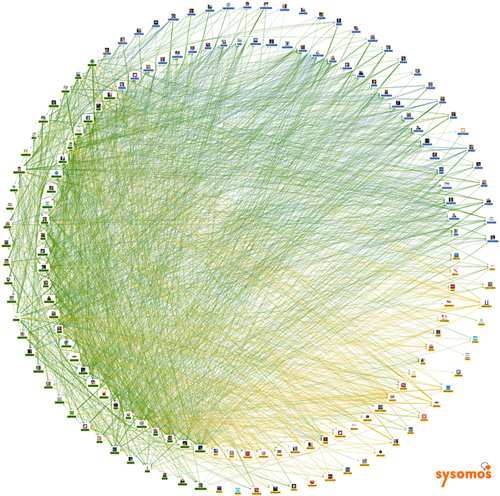
Inside the Political Twittersphere. Sysomos

Continue reading

Materialism and World Politics conference

Materialism and World Politics

20-22 October, 2012
LSE, London, UK

Registration is now open here for anyone who wants to attend.


Scheduled Speakers:

Keynote: The ontology of global politics
William Connolly (Johns Hopkins University)

Opening Panel: What does materialism mean for world politics today?
John Protevi (Louisiana State University)
More TBC

Closing Panel: Agency and structure in a complex world
Colin Wight (University of Sydney)
Erika Cudworth (University of East London)
Stephen Hobden (University of East London)
Diana Coole (Birkbeck, University of London)

ANT/STS Workshop keynote:
Andrew Barry (University of Oxford)

ANT/STS Workshop roundtable:
Iver Neumann (LSE)
Mats Fridlund (University of Gothenburg)
Alberto Toscano (Goldsmiths, University of London)
More TBC

*******

The annual conference for volume 41 of Millennium: Journal of International Studies will take place on 20-22 October, 2012 at the London School of Economics and Political Science. This includes 2 days of panels and keynotes on the weekend, and a special Monday workshop on actor-network theory (ANT), science and technology studies (STS), and alternative methodologies. Space for the latter is limited though, so let Millennium know of your interest in attending it as soon as possible.

The theme of this year’s conference is on the topic of materialism in world politics. In contrast to the dominant discourses of neorealism, neoliberalism and constructivism, the materialist position asks critical questions about rational actors, agency in a physical world, the role of affect in decision-making, the biopolitical shaping of bodies, the perils and promises of material technology, the resurgence of historical materialism, and the looming environmental catastrophe. A large number of critical writers in International Relations have been discussing these topics for some time, yet the common materialist basis to them has gone unacknowledged. The purpose of this conference will be to solidify this important shift and to push its critical edges further. Against the disembodied understanding of International Relations put forth by mainstream theories, this conference will recognize the significance of material factors for world politics.

Open Access, Harvard Delight Edition

An extraordinary and delightful communiqué from Harvard on journal pricing has surfaced (early reactions here and here and here). It was actually issued almost a week back, but the Twitter hive mind (or my corner of it) appears only now to have noticed (h/t to JamieSW for that). The contents are pretty extraordinary, even too good to be true. The preamble is brutal about the current state of the journal system, observing that Harvard spent almost $3.75 million last year on bundled journal provision from some publishers (10% of all collection costs and 20% of all periodical costs for 2010); that “profit margins of 35% and more suggest that the prices we must pay do not solely result from an increasing supply of new articles”; that “[t]he Library has never received anything close to full reimbursement for these expenditures from overhead collected by the University on grant and research funds”; and that “[i]t is untenable for contracts with at least two major providers to continue on the basis identical with past agreements. Costs are now prohibitive” (I’m guessing one provider at least is Elsevier).

Then some options-cum-recommendations for Faculty are laid out:

1. Make sure that all of your own papers are accessible by submitting them to DASH in accordance with the faculty-initiated open-access policies.

2. Consider submitting articles to open-access journals, or to ones that have reasonable, sustainable subscription costs; move prestige to open access.

3. If on the editorial board of a journal involved, determine if it can be published as open access material, or independently from publishers that practice pricing described above. If not, consider resigning.

4. Contact professional organizations to raise these issues.

5. Encourage professional associations to take control of scholarly literature in their field or shift the management of their e-journals to library-friendly organizations.

6. Encourage colleagues to consider and to discuss these or other options.

7. Sign contracts that unbundle subscriptions and concentrate on higher-use journals.

8. Move journals to a sustainable pay per use system.

9. Insist on subscription contracts in which the terms can be made public.

Note in particular point 3. Harvard is asking its academics to seriously consider resigning from major journals if substantive good-faith moves are not made towards open access or “sustainable subscription costs” (read: a major reversal of current practice). As previously suggested, only serious insurgencies within major centres of academic prestige will undo the private stranglehold on knowledge-in-common. On those grounds, I’m tempted to giddy excitement. The question, of course, is which other major institutions (and which serious academic figures) will have the solidarity and good sense to follow this example. As a rallying point, social sciences and social theory need some version of The Cost Of Knowledge manifesto that spans the entire issue of journals and knowledge production. At the very least, we now have a new rhetorical device: open access is good enough for Harvard: why isn’t it good enough for you?

What We Talked About At ISA: The U.S. Military-Industrial Complex, Part I

Earlier this year, the U.S. government set out to reduce its vast defence budget. On 5 January, Barack Obama became the first U.S. president to hold a press conference at the Pentagon. What prompted it was the release of Sustaining U.S. Global Leadership: Priorities for 21st Century Defence, a “strategic guidance” document outlining the national blueprint for “deterring and defeating aggression,” while reducing record budget deficits “through a lower level of defence spending.” (The document also attracted much media attention because it offered a rare glimpse into the strategic thinking of a president who seems to refuse to be associated with a “doctrine.”) In his State of the Union address three weeks later, Obama reinstated his belief that paring defence sending could help “pay down our debt.” The Pentagon’s FY2013 budget projection followed on 13 February, with a request for $614 billion in funding: $525 billion for the base budget and $88 billion for the so-called overseas contingency operations. FY2012 budget request, the Pentagon noted, was bigger.

Pundits in the US have been debating the meaning of the coming defence cuts, starting with the question of whether there will, in fact, be any cuts in the first place. This debate will probably intensify as the election date approaches, although, indicatively, Obama’s strategic guidance contains no “East of Suez” moments, and his Pentagon speech was a candid expression about the need to stay the course: “Over the next 10 years, the growth in the defence budget will slow, but the fact of the matter is this: It will still grow, because we have global responsibilities that demand our leadership… I firmly believe, and I think the American people understand, that we can keep our military strong and our nation secure with a defence budget that continues to be larger than roughly the next 10 countries combined” (emphasis mine; also, “10” appears to be way too low).

Much remains to be said about the type, magnitude, and sequence of the coming changes to America’s defence, and the electoral 2012 will be too short to say it all. The first round of projected budget cuts (“$487 billion”) takes into consideration the provisions of the self-flagellating Budget Control Act from August 2011. The second round of cuts (“$500 billion”) refers the so-called automatic sequestration cuts, also specified in the Act, which will take effect in January 2013 if Congress does find “alternative” ways to control the budget. U.S. Secretary of Defense Leon Panetta described these automatic cuts as the “doomsday scenario,” a label that Congress’s bipartisan supercommittee will no doubt keep in mind as it looks for those alternatives (such as, for example, legislation to reverse the Act). In the end, what will change is the ordering of America’s military priorities, but not the militarization of America’s “global responsibilities” (to use Obama’s own label) as such. Behind it, after all, are multiple and reinforcing structural factors that make real cuts difficult. One of them is “defence industry,” which some pundits and watchdog organizations like to call, somewhat retrospectively, the “military-industrial complex” (MIC).

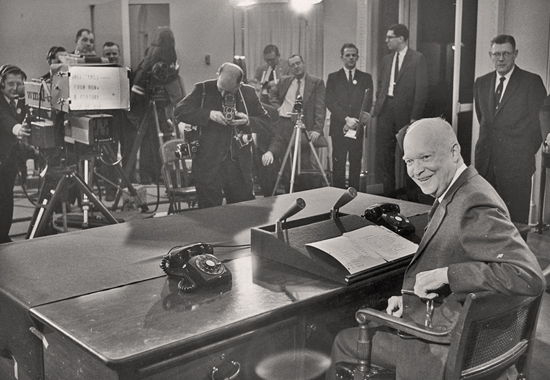
As a conceit, the MIC goes back at least to World War I, but it is popularly dated to Eisenhower’s ‘Farewell Address’ in 1961. As far as US presidential speeches/speechwriting goes, Eisenhower’s was a tour de force in every respect, but the reason why we read it today – or, rather, search for it on YouTube – is for the parts where the president urges the American citizens to pay attention to the “conjunction of an immense military establishment and a large arms industry [that is] new in the American experience,” while advising the American government to “guard against the acquisition of unwarranted influence, whether sought or unsought, by the military-industrial complex.”

Continue reading

All Your Brain Are Belong To Us: Neuroscience Goes To War

The Royal Society has just released a fascinating report entitled “Neuroscience, Conflict and Security” that examines the increasing role that neuroscientific research is playing in the military today (thanks to Nick for drawing my attention to it). Indeed, as was reported by Wired’s Danger Room a couple of years ago, the US Air Force has been soliciting  research proposals for “innovative science and technology projects to support advanced bioscience research” that include “bio-based methods and techniques to sustain and optimize airmen’s cognitive performance”, “identification of individuals who are resistant to the effects of various stressors and countermeasures on cognitive performance” and “methods to degrade enemy performance and artificially overwhelm enemy cognitive capabilities.” Likewise, DARPA (the Defense Advanced Research Projects Agency that gave us the Internet) has long shown significant interest in the potential military applications of neuroscience.

As the Royal Society report puts it, military neuroscience can be seen to have “two main goals: performance enhancement, i.e. improving the efficiency of one’s own forces, and performance degradation, i.e. diminishing the performance of one’s enemy” (p.1). It is with reference to these two goals that I will attempt in this post to make some sense of the wider context and implications of neuroscience’s entanglement with contemporary martial practices.

Continue reading

Academia in the Age of Digital Reproduction; Or, the Journal System, Redeemed

It took at least 200 years for the novel to emerge as an expressive form after the invention of the printing press.

So said Bob Stein in an interesting roundtable on the digital university from back in April 2010. His point being that the radical transformations in human knowledge and communication practices wrought by the internet remain in their infancy. Our learning curves may be steeper but we haven’t yet begun to grapple with what the collapsing of old forms of social space means. We tweak and vary the models that we’re used to, but are generally cloistered in the paradigms of print.

When it comes to the university, and to the journal system, this has a particular resonance. Academics find themselves in a strange and contradictory position. They are highly valued for their research outputs in the sense that this is what determines their reputation and secures their jobs (although this is increasingly the value of the faux-market and the half-assed quality metric). This academic authority, won by publications, is also, to some extent, what makes students want to work with them and what makes them attractive as experts for government, media and civil society. They are also highly valued in a straight-forward economic sense by private publishing houses, who generate profit from the ability to sell on the product of their labour (books and articles) at virtually no direct remuneration, either for the authors or for those peer reviewers who guarantee a work’s intellectual quality. And yet all (OK, most) also agree that virtually nobody reads this work and that peer review is hugely time-consuming, despite being very complicated in its effects. When conjoined with the mass noise of information overload and the extension and commercialisation of higher education over the last decades, our practices of research, dissemination and quality control begin to take on a ludicrous hue. As Clifford Lynch nicely puts it, “peer review is becoming a bottomless pit for human effort”.

This is an attempt to explore in more detail what the potentialities and limits are for academic journals in the age of digital reproduction. Once we bracket out the sedimented control of current publishers, and think of the liveliness of intellectual exchange encountered through blogs and other social media, a certain hope bubbles up. Why not see opportunity here? Perhaps the time is indeed ripe for the rebirth of the university press, as Martin Weller argues:

the almost wholesale shift to online journals has now seen a realignment with university skills and functions. We do run websites and universities are the places people look to for information (or better, they do it through syndicated repositories). The experience the higher education sector has built up through OER, software development and website maintenance, now aligns nicely with the skills we’ve always had of editing, reviewing, writing and managing journals. Universities are the ideal place now for journals to reside.

Continue reading

Figure/Ground Interview

For anyone who’s interested, there’s an interview with me over at the Figure/Ground Communication site. It touches on a few topics such as the changing nature of the university, the technological shifts in teaching, and some thoughts on the philosophical movement of speculative realism. Many thanks to Laureano Ralon for the generous opportunity as well.

Affect! Biopolitics! Technology! Ecology!: A Call for Papers

A brief pre-holiday announcement of the next Millennium annual conference, to be convened on the theme of Materialism and World Politics. Full details below the fold. The range of suggested topics looks both fascinating and much-needed, and I am assured by well-placed sources that there will also be some stellar speakers, for those who are tempted by such things. As always, papers submitted in the wake of the conference which survive the rigours of peer review will be published in a resulting special issue (Vol. 41, No. 3). Also, don’t forget about the Northedge Essay Competition (deadline 30 January 2012).

Continue reading